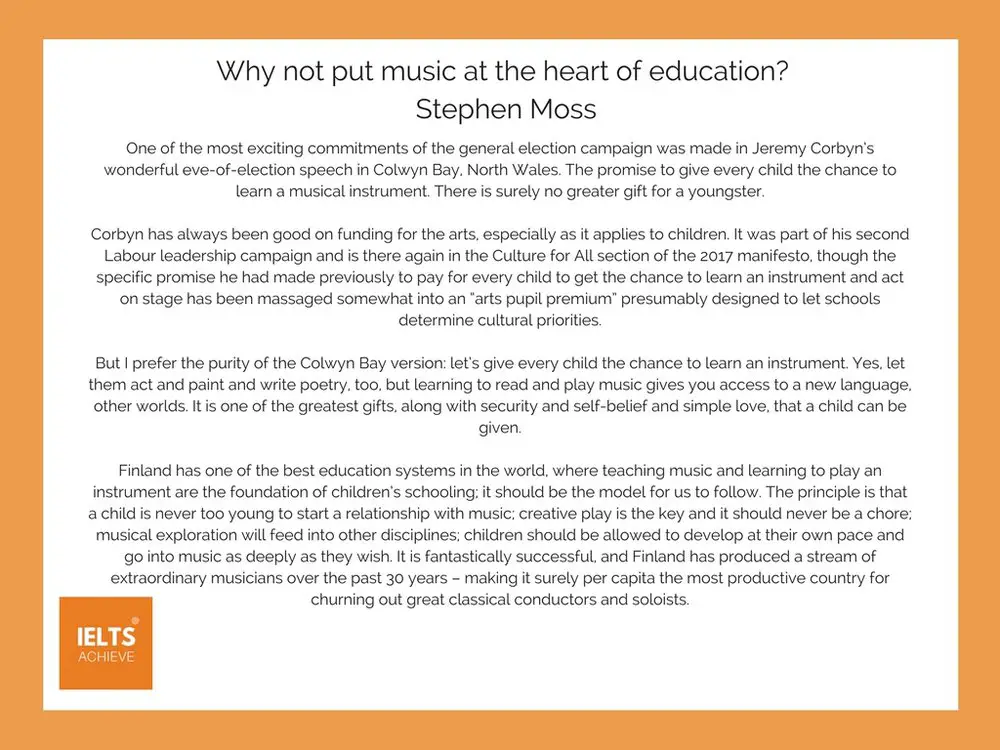
You should spend about 20 minutes on Questions 14-26, which are based on reading text 2.
Robotics in Healthcare – Get ready!
While there are concerns about machines replacing people in the workforce, the benefits are tempting. Imagine how a machine that doesn’t need sleep or food, doesn’t have prejudices that we humans so often have could change the way we treat people who are sick and vulnerable. With some preparation and forethought, we can make sure the human touch stays relevant in medicine while taking advantage of our metallic allies. For this reason, here are some interesting examples of robotics in healthcare.
Surgery is an unpleasant experience at best. The waiting lists can be long depending on available manpower and resources. daVinci helps alleviate the problem. It has been used in a wide variety of fields from head and neck to urologic surgery. The surgeon is in complete control of the system at all times, however as the machine has greater reach and flexibility, smaller incisions made with more precision are enough to access the problem areas.
During a hospital stay, patients interact with nurses the most. They draw blood, check your vital signs, check on your condition and take care of your hygiene if needed. They are often overwhelmed by physically and mentally daunting tasks, and the result is often an unpleasant experience for everyone involved. Robotic nurses will help carry this burden in the future. They are designed to be able to carry out repetitive tasks. This way the staff has more energy to deal with issues that require human decision-making skills and empathy. Certain robots can even take your blood sample.
But robotics in healthcare is so much more than drawing blood. With a remote controlled robot, such as the ones developed by Anybots Inc caretakers can interact with their patients, check on their living conditions and the need for further appointments. This would help efficiency a great deal by eliminating the time-consuming home visits. Companies producing and the ones maintaining the system will have to make great efforts to alleviate privacy concerns. As with every such device, it must be near impossible to access for non-authorized personnel. With the proper safeguards in place, these robots can greatly improve the lives of caretakers and patients alike.
Chances are you have been in a situation before where, if an accident were to happen, medical professionals would not have been able to reach you in time. To some of us in the developed world, it’s a rare occurrence. But even in 2016 billion live outside of the reach of conventional emergency services. With InTouch Health, patients in remote areas have access to high-quality emergency consultations for stroke, cardiovascular, and burn services. On the patient’s side, it can be accessed on a tablet or personal computer, and clinicians can also use the same type of devices as best suits their needs.
You have seen them in movies, taken advantage of them in video games and now they are here for real: exoskeletons. With the help of these devices paralysed people can walk, rehabilitation of stroke or spinal cord injury patients. They can enhance strength in order to allow a nurse to lift an elderly patient. While they have many exciting uses, it’s important to remember that currently, they are costly to make and power, so at least at first they will not be available for everyone. Although, in some cases, insurance companies had to cover the costs. Because of this, it has the potential to deepen already existing social and economic inequalities. Decision makers have to lay the groundwork to regulate the use of such devices. They will have to stay up to date on their capabilities to prevent misuse.
The great thing about robots is that they can be built to be so durable that they can overtake tasks that for humans would be simply too dangerous. Take Petman for example: designed for testing chemical protection clothing. It moves freely and can even adjust suit temperature and simulate sweating to provide realistic conditions.
Such solutions not only minimise the risk to human testers, in the long run, mechanisation of the supply chain makes production cheaper as well. Robots don’t need vacations, to eat or sleep. With a new generation of them more sturdy, agile and flexible than ever they increase productivity in all kind of factories.
Hospital acquired infections (such as MRSA) are among the leading causes of death in the US. According to CDC statistics used by Xenex show that in the United States, 1 in every 25 patients will contract an HAI. Of those, 1 in 9 will die. In addition to the human cost, it takes its toll financially as well. These infections cost more than $30 billion dollars a year. Xenex, a Texas-based company produces a unique robot. It uses high-intensity ultraviolet light to disinfect any space in a health care facility quickly and efficiently. The Xenex Robot is more effective in causing cellular damage to microorganisms than other devices designed for disinfection. It reduces the number of hospital-acquired infections. It’s yet another example of how robotics in healthcare helps hospital staff to decrease workload and will lead to a much friendlier environment.
As with nurses, pharmacists are burdened with tasks that could be eliminated by utilising the advancing robotics in healthcare. Heavy lifting, as always, is a big help, but a robot could process information much faster and much more accurately than humans. This way it could make more precise recommendations after sifting through the patient’s available medical data. Pharma dispensers could work as an ATM does, so no matter time of day patients can get access to their prescriptions. If robots were used for such tasks, pharmacists would have the time and the incentive to participate in the social aspect of healing: educate people of preventive measures, give practical advice and therefore make sure that healthcare truly becomes caring.
Questions 14-17
Do the following statements agree with the claims of the writer in text 2?
In boxes 14-17 on your answer sheet, write
YES – if the statement agrees with the views or claims
NO – if the statement contradicts the views or claims
NOT GIVEN – it is impossible to say what the writer’s views/claims are
14. Governments should do more to ensure that Robotics are readily available in the hospital systems.
15. Surgical procedures can be enhanced.
16. In the future, the healthcare system will increase its dependency on robots.
17. Hospitals in the United States reported that infections caught in hospital care cost the nation over 50 billion each year.
Questions 18-21
Complete the sentences below.
Choose ONE WORD ONLY from the text for each answer.
Write your answers in boxes 18-21 on your answer sheet.
18. In the future, medical robots will provide many ………………………… in the health care system.
19. Some machines or robotics will use data to increase …………………………………
20. With help from ………………………………… many people can walk.
21. Many robots can perform tasks that people cannot because they are too ………………………….
Questions 22-26
Look at the following names and list of statements below.
Match each name with the correct statement, A-H.
Write the correct letter, A-H, in boxes 22-26 on your answer sheet.
22. daVinci
23. Anybots Inc
24. InTouch Health
25. Petman
26. Xenex
List of Findings
A. Can perform autonomous head and neck surgery.
B. Provide specialist equipment for surgical procedures that give accurate lacerations.
C. Develop robots that can take blood.
D. Make health care workers that can investigate on patients easily.
E. Can offer healthcare services to those who live in remote places.
F. Can assist in lifting patients with spinal cord injuries.
G. Can perform jobs that are too risky for humans.
H. Ensures that spaces are kept clean, safe from the spread of epidemic particles.
If you need help to answer these questions with extra practice please read the posts below >>
We hope you found this post useful in helping you to study for the IELTS Test. If you have any questions please let us know in the comments below or on the Facebook page.
The best way to keep up to date with posts like this is to like us on Facebook, then follow us on Instagram and Pinterest.
If you need help preparing for the IELTS Test, join the IELTS Achieve Academy and see how we can assist you to achieve your desired band score. We offer an essay correction service, mock exams and online courses.
You should spend about 20 minutes on Questions 27-40, which are based on reading text 3.
What is the main theme in Jane Austen’s writings?
A
One of the most important themes in Jane Austen’s writings is society and a woman’s place in it. To deliver this theme she uses satire to get her female readers (and her male ones) to see themselves in the comical and small-minded antics of her characters and to relate to that and think how they can improve in the elements that apply to them – each reader as an individual. For example, are they like fluffy and empty-headed and short-sighted like Mrs Bennet? Or perhaps they are Lydia (impetuous, naive, impulsive and similarly short-sighted? perhaps they are a tad arrogant and full of themselves to the extent that they are thoughtlessly hurtful to others (‘badly done Emma, badly done!) For other readers, perhaps a female reader may recognize Mr Wickham as some irresponsible, self-serving youth as someone they know – a male reader may, of course, recognize himself! With gentle humour, Austen gets us to see society in a new way.
B
Austen was born in a rectory and died, unmarried, at the age of 41. She is buried in Winchester Cathedral, which she probably would have preferred to the Poets’ Corner in Westminster. Austen’s life is easily summarised because we don’t know much about it. We can assume, however, that nothing much happened in her life other than the writing of her novels. Unlike her contemporary Mary Wollstonecraft, Austen seems not to have held fierce views on the rights of women. She accepted the world into which she had been born and the status of women within it.
C
The heroine of her first novel, Northanger Abbey, Catherine Morland, is just 15, growing from a tomboyish adolescence into womanhood. The plot of Northanger Abbey revolves around the question: Who will Catherine marry, and how will she get to the altar? The theme, however, focuses on a different question: What is it to be grown up? What is it to be morally mature? How does one become the kind of person who can deal with the complicated issues of life? Austen intertwines that question with another question: What, in the process of growing up, is the function of the English novel? Austen believed that the novel could help readers mature; it could serve as a moral instructor, with a similar role as the weekly sermons the author would have heard in church. ion, which is romantic, addicting, light-headed, and corrupting. The point for Austen, though, is how fiction is used and, more importantly, the relationship of the novel to moral maturity and growth.
D
In another early novel, Sense and Sensibility, Austen pondered, in the characterization of the two Dashwood sisters, which was the road to maturity—sense and rationalism, as embodied in the elder sister, Eleanor, or sensibility and passion, as embodied in the younger sister, Marian? In typically English fashion, the answer lies in the middle road.
E
In a later novel, Mansfield Park, probably composed around 1810, Austen debates a central issue for her: Should a woman marry for love or for interest, prudently, that is, with an eye toward finances? The ironic opening of Mansfield Park recalls the decisions on this all-important question of three sisters of the Ward family. The novel tells us that there is no magic formula for happiness. This opening sets the stage for the novel proper, the story of Fanny Price, the namesake daughter of Frances, adopted from her impoverished house in Portsmouth to Mansfield Park, a grand estate, where she is never quite accepted. In the course of the novel, Fanny manages to resist pressures and make the right marriage choices. She becomes the mistress of Mansfield Park and a leading figure in society. These are the questions that Jane Austen asks: sense or sensibility, love in a cottage or love in a castle, marriage or independence? Time is an enemy here; a woman has only a few years in which to make these important choices.
F
In Austen’s last completed novel, Persuasion, the heroine, Anne Elliott, at age 28, has lost her bloom. Will she be able to marry at her age? In her novels, Austen asks the most important questions in a woman’s life. How does any woman determine the course that her life will take? Such decisions depend on the situation in which the woman finds herself. For Austen, novels, particularly great works of morality such as her own, can help women negotiate these paths.
Questions 27-32
Reading text 3 has six paragraphs, A-F.
Which paragraph contains the following information?
Write the correct letter, A-F, in boxes 27-32 on your answer sheet.
NB You may use any letter more than once.
27. The author questioned how one should navigate their growth.
28. The author loved to write.
29. The author thought about the personality traits of the two main characters.
30. There is no alchemy that can create bliss.
31. The character of this book showed the immaturity of their youth.
32. Characters were created in a playful way.
Questions 33 and 34
Choose TWO letters, A-E.
Write the correct letters in boxes 33 and 34 on your answer sheet.
Which TWO of these points are made by the writer of the text of the novel Mansfield Park by Jane Austen?
A. Crucial decisions must be made in good time in order to have a happy life.
B. Choosing to be secure over love is key.
C. A woman has the right to choose her own destiny.
D. Women should always be dependent.
E. Choosing marriage should always be the right choice.
Questions 35 and 36
Choose two letters, A-E.
Write the correct letters in boxes 35 and 36 on your answer sheet.
Which TWO of the following themes are regularly included in Jane Austen’s Novels?
A. Feminism.
B. Women and their place in the community.
C. Friendships.
D. Love, marriage and money.
E. The themes are all very similar.
Questions 37-40
Complete the summary below.
Choose ONE WORD ONLY from the passage for each answer.
Write your answers in boxes 37-40 on your answer sheet.
The Themes in Austen’s Work
The themes within Jane Austen’s novels were as relevant in the 1800’s as they are today. One of the most regular themes is that of 37. …………………………….. and their place in society. Austen liked to develop characters that her readers could identify with and perhaps recognise their characteristics within themselves. Many of the novel’s themes centre on love, finding a good match to 38. ………………………… and financial security. Many of the author’s heroines are faced with the dilemma of marrying or having 39. …………………………………… The novels look at how women make 40. …………………………… to shape their lives, by giving in to the pressures to marry and be with someone who can provide or to make it on their own, without anyone to depend on.
If you need help to answer these questions with extra practice please read the posts below >>
We hope you found this post useful in helping you to study for the IELTS Test. If you have any questions please let us know in the comments below or on the Facebook page.
The best way to keep up to date with posts like this is to like us on Facebook, then follow us on Instagram and Pinterest.
If you need help preparing for the IELTS Test, join the IELTS Achieve Academy and see how we can assist you to achieve your desired band score. We offer an essay correction service, mock exams and online courses.
The 6 most exciting activities you can do on a family holiday
A
Siemens Cookery School
Whether you have children who need to be fed or a busy working life, finding time to learn new cooking skills is a challenge. Expert chefs share all the tricks and skills required to cook to a professional standard. In the summer you may even learn to cook in the open air. Heaven.
B
Cycling
The landscape surrounding the hotel has some of the best cycling terrains in the world. Whether you want to ride along the glorious coast on a road bike or take on some serious climbs and downhills in the Sierra Nevada, there are options for all abilities. Robinson can also organise group tours to Salobreña and Calahonda.
C
Archery
Your holiday experiences of archery are probably limited to cheap equipment in a random part of the hotel. But here there’s a unique archery centre with distances of up to 40m for true experts. There are also beginners’ classes for keen novices.
D
Padel Tennis
This exciting game, which originated in Mexico, is a cross between tennis and squash. There is a net, and back and side walls to bounce the ball off. This hotel has introduced the game for the first time this year.
E
WellFit
Robinson coined this term to describe its extensive spa and fitness facilities. At Cala Serena, there is a huge range, including a fitness studio, GroupFitness classes including step, Aqua Fit and indoor cycling, a body and mind room offering Yoga and Stretch & Relax classes and the soothing WellFit spa, with a Finnish sauna and even a Cleopatra bath (additional charge).
F
Diving
The Red Sea is a veritable Eden of underwater delights and when you stay at Soma Bay in Hurghada you can take a range of diving courses to explore the world beneath the sea.
The latest dive equipment waits and instructors can guide you through a taster session to your PADI Open Water qualification and beyond with SSI Diamond Dive Resort Daily excursions. The ultra-sporty can even try freediving, or if you prefer, there are snorkelling courses available.
Questions 1-7
Look at the six advertisements above, A-F
For which activity are the following statements true?
Write the correct letter, A-F, in boxes 1-7 on your answer sheet.
NB You may use any letter more than once.
1. You can ride along the beach or try something more difficult, depending on their capabilities.
2. Travel underwater to explore
3. Play an exciting game
4. Prepare something to eat
5. Participants can try something for both beginners and the more experienced
If you like people, have a passion for scuba diving and want an extraordinary life – become a PADI Instructor. Teaching scuba diving allows you to share your love of the aquatic world with others while doing what you enjoy – being in, around and under water. PADI Open Water Scuba Instructors and PADI Assistant Instructors are the most sought-after dive professionals around the world because they’ve completed the program that sets the standard for training dive professionals. You earn a PADI Instructor rating through hard work and commitment, but you’re rewarded with a job that lets you share incredible underwater adventures with others – transforming their lives for the better and enriching yours.
Are you ready to join the ranks of the dedicated professionals who teach the world’s most progressive and popular scuba diver education programs? Then Go PROSM with an Instructor Development Course. The Instructor Development Course (IDC) is made up of two parts – the Assistant Instructor (AI) course and the Open Water Scuba Instructor (OWSI) program. Most dive professionals complete the entire IDC and go on to attend an Instructor Examination (IE), which is the final step to earning a PADI Instructor certification.
Successfully completing just the AI course results in a PADI Assistant Instructor qualification. When an AI is ready to progress, attending an OWSI program allows entry into an IE to earn a full PADI Instructor rating. Dive professionals who hold an instructor rating with another diver training organisation may be eligible to enrol directly in the OWSI program. This recognises prior instructor training and provides a path to become a PADI Instructor.
Over a minimum of five days, but usually, more like seven, the IDC teaches you to conduct all PADI core courses. You’ll be able to organise and present information, conduct skill development sessions and control open water dives. Basically, you become a better public speaker and get really good at demonstrating skills while watching out for student diver safety.
Questions 8-14
Do the following statements agree with the information given in the text above?
In boxes 8-14 on your answer sheet, write
True – if the statement agrees with the information
False – if the statement contradicts the information
Not Given – if there is no information present
8. You need to be enthusiastic and motivated on this course
9. To complete the course you have to perform well and show responsibility
10. The diving course takes more than two days to complete
11. The Instructor development Course is made up of 3 parts
12. You can enrol onto the OWSI program if you have previous training
13. It is important that you are a strong swimmer
14. An important part of the course is diving in deep water to look for sea life
For help to answer these questions with practice please read the posts below >>
We hope you found this post useful in helping you to study for the IELTS Test. If you have any questions please let us know in the comments below or on the Facebook page.
The best way to keep up to date with posts like this is to like us on Facebook, then follow us on Instagram and Pinterest.
If you need help preparing for the IELTS Test, join the IELTS Achieve Academy and see how we can assist you to achieve your desired band score. We offer an essay correction service, mock exams and online courses.
We all know the simple don’ts of an interview such as don’t arrive late, don’t dress inappropriately and don’t show up looking unprepared. However, I have compiled a more in-depth Top 10 List of Don’ts derived from the feedback of industry companies and candidates alike.
1) Don’t mispronounce the names of those interviewing you. Double check the pronunciation of names with the receptionist or hiring manager prior to your interview. Getting names correct is a simple matter of courtesy and respect.
2) Don’t walk into the interview without knowing about the company. Do your homework and research the company prior to the interview. Visiting their website is a good place to start.
3) Don’t even think about answering your cell phone during the interview. It’s best to turn it off prior to entering the building.
4) Don’t make negative comments or remarks about your present or past employers. When explaining why you are seeking a change, communicate your rationale professionally.
5) Don’t answer questions with a simple “yes” or “no”. Explain and give details whenever possible. However, make sure you provide the details in a succinct and articulate manner.
6) Don’t expect your resume to close the deal. Sell yourself by providing more information and cite specific examples of how you have been successful at your current or past job(s).
7) Don’t pretend to know-it-all. If you don’t know the answer to a question, say so. Never pretend to know something or someone if you don’t.
8) Don’t inquire about salary, vacation, benefits, bonuses or retirement during the initial interview. This information will be provided at a later date if the process proceeds. If the interviewer asks about the salary you want, give a range based on your research of competitive rates. However, it might be best to indicate that you are more interested in the opportunity than a specific salary.
9) Don’t falsify application information. Most companies do background checks on candidates and any false information you provide will be exposed.
10) Don’t’ leave the interview without asking about the next steps in the process and don’t forget to write a thank-you note immediately after the interview.
Questions 15-20
Complete the sentences below.
Choose ONE WORD ONLY from the text for each answer.
Write your answer in boxes 15-20 on your answer sheet.
15. Before the interview make sure you………………………… the company.
16. Only say good things about your past employers, nothing …………………………..
17. Give good answers to questions with lots of …………………………….
18. Include……………………….. of how you have used your skills in previous jobs.
19. It is better not to ask questions about the ………………………………
20. Be honest, most places will do a ………………………. check.
This course is suitable for people aged 16+ who work in high-hazard environments such as construction, manufacturing or agriculture.
It is also ideal for organisations whose needs assessment identifies a requirement for additional first aid training (e.g. due to having employees with a disability or medical condition).
It gives learners the skills and confidence to respond to a range of accidents and first aid emergencies they could encounter in the workplace.
Length
3 days
Time
09:00-17:00
Course content includes:
Our first aid at work course covers the content specified in the Health and Safety (First Aid) Regulations 1981.
It gives learners the first aid skills to help someone who:
is unresponsive and breathing
is unresponsive and not breathing (including the use of an automated external defibrillator/AED)
is choking
is bleeding
is suffering from shock
is burnt
feels faint
has been poisoned
has a head injury
has hypothermia or heat exhaustion
is having a medical emergency:
seizure
heart attack*
angina attack
stroke
asthma attack
severe allergic reaction
diabetic emergency
has an injury to a bone muscle or joint (including spinal injuries).
The course also includes information on:
dealing with an emergency:
assessing a casualty
monitoring a casualty
where to get help
electrical incidents
accident recording and reporting
control of substances hazardous to health (COSHH).
Each learner receives a training pack including a host of resources to help them practice the skills covered. The pack includes a course companion workbook, first aid manual, bandages and more.
Qualification
The HSE requires at least 18 training and contact hours for this course. Learners must attend all sessions to be eligible for assessment, which is done by continuous observation and questioning during the course.
On successful completion of this course, you will receive a first aid at work certificate which is valid for three years.
For best practice, we support the HSE recommendation to complete an annual first aid skills update.
Pre-requisites
Our courses offer a practical, hands-on approach that delivers the skills and confidence to use first aid skills in a real life situation. Learners must be physically able to carry out the practical elements of the course.
Questions 21-27
Answer the questions below.
Choose ONE OR TWO WORDS ONLY AND/OR A NUMBER from the text for each answer.
Write your answers in boxes 21-27 on your answer sheet.
21. What is the minimum age to enrol on the course?
22. Which position is the certificate intended for?
23. How many days does the course cover?
24. What does each participant receive during the course?
25. How many hours must the students attend in order to pass the course?
26. How long is the course certificate valid for?
27. What do the students have to be, so that they can manage the course?
For help to answer these questions with practice please read the posts below >>
We hope you found this post useful in helping you to study for the IELTS Test. If you have any questions please let us know in the comments below or on the Facebook page.
The best way to keep up to date with posts like this is to like us on Facebook, then follow us on Instagram and Pinterest.
If you need help preparing for the IELTS Test, join the IELTS Achieve Academy and see how we can assist you to achieve your desired band score. We offer an essay correction service, mock exams and online courses.
Answers >
Questions 15-20
15. research
16. negative
17. details
18. examples
19. salary
20. background
Questions 21-27
21. 16
22. One of the following – Construction/Manufacturing/Agriculture
Henry, the second son of King Henry VII and Elizabeth of York, was born on 28 June 1491 at Greenwich Palace. After the death of his elder brother Arthur in 1502, Henry became heir to the English throne.
B
When Henry VII died in 1509, this popular eighteen-year-old Prince, known for his love of hunting and dancing, became King Henry VIII. Soon after he obtained the papal dispensation required to allow him to marry his brother’s widow, Catherine of Aragon. In the first years of his reign Henry VIII effectively relied on Thomas Wolsey to rule for him, and by 1515 Henry had elevated him to the highest role in government: Lord Chancellor. In 1521 Pope Leo X conferred the title of Defender of the Faith on Henry for his book ‘Assertio Septem Sacramentorum’, which affirmed the supremacy of the Pope in the face of the reforming ideals of the German theologian, Martin Luther.
C
Henry VIII’s early military campaigns began when he joined Pope Julius II’s Holy League against France in 1511. Wolsey proved himself to be an outstanding minister in his organisation of the first French campaign and while the Scots saw this war as an opportunity to invade England, they were defeated at Flodden in 1513. However, war with France ultimately proved expensive and unsuccessful. Henry VIII is known as the ‘father of the Royal Navy.’ When he became king there were five royal warships. By his death, he had built up a navy of around 50 ships. He refitted several vessels with the latest guns including the Mary Rose, which sank in 1545. Henry also built the first naval dock in Britain at Portsmouth and in 1546 he established the Navy Board. This set up the administrative machinery for the control of the fleet.
D
Henry was acutely aware of the importance of securing a male heir during his reign. He was worried that he had only one surviving child, Mary, to show for his marriage to Catherine, who was now in her 40s. So the king asked Cardinal Wolsey to appeal to Pope Clement VII for an annulment and it soon became clear he wanted to marry Anne Boleyn, who had been a lady-in-waiting to his first wife. But, unwilling to anger Catherine of Aragon’s nephew – the most powerful ruler in Europe, the Holy Roman Emperor Charles V – the Pope refused. Thomas Wolsey’s ascendancy was cut short by this failure. In 1533, Henry VIII broke with the church and married the now pregnant Anne Boleyn in a secret ceremony. Henry was excommunicated by the Pope. The English Reformation had begun.
E
After Wolsey’s downfall, Thomas Cromwell became Henry’s chief minister and earned the confidence of the King by helping him to break with Rome and establish Henry VIII as head of the Church of England. This act also brought him much needed wealth through the dissolution of the well-funded monasteries. Over four years Cromwell ordered that 800 monasteries be disbanded and their lands and treasures were taken for the crown. The cultural and social impact was significant, as much of the land was sold to the gentry and churches and monasteries were gutted and destroyed. Henry’s personal religious beliefs remained Catholic, despite the growing number of people at court and in the nation who had adopted Protestantism.
F
In September 1533 Anne gave birth to a daughter, Elizabeth (the future Queen Elizabeth I). Henry had grown tired of her, and after two further pregnancies ended in miscarriages, she was arrested in 1536 on trumped up charges of adultery and publicly beheaded at the Tower of London. Henry’s third marriage, this time to the lady-in-waiting, Jane Seymour, finally produced the son he so desperately desired with the birth of Edward in 1537. Jane Seymour died after childbirth and Henry ordered that she be granted a queen’s funeral. In an attempt to establish ties with the German Protestant alliance, Thomas Cromwell arranged a marriage between the king and German princess Anne of Cleves. The marriage was a disaster and Henry divorced Anne a few months later. Henry blamed Cromwell for this mismatch and soon afterwards had him executed for treason.
G
The final years of his reign witnessed Henry VIII’s physical decline and an increasing desire to appear all-powerful. Henry continued with fruitless and expensive campaigns against Scotland and France. In 1540, the ageing King married the teenage Catherine Howard. Their marriage was short-lived. It was alleged that she had a previous relationship with Henry’s courtier Francis Dereham and an affair with another courtier Thomas Culpeper. Catherine was executed for adultery and treason in 1542. Henry’s final marriage to Catherine Parr, who acted as a nurse, was more harmonious and she would go on to outlive him. Henry VIII died on 28 January 1547 and was succeeded by his son, Edward VI. He was buried next to Jane Seymour in St. George’s Chapel at Windsor Castle.
Questions 35 – 37
Complete the summary below.
Choose NO MORE THAN TWO WORDS from the text for each answer.
Write your answers in boxes 35-37 on your answer sheet.
Who was Henry VIII?
Henry VIII was one of the most notable and memorable monarch’s that England has seen. Much talked about throughout history, Henry VIII ascended to the throne when his father died and he was the only 35 ……………………………… He married his brother’s widow Catherine of Aragon and took counsel from one of the more well-known figures in history 36 …………………………………………. Throughout his reign, Henry VIII was known for his many relationships, foremost with his second wife 37 ……………………………………………. This relationship was the driving force behind Henry’s break with Rome and the Catholic faith.
Questions 38-40
Complete the notes below.
Choose ONE WORD ONLY from the text for each answer.
Write your answers in boxes 38-40 on your answer sheet.
The Wives of Henry VIII
Catherine of Aragon was the first wife of Henry VIII, originally married to his brother.
His second wife was Anne Boleyn, mother of 38 …………………………………. He grew tired of her and had her beheaded.
Moving on to Jane Seymour who gave Henry the son he so wanted, she died during childbirth.
Next was Anne of Cleaves, who was thought to have disappointed Henry with her appearance, however, she survived the marriage as it ended in 39 ………………………………………
After that, he married teenager Catherine Howard, who was much younger than him and was rumoured to have had many affairs.
Lastly he married Catherine Parr, who went on to 40 ………………………………… him.
If you need help to answer these questions with extra practice please read the posts below >>
We hope you found this post useful in helping you to study for the IELTS Test. If you have any questions please let us know in the comments below or on the Facebook page.
The best way to keep up to date with posts like this is to like us on Facebook, then follow us on Instagram and Pinterest.
If you need help preparing for the IELTS Test, join the IELTS Achieve Academy and see how we can assist you to achieve your desired band score. We offer an essay correction service, mock exams and online courses.
Essential strategies and practice techniques for this IELTS Reading question type. Learn how to manage time and improve accuracy.
Originally published June 2017. Last reviewed 3 July 2026.
Reading Text 1
This text is from Science Mag and written by Carrie Arnold
You should spend around 20 minutes on Questions 1-13, which are based on reading text 1.
Shhh, The Ants Are Talking
If you want to survive as an ant, you’d better get ready to make some noise. A new study shows that even ant pupae—a stage between larvae and adult—can communicate via sound and that this communication can be crucial to their survival.
“What’s very cool about this paper is that researchers have shown for the first time that pupae do, in fact, make some sort of a sound,” says Phil DeVries, an entomologist at the University of New Orleans in Louisiana who was not involved in the study. “This was a very clever piece of natural history and science.”
Scientists have known for decades that ants use a variety of small chemicals known as pheromones to communicate. Perhaps the most classic example is the trail of pheromones the insect’s place as they walk. Those behind them follow this trail, leading to long lines of ants marching one by one. However, the insects also use pheromones to identify which nest an ant is from and its social status in that nest. Because this chemical communication is so prevalent and complex, researchers long believed that this was the primary way ants shared information.
However, several years ago, researchers began to notice that adults in some ant genuses, such as Myrmica, which contains more than 200 diverse species found across Europe and Asia, made noise. These types of ants have a specialised spike along their abdomen that they stroke with one of their hind legs, similar to dragging the teeth of a comb along the edge of a table. Preliminary studies seemed to indicate that this noise served primarily as an emergency beacon, allowing the ants to shout for help when being threatened by a predator.
Larvae and young pupae have soft outer skeletons, which means their specialised spikes haven’t yet formed and they can’t make noise. However, as the pupae mature, their covering hardens into a tough exoskeleton like that found in adult ants. These older pupae do have fully functional spikes but were generally thought to be silent.
Karsten Schönrogge, an entomologist at the Centre for Ecology & Hydrology, Wallingford, in the United Kingdom, thought it odd that mature pupae would have the capability to produce sound but remain silent. So he and his colleagues listened in to a group of Myrmica scabrinodisants. These 4- to 5-millimeter-long, reddish-brown ants are commonly found in northern Europe, in low-lying areas like peat bogs.
Using an extra-sensitive microphone that would pick up on the faint acoustic signals, the researchers measured the sounds produced by 10 differentM. scabrinodis larvae, six immature pupae, and six mature pupae. Whereas the larvae and immature pupae were completely silent, the mature pupae produced brief pulses of sound, the team reports online today in Current Biology.
Further analysis of this noise showed that it was a simplified version of the more complex adult sound. It was as if the mature pupae were saying, “Help!” while the adults were saying “Hey, I’m over here! Please come help! It’s your friend!”
To test the function of these noises in the mature pupae, the researchers first played back the sounds made by either the mature pupae or adult M. scabrinodis. Adult worker ants responded the same way to both recordings, such as walking over to the speaker, rubbing their antennae against it, and guarding it. They didn’t show these responses when Schönrogge and colleagues played white noise. These behaviours, which represent a worker ant’s attempts to protect its nestmates, indicate that acoustic communication served to bring assistance in both mature pupae and adult ants.
To see how the ants used this acoustic communication, the team removed the abdominal spike from some of the mature pupae in a nest. The researchers then disturbed the nest, spilling out larvae, pupae, and adult workers into an experimental arena. Normally, the adult ants rescue their nestmates in a specific order: mature pupae, immature pupae, and, finally, the larvae. In the experiments by Schönrogge and colleagues, the adult workers indeed rescued the unmuted mature pupae first. However, the adult ants completely ignored the muted ants. It was as if the mute mature pupae simply didn’t exist.
“The sounds they make rescue them by signalling their social status,” Schönrogge says. “There is complex information in these signals,” that combine with chemical signals to provide an array of information about the individual. Researchers have yet to decode everything the ants are communicating by sound and how the ants interpret these signals. Acoustic communication may be especially important in mature pupae because they don’t yet produce the full array of adult pheromones, but they also don’t smell and behave like larvae, either.
DeVries cautions that the discovery doesn’t mean that chemical communication in ants is less important. “Ants live in these enormously sophisticated societies,” he says. “Acoustic signalling adds another gorgeous piece to what we know about how insect societies communicate.”
Questions 1-6
Do the following statements agree with the information in the text?
In boxes 1-6 on your answer sheet, write
True – if the statement agrees with the information
False – if the statement contradicts the information
Not Given – if there is no information present
1. Adult ants have spiked legs
2. Mature ants and pupae can convey they need help by creating sounds
3. The larvae do no produce any signals
4. Quiet ants were not retrieved by the mature ants
5. The ants tested did not show any positions relating to hierarchy
6. Ants live in practical communities
Questions 7-9
Complete each sentence with the correct ending, A-F below
Write the correct letter A-F, in boxes 7-9 on your answer sheet.
7. The ants can use their sense of smell
8. Some ants can create a sound
9. Some researchers
A. to detect other insects
B. to talk to each other and gain knowledge of their place in the hierarchy
C. from using their antennae
D. that is used to ask for help
E. documented the tone from various stages of ant formation
F. created a support network for the ants
Questions 10-13
Complete the flow chart below.
Choose NO MORE THAN TWO WORDS from the text for each answer.
Write your answers in boxes 10-13 on your answer sheet.
If you need help to answer these questions with extra practice please read the posts below >>
We hope you found this post useful in helping you to study for the IELTS Test. If you have any questions please let us know in the comments below or on the Facebook page.
The best way to keep up to date with posts like this is to like us on Facebook, then follow us on Instagram and Pinterest.
If you need help preparing for the IELTS Test, join the IELTS Achieve Academy and see how we can assist you to achieve your desired band score. We offer an essay correction service, mock exams and online courses.
You should spend about 20 minutes on Questions 14-26, which are based on reading text 2.
Questions 14-18
The text below has five paragraphs A-E.
Choose the correct heading for each paragraph from the list of headings below.
Write the correct number, i-viii, in boxes 14-18 on your answer sheet.
List of Headings
i. A new beginning
ii. A career like no other
iii. Integration and education
iv. The result of the overall benefits
v. Some drawbacks of working in the healthcare system
vi. From the initial process to the workplace
vii. The future of healthcare for refugees and migrants
viii. Examples of medical staff success
14. Paragraph A
15. Paragraph B
16. Paragraph C
17. Paragraph D
18. Paragraph E
World Refugee Day: WHO training enables Syrian doctors and nurses to provide health care in Turkey
A
“We and the Turkish doctors are working like brothers and sisters.” These are the words of Muhammed Hattab, 1 of more than 3 million Syrian refugees now living in Turkey – the country with the highest number of refugees in the world. A doctor who fled his home in Aleppo more than 2 years ago, Muhammed did not know whether by leaving northern Syria he was also abandoning his profession and the career he had built in his home country. However, thanks to a joint programme of the WHO Country Office in Turkey and the Turkish Ministry of Health, he has been able to begin a new chapter of his life and career, working in the Turkish national health system and providing care for his fellow Syrians in Turkey.
B
In 2016, the Turkish government enacted a law that allows Syrian health professionals to enter the workforce in the Turkish health system, with the aim of both integrating Syrian professionals into the health system and also ensuring that Syrian refugees can receive health care without encountering language or cultural barriers. In order to implement this law, the Public Health Institution of Turkey, associated with the Ministry of Health, and the WHO Country Office developed an adaptation training for Syrian health workers living Turkey – including doctors, nurses and midwives. The initiative is supported financially by the European Civil Protection and Humanitarian Operations (ECHO).The training provides classroom and practical coursework, resulting in a certificate that authorises Syrian health-care workers to practice in refugee health centres established in Turkey and to deliver health services to Syrian refugees.
C
Since the trainings began in November 2016, over 380 doctors and 360 nurses and midwives have received vocational competence certificates, allowing them to serve refugee populations in Turkey. Ultimately, they will staff the 260 refugee health centres and 600 refugee health units that the Ministry of Health has opened and will establish in the future. These centres and units provide primary health care, with services offered to Syrian refugees free of charge. “This project in Turkey was the salvation for Syrian doctors,” says Muhammed. “With this programme, we felt like doctors for the first time in 2 years.”
D
While the health-care profession has general underlying principles that are universal across different parts of the world, some important regulations and practices differ greatly from country to country. The adaptation training seeks to give Syrian health workers the knowledge and experience they need in order to be fully competent and skilled in the Turkish setting. They must first apply for the programme and go through a selection process. Once approved by the Ministry of Health, they undergo a 1-week classroom training with Turkish university professors and lecturers, followed by 6 weeks of on-the -job training in a Refugee Health Centre. By working under the mentorship of Turkish health professionals for several weeks, they are able to familiarise themselves with the Turkish health system and prepare to provide care within this system. They are also evaluated at each stage of the training process before becoming certified to work in Turkey, helping to ensure good results for Syrian patients in the country.
E
“These trainings are not only a way to address language barriers but a good example of the collaboration between national and international partners in Turkey to help the integration of Syrian medical doctors, nurses and midwives to serve the community of refugees. We appreciate that the Government of Turkey, the Ministry of Health and Turkish health staff ensure equitable access to health services. And we consider this a one-of-a-kind collaboration among WHO, academia and the Ministry of Health to set an example for other countries, accommodating high numbers of refugees and migrants,” comments Dr Pavel Ursu, WHO Representative to Turkey. WHO supports the classroom portion of the training, in collaboration with the Ministry, and is committed to making sure that Syrian health professionals are equipped with the essential theoretical background for their future career. In addition, WHO provides trainees with financial support for the duration of practical training to cover living expenses and travel costs.
Questions 19-22
Look at the following titles/names (Questions 19-22) and the list of statements below.
Match each title/name with the correct statement, A-F.
Write the correct letter, A-F, in boxes 19-22 on your answer sheet.
19. Muhammed Hattab
20. The Turkish Government
21. The Ministry of Health
22. Dr Pavel Ursu
A. Moved to Turkey
B. Provides healthcare for Syrians in Turkey
C. Implemented a system allowing migrant and refugee medical workers to undergo training in similar practices
D. Are evaluating the Turkish health system
E. Has opened many places for people to receive free healthcare
F. Gives praise to the new collaboration amongst professionals and the government
Questions 23-26
Complete the sentences below.
Choose NO MORE THAN TWO WORDS from the text for each answer.
Write your answers in boxes 23-26 on your answer sheet.
23. Muhammed Hattab refers to working with fellow Syrians like working with brothers ………………………………………….
24. The Turkish government is making it easier for Syrians to be treated medically by fellow ……………………………
25. Syrian medical professionals are entered into a …………………………. program that updates their knowledge of the Turkish healthcare system.
26. Everyone involved is trying to set an ………………………. to other places in the world.
If you need help to answer these questions with extra practice please read the posts below >>
We hope you found this post useful in helping you to study for the IELTS Test. If you have any questions please let us know in the comments below or on the Facebook page.
The best way to keep up to date with posts like this is to like us on Facebook, then follow us on Instagram and Pinterest.
If you need help preparing for the IELTS Test, join the IELTS Achieve Academy and see how we can assist you to achieve your desired band score. We offer an essay correction service, mock exams and online courses.
You should spend about 20 minutes on Questions 27-40, which are based on reading text 3.
Mental Health and the Effects of Social Media
Is Facebook making you depressed? If so, you’re not alone. According to a recent study by UK disability charity Scope, of 1500 Facebook and Twitter users surveyed, 62 percent reported feeling inadequate and 60 percent reported feelings of jealousy from comparing themselves to other users.
I’ve heard similar complaints from friends and I’ve felt it myself on a bad day. Most frequently, I hear such statements from those who are struggling with depression. It makes sense that if you are already in a low mood or not feeling good about yourself, having pictures of happy couples and smiling babies pop up on your screen on a consistent basis may make you feel worse. The same is true if you tend to generally have a negative outlook on life.
If Facebook posts depress you, the solution is simple. Here are four things you can do today to help you cope:
Deactivate your Facebook account (you can always reactivate it later)
Unfollow your most (seemingly) happy and successful, friends
Remember that Facebook isn’t a representation of reality
Turn off the computer and go make your own annoyingly happy moments
Should you really take the four actions above?
In a 2015 study on the effects of Facebook use on mental health, researchers at the University of Missouri discovered that regular use could lead to symptoms of depression if the site triggered feelings of envy in the user.
“If it is used as a way to size up one’s own accomplishments against others, it can have a negative effect,” said Professor Margaret Duffy, one of the professors who co-authored the research. She explains that if it’s used “to see how well an acquaintance is doing financially or how happy an old friend is in his relationship – things that cause envy among users – use of the site can lead to feelings of depression.”
However, those who use the site primarily to feel connected do not experience the negative effects. In fact, when not triggering feelings of envy, the study shows, Facebook could be a good resource and have positive effects on well-being.
Further studies have shown that the majority of social media users tend to edit and post only their most attractive pictures, or ‘put a rose-tinted gloss over their lives’ in an effort to idealise themselves and, researchers believe, to improve others’ impressions of them.
To avoid Facebook-induced depression, users should be aware of the risks of using the site as a tool for comparison. Furthermore, users should be aware that most people are presenting a biased, positive version of reality on social media. Finally, if you’re still feeling down, angry, or generally disillusioned because of the positive news shared by your Facebook friends, on or offline, you should question why you feel that way.
Barring clinical depression or a recent life setback, is it really such a bad thing to see another human being enjoying life, especially if it’s a friend- or at least someone you tolerate enough to accept as a Facebook friend?
With all of the suffering and pain in the world, wouldn’t it be a tragedy if people stopped sharing joyful events for fear of making someone else jealous? Imagine if people only discussed all of the negative things that surrounded them. Especially over this past year, don’t we have enough tragic posts appearing in our newsfeeds 24/7?
Given that there will always be someone who’s taller, richer, better-looking, who has more friends, a better job, etc., we can either allow ourselves to fall into the dangerous trap of comparison, or we can choose to remember that regardless of what others around you appear to have, everyone is grappling with their own struggles. For every promotion, a book deal and Tony nomination, chances are, the recipient has experienced equally or more significant life setbacks.
Also important to remember is that for every person that seems to have more, there is another with less. For each individual whose qualities you covet, there’s someone out there who wishes they had what you have. If we can’t change our outer circumstances, at least we can try to change our perspective and learn to be grateful for what we have. We can also learn to celebrate other’s successes. Sharing in other people’s joy can often lift our spirits.
“Be aware of what others are doing, applaud their efforts, acknowledge their successes, and encourage them in their pursuits. When we all help one another, everybody wins” – Jim Stovall
These suggestions may be difficult, especially if you’re struggling with low self-worth or depression. If that is the case, seek help from a friend or a professional. Whether it’s reaching out for support, practising gratitude or simply surrounding yourself with more of the positive, you owe it to yourself to make the best out of this life.
Stop torturing yourself by comparing your life with everyone else’s positively biased representations of theirs. Seek to improve your own life in a realistic manner. Choose to look at the positives and to celebrate your wins… as well as theirs.
Questions 27-32
Do the following statements agree with the claims of the writer in the text?
In boxes 27-32 on your answer sheet write
YES – if the statement agrees with the views or claims
NO – if the statement contradicts the views or claims
NOT GIVEN – it is impossible to say what the writer’s views/claims are
27. Social media makes many people unhappy
28. When people see photographs of others having fun it makes them feel really happy
29. There are steps you can take to lessen the effects of social media on your wellbeing
30. Research shows how certain aspects can make you feel good about yourself
31. Ask for help on Facebook and Twitter
32. Seek positivity in your own life and stop comparing yourself to others
Questions 33-40
Complete the summary below.
Choose NO MORE THAN TWO WORDS from the text for each answer.
Write your answers in boxes 33-40 on your answer sheet.
Mental Health And Social Media
There is a desire among most people to check their social media accounts obsessively with many people feeling 33. ……………………….. when they compare their lives to others. This is often felt by those suffering from depression or who have simply had a bad day. When looking through your newsfeed and seeing photographs of people having a great time, could make you feel 34. …………………………… There are steps that can be taken to reduce these feelings, including removing yourself from Facebook or other social media accounts. Another step is to leave the computer alone and go and do something you enjoy. Research has shown that looking at Facebook obsessively can point your mental health into the direction of 35 ………………………………….. When comparing your life to those that you see on social media feeds it can have a 36………………………………. effect. When people start to envy others on social media, it can lead to a person thinking badly about their own lives and themselves. Those people who use Facebook to keep in touch with friends and family experience more 37…………………………………. effects. Research also shows that most people who post photographs, heavily edit in an attempt to make others see them how they want to be seen. It is important to think about how everyone has their own problems in the world, glamorous people on Facebook included. For each person you see who inspires you to crave what they have, there are others who want what 38 ……………………………………… We should be happy for others good fortune and learn to be grateful for our own successes. If you feel like you are having difficulties with depression or low 39 …………………………………. ask for help. Even if you talk through it all with a good friend or colleague or envelop yourself in a more positive environment, small changes can make sure that you get 40 ………………………………. out of your life.
If you need help to answer these questions with extra practice please read the posts below >>
We hope you found this post useful in helping you to study for the IELTS Test. If you have any questions please let us know in the comments below or on the Facebook page.
The best way to keep up to date with posts like this is to like us on Facebook, then follow us on Instagram and Pinterest.
If you need help preparing for the IELTS Test, join the IELTS Achieve Academy and see how we can assist you to achieve your desired band score. We offer an essay correction service, mock exams and online courses.
Essential strategies and practice techniques for this IELTS Reading question type. Learn how to manage time and improve accuracy.
Originally published June 2017. Last reviewed 3 July 2026.
In this post, we will take a look at the reading skills you need to be successful in the IELTS Reading Test and how you can improve your skills.
There are 7 main reading skills you will use during your preparation for the IELTS Reading Test;
Previewing
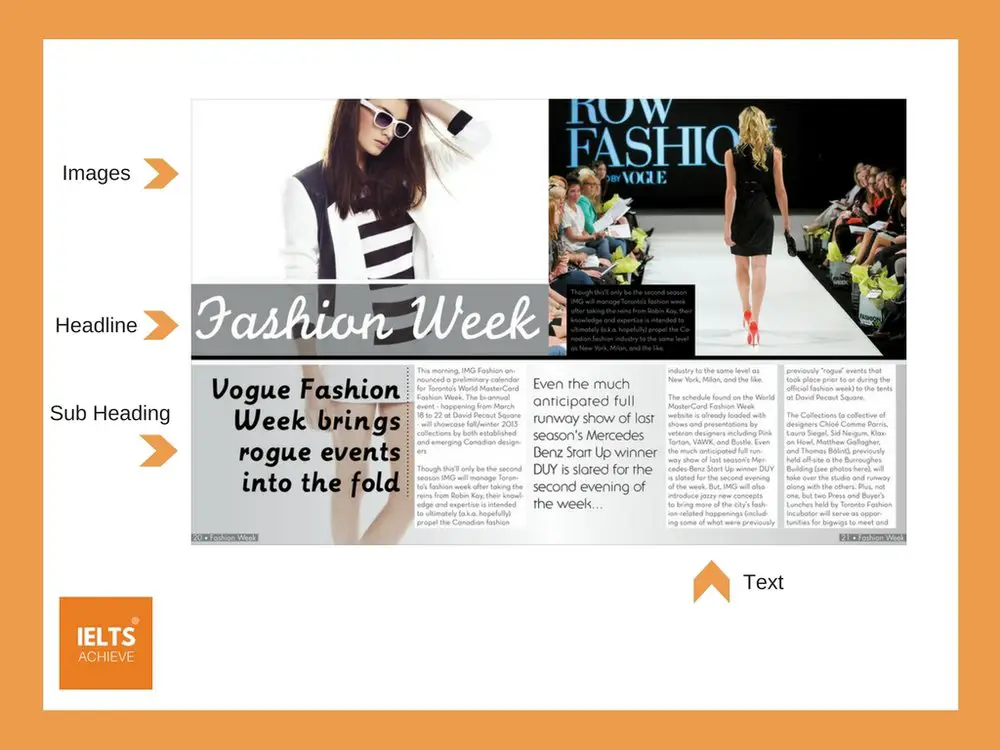
When you preview a text you look at the headings, the layout and any images to get an idea of what the text is about before you decide if you want to read it or not. For example, when you look at an article in a newspaper or a magazine, the headline and images give you an idea of what it is about. Previewing is an important skill to have because it helps you to foresee the content and this makes it easier to understand the text.
TIP >> Next time you read an article think about the headline, subheading and the images and think about the following questions – How do they draw you in to read more? How do they tell you what the article is about?
Predicting Content And Structure
This is when you use your knowledge and guess what a text is going to be about. For example, if you see an advert about adopting animals or donating to animal shelters, you would be able to guess the purpose of the text and the image(s) was to make you want to adopt an animal or help the shelters by donating money, therefore the vocabulary used would be related to this. Predicting is an important reading skill because you can make sense of a text when you already know about the topic.
TIP >>Practice by looking at adverts you see in magazines, online (blogs etc) and look at the vocabulary used and think about the following questions – How does it relate to the topic? How does it tell you about the purpose of the advert?
Source
Skimming
When you skim read a text for the main idea, you read the text quickly to get the general idea of the main topic. When you do this, you are looking for the main idea – not the specific details. For example, you may skim read the back cover of a book jacket to get an idea of what the book is about before you decide to read/buy the book. Skimming is an important skill because in the test you are time conscious, so you need to skim read texts in order to get the main idea, before locating specific information needed to answer questions.
TIP >> Practice skim reading by reading articles, reviews and summaries to get the main idea. Choose content that interests you, not only IELTS practice materials.
When you scan a text to find the information you also do this quite quickly to find what you need. You normally use this skill when you are looking for facts. For example, if you are looking for a train time or the departure gate you need at the airport, you scan the board’s looking for the information. Therefore, you use this skill every day when looking at times, dates or places.
TIP >> Practice scanning by looking for information in timetables, the TV guide etc and find facts you need quickly.
Intensive Reading
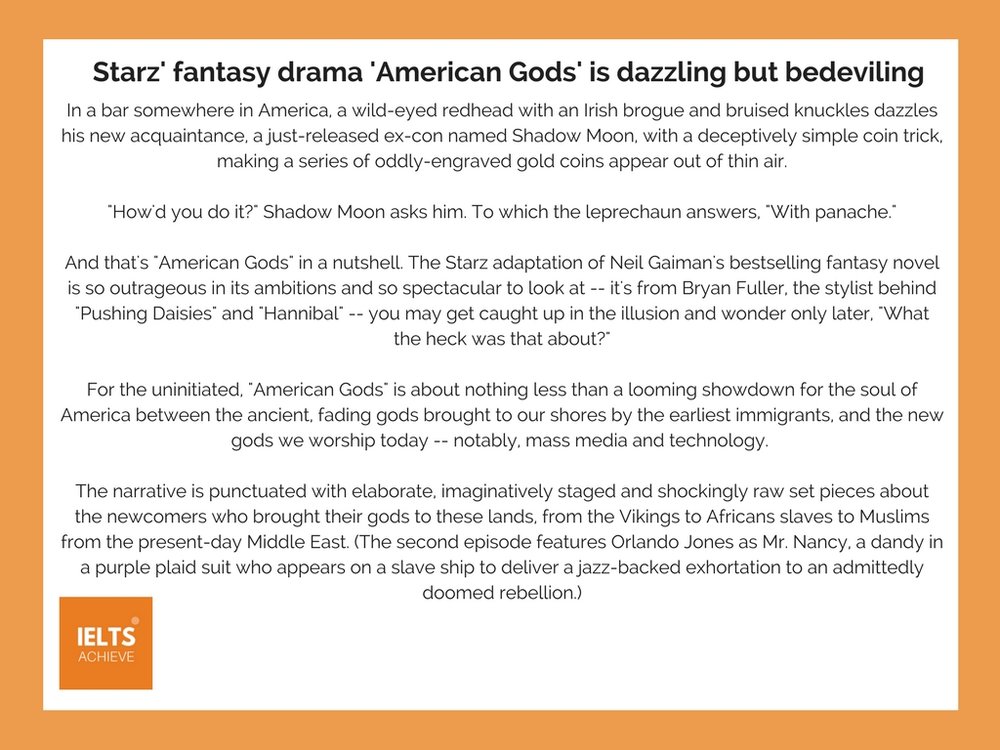
When you read a text carefully and study the information, this is intensive reading. You do this when the content is important. For example, if you had to fill out some important forms, like renewing your passport or filling out a tax return, you would read the instructions carefully, before filling out the forms. You need to read carefully for more detail when you need to understand the writer’s meaning. For instance, when reading a tv show review, you might want to read it intensively to find out the details to see if you want to watch it or not.
TIP >> Read reviews and other texts you find interesting and study the content. Think about how detailed the information is, do you understand the writer’s meaning?
Look at the review below of the TV Show ‘American Gods’ – How does the writer tell you what they think about the show?
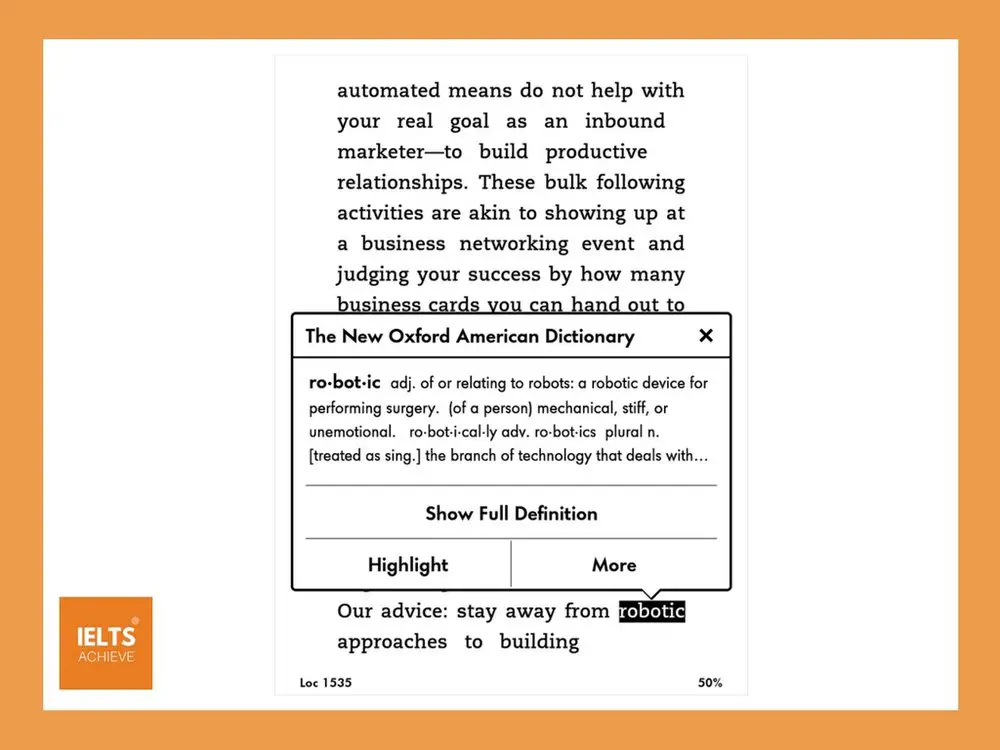
When you are reading and you come across a word or words you don’t know, you can sometimes guess the meaning from the context they are in. If not then you will have to look up the meaning in a dictionary (although this is not allowed in the test). For instance, if you were reading a book and you saw a word you did not know, you might be able to work out the meaning from the context of that sentence or paragraph.
TIP >> When you read – keep a dictionary and a notebook with you and write down any words you do not know the meaning of. Alternatively, you can do this easily if you use your smartphone or Ipad. If you have an e-reader, the built-in dictionary will show you the meaning of the words once highlighted. This is so useful for learning new vocabulary.
When you read a book, article etc, you should be able to understand how the writer feels or thinks about a subject. For example, in an article or blog about travelling, you may read views on certain places and how they feel when going there. This can help you to understand how they explain their opinions and views through the language they use. Understanding attitude and opinion are important skills because writers do not always clearly state how they think or feel.
TIP >> Read reviews or opinions from opinion sections of newspapers like The Guardian or The Washington Post. Think about how the writer shares their opinion – is it obvious? What language/vocabulary do they use? How can you tell what they are thinking or feeling?
Look at the opinion piece below from The Guardian – how does the writer share his opinion about the topic?
Read more – Read as much as you can in English, choose anything that interests you – not just IELTS practice materials. Read novels, magazines, news articles, blogs and anything else that holds your attention. Reading really helps with your writing, as you learn new vocabulary, grammar and understand how structures work.
Make a note of any new words – Write them down and look them up – this will help you to remember the words and their meaning.
Take note of the grammar – Think about the structures used, look at the sentences, the tenses and the punctuation.
Idea development – When reading news articles think about how the writer leads you through the information, how do they develop their ideas? How do they structure the writing? Where do they put the facts? The opinions?
Opinions – How do they share their opinions with the reader? What kind of language and structure do they use to do this?
Schedule some reading time – when you are travelling on your commute to work, lunchtime, before bed – try to fit in some reading.
We hope you found this post useful in helping you to study for the IELTS Test. If you have any questions please let us know in the comments below or on the Facebook page.
The best way to keep up to date with posts like this is to like us on Facebook, then follow us on Instagram and Pinterest.
If you need help preparing for the IELTS Test, join the IELTS Achieve Academy and see how we can assist you to achieve your desired band score. We offer an essay correction service, mock exams and online courses.
Essential strategies and practice techniques for this IELTS Reading question type. Learn how to manage time and improve accuracy.
Originally published June 2017. Last reviewed 3 July 2026.
In this post, we will be looking at how you can understand the IELTS Reading Test Band Scores for both the Academic Test and The General Training Test.
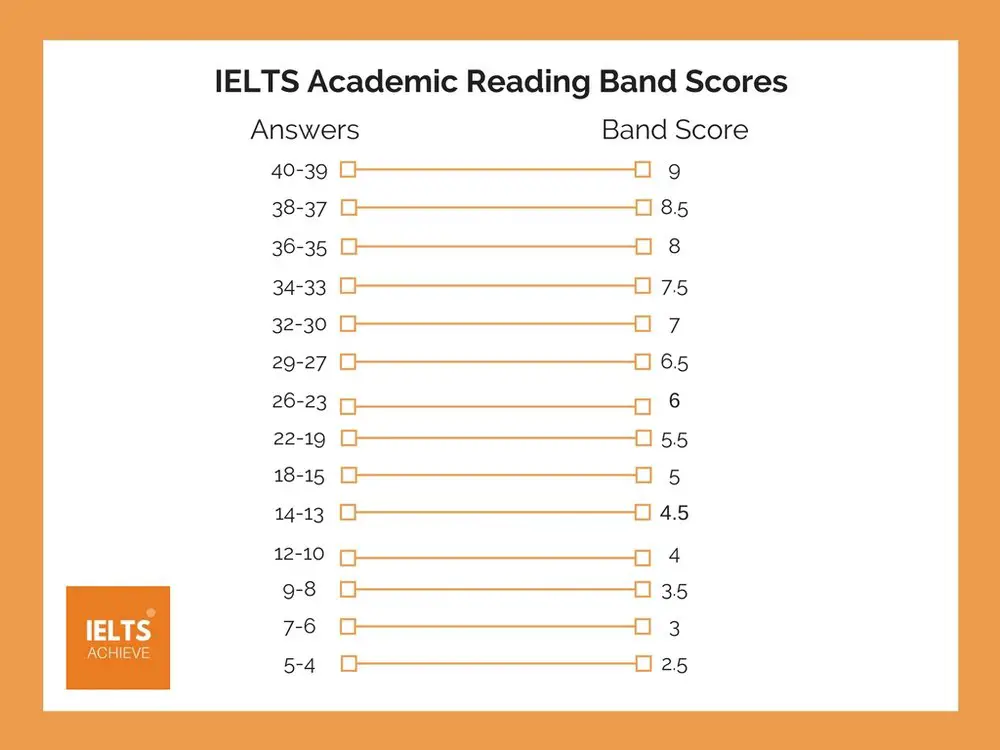
The IELTS Reading Test has 40 questions with each correct answer given one mark. The score you get out of 40 is then converted into a band score. The scores are reported in both whole and half bands.
IELTS Reading Band Score Calculator.
Calculate Your IELTS Reading Band Score
The main difference between the Academic and General Training Reading tests are the type of reading texts the students are given.
General Training
IELTS General Reading Band Score
The General Training texts are generally a bit easier to comprehend, with information from flyers, job descriptions, train timetables, travel brochures, an extract from a novel or job application instructions.
Number of correct answers
IELTS General Training Reading Band Score
40
9
39
8.5
37-38
8
36
7.5
34-35
7
32-33
6.5
30-31
6
27-29
5.5
23-26
5
19-22
4.5
15-18
4
12-14
3.5
9-11
3
Academic
IELTS Academic Reading Band Score
The Academic texts are more difficult, usually taken from magazines, newspapers, journals and research. These feature more complex ideas and vocabulary.
The tables below show the average number of marks required to attain a certain band score in Academic Reading and General Training Reading.
Number of correct answers
IELTS Academic Reading Band Score
40-39
9
38-37
8.5
36-35
8
34-33
7.5
32-30
7
29-27
6.5
26-23
6
22-19
5.5
18-15
5
14-13
4.5
12-10
4
9-8
3.5
7-6
3
5-4
2.5
We hope you found this post useful in helping you to study for the IELTS Test. If you have any questions please let us know in the comments below or on the Facebook page.
The best way to keep up to date with posts like this is to like us on Facebook, then follow us on Instagram and Pinterest.
If you need help preparing for the IELTS Test, join the IELTS Achieve Academy and see how we can assist you to achieve your desired band score. We offer an essay correction service, mock exams and online courses.