Step-by-step guide to answering this type of IELTS Writing Task 1 question. Covers structure, key language, and band-scoring criteria.
Originally published July 2017. Last reviewed 3 July 2026.
In this post, we will look at mapsin the listening test.
On maps there are many symbols/icons that are easily recognised. In the image below you will see many icons that are used in maps. How many do you know?
Vocabulary
In the maps questions, you will hear vocabulary that is specific to giving directions. They have their own common terms that you will become familiar with. Different prepositions are used for some explanations.
For example;
Across from the …….
…….. is at the end of the street
At the junction of ……………..
On/at the corner of …………………
Near the entrance/exit to ……………………….
Just past/over the roundabout ……………………..
…………… at the next traffic light
……………… in the next street
Practice
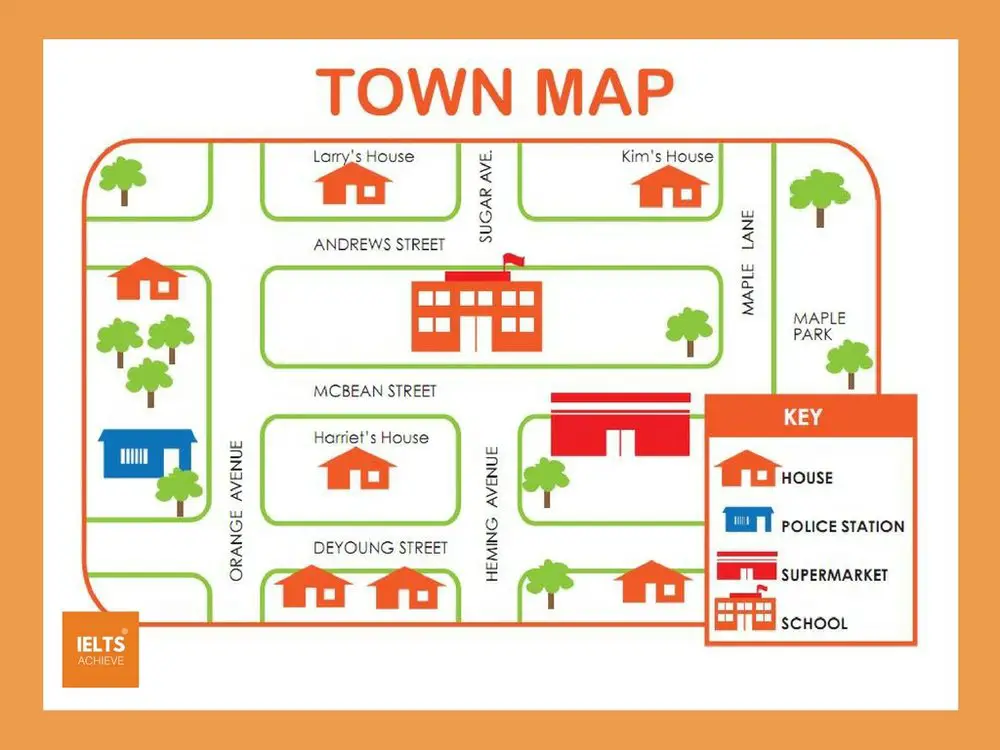
Look at the map below and see if you can answer the following questions >>
Is there a school near to the housing estate on Deyoung Street?
Is the supermarket on the right when you travel up Heming Avenue towards the school?
Is the police station on Maple Lane?
Where is Kim’s house?
How would you get to Larry’s house after leaving school?
How could you get to the park from Harriet’s house?
Grammar
In the IELTS Listening Test, you will listen to directions and have to follow them in order to label places on a map.
When listening to the directions you will often hear the imperative, for example;
Turnright, then go straight ahead past the school. Walkalong Park Avenue.
Imperatives give an instruction, in this case, telling you what to do. They are also used in other parts of the IELTS test, for instance when you are writing or talking about something in a sequence; First, Then, Next, After that, Finally.
Directions can also use the second person singular form, for example;
When you see the school library, you turn right onto Russel Road.
Modal verbs can also be used in directions, for example;
At the roundabout, you can either go straight ahead or you could turn right and walk the longer route past the shopping area.
You could take the main street or turn left onto Brownie Road.
Prepositions
Prepositions of movement are used to show movement to or from a place.
For example;
to, through, across
When you use the word to it can show movement to a specific destination.
To get to the library you should go to Baker Street first, then take a right.
I moved to Greece in 1985.
She has gone to the shopping mall.
Through is used to show movement from one side of a confined space to the other.
The bus went through the tunnel
To get to the tennis courts you could cut through the library.
To visit the shopping mall’s busiest area, you could walk through the main car park
The word across is used to show movement from one side to another.
To reach the supermarket you can go across Grant Street and turn right.
To get to the theatre she went across the walkway and turned left into Grimwald Street.
To reach the tennis courts, walk across the car park and enter the door on the right.
More prepositions of movement >>
along – the road
around – the park
away from – the busy road
back to – the library
down – the embankment
into – the shop
off – the bus
out of – the cinema
over – the road, bridge, hill etc
past – the supermarket
round – the football field
towards – the bakery
under – the bridge
up – the hill
The words at and in can be used to show the purpose of movement, for example;
The supermarket is at the end of the street, next to the large carpark.
The library is in a busy area, next to the main campus cafeteria.
Labelling A Map
Some questions will ask you to label a map. You will be given a list of places to match up with places that are numbered.
Question Example
Question 6-10
Label the map.
Choose five answers from the box and write letters A-H next to questions 6-10.
Review And Strategy
TIP >> The plans, maps and diagrams questions do not follow the order that you hear the information in the recording. Therefore it is important that you read the questions and familiarise yourself with the plan or map you are looking at before you start listening.
TIP >> Study the map and see where things are before listening to the recording. Marks can be lost if you do not do this and read the questions properly.
TIP >> Listen carefully for information but be wary of distractors.
TIP >> Make notes on the paper and draw lines to destinations etc. This may help you to locate information.
We hope you found this post useful in helping you to study for the IELTS Test. If you have any questions please let us know in the comments below or on the Facebook page.
The best way to keep up to date with posts like this is to like us on Facebook, then follow us on Instagram and Pinterest.
If you need help preparing for the IELTS Test, join the IELTS Achieve Academy and see how we can assist you to achieve your desired band score. We offer an essay correction service, mock exams and online courses.
Proven strategies for this IELTS Listening question type. Includes prediction techniques and common traps to avoid.
Originally published July 2017. Last reviewed 3 July 2026.
In this post, we will look at plansin the listening test.
Students will have to understand a description of a place and follow directions. You will probably be familiar with some of these plans, as you see them when you visit galleries, museums and other places like schools.
In section 2 you will probably hear a person talking about a topic that is not academic. It is usually someone talking about an event or showing them around a building.
The plans below are a bit more complex than those that you will see in the IELTS Listening Test. When you listen to the recording during the test, look out for the language of location. For example, next to, near, opposite, in front of etc.
TIP >> During the test make notes and/or mark the way on the question paper before transferring your answers at the end.
TIP >> Make sure you spell your answers correctly.
Question Example
Label the plan below.
Choose EIGHT answers from the box and write the correct letters A-I next to questions 11-15.
The Language of Location
To understand the description of a plan and to locate certain places you need to understand the language of location.
You should also be familiar with prepositions of place, such as in, at, on, by, next to, beside, near, between, among, behind, in front of, under, below, over, above, across, through, to, into, towards, onto and from.
For example, if we look at the plan above;
Gallery 1 is next to gallery 2.
Gallery 2 is beside gallery 3.
Gallery 6 is in front of gallery 7.
Labelling A Plan
In order to be able to label a plan, you must listen for a description or directions on the recording. You will most likely hear a person describing a plan or showing people around somewhere. You may be given a list of possible answers in a box or not.
The information you hear will be in the same order as the recording. You should study the plan carefully before listening so that you have an idea of where the options may be.
TIP >> You can cross out any options that you think are wrong and if you can’t decide between two answers, write both down and make a choice later.
Question Example
Label the plan.
Write the correct letter. A-E, next to questions 11-15.
Distractors
A distractor is when you are given information that is wrong. This can lead you to choose the incorrect answer. They are common in the IELTS Listening tests, as they test your ability to choose the right information for the answers, by ignoring the wrong information.
The distractors will try to trick you into selecting the wrong answer, so you must listen carefully for specific information.
The distractors for this type of task might be more rooms etc on the plan or extra options in the list of possible answers.
Paraphrasing
The questions will paraphrase the information from the recording, or a speaker in the recording may paraphrase, so you will have to use your knowledge of synonyms, noticing any keywords and terms. Recognising and using synonyms shows the examiner that you have good vocabulary knowledge. Paraphrasing is a skill that is needed in all parts of the test.
Review And Strategy
TIP >> The plans, maps and diagrams questions do not follow the order that you hear the information in the recording. Therefore it is important that you read the questions and familiarise yourself with the plan or map you are looking at before you start listening.
TIP >> Study the map and see where things are before listening to the recording. Marks can be lost if you do not do this and read the questions properly.
TIP >> Listen carefully for information but be wary of distractors.
TIP >> Make notes on the paper and draw lines to destinations etc. This may help you to locate information.
We hope you found this post useful in helping you to study for the IELTS Test. If you have any questions please let us know in the comments below or on the Facebook page.
The best way to keep up to date with posts like this is to like us on Facebook, then follow us on Instagram and Pinterest.
If you need help preparing for the IELTS Test, join the IELTS Achieve Academy and see how we can assist you to achieve your desired band score. We offer an essay correction service, mock exams and online courses.
Essential strategies and practice techniques for this IELTS Reading question type. Learn how to manage time and improve accuracy.
Originally published July 2017. Last reviewed 3 July 2026.
In this post, we will look at sentence completion questions in the listening test.
Similar to short-answer questions, sentence completion questions are designed to assess your ability to find specific information. You will have to choose the right words or keywords from a text to complete a sentence. The words will be in the text and when you write them, they must be grammatically correct.
The questions will paraphrase the information from the recording, or a speaker in the recording may paraphrase, so you will have to use your knowledge of synonyms, noticing any keywords and terms. Recognising and using synonyms shows the examiner that you have good vocabulary knowledge. Paraphrasing is a skill that is needed in all parts of the test.
A question might paraphrase an idea during the recording.
For example;
The trip we went on was meant to last five days.
The journey we took was supposed to be for just less than a week.
The place we visited first was beautiful.
The area we toured, to begin with, was stunning.
The shuttle bus took us from the hotel into the town.
We were provided with free transport to the metropolis.
Examples of Synonyms
Money = cost / price / cash / pay
Location = area / district / neighbourhood
Transport = carriage / transportation / shipment
Journey = adventure / expedition / exploring
An effect = consequence / development
A cause = motive / purpose
Grammatical Accuracy
Each sentence must be grammatically correct and complete with the word limit expressed in the instructions. Don’t use more words than you are allowed according to the instructions in the question.
For example, you may be asked to:
Write NO MORE THAN ONE WORD for each answer
Write NO MORE THAN ONE WORD AND/OR A NUMBER for each answer
Write NO MORE THAN TWO WORDS for each answer
If your answer does not follow the instructions given, it will be marked as incorrect.
Always read the questions before you listen to the recording and predict the type of words you would be able to use.
For example;
The Great North Run is on ……………………………….
Possible answers
An adverbial time phrase: The Great North Run is on – every year, once a year, in the summer.
A prepositional phrase that expresses a place: The Great North Run is on – in Newcastle, in the North-East, in the North.
Exercise 1
Read the questions first before you listen to the recording.
Write NO MORE THAN THREE WORDS AND/OR A NUMBER for each answer.
1. Running in the race was the well known male runner …………………………….
2. The race was on in the ………………………………
3. This is the ………………………………….
4. Taking part in the race are …………………………………………
Answers at the bottom of the page.
Exercise 2
For most of the sentence completion questions you have to complete the end of the question, but there are other questions that will ask you to fill in gaps in other places. This could be at the beginning or the middle of a sentence.
Read the questions first before you listen to the recording.
Write NO MORE THAN TWO WORDS for each answer.
1. Prince Harry came home with three ……………….. ……………………. people.
2. Prince Harry thinks that to him we are all the same and the people he worked with know him as ……………………. …………………………….. not just as a prince.
3. They want an …………………………… to …………………………. to themselves that they are the same people.
4. Prince Harry wants to make sure that the mood is ……………………………………. and that the everyone ……………………………. it.
Answers at the bottom of the page.
REVIEW AND STRATEGY
TIP >> Read the instructions and questions before you start listening to the recording. What are you being asked to do? Familiarise yourself with the questions and think about the context.
TIP >> Look at the information/options you have been given and highlight any keywords.
TIP >> Listen carefully for information but be wary of distractors.
TIP >> Be aware of paraphrasing and synonyms.
TIP >> If you do miss an answer or were not sure, then it is ok to take a guess. This is better than leaving a blank space and you never know, you might answer correctly!
Answers >>
Exercise 1
1. Mo Farah
2. the North East
3. the 36th Race
4. different nationalities
Exercise 2
1. seriously wounded
2. Captain Wales
3. opportunity / prove
4. electric / enjoy
We hope you found this post useful in helping you to study for the IELTS Test. If you have any questions please let us know in the comments below or on the Facebook page.
The best way to keep up to date with posts like this is to like us on Facebook, then follow us on Instagram and Pinterest.
If you need help preparing for the IELTS Test, join the IELTS Achieve Academy and see how we can assist you to achieve your desired band score. We offer an essay correction service, mock exams and online courses.
Comprehensive guide covering essential IELTS preparation strategies and techniques to help you achieve your target band score.
Originally published July 2017. Last reviewed 3 July 2026.
In this post, we will look at short answer questions in the listening test.
Short answer questions in the listening test, will require you to write no more than a set number of words and/or numbers. You will probably be given a limit, for example, ‘No more than two words and/or a number’. If you write more words than the instructions tell you to, your answer will be marked as incorrect.
The short answers only need keywords, meaning you will not be able to write a sentence. These questions are there to see how well you can find specific information and be able to recognise when some information is not needed.
It is really important that you read the instructions of the questions carefully, often when people do not read them and follow them correctly they lose marks. When you are asked to complete questions, you will also be enlightened as to what information you can put into the gaps.
Being able to provide accurate short answers in the listening test is really important in order for you to gain a high score.
For example, you may be asked to:
Write NO MORE THAN ONE WORD for each answer
Write NO MORE THAN ONE WORD AND/OR A NUMBER for each answer
Write NO MORE THAN TWO WORDS for each answer
If your answer does not follow the instructions given, it will be marked as incorrect.
In the IELTS listening test, you must listen for specific information and be able to recognise when some information is not needed.
Exercise 1
Look at the text below and provide an answer that is NO MORE THAN TWO WORDS.
Question – What did Segovia influence?
Spain will always hold a special place in my heart. It was the destination of my first international trip, and where I studied Spanish abroad and started to discover how much excitement the world had to offer.
My favourite part of that first trip was being able to explore smaller cities and towns in Spain that I wouldn’t have known about prior, and that is somewhat off the tourist path. I spent a month in Spain that summer, living in Salamanca and El Puerto de Santa Maria, and exploring the surrounding regions.
From Madrid, you can get to the city of Segovia in less than thirty minutes on the high-speed train, and I recommend getting out there. Famous for its Acazar and Roman aqueduct, Segovia is a gorgeous UNESCO World Heritage Site.
One thing that I found interesting about Segovia is that it’s said that Walt Disney drew inspiration from the majestic Acazar for the iconic Cinderella’s castle.
Answer at the bottom of the page.
Distractors
A distractor is when you are given information that is wrong. This can lead you to choose the incorrect answer. They are common in the IELTS Listening tests, as they test your ability to choose the right information for the answers, by ignoring the wrong information. The distractors will try to trick you into selecting the wrong answer, so you must listen carefully for specific information.
Exercise 2
Listen to the following sound clip which contains a number of distractors. Before you listen, take a look at the questions and think about the context. What words or phrases would you expect to hear? Can you predict?
Question
Write NO MORE THAN ONE WORD AND/OR A NUMBER for each answer.
1. What does he divide the meat into? ………………………..
2. What does he marinate the burgers with? ……………………………
Answers at the bottom of the page.
Practice Short Answer Questions
The IELTS listening test will allow you some time to read the questions before you listen to the recording. For the short answer questions, you should read the questions before you start and try to predict the answers, or what type of word would be appropriate for the answer.
Exercise 3
Read the following questions before listening to the sound clip.
Write NO MORE THAN THREE WORDS AND/OR A NUMBER to answer.
1. According to the author, what does she say about writing another Harry Potter novel? …………………………….
2. The author doesn’t want to write which book? ……………………………………..
3. Was Harry Potter one of the bestselling book series in? …………………………………
4. What is the author worth financially? ……………………………………
5. How does the author help children around the world? ……………………………………….
Answers at the bottom of the page.
Exercise 4
Short answer questions can be presented in other ways, for example asking you to listen to a recording and choose options.
Read the following questions before listening to the sound clip.
Write NO MORE THAN TWO WORDS AND/OR A NUMBER to answer.
1. What does the student need to improve?
A. ………………………….
B. ………………………….
2. What are the writer’s obligations to their readers?
A. ………………………….
B. ………………………….
Answers at the bottom of the page.
REVIEW AND STRATEGY
TIP >> Read the instructions and questions before you start listening to the recording. What are you being asked to do? Familiarise yourself with the questions and think about the context.
TIP >> Look at the questions/options you have been given and highlight any keywords.
TIP >> Listen carefully for information but be wary of distractors.
TIP >> Be aware of paraphrasing and synonyms.
TIP >> If you do miss an answer or were not sure, then it is ok to take a guess. This is better than leaving a blank space and you never know, you might answer correctly!
Answers >>
Exercise 1
Cinderella’s Castle
Exercise 2
1. 200g
2. Mustard
Exercise 3
1. Never say never
2. Harry Potter 8
3. History
4. 1 billion dollars
5. Through charity work
Exercise 4
1. A – clear development / B – first sentence
2. A – Readership / B – Thesis
We hope you found this post useful in helping you to study for the IELTS Test. If you have any questions please let us know in the comments below or on the Facebook page.
The best way to keep up to date with posts like this is to like us on Facebook, then follow us on Instagram and Pinterest.
If you need help preparing for the IELTS Test, join the IELTS Achieve Academy and see how we can assist you to achieve your desired band score. We offer an essay correction service, mock exams and online courses.
Step-by-step guide to answering this type of IELTS Writing Task 1 question. Covers structure, key language, and band-scoring criteria.
Originally published July 2017. Last reviewed 3 July 2026.
In the IELTS listening test, you may have to complete a flowchart, table, notes, a summary or a form. In this post, we will look at how you should answer these types of questions in more detail.
It is really important that you read the instructions of the questions carefully, often when people do not read them and follow them correctly they lose marks. When you are asked to complete questions, you will also be enlightened as to what information you can put into the gaps.
For example, you may be asked to:
Write NO MORE THAN ONE WORD for each answer
Write NO MORE THAN ONE WORD AND/OR A NUMBER for each answer
Write NO MORE THAN TWO WORDS for each answer
If your answer does not follow the instructions given, it will be marked as incorrect.
Lexical Resource
As the answers require you to follow strict instructions about how many words or numbers you can use in your answers, you may need to change the verbs to nouns, nouns to verbs or verb-adverb combinations to other words.
For example;
Once the ingredients had been added the mixture was pliable.
When you add the ingredients you will see the mixture start to change.
After adding the two main ingredients, the mixture was ready to be stirred.
Each example gives you the same idea, using different words. The listening test will test your ability to use language to show your understanding.
You must also be aware of synonyms and paraphrasing, as the words used in the listening test may say for example ‘travel’ and on the paper say ‘excursion’.
Completing A Flowchart
You may see a flowchart that requires you to listen to the recording and then fill in the missing words.
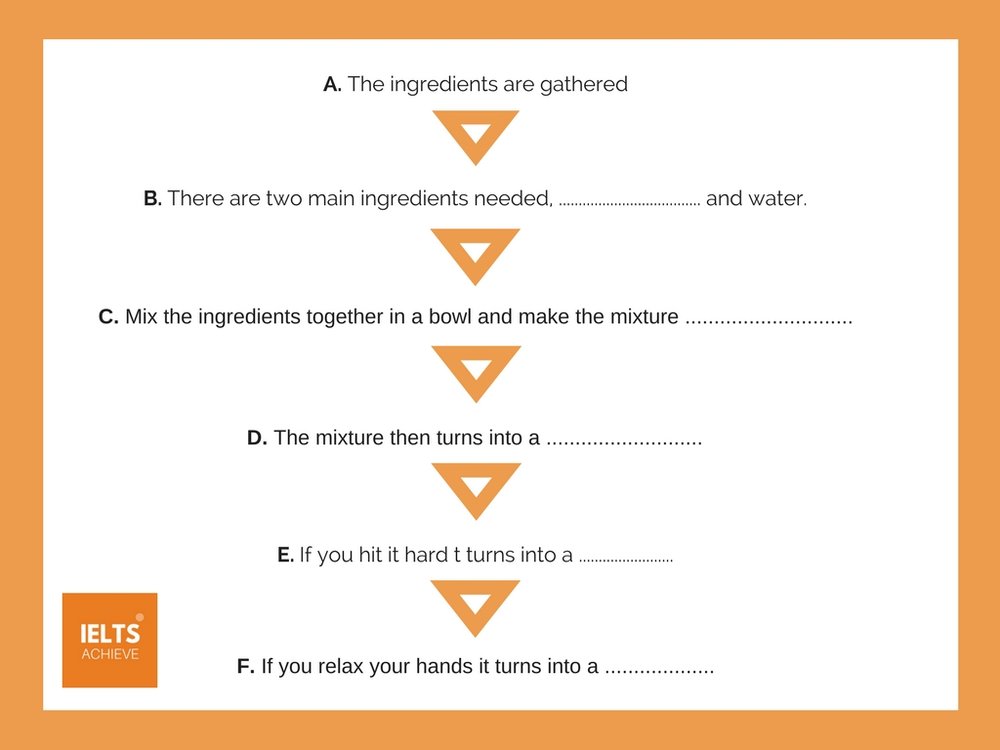
Look at the flowchart below, would you be able to guess the missing words before listening to the recording?
Example Flowchart Question
Write NO MORE THAN TWO WORDS for each answer.
Answers at the bottom of the page.
Notes
Notes are often numbered or organised with bullet points. They may also be organised by heading and subheading followed by the organised information.
You would hear information that will allow you to complete the notes by filling in the missing information.
Example Notes Question
Write NO MORE THAN THREE WORDS AND/OR A NUMBER for each answer.
History of The Acropolis
The Beginning
A temple to the goddess 31. …………………………
A symbol of culture and 32. ……………………………………..
Aesthetics
Full of decoration, the Parthenon was home to a detailed 33. ……………………………. above the columns.
The Parthenon had been built for 34. ……………………… years.
Under Attack
The Parthenon was attacked during 35. …………………….
Later on, Lord Elgin wanted to remove the 36. ………………………………….. and take them to England.
Completing A Table
You may be asked to complete a table, with gaps for you to complete. The headings in the table will tell you the type of information you will hear and need to listen for. You may have a gap fill table or a task to complete a table with a list of words in a box to choose from.
To complete a table you will need to write words that you hear in the recording during the test. You will be given a number of words and/or numbers to write in the instructions.
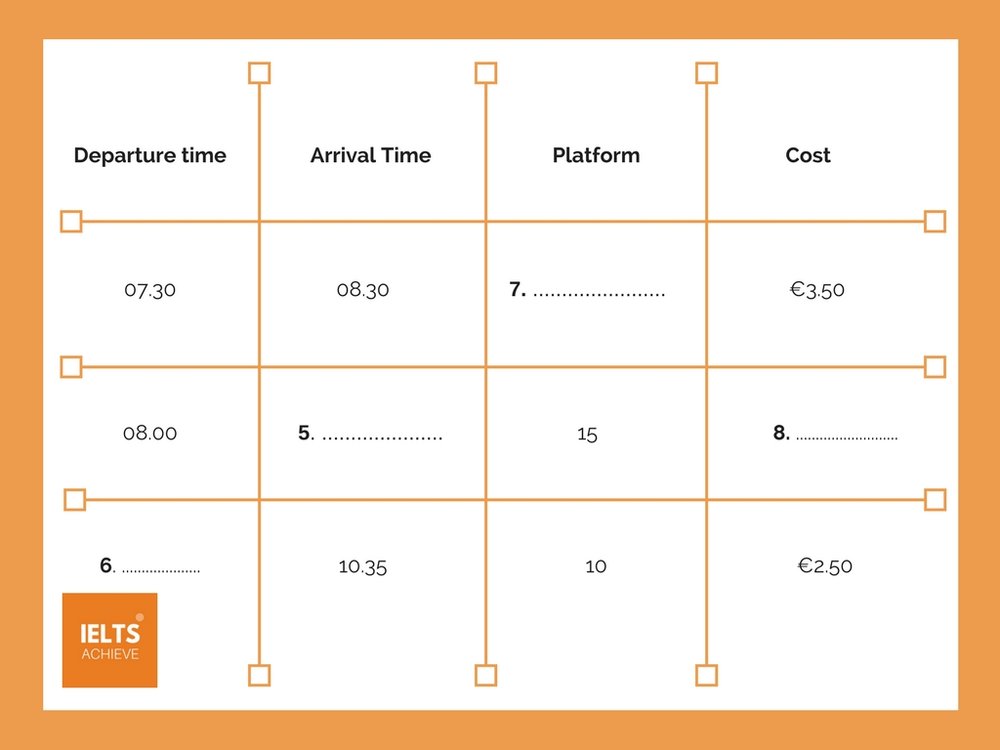
Example Table Question
You would hear information during the test that will allow you to complete the table by filling in the missing words/numbers.
Complete Questions 5-8.
Write NO MORE THAN ONE WORD AND/OR A NUMBER.
Trains To Berwick
Completing A Summary
Summaries are seen often, from recommending a book, movie or even a restaurant, we summarise the events. When you see a summary question in the listening test, it will look similar to other summary exercises you have seen, including gap-fill questions. The summary answers do require you to show that your answers are grammatically correct.
You will hear information that will allow you to complete the summary by filling in the missing information.
Before listening to the sound clip you should read through the paragraph and try to predict the word that would be suitable for each gap.
Example Summary Question
Complete the summary below.
Choose ONE WORD ONLY from the passage for each answer.
How To Write A Speech
This is the second most important thing you need to do when you are creating your speech. The first thing you should do is understand what your 37. …………………………….. will be. How do you plan on getting people’s attention? You need to think of something that will link to the 38. ……………. this is the idea that you are trying to sell or the point you are making to your audience. The next thing you need to include is the 39. ……………………….. this would be the main points you are getting across. Next, you would have a call to action, telling them what you want them to do. Finally, you will 40. …………………………. and link this back to the opening.
Answers at the bottom of the page.
Completing A Form
You have probably filled out many forms during your life, for courses, official documents or job applications. In the listening test, you may see a form with missing information, which includes names, dates and numbers.
You would hear information in the test that will allow you to complete the form by filling in the missing information.
Before listening to the sound clip during the test you should read through the form and try to predict the word that would be suitable for each gap.
REVIEW AND STRATEGY
TIP >> Read the instructions and questions before you start listening to the recording. What are you being asked to do? Familiarise yourself with the questions and think about the context.
TIP >> Look at the information/options you have been given and highlight any keywords.
TIP >> Listen carefully for information but be wary of distractors.
TIP >> Be aware of paraphrasing and synonyms.
TIP >> If you do miss an answer or were not sure, then it is ok to take a guess. This is better than leaving a blank space and you never know, you might answer correctly!
Answers >>
Flowchart Answers >>
B – cornstarch
C – smooth
D – slime
E – solid
F – liquid
Notes Answers >>
31. Athena
32. refinement
33. frieze
34. 2000
35. 1687
36. marble friezes
Summary Answers >>
37. opening
38. premise
39. body
40. close
We hope you found this post useful in helping you to study for the IELTS Test. If you have any questions please let us know in the comments below or on the Facebook page.
The best way to keep up to date with posts like this is to like us on Facebook, then follow us on Instagram and Pinterest.
If you need help preparing for the IELTS Test, join the IELTS Achieve Academy and see how we can assist you to achieve your desired band score. We offer an essay correction service, mock exams and online courses.
Proven strategies for this IELTS Listening question type. Includes prediction techniques and common traps to avoid.
Originally published July 2017. Last reviewed 3 July 2026.
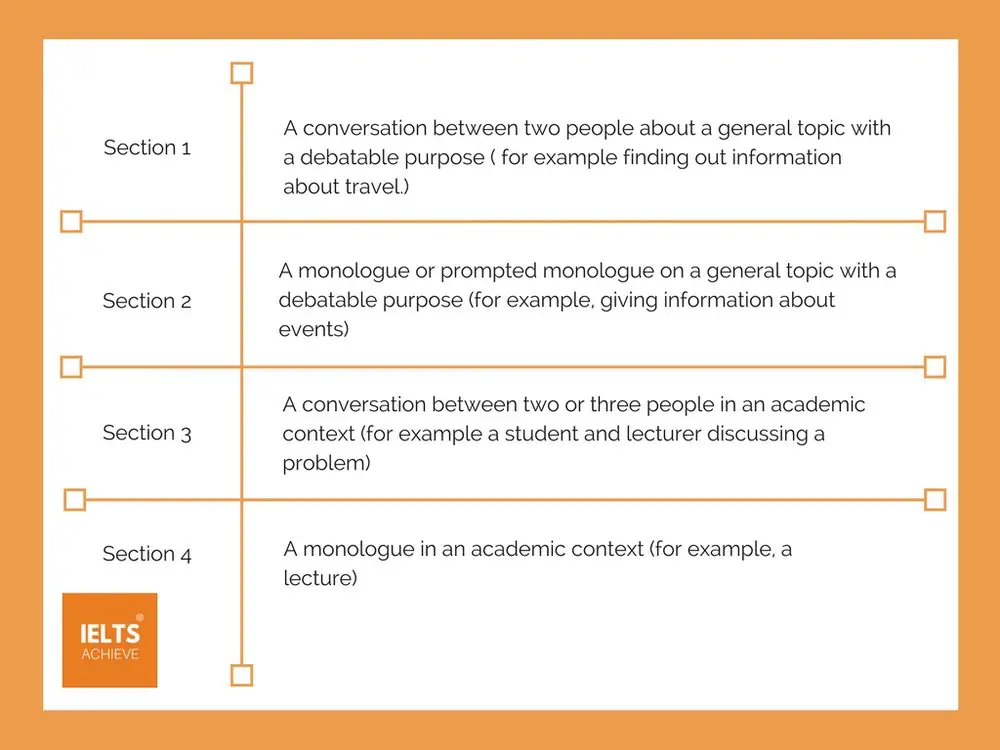
The IELTS Listening Test lasts 30 minutes, with an extra 10 minutes to transfer answers to the answer sheet. It is made up of four parts, with a total of 40 questions (10 per section).
During the test, the texts become more difficult, with part one being the easiest and part 4 the hardest. You will only hear each recording once, never more than that.
IELTS Academic and IELTS General students take the same test and it is marked in the same way.
What you will listen to
Sections 1 and 2 are set in a social context and sections 3 and 4 are set in an academic context.
You may hear one of the following;
A conversation between a travel agent and a customer
An introduction to animal science
A dialogue between three students in a cafe.
A lecture about climate change
A conversation between student and teacher.
Parts 1 and 2 of the Test
Parts 1 and 2 are set in a social context, with general topics.
In part 1 you will listen to a conversation between two people, during the conversation they will complete some sort of transaction. A common plot involves a customer who calls a company to find out specific information about a service or product.
In part 2 you will hear a monologue that provides some sort of information. A possible plot is a speaker giving a short presentation on a service or a guided tour.
Parts 3 and 4 of the Test
Parts 3 and 4 are set in an academic context, with specialised topics.
In part 3 you will most likely hear a student and teacher discussing an academic topic.
In part 4 you will probably hear a speech or a lecture, in an educational setting. it is likely to be a topic you will know little about, but simple enough for you to understand.
Who is speaking and what is the topic?
Listen to the sound clip and think about the context – you should try to think about the context as soon as you can, this will enable you to predict the communication and information that you will hear.
Read the following questions and answer them as you listen;
What is the format of the recording? (is it a monologue? a conversation?)
Who is speaking? (an expert? a sales representative? A lecturer?)
What is the topic? (A lecture? A request for information? A tour?)
Answers are at the bottom of the page.
Accents you will hear
During the test, you will likely hear a variety of English accents, not just those from Britain. You could hear accents from America, Canada, Australia and New Zealand.
it is a good idea to try and listen to these accents before you take your test, listening to the radio, watching movies or TV shows is a good way to become more used to those types of accents.
Task Types
During the test, you will have 10 questions for each section of the listening test. below are the task types you may find in any section.
Notes/summary/table/flowchart completion – To complete with a suitable word or words with a given word limit.
Multiple Choice – Choose an answer (could be one answer or two answers from A-C / A-E.
Short Answer Questions – answer questions within the given word limit.
Sentence Completion – Complete a sentence with the suitable word(s) within the given word limit.
Labelling a diagram, plan or map – Label the diagram, plan or map with suitable words or choose them from a box of possible answers.
Classification – Classify the information according to three different types of criteria (A, B or C). This could include names, dates or times.
Matching – Match a list of statements to a list of possible answers in a box, for example, people, theories or dates.
The information you hear will be in a logical order, that is the information given will appear in the same order as the recording. You will hear the information relating to the first question before you hear the information for the second and so on.
Sometimes, you may need to select an opinion from a list of options and the listed items are in a random order.
Spelling and Numbers
Be aware of you spelling during the test as misspelt words will cost you marks. Both US and UK spelling are allowed in the test, but any that are incorrect will be marked as incorrect. This is important for all spelling, but important for names and places too, make sure you spell them with a capital letter to get a correct answer.
At the end of the test when you transfer your answers to the answer sheet (10 mins) be careful with your spelling and make sure your answers are grammatically correct.
You should also be aware of numbers during the test, as they will likely be included in part 1 of the listening test. How well do you know your numbers?
52nd = ordinal number
65% = percentage
€35.00 = amount of money
365 – cardinal number
1980 – date
Do you also know currencies? from British Pounds £ to Euros € to US Dollars $?
Practice
Practice with a range of test papers you find online or from IELTS textbooks. You can find IELTS listening practice tests from the British Council . Try to complete the test in exam conditions (listening only once!)and go through your answers, checking the errors and looking back to see why you made those errors.
You should also aim to listen to English as often as you can, from the BBC News, TED Talks, movies, TV shows, documentaries etc in a variety of accents. Think about listening to different accents – American, Canadian, Australian, New Zealand as well as regional accents from the UK.
Answers >>
Who is speaking and what is the topic?
1. The recording is a monologue.
2. A female speaker who is promoting an exhibition.
3. This is a presentation to introduce an exhibition.
We hope you found this post useful in helping you to study for the IELTS Test. If you have any questions please let us know in the comments below or on the Facebook page.
The best way to keep up to date with posts like this is to like us on Facebook, then follow us on Instagram and Pinterest.
If you need help preparing for the IELTS Test, join the IELTS Achieve Academy and see how we can assist you to achieve your desired band score. We offer an essay correction service, mock exams and online courses.
You should spend around 20 minutes on Questions 1-13, which are based on reading text 1.
Questions 1-7
Text 1 has seven paragraphs, A-G.
Choose the correct heading for each paragraph from the list of headings below.
Write the correct number, i-x, in boxes 1-7 on your answer sheet.
List of Headings
i. New regulations
ii. New rules introduced for those that leave trash on the roads
iii. Environmental destruction
iv. Improving the Environment
v. Guidelines to be followed
vi. The consequences
vii. How wildlife is being affected
viii. The clean up has started
ix. Public incentives
x. The future of littering
1. Paragraph A ……………………………….
2. Paragraph B ……………………………….
3. Paragraph C ……………………………….
4. Paragraph D ……………………………….
5. Paragraph E ……………………………….
6. Paragraph F ……………………………….
7. Paragraph G ……………………………….
Government publishes new anti-littering strategy
A
Litter louts could be hit with £150 fines as part of ambitious new plans to tackle rubbish in England. Environment Secretary Andrea Leadsom unveiled the Government’s first Litter Strategy for England to reduce the near £800m burden to the taxpayer of clean-up costs. Under the new measures, the most serious litterers could be hit with the £150 fines, while vehicle owners could receive penalty notices when it can be proved litter was thrown from their car – even if it was discarded by somebody else.
B
The new motoring rules, which are already in force in London, make owners liable even if they didn’t throw the litter themselves.
Environment Secretary Andrea Leadsom said:
Litter is something that affects us all – blighting our countryside, harming our wildlife, polluting our seas, spoiling our towns, and giving visitors a poor impression of our country.
Our litter strategy will tackle this antisocial behaviour by building an anti-litter culture; making it easier for people to dispose of rubbish; and hitting litter louts in the pocket.
We want to be the first generation to leave our environment in a better state than we found it, and tackling litter is an important part of our drive to make the country a better place to live and visit.
C
Further new measures drawn up by the environment, transport and communities departments include:
Issuing new guidance for councils to be able to update the nation’s ‘binfrastructure’ through creative new designs and better distribution of public litter bins, making it easier for people to discard rubbish.
Stopping councils from charging householders for disposal of DIY household waste at civic amenity sites (rubbish dumps) – legally, household waste is supposed to be free to dispose of at such sites.
Recommending that offenders on community sentences, including people, caught fly-tipping, help councils clear up litter and fly-tipped waste.
Working with Highways England to target the 25 worst litter hotspots across our road network to deliver long-lasting improvements to cleanliness.
Creating a ‘green generation’ by educating children to lead the fight against litter through an increased number of Eco-Schools and boosting participation in national clean-up days.
Creating a new expert group to look at further ways of cutting the worst kinds of litter, including plastic bottles and drinks containers, cigarette ends and fast food packaging.
D
Communities Minister Marcus Jones said:
It’s time we consigned litter louts and fly-tippers to the scrap heap of history. Through our first ever National Litter Strategy we plan to do exactly that.
Our plans include targeting the worst litter hotspots, cracking down on litter louts with increased fines and getting people to bin their rubbish properly.
For too long a selfish minority have got away with spoiling our streets. It’s time we sent them a clear message – clean up or face having to cough up.
E
Transport Minister John Hayes said:
Litter on our roads is a major and costly problem to deal with. It makes our roads look messy, can threaten wildlife and even increase the risk of flooding by blocking drains.
To combat this needless blight on our landscape, I am working with Highways England to target the worst 25 litter hotspots on our road network, on which hundreds of thousands of sacks are collected every year with the clean-up bill running into millions of pounds.
By increasing fines and working with local authorities, the Government is taking decisive action to clean up our environment.
F
The strategy also outlines measures to protect seas, oceans and marine life from pollution. It builds on the success of the 5p plastic bag charge, which has led to a 40% decrease in bags found on the beach. Funding will also be made available to support innovative community-led projects to tackle litter that could turn local success stories into national initiatives.
G
The Government will follow the strategy with a new national anti-littering campaign in 2018, working with industry and the voluntary sector to drive behaviour change. The consultation on the new enforcement measures officially opens today. Guidance will then be issued to councils to accompany any new enforcement powers, to make sure they are targeted at cutting litter while preventing over-zealous enforcement or fines being used to raise revenue.
Questions 8-13
Complete the sentences below.
Choose NO MORE THAN TWO WORDS from the text for each answer.
Write your answers in boxes 8-13.
8. The litter removal costs close to 800m funded by the ………………………………………..
9. Combatting the litter problem now will help the ………………………………….. in the future.
10. Informing people about keeping the environment clean will start by …………………………………………..
11. As a punishment for littering, people will either have to ………………………………… or pay.
12. The success of having to pay for plastic bags has seen a ………………………………….. in bags found on the shore.
13. Officials will push this new regime and promote…………………………………………
If you need help to answer these questions with extra practice please read the posts below >>
We hope you found this post useful in helping you to study for the IELTS Test. If you have any questions please let us know in the comments below or on the Facebook page.
The best way to keep up to date with posts like this is to like us on Facebook, then follow us on Instagram and Pinterest.
If you need help preparing for the IELTS Test, join the IELTS Achieve Academy and see how we can assist you to achieve your desired band score. We offer an essay correction service, mock exams and online courses.
You should spend about 20 minutes on Questions 14-26, which are based on reading text 2.
Hating the Elite
A
Many deride the wealthy elite as symbols of inequality in democratic societies supposedly founded on equality. Why do people hate them so much? If we hate them, why do we tolerate them? Hunter-gatherer bands had few clear status distinctions apart from those of age and gender. Headmen, and occasionally head women, functioned as servant leaders who spent much of their time offering free counselling and conflict resolution services to members of the band. In these societies, headmen were more likely to marry a second wife but received no other benefits of office. Successful hunters had high status in the group and were in greater demand as extramarital partners, but they were always careful to avoid seeming boastful.
B
Anthropologists struggle to explain why inequality first arose but the transition to agriculture is a plausible explanation. Neolithic farmers in Europe had inherited status as revealed by analysis of objects buried with them (grave goods). Men buried with stone adzes (likely used to construct their wooden houses) were of higher status than others and acquired this rank from being raised on fertile loess soil that they inherited from their fathers. Fertile land is a valuable resource and much early warfare involved territorial aggression over land. Warfare required increased social organisation and political leadership increases a person’s status. The conversion of material wealth into political power may be the most common mechanism through which inequality arises. Arguably, the Native American Potlatches were not so very different from Hugo Chavez giving away refrigerators to Venezuela’s poor.
C
The same theme is expressed in Egypt’s Pharaohs controlling their population by creating a monopoly on storable food, such as wheat. The first large city – Uruk – was maintained by a highly productive agricultural system that was based on extensive irrigation. The rulers controlled the public works necessary to provide irrigation water and their administration was by means of an elaborate hierarchy of civil servants with slaves at the bottom and the monarch at the top. Agriculture may have been the earliest form of heritable wealth, but it pales in significance compared to the power of money and modern financial institutions. Unequal distribution of wealth today reflects ownership of financial assets (particularly stocks and bonds). Steady appreciation of these assets over time means that developed countries are increasingly divided into haves and have-nots. That creates problems.
D
Income inequality produces two main kinds of adverse effect. First, it produces or aggravates, many health problems. Second, it undermines social trust thereby impeding the smooth functioning of a society. The health problems are by now fairly well appreciated. Low-income groups have a substantially lower life expectancy. This is another way of saying that they experience a wide variety of health problems that subtract from their longevity. The underlying mechanisms are complex and cause range from environmental pollution to psychological stress, bad diet, and poor lifestyle, all of which are strongly associated with income. Unequal societies lack social trust. There is a pervasive feeling that the social contract is broken so that no one can be expected to obey laws, participate in politics, or invest in their local communities. Of course, some segments of the community are more disaffected than others and their communities are the most dysfunctional and crime-plagued. All of these problems are so serious, and so clearly produced by inequality that inequality itself can be considered a problem that must somehow be addressed, difficult though that might be.
E
Elites elicit hatred because they control resources that others wish they could enjoy. Moreover, humans have always preferred equality in social interactions, judging from the flatness of hunter-gatherer societies. So why do we accept a hereditary elite instead of insisting upon liberty, equality, and brotherly love, as expressed in the slogan of the French Revolution? One fairly obvious answer is in terms of the power structure, whether political or economic. Neolithic farmers who occupied loess soil were healthier and stronger than rivals that enabled them to repel; rivals and perpetuate their hereditary advantage of controlling better land. Analogous advantages are built into other kinds of elites, whether it is the higher earning power of more intelligent people or the systematic advantages enjoyed by financial elites compared to workers.
F
Economists cannot help but be impressed by the fact that financial wealth increases exponentially across generations whereas wages increase more slowly. This means that the financial system, of itself, exacerbates inequality. It is a giant squid that sucks value out of worker effort and secretes it in the accounts of the wealthy, a process that continues until there is a financial collapse. Such shocks may bankrupt the wealthy – unless they get bailed out by the government. The fact that elites may sometimes get bailed out is often dismissed as a side effect of corruption in government but it also suggests that wealthy institutions, such as banks play an essential role in facilitating the smooth functioning of economies. Much as we may hate the elites, there is also a sense that we are actually worse off without them and levelling experiments from the French Revolution to China’s Cultural Revolution did not go well. Whether the authority of the monarch, the lending power of the banker, the enterprise of an entrepreneur, or the glamour of a celebrity, the elites may satisfy practical or psychological needs of their victims. Or we are just stuck with them because they have all the power.
Questions 14-18
Text 2 has six paragraphs, A-F.
Which paragraphs contain the following information?
Write the correct letter, A-F, in boxes 14-18 on your answer sheet.
NB you may use any letter more than once.
14. The class system started many years ago and now has grown out of control.
15. The upper class have formed good connections with finance companies and the government.
16. The ownership of certain items gives a person status.
17. Many people are envious of what the elected population have.
18. The suggestion that fortunate workers held more status.
Questions 19 and 20
Choose TWO letters, A-E.
Write the correct letters in boxes 19-20 on your answer sheet.
Which TWO of these possible reasons for hating the elite are mentioned in the text?
A. They are obnoxious.
B. They are financially prosperous.
C. They promote a certain type of lifestyle.
D. They are mostly bankers.
E. They hold power in society.
Questions 21 and 22
Choose TWO letters, A-E.
Write the correct letters in boxes 21 and 22 on your answer sheet.
The list below shows possible forms of proof that people hate the elite.
Which TWO possible forms of proof does the writer say has been found?
A. People have started petitions.
B. They control the media and the masses do not want this.
C. There have been large-scale protests.
D. They have been saved by financial institutions when needed, furthering the gap between those who have and those who have not.
E. In social situations, the elite are ignored.
Questions 23-26
Do the following statements agree with the claims of the writer in text 2?
In boxes 23-26 on your answer sheet, write
YES – if the statement agrees with the views or claims
NO – if the statement contradicts the views or claims
NOT GIVEN – it is impossible to say what the writer’s views/claims are
23. The elite should receive more funds from the government.
24. There are problems between the elite and society.
25. The elite has been integral in helping to shape and form communities.
26. There is evidence to support the writers claims that people hate the elite.
If you need help to answer these questions with extra practice please read the posts below >>
We hope you found this post useful in helping you to study for the IELTS Test. If you have any questions please let us know in the comments below or on the Facebook page.
The best way to keep up to date with posts like this is to like us on Facebook, then follow us on Instagram and Pinterest.
If you need help preparing for the IELTS Test, join the IELTS Achieve Academy and see how we can assist you to achieve your desired band score. We offer an essay correction service, mock exams and online courses.
You should spend about 20 minutes on Questions 27-40, which are based on reading text 3.
Juvenile Crime in the 19th Century
Novels such as Oliver Twist have made Victorian child-thieves familiar to us, but to what extent did juvenile crime actually, exist in the 19th century? Drawing on contemporary accounts and printed ephemera, Dr Matthew White uncovers the facts behind the fiction. The success of Oliver Twist owes much to the biting satire and keen social observations contained within its pages. The misery of workhouses, the morally corrosive effects of poverty and the degradation of life in Victorian slums all received Dickens’s close attention. The novel’s prominent theme though is criminality, witnessed most vividly in the activities of Fagin’s gang of nimble-fingered child-thieves. But how realistic was Dickens’s portrayal of criminality among Victorian boys and girls?
Although youth crime had been a concern since the 1700s, a decline in formal apprenticeships and the disruptive effects of industrialisation on family life after 1800 did much to create fears among the general public about the activities of criminal gangs of boys and girls in London and elsewhere.
Sensational stories of crime and violence filled the pages of the popular press after 1800 with details of juvenile crime appearing in newspapers, broadsides and pamphlets. The activities of so-called ‘lads-men’ were regularly reported. These were criminal bosses who supposedly trained young boys to steal and then later sold the stolen goods they received from them. Thomas Duggin, for example, was an infamous ‘thief-trainer’ who worked in London’s notorious St Giles slum in 1817, and as late as 1855 The Times newspaper reported the activities of Charles King, a man who ran a gang of professional pick-pockets. Among King’s gang was a 13-year-old boy named John Reeves, who stole over £100 worth of property in one week alone. Similarly, Isaac ‘Ikey’ Solomon was a well-known receiver of stolen goods in the 1810s and 1820s who was arrested several times, and on one occasion escaped from custody. Solomon gained notoriety for being a trainer of young thieves and was for some time (incorrectly) considered to be the inspiration behind Dickens’s character of Fagin owing to his similar Jewish heritage.
‘Flash-houses’ also received regular attention from the police during the first half of the century. These were pubs or lodging houses where stolen property was ‘fenced’, and was considered by the police and magistrates to be ‘nurseries of crime’. One report in 1817 described flash-houses as containing ‘distinct parties or gangs’ of young boys, while later in 1837 a police witness recalled how one lodging house in London had ‘20 boys and ten girls under the age of 16’ living together, most of whom were ‘encouraged in picking pockets’ by their ‘captain’.
Evidence from the courts and newspaper articles during the first half of the 19th century suggests that juvenile crime was indeed a genuine problem. Dr Valerie Watters reported that the picking of pockets was especially troublesome, particularly the theft of silk handkerchiefs, which had a relatively high resale value and could thus be easily sold. Field Lane in London for example (the setting of Fagin’s den in Oliver Twist) was the home to several notorious receivers of stolen goods, where it was believed more than 5,000 handkerchiefs were handled each week. Often these were hung on poles outside the shops for sale to passers-by, many of whom went there to buy back their own stolen property.
Crowded places such as fairs, marketplaces and public executions were particularly profitable for young thieves. In 1824, for example, a 15-year-old boy, Joseph Mee, was charged with picking pockets at a public execution taking place at the Old Bailey; a youth described by the magistrate as a ‘hardened and unconcerned’ offender. At Greenwich Fair in 1835 13-year-old Robert Spencer was caught by a policeman drawing a handkerchief from the pocket of a gentleman in the crowd, while later in 1840 another constable stated in court how he witnessed 11-year-old Martin Gavan and another boy ‘try several pockets’ before stealing a gentleman’s handkerchief among a crowd that had gathered around a traffic accident.
Around three in every four petty thefts of personal property recorded in the county of Middlesex in the first quarter of the 19th century were committed by people under 25 years old, the vast majority of whom were teenagers or younger boys. Between 1830 and 1860, over half of all defendants tried at the Old Bailey for picking pockets were younger than 20 years of age.
London Labour and the London Poor Mayhew described life in the capital’s ‘low-lodging houses’, where he found several young boys engaged in daily petty thefts, including one who recounted how he was regularly drunk at the age of 10. Mayhew also described the activities of ‘Mudlarks’: boys and girls aged between eight and 15, who plundered goods from barges moored on the River Thames. However, historians have debated the true extent of juvenile crime in the 19th century. Changes in the way that children could be prosecuted after 1847, more sophisticated ways of gathering statistics and an over-emphasis on child criminality by moral reformers may have contributed to an exaggeration of an assumed increase in ‘juvenile delinquency’.
To modern eyes, the treatment of juvenile criminals in the 19th century appears particularly savage. After 1800 children between the ages of seven and 14 were considered incapable of forming criminal intentions, but could nevertheless be found guilty where this was proven beyond doubt. In theory, children convicted of serious felonies, therefore, faced the full penalty of the law: namely sentences of imprisonment, transportation and death.
Historian Martin Jones said, ‘In reality, death sentences bestowed on children were almost always commuted to lesser sentences on the grounds of leniency’. Of the 103 children aged 14 or under who were sentenced to death at the Old Bailey between 1801 and 1836, not one was executed. Typically, when two 13-year-olds and a 12-year-old were convicted of a burglary in 1821, they were ‘recommended to mercy on account of their youth’: a phrase that was regularly recorded by the courts. The last execution of a juvenile in England was probably that of John ‘Any Bird’ Bell, at Maidstone in Kent in 1831: a 14-year-old who committed a cold-blooded murder of a 12-year-old boy during a bungled robbery. His sentence by this time was already considered exceptional.
Death sentences for girls and boys under 16 years of age were in practice usually commuted to transportation. By the 1830s, each year around 5,000 prisoners, some of whom were as young as 10, were carried by ship to penal colonies in Australia, to serve sentences of seven or 14 years (and occasionally life). Once safely arrived, the convicts were set to work on public projects (such as building harbours or prisons) or were otherwise given manual tasks as servants to private employers, all of which (it was hoped) would help reform the offenders. Transportation was finally abolished in 1857 following concerns about the deterrent effect of the sentence on would-be criminals.
Questions 27-30
Choose the correct letter, A, B, C or D.
Write the correct letter in boxes 27-30 on your answer sheet.
27. What does the writer state about juvenile crime in the 19th century in the first paragraph?
A. Poverty caused young people to commit crimes.
B. Many children were sold to workhouses.
C. The children were often in gangs.
D. That the novel Oliver Twist by Dickens gives us an insight.
28. What are we told about the punishments for juvenile crimes?
A. Children under the age of 15 were given light sentences.
B. The laws did not affect children younger than 8.
C. Young offenders received the same sentences as adults with the same punishments for heinous crimes.
D. Many children were allowed to complete their sentence in a workhouse.
29. The writer refers to death sentences and transportation in order to
A. Show the serious way in which all crimes were dealt with in the 19th century.
B. Relay the facts of available punishments for juveniles.
C. Explain which crimes would receive those punishments.
D. Justify the need for such serious punishments.
30. In the sixth paragraph, we are told that
A. Serious crimes were committed regularly.
B. Pickpockets were rife.
C. Young offenders worked in gangs and shared profits.
D. Many youths were held accountable for their actions.
Questions 31-35
Look at the following opinions and the list of people below.
Match each opinion with the correct person, A, B, C or D.
Write the correct letter, A, B, C or D, in boxes 31-35 on your answer sheet.
NB You may use any letter more than once.
31. Stealing from people was easy for children with small hands, particularly smaller luxury items
32. Children were often given shorter more lenient sentences.
33. The most problematic crime was stealing from pockets.
34. Wanted to find out the truth about youth crimes in the 19th Century.
35. Regular minor thefts were performed daily by young boys.
List of People
A. Dr Matthew White
B. Mayhew
C. Martin Jones
D. Dr Valerie Watters
Questions 36-39
Complete the summary using the lists of words, A-H below.
Write the correct letter, A-H, in boxes 36-39 on your answer sheet.
Juvenile Crime In The 19th Century
According to Dr Matthew White, there have been varied accounts of juvenile crime in the 19th century, with vivid accounts coming from the novels of 36. ……………………………. In truth, many youths were recruited into 37. …………………………. and trained to perform variously skilled robberies on unsuspecting victims. Pickpockets often stole 38. ………………………………….. which were easy to sell on for a high price. The consequences for crimes in the 19th century varied but were known to be severe, including 39. ………………………………. and even death.
List of words >>
A. imprisonment
B. pockets
C. Dickens
D. items
E. gangs
F. Fagin
G. handkerchiefs
H. transportation
Question 40
Choose the correct letter, A, B, C or D.
Write the correct letter in box 40 on your answer sheet.
40. The writer’s purpose in writing the article is to
A. illustrate how the judiciary system worked in the 19th Century.
B. criticise the treatment of convicted children.
C. explain the various crimes and punishments of young people beginning from around the 1700’s.
D. promote the advantages of the youth justice system from that time.
If you need help to answer these questions with extra practice please read the posts below >>
We hope you found this post useful in helping you to study for the IELTS Test. If you have any questions please let us know in the comments below or on the Facebook page.
The best way to keep up to date with posts like this is to like us on Facebook, then follow us on Instagram and Pinterest.
If you need help preparing for the IELTS Test, join the IELTS Achieve Academy and see how we can assist you to achieve your desired band score. We offer an essay correction service, mock exams and online courses.
You should spend around 20 minutes on Questions 1-13, which are based on reading text 1.
THE VIKINGS AS EXPLORERS AND SETTLERS
As impressive as the Vikings’ accomplishments as raiders and warriors were, their accomplishments as explorers and settlers were equally magnificent. The Vikings ventured far from their homelands in Scandinavia and became the first Europeans to discover Greenland and even North America (which they called “Vinland”) – roughly 500 years before Christopher Columbus. Along the way, they became the first people to establish sizable settlements in Iceland and other North Atlantic islands, and also colonised the territories their warriors conquered throughout northern Europe. These explorations and settlements have had a decisive impact on these places that persists even today.
The Vikings’ motivations for faring so far across the globe and founding new settlements in the lands they reached were as varied as the individuals who undertook these tremendous projects. But a few motives stand out as being especially strong and generally applicable. In places that the Vikings were the first sizable group to explore and/or settle, these were the quest for fame, prestige, and honor; the desire for the level of personal freedom that one can only find in a sparsely-populated area with no pre-established government; and the ability to take advantage of virgin natural resources.
In places where the Vikings conquered existing populations, they were driven by political ambitions, the desire for wealth through tribute and the control of trade, and, as in newly-inhabited lands, the ability to make a name for oneself.
The Vikings didn’t just explore and settle new territories. They also settled in the lands in Europe that they conquered through warfare. In such cases, it was sometimes just the warriors themselves who settled down, began working the land, and took wives from among the native population. At other times, whole families moved from Scandinavia to the newly-conquered territories. In the British Isles, for example, the Scandinavian genetic contribution to some areas is evenly split between men and women, whereas in other places it’s overwhelmingly male.
Viking rulers in conquered territories largely adapted to what was expected of a ruler in those lands rather than simply imposing Scandinavian customs on the populace. Viking rulers in non-Norse lands often maintained good relations with the Christian Church, used written documents in governance, and even minted coins. Their Viking followers did likewise, to the point that archaeologists often find it nearly impossible to distinguish the graves of Vikings from the graves of non-Vikings in Viking-controlled territories.
The Viking conquest with the deepest and longest impact was that of the British Isles. The Scandinavians who migrated to England, Scotland and Ireland forever changed the character of those countries. Perhaps this should be unsurprising given the sheer extent of Viking rule in these places. By the late ninth century, the Norse controlled virtually all of England besides Wessex, and large swaths of Scotland and Ireland as well.
Even after the English regained control of the country in the mid-tenth century, many Scandinavian settlers remained and had a large influence on England’s culture, as loanwords, place-names, law codes, and other lines of evidence indicate. The modern English language, for example, has no less than 600 loanwords from Old Norse, including such common words as “cast,” “knife,” “take,” “window,” “egg,” “ill,” and “die.”
The Vikings settled northern Scotland especially heavily, mostly due to the fact that it was both close to Norway and a convenient jumping-off point for raids in England and Ireland. The Norse found and conquered lots of already-thriving settlements there in the ninth century, subjugating the local populations. The level of Norse influence upon the people of Scotland and its islands was so great that today, Shetlanders have 44 percent Scandinavian DNA, the Orkneys’ inhabitants have 30 percent, and those who live in the Western Isles have 15 percent. The inhabitants of the Orkney and Shetland Islands spoke Norn, a dialect of Old Norse, until the nineteenth century. The influence didn’t just go one way, however. The Norse adapted to the local customs, including becoming Christians.
Over the course of the ninth century, as the Vikings settled in Ireland, they became more and more integrated into Irish society. They fought wars on behalf of Irish leaders, intermarried with the Irish, adopted Christianity, and so forth. The Irish had no particular tradition of trade with the outside world and relied on the enterprising and well-connected Vikings to perform this activity on their behalf so that they could enjoy the fruits of interaction with international markets. While Viking settlements in Ireland were confined to trade towns – the Irish made a point to keep them out of the rest of the country – those trade towns had a great impact on the contemporary and subsequent character of the country. One of them, Dublin, is now Ireland’s capital city.
Questions 1-8
Do the following statements agree with the information given in text 1 above?
In boxes 1-8 on your answer sheet, write
True – if the statement agrees with the information
False – if the statement contradicts the information
Not Given – if there is no information present
1. The Vikings were renowned for their ability to travel and discover new places.
2. The Vikings were happy to bow to the rule of the lands they found, with little initiative among them.
3. The Vikings claimed many new places through battles.
4. Viking elders were tough and often unkind to those that they ruled over.
5. In England, the Vikings contributed to the development of its personality
6. The impact of Old Norse on the English Language was nil.
7. The Vikings preferred to raid Scotland as there was a smaller population.
8. All of Ireland was commanded by the Norse culture.
Questions 9-13
Choose the correct letter, A, B, C or D.
Write your answers in boxes 9-13 on your answer sheet.
9 – When the Vikings left Scandinavia they
A. sailed around the world.
B. tried to impress rulers.
C. discovered and colonised new lands.
D. terrorised many populations.
10 – What are we told about the Vikings in the fifth paragraph?
A. Viking rulers enforced strict laws.
B. The Vikings adapted well to new customs.
C. They ignored the Christian Church.
D. They merged their own culture with that of the place they settled.
11. The Vikings who settled in England, Scotland and Ireland
A. helped to shape aspects of the culture of the nation.
B. raided the lands.
C. held many battles with the people of the lands.
D. decided to leave.
12. What is the writer doing in the seventh paragraph?
A. Criticising the Norse culture.
B. Explaining how Old Norse words have been integrated into the English language.
C. Describing how the English language has developed.
D. Rejecting the idea that the English language has an outside influence.
13. What is the writer’s main point in the final paragraph?
A. That the Vikings adopted Irish customs.
B. The Irish people disliked the Viking culture and all that was associated with it.
C. Explaining the wealth of influence the Vikings had in Ireland.
D. The Irish people allowed the Vikings to settle wherever they wished, with lands given to them as spoils of war.
If you need help to answer these questions with extra practice please read the posts below >>
We hope you found this post useful in helping you to study for the IELTS Test. If you have any questions please let us know in the comments below or on the Facebook page.
The best way to keep up to date with posts like this is to like us on Facebook, then follow us on Instagram and Pinterest.
If you need help preparing for the IELTS Test, join the IELTS Achieve Academy and see how we can assist you to achieve your desired band score. We offer an essay correction service, mock exams and online courses.