Essential strategies and practice techniques for this IELTS Reading question type. Learn how to manage time and improve accuracy.
Originally published June 2017. Last reviewed 3 July 2026.
In this post, see the top 5 reading tips that will help you to achieve a band score 7 or above.
In the IELTS Reading Test for both the General Training and the Academic, the skills needed are the same. The main difference of these tests is the type of texts the students will read. In the General Training Reading Test, the students will read both long and short texts taken from newspapers, flyers, timetables, etc. The Academic students will have 3 long texts that will progressively get more difficult. They will be taken from journals, newspapers, books etc.
You will have 40 questions to answer in 60 minutes, with no extra time to transfer your answers to the answer sheet.
Here is a list of the different types of IELTS reading questions:
Always make sure that you read the instructions before you start looking at the questions or text. The instructions for the reading test are very specific – meaning if you don’t follow them exactly you will lose marks.
For example, if the instructions say to only write one word – then look for one-word answers. If you write more than that your answer will be marked as incorrect. The same goes for two-word answers or three, look for the amount of words or numbers that you are allowed to write.
TIP 2: Be Aware Of Timing
Ideally, you should spend around 20 minutes or just under on each text as you have 60 minutes to complete the reading test. In that 20 minutes – look at one text, answer the questions, transfer them to the answer sheet and check them. It is important that you leave yourself enough time to transfer your answers onto the answer sheet and check them.
Practice as much as you can with sample tests, looking at those that challenge you as well as other texts that you find slightly easier. The more difficult texts can take more time, so be aware of how much time you spend on those, practising skimming and scanning skills to increase your reading speed.
TIP 3: Answer Every Question
Try to answer every question, even if you are not 100% sure of the answer. Many students report leaving gaps on their answer sheet because they did not know the answer or they ran out of time. You can try your best to answer each and every question.
TIP 4: Forget What You Know Already
The IELTS Reading Test is testing your ability to understand information in the texts you are given. So don’t think about your previous knowledge on the topic, only focus on the text in front of you.
TIP 5: Paraphrasing, Synonyms And Vocabulary
It is really important to study all forms of English when studying for the IELTS Test, looking at how a text is paraphrased, learning new words and using synonyms. Reading more will definitely help you to develop your vocabulary knowledge, as well as recognising synonyms.
When you are studying, use an online thesaurus to check for synonyms and meanings and if you are reading longer complex texts, keep a notebook of words you do not know and their meaning. You will also see how ideas are connected, which can help you in the writing tasks also.
When studying for the IELTS Reading Test, it is important that you take the time to learn how to increase your reading speed, if you are aiming for a band score 7 or higher. During the reading test, you will have texts to read comprising of 1000+ words each. You will not have enough time in the 60 minutes given to read and understand every word in detail. Therefore you must practice with sample tests and learn how to skim read, scan and speed up!
Skimming and Scanning
The differences between skim reading and scanning are;
Skimming – a text quickly for the main ideas.
Scanning – looking through a text for specific details.
Skim reading a text means to read it quickly to find the main idea, it will also show you how the information has been organised. With practice, you should be able to skim read around 100 words in 30/40 seconds.
Scanning a text for specific details is another important skill to develop, as this can help you to find information quickly, like dates, numbers or names.
For more in-depth information on skimming and scanning please take a look at this post.
Speed Reading
Learning how to increase your reading time will give you many advantages in the reading test, including being able to get a higher band score.
By practising speed reading, you will understand the main ideas quickly and be able to locate the information you need in order to answer the questions. Here are some tips to help you to get started >>
TIP 1 >> Cover It Up
Use a blank sheet of paper to cover the words as you read down the page. this can help to stop your eyes from jumping back to text you have already read.
TIP 2 >> Use A Pencil/Pen To Guide You
Try following the words on the page with a pencil or pen, it can help to increase the speed that you go through the text.
TIP 3 >> Time Yourself
Try timing yourself when you are reading practice texts, how much can you go through in 30/40 seconds? How much of that did you understand?
TIP 4 >> Set Goals
Start practising with sample texts and see how much you can read in two minutes, three minutes or five. then, cut that time down less and less and see how much information from the texts you can remember.
TIP 5 >> Look After Yourself
Know when you work best and set aside some time to prepare. If you work best in the mornings (or evenings), set some time to practice in a quiet environment if you can. Rest those eyes and have a break after 30/60 minutes.
Exercise 1
Read the text below taken from an article on the BBC News Website. There are four paragraphs, each with around 100 words.
Using a timer – read through the text to understand the main idea
After only 30 seconds start reading the next paragraph
A
“Mean-spirited” and “wrong-headed” is how teachers’ leaders have described Theresa May’s plan to scrap free school meals for infant pupils in England. And perhaps to some, it may seem bullish to deny the youngest kids a free lunch, even if free breakfast is on offer. The move has sparked taunts of “May, the meals snatcher” – reminiscent of Margaret Thatcher’s infamous cancelling of free school milk. But to Theresa May’s Conservatives, it was a policy that no longer added up. The party does not believe “a free school lunch for every child in the first three years of primary school… is a sensible use of public money”.
B
It’s one of those tough decisions – but a free breakfast, cheap at a 10th of the price, now seems a more desirable alternative to the Conservatives – although the value of the free-lunch scheme has never been assessed. For some, the idea – brought in by the coalition government in 2014 – was always too expensive. It was very much a Liberal Democrat policy and plans were announced by Nick Clegg at his party’s conference in 2013. It was not long before his man in the education department, the then schools minister David Laws, was accused of understating the costs of the policy itself.
C
They say the pressures on their budgets are much more about the unfunded extra costs of teachers’ pay, pensions and national contributions. Valentine Mulholland, head of policy at the National Association of Head Teachers, said: “After the nightmare of bringing this policy in at breakneck speed and all the capital funding spent to upgrade kitchens and dining facilities, it’s pretty sad to see this U-turn.” A BBC News Freedom of Information request just six months before it was due to come into force, in September 2014, found 2,700 primary schools needed new catering facilities before they could even think about offering free meals to all infant pupils.
D
Mr Courtney’s claim may seem alarmist to some, but it will ring true for many teachers, who often raise the issue of pupil hunger. Nicky Gillhespie, the school business manager at Cheam Fields Primary, said things were very different before her school introduced free school meals.”We had children coming in with nothing. “There were some who’d been given a pound by their parents to stop and get something in the sweet shop for lunch on the way to school,” she said. The school in Cheam, south London, had no kitchen when the free school meals pledge was made and dinners were driven over to the school by a catering firm.
Questions
Look at the questions below and answer without looking back at the paragraphs for detail, try to remember where you read this information >>
Question 1.1
A – At the beginning
B – In the middle
C – At the end
1. A comparison of school meals now and in the past
2. Many kitchens and canteens had been renovated
3. Some pupils were given little money to buy food/snacks
Skim read the paragraphs for the answers to the following questions >>
Question 1.2
Which of the titles below would be most appropriate for this article?
A. Children’s school dinners are badly prepared
B. Free school dinners are no longer an option
C. Why free school dinners are soon to be forgotten
D. Why kids love free school lunches
Question 1.3
Which of the following describes the writer’s tone in this article extract?
A. She is giving a neutral account
B. She is showing how shocked she is that school dinners may no longer be free
C. She shows her enthusiasm for the government’s response to school dinners
D. She doubts that the situation will change in the future
Answers are at the bottom of the page.
Review and Strategy
TIP >> Skim read the text for the main idea – don’t worry if you do not understand all of it, read what you need to answer the questions and move on.
TIP >> Know your timing for each question – three texts with 20 minutes each – including transfer time. Answer the easier questions first, so that you can spend a little longer on the hard questions. The easier questions should come first, as the texts get progressively more difficult.
TIP >> Read the instructions before you do anything – understand what you have to look for before you start reading the questions and the text.
TIP >> Use your other reading skills to help you to increase your reading speed and get the best band score possible!
Answers >>
Question 1.1
A – 1
B – 2
C – 3
Question 1.2
C
Question 1.3
A
We hope you found this post useful in helping you to study for the IELTS Test. If you have any questions please let us know in the comments below or on the Facebook page.
The best way to keep up to date with posts like this is to like us on Facebook, then follow us on Instagram and Pinterest.
If you need help preparing for the IELTS Test, join the IELTS Achieve Academy and see how we can assist you to achieve your desired band score. We offer an essay correction service, mock exams and online courses.
A detailed guide to this IELTS Writing Task 2 essay type, with structure templates, useful vocabulary, and techniques to achieve Band 7+.
Originally published June 2017. Last reviewed 3 July 2026.
In this post, we will be looking into how you can understand the writer’s opinion and attitude in a text.
When you read a book, article, etc, you should be able to understand how the writer feels or thinks about a subject. For example, in an article or blog about travelling, you may read views on certain places and how they feel when going there. This can help you to understand how they explain their opinions and views through the language they use.
Understanding attitude and opinion are important skills because writers do not always clearly state how they think or feel.
When reading an opinion piece, think about the following questions;
How does the writer share their opinion – is it obvious?
What language/vocabulary do they use?
How can you tell what they are thinking or feeling?
Exercise 1
Look at the opinion piece below from The Guardian – how does the writer share his opinion about the topic?
Answer the following questions (Yes, No, Not Given)
Skim the text and see if the statements below agree with the claims of the writer >>
YES – if the statement agrees with the views or claims
NO – if the statement contradicts the views or claims
NOT GIVEN – it is impossible to say what the writer’s views/claims are
10. The hospital staff were mainly from the UK
11. The surgical procedure the writer needed was created by a Doctor from the Philippines
12. This is the second time the author has had heart surgery
13. Officials should give more funding to the NHS and employ more people from around the world
I’m having heart surgery in a few hours. I fear for myself – and the NHS – By Giles Fraser
Last Sunday afternoon, on the feast day of Pentecost, I had a heart attack. A pain seized my chest and coursed down my left arm. Maybe, as a middle-aged, overweight diabetic, I shouldn’t have been all that surprised. But I was. Within minutes of phoning 101, I was on my back in St Thomas’ hospital, central London, hooked up to beeping machines, sweaty and scared.
The doctor who looked after me in A&E had been up all night, saving the lives of men and women who had been stabbed by terrorists around Borough Market. And though it feels crass to say, I am going to say it anyway: he was Muslim. And French. The off-duty Australian nurse who rushed to help the dying, and was murdered for her compassion, was also from this NHS trust. On the ward, those who could stand for a minute’s silence to remember her.
The word multicultural is no longer fashionable. But I don’t know what other words to use to describe the feel of St Thomas’. The nurse who wheeled me over to x-ray was Portuguese. The woman who made me a cup of tea was Brazilian. One of my consultants wore a turban. The other was Thai. My night nurse was from Essex. And the doctor doing my angiogram was, I guessed, from Nigeria. “How are you?” she asked. “Wahala,” I replied, knowing the Yoruba for trouble. She laughed. I had guessed right.
The Pentecost story from the book of Acts tells of the disciples being miraculously understood across many languages. The reading has a wonderful rhythm to it, familiar to churchgoers. They were understood by “Parthians, Medes and Elamites; residents of Mesopotamia, Judea and Cappadocia, Pontus and Asia, Phrygia and Pamphylia, Egypt and the parts of Libya near Cyrene; visitors from Rome (both Jews and converts to Judaism); Cretans and Arabs”.
On Sunday morning I was preaching about how people were united across cultures, in a common cause to bring life to others. By the afternoon I wasn’t just talking about it, I was living it. Pentecost is the original feast day of multiculturalism. And, in this country at least, the NHS is its most impressive secular institution – though the religious and the secular are not entirely unconnected. This hospital was founded by monks in the 12th century. And it carries a saint’s name that time cannot unfrock.
So on Friday, as others are digesting what flavour of government we are going to be living under for the next five years, I will be oblivious to politics, undergoing triple heart bypass surgery (by a Greek surgeon). It turns out that the arteries around my heart need replacing.
Though pretty commonplace these days, this amazing surgery was pioneered by an Argentinian doctor, René Favaloro. And his is a remarkable story. Having opposed the right-wing military regime of President Juan Perón, he was refused a prestigious medical position and instead set up a practice for the poor, after which he emigrated to Cleveland, Ohio, even though he spoke little English.
In October 1967 he operated on a vegetable wholesaler from DeKalb, Illinois. This man’s coronary arteries were so dangerously blocked that he had been told by his family doctor that he had no more than three months to live. Offered experimental surgery by Favaloro, the patient agreed. Favaloro opened up the patient’s ribcage, took a vein from his leg and used it to bypass the blocked section of artery around the heart. It worked. Fifty years later, this is pretty much the same operation that I’m about to undergo.
As hospital reading, my wife brought me The Matter of the Heart, Thomas Morris’s new book on the history of pioneering heart operations. The story begins with a second world war US army surgeon working to remove shrapnel from soldiers’ chests in a shed in the Cotswolds and ends with the surreal prospect of the 3D printing of hearts. For someone in my condition, it’s on the edge of being too much information. And it doesn’t attempt to get to grips with the symbolic nature of the heart: of how it developed a connection with the emotions, of why it makes sense to say that “I love you with all my heart” or that someone with courage has a big heart. Certainly, a heart operation feels viscerally different from an operation, say, on the liver, though both can kill you. Perhaps it is the spasmodic rhythm of the heart’s beating that suggests the source of life itself. It feels almost creepy that someone will soon be holding my heart in their hands.
“In a lifetime of 80 years, the heart beats around 3bn times,” Morris explains. I calculate that if I want to live well past 80, my replumbed heart will have to shift another 100m litres of blood. That’s around 40 swimming pools full. Preferably, I don’t want it to pack up before then. The vegetable salesman lived for another 26 years after Favaloro changed his pipes. I’d like to do a bit better than that.
When I come round from surgery – prayers and crossed fingers all welcome – I may be in a ward facing parliament. Whichever government takes up residence over there, it absolutely has to be one that treasures this extraordinary, wonderful, beautiful National Heath Service. I’m obviously being emotional about it. And biased. But the blood supply of the NHS is both funds and staff – and to those who would use Brexit to restrict the flow of immigration, I remind them that, for the NHS, this means international staff too.
After his time in the US, Favaloro returned to Argentina, to work once more with the poor in Buenos Aires: his heart procedure was not just for the overfed and wealthy. But this life-saving work was undermined by a financial crisis in his hospital. Increasingly desperate, in 2000 René Favaloro shot himself. And inevitably, perhaps, he aimed the gun at his heart. In a suicide note, he expressed frustration that the government refused properly to fund patient care. Those who have ears to hear, let them hear.
Answers are at the bottom of the page.
REVIEW AND STRATEGY
TIP >> Read the instructions before you start reading the questions or the text. Take note if the questions are true, false, not given or yes, no, not given.
TIP >> Read the questions and the given text. For the yes, no, not given questionslook out for keywords that suggest the writer is sharing their view or opinion, like; always, occasionally, some or claimed.
TIP >> Skim read the text and match the statement to the correct part of the text.
TIP >> Check that the statement exactly matches the meaning of the text if you are going to say it is true (or yes). If it does not it is false (or no). If there is no information – it is not given.
TIP >> Answers are in the same order as the text, work your way through them. If you are going over and over looking for something, then it is most likely ‘not given’. Don’t waste lots of time looking for something that is not there.
TIP >> Be aware of synonyms and paraphrasing.
Answers >>
How does the writer share his opinion about the topic?
The writer shares his feelings about the NHS staff and the care he received from them by explaining how he was attended to by many people from all over the world. That the NHS is a multicultural place bringing people together for one cause – to help people and save lives. He gives his opinion that the government should make sure they treat the NHS well, giving more funds and not restricting international staff from working in the UK.
Exercise 1 Answers >>
10. No 11. No 12. Not Given 13. Yes
We hope you found this post useful in helping you to study for the IELTS Test. If you have any questions please let us know in the comments below or on the Facebook page.
The best way to keep up to date with posts like this is to like us on Facebook, and then follow us on Instagram and Pinterest.
If you need help preparing for the IELTS Test, join the IELTS Achieve Academy and see how we can assist you to achieve your desired band score. We offer an essay correction service, mock exams, and online courses.
Comprehensive guide covering essential IELTS preparation strategies and techniques to help you achieve your target band score.
Originally published June 2017. Last reviewed 3 July 2026.
In this post, we will be looking at skimming and scanning skills which are needed for the IELTS Reading Test.
In the IELTS Reading Test, you have 60 minutes to read through and answer questions on 3 texts of 1000 words or more. If you try to read every word in detail you will run out of time and lose marks. In order to get a band score 7 or above, you need to practice skim reading and scanning texts for information, making sure that you are using your time well when looking for the answers.
Skimming – a text quickly for the main ideas.
Scanning – looking through a text for specific details.
Skimming
When you skim read a text for the main idea, you read the text quickly to get the general idea of the main topic. When you do this, you are looking for the main idea – not the specific details. For example, you may skim read the back cover of a book jacket to get an idea of what the book is about before you decide to read/buy the book.
Skimming is an important skill because in the test you are time conscious, so you need to skim read texts in order to get the main idea, before locating specific information needed to answer questions.
TIP >> Practice skim reading by reading articles, reviews and summaries to get the main idea. Choose content that interests you, not only IELTS practice materials.
Exercise 1
Skim read the following article from The Guardian and answer the question >>
Question (Multiple Choice) >>
What does the author want to communicate to the reader?
Choose one letter A-D
A. the Brexit is to blame for many people leaving Britain
B. many Academics are leaving Universities in the EU which concerns officials
C. the government are trying to recruit Academics from outside of the UK
D. the rights of Academics in the EU
Fear of Brexit brain drain as EU nationals leave British universities
More than 1,300 academics from the European Union have left British universities in the past year, prompting concerns of a Brexit brain drain.
There has been a 30% rise in departures of EU staff in just two years, according to data released by dozens of universities under the Freedom of Information Act.
Among those universities most affected were Cambridge, which lost 184 staff in the past year, up 35% on 2014-15, and Edinburgh, which lost 96 EU staff, up from 62 in 2014-15. However, the figures do not take into account new staff arriving from the EU.
The 64 universities that offered a figure for the past year said that 1,393 EU staff were leaving. While many will leave as part of natural turnover, it has prompted concerns that the government’s refusal to guarantee the rights of EU nationals is having an adverse effect on their ability to retain staff.
A recent analysis by the Russell Group, which represents 24 of the UK’s leading universities, found that there are 24,860 members of staff from other EU countries at UK universities, making up 23% of all academics.
Sally Hunt, the general secretary of the University and College Union, said: “These findings are worrying and highlight how damaging the government’s refusal to guarantee the rights of EU staff can be. Theresa May may wish to style herself as the strong and stable candidate, but she is creating dangerous insecurity in our universities.
“By its very nature, higher education is international, and the exchange of knowledge across borders is critical to its success. If we are to preserve our global reputation for excellence, our universities must be unencumbered when it comes to attracting and retaining overseas staff and students.”
Tim Bradshaw, the Russell Group’s acting director, also called for reassurances. “Students, lecturers, researchers and professional services staff from across Europe have helped make our higher education sector a world leader,” he said. “We want them to stay after the UK leaves the EU. We need an immigration system that lets us recruit and retain the best minds from around the globe.
Sally Hunt, the general secretary of the University and College Union, says Theresa May is creating ‘dangerous insecurity’ in universities. Photograph: Sarah Lee for the Guardian
“We have called on the government to guarantee that EU citizens living and working in the UK will be able to stay and the rights they have at present will be respected. International staff and students are our number one Brexit priority bar none.”
Julian Huppert, an academic and Liberal Democrat candidate for Cambridge who compiled the data on the departure of EU academics, said Brexit risked leading to a “sharp rise” in people from Europe leaving.
“Theresa May bears some responsibility, for pursuing an extreme version of Brexit that will rupture our ties with Europe and fail to guarantee the rights of EU nationals,” he said. “But Labour’s refusal to back free movement, instead of giving their backing to May over Article 50, means that there is no comfort there.
“Lib Dems will stand up for the rights of EU citizens and give people the final say, with a chance to reject a bad Brexit deal and remain in the EU.”
Universities minister Jo Johnson said that throughout the Brexit process, the Tories would “ensure the UK remains the go-to place for scientists and innovators, securing the status of EU nationals in Britain and British nationals in the EU and increasing spending on R&D”.
“Theresa May has a plan to make a success of leaving the EU so our world-leading universities continue to thrive,” he said. “All the Lib Dems offer is Jeremy Corbyn as prime minister, in a coalition of chaos that would disrupt the Brexit negotiations and put our future at risk.”
Answer at the bottom of the page.
REVIEW AND STRATEGY (Skimming)
TIP >> Read the instructions before you start reading the questions or the text.
TIP >> Read the questions.
TIP >> Skim read the text and look for the main idea.
TIP >> Choose your answers through an elimination process. Which ones do not fit? Which ones can you dismiss? Don’t be fooled by the answers that use the same words as the text.
Scanning
When you scan a text to find the information you do this quite quickly to find what you need. You normally use this skill when you are looking for facts. For example, if you are looking for a train time or the departure gate you need at the airport, you scan the board’s looking for the information. Therefore, you use this skill every day when looking at times, dates or places.
TIP >> Practice scanning by looking for information in timetables, the TV guide etc and find facts you need quickly.
Exercise 2
Scan the following article from The Economist and answer the questions >>
Questions (Matching Features) >>
BBC Employees
Zipcube
Stanford University
A. often have to ask permission to work from home
B. do not always have somewhere to work
C. is a company providing alternative places for people to work
D. says sharing a desk is quite common
E. research says that working in an office place is better than working from home
Answers are at the bottom of the page.
Mind if I take this space?
EVERY morning workers at the British Broadcasting Corporation (BBC), Britain’s public-service broadcaster, rush into New Broadcasting House, the company’s home in central London. It is not because they cannot wait to start work. Rather, they are involved in a daily scramble to secure a desk in the offices: the corporation has committed to “hot-desking”, a gauche office trend whereby no one seat is assigned to a single person. So irksome is the hot-desking problem, it was made fun of in “W1A”, the broadcaster’s recent navel-gazing sitcom.
To alleviate the pain, BBC employees could open their web browser—and seek alternative workday shelter. A growing number of services provide this. ShareDesk, a two-year-old startup, for instance, offers 2,400 different workplaces in 70 different countries across the globe. It lists workspaces on its website and provides a booking service for venues and prospective renters. Listings are free, and customers booking the space pay no booking fee to ShareDesk. Rather, the company takes a 15% cut from the provider of the space for carrying out the transaction.
Another example following a similar model is Zipcube. Launched earlier this year, the firm helps users find offices in 180 different locations around London—a number that will double by next month. By the end of 2014, Zipcube hopes to expand to other cities in Britain and European business hubs. Those seeking offices pay the same amount for a booking made through Zipcube as they would by contacting a venue directly. Those offering space can list available venues for no cost, but the company takes 15% in commission on any booking, an industry-standard cost.
These services are more flexible than established providers of office space, such as Regus, the world’s biggest with revenues of £1.5 billion ($2.5 billion) in 2013, says David Hellard of Zipcube. Finding a venue for a workday or a business meeting can be tough and time-consuming: many buildings only offer certain amenities; most don’t offer online booking.
Booking space on sites like Zipcube also beats other alternatives. It may not be cheaper, but certainly more comfortable than gently nursing a quickly cooling cup of coffee for several hours in order to use a café’s free Wi-Fi. It is more productive than working from home, according to recent research by economics professors at Stanford University. And management wages point to an increase in inventive thinking when people meet in short-term co-working spaces.
There is another potential benefit, too: many workers in traditional offices gripe about the co-workers with whom they share a space. With one click, you can whisk yourself away from the loud talker in the next cubicle and into a new, quieter, office.
Answer at the bottom of the page.
REVIEW AND STRATEGY (Scanning)
TIP >> Read the instructions before you start reading the text. Make sure you understand what the question is asking you to do.
TIP >> Read the names/ places first and scan the text to find them. You can underline/highlight them – they may be mentioned more than once.
TIP >> Look for the connection between their name and what they have achieved etc, that relates to the options. Be wary of synonyms and paraphrasing.
TIP >> Choose your answers through an elimination process. Which ones do not fit? Which ones can you dismiss?
Answers >>
Exercise 1 Answer >>
B
The main idea of the article is that many Academics are leaving Universities in the EU which concerns officials. The writer is sharing data led information and linking it to the Brexit, saying that the government cannot ‘guarantee the rights of EU nationals‘.
Exercise 2 Answers >>
1 – B
2 – C
3 – E
We hope you found this post useful in helping you to study for the IELTS Test. If you have any questions please let us know in the comments below or on the Facebook page.
The best way to keep up to date with posts like this is to like us on Facebook, then follow us on Instagram and Pinterest.
If you need help preparing for the IELTS Test, join the IELTS Achieve Academy and see how we can assist you to achieve your desired band score. We offer an essay correction service, mock exams and online courses.
Comprehensive guide covering essential IELTS preparation strategies and techniques to help you achieve your target band score.
Originally published June 2017. Last reviewed 3 July 2026.
In this post, we will be looking at identifying information and the writer’s views or claims,including true, false and not given and yes, no not given questions.
True, False, Not Given
In the IELTS Reading Test, common questions include true, false, not given. You will be asked to identify information in a text, then reading statements and deciding if they are true, false or not given.
When reading the text, you must concentrate and look for the following;
TRUE – this means that the statement agrees with the information in the text.
FALSE – This means that the information disagrees with the information in the text.
NOT GIVEN – this means that the information is not present in the text – so you cannot say if it is either true or false.
For the answer to be true, it must agree and be true to the information given in the text. Any information that is not shown in the text would be not given.
TEST QUESTION
In the IELTS test, the true, false, not given questions will look similar to the those below >>
Exercise 1
Read the text below (from the English History website) and decide if the statements are true, false or not given.
Mary, Queen of Scots was one of the most fascinating and controversial monarchs of 16th century Europe. At one time, she claimed the crowns of four nations – Scotland, France, England and Ireland. Her physical beauty and kind heart were acknowledged even by her enemies. Yet she lacked the political skills to rule successfully in Scotland. Her second marriage was unpopular and ended in murder and scandal; her third was even less popular and ended in forced abdication in favour of her infant son. She fled to England in 1568, hoping for the help of her cousin, Elizabeth I. Her presence was dangerous for the English queen, who feared Catholic plotting on Mary’s behalf. The two queens never met and Mary remained imprisoned for the next nineteen years. She was executed in 1587, only forty-four years old. By orders of the English government, all of her possessions were burned. In 1603, upon Elizabeth’s death, Mary’s son became king of England as James I.
True – if the statement agrees with the information
False – if the statement contradicts the information
Not Given – if there is no information present
10. Mary Queen of Scots was once the monarch of four different places.
11. Mary married her first husband Francis ii of France in 1558.
12. Mary and Queen Elizabeth 1st were good friends and met often.
13. After her death, Mary’s son James 1st became the King of Scotland.
Answers at the bottom of the page.
TIP >> NOT GIVEN > The IELTS Reading Test is measuring your ability to be able to read a text and find information within it. Not about your general knowledge on the subject. If the information is not in the text – your answer would, therefore, be not given.
Exercise 2
Read the text below (from the English History website) and decide if the statements are true, false or not given.
Henry’s first wife, Katharine of Aragon, was the youngest child of the ‘Catholic Kings’ of Spain, Ferdinand and Isabella; she and Henry were married for over twenty years. His second wife, Anne Boleyn, was the daughter of an ambitious knight; she was executed after three years of marriage. His third wife, Jane Seymour, died after less than two years of marriage, having finally produced a son and heir for Henry. His fourth wife, Anne of Cleves, was divorced mere months after the wedding, for Henry found her unattractive and was already courting his fifth wife, Catherine Howard. Catherine was executed after less than two years of marriage and the king settled upon the twice-widowed Katharine Parr as his sixth wife. She outlived the mercurial king.
True – if the statement agrees with the information
False – if the statement contradicts the information
Not Given – if there is no information present
14. Henry’s first wife Katharine of Aragon was the longest relationship he had with any of the wives.
15. Henry Viii favoured his second wife Anne Boleyn above all the others.
16.Henry Viii divorced Anne of Cleaves after a short time.
17. atherine Parr had two sons with Henry Viii before he died.
Answers at the bottom of the page.
Exercise 3
Read the text below (from the English History website) and decide if the statements are true, false or not given.
Elizabeth Tudor is considered by many to be the greatest monarch in English history. When she became queen in 1558, she was twenty-five years old, a survivor of scandal and danger, and considered illegitimate by most Europeans. She inherited a bankrupt nation, torn by religious discord, a weakened pawn between the great powers of France and Spain. She was only the third queen to rule England in her own right; the other two examples, her cousin Lady Jane Grey and half-sister Mary I, were disastrous. Even her supporters believed her position dangerous and uncertain. Her only hope, they counselled, was to marry quickly and lean upon her husband for support. But Elizabeth had other ideas.
She ruled alone for nearly half a century, lending her name to a glorious epoch in world history. She dazzled even her greatest enemies. Her sense of duty was admirable, though it came at a great personal cost. She was committed above all else to preserving English peace and stability; her genuine love for her subjects was legendary. Only a few years after her death in 1603, they lamented her passing. In her greatest speech to Parliament, she told them, ‘I count the glory of my crown that I have reigned with your love.’ And five centuries later, the worldwide love affair with Elizabeth Tudor continues.
‘Proud and haughty, as although she knows she was born of such a mother, she nevertheless does not consider herself to inferior degree to the Queen, whom she equals in self-esteem; nor does she believe herself less legitimate than her Majesty, alleging in her own favour that her mother would never cohabit with the King unless by way of marriage, with the authority of the Church….
She prides herself on her father and glories in him; everybody saying that she also resembles him more than the Queen does and he therefore always liked her and had her brought up in the same way as the Queen.’ the Venetian ambassador Giovanni Michiel describes Elizabeth; spring 1557.
Elizabeth Tudor was born on 7 September 1533 at Greenwich Palace. She was the daughter of King Henry VIII and his second wife, Anne Boleyn. Henry had defied the papacy and the Holy Roman Emperor to marry Anne, spurred on by love and the need for a legitimate male heir. And so Elizabeth’s birth was one of the most exciting political events in 16th-century European history; rarely had so much turmoil occurred on behalf of a mere infant. But the confident predictions of astrologers and physicians were wrong and the longed-for prince turned out to be a princess.
True – if the statement agrees with the information
False – if the statement contradicts the information
Not Given – if there is no information present
18. Queen Elizabeth 1st wanted to find a husband to share her royal responsibilities.
19. Queen Elizabeth 1st was loved by many.
20. Queen Elizabeth 1st was the only female heir to the throne.
21. Henry was determined to marry Anne Boleyn, driven by his affection and his longing for a son.
Answers at the bottom of the page.
What is the difference between true, false, not given and yes, no, not given questions?
There is a difference between the true, false, not given questions and the yes, no, not given questions.
The true, false, not given questions are asking you to look for information based on facts in the text.
The yes, no, not given questions are asking you to look for the writer’s views or claims in the text.
Identifying The Writer’s View or Claims
When the writer is giving their opinion, this is them expressing their view on a topic. If the writer presents something as a fact, then this is a claim. Therefore to find a claim or view in the text, you are required to read the text and use your own interpretation of it.
Not given still means that you cannot find any information in the text in relation to the statement.
Yes, No, Not Given
For these questions you will look at the following;
YES – if the statement agrees with the views or claims
NO – if the statement contradicts the views or claims
NOT GIVEN – it is impossible to say what the writer’s views/claims are
TEST QUESTION
In the IELTS test, the yes, no, not given questions will look similar to the those below >>
Exercise 4
Read the text below (from the BBC English History website) and decide if the statements are yes, no or not given.
Viking Raids
Raids by seaborne Scandinavian pirates on sites in Britain, especially largely undefended monastic sites, began at the end of the eighth century AD.
By the end of the ninth century, there were large-scale settlements of Scandinavians in various parts of Britain, and they had achieved political domination over a significant territory.
Early in the 11th century, the king of Denmark became King of England as well. And in 1066 there were separate invasions by the king of Norway, Harald Hardrada, and Duke of Normandy, William, the latter the descendant of Scandinavian settlers in northern France.
Many monasteries in the north were destroyed, and with them any records of the raids.
Yet the most significant development of the period was an indirect result of Scandinavian involvement in the affairs of Britain – the emergence of two kingdoms of newly unified territories, England and Scotland.
In 793 AD, an anguished Alcuin of York wrote to the Higbald, the bishop of Lindisfarne and to Ethelred, King of Northumbria, bemoaning the unexpected attack on the monastery of Lindisfarne by Viking raiders, probably Norwegians sailing directly across the North Sea to Northumbria.
It is clear from the letter that Lindisfarne was not destroyed. Alcuin suggested that further attack might be averted by moral reform in the monastery.
Over the next few decades, many monasteries in the north were destroyed, and with them any records they might have kept of the raids. We know no historical details of the raids in Scotland, although they must have been extensive.
Iona was burnt in 802 AD, and 68 monks were killed in another raid in 806 AD. The remaining monks fled to Kells (County Meath, Ireland) with a gospel-book probably produced in Iona, but now known as the ‘Book of Kells’.
Other monasteries in Scotland and northern England simply disappear from the record. Lindisfarne was abandoned, and the monks trailed around northern England with their greatest possession, the relics of St Cuthbert, until they found a home in Durham in 995 AD.
Skim the text and see if the statements below agree with the claims of the writer >>
YES – if the statement agrees with the views or claims
NO – if the statement contradicts the views or claims
NOT GIVEN – it is impossible to say what the writer’s views/claims are
7. The most important part of that time was the evolution of two empires.
8. The fear that the Norwegians would cross the ocean and settle into the North of England.
9. The Vikings left with treasures including ‘The Book of Kells’.
10. The Vikings ruined many places along the north coast in the UK including Bamburgh Castle.
Answers at the bottom of the page.
Exercise 5
Read the text below (from the BBC English History website) and decide if the statements are yes, no or not given.
The Home Front
The concept of a ‘Home Front’ – when civilians are mobilised en masse to support the war effort during a conflict – dates from World War One, as far as the British are concerned. It was re-activated in 1938 during the Munich crisis when civilians were encouraged to enrol in Air Raid Precautions (ARP) or the Auxiliary Fire Service (AFS).
Anticipating terror from the air
ARP was a reaction to the fear, shared throughout Europe in the 1930s, of the mass bombing of civilians from the air. In the 1930s, the government estimates calculated that 600,000 people would be killed and 1.2 million injured in air raids during a future war.
The evacuation had already been running for two days by the time war with Germany was announced on 3 September 1939. Throughout the war, three million people were moved beyond the reach of German bombers, in what became a fundamentally life-changing event for many. The internment of German and Austrian ‘aliens’ also commenced at the outbreak of war, and those considered high risks were interned immediately. Later, Italian aliens were ’rounded up’ under Churchill’s orders after Italy joined the war in June 1940.
‘Doing your bit’
The nation’s labour was once again mobilised, and to an even greater extent than World War One. Half a million women joined the uniformed services, and millions more worked in the factories and on the land. Both men (from 1939) and women (from 1941) were conscripted. Men were even conscripted into the coal mines – one in ten of those enlisted domestically.
Skim the text and see if the statements below agree with the claims of the writer >>
YES – if the statement agrees with the views or claims
NO – if the statement contradicts the views or claims
NOT GIVEN – it is impossible to say what the writer’s views/claims are
11. Although many people were in the military services during World Wars 1 and 2 much more volunteered to help.
12. During the war, many people were displaced.
13. People from Italy were offered protection from the English government.
14. Women completed more roles during the war effort than men.
Answers at the bottom of the page.
REVIEW AND STRATEGY
The true, false, not given / yes, no, not givenquestions are common in the IELTS Reading Test, therefore you should practice and develop a strategy for answering.
TIP >> Read the instructions before you start reading the questions or the text. Take note if the questions are true, false, not given or yes, no, not given.
TIP >> Read the questions and the given text. For the yes, no, not given questionslook out for keywords that suggest the writer is sharing their view or opinion, like; always, occasionally, some or claimed.
TIP >> Skim read the text and match the statement to the correct part of the text.
TIP >> Check that the statement exactly matches the meaning of the text if you are going to say it is true (or yes). If it does not it is false (or no). If there is no information – it is not given.
TIP >> Answers are in the same order as the text, work your way through them. If you are going over and over looking for something, then it is most likely ‘not given’. Don’t waste lots of time looking for something that is not there.
TIP >> Be aware of synonyms and paraphrasing.
Answers >>
Exercise 1 Answers >>
10. True
11. Not Given
12. False
13. False
Exercise 2 Answers >>
14. True
15. Not Given
16. True
17. False
Exercise 3 Answers >>
18. False
19. True
20. Not Given
21. True
Exercise 4 Answers >>
7. Yes
8. Yes
9. No
10. Not Given
Exercise 5 Answers >>
11. Yes
12. Yes
13. No
14. Not Given
We hope you found this post useful in helping you to study for the IELTS Test. If you have any questions please let us know in the comments below or on the Facebook page.
The best way to keep up to date with posts like this is to like us on Facebook, then follow us on Instagram and Pinterest.
If you need help preparing for the IELTS Test, join the IELTS Achieve Academy and see how we can assist you to achieve your desired band score. We offer an essay correction service, mock exams and online courses.
Essential strategies and practice techniques for this IELTS Reading question type. Learn how to manage time and improve accuracy.
Originally published June 2017. Last reviewed 3 July 2026.
In this post, we will be looking at multiple choice questions.
In the IELTS Reading Test, multiple choice questions are testing your skills of understanding the main idea in the given text.
Some multiple choice questions start with a question, that has (for example) four possible answers. Others may start with an unfinished sentence, that has (for example) four possible endings. The questions will ask you to choose one, two three or four options.
TIP >> You must make sure you read the instructions before beginning to answer the questions so that you choose the right amount of answers.
TIP >> You should also use your skim reading skills so that you can scan the text quickly for the main idea.
There is increasing global awareness that good quality care is key to keeping mothers and babies alive and well. Today, each year there are 303 000 deaths of women during pregnancy and childbirth, 2.6 million stillbirths, and 2.7 million deaths of babies during the first 28 days of life. Better care can prevent many of these deaths.
More babies are being born in health facilities. A new UN- and partner-supported “Network for Improving Quality of Care for Maternal, Newborn and Child Health” aims to help countries improve the quality of care in those facilities and to respect the rights and dignity of those who seek care.
What is the subject?
What is the main idea expressed?
Where do you find the main idea?
The main idea is usually in the opening sentence, then it is supported by other sentences. The main idea in this text is that the quality of care in health facilities is improving.
Awareness about elder abuse, still largely a taboo topic, has started to increase across the world. It is defined as actions or lack of appropriate action which can cause harm or distress to an older person, occurring within any relationship where there is an expectation of trust. All types of elder abuse can have an impact on the health and well-being of the older person. Psychological abuse is the most pervasive and includes behaviours that harm an older person’s self-worth or wellbeing such as name calling, scaring, embarrassing, destroying property or preventing them from seeing friends and family.
What is the main idea of the text?
Choose one letter A-D
A. The elderly suffer psychological abuse
B. The awareness of the mistreatment of older people is on the rise
C. People should know more about the abuse of the elderly
D. The government is trying to raise awareness of the abuse of the elderly
There are many ways to cope with exercising in hot weather. But one of the most effective may be, surprisingly, to soak in long, hot baths in the days beforehand, according to a well-timed new study of how best to prepare for athletic competitions in the heat. Across the United States and much of the Northern hemisphere, summer temperatures are spiking, which can make outdoor exercise gruelling. When it is hot, our hearts labour to shunt more blood to the skin, which allows internal heat to dissipate but also leaves us feeling fatigued and potentially at risk for heat illnesses, ranging from nausea to grievous heat stroke.
What is the main idea of the text?
Choose one letter A-D
A. How to cope with exercising in hot weather
B. How to exercise outdoors in the summer
C. How to prepare for your exercise routine
D. How to prepare for an athletic competition in scorching temperatures
Answers are at the bottom of the page.
Exercise 3
Read the paragraph below from an article taken from The Economist.
America is one of only a few countries in the Western world that still puts criminals to death. Even there, executions are on the wane: just 20 were carried out in 2016, down from a peak of 98 in 1999. Popular support is declining, too. Just 60% of Americans approve of the death penalty for murder, down from 80% in the 1990s. Only eight states have carried out an execution since 2015, and around two-thirds either have abolished capital punishment or have a moratorium on its use. But it has not disappeared altogether: during an eight-day stretch in April, Arkansas executed four people, so as not to waste its expiring supply of a lethal injection drug. And last month in Alabama, a man who spent 35 years on death row—and eluded seven execution dates—was finally put to death. Why does America continue to execute people?
Which two of the following points best describe the paragraph?
Choose two letters A-E
A. Though the American people mostly agree with the death penalty, it has been declining over the past few years
B. Punishing people to the extreme
C. America’s judiciary system still includes execution in selected areas
D. All Americans believe in lethal injections as a punishment for committing murder
E. Death row is a place where many criminals wait for sentencing
Answers are at the bottom of the page.
Exercise 4
Read the excerpt below from an article taken from The BBC News.
But for years already, the country has been struggling with another form of isolation – depression and suicide. A new report by Unicef contains a shocking statistic – New Zealand has by far the highest youth suicide rate in the developed world. A shock but no surprise – it’s not the first time the country tops that table. The Unicef report found New Zealand’s youth suicide rate – teenagers between 15 and 19 – to be the highest of a long list of 41 OECD and EU countries. The rate of 15.6 suicides per 100,000 people is twice as high as the US rate and almost five times that of Britain.
What does the author want to communicate to the reader?
Choose one letter A-D
A. The rising suicide rate of people in New Zealand
B. The appalling data collected of adolescent suicides in New Zealand
C. The growingnumber of people who have depression and feel isolated
D. A report was commissioned by UNICEF
Answers are at the bottom of the page.
Review and Strategy
The multiple choice questions are common in the IELTS Reading Test, therefore you should practice and develop a strategy for answering.
TIP >> Read the instructions before you start reading the questions or the text. Take note if the question asks you for one, two or three choices.
TIP >> Read the questions.
TIP >> Skim read the text and look for the main idea.
TIP >> Choose your answers through an elimination process. Which ones do not fit? Which ones can you dismiss? Don’t be fooled by the answers that use the same words as the text.
Answers >>
Exercise 1 Answer >> B
Exercise 2 Answer >> D
Exercise 3 Answers >> A and C
Exercise 4 Answer >> B
We hope you found this post useful in helping you to study for the IELTS Test. If you have any questions please let us know in the comments below or on the Facebook page.
The best way to keep up to date with posts like this is to like us on Facebook, then follow us on Instagram and Pinterest.
If you need help preparing for the IELTS Test, join the IELTS Achieve Academy and see how we can assist you to achieve your desired band score. We offer an essay correction service, mock exams and online courses.
Essential strategies and practice techniques for this IELTS Reading question type. Learn how to manage time and improve accuracy.
Originally published June 2017. Last reviewed 3 July 2026.
In this post, we will be looking at matching features.
In the IELTS Reading Test, you could be given questions that ask you to match features, often with texts that include theories or comments about people, places, years and things. To comprehend how to complete these questions, you need to be able to skim read.
The questions will not be ordered in the same way as the given text, the various options will be presented in a box and you will match them to the questions. There will be paraphrased information and more questions are given than needed to complete the task.
EXERCISE 1
The paragraphs for this practice exercise is from a text called “Giving blood in a time of crisis” from The World Health Organisation (WHO) website.
Read the questions, skim read the following text, and look for the important details;
Prakash Ghimire was just leaving his home in Kathmandu to travel to the airport when the shaking started.
Within a minute, a massive 7.8 magnitude earthquake – the worst to strike the region in more than 80 years – had laid waste to large parts of the city, wreaking destruction that would leave about 9000 people dead and another 22 000 injured.
Half an hour later, Dr Ghimire, a national professional officer at WHO’s country office in Nepal, was at the Health Ministry to join the team assembled at the health emergency operation centre. He was put in charge of coordinating the blood transfusion services, including the availability of blood and blood products in earthquake response operations.
“Immediately after the earthquake, we assembled and started taking stock of what had happened,” he says.
An initial assessment revealed extensive damage to the nation’s blood supply infrastructure. Out of about 100 blood transfusion centres, 9 were completely destroyed and 21 were partially damaged. The Central Blood Transfusion Service building in Kathmandu had large cracks in its walls and was deemed structurally unsound.
There were also deaths and injuries at two of the sites carrying out blood collection activities that day. One Nepal Red Cross staff member, one volunteer and seven donors had died, and others remained trapped in a collapsed donation centre, awaiting rescue.
But Nepal had long feared a devastating earthquake and had made some preparations. The country’s first solar-powered emergency blood transfusion service centre had been inaugurated just five days before the earthquake struck. The designers had predicted that power would be a significant problem after a natural disaster; the rooftop solar panels meant that this was not an issue.
Match the features >>
Prakash Ghimire
Dr Ghimire
Nepal
A. A nurse
B. Place of the earthquake
C. a doctor
D. a blood donor
E. Earthquake victim
Answers are at the bottom of the page.
Exercise 2
The paragraphs for this practice exercise is from a text called “Forgetting to wash your hands can cost lives“ from The World Health Organisation (WHO) website.
Read the questions, skim read the following text, and look for the important details;
When Bandana Das, a midwife in India, washes her hands it is not simply routine, it is a critical step in reducing infection and saving the lives of mothers and newborns.
“I have seen mothers discharged from the health facility and then come back to the same facility with severe infections and high temperatures,” says Bandana, the president of the Society of Midwives in India. “Many of these mothers do not survive.”
Worldwide, 30 000 women and 400 000 babies die every year from infections, such as puerperal sepsis, often caused by lack of water, sanitation and poor hand-washing practices. In an era of antimicrobial resistance, it is crucial that all midwives wash their hands at key moments – before and after touching a patient, before medical procedures, and after being exposed to bodily fluids.
However, up to 70% of health workers do not adhere to recommended hand hygiene practices, according to WHO.
In India and many low- and middle-income countries, practising good hand hygiene is not easy. Bandana, like many midwives in India, often does not have access to water, a toilet, or soap.
“In some places, water has been so dirty it is unusable,” she says. “It is very difficult to practice good hygiene in these circumstances.”
According to a WHO and UNICEF report, more than 1 in 3 health facilities in low- and middle-income countries do not have any access to water at all. When the reliability, safety, and distance of the water supply is taken into account, that ratio increases to 1 in 2.
Lack of water is only one challenge. Nearly 1 in 5 of these facilities do not have toilets and more than 1 in 3 does not have soap for hand washing. Clean water, functioning toilets and soap are all essential to protecting the lives of mothers and newborns during the time of birth.
Match the features >>
WHO and UNICEF
Bandana Das
Health workers
A. leads the way in good hygiene practices in India
B. wrote a report about the shortage of midwives in India
C. communicated information about some places having no water
D. often do not clean their hands
E. Performed tests on the water in India
Answers are at the bottom of the page.
REVIEW AND STRATEGY
The matching features questions are common in the IELTS Reading Test, therefore you should practice and develop a strategy for answering.
TIP >> Read the instructions before you start reading the text. Make sure you understand what the question is asking you to do.
TIP >> Read the names/ places first and scan the text to find them. You can underline/highlight them – they may be mentioned more than once.
TIP >> Look for the connection between their name and what they have achieved etc, that relates to the options. Be wary of synonyms and paraphrasing.
TIP >> Choose your answers through an elimination process. Which ones do not fit? Which ones can you dismiss?
Answers >>
Exercise 1 Answers >>
1 – E
2 – C
3 – B
Exercise 2 Answers >>
1 – C
2 – A
3 – D
We hope you found this post useful in helping you to study for the IELTS Test. If you have any questions please let us know in the comments below or on the Facebook page.
The best way to keep up to date with posts like this is to like us on Facebook, then follow us on Instagram and Pinterest.
If you need help preparing for the IELTS Test, join the IELTS Achieve Academy and see how we can assist you to achieve your desired band score. We offer an essay correction service, mock exams and online courses.
Essential strategies and practice techniques for this IELTS Reading question type. Learn how to manage time and improve accuracy.
Originally published June 2017. Last reviewed 3 July 2026.
In this post, we will be looking at matching sentence endings.
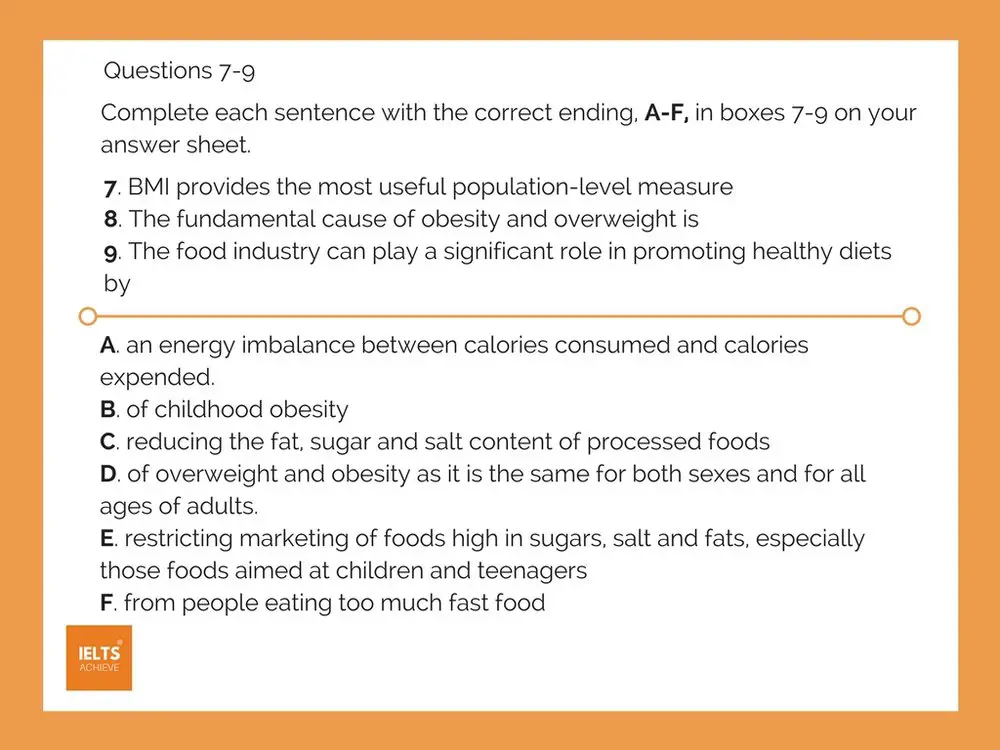
In the IELTS Reading Test, you could be given questions that ask you to match sentence endings, often with many combinations that include incorrect sentences. To comprehend how to complete these questions, you need to see how ideas are connected in the texts.
You should read the first half of the sentence and then look through the text to find the information. After that read through the section of the text and choose the relevant sentence ending. There will be more sentence endings given than needed to complete the task.
Before trying the practice questions below, see if you can match the following sentence endings, only using your logic and knowledge of grammar >>
When I turn the key
If you turn the tap on
The child obesity rate
The hospital service
Substance abuse in teens
A. is steadily growing in high-income countries
B. creates many illnesses and problems
C. the door opens
D. reported cuts to spending in 2017
E. water flows out
F. reported they had been successful
Answers are at the bottom of the page.
TEST QUESTION
In the IELTS test, the matching sentence endings questions will look similar to this example below >>
The paragraphs for the practice exercises are from a text called “Obesity and Overweight” from The World Health Organisation (WHO) website.
Exercise 1
What causes obesity and overweight?
The fundamental cause of obesity and overweight is an energy imbalance between calories consumed and calories expended. Globally, there has been:
an increased intake of energy-dense foods that are high in fat; and
an increase in physical inactivity due to the increasingly sedentary nature of many forms of work, changing modes of transportation, and increasing urbanisation.
Changes in dietary and physical activity patterns are often the result of environmental and societal changes associated with the development and lack of supportive policies in sectors such as health, agriculture, transport, urban planning, environment, food processing, distribution, marketing, and education.
Match the sentence endings >>
Weight issues are created when
Having a job where you are sitting for long periods of time or no exercise in your regular routine can
The situation around you can affect your
A. the number of calories burned are not the same as the calories that have been eaten
B. health and the lifestyle that you have
C. a person consumes too much fast food
D. lead to weight gain, because of less movement
E. make a person gain weight and go out less
F. outlook on life, which affects your daily diet and exercise routine
Answers are at the bottom of the page.
Exercise 2
How can overweight and obesity be reduced?
Overweight and obesity, as well as their related noncommunicable diseases, are largely preventable. Supportive environments and communities are fundamental in shaping people’s choices, by making the choice of healthier foods and regular physical activity the easiest choice (the choice that is the most accessible, available and affordable), and therefore preventing overweight and obesity.
At the individual level, people can:
limit energy intake from total fats and sugars;
increase consumption of fruit and vegetables, as well as legumes, whole grains and nuts; and
engage in a regular physical activity (60 minutes a day for children and 150 minutes spread through the week for adults).
Individual responsibility can only have its full effect where people have access to a healthy lifestyle. Therefore, at the societal level, it is important to support individuals in following the recommendations above, through sustained implementation of evidence-based and population-based policies that make regular physical activity and healthier dietary choices available, affordable and easily accessible to everyone, particularly to the poorest individuals. An example of such a policy is a tax on sugar-sweetened beverages.
Match the sentence endings >>
Being overweight
People can
Society must
A. offer help to those who are overweight, making sure that healthy diet options and regular activities are easily accessible
B. can be stopped, by making changes and receiving help from the community
C. is caused by being irresponsible
D. watch what they eat
E. be careful with their daily eating habits, making sure they consume a healthy amount of fruits and vegetables
F. promote a sugar tax on all unhealthy foods
Answers are at the bottom of the page.
Exercise 3
What are common health consequences of overweight and obesity?
Raised BMI is a major risk factor for noncommunicable diseases such as:
cardiovascular diseases (mainly heart disease and stroke), which were the leading cause of death in 2012;
diabetes;
musculoskeletal disorders (especially osteoarthritis – a highly disabling degenerative disease of the joints);
some cancers (including endometrial, breast, ovarian, prostate, liver, gallbladder, kidney, and colon).
The risk for these noncommunicable diseases increases, with increases in BMI.
Childhood obesity is associated with a higher chance of obesity, premature death and disability in adulthood. But in addition to increased future risks, obese children experience breathing difficulties, increased risk of fractures, hypertension, early markers of cardiovascular disease, insulin resistance and psychological effects.
Match the sentence endings >>
Eventual exposure
Being obese at a young age
The dangerous circumstances surrounding obesity
A. can lead to early death
B. are higher when a person’s BMI is immense
C. can make it tough for a young person at school
D. can lead to children struggling to breathe and other complications
E. projects a future of obesity and ongoing serious health issues
F. to the health issues caused by obesity can cause a number of diseases
Answers are at the bottom of the page.
REVIEW AND STRATEGY
The matching sentence endings are common in the IELTS Reading Test, therefore you should practice and develop a strategy for answering.
TIP >> Read the instructions before you start reading the text, partial sentences or the sentence endings.
TIP >> Read the partial sentences first and the sentence endings.
TIP >> Skim read the text and look for any clear answers.
TIP >> Choose your answers through an elimination process. Which ones do not fit? Which ones can you dismiss? Be attentive to synonyms and paraphrasing.
Answers >>
Practice Questions Answers >>
1 – C
2 – E
3 – A
4 – D
5 – B
Exercise 1 Answers >>
1 – A
2 – D
3. F
Exercise 2 Answers >>
1 – B
2 – E
3 – A
Exercise 3 Answers >>
1 – D
2 – E
3 – B
We hope you found this post useful in helping you to study for the IELTS Test. If you have any questions please let us know in the comments below or on the Facebook page.
The best way to keep up to date with posts like this is to like us on Facebook, then follow us on Instagram and Pinterest.
If you need help preparing for the IELTS Test, join the IELTS Achieve Academy and see how we can assist you to achieve your desired band score. We offer an essay correction service, mock exams and online courses.
Essential strategies and practice techniques for this IELTS Reading question type. Learn how to manage time and improve accuracy.
Originally published June 2017. Last reviewed 3 July 2026.
In this post, we will be looking at matching headings.
The matching heading questions normally ask you to match a list of headings to paragraphs. The texts given can consist of six to nine paragraphs.
When you see this type of task, you should;
Quickly read the headings and underline/highlight any keywords.
Skim read the text – so you understand the overall meaning
Read the first paragraph and see if any headings match up
Choose the best heading for the paragraph (read again if needed)
Repeat this strategy for every paragraph
This strategy above allows you to choose the heading appropriate for each paragraph by going through a process of elimination.
What is a heading?
A paragraph heading sums up the paragraph as a whole, not just parts of it. Try not to match up words in the heading with words you see in the paragraph, that could lead you to make an incorrect choice. The heading should apply to all information written about in the paragraph, not just parts of it.
When you look at the heading choices you may think that more than one could match up with different paragraphs, but you need to look closer to see which option is the best fit. You should take the time to practice matching headings to paragraphs, summing up the main idea, not just trying to match the words.
Test Question
In the IELTS test, the matching headings questions will look similar to the those below and it will appear before a text, not after it >>
The paragraphs for the practice exercises are from a text called “Adolescents: health risks and solutions” from The World Health Organisation (WHO) website.
All answers are at the bottom of the page.
Exercise 1
Read the following headings and then skim read the text, choose the heading that supports the main idea of each paragraph >>
What topic do all of the headings have in common? Underline/highlight and keywords.
i. The future of mental health
ii. Violence has a wide scope in urban areas
iii. Support is on offer for youths surviving violent backgrounds
iv. The cause of female and male violence
v. The future of mental health in the school system and beyond
vi. Conflict prevention methods should be used to promote harmony
vii. Knowledge of assaults on women and men
A
Depression is the third leading cause of illness and disability among adolescents, and suicide is the third leading cause of death in older adolescents (15–19 years). Violence, poverty, humiliation and feeling devalued can increase the risk of developing mental health problems.
B
Building life skills in children and adolescents and providing them with psychosocial support in schools and other community settings can help promote good mental health. Programmes to help strengthen the ties between adolescents and their families are also important. If problems arise, they should be detected and managed by competent and caring health workers.
C
Violence is a leading cause of death in older adolescent males. Interpersonal violence represents 43% of all adolescent male deaths in LMICs in the WHO Americas Region. Globally, 1 in 10 girls under the age of 20 years reports experiencing sexual violence.
D
Promoting nurturing relationships between parents and children early in life, providing training in life skills, and reducing access to alcohol and firearms can help to prevent injuries and deaths due to violence. Effective and empathetic care for adolescent survivors of violence and ongoing support can help deal with the physical and psychological consequences.
TIP >> Don’t try to match the words in the headings to the words in the text. You need to focus on the whole idea in each paragraph.
TIP >> Try and narrow the choices down when you are completing the task – through an elimination process. Look at paragraph A and decide which headings do connect with it, which ones do not?
Exercise 2
Read the following headings and then skim read the text, choose the heading that supports the main idea of the paragraph >>
i. The detrimental effects of alcohol abuse
ii. How young people are affected by bad drinking habits
iii. Drinking alcohol can create many health problems
A
Harmful drinking among adolescents is a major concern in many countries. It reduces self-control and increases risky behaviours, such as unsafe sex or dangerous driving. It is a primary cause of injuries (including those due to road traffic accidents), violence (especially by a partner) and premature deaths. It can also lead to health problems in later life and affect life expectancy. Setting a minimum age for buying and consuming alcohol and regulating how alcoholic drinks are targeted at the younger market are among the strategies for reducing harmful drinking.
Exercise 3
Read the following headings and then skim read the text, choose the heading that supports the main idea of the paragraph >>
i. How to have a healthy diet
ii. The key to being healthy at a young age
iii. An insight to the eating habits and daily activities of young people
B
Developing healthy eating and exercise habits in adolescence are foundations for good health in adulthood. Reducing the marketing of foods high in saturated fats, trans-fatty acids, free sugars, or salt and providing access to healthy foods and opportunities to engage in physical activity are important for all but especially children and adolescents. Yet available survey data indicate that fewer than 1 in every 4 adolescents meets the recommended guidelines for physical activity: 60 minutes of moderate to vigorous physical activity daily.
Exercise 4
Read the following headings and then skim read the text, choose the heading that supports the main idea of the paragraph >>
i. Observations of cigarette use amongst young people in modern society
ii. The problems associated with smoking
iii. How to stop people from smoking
C
The vast majority of people using tobacco today began doing so when they were adolescents. Prohibiting the sale of tobacco products to minors and increasing the price of tobacco products through higher taxes, banning tobacco advertising and ensuring smoke-free environments are crucial. Globally, at least 1 in 10 adolescents aged 13 to 15 years uses tobacco, although there are areas where this figure is much higher. Cigarette smoking seems to be decreasing among younger adolescents in some high-income countries.
Exercise 5
Read the following headings and then skim read the text, choose the heading that supports the main idea of the paragraph >>
i. The history of HIV
ii. An understanding of the current status of HIV in minors
iii. Problems associated with HIV
D
More than 2 million adolescents are living with HIV. Although the overall number of HIV-related deaths is down 30% since the peak in 2006 estimates suggest that HIV deaths among adolescents are rising. This increase, which has been predominantly in the WHO African Region, may reflect the fact that although more children with HIV survive into adolescence, they do not all then get the care and support they need to remain in good health and prevent transmission. In sub-Saharan Africa, only 10% of young men and 15% of young women aged 15 to 24 are aware of their HIV status.
Exercise 6
Read the following headings and then skim read the text, choose the heading that supports the main idea of the paragraph >>
i. The health issues relating to the youth of today
ii. Problems affecting adolescents in modern society
iii. The most common health issues that stop young people from reaching their full potential
E
Around 1.2 billion people, or 1 in 6 of the world’s population, are adolescents aged 10 to 19. Most are healthy, but there is still substantial premature death, illness, and injury among adolescents. Illnesses can hinder their ability to grow and develop to their full potential. Alcohol or tobacco use, lack of physical activity, unprotected sex and/or exposure to violence can jeopardise not only their current health, but also their health as adults, and even the health of their future children.
REVIEW AND STRATEGY
The matching headings questions are common in the IELTS Reading Test, therefore you should practice and develop a strategy for answering.
TIP >> Read the instructions before you start reading the text. Make sure you understand the question.
TIP >> Skim read each paragraph and get the main idea of each one.
TIP >> Look at the headings and highlight any keywords you can see, then match them up if you see anything clear.
TIP >> Choose your answers through an elimination process. Which ones do not fit? Which ones can you dismiss? Be attentive to synonyms and paraphrasing.
Answers >>
Exercise 1 – Answers >>
A = iv
B = v
C = vii
D = vi
Exercise 2 – Answers >>
A = ii
Exercise 3 – Answers >>
B = iii
Exercise 4 – Answers >>
C = i
Exercise 5 – Answers >>
D = ii
Exercise 6 – Answers >>
E = i
We hope you found this post useful in helping you to study for the IELTS Test. If you have any questions please let us know in the comments below or on the Facebook page.
The best way to keep up to date with posts like this is to like us on Facebook, then follow us on Instagram and Pinterest.
If you need help preparing for the IELTS Test, join the IELTS Achieve Academy and see how we can assist you to achieve your desired band score. We offer an essay correction service, mock exams and online courses.
Essential strategies and practice techniques for this IELTS Reading question type. Learn how to manage time and improve accuracy.
Originally published June 2017. Last reviewed 3 July 2026.
In this post, we will be looking at matching information.
For the matching information tasks, you should look at each phrase in the questions and then find the information or idea in the text. The order of the questions is not in the order of where you will find the information in the text. A skill that is important and will help you is skim reading.
Skim Reading
Skim reading is a skill that is used to locate information in a text quickly. It is often used to find the main ideas or the main points in a text. In the IELTS Reading Test, skim reading is a skill you should use when trying to find numbers or dates, a measurement, a reason, a finding, a description, a reaction, an account, a cause or an effect, a conclusion or a problem. It will help you to find the information you need to answer questions and it makes sure you know the overall meaning of the text.
Look at the sentences below, which ones have a number, a date, a description, a measurement, a finding, a reaction, a cause, an effect, a conclusion? (More than one type may apply to each sentence).
Skim read through to find the information >>
The Medical Journal of the American Research Institute last year published many articles relating to new developments in medicine.
By 2020, the number of people aged 60 years and older will outnumber children younger than 5 years.
Many people have been shocked by the number of cuts in the health system this year.
The government has made a huge mistake in failing to give nurses a pay rise for over 10 years, thus losing voters and support from that profession.
The impact of spending cuts in the NHS has seen many people suffer long waiting hours over a number of departments, increasing the wait time in A&E in some hospitals to over 4 hours.
Answers at the bottom of the page.
Matching Information
Look at the extracts from texts below and match them to the following information >>
An Effect
A Date
A Finding
An Account
People worldwide are living longer. Today, for the first time in history, most people can expect to live into their sixties and beyond. By 2050, the world’s population aged 60 years and older is expected to total 2 billion, up from 900 million in 2015.
According to The World Health Organisation (WHO), a longer life brings with it opportunities, not only for older people and their families but also for societies as a whole. Additional years provide the chance to pursue new activities such as further education, a new career or pursuing a long-neglected passion.
In fact, in the research paper on ageing by The World Health Organisation (WHO), there is, however, little evidence to suggest that older people today are experiencing their later years in better health than their parents. While rates of severe disability have declined in high-income countries over the past 30 years, there has been no significant change in mild to moderate disability over the same period.
If people can experience these extra years of life in good health and if they live in a supportive environment, their ability to do the things they value will be little different from that of a younger person. If these added years are dominated by declines in physical and mental capacity, the implications for older people and for society are more negative.
Below is an example of how a matching information question may look in the IELTS Reading test. In the examples given in this post, the texts are short, to give you an introduction to how to answer this type of question. In the test, the texts will be much longer with a word count of 1000+, you will need to skim read the whole text to find the answers you are looking for.
Read the information below and match the information, remember to skim read the text, don’t read every word.
Diversity in older age (A) There is no ‘typical’ older person. Some 80 year-olds have physical and mental capacities similar to many 20 year-olds. Other people experience significant declines in physical and mental capacities at much younger ages. A comprehensive public health response must address this wide range of older people’s experiences and needs.
Health inequities (B) The diversity seen in older age is not random. A large part arises from people’s physical and social environments and the impact of these environments on their opportunities and health behaviour. The relationship we have with our environments is skewed by personal characteristics such as the family we were born into, our sex and our ethnicity, leading to inequalities in health. A significant proportion of the diversity in older age is due to the cumulative impact of these health inequities across the life course. Public health policy must be crafted to reduce, rather than reinforce, these inequities.
Outdated and ageist stereotypes (C) Older people are often assumed to be frail or dependent, and a burden to society. Public health, and society as a whole need to address these and other ageist attitudes, which can lead to discrimination, affect the way policies are developed and the opportunities older people have to experience Healthy Ageing.
Which paragraph contains the following information?
Write the correct letter A-C, in boxes 11-13 on your answer sheet.
11. A description of the way society views the elderly.
12. A reaction to the rights for the elderly living in our society.
13. The effect of our surroundings partnered with our own personality traits, which lead to health differences.
Answers at the bottom of the page.
How You Can Prepare = Read More
You should prepare as much as possible before your IELTS Test and that includes reading regularly. You can find good texts to read on various websites like the news sites listed in the Introduction to IELTS Reading post.
You should try to read around a range of topics, from health, the environment, technology, education, history and general interest articles. The IELTS articles will not cover politics or religion, so you can focus on other topics.
Some articles may seem challenging to read, but this is really good practice! Keep a notebook and write down any words you do not know the meaning of, then look them up and write the meaning in the book. This is a good way to learn new vocabulary.
REVIEW AND STRATEGY
The matching information questions are common in the IELTS Reading Test, therefore you should practice and develop a strategy for answering.
TIP >> Read the instructions before you start reading the text. Make sure you understand the questions.
TIP >> Skim read the text/paragraphs and get the main idea.
TIP >> Look at the questions and think about if they match up with any of the paragraphs. Is anything standing out to you?
TIP >> Choose your answers through an elimination process. Which ones do not fit? Which ones can you dismiss? Be attentive to synonyms and paraphrasing.
Task Answers >>
Skim reading exercise answers >>
A finding
A description
A reaction
A cause
An effect
Matching Information Answers (Task 1) >>
A Date
An Account
A Finding
An Effect
Matching Information Answers (Task 2) >>
11. C
12. A
13. B
We hope you found this post useful in helping you to study for the IELTS Test. If you have any questions please let us know in the comments below or on the Facebook page.
The best way to keep up to date with posts like this is to like us on Facebook, then follow us on Instagram and Pinterest.
If you need help preparing for the IELTS Test, join the IELTS Achieve Academy and see how we can assist you to achieve your desired band score. We offer an essay correction service, mock exams and online courses.