Expert tips and strategies for this part of the IELTS Speaking test. Includes sample responses and key vocabulary for Band 7+.
Originally published August 2017. Last reviewed 3 July 2026.
In this post, you will see one of the most common IELTS speaking topics (fashion) and sample answers.
Please remember that in the actual test you should give honest answers and talk about your own experiences, thoughts, feelings and opinions. Do not try to memorise answers, as the examiners will probably be able to guess and you will lose marks.
However, you are able to make up information to extend your answers, but be sure that you are confident when speaking about the chosen topic and that it is believable.
TIP >> Each answer should be at least 2-3 sentences long.
TIP >> Listen carefully to the question so that you answer in the correct tense.
TIP >> When answering a yes/no question – answer then give your reasons for your answer. You must extend your answer to gain more marks.
TIP >> Just relax and think of it as a regular conversation you are having, make eye contact and be positive.
Take a look at the questions and sample answers below on the topic of ‘fashion‘ >>
Q: Do you like to wear watches?
A: Not really, I only really wear one when I travel, so that I can keep an eye on the time. I don’t want to be late and miss a flight!
Q: Why do people like expensive watches?
A: They probably see it as a status symbol, the same as having a designer handbag or other expensive accessories. To show to others their wealth and position. On the other hand, they may need it to have special capabilities, which would make it cost more. For example, the apple watch, which can work in sync with your other devices.
Q: Do you like shoes?
A: yes of course! I love shoes, from comfortable trainers, winter boots and pretty summer sandals.
Q: Have you ever bought shoes online?
A: No, I prefer to buy my shoes in a store, because I need to try them on and see how they fit. Buying shoes online can be risky, as they may be larger or smaller in size. Then if you don’t want to keep them, you have the hassle of returning them.
Q: Do you prefer comfortable or good-looking shoes?
A: That depends on the occasion! For everyday activities, like walking the dog I would choose comfortable shoes, like trainers or sandals. But for an event or special outing, I would wear something a bit more fancy, like heels or high wedges. They have to coordinate with my outfit of course!
Q: Do people own too many shoes?
A: In my opinion, it depends on the person, as for me, I own many shoes, including sandals, trainers and boots. Depending on a persons lifestyle and habits, a large shoe collection is normally necessary for the different weather conditions we experience through the year, as well as going to different events and completing various activities.
Q: Do you think wearing a hat on sunny days is important?
A: Yes of course! Wearing a hat gives you added protection against the suns harmful rays.
Q: Did you wear a hat as a child? Why?
A: Yes, I always wore a hat when the sun was out, as I am fair skinned and burn easily. My parents wanted to make sure I was protected from the sun. Children have much fairer skin, so need added protection from the suns rays.
Q: What is the importance of a hat?
A: You can easily burn your head and face in the sun without any protection, especially when walking around. Wearing a hat can help you to stay cool and for your face to have some shade.
Q: Do you like bags?
A: Yes! I have quite a few bags at home, all for various occasions. They range in size, from large to small, some are more expensive than others, as I have a love for buying tan leather bags.
Q: What types of bags do you like?
A: At the moment I really love bags by the brand Coccinelle, they are so pretty, with small leather bags in a range of neutrals and pastel colours. I recently bought a tan leather small handbag which is great for travelling light.
Q: Do you usually carry a bag (when you go out)?
A: Absolutely! I need to carry lots of things with me when I go anywhere, so need to have a bag for my phone, wallet, keys and other necessary items. The items change, depending on where I am going.
Q: Do you have different bags for different occasions (or, different purposes)?
A: Yes, I have large tote bags for work, a large beach bag, a tan leather backpack for shopping and errands, a laptop bag and small leather bags for various occasions. I also have a collection of beaded clutch bags, which add a touch of sparkle to any evening outfit!
Q: What do you put in these bags?
A: Depending on where I am going, I may take my laptop, books, iPad, documents and snacks to work. If I am going to the beach, the beach bag will be loaded with sunscreen, towels, a scarf and my e-reader. For walking the dog, my bag must include dog treats. Normally when I go shopping, my bag just contains my phone, wallet and keys.
Q: What sorts of bags do women like to buy?
A: I think that women buy practical bags for going to work and the gym, but allow themselves to become more creative when choosing bags for different occasions. Leather over the shoulder bags in neutral colours like black or tan are timeless and will never go out of fashion. I also think that if they can afford it, women like to treat themselves to designer bags, for quality and of course luxury.
We hope you found this post useful in helping you to study for the IELTS Test. If you have any questions please let us know in the comments below or on the Facebook page.
The best way to keep up to date with posts like this is to like us on Facebook, then follow us on Instagram and Pinterest.
If you need help preparing for the IELTS Test, join the IELTS Achieve Academy and see how we can assist you to achieve your desired band score. We offer an essay correction service, mock exams and online courses.
Expert tips and strategies for this part of the IELTS Speaking test. Includes sample responses and key vocabulary for Band 7+.
Originally published August 2017. Last reviewed 3 July 2026.
In this post, you will see one of the most common IELTS speaking topics (hometown) and sample answers.
Please remember that in the actual test you should give honest answers and talk about your own experiences, thoughts, feelings and opinions. Do not try to memorise answers, as the examiners will probably be able to guess and you will lose marks.
However, you are able to make up information to extend your answers, but be sure that you are confident when speaking about the chosen topic and that it is believable.
TIP >> Each answer should be at least 2-3 sentences long.
TIP >> Listen carefully to the question so that you answer in the correct tense.
TIP >> When answering a yes/no question – answer then give your reasons for your answer. You must extend your answer to gain more marks.
TIP >> Just relax and think of it as a regular conversation you are having, make eye contact and be positive.
Take a look at the questions and sample answers below on the topic of ‘hometown‘ >>
Q: Describe your hometown.
A: It is a big city in the North of England, with galleries, theatres and nightlife. It is a popular place for students, as there are two universities. Shopping and eating out are part of the lifestyle, with many places to go. In the surrounding areas, there are many historical places to visit.
Q: Is that a big city or a small place?
A: It is a big city, with a twenty-four-hour culture. It has a reputation as a party place, with many people travelling to visit the restaurants, bars and nightclubs in the city.
Q: What do you like (most) about your hometown?
A: I like that the city is close to historical sites in Northumberland. You can easily travel by car to places that the Vikings invaded and explore quaint seaside villages on the north coast.
Q: Is there anything you dislike about it?
A: I don’t like the drinking culture and the violence that follows. On a night out in the city, there is often a heavy police presence, as many people make trouble. People frequently drink alcohol from early in the morning until late at night, which in my opinion is not a good way to spend time or money.
Q: Do you think you will continue living there for a long time?
A: I don’t currently live there, I moved away for work and now live in Greece. I do however visit quite often to see friends and family. I have no plans to move back there anytime soon.
Q: Can you tell me something exciting about your town?
A: There have been quite a few celebrities from there, who have become well known in the media, including TV presenters Ant and Dec, Cheryl Cole, Sting and actor Charlie Hunnam.
Q: Has your hometown changed much since you were a child?
A: Yes it has evolved from a relatively quiet city to a hub of shopping and entertainment. There have been major developments, with shopping mall renovations and the addition of shop lined streets leading all around the city. There are also more restaurants and bars catering for all tastes.
Q: Are there any changes you would like to make in your hometown?
A: Perhaps the introduction of strict opening times for pubs, selling alcohol from a later time in the day. Also, the coffee shops could stay open much later, to promote a healthier culture of socialisation.
We hope you found this post useful in helping you to study for the IELTS Test. If you have any questions please let us know in the comments below or on the Facebook page.
The best way to keep up to date with posts like this is to like us on Facebook, then follow us on Instagram and Pinterest.
If you need help preparing for the IELTS Test, join the IELTS Achieve Academy and see how we can assist you to achieve your desired band score. We offer an essay correction service, mock exams and online courses.
Expert tips and strategies for this part of the IELTS Speaking test. Includes sample responses and key vocabulary for Band 7+.
Originally published August 2017. Last reviewed 3 July 2026.
In this post, you will see one of the most common IELTS speaking topics (food) and sample answers.
Please remember that in the actual test you should give honest answers and talk about your own experiences, thoughts, feelings and opinions. Do not try to memorise answers, as the examiners will probably be able to guess and you will lose marks.
However, you are able to make up information to extend your answers, but be sure that you are confident when speaking about the chosen topic and that it is believable.
TIP >> Each answer should be at least 2-3 sentences long.
TIP >> Listen carefully to the question so that you answer in the correct tense.
TIP >> When answering a yes/no question – answer then give your reasons for your answer. You must extend your answer to gain more marks.
TIP >> Just relax and think of it as a regular conversation you are having, make eye contact and be positive.
Take a look at the questions and sample answers below on the topic of ‘food‘ >>
Q: Is food important to you? (Why?)
A: Yes, I like to cook and to use fresh vegetables and try to get everything as organic as possible. I also like to eat no gluten whenever possible, no soy or dairy. eating clean is important for my health and overall well-being.
Q: What kinds of food do you particularly like?
A: I really enjoy eating fresh fish, homegrown vegetables and fruits and on special occasions meat that comes from local farmers. I also enjoy fresh eggs from neighbours and family members.
Q: Is there any food you don’t like? (Why?)
A: I don’t like processed food because it is really bad for my body. After having a particular diet, eating processed food does not agree with my body and can make me feel unwell. I also avoid dairy because I have an intolerance.
Q: What kinds of food are most popular in your country?
A: Fresh home grown vegetables, fruits and meat are part of the staple diet here in Greece. Particular dishes, such as kokinisto – beef cooked in a red wine sauce is popular, along with other signature dishes. Of course, a Greek salad is mandatory as well as a lot of olive oil in everything!
Q: Do you like cooking? (Why?/Why not?)
A: Yes, I really like to cook and since moving to Greece I have become a much better cook. I regularly cook Greek food, from various pies, meat dishes and fish to sweets and desserts. I was taught some traditional recipes and methods from my mother in law.
Q: Who usually does the cooking in your home?
A: I normally cook and look for recipe ideas online and in books. I like to experiment and make a variety of dishes, even though my husband has a preference for mostly Greek food.
Q: Do you like chocolate?
A: yes, but I can only eat very dark chocolate or chocolate that is free from dairy and gluten.
Q: Did you like chocolate as a child?
A: Of course! Until I discovered I had a lactose intolerance, then I cut it out of my diet as it was making me ill. The ‘free from’ options are great, as I can enjoy chocolate without dairy or gluten.
Q: Do you think most people like chocolate? Why?
A: Yes, as it is a lovely sweet treat. Chocolate can give you a sugar high and of course, it tastes delicious. There is nothing better than selecting chocolates and treating yourself after a long day or as a celebration. People enjoy it as a way of treating themselves.
We hope you found this post useful in helping you to study for the IELTS Test. If you have any questions please let us know in the comments below or on the Facebook page.
The best way to keep up to date with posts like this is to like us on Facebook, then follow us on Instagram and Pinterest.
If you need help preparing for the IELTS Test, join the IELTS Achieve Academy and see how we can assist you to achieve your desired band score. We offer an essay correction service, mock exams and online courses.
Expert tips and strategies for this part of the IELTS Speaking test. Includes sample responses and key vocabulary for Band 7+.
Originally published August 2017. Last reviewed 3 July 2026.
In this post, you will see one of the most common IELTS speaking topics (your home) and sample answers.
Please remember that in the actual test you should give honest answers and talk about your own experiences, thoughts, feelings and opinions. Do not try to memorise answers, as the examiners will probably be able to guess and you will lose marks.
However, you are able to make up information to extend your answers, but be sure that you are confident when speaking about the chosen topic and that it is believable.
TIP >> Each answer should be at least 2-3 sentences long.
TIP >> Listen carefully to the question so that you answer in the correct tense.
TIP >> When answering a yes/no question – answer then give your reasons for your answer. You must extend your answer to gain more marks.
TIP >> Just relax and think of it as a regular conversation you are having, make eye contact and be positive.
Take a look at the questions and sample answers below on the topic of ‘your home‘ >>
Your home questions and answers
Q: Do you live in a house or a flat?
A: I currently live in a house with three bedrooms, a bathroom and an open living space, with a dining area and kitchen. It also has a large yard at the front of the house and a large veranda at the back of the house, which has great views.
Q: Do you like your house?
A: Very much! The house itself is very spacious for us and is in a good spot. I have my own office space and plenty of room still for all the family. Built on top of another house it has a high position, with great views of the town and even a sea view.
Q: Why do you like it?
A: Not only because it is very spacious, but because of its location. It is situated in a village on the outskirts of town, with a bus stop just metres away, which is convenient because I don’t always have the car. There is also a small supermarket less than 5 minutes walk from the house.
Q: How do you expect your future house to be and why?
A: In the future, we plan on building our own property to our uniquely designed specifications. With at least 3 bedrooms and 2 bathrooms, it would also have a large open plan living room/dining area, with a built in kitchen area. The outside would have a garden, patio, and car port.
Q: Do you like visitors coming to your home?
A: Definitely! I love it when people come to stay with us. We like to show them around the island and to visit the best spots for swimming. We also know where to take them for the best coffee in town and of course where the best places to eat are.
Q: Do you prefer to have friends visit you, or relatives?
A: I prefer to have family members staying with us, as we don’t get to see any of them very often. We try to visit them as often as we can, and they come to us for holidays normally in the summer months, so they can enjoy the weather.
Q: Do you often invite friends to visit your home?
A: yes, I have friends over most weekends. They come over for food and drinks on Saturday nights or Sunday afternoons. We often have Greek style barbeques, with plenty of food and more people than we can fit into our yard.
We hope you found this post useful in helping you to study for the IELTS Test. If you have any questions please let us know in the comments below or on the Facebook page.
The best way to keep up to date with posts like this is to like us on Facebook, then follow us on Instagram and Pinterest.
If you need help preparing for the IELTS Test, join the IELTS Achieve Academy and see how we can assist you to achieve your desired band score. We offer an essay correction service, mock exams and online courses.
Expert tips and strategies for this part of the IELTS Speaking test. Includes sample responses and key vocabulary for Band 7+.
Originally published August 2017. Last reviewed 3 July 2026.
In this post, see the top 10 speaking part 1 tips that will help you to achieve a band score 7 or above.
The IELTS Speaking Test lasts 11-14 minutes.
The test has three parts, where you are interviewed by a trained examiner. You are not allowed to use a dictionary during the test. IELTS Academic and IELTS General students take the same test and it is marked in the same way.
PART 1 INFORMATION
To begin with, the examiner will introduce themselves to you, then ask you your name and for proof of identity.
Time:4-5 minutes You will be asked questions on familiar topics, like your hobbies, family, where you are from, what your hometown/city is like, etc.
The topics that are included:
Your studies/education
Hobbies/sports
Your family
What kind of movies, books, tv shows or music you like
What you like to eat / where you like to eat
Your job
Where you live
To view sample questions and answers on a variety of part 1 speaking topics, take a look at the other posts in this section.
Take a read through our top ten tips below, that will help you to gain a band score of 7 or above!
Speaking Tips
Tip 1: Be Prepared
As well as being prepared for the test questions on the day of your exam, you should also be aware of what to expect in terms of getting to the test centre and the beginning of the test. Arrive in plenty of time, so that you are not under pressure/late and have time to relax before the test.
The examiner will introduce themselves and ask you for your name and proof of identity (Passport etc), to begin with. They will also ask you where you are from, which requires a simple answer – this is more of a formality, so you don’t have to extend your answer here, but simply state, for example; “I am from Romania’ (or name the town/city etc you are from and where).
Take a look at this post for help with how to prepare for the speaking part 1 test..
Tip 2: Make A Good First Impression
Try to be relaxed and confident, having confidence will help you to do well in your test. Make eye contact with the examiner and answer any questions in a polite manner. Try to keep your body language friendly and open. Think of it as a natural conversation and try to stay calm, like you are talking to your IELTS teacher or practice partner.
Tip 3: Listen Carefully
Listen carefully to the examiner, so that you understand the questions and can answer in an appropriate way. You should also be listening for tenses – for example; “What TV Shows did you use to like as a child?’ then you know that you should answer in the past tense – ‘I used to watch…..’
You should also listen out for any yes/no questions and remember to answer and give reasons. Take a look at this post for help with how to answer those yes/no questions.
Tip 4: Show Enthusiasm
Show that you are interested in the questions by answering with enthusiasm, even if you are not really interested in the subject. Native speakers show enthusiasm by varying the pitch of their voice (intonation – the voice falls and rises) to show how they feel about something.
Listen to examples and think about how native speakers talk when answering questions, what happens to their voice? It gets higher when they are interested or excited by a subject and it falls when they are not happy or disinterested.
Watch the video clip below from the US TV show ‘Friends’ and see how the intonation falls and rises when the actors talk – can you notice the difference? How does it impact on what they are saying?
Tip 5: Extend Your Answers
When giving your answers, try to make sure that they are not too short – for example, if the examiner asks you what is your favourite TV show, saying ‘I really like Peaky Blinders’ is too short.
You can expand your answer by adding more detail of what it is about, and why you like it so much for example; ‘I really like the BBC drama Peaky Blinders, it has an excellent cast and the writing keeps me interested in the story. There is lots of action, as the story is centred on a gangster family in 1920’s Birmingham, who are up to no good!’.
The answers in part 1 should not be too long either, talking for 2 minutes or more is far too long, parts 2 and 3 will allow you to speak for a longer time and go into more detail.
You should aim to use more than one clause when you give your answers, for example;
Q: Do you work or study?
A: I work at the moment but I continue my studies at the same time. I continue to learn through courses and gain new qualifications every year, this means my knowledge is always up to date.
Take a look at this post for more information on how to extend your answers.
Tip 6: Be Confident
Show your confidence by speaking clearly and at a normal level. Don’t speak too loudly or quietly, make sure the examiner can understand and hear your answers. Have faith in yourself, to answer whatever questions you get to the best of your ability.
When answering the questions, try to be as honest as possible, telling the examiner your thoughts, feeling and opinions, for example:
Q: Do you think vacations are becoming more and more important?
A: Yes, I think that many people are working longer hours and have more stress than ever placed upon them. taking a break is necessary to unwind and recharge so that they can let go of the stress and focus on their own well-being.
Tip 8: Study/Look at past questions and sample answers
Look at past questions and sample answers to get an idea of how you can extend your answers and the type of questions that come up. There are some speaking topics that are popular, regularly being used over and over, which include;
Your studies/education
Hobbies/sports
Your family
What kind of movies, books, tv shows or music you like
What you like to eat / where you like to eat
Your job
Where you live
You may also be asked questions about any topic, recently there have been questions about flowers and photography. Going back to tip 7 – be honest, answer any questions you get with honesty, telling the examiner your own opinions, thoughts and views. Do not memorise answers to recite to the examiner, they will be able to tell and ask you something else.
Tip 9: Read The Criteria
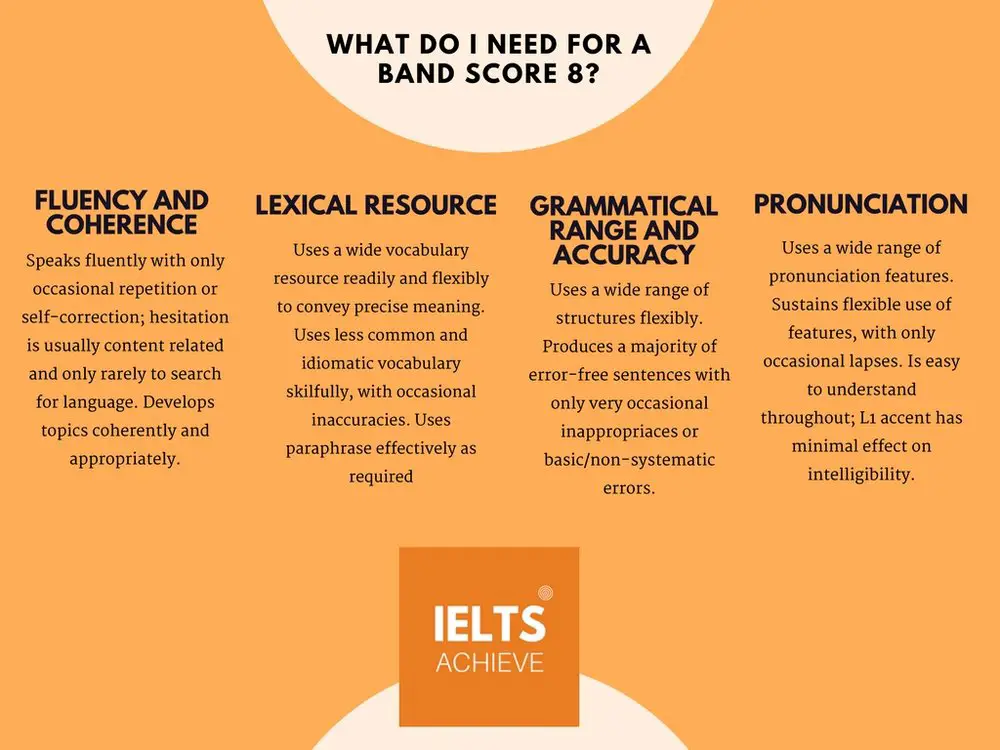
You should read through the marking criteria and be aware of what is required for a band score 7 or above. Many students do not do this and have no idea what they need to achieve in order to get the band score they want. Read it, understand it and aim to achieve it. Ask your IELTS teacher for help to understand it and to see the level you are at now.
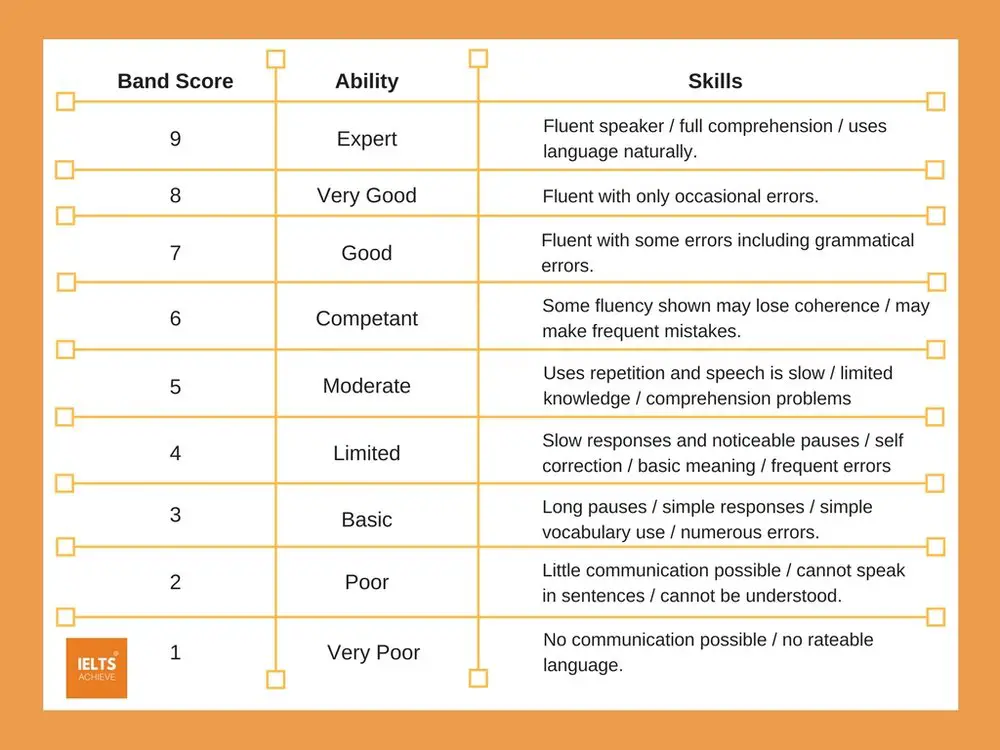
You should also read the scoring information to see how the band scores are given:
Tip 10: Practice
Practice as much as possible with your native speaking IELTS teacher, a partner or friend. Take a look at the most common topics (see the other posts in this section) and practice answering those questions. A good way to listen for errors is to record yourself speaking. Listen to your recording and notice any errors you have made, including grammar mistakes, pronunciation, intonation and fluency. Keep practising and use the posts in this section to help you.
Expert tips and strategies for this part of the IELTS Speaking test. Includes sample responses and key vocabulary for Band 7+.
Originally published August 2017. Last reviewed 3 July 2026.
This post will look at how to extend your part 1 answers.
In part 1 the examiner will ask you about familiar topics, like your home, hometown, hobbies and work. The answers you give should be honest and show the examiner your ability to use English well.
When giving your answers, try to make sure that they are not too short – for example, if the examiner asks you ‘What is your favourite TV show?’, saying ‘I really like Peaky Blinders’ is too short.
You can expand your answer by adding more detail of what it is about, and why you like it so much for example; ‘I really like the BBC drama Peaky Blinders, it has an excellent cast and the writing keeps me interested in the story. There is lots of action, as the story is centred on a ganster family in 1920’s Birmingham, who are up to no good!’.
The answers in part 1 should not be too long either, talking for 2 minutes or more is far too long, parts 2 and 3 will allow you to speak for a longer time and go into more detail.
You should aim to use more than one clause when you give your answers, for example;
Q: Do you work or study?
A: I work at the moment but I continue my studies at the same time. I continue to learn through courses and gain new qualifications every year, this means my knowledge is always up to date.
Take a look at the ways that you can extend your answers below, in the aim of getting you a higher score! >>
Be Honest
When answering the questions, try to be as honest as possible, telling the examiner your thoughts, feeling and opinions, for example;
Q: Do you think vacations are becoming more and more important?
A: Yes, I think that many people are working longer hours and have more stress than ever placed upon them. taking a break is necessary to unwind and recharge so that they can let go of the stress and focus on their own well-being.
Give Details (Contrast)
You can extend your answers by giving contrasting details, using words like – but, however, although, even though, while, whereas.. etc. For example;
Q: Do you use the Internet for your studies?
A: Yes, I do research online, reading articles from trusted resources. However, there is a lot of information out there, so you need to be able to separate the good from the bad.
You can also add more details into your answer by using the words with, and, another, also, next – for example;
Q: Do you enjoy your work?
A: Yes I do, it is always exciting to meet new students and to help them on their learning journey. Writing is also a fun way to let my imagination free and to research topics that interest me, like interior design, architecture and fine art.
You may also be asked to contrast an opinion or opinions of others where these words – but, however, although, even though, while, whereas.. etc. would also be appropriate to use. For example;
Q: What do you like/dislike about your job?
A: The thing I like most about my job is being able to help people achieve their goals. I also like the flexibility, as I am responsible for my own schedule. However, I don’t like the number of hours I sometimes work, but it can be necessary.
Compare
You can make comparisons thinking about things you used to enjoy or used to do but now enjoy/do something different. You can use words like – similarly, likewise, also, like, same as, similar to… For example;
Q: What sports do you like? (Why?)
A: I used to enjoy classes like Zumba and body combat but now really enjoy swimming and running. Swimming and running are great ways to stay fit as they allow me to experience nature, as well as exercise.
Give a reason why
Expand your answers with reasons…..why you do or do not like something etc (depending on what you are being asked). You can use words like – for, because, since, as. For example;
Q: Why are vacations important to you?
A: Because they are much needed during certain times of the year, for example when the weather becomes too hot to bear or I feel as though I need a break from work. They help me to relax and de-stress from everything.
Q: What’s your favourite weather? (Why?)
A: I prefer warm days at around 24/25 degrees with clear blue skies and the sun, since this is good for walking my dog and to enjoy the outdoors without being too uncomfortable.
Think about the future
When the examiner asks you a question, think about the future – using the future tense and what you would like to do in the future. You can use will be/going to or in a hypothetical situation you can use would or could. For example;
Q: What will you do in the future? (work related)
A: In the future, I would like to be able to expand my teaching responsibilities and to have more student groups. I also want to write a book, a fiction novel or two!
Q: If you could take a vacation anywhere in the world, where would you go? Why? (travel)
A: I would like to visit a pretty place with snow, lots and lots of snow, somewhere like Canada or maybe even in the mountains in Greece during the winter months. In the future, I would like to go skiing, try snowboarding and stay in a well-decorated log cabin, with a large real fireplace.
Give examples
Support your answers with examples from your life or past experiences. It is much better to do this then try to make something up, as you will be more confident giving an example that you have experienced. You can use – for example, for instance, such as, including. For example;
Q: How often do you buy something in a shop?
A: That depends on what it is, for example, I will go the shop every day to buy freshly baked bread. For other groceries, it may be once a week and for other items, such as clothes it will be less often.
Q: Does the weather ever affect what you do?
A: Yes, plans change according to the weather, for instance, if there is a heavy downpour I will not be able to walk my dog or to go shopping in town.
Regularity
You can extend your answers by using words to show how often you do something. Use words like – never, often, sometimes, all the time, usually. For example;
Q: How often do you swim?
A: I usually go swimming every day or at least three times per week. This allows me to do some exercise in the water which is good for my overall health.
Practice
Practice as much as you can with a partner or your teacher, looking at past questions and working on your overall conversation. The best student answers are given naturally, explaining, giving detail and being honest.
Think about the structures you need to use and the words that will help you to connect your information together. Take a look through the practice question and answers in this section to get some ideas.
Don’t overcomplicate it by thinking of ‘complex structures’ and grammar that you need to use when you are answering.
Join our private Facebook Group and find people to start practising with! Sign up for our newsletter to receive the link, then join the group to meet other IELTS students.
We hope you found this post useful in helping you to study for the IELTS Test. If you have any questions please let us know in the comments below or on the Facebook page.
The best way to keep up to date with posts like this is to like us on Facebook, then follow us on Instagram and Pinterest.
If you need help preparing for the IELTS Test, join the IELTS Achieve Academy and see how we can assist you to achieve your desired band score. We offer an essay correction service, mock exams and online courses.
Expert tips and strategies for this part of the IELTS Speaking test. Includes sample responses and key vocabulary for Band 7+.
Originally published August 2017. Last reviewed 3 July 2026.
In this post, we will be looking in-depth at part 1 of the speaking test.
The IELTS Speaking Test lasts 11-14 minutes.
The test has three parts, where you are interviewed by a trained examiner. You are not allowed to use a dictionary during the test. IELTS Academic and IELTS General students take the same test and it is marked in the same way.
PART 1 Information
To begin with, the examiner will introduce themselves to you, then ask you your name and for proof of identity.
4-5 minutes >> You will be asked questions on familiar topics, like your hobbies, family, where you are from, what your hometown/city is like, etc.
The topics might include;
Your studies/education
Hobbies/sports
Your family
What kind of movies, books, tv shows or music you like
What you like to eat / where you like to eat
Your job
Where you live
Part 1 Questions
The questions in part 1 will possibly be about your work or studies, hobbies, your family, where you live, hometown or where you live now. Your answers should include facts and your own opinions or feelings.
Possible questions >>
Do you live in a house or an apartment?
What do you do at the weekends?
Do you have any hobbies?
How often do you like to travel?
Where is a good place to visit in your hometown or city?
Do you go to the cinema often?
Example Q+A
Take a look at the questions below and the two possible answers, which one is better?
Question: Do you like to travel?
Answer 1: yes, I do.
Answer 2: Yes, I have been to many places in Europe, including Italy, Spain, Greece and the UK. In the future I would love to be able to visit and explore the USA, going to New York and perhaps driving through other states.
Which answer looks better to you?
Feedback: Answer 2!Why? The first answer does not fully answer the question and show off the students ability to speak English. In part one, your answer should be at least 2-3 sentences. The second answer is much better, giving background information (I have been to many places in Europe, including Italy, Spain, Greece and the UK.) and adding details (I would love to be able to visit and explore the USA).
Answering The Question
Make sure you answer the question fully, with correct tenses where appropriate.
Question: Do you enjoy going to the cinema?
Answer 1 – Kate: Yes, I do love going to the cinema and I always think it is good to go and see new movies, especially in the IMAX. On the other hand, I also like to watch movies in my house, as it is more comfortable.
Answer 2- Georgina: I went to the cinema last weekend. I was invited to go with a friend. She wanted to see the latest thriller.
Feedback: Georgina did not answer the question, she didn’t make it clear whether she enjoyed going to the cinema, she used the past tense and the question was in the present tense. her answer was also short in length. Kate has a high-level answer, she answered the question using varied vocabulary, not just repeating the words the examiner had used. She also connected her ideas by using ‘on the other hand’ and used the present tense.
Yes/No Questions
When you hear a yes/no question, try to start your answer with one of the following phrases >>
I don’t think so
not really
absolutely!
definitely!
I think so
not very often
most of the time
sometimes
yes, in general
For example for the following questions….the answers can be started with one of the phrases from above and expanded upon, you can add more detail or give an example. This is so you don’t answer the question with a simple yes or no, which would not get you many marks.
Question: Do you use your phone or tablet every day?
Answer: Absolutely! I always check my phone for emails and texts, then of course to see social media.
Question: Is travelling important to you?
Answer: Definitely! It is something that I aim to do as often as I can, for example, next year I plan to visit Barcelona.
Question: Is reading important to you?
Answer: Not really, I don’t have much time to read, I prefer to listen to music or watch netflix.
Preference Questions
Some part 1 questions may ask you about your preferences.
Can you see which is the better answer?
Question: Do you prefer travelling alone or in a group?
Answer 1 – Claire: I prefer to travel alone, I don’t really like to be in a group.
Answer 2 – Susan: I haven’t ever travelled on my own, I have always been with friends. It is so much fun to travel in a group, as you can share experiences and have a laugh with your friends. I think travelling alone in some parts of the world could be dangerous.
Feedback: Claire’s answer is short and repeats too many words from the question. Susan’s answer is better because she gives more detail and uses different words to the question, she also gives reasons for her preferences.
You can use the following phrases in your answers for a high-level answer >>
I like…… more than…..
It depends on………
I like both………..and………….
My first choice would be …………..
I’d rather…………..than………………..
For example, ‘I like both travelling on my own and with friends, because……’ or ‘I like travelling with friends more than on my own, because……’.
Using Would and Could
Some questions may ask you a hypothetical question, which invites you to use the words ‘would’ or ‘could’.
Question: Where would you recommend a foreigner to visit in your country?
Answer 1 – Marco: I will tell them to visit the Vatican and to see the sights.
Answer 2 – Ricardo: I would highly recommend that they visit the galleries and museums when in Rome, especially in the Vatican. A great historical site to see is the Colosseum, a stunning example of architecture. I could also recommend visiting the Trevi Fountain and sampling some delicious ice cream!
Feedback: Marco’s answer is short and does not use enough vocabulary. Ricardo expands on his answer, listing places to visit and uses the words ‘would’ and ‘could’ in his answer.
We hope you found this post useful in helping you to study for the IELTS Test. If you have any questions please let us know in the comments below or on the Facebook page.
The best way to keep up to date with posts like this is to like us on Facebook, then follow us on Instagram and Pinterest.
If you need help preparing for the IELTS Test, join the IELTS Achieve Academy and see how we can assist you to achieve your desired band score. We offer an essay correction service, mock exams and online courses.
Key grammar structures needed for IELTS. Learn how to use these correctly to improve your band score.
Originally published July 2017. Last reviewed 3 July 2026.
In this post, we will be looking in-depth at tenses.
In the IELTS Speaking Test, the examiner will probably ask you questions that will require you to answer with the correct tense, while also giving additional information.
Listen for the tenses in the questions, as this is the tense you should use in your answer. You should be able to understand if the question is about the past, the present or the future. Think about using related tenses when giving more information if relevant.
For example, the examiner might ask you;
What are your future career plans?
I would like to study for a Master’s and go much further academically, in the next 3-5 years. I had previously studied creative writing as part of my university course. I have a huge interest in seeing where my creativity could take me. I want to be able to write novels in the future, preferably non-fiction.
What tenses are used in the answer?
TIP >> The questions asked is an opportunity for you to talk about your own experiences, with examples. A simple answer will not gain you a high band score. You must extend your answer giving more information to show off your vocabulary and grammar knowledge.
The Past Simple
The past simple and the past continuous are commonly used to describe events in the past.
The past simple is used to express something that happened a past point in time. Remember to always use a past time expression, or a clear contextual clue when using the past simple. If you do not indicate when something happened, use the present perfect for unspecified past.
This tense is often used with the following time expressions:
… ago
… in + year / month
…yesterday
…last week/month/year… when …
Examples;
Positive
Subject + Past Tense + object(s) + time Expression
I went to the beach yesterday.
Negative
Subject + did + not (didn’t) + verb + object(s) + time Expression
They didn’t join us for lunch yesterday.
Question
(Question Word) + did + subject + verb + object(s) + time Expression
When did you buy that jacket?
The Past Continuous
The past continuous tense is used to describe what was happening at a specific moment in the past. Do not use this form when referring to longer periods of time in the past such as ‘last May’, ‘three years ago’, etc.
This tense is often used with the following time expressions:
… at 6.30, four o’clock, etc.
Examples;
Positive
Subject + was / were + verb + ing + object(s) + time Expression
We were meeting with Lana at one o’clock yesterday afternoon.
Negative
Subject + was / were + not (wasn’t, weren’t) + verb + ing + object(s) + time Expression
They weren’t playing volleyball at two o’clock on Sunday.
Question
(Question Word) + was / were + subject + verb + ing + object(s) + time Expression
What were you doing at three-thirty yesterday afternoon?
The Present Simple
The present simple is used to express daily routines and habits. Adverbs of frequency such as ‘usually’, ‘sometimes’, ‘rarely’, etc. are often used with the present simple.
This tense is often used with the following time expressions:
always, usually, sometimes, etc.
… every day
… on Sundays, Tuesdays, etc.
Positive
Subject + Present Tense + object(s) + time Expression
Jamie usually, takes a train to college.
Negative
Subject + do / does + not (don’t / doesn’t) + verb + object(s) + time Expression
They don’t often go to London.
Question
(Question Word) + do / does + subject + verb + object(s) + time Expression
How often do you play volleyball?
The Present Continuous
One use of the present continuous tense is for action that is occurring at the moment of speaking. Remember that only action verbs can take the continuous form.
This tense is often used with the following time expressions:
… at the moment
… now
… today
… this morning/afternoon/evening
Positive
Subject + be + verb + ing + object(s) + time Expression
She’s watching a movie now
Negative
Subject + be + not (isn’t, aren’t) + verb + ing + object(s) + time Expression
They aren’t having food this morning.
Question
(Question Word) + be + subject + verb + ing + object(s) + time Expression
What are you doing?
The Present Continuous (for events)
One use of the present continuous tense is for scheduled future events. This is especially useful when talking about appointments and meetings.
This tense is often used with the following time expressions:
… tomorrow
… on Friday, Monday, etc.
… today
… this morning/afternoon/evening
… next week/month
… in December, March, etc.
Positive
Subject + be + verb + ing + object(s) + time Expression
I’m meeting Tom at seven o’clock this evening.
Negative
Subject + be + not (isn’t, aren’t) + verb + ing + object(s) + time Expression
Shelley isn’t attending the study group on Friday.
Question
(Question Word) + be + subject + verb + ing + object(s) + time Expression
When are you discussing the essay with Tom?
Present Question and Answer Example >>
Question >> What do you like about your town/city?
I really enjoy the culture here, the architecture and the atmosphere. The historical town was built by the Venetians, which makes the architecture of the streets similar to many places in Italy. There are also many great restaurants to visit, from places in the centre of the town to others next to the sea. My favourite restaurant is a busy place on the corner of a narrow street that serves traditional Greek food and it is always busy. A new place has opened up next to the sea and I want to go and eat there next week.
The answer tells the examiner about the present and mentions future plans – A new place has opened up next to the sea and I want to go and eat there next week. The answer uses the present simple and the present continuous.
The Future Simple
The future simple refers to a time later than now and expresses facts or certainty. In the IELTS Speaking Test, it is likely that if you are asked a question about the future it will be a prediction. For example, asking you about your plans after your studies, where you will go on your next holiday and other possible situations.
The future with ‘will’ is used for a number of situations:
Used for Predictions
It will rain this week.
It will be really hot tomorrow.
Used for Plans
The future with ‘going to’ is used to express planned events or intentions.
These events or intentions are decided on before the moment of speaking.
Jamie is going to study Nursing.
Where are they going to stay when they visit?
Future Question and Answer Example >>
Question >> What do you think you will be doing in five years time?
In five years I would like to have a senior position in the hospital I work in. I am enjoying working there and I’m trying my best to progress further. I will continue to work in my chosen area of paediatrics, as I really enjoy working with children and helping them to get better. I want to be able to have a more senior role in the future so that I can have more of a say in decision-making and take on more responsibility.
Can you see the tenses used?
The present continuous >I am enjoying working there and I’m trying my best to progress further.
The present simple > I want to be able to have a more senior role in the future so that I can have more of a say in decision-making and take on more responsibility. (This describes her long-term plans)
The future simple >I will continue to work in my chosen area of paediatrics, as I really enjoy working with children and helping them to get better.
We hope you found this post useful in helping you to study for the IELTS Test. If you have any questions please let us know in the comments below or on the Facebook page.
The best way to keep up to date with posts like this is to like us on Facebook, then follow us on Instagram and Pinterest.
If you need help preparing for the IELTS Test, join the IELTS Achieve Academy and see how we can assist you to achieve your desired band score. We offer an essay correction service, mock exams and online courses.
Expert tips and strategies for this part of the IELTS Speaking test. Includes sample responses and key vocabulary for Band 7+.
Originally published July 2017. Last reviewed 3 July 2026.
In this post, we will be looking in-depth at English pronunciation.
While you are preparing for your IELTS Speaking Test it is important that you understand the marking criteria. Pronunciation counts for 25% of your speaking score, therefore it is vital that you understand what the examiner wants. Getting individual sounds correct is really important in order to gain a band score of 5 or higher. You will be able to achieve a higher score if you can demonstrate your ability to form individual sounds correctly; word stress, sentence stress, intonation (pitch), pausing and chunking, elision (dropping individual sounds), assimilation (changing individual sounds when you speak quickly) and linking (moving sounds from the end of one word to the beginning of the next).
In the IELTS Speaking Test, any form of pronunciation from British, American, Canadian, Australian etc is accepted.
Pronunciation
Pronunciation is the act or manner of speaking a word. Many words in English are not pronounced the way they are spelt, and some sounds can be represented by more than one combination of letters.
One of the most important aspects of the IELTS Speaking Test is pronunciation. Without clear pronunciation, it is difficult to make yourself understood. Native speakers emphasise the most important words in a sentence by pronouncing them slowly and loudly. Have you ever noticed this?
Word Stress
When you are speaking English the words you stress can change the underlying meaning of a sentence.
For example: look at the following sentence: I don’t think that is a good idea.
This simple sentence can have many levels of meaning based on the word you stress. Consider the meaning of the following sentences with the stressed word in bold. Read each sentence aloud and give a strong stress to the word in bold:
I don’t think that is a good idea. Meaning – other people might think it is a good idea.
I don’t think that is a good idea. Meaning – it’s not true that I think it is a good idea.
I don’t think that is a good idea. Meaning – I’m not sure if it is a good idea.
“There is a great deal of evidence that native speakers rely very much on the stress pattern of words when they are listening. In fact, experiments have demonstrated that often when a native speaker mishears a word, it is because the foreigner has put the stress in the wrong place, not because he or she mispronounced the sound of the word.”
— Joanne Kenworthy, Teaching English Pronunciation. Longman, 1987
Punctuation
Use punctuation to help your pronunciation by adding a pause after each period, comma, semicolon or colon. By using punctuation to guide you when you pause, you will begin to speak in a more natural manner.
For example: I’m going to visit my friends in London. They have a beautiful house in Chelsea, so I’m staying with them for one week.
In this example, pause after ‘London’ and ‘Chelsea’. This will help anyone who’s listening to you follow you more easily. On the other hand, if you rush through the sentences, where the periods and commas (and other punctuation marks) would be, your pronunciation will sound unnatural and it will be difficult for listeners to follow your thoughts.
Intonation
Intonation is the act of raising and the lowering of the voice when speaking. In other words, intonation refers to the voice rising and falling. We use the pitch of our voice to change the meaning of what we are saying.
For example: Look at the questions below and then say them out loud, raising your voice on the last words, this allows the listener to know you are asking them a question:
Raising Your Voice at the End of a Question If the question is a yes / no question, the voice rises at the end of a question. Do you like living in Greece? Have you lived here for a long time? Did you visit any of the Ionian Islands last month?
Falling Voice at the End of a Question If the question is an information question – in other words, if you are asking a question with ‘where’, ‘when’, ‘what’, ‘which’, ‘why’, ‘what / which kind of..’, and questions with ‘how’ – let your voice fall at then end of a question.
Where are you going to stay on holiday this year?
When did you leave your town?
How long have you lived in the UK?
When using a question to clarify some information, let your voice rise to let the listener know that you expect more information.
Jane isn’t going to be at the restaurant, is she?
You understand your position here, don’t you?
We aren’t expected to finish the assignment by Tuesday, are we?
We also use a specific type of intonation when using commas in a list.
For example: John enjoys playing volleyball, swimming, kayaking, and quad biking. In this example, the voice rises after each item on the list. For the final item, let the voice fall. In other words, ‘volleyball’, ‘swimming’, and ‘kayaking’ all rise in intonation. The final activity, ‘quad biking’, falls in intonation.
Practice with a few more examples;
We bought some gluten-free pasta, bananas, orange juice and potatoes.
Maria wants to go to New York, Barcelona, Rome, and Athens.
Comprehensive guide covering essential IELTS preparation strategies and techniques to help you achieve your target band score.
Originally published July 2017. Last reviewed 3 July 2026.
In this post, we will be looking in-depth at the grammatical range and accuracy.
While you are preparing for your IELTS Speaking Test it is important that you understand the marking criteria. Grammatical range and accuracy count for 25% of your speaking score, therefore it is vital that you understand what the examiner wants.
You will be able to achieve a higher score if you can demonstrate your ability to use a variety of sentence structures, a variety of tenses and advanced verb forms including conditionals, modal verbs and the passive voice.
Complex Sentences
Complex sentences have more than one clause, they contain an independent clause (main clause) and at least one dependent clause.
Therefore, a complex sentence is made up of the main clause with one or more dependent clauses joined to it with an appropriate conjunction or pronoun.
The complex sentence is conventionally regarded as one of the four basic sentence structures in English. The other structures are the simple sentence, the compound sentence, and the compound-complex sentence.
Complex Sentences examples;
Although Lana had a busy day at work, she decided to go to the beach with her friends.
The woman who lives at the end of my street is good friends with my grandmother.
I wish that I could go on holiday this month with my friends to relax and have fun.
Complex sentences have more than one clause >>
Although Lana had a busy day at work, she decided to go to the beach with her friends.
The woman who lives at the end of my street is good friends with my grandmother.
I wish that I could go on holiday this month because I want to relax and have fun.
Sentences with multiple clauses use connecting words such as -> that, which, who, where, when, how, although, because, before, after, etc.
Can you answer these questions using complex sentences?
Where do you live?
I live in a house that is built on top of a larger house in a quiet area, which has great views of the city.
What is your favourite movie?
The movie that I can watch again and again is dirty dancing because it has a great love story with an amazing soundtrack.
Where do you like to go on holiday?
Although I like to travel to the city for some culture, I love to have a relaxing beach holiday, with hot weather and a laid back atmosphere.
What was the last book your read?
I read an interesting book that detailed the life stories of young women who worked in a factory in 1920’s called ‘The Radium Girls‘.
Simple And Complex Sentences
Native speakers use both simple and complex sentences when speaking. In the IELTS Speaking Test, it is important to use a variety of sentence structures.
A simple sentence is a sentence with only one independent clause (also known as a main clause). Also known as a clausal sentence.
For example;
My favourite book is Harry Potter.
I like to eat sorbet.
I buy gluten free pasta.
I enjoy swimming in the sea.
Look at the example below, can you see which sentences are complex and which ones are simple?
Question
Where is your favourite place to visit in your country?
I really enjoy walking my dog in a large park called Mon Repos because it is a great place to explore and some paths lead to a secluded beach. My dog enjoys it very much. We often take him there late afternoon, which is perfect for him as the temperature is a lot cooler and the other dog walkers are there, so he can play with his furry friends. Mon Repos is steeped in history, although it is open to the public now, it was where some of the Greek Royal family once lived.
The simple sentences are highlighted below >>
All of the other sentences are complex – > can you see the connecting words?
I really enjoy walking my dog in a large park called Mon Repos because it is a great place to explore and some paths lead to a secluded beach. My dog enjoys it very much. We often take him there late afternoon, which is perfect for him as the temperature is a lot cooler. When we visit the park the other dog walkers are often there, so he can play with his furry friends. Mon Repos is steeped in history. Although it is open to the public now, it was where some of the Greek Royal family once lived.
The example gives an answer to the question, but also provides extra information, which is a great way to be able to demonstrate vocabulary and grammar to the examiner.
We hope you found this post helpful in helping you to study for the IELTS Test. Let us know in the comments or on the Facebook page if you have any questions. The best way to keep up to date with posts like this is to like us on Facebook, and then follow us onInstagramand Pinterest. We offer essay correction services, mock exams, and online courses. If you need help preparing for the IELTS Test, join the IELTS Achieve Academy and see how we can help you achieve your desired band score faster.