A detailed guide to this IELTS Writing Task 2 essay type, with structure templates, useful vocabulary, and techniques to achieve Band 7+.
Originally published December 2017. Last reviewed 3 July 2026.
In writing task 2 you will be asked to write a discursive essay (250 words minimum). You will be given a question asking you to give your opinion, discuss a problem or issue. You could also be asked to provide solutions, evaluate a problem, compare and contrast different ideas or challenge an idea. In this post, we will be focussing on how to write a cause/effect essay.
One of the first things you should do is read the marking criteria to see what the examiners expect. This is really important, as you need to know what they are looking for in the band 7+ boxes.
You should be able to give the examiners exactly what they want, in order to get a 7+ band score.
If you would like to purchase a 30 page PDF download that is easy to read and print out please take a look at the bookshop >
WRITING TASK 2 Cause/Effect STRUCTURE
The structure that I advise my students to use, will be sure to get you a band score 7+. You need to practice using this structure, with as many questions as you can, before sitting your IELTS test. This writing task 2 structure has been proven to be successful for my students and when perfected, can easily help you to achieve a high band score.
TIP >> Before you start writing, plan your ideas so that you can organise the information clearly. You must decide what you think is the main cause and what the specific effects are. Take 5 minutes and plan out your ideas and examples.
TIP >> It is very important that spend a full 40 minutes on this task as the score you get for writing task 2 is two-thirds of your total writing score. You also need to write a minimum of 250 words and use your own ideas.
TIP >> Remember to write in a formal tone, this is an academic essay, therefore your writing should be formal.
This is one possible way to structure your essay;
IT IS A 4-PARAGRAPH STRUCTURE >>
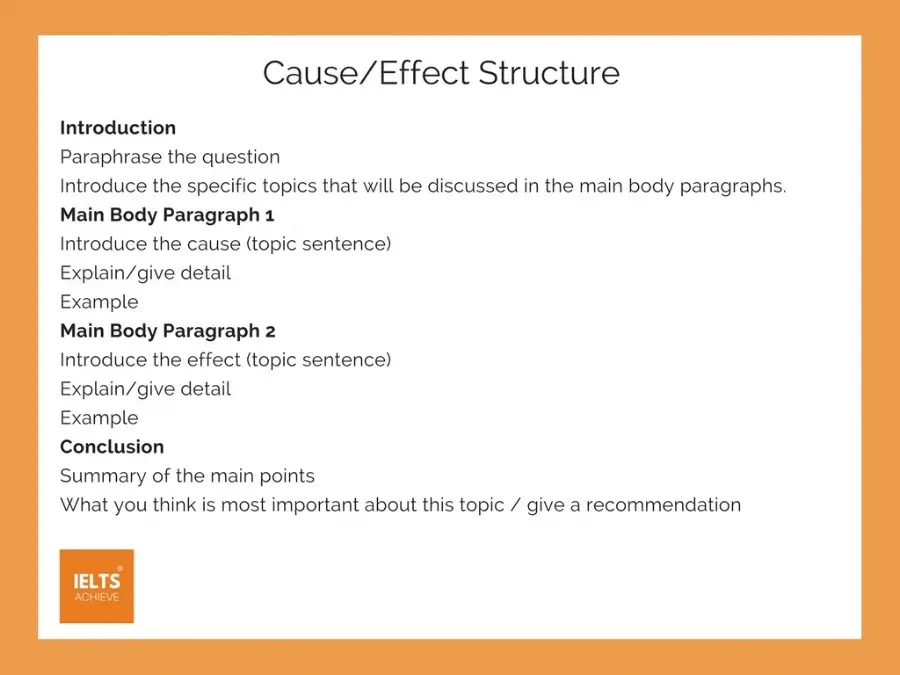
Paragraph 1 – The Introduction
This is the introduction to the essay and where you should start off by paraphrasing the question.
Do you understand what I mean, when I say ‘paraphrase’ the question?
This means that you rewrite the question in your own words using synonyms. You can’t just copy the question again or use the same words in the question. Paraphrase and show off your vocabulary knowledge by using synonyms. When practising your essay writing, use an online thesaurus to help you. This is a great tool and can help you to learn many new words.
Then your next sentence should introduce the essay, this will tellthe examiner exactly what you will discuss in the main body paragraphs. For example, Firstly this essay will discuss……… Secondly this essay will discuss…….
There are two sentences you need in the introduction >>
Paraphrase the question
Introduce the specific topics that will be discussed in the main body paragraphs.
Paragraph 2 – Main Body Paragraph 1
In this paragraph, you should describe a specific cause.
Start the paragraph by introducing the cause. This is where you need to have a topic sentence. The next sentence(s) should explain the cause, going into detail. The third sentence should give an example that supports.
The example you give could be something from your own experience or made up – it is ok to make up something as the examiners will not fact check your information. They want to see your ability to use English at a certain level. You could make up an example from a report, journal, newspaper or University study.
This is how the paragraph should look >>
Introduce the cause (topic sentence)
Explain/give detail
Example
Paragraph 3 – Main Body Paragraph 2
In this paragraph, you should write about the effect.
Start the paragraph by introducing the effect. This is where you need to have a topic sentence. The next sentence(s) should explain the effect, going into detail. The third sentence should give an example.
The example you give could be something from your own experience or made up – it is ok to make up something as the examiners will not fact check your information. They want to see your ability to use English at a certain level. You could make up an example from a report, journal, newspaper or University study.
This is how the paragraph should look >>
Introduce the effect (topic sentence)
Explain/give detail
Example
If you would like to purchase a 30 page PDF download that is easy to read and print out please take a look at the bookshop >
Paragraph 4 – The Conclusion
In the fourth paragraph, you write the conclusion giving a summary of your main points and say what you think is most important about this topic and give a recommendation. You should not enter any new information or ideas in this paragraph.
Summary of the main points
What you think is most important about this topic / give a recommendation
Another possible way to structure your cause/effect essay is this;
Introduction
Cause 1 – Describe a specific cause
Cause 2 – Describe another specific cause
Effects – Describe the effects from both causes
Conclusion
SAMPLE Cause/Effect ESSAY >>
**All questions have been reported by students who have taken the IELTS exam.**
In many countries all over the world today, there are many people who are extremely overweight. This essay will firstly discuss the main reasons that this is happening and secondly look at the effects this is having on individuals and society.
Firstly, obesity is caused by many factors in modern society, including the easy availability of unhealthy food. When a bad diet is matched with a sedentary lifestyle, weight gain is inevitable, since eating large portions of food that is mainly processed, high in salt, sugar and filled with chemicals, the body gains weight fast. For example, a documentary by Channel 4 in 2016 showed that the most obese populations were situated in underdeveloped nations, like Venezuela, where people admitted to finding it difficult to eat a balanced and healthy diet and had no nutritional education.
Secondly, the effect that immense weight gain can have on a person, is that they will likely develop health issues, like diabetes or heart disease. As the body becomes larger, the metabolism slows down, so that the body is more likely to get a chronic illness. This is impacting on health services around the world, as hospitals are seeing an increased demand to care for obese patients. For instance, The NHS in the UK has admitted to spending around 16 billion per year on obese related diseases like diabetes. UK newspaper The Telegraph reported in 2016 that more money is spent on treating obesity in the UK than on staffing the police force and fire service.
In conclusion, obesity is being caused by easily available calorie-rich processed food and little exercise. The effects of this are impacting individuals health as well as the cost of national healthcare services. In order for obesity to be lessened, individuals should be educated about nutrition, furthermore, the governments should implement higher taxes on all junk food and sugar.
(Word Count – 310 / Band Score 9)
Task Achievement – The answer provides a paraphrased question, to begin with, followed by a relevant cause and effects. Both the cause and effects are fully supported (relevant examples are given) in the main body paragraphs in the essay, with fully extended and well-supported ideas. the style of the writing is appropriate for an academic essay.
Coherence and Cohesion – The answer has been divided into clear logical paragraphs and each main body paragraph only has one main idea. There are cohesive links between the main body paragraphs and between most sentences. Examples are highlighted with discourse markers like – for example, and for instance. The conclusion gives a clear recommendation, which is linked to the information in the main body paragraphs.
Lexical Resource – There is evidence of a wide range of vocabulary, with no errors in the text.
Grammatical Range and Accuracy – The answer has no grammatical errors. The sentences have a wide range of structures.
TIP >> Remember to give both a cause and effect. Use each of the main body paragraphs to support your ideas, giving examples that are relevant. In the conclusion, summarise your main points and say what is important about the topic/give a recommendation.
WRITING TASK 2 BAND SCORE 9 CRITERIA >>
If you would like to view more high band score cause and effect essay examples please click the button below >
We hope you found this post helpful in helping you to study for the IELTS Test. Let us know in the comments or on the Facebook page if you have any questions. The best way to keep up to date with posts like this is to like us on Facebook, and then follow us onInstagramand Pinterest. We offer essay correction services, mock exams, and online courses. If you need help preparing for the IELTS Test, join the IELTS Achieve Academy and see how we can help you achieve your desired band score faster.
A detailed guide to this IELTS Writing Task 2 essay type, with structure templates, useful vocabulary, and techniques to achieve Band 7+.
Originally published December 2017. Last reviewed 3 July 2026.
In this post, we will look at the common topics that are seen again and again in the IELTS writing task 2 test. Students often ask if the questions are repeated year after year and the answer is no, but the topics are. There are so many questions written each year, you may find you practice answering various questions on different topics. For example, you could write essays to answer questions about education or the environment, which benefits you because you learn vocabulary associated with those topics and develop ideas that can help you in your writing test.
Practicing writing IELTS task 2 essays on a range of topics is a great way to learn new vocabulary for those topics, but also to practice your essay structures. You begin to develop your ideas around those topics, thinking of examples and giving your opinions.
Writing Task 2 Common Topics
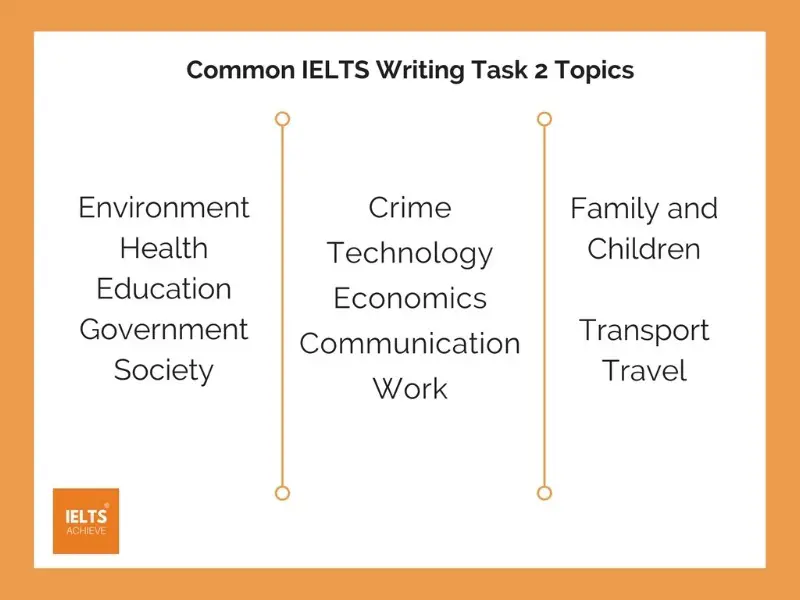
The list below shows you the common topics that are seen every year.
There is quite a range of writing task 2 topics, with many subtopics. Take a look at the list below and look for questions in each area when you are completing your IELTS preparation >
Environment
Government legislation
Environmental problems
Climate Change
Animals
Health
Obesity
Hospitals
The elderly
Funding
Poor countries vs rich countries
Health education
Exercise
Education
The rise of technology
Subjects/curriculum changes
Uniforms
The role of teachers
Discipline
Funding
Rules
Government
Change to laws
Rules that affect groups of individuals
International laws
Benefits to individuals and society
Funding
Society
Poverty
Overpopulation
Homelessness
Modern lifestyles
Funding
Public services
Crime
Youth crime
Punishment
Repeat offenders
Major vs minor crimes
Prisons
Technology
The role of technology in our lives/in society
The internet
Social media
Children online / safety measures
Hacking/data protection
Economics
World spending
Cash vs credit cards
Economic progress and success
Communication
Technology
Family
Social media
Types of personalities
Characters in society
Work
Women in the workplace
The role of the employee
Employer vs employee issues
Types of jobs
Salary
Equality
Family and Children
Family roles
Family size
Role models
Discipline (parents to children)
Education
Transport
Different forms of transport
Comparisons
Problems
Environmental issues
Travel
Culture differences
Travelling benefits/drawbacks
Meeting people
Forms of travel
There are many other topics that you can also prepare for, including art, business, marketing, sport, reading, language, and food/diet.
Top Tips For IELTS Writing Task 2 Preparation
When you are preparing for your IELTS writing task 2 test, practice answering questions on topics that you find difficult, as this is really good practice.
Learn vocabulary associated with the topic. Make word lists and learn the meanings of those words.
Read around the topic, take a look at news websites or journals and read about these topics. What is happening in the news? Can the news stories give you ideas for examples that you can use in your essay?
Listen to TED Talks, podcasts, the news or documentaries related to the common topics and develop ideas, vocabulary and your opinions.
Practice talking about these topics with a friend. Ask them their opinion about something you have seen in the news and give them your opinion, discuss the latest news and events related to the common topics.
We hope you found this post useful in helping you to study for the IELTS Test. If you have any questions please let us know in the comments below or on the Facebook page.
The best way to keep up to date with posts like this is to like us on Facebook, then follow us on Instagram and Pinterest.
If you need help preparing for the IELTS Test, join the IELTS Achieve Academy and see how we can assist you to achieve your desired band score. We offer an essay correction service, mock exams and online courses.
A detailed guide to this IELTS Writing Task 2 essay type, with structure templates, useful vocabulary, and techniques to achieve Band 7+.
Originally published December 2017. Last reviewed 3 July 2026.
In this post, we will look at how you can make your writing task 2 essay clear for the examiner. Having a clear and easy to understand essay improves your score in coherence and cohesion. Creating a clear essay may sound like a simple thing to do, but many students often try too hard and end up with an essay that is confusing and difficult to follow. This obviously lowers your score if the examiner cannot understand what it is you are trying to say in your writing.
How To Write A Clear Essay
Here are 5 tips on how to write a clear essay >
1. Understand the Question
Read the question and understand it, look at the keywords and what it is asking you to do. What are the main issues and the sub-issues? Can you tell if it is an agree/disagree essay? What type of essay is it? These are all questions you should be able to answer from understanding the question. If you do not understand the question properly, you could present irrelevant information in your essay, which can lead to a confusing essay and lower marks.
When you are thinking of ideas for your essay, make sure they are specific. Don’t write generally about the topic or try to stuff as many ideas as possible into the main body paragraphs. The main body paragraphs should each contain one main idea. If you present more than this, the paragraphs will become confusing for the examiner. The paragraphs should follow a certain structure, to ensure you gain marks for coherence and cohesion. If you have many ideas, you will not have time to explain them all and support them with examples. By choosing one main specific idea, explaining it, giving details and supporting with an example, this will make the information clear and easy to understand.
If the essay question asks you to give your opinion, then make sure you give it clearly in the writing. There are many ways to introduce your opinion, including using ‘in my opinion, I believe that’ or ‘In my view’. If you don’t give a clear opinion or state your position on the subject, then you can lose marks.
By reviewing and practising the essay structures for the various question types, you will be able to demonstrate to the examiner that you can structure an IELTS writing task 2 essay successfully. The marking criteria – coherence and cohesion for a band score 7 states ‘logically organise information and ideas, there is clear progression throughout, uses a range of cohesive devices appropriately although there may be some under/overuse, presents a clear central topic within each paragraph’, and for a band score 8 ‘sequences information and ideas logically, manages all aspects of cohesion well, uses paragraphing sufficiently and appropriately’. If you can organise your essay into clear easy to follow paragraphs, with cohesive devices and logical order, then you will be on your way to gaining a high band score.
Take a look at the structures needed for each type of Writing Task 2 essay here.
5. Vocabulary
The vocabulary you use in your essay also has a huge impact on how easy it is to read through and understand. When students try too hard, putting in high-level words they don’t really know the meaning of and trying to fit in as many complex structures as possible, this makes an essay very difficult for the examiner to read and follow. When you read your essay over after you have finished, does it make sense to you? Can you clearly understand each part? It is very important that your essay clearly communicates your message in relation to the question. If you have many grammatical errors this can also make the essay hard to understand.
Here is an example of an essay that is not very clear due to grammatical errors, structure and vocabulary (this essay is a band score 5).
Can you list the errors?
How could you improve this essay?
Writing task 2 — Cause/Effect essay People in all modem societies use drugs, but today’s youth are experimenting with both legal and illegal drugs, and at an early age. Some sociologists claim that parents and other members of society often set a bad example. Discuss the cause and effects of widespread drug abuse by young people. Make any recommendations you feel are necessary to help fight youth drug abuse.
Drug usage is very common in present-day population, however the teens starting to use legal and illegal products as well, at very young age. Usually a bad model, this is what some experts are saying. This essay will discuss some reasons why this has occurred and analyze the consequences of this worrying trend. One of the main causes of this problem is the stressful life of the people, some sever trauma or injury, but also an other reason can be a parent who had an addiction. Furthermore, in modern societies the street drugs and alcohol are very available even for the adolescents. A newspaper article shows that last year a Secret Service in New York made an investigation in 50 different schools and universities regarding to the drug consumption. The results were shocking: in 42 institutes they found a drug dealer.
The effects of this have been and will be very serious. Firstly the drug abuse can occur severe health problems like heart diseases, kidney or liver damage, abdominal pain, can weaken the immune system etc. Secondly can also damage the brain, causing for example behavior problems. While using drugs people are unable to do different activities well, or to think clear. This can lead to conflicts in families or between friends, and unfortunately sometimes can go into crime. In short, it is obvious that nowadays the usage of different psychotropic agents is widespread already in early age, and the effects of this are very tragically. The society should fight more and harder against drug abuse, the prevention programs could be much convincing, and the social media could help too, for example with more antidrug publicity.
If you would like to view more high band score essay examples please click the button below >
Good Example
Here is the re-written essay, can you see the difference? Is it easier to understand? This essay follows the following elements for a successful high scoring essay (this essay is a band score 8) >
Answers the question
Uses paraphrasing and synonyms
Follows the cause/effect essay structure
Uses logical paragraphing
Includes relevant ideas
Includes specific examples
Uses cohesive devices
Uses complex sentences
Has a wide variety of vocabulary
No grammatical errors
People in all modem societies use drugs, but today’s youth are experimenting with both legal and illegal drugs, and at an early age. Some sociologists claim that parents and other members of society often set a bad example. Discuss the cause and effects of widespread drug abuse by young people. Make any recommendations you feel are necessary to help fight youth drug abuse.
Drug usage is very common in the present-day population as many adolescents are using these legal and illegal products, beginning in their childhood years. Some social academics think that adults are terrible role models because they are heavily influencing the behaviour of the young people around them. This essay will discuss the principal reason why this has occurred and analyze the main consequence of this worrying trend.
On the one hand, the primary cause of this issue is the stressful lives many of these young people are living in today’s society. Some may have terrible home lives, with absent parents, no stable accommodation or other traumatic events experienced on a daily basis. For many youngsters, they experiment with illegal drugs and alcohol, in order to escape from their present situations. These kinds of substances are readily available to children and teens, as they are eager to try drugs, or are pressured into it by their peers or family members. For example, an article from the New York Times in 2017 reported that in 50 state schools interviewed, over 90% of the students aged between 14-16 had experimented with a class A drug.
On the other hand, common substance abuse in adolescents can lead to one main consequence, which is health problems. Regularly using drugs, from prescription medication to hard drugs can have both short term and long terms health effects, including; heart disease, kidney or liver damage, abdominal pain and lead to a weaker immune system. Certain drugs can also cause brain damage, sometimes causing severe problems with the use of motor skills or nerves. For instance, a documentary filmed by the BBC in 2017, showed the effects of serious drug dependencies amongst teenagers aged between 16-19. One person interviewed had developed serious damage to the brain, as well as facial nerves, through the overuse of MDMA. This had left the teen with permanent facial twitching and psychosis. In addition, teens should be taught about the serious and harmful effects of taking drug in school. The students should learn about the damaging and lasting effects of taking recreational drugs, even though they may see them as a way to unwind or escapism. The health issues relating to drugs and alcohol should be explained with case studies given as a deterrent to any young people who are thinking about experimenting. For example, as part of the curriculum in Sixth Form Colleges in the UK, students are made to watch a series of documentaries about the dangers of drugs and alcohol, in order to learn about the risks. They listen to teenagers talk about their own bad experiences and the consequences of this. In conclusion, many teens are experimenting with common drugs from an early age, leading to heavy consequences like health issues, as they grow older. To combat this issue, more initiatives should be set forth through the school system, to create awareness of the risks involved.
We hope you found this post helpful in helping you to study for the IELTS Test. Let us know in the comments or on the Facebook page if you have any questions. The best way to keep up to date with posts like this is to like us on Facebook, and then follow us onInstagramand Pinterest. We offer essay correction services, mock exams, and online courses. If you need help preparing for the IELTS Test, join the IELTS Achieve Academy and see how we can help you achieve your desired band score faster.
Step-by-step guide to answering this type of IELTS Writing Task 1 question. Covers structure, key language, and band-scoring criteria.
Originally published December 2017. Last reviewed 3 July 2026.
In this post, we will look at the word count needed in the writing tasks. You should know that 250 words are the minimum for a writing task 2 essay and 150 words are minimal for writing task 1. If you write less than the word counts specified in the question, you will lose marks in task achievement, because you will not have completed one of the requirements for the task.
The examiner will count your words to check that you have the minimum word count. If you have not reached 250 and have, for example, 240 words they will mark your essay lower because of this. It is possible to write more than 250 words during the time allocated for the task 2 essay, however, you should be careful you do not run out of time and find that you cannot write a conclusion, or check over your work.
Test Instructions
On the writing test paper, the instructions will look something like this below (Taken from the British Council IELTS) >
The highlighted sections show you that the instructions state clearly that at least 150 words are required for Task 1 and at least 250 words are required for Task 2.
The question examples below are taken from a free resource available on The British Council’s IELTS page. Take a look and download the free practice papers.
As you can see below, the highlighted section shows you that you have to write at least 150 words in Task 1.
TIP: Plan your work before you start to write, to make sure that all of the information you write in your essay is relevant. Do not write and write about anything and everything and go off-topic. It is more than possible to write a 250-word essay that is concise and to the point.
TIP: Check your word count during your IELTS essay preparation. Count the words (or if you are typing using the word count option) and see how many you are producing in 40 minutes for task 2 and 20 minutes for task 1.
TIP: Words that are hyphenated like in-depth or part-time will be counted as one word. prepositions like in, of, on and articles like the, a, at will all be counted. Punctuation, like commas, semi-colons and full stops (periods) will not be counted.
TIP: Practice writing your essay answers on the official writing answer sheet. This will allow you to practice counting your words to see how many you get in the time period allowed. You should aim to exceed the word count slightly so that you are sure you have met the minimum requirements.
Complete guide to writing this type of IELTS letter. Covers format, tone, useful phrases, and sample answers for Band 7+.
Originally published December 2017. Last reviewed 3 July 2026.
In this post, we will look at the differences between formal and informal writing. Formal and informal language refers to using different forms of language in different situations. For example, in writing, if you were writing an essay for university this would have a different tone than if you were writing a diary entry about your thoughts and feelings or an email to a friend.
In writing, writing an academic essay is different from writing a letter to a close friend. Using the correct form of language is essential for getting a high score on the IELTS writing test.
Informal Writing Style
Colloquial Language
Informal writing is similar to a spoken conversation. Informal writing may include slang, figures of speech, broken syntax, asides and so on. Informal writing takes a personal tone as if you were speaking directly to your audience (the reader). You can use the first or third person point of view (I and we), and you are likely to address the reader using second person (you and your).
Simple Sentences
Using short sentences is acceptable and sometimes essential to making a point in informal writing. There may be incomplete sentences or ellipsis(…) to make points.
Contractions and Abbreviations
Words are likely to be simplified using contractions (for example, I’m, doesn’t, couldn’t, it’s) and abbreviations (e.g. TV, photos) whenever possible.
Showing Empathy and Emotion
The author can show empathy towards the reader regarding the complexity of a thought and help them through that complexity. See our page: What is Empathy? for more.
Formal Writing Style
Complex Sentences
Longer sentences are likely to be more common in formal writing. You need to be as thorough as possible with your approach to each topic when you are using a formal style. Each main point needs to be introduced, explained and supported.
State The Objective
State your main points confidently and offer full supportive arguments. A formal writing style shows a limited range of emotions and avoids emotive punctuation such as exclamation points, ellipsis, etc. unless they are being cited from another source.
Use Full Words
No contractions should be used to simplify words (in other words use “It is” rather than “It’s”). Abbreviations must be spelt out in full when first used, the only exceptions being when the acronym is better known than the full name (BBC, ITV or NATO for example).
Third Person
Formal writing is not a personal writing style. The formal writer is disconnected from the topic and does not use the first person point of view (I or we) or second person (you).
When to Use Formal and Informal Writing
A formal writing style is necessary to use in the IELTS Test. If you are studying for the General Training writing test part 1, you should familiarise yourself with the difference between informal, semi-formal and formal letter writing.
Writing for the Academic writing test parts 1 and 2 and the General Training writing test part 2 requires the formal writing style, although during the speaking test you may use a more informal tone when speaking to the examiner.
Formal Writing Style in Writing Task 2
In writing task 2 you are expected to write your essay in a formal academic style. Here are two examples of the main body paragraph from a positive/negative question >
Bad Example
Sometimes working from home can be great, you can work when you want and live your life around your own clock. If you have kids to look after it makes it even better because you can work around their timetables. I can work from anywhere I want too like if I want to go on holiday I can just take my laptop with me and work from a cafe or anywhere that has wifi. You can fit your work around your life, which is really easy for all sorts of reasons. For example, my friend works from home and she loves it, she’s always saying how great it is that she can work from anywhere she wants to. She even went on holiday and worked from her sun lounger next to the swimming pool. I would love to do something like that for work, it sounds like it can give you lots of time to travel and explore the world.
Good Example
On the one hand, having the option to work from home, can have a positive impact on an employee’s schedule. This is especially so if the person has children or other dependants because working long hours is not always possible depending on your lifestyle. Therefore it allows the employee to manage their own schedule while ensuring that they maintain a work-life balance, working from wherever they are in the world. Having flexible working hours means that collecting children from school, spending time travelling and being able to attend non-work related appointments becomes much easier. For example, Google allows senior engineers to work remotely, using flexible hours for those who travel a lot or have the need to work with little interruptions.
Can you see the difference?
The bad example has been written in an informal manner as if the writer is writing to a friend. The good example shows the formal style and elements of a high-level IELTS main body paragraph, through the structure, use of cohesive devices, complex sentences and the tone.
We hope you found this post useful in helping you to study for the IELTS Test. If you have any questions please let us know in the comments below or on the Facebook page.
The best way to keep up to date with posts like this is to like us on Facebook, then follow us on Instagram and Pinterest.
If you need help preparing for the IELTS Test, join the IELTS Achieve Academy and see how we can assist you to achieve your desired band score. We offer an essay correction service, mock exams and online courses.
A detailed guide to this IELTS Writing Task 2 essay type, with structure templates, useful vocabulary, and techniques to achieve Band 7+.
Originally published December 2017. Last reviewed 3 July 2026.
In this post, we will look at how to use cohesive devices in your IELTS writing task 2 essay. Being able to include cohesive devices in your writing is important because it shows the examiner that you know how to use them effectively. This can increase your band score in the coherence and cohesionsection.
Cohesive devices are also known as linking words and they are there to help the examiner to read through your essay clearly. Linking words are a great way to join your ideas together and make your sentences and your paragraph much more coherent.
Cohesive Devices
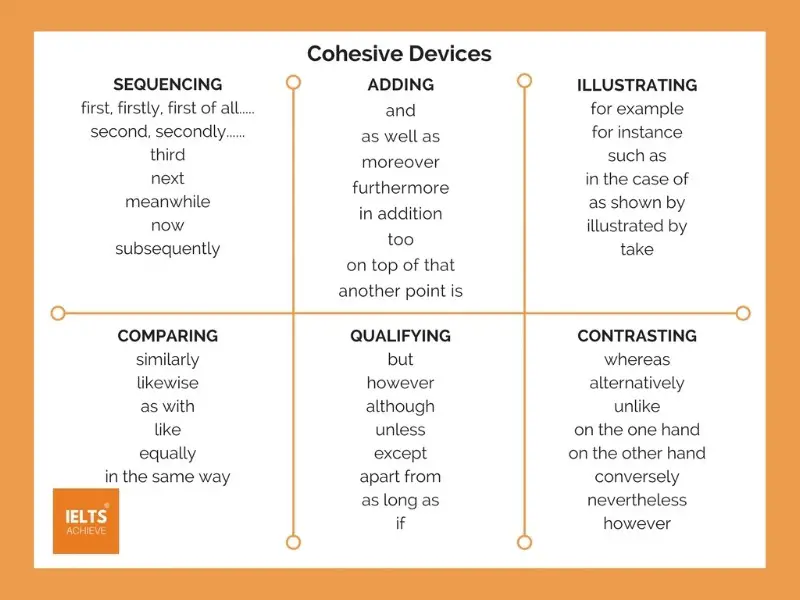
Below is a list of cohesive devices that you will use in your IELTS essays. In the IELTS exam, to reach a band 7 or above you need to be able to use a range of cohesive devices accurately.
Examples
In the writing task 2 marking criteria for a band score of 7, it states – ‘ uses a range of cohesive devices appropriately although there may be some under-/over-use‘. This means that the student understands how to use cohesive devices but is using too many (in nearly every sentence) or too few.
Many students who receive a band score 6 or lower, will have used far too many, making the writing sound mechanical and not like a native speaker. A high scoring answer of 8+ will contain a few but well placed cohesive devices as using them with precision and in the correct context counts for more than inserting as many as possible.
Take a look at the examples below with the cohesive devices highlighted in bold >>
Bad Example
On the one hand, the main advantage of having a standardised punishment system could lead to a downward trend in crime, as the system would serve as a deterrent. Therefore, this would allow the courts to easily hand out justice to all criminals, in order to make the judiciary system more powerful. For example, in some states in the USA, there are tough sanctions in place for criminals, including death by lethal injection. However, in 2014, the New York Times reported that up to 65% of criminals who were incarcerated for high-level crimes (murder, manslaughter) received the lethal injection.
Good Example
On the one hand, the main advantage of having a standardised punishment system could lead to a downward trend in crime, as the system would serve as a deterrent. This would allow the courts to easily hand out justice to all criminals, in order to make the judiciary system more powerful. For example, in some states in the USA, there are tough sanctions in place for criminals, including death by lethal injection. In 2014, the New York Times reported that up to 65% of criminals who were incarcerated for high-level crimes (murder, manslaughter) received the lethal injection.
How Should I Use Them In My Essay?
Review sample essays and see how many are used in high-level answers. You will see that there are the same ones used in many sample essays time and time again. Learn a core few and use them during your writing practice.
Take a look at this band 9 essay below and see how the cohesive devices have been used to introduce the reader to the paragraphs and to lead them through the essay effortlessly. The cohesive devices are highlighted in bold.
Essay Example >>
Question
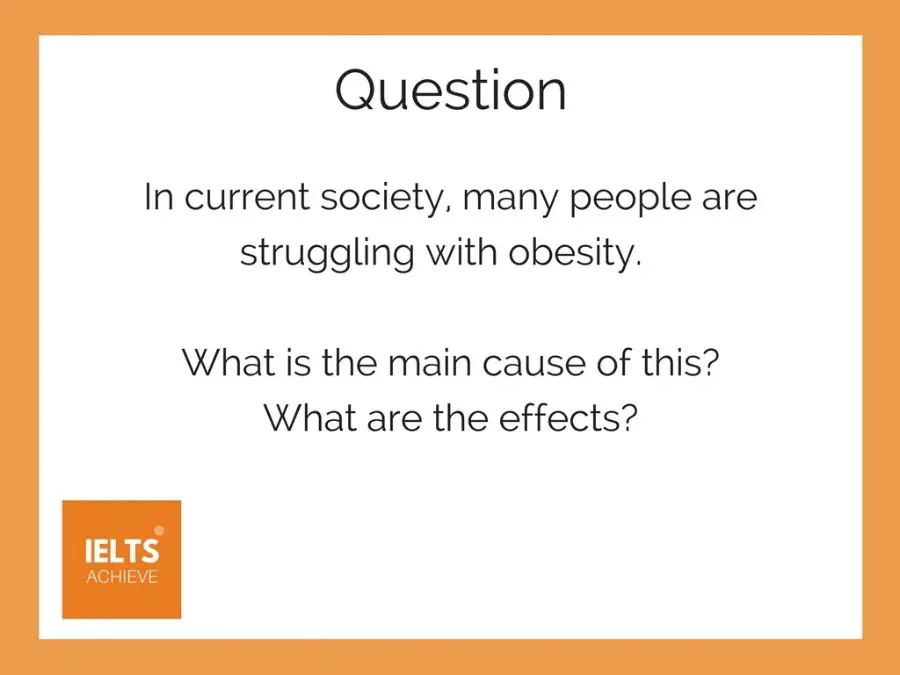
In current society, many people are struggling with obesity. What is the main cause of this? What are the effects?
Answer
In many countries all over the world today, there are many people who are extremely overweight. This essay will firstly discuss the main reasons that this is happening and secondly look at the effects this is having on individuals and society.
Firstly, obesity is caused by many factors in modern society, including the easy availability of unhealthy food. When a bad diet is matched with a sedentary lifestyle, weight gain is inevitable, since eating large portions of food that is mainly processed, high in salt, sugar and filled with chemicals, the body gains weight fast. For example, a documentary by Channel 4 in 2016 showed that the most obese populations were situated in underdeveloped nations, like Venezuela, where people admitted to finding it difficult to eat a balanced and healthy diet and had no nutritional education.
Secondly, the effect that immense weight gain can have on a person, is that they will likely develop health issues, like diabetes or heart disease. As the body becomes larger, the metabolism slows down, so that the body is more likely to get a chronic illness. This is impacting on health services around the world, as hospitals are seeing an increased demand to care for obese patients. For instance, The NHS in the UK has admitted to spending around 16 billion per year on obese related diseases like diabetes. UK newspaper The Telegraph reported in 2016 that more money is spent on treating obesity in the UK than on staffing the police force and fire service.
In conclusion, obesity is being caused by easily available calorie-rich processed food and little exercise. The effects of this are impacting individuals health as well as the cost of national healthcare services. In order for obesity to be lessened, individuals should be educated about nutrition, furthermore, the governments should implement higher taxes on all junk food and sugar.
We hope you found this post helpful in helping you to study for the IELTS Test. Let us know in the comments or on the Facebook page if you have any questions. The best way to keep up to date with posts like this is to like us on Facebook, and then follow us onInstagramand Pinterest. We offer essay correction services, mock exams, and online courses. If you need help preparing for the IELTS Test, join the IELTS Achieve Academy and see how we can help you achieve your desired band score faster.
Comprehensive guide covering essential IELTS preparation strategies and techniques to help you achieve your target band score.
Originally published December 2017. Last reviewed 3 July 2026.
In this post, we will look at how to use complex sentences in your IELTS writing task 2 essay. Being able to include complex sentences in your writing is important because it shows the examiner that you know how to use them effectively. This can increase your band score in the grammatical range and accuracysection.
In order to gain a band score 7, you need to be able to show the examiner that you can ‘use a variety of complex structures’. For the higher band scores of 8, you need to ‘use a wide range of structures’ and for a band score 9 ‘use a wide range of structures with full flexibility and accuracy’. This means that you should include complex sentences in your essay, but you do not have to make all of your sentences complex.
What Is A Complex Sentence?
Complex sentences are when two or more basic sentences are joined together, using connecting words. Below you will see four simple sentences:
Simple Sentences
Communities meet online via private Facebook groups.
People no longer meet up in a community hall to discuss matters.
Many people do not socialise physically with others.
People like to isolate themselves in a virtual world.
If you wrote all of your sentences like this in the essay, you would gain a low band score. Therefore, you take the basic sentences like those above and make them into complex sentences by joining them together. Take a look at the example below where you can see the word ‘since’ joins the sentences together;
Complex Sentence Example
Communities meet online via private Facebook groups, instead of in a community hall to discuss matters, since this does not allow them to socialise physically with people, they isolate themselves in this virtual world.
Where do I use them in my essay?
In your writing task 2 essay, you can use a complex sentence in any part of the essay. Here we will look at how they can be used to explain your main idea in your main body paragraphs. Your first sentence can be a basic sentence, that introduces the main topic, followed by a complex sentence that explains the main idea, then an example, which can contain a mixture of simple and complex sentences. Think of it like this;
Main Body Paragraph
Simple sentence (introduce your topic)
Complex sentence (explain your topic/main idea)
Complex sentence (example)
Take a look at this example below from a discussion essay;
Firstly, during the last two decades, there have been many tech developments and advancements, bringing convenience to all. One significant attribute of this modernization is the internet, while this technology has made our lives more convenient in many aspects, including our approach to communication. In the past, we only used mail or the telephone to send our messages across the globe, whereas today, the internet allows us to reach out to almost everyone in just a few seconds. The inconvenience of long distances is eliminated as we can talk and even see distant friends or relatives for an unlimited time. For example, the internet connects people whose relatives or families are abroad, through Facebook, Twitter or Skype anytime and anywhere.
If we break it up you can see how it has been structured;
The first sentence – introduces the topic and is simple >
Firstly, during the last two decades, there have been many tech developments and advancements, bringing convenience to all.
The second part of the paragraph is more complex and gives the reader an explanation of the main topic. The words highlighted in bold connect the clauses and make the sentences complex >
One significant attribute of this modernization is the internet, while this technology has made our lives more convenient in many aspects, including our approach to communication. In the past, we only used mail or the telephone to send our messages across the globe, whereas today, the internet allows us to reach out to almost everyone in just a few seconds. The inconvenience of long distances is eliminated as we can talk and even see distant friends or relatives for an unlimited time.
The third part of the paragraph is the example and it is a complex sentence, connected by the words highlighted in bold >
For example, the internet connects people whose relatives or families are abroad, through Facebook, Twitter or Skype in order to contact them anytime and anywhere.
Clauses – A clause is the key element of a sentence.
A clause is a group of words that contains a subject and a verb. It can form part of a sentence or a complete simple sentence. Clauses can be main or subordinate and they can behave like adjectives or adverbs.
Main Clauses – Also known as an independent clause, the main clause includes a subject and a verb and expresses a complete thought. Main clauses are the same as simple sentences because they have to make sense on their own.
Example– The dog (subject) played (verb).
Subordinate Clauses – A subordinate clause (also called a dependent clause) contains a subject and a verb but it does not make sense on its own. It depends on the main clause for its meaning. Subordinate clauses often explain or add more information about where or when things happen, or how they are done. relative and adverbial clauses are types of subordinate clauses.
Example – Because the dog (subject) was lazy (verb).
Relative Clauses – Relative clauses are also known as adjective clauses, and they are a type of subordinate clause. Like adjectives and adjectival phrases, relative clauses describe nouns and pronouns. Unlike adjectives, they can only be placed after the noun or pronoun they are modifying. Relative clauses always start with one of the relative pronouns who, whom, whose, which or that, which acts as the subject or the object of the clause.
Examples
Subject > which was (verb) excellent (adjective)
Object > which the dog (subject) did (verb) every day (adverbial phrase)
Adverbial Clauses – An adverbial clause is a type of subordinate clause that behaves like an adverb. It gives additional information about how, when where and why something is happening. Adverbial clauses start with subordinators such as because, although, after, while, as and until.
Examples
Why? as (subordinator) the dog (subject) wanted (verb) food (object)
When? after (subordinator) the dog (subject) had eaten (verb) food (object)
Sentence Structures
Simple Sentences
A simple sentence is the same as the main clause. it must have a subject and one main verb and it must express a single idea. The subject is the person or thing that does the action (the verb), but one subject can be made up of more than one person or thing. Most simple sentences also include an object, which is the person or thing receiving the action.
Example
The student and his friends enjoyed the library field trip.
Compound Sentences
Compound sentences are made up of two or more main clauses, but no subordinate clauses. The main clauses are linked using conjunctions and the resulting sentence conveys different ideas of equal importance. Compound sentences are a useful way of connecting two or more ideas of equal importance. They help to improve the flow of a piece of writing as many successive simple sentences can be uncomfortable to read. to make most compound sentences, two main clauses, each containing a subject and a verb are joined together using a coordinating conjunction such as and, but or so. A comma is used before the coordinating conjunction to separate the two clauses.
Example
John is a student who loves to study English grammar, and he also reads many science fiction books.
Complex Sentences
A complex sentence is made up of a main clause and one or more subordinate clauses. The subordinate clause depends on the main clause for its meaning. Complex sentences are useful because they can be used to indicate that one idea is more important than another. The secondary idea is contained in a subordinate clause, which has a subject and a verb but does not make sense without the main clause to which it is attached. Subordinate clauses add information to main clauses.
Examples
John put his hat on because he was cold.
The couple allowed their dog to sleep on their bed, although they managed to have very little sleep.
Preparing For Your IELTS Test
Please practice writing IELTS essays and using complex sentences in your work before your test day. Some students try to write complex sentences, which then turn into very hard to understand sentences. They somehow get the word order muddled up and the writing becomes confusing. Don’t allow this to happen, check your work and practice, using essay examples to guide you.
Even better – have lessons or essay corrections with an experienced teacher, who can help you to understand how to structure your essay, make it clear and include all of the necessary elements to pass with a high band score.
We hope you found this post useful in helping you to study for the IELTS Test. If you have any questions please let us know in the comments below or on the Facebook page.
The best way to keep up to date with posts like this is to like us on Facebook, then follow us on Instagram and Pinterest.
If you need help preparing for the IELTS Test, join the IELTS Achieve Academy and see how we can assist you to achieve your desired band score. We offer an essay correction service, mock exams and online courses.
If you would like to purchase a 16 page PDF download that is easy to read and print out please take a look at the bookshop >
Comprehensive guide covering essential IELTS preparation strategies and techniques to help you achieve your target band score.
Originally published December 2017. Last reviewed 3 July 2026.
In this post, we will look at how to write relevant examples to support your main points in the writing task 2 essay. Being able to write strong examples is important because it shows the examiner that you can logically organise your ideas and support your points with evidence.
In the main body paragraphs, you want to show the examiner that you can write about your ideas, explain them and support them with examples that are relevant, if you do this, you will gain marks for task achievement and coherence.
For a band score 8 in the task achievement section, the marking criteria states ‘presents a well-developed response to the question with relevant, extended and supported ideas’. For a band 9, it says ‘presents a fully developed position in answer to the question with relevant, fully extended and well-supported ideas’.
Why does my essay need to have relevant examples?
As a recap here is what your main body paragraph structure should look like for a high score >
Your main body paragraphs should have 3 main sentences >
Introduce the topic
Explain/give detail
Example
Introduce the topic
Start the paragraph by introducing the topic. This is where you need to have a topic sentence that introduces the examiner to the main idea of the paragraph.
Explain/give detail
The next sentence(s) should explain the topic, going into detail. This gives some background information related to the main idea of the paragraph. It explains the idea, telling the examiner how it is relevant to the question.
Example
The third part of your main body paragraph should give an example to support your main points. The example you give could be something from your own experience or made up – it is ok to make up something as the examiners will not fact check your information. They want to see your ability to use English at a certain level. You could make up an example from a report, journal, newspaper or University study to support your view.
How Do I think of Relevant Examples?
When you are trying to think of relevant examples, you can use your own personal experiences, or information from something you have seen or read about. If you really can’t think of anything, then you are allowed to make one up. The examiners will not check the facts that you present in your examples, as they want to see that you can support your main ideas well and that you have a high level of written English.
When writing relevantexamples you can use one of the following >
1. A University Study
You can make up a fictional study from a University in your country or city. If you want you can even use a study from a famous University, like Harvard, Cambridge or Oxford in the UK. These types of examples are great for supporting points about education, students or children.
Example
For example, Cambridge University in the UK surveyed over 500 students in 2017 and reported that over 65% had completed a gap year before starting their chosen course.
2. A Newspaper Report
Another way of writing a relevant example is to make up some information from a newspaper report or article. This may even be loosely based on something you have read in the news or seen online.
Example
For instance, according to an article published in The New York Times in 2016, a survey of people who work online, from home in the state of New York showed that 24% of people said they had developed depression.
3. Statistics from The Police
If you are writing an example for a crime or punishment related question you could include statistics from the police or government.
Example
For example, in some states in the USA, there are tough sanctions in place for criminals, including death by lethal injection. In 2014, the Texas State Police Department reported that up to 65% of criminals who were incarcerated for high-level crimes (murder, manslaughter) received the lethal injection.
4. Statistics from A Health Organisation
If you are writing an example for a health-related question you could include statistics from a health organisation like The WHO (World Health Organisation), the NHS in the UK or a private organisation like BUPA. Think of places from your own country that you could write about.
Example
For instance, the NHS in the UK regularly hold talks in schools for both parents and students to educate communities on how to have a balanced diet. They also promote proper exercise, involvement in sports, and having an active lifestyle. As a result of this program, in some areas, they saw a decrease in the number of overweight health issues.
5. Data from a Tech Company
If you are writing an example for a technology or communication-related question you could include statistics from a tech company.
Example
For example, in 2015 Google allowed senior engineers to work remotely, using flexible hours for those who travel a lot or have the need to work with little interruptions. This increased productivity to over 70% as the senior members could work seamlessly without any delays.
6. A Documentary
Another way of writing a relevant example is to make up some information from a documentary you have seen.
Example
For example, a documentary by Channel 4 in 2016 showed that the most obese populations were situated in underdeveloped nations, like Venezuela, where people admitted to finding it difficult to eat a balanced and healthy diet and had no nutritional education.
7. Your Own Experience
You can also include examples that display your own experiences in relation to the question. You should avoid using personal pronouns in the essay, but in this example, where you are writing about your own experience it is acceptable.
Example
For instance, In my experience, I know that in Romania, it is common practice for graduates from state-funded university courses to work in areas where their services are needed for a minimum of two years before they are able to apply to work abroad.
Make Your Examples Specific
You need to make sure that your examples are specific as this gives your point more authenticity. If your point is too general, then you will not be supporting your main idea enough for a high band score.
Look at these examples below >
Bad Example
For example, many students have a gap year before starting their chosen course.
Good Example
For example, Cambridge University in the UK surveyed over 500 students in 2017 and reported that over 65% had completed a gap year before starting their chosen course.
Feedback
You can see in the bad example that the example is not developed enough and gives general information to the reader. It tells you that many students have a gap year before starting University, but that is all of the information given.
The good example gives you specific data related to the main idea. There is a time (2017) how many students were asked (500) and the percentage of how many had a gap year (65%). This example gives more authenticity to the answer and provides an academic example. This is the type of answer that will fully support your main idea in the paragraph, which will score higher in the marking criteria.
You can make your example specific by adding the following >
Introduce the example with a cohesive device – For exampl/For instance
Include a percentage (if you are giving the results of a survey)
We hope you found this post useful in helping you to study for the IELTS Test. If you have any questions please let us know in the comments below or on the Facebook page.
The best way to keep up to date with posts like this is to like us on Facebook, then follow us on Instagram and Pinterest.
If you need help preparing for the IELTS Test, join the IELTS Achieve Academy and see how we can assist you to achieve your desired band score. We offer an essay correction service, mock exams and online courses.
Comprehensive guide covering essential IELTS preparation strategies and techniques to help you achieve your target band score.
Originally published December 2017. Last reviewed 3 July 2026.
In this post, we will look at how to use synonyms in your writing task 2 essay. To begin with, when you paraphrase text, you read the question then rewrite it in your own words. You should not copy words straight from the question, instead change the order of the words and choose words with a similar meaning (a synonym). This means you are using different words to write about the same idea.
It is important to use synonyms in your writing, as you will lose marks if you repeat words from the question and use the same words in your essay over and over. If you do that, it will show the examiner that you have a limited vocabulary and you want to do the opposite for a high band score. By using synonyms well you can show the examiner that you have a ‘wide range of vocabulary and can skillfully use it to convey precise meanings’ (band score 8).
TIP >> When paraphrasing the question in your introduction, you don’t need to change all of the words, but you should try to change most of them. Be careful though, because choosing a word that has a similar meaning – not the same meaning can make the meaning of the sentence change or become unclear.
TIP >> The best way to practice this is to have a look at writing task 2 questions and paraphrase/re-write the question in your own words. Whilst practising you can use an online thesaurus tool to help you find synonyms and learn new words
What Is A Synonym?
Synonyms are words that are similar or have a related meaning, to another word. They are important to use in your IELTS writing when you want to avoid repeating the same word over and over. Also, sometimes the word you have in mind might not be the most appropriate word, which is why finding the right synonym is crucial. When you are preparing for your IELTS test, take some time to use an online tool, to help you research many synonym examples. A great way to practice finding the right synonyms is to use an online thesaurus.
Choosing a Synonym
There is a certain skill involved in choosing the most appropriate synonym, as not all are created equal. It is important to consider the connotation of the word because some synonyms can inject a different meaning than the one intended.
For example, one synonym of the word child is “brat” however, this word carries quite a negative connotation. Depending on the circumstance you can use it, but in this instance, if you just want to say that someone is young (a child) then another synonym such as “young child” or “minor” would be more applicable.
TIP >> Make sure the synonym you choose has the same meaning. Inserting a synonym with an incorrect meaning can change the ideas in your essay, which can lower your band score.
Synonym Examples
Here is a list of adjectives and their synonyms that are commonly used >>
These are just a few examples of synonyms but hopefully, you can see that working with synonyms can make your IELTS writing more varied and help you to expand your vocabulary.
We hope you found this post useful in helping you to study for the IELTS Test. If you have any questions please let us know in the comments below or on the Facebook page.
The best way to keep up to date with posts like this is to like us on Facebook, then follow us on Instagram and Pinterest.
If you need help preparing for the IELTS Test, join the IELTS Achieve Academy and see how we can assist you to achieve your desired band score. We offer an essay correction service, mock exams and online courses.
Comprehensive guide covering essential IELTS preparation strategies and techniques to help you achieve your target band score.
Originally published December 2017. Last reviewed 3 July 2026.
In this post, we will look at the importance of being able to paraphrase. Paraphrasing is very important in your IELTS writing, not only for the writing test but for all of the other parts of the test too. Being able to paraphrase will show the examiner that you have a wide vocabulary, helping you to achieve a higher band score.
To paraphrase text is to read the question then rewrite it in your own words. You should not copy words straight from the question, instead change the order of the words and choose words with a similar meaning (a synonym). This means you are using different words to write about the same idea.
Paraphrasing Example 1
Here is an example of a Writing Task 2 Question >>
In current society, many people are struggling with obesity. What is the main cause of this? What are the effects?
Paraphrased >>
In many countries all over the world today, there are many people who are extremely overweight.
Feedback
Here the student changed obesity to extremely overweight and then changed current society to many countries all over the world.
Paraphrasing Example 2
Here is an example of a Writing Task 2 Question >>
Many people in society believe that having fixed punishments for all crimes is a more efficient way of dealing with criminals in the justice system.
What are the advantages and disadvantages of having a fixed punishment?
Paraphrased >>
There is an ongoing debate on the merits of having a rigid discipline system in place for all crimes committed.
Feedback
Here the student changed the wording, to have a similar meaning, but they have not directly copied words from the question. They have used rigid discipline system to replace fixed punishments.
Paraphrasing Example 3
Here is an example of a Writing Task 2 Question >>
Due to poorer countries experiencing a ‘brain drain’ they are seeing many professionals, such as doctors and teachers, leaving to work in more developed countries.
What problems does this cause? What solutions can be suggested to deal with this problem?
Paraphrased >>
In many developing countries, there are a number of skilled academics leaving in search of better pay, increased socioeconomic benefits, and the chance to earn citizenship in a developed country.
Feedback
Here the student has replaced professionals with skilled academics. They have also expanded on the ‘why’ looking at reasons these people might leave.
USING SYNONYMS
Synonyms are words you use when you want to write a word that has a similar meaning to the original word in the question. For example;
Society / Community / Humanity
Professional / Specialist / Authority
Healthy / Active / Lively
Economic / Fiscal / Commercial
Obese / Fat / Heavy
Punishment / Discipline / Retribution
TIP >> When paraphrasing the question, you don’t need to change all of the words, but you should try to change most of them. Be careful though, because choosing a word that has a similar meaning – not the same meaning can make the meaning of the sentence change or become unclear.
TIP >> The best way to practice this is to have a look at writing task 2 questions and paraphrase/re-write the question in your own words. Whilst practising you can use an online thesaurus tool to help you find synonyms and learn new words.
We hope you found this post useful in helping you to study for the IELTS Test. If you have any questions please let us know in the comments below or on the Facebook page.
The best way to keep up to date with posts like this is to like us on Facebook, then follow us on Instagram and Pinterest.
If you need help preparing for the IELTS Test, join the IELTS Achieve Academy and see how we can assist you to achieve your desired band score. We offer an essay correction service, mock exams and online courses.