Comprehensive guide covering essential IELTS preparation strategies and techniques to help you achieve your target band score.
Originally published February 2018. Last reviewed 3 July 2026.
About Mariella’s IELTS Journey
Mariella, a doctor from Spain, needed to achieve a specific IELTS band score for professional registration and visa purposes. Like many healthcare professionals, Mariella faced the challenge of demonstrating English language proficiency while maintaining a demanding work schedule.
The Challenge
Healthcare professionals seeking to work internationally typically need an IELTS overall band score of 7.0, with no individual component below 6.5 for nursing registration, or 7.0 in each component for medical registration in countries like the UK and Australia. This is a high standard that requires focused, strategic preparation.
Key Strategies That Helped
Focused practice on weaker skills: Identifying and targeting specific skill gaps rather than generic study
Using professional context: Leveraging medical and healthcare vocabulary already known from work
Consistent daily practice: Even 30-60 minutes of targeted daily practice builds steady improvement
Professional feedback: Getting expert evaluation on writing and speaking to understand examiner expectations
Advice for Other Healthcare Professionals
If you are a doctor or healthcare worker preparing for IELTS, focus on the academic register required for professional contexts. Practise writing reports, describing processes, and explaining medical procedures clearly — these skills directly transfer to IELTS Writing and Speaking tasks.
Originally published on IELTS Achieve. Last reviewed 3 July 2026.
Comprehensive guide covering essential IELTS preparation strategies and techniques to help you achieve your target band score.
Originally published February 2018. Last reviewed 3 July 2026.
About John’s IELTS Journey
John, a nurse from the Philippines, needed to achieve a specific IELTS band score for professional registration and visa purposes. Like many healthcare professionals, John faced the challenge of demonstrating English language proficiency while maintaining a demanding work schedule.
The Challenge
Healthcare professionals seeking to work internationally typically need an IELTS overall band score of 7.0, with no individual component below 6.5 for nursing registration, or 7.0 in each component for medical registration in countries like the UK and Australia. This is a high standard that requires focused, strategic preparation.
Key Strategies That Helped
Focused practice on weaker skills: Identifying and targeting specific skill gaps rather than generic study
Using professional context: Leveraging medical and healthcare vocabulary already known from work
Consistent daily practice: Even 30-60 minutes of targeted daily practice builds steady improvement
Professional feedback: Getting expert evaluation on writing and speaking to understand examiner expectations
Advice for Other Healthcare Professionals
If you are a nurse or healthcare worker preparing for IELTS, focus on the academic register required for professional contexts. Practise writing reports, describing processes, and explaining medical procedures clearly — these skills directly transfer to IELTS Writing and Speaking tasks.
Originally published on IELTS Achieve. Last reviewed 3 July 2026.
Comprehensive guide covering essential IELTS preparation strategies and techniques to help you achieve your target band score.
Originally published February 2018. Last reviewed 3 July 2026.
About Daniela’s IELTS Journey
Daniela, a nurse from Romania, needed to achieve a specific IELTS band score for professional registration and visa purposes. Like many healthcare professionals, Daniela faced the challenge of demonstrating English language proficiency while maintaining a demanding work schedule.
The Challenge
Healthcare professionals seeking to work internationally typically need an IELTS overall band score of 7.0, with no individual component below 6.5 for nursing registration, or 7.0 in each component for medical registration in countries like the UK and Australia. This is a high standard that requires focused, strategic preparation.
Key Strategies That Helped
Focused practice on weaker skills: Identifying and targeting specific skill gaps rather than generic study
Using professional context: Leveraging medical and healthcare vocabulary already known from work
Consistent daily practice: Even 30-60 minutes of targeted daily practice builds steady improvement
Professional feedback: Getting expert evaluation on writing and speaking to understand examiner expectations
Advice for Other Healthcare Professionals
If you are a nurse or healthcare worker preparing for IELTS, focus on the academic register required for professional contexts. Practise writing reports, describing processes, and explaining medical procedures clearly — these skills directly transfer to IELTS Writing and Speaking tasks.
Originally published on IELTS Achieve. Last reviewed 3 July 2026.
Comprehensive guide covering essential IELTS preparation strategies and techniques to help you achieve your target band score.
Originally published February 2018. Last reviewed 3 July 2026.
About Andrei’s IELTS Journey
Andrei, a nurse from Romania, needed to achieve a specific IELTS band score for professional registration and visa purposes. Like many healthcare professionals, Andrei faced the challenge of demonstrating English language proficiency while maintaining a demanding work schedule.
The Challenge
Healthcare professionals seeking to work internationally typically need an IELTS overall band score of 7.0, with no individual component below 6.5 for nursing registration, or 7.0 in each component for medical registration in countries like the UK and Australia. This is a high standard that requires focused, strategic preparation.
Key Strategies That Helped
Focused practice on weaker skills: Identifying and targeting specific skill gaps rather than generic study
Using professional context: Leveraging medical and healthcare vocabulary already known from work
Consistent daily practice: Even 30-60 minutes of targeted daily practice builds steady improvement
Professional feedback: Getting expert evaluation on writing and speaking to understand examiner expectations
Advice for Other Healthcare Professionals
If you are a nurse or healthcare worker preparing for IELTS, focus on the academic register required for professional contexts. Practise writing reports, describing processes, and explaining medical procedures clearly — these skills directly transfer to IELTS Writing and Speaking tasks.
Originally published on IELTS Achieve. Last reviewed 3 July 2026.
A detailed guide to this IELTS Writing Task 2 essay type, with structure templates, useful vocabulary, and techniques to achieve Band 7+.
Originally published January 2018. Last reviewed 3 July 2026.
In writing task 2 you will be asked to write a discursive essay (250 words minimum). You will be given a question asking you to give your opinion, discuss a problem or issue. You could also be asked to provide solutions, evaluate a problem, compare and contrast different ideas or challenge an idea. In this post, we will be focussing on how to write a direct question essay.
One of the first things you should do is read the marking criteria to see what the examiners expect. This is really important, as you need to know what they are looking for in the band 7+ boxes.
You should be able to give the examiners exactly what they want, in order to get a 7+ band score.
If you would like to purchase a 29 page PDF download that is easy to read and print out please take a look at the bookshop >
WRITING TASK 2 Direct Question STRUCTURE
The structure that I advise my students to use, will be sure to get you a band score 7+. You need to practice using this structure, with as many questions as you can, before sitting your IELTS test. This writing task 2 structure has been proven to be successful for my students and when perfected, can easily help you to achieve a high band score.
TIP >> Before you start writing, plan your ideas so that you can organise the information clearly. You must read the question and answer the questions asked in your essay. Take 5 minutes and plan out your ideas and examples.
TIP >> It is very important that spend a full 40 minutes on this task as the score you get for writing task 2 is two-thirds of your total writing score. You also need to write a minimum of 250 words and use your own ideas.
TIP >> Remember to write in a formal tone, this is an academic essay, therefore your writing should be formal.
TIP >> The structure may differ depending on the question. Most questions will ask as two questions but other questions may ask further questions. You will have to adjust the structure, to make sure you are answering all parts of the question. This means adding an extra paragraph to answer another question, or to give your opinion.
IT IS A 4-PARAGRAPH STRUCTURE >>
Paragraph 1 – The Introduction
This is the introduction to the essay and where you should start off by paraphrasing the question.
Do you understand what I mean, when I say ‘paraphrase’ the question?
This means that you rewrite the question in your own words using synonyms. You can’t just copy the question again or use the same words in the question. Paraphrase and show off your vocabulary knowledge by using synonyms. When practising your essay writing, use an online thesaurus to help you. This is a great tool and can help you to learn many new words.
Then your next sentence should outline for the examiner exactly what you will discuss in the main body paragraphs. For example, Firstly this essay will discuss……… Secondly this essay will discuss…….
There are two sentences you need in the introduction >>
Paraphrase the question.
Outline the specific topics that will be discussed in the main body paragraphs.
Paragraph 2 – Main Body Paragraph 1
In this paragraph, you should answer the first question asked. You should give specific information and only write about one main idea in each main body paragraph.
Start the paragraph by introducing the topic. This is where you need to have a topic sentence. The next sentence(s) should explain the topic, going into detail. The third sentence should give an example that supports the positive aspect.
The example you give could be something from your own experience or made up – it is ok to make up something as the examiners will not fact check your information. They want to see your ability to use English at a certain level. You could make up an example from a report, journal, newspaper or University study to support your view.
This is how the paragraph should look >>
Introduce the topic (answer the first question)
Explain/give detail
Example
Paragraph 3 – Main Body Paragraph 2
In this paragraph, you should answer the second question asked. You should give specific information and only write about one main idea in each main body paragraph.
Start the paragraph by introducing the topic. This is where you need to have a topic sentence. The next sentence(s) should explain the topic, going into detail. The third sentence should give an example that supports the view.
The example you give could be something from your own experience or made up – it is ok to make up something as the examiners will not fact check your information. They want to see your ability to use English at a certain level. You could make up an example from a report, journal, newspaper or University study to support your view.
This is how the paragraph should look >>
Introduce the topic (answer the second question asked)
Explain/give detail
Example
If you would like to purchase a 29 page PDF download that is easy to read and print out please take a look at the bookshop >
Paragraph 4 – The Conclusion
In the fourth paragraph, you write the conclusion giving a summary of your main points and give a recommendation. You should not enter any new information or ideas in this paragraph.
Summary of the main points
Give a recommendation
*Note – There may be more than 2 questions asked in the main essay question, therefore you can add a third paragraph if necessary. Your essay should never contain more than three main body paragraphs.*
SAMPLE Direct Question ESSAY >>
**All questions have been reported by students who have taken the IELTS exam.**
Creative pleasures such as viewing fine arts, listening to music and watching a play are treated by many as enjoyable and essential as part of their everyday living. Firstly this essay will discuss how the arts are a crucial element in most people’s lives and secondly will discuss how it is vital that creative subjects are included in the school’s curriculum.
Firstly, the creative arts, such as paintings, sculptures, music and theatre have a long and ardent history throughout the ages. They have grown and evolved with the times, appealing to new generations every year, in order to keep being a part of everyday life. People enjoy the arts, often as an escape from their lives, listening to music they enjoy, going to see a play with friends or visiting galleries and museums to see paintings, photography or sculptures. For example, a study from the New York Times in 2017 showed that over 75% of New Yorkers said that they regularly visited the cities art galleries, museums and theatres. A further 35% said that they donated money regularly to art societies, for the preservation of the collections, so they can continue for many years to come.
Secondly, many people develop a love for the arts early in life, when they are at school. In my opinion, I think that a range of arts subjects should be included in the school curriculum, as not all students are ‘left brained’ enjoying logical, core subjects like mathematics. Others are more ‘right brained’ where they enjoy being creative, whether that is in writing, painting or making music. Children should be encouraged to find their talents at school and develop them for their own enjoyment and advancement. For instance, St. Cuthberts school in the north of England dedicated 40% of the curriculum of creative subjects, including fine art, pottery, music, drama and dance. Those subjects proved to enhance school results by over 25% in 2017.
In conclusion, there are clear benefits to individuals who are passionate about the arts and find enjoyment in them regularly. If more people tried to become involved in the arts, then perhaps they would find a way to allow themselves time to become creative or to relax, while learning something new.
(Word Count = 371 / Band Score 9)
Task Achievement – The answer provides an answer to both questions asked, supported by relevant examples.
Coherence and Cohesion – The answer has been divided into clear logical paragraphs and each main body paragraph only has one main idea. There are cohesive links between the main body paragraphs (firstly, secondly).
Lexical Resource – There is evidence of a wide range of vocabulary, with no errors in the text.
Grammatical Range and Accuracy – The answer has no grammatical errors. The sentences have a wide range of structures.
TIP >> Remember to read the question and plan your answer around what it is asking you to do.
WRITING TASK 2 BAND SCORE 9 CRITERIA >>
If you would like to view more high band score direct question essay examples please click the button below >
We hope you found this post helpful in helping you to study for the IELTS Test. Let us know in the comments or on the Facebook page if you have any questions. The best way to keep up to date with posts like this is to like us on Facebook, and then follow us onInstagramand Pinterest. We offer essay correction services, mock exams, and online courses. If you need help preparing for the IELTS Test, join the IELTS Achieve Academy and see how we can help you achieve your desired band score faster.
A detailed guide to this IELTS Writing Task 2 essay type, with structure templates, useful vocabulary, and techniques to achieve Band 7+.
Originally published December 2017. Last reviewed 3 July 2026.
In writing task 2 you will be asked to write a discursive essay (250 words minimum). You will be given a question asking you to give your opinion, discuss a problem or issue. You could also be asked to provide solutions, evaluate a problem, compare and contrast different ideas or challenge an idea. In this post, we will be focussing on how to write a positive/negative essay.
One of the first things you should do is read the marking criteria to see what the examiners expect. This is really important, as you need to know what they are looking for in the band 7+ boxes.
You should be able to give the examiners exactly what they want, in order to get a 7+ band score.
If you would like to purchase a 29 page PDF download that is easy to read and print out please take a look at the bookshop >
WRITING TASK 2 Positive/Negative STRUCTURE
The structure that I advise my students to use, will be sure to get you a band score 7+. You need to practice using this structure, with as many questions as you can, before sitting your IELTS test. This writing task 2 structure has been proven to be successful for my students and when perfected, can easily help you to achieve a high band score.
TIP >> Before you start writing, plan your ideas so that you can organise the information clearly. You must decide on the positive and negative points and possible examples you can use. Take 5 minutes and plan out your ideas and examples.
TIP >> It is very important that spend a full 40 minutes on this task as the score you get for writing task 2 is two-thirds of your total writing score. You also need to write a minimum of 250 words and use your own ideas.
TIP >> Remember to write in a formal tone, this is an academic essay, therefore your writing should be formal.
TIP >> The structure may differ depending on the question. Most questions will simply ask ‘is this a positive or negative development?’ but other questions may ask further questions. You will have to adjust the structure, to make sure you are answering all parts of the question. This means adding an extra paragraph to answer another question, or to give your opinion.
IT IS A 4-PARAGRAPH STRUCTURE >>
Paragraph 1 – The Introduction
This is the introduction to the essay and where you should start off by paraphrasing the question.
Do you understand what I mean, when I say ‘paraphrase’ the question?
This means that you rewrite the question in your own words using synonyms. You can’t just copy the question again or use the same words in the question. Paraphrase and show off your vocabulary knowledge by using synonyms. When practising your essay writing, use an online thesaurus to help you. This is a great tool and can help you to learn many new words.
Then your next sentence should outline for the examiner exactly what you will discuss in the main body paragraphs. For example, Firstly this essay will discuss……… Secondly this essay will discuss…….
There are two sentences you need in the introduction >>
Paraphrase the question
Outline the specific topics that will be discussed in the main body paragraphs.
Paragraph 2 – Main Body Paragraph 1
In this paragraph, you should write about the positive view that supports your opinion on the issue from the question. You should give specific information and only write about one main idea in each main body paragraph.
Start the paragraph by introducing the topic. This is where you need to have a topic sentence. The next sentence(s) should explain the topic, going into detail. The third sentence should give an example that supports the positive aspect.
The example you give could be something from your own experience or made up – it is ok to make up something as the examiners will not fact check your information. They want to see your ability to use English at a certain level. You could make up an example from a report, journal, newspaper or University study to support your view.
This is how the paragraph should look >>
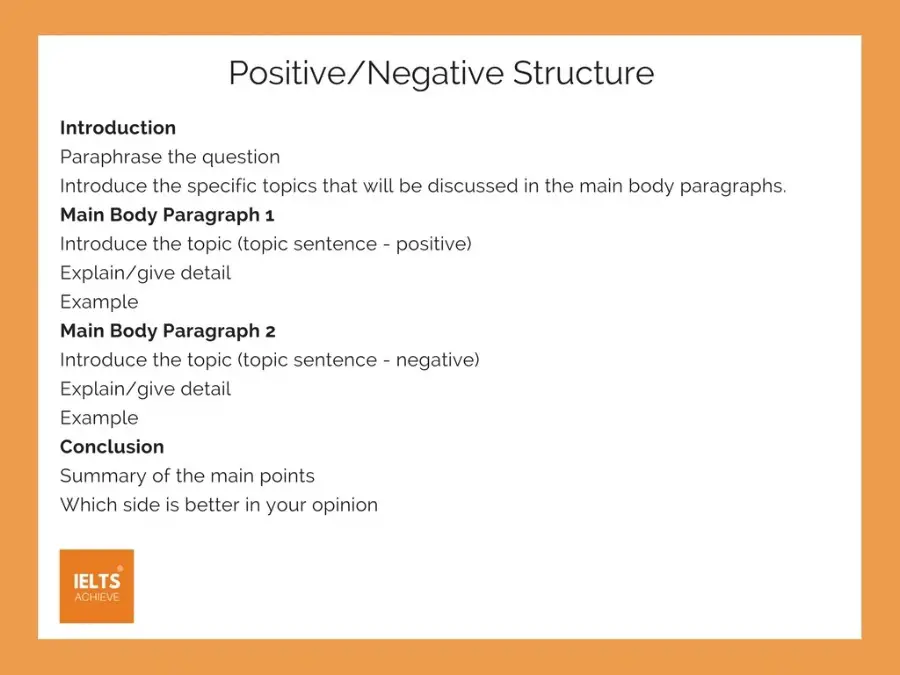
Introduce the topic (topic sentence – positive)
Explain/give detail
Example
If you would like to purchase a 29 page PDF download that is easy to read and print out please take a look at the bookshop >
Paragraph 3 – Main Body Paragraph 2
In this paragraph, you should write about the negative view (depending on the question) or another positive view that supports your opinion on the issue from the question.
If the questions says positive or negative development – write in support of the view you are leaning towards.
You should give specific information and only write about one main idea in each main body paragraph.
Start the paragraph by introducing the topic. This is where you need to have a topic sentence. The next sentence(s) should explain the topic, going into detail. The third sentence should give an example that supports the view.
The example you give could be something from your own experience or made up – it is ok to make up something as the examiners will not fact check your information. They want to see your ability to use English at a certain level. You could make up an example from a report, journal, newspaper or University study to support your view.
This is how the paragraph should look >>
Introduce the topic (topic sentence – negative)
Explain/give detail
Example
Paragraph 4 – The Conclusion
In the fourth paragraph, you write the conclusion giving a summary of your main points and say which side is better in your opinion. You should not enter any new information or ideas in this paragraph.
Summary of the main points
Which side is better in your opinion
SAMPLE Positive/Negative ESSAY >>
**All questions have been reported by students who have taken the IELTS exam.**
In the modern workplace, many workers are being given the option to undertake their job from home, thus leading to the managing of one’s own time. In my opinion, I believe that this is a positive development. Firstly, this essay will discuss, how being able to work away from the confinement of an office can bring positive elements into a worker’s life. Secondly, it will discuss the positive impact this may have on a person when no longer involved in the day to day activities happening in the office environment.
Firstly, having the option to work from home, can have a positive impact on an employee’s schedule. This is especially so if the person has children or other dependants because working long hours is not always possible depending on your lifestyle. Therefore it allows the employee to manage their own schedule while ensuring that they maintain a work-life balance, working from wherever they are in the world. Having flexible working hours means that collecting children from school, spending time travelling and being able to attend non-work related appointments becomes much easier. For example, Google allows senior engineers to work remotely, using flexible hours for those who travel a lot or have the need to work with little interruptions.
Similarly, employees can develop better mental health when they are removed from the everyday office environment. When working away from the office, the individual may feel like they can work at their own pace, take breaks when needed and deal with less stress. Working for long hours each day in an office environment with co-workers and management can seriously impact a person’s mental health, leading to frustration, depression and burnout. For instance, according to an article published in The New York Times in 2016, a survey of people who work online, from home in the state of New York showed that 94% of people said they had developed overall better health.
In conclusion, in my view, there are more positive elements than negative, as there are clear benefits to individuals who have the opportunity to work from home, including having a flexible schedule. However, those working away from the office environment should also manage their work/life balance, so they take care of their mental health.
(Word Count = 355 / Band Score 9)
Task Achievement – The answer provides the view that there are more positive sides than negative, supported by relevant examples.
Coherence and Cohesion – The answer has been divided into clear logical paragraphs and each main body paragraph only has one main idea. There are cohesive links between the main body paragraphs (firstly, similarly).
Lexical Resource – There is evidence of a wide range of vocabulary, with no errors in the text.
Grammatical Range and Accuracy – The answer has no grammatical errors. The sentences have a wide range of structures.
TIP >> Remember to read the question and plan your answer around what it is asking you to do.
WRITING TASK 2 BAND SCORE 9 CRITERIA >>
If you would like to view more high band score positive or negative essay examples please click below >
We hope you found this post useful in helping you to study for the IELTS Test. If you have any questions please let us know in the comments below or on the Facebook page.
The best way to keep up to date with posts like this is to like us on Facebook, then follow us on Instagram and Pinterest.
If you need help preparing for the IELTS Test, join the IELTS Achieve Academy and see how we can assist you to achieve your desired band score. We offer an essay correction service, mock exams and online courses.
A detailed guide to this IELTS Writing Task 2 essay type, with structure templates, useful vocabulary, and techniques to achieve Band 7+.
Originally published December 2017. Last reviewed 3 July 2026.
In writing task 2 you will be asked to write a discursive essay (250 words minimum). You will be given a question asking you to give your opinion and discuss a problem or issue. You could also be asked to provide solutions, evaluate a problem, compare and contrast different ideas or challenge an idea. In this post, we will be focussing on how to write an agree/disagree/opinion essay.
One of the first things you should do is read the marking criteria to see what the examiners expect. This is really important, as you need to know what they are looking for in the band 7+ boxes.
You should be able to give the examiners exactly what they want, in order to get a 7+ band score.
If you would like to purchase a 31 page PDF download that is easy to read and print out please take a look at the bookshop >
Writing Task 2 Agree/Disagree Essay Structure
The structure that I advise my students to use, will be sure to get you a band score of 7+. You need to practice using this structure, with as many questions as you can, before sitting your IELTS test. This writing task 2 structure has been proven to be successful for my students and when perfected, can easily help you to achieve a high band score.
TIP >> Before you start writing, plan your ideas so that you can organise the information clearly. You must decide how much you agree or disagree and why. Take 5 minutes and plan out your ideas, opinions and examples.
TIP >> It is very important that spend a full 40 minutes on this task as the score you get for writing task 2 is two-thirds of your total writing score. You also need to write a minimum of 250 words and use your own ideas.
TIP >> Remember to write in a formal tone, this is an academic essay, and therefore your writing should be formal.
IT IS A 4-PARAGRAPH STRUCTURE
Paragraph 1 – The Introduction
This is the introduction to the essay and where you should start off by paraphrasing the question.
Do you understand what I mean, when I say ‘paraphrase’ the question?
This means that you rewrite the question in your own words using synonyms. You can’t just copy the question again or use the same words in the question. Paraphrase and show off your vocabulary knowledge by using synonyms. When practising your essay writing, use an online thesaurus to help you. This is a great tool and can help you to learn many new words.
Then your next sentence should give your view/opinion on the issue. A good way to say this is to start with…I agree…. or I disagree…… or In my opinion, I believe that……..
The third sentence in the introduction should outline for the examiner exactly what you will discuss in the main body paragraphs. For example, Firstly this essay will discuss……… Secondly, this essay will discuss…….
There are three sentences you need in the introduction >>
Paraphrase the question
Give your view/opinion
Outline the specific topics that will be discussed in the main body paragraphs.
Paragraph 2 – Main Body Paragraph 1
In this paragraph, you should write about your first main idea (opinion A) that supports your opinion on the issue from the question. You should give specific information and only write about one main idea in each main body paragraph.
Start the paragraph by introducing the topic. This is where you need to have a topic sentence. The next sentence(s) should explain the topic, going into detail. The third sentence should give an example that supports the view.
The example you give could be something from your own experience or made up – it is ok to make up something as the examiners will not fact check your information. They want to see your ability to use English at a certain level. You could make up an example from a report, journal, newspaper or University study to support your view.
This is how the paragraph should look >>
Introduce the topic (topic sentence – opinion A)
Explain/give detail
Example
Paragraph 3 – Main Body Paragraph 2
In this paragraph, you should write about your second main idea (opinion B) that supports your opinion on the issue from the question. You should give specific information and only write about one main idea in each main body paragraph.
Start the paragraph by introducing the topic. This is where you need to have a topic sentence. The next sentence(s) should explain the topic, going into detail. The third sentence should give an example that supports the view.
The example you give could be something from your own experience or made up – it is ok to make up something as the examiners will not fact check your information. They want to see your ability to use English at a certain level. You could make up an example from a report, journal, newspaper or University study to support your view.
This is how the paragraph should look >>
Introduce the topic (topic sentence- opinion B)
Explain/give detail
Example
If you would like to purchase a 31 page PDF download that is easy to read and print out please take a look at the bookshop >
Paragraph 4 – The Conclusion
In the fourth paragraph, you write the conclusion giving a summary of your main points and restate your opinion/views and justify them. You should not enter any new information or ideas in this paragraph.
Summary of the main points
Restate own views/opinion/justify
Expressing your opinion
To get a high score in IELTS academic writing task 2, you should use as many different structures, collocations and idioms as you can.
Sequencing ideas
You can use phrases like these to make statements, for example; On the one hand sunbathing can give your body vitamin D, on the other hand, it can also be very dangerous for your health.
Sample Agree/Disagree essay
**All questions have been reported by students who have taken the IELTS exam.**
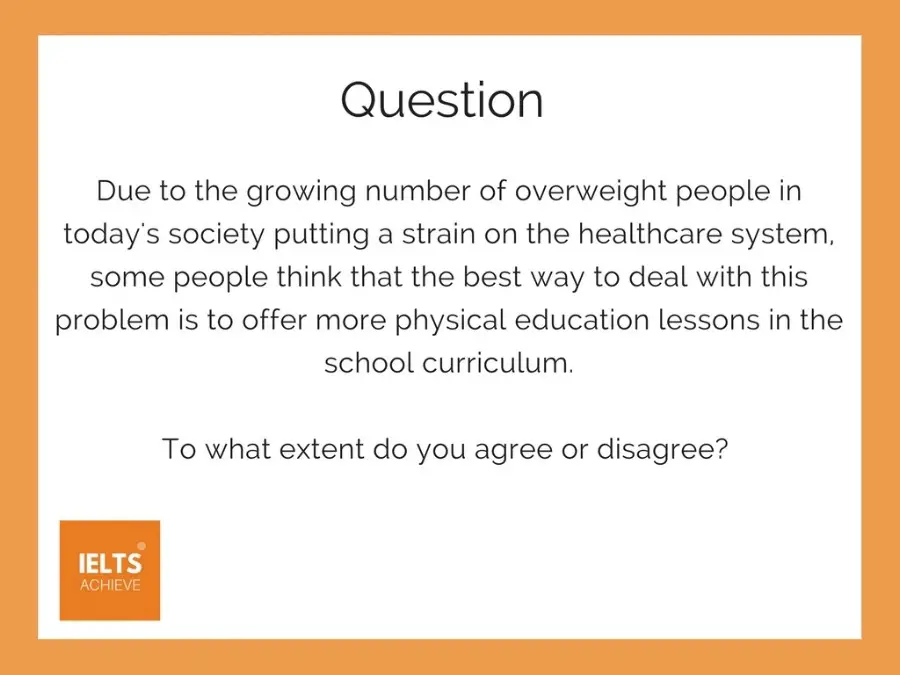
Obesity has become a huge concern as an increasing percentage of the population have become overweight and this has put a tremendous strain on the healthcare authorities, leading to increased costs. One solution that is being implemented is the introduction of more sports lessons in the school curriculum. In my opinion, I strongly agree that the integration of active lessons will greatly assist in kerbing obesity. Firstly, this essay will discuss how sports lessons will increase awareness of the benefits of having a healthy lifestyle. Secondly, this essay will discuss, the importance of combining exercise with a healthy diet.
On the one hand, I believe that the best way to fight health care problems is by utilising health education. By integrating physical education classes into the curriculum, impressionable young children and adults will be exposed to healthy lifestyle practices of sport and exercise, whereas they will also learn about teamwork and see their self-confidence grow. For example, at Westminster primary school in the UK, 10-minute exercise intervals were introduced between classes. The children must run laps around the playground before going to their next lesson. This formed part of a study by Cambridge University, where it reported that 85% of the children performed better on tests and obesity records were at an all-time low.
On the other hand, in my view having more physical education classes in the curriculum is not the only way to teach young people how to have a healthy lifestyle. The children should be educated how to balance exercise with a healthy diet, so that this could extend, not only to the students in the schools but also to the parents. For instance, the NHS in the UK regularly hold talks in schools for both parents and students to educate communities on how to have a balanced diet. They also promote proper exercise, involvement in sports, and having an active lifestyle. As a result of this program, in some areas, they saw a decrease in the number of overweight health issues.
In conclusion, I strongly agree that having more sports lessons in schools will help to fight the growing number of overweight people. By combining this with a healthy diet, the students will be encouraged to be healthy, from a young age, right through into adulthood.
(Word Count = 385 / Band Score 9)
Task Achievement – The answer provides a paraphrased question, to begin with, followed by a clear opinion. The opinion is fully supported in the main body paragraphs in the essay, with fully extended and well-supported ideas
Coherence and Cohesion – The answer has been divided into clear logical paragraphs and each main body paragraph only has one main idea. There are cohesive links between the main body paragraphs and between most sentences.
Lexical Resource – There is evidence of a wide range of vocabulary, with no errors in the text.
Grammatical Range and Accuracy – The answer has no grammatical errors. The sentences have a wide range of structures.
TIP >> Remember to give your opinion, state your opinion in the introduction clearly and develop your main body paragraphs around it. Use each of the main body paragraphs to support your opinion, giving examples that are relevant. In the conclusion, summarise your main points and restate your opinion.
Writing Task 2 Band Score 9 Criteria
If you would like to view more high band score agree or disagree essay examples please click the button below >
We hope you found this post helpful in helping you to study for the IELTS Test. Let us know in the comments or on the Facebook page if you have any questions. The best way to keep up to date with posts like this is to like us on Facebook, and then follow us onInstagramand Pinterest. We offer essay correction services, mock exams, and online courses. If you need help preparing for the IELTS Test, join the IELTS Achieve Academy and see how we can help you achieve your desired band score faster.
A detailed guide to this IELTS Writing Task 2 essay type, with structure templates, useful vocabulary, and techniques to achieve Band 7+.
Originally published December 2017. Last reviewed 3 July 2026.
In writing task 2 you will be asked to write a discursive essay (250 words minimum). You will be given a question asking you to give your opinion, discuss a problem or issue. You could also be asked to provide solutions, evaluate a problem, compare and contrast different ideas or challenge an idea. In this post, we will be focussing on how towrite a discuss both views and give your opinion essay.
One of the first things you should do is read the marking criteria to see what the examiners expect. This is really important, as you need to know what they are looking for in the band 7+ boxes.
You should be able to give the examiners exactly what they want, in order to get a 7+ band score.
If you would like to purchase a 34 page PDF download that is easy to read and print out please take a look at the bookshop >
WRITING TASK 2 Discuss Both Views and Give Your Opinion Essay STRUCTURE
The structure that I advise my students to use, will be sure to get you a band score of 7+. You need to practice using this structure, with as many questions as you can, before sitting your IELTS test. This writing task 2 structure has been proven to be successful for my students and when perfected, can easily help you to achieve a high band score.
TIP >> Before you start writing, plan your ideas so that you can organise the information clearly. You must decide how much you agree or disagree with and why. Take 5 minutes and plan out your ideas, opinions and examples.
TIP >> It is very important that spend a full 40 minutes on this task as the score you get for writing task 2 is two-thirds of your total writing score. You also need to write a minimum of 250 words and use your own ideas.
TIP >> Remember to write in a formal tone, this is an academic essay, therefore your writing should be formal.
IT IS A 5-PARAGRAPH STRUCTURE >>
Paragraph 1 – The Introduction
This is the introduction to the essay and where you should start off by paraphrasing the question.
Do you understand what I mean, when I say ‘paraphrase’ the question?
This means that you rewrite the question in your own words using synonyms. You can’t just copy the question again or use the same words in the question. Paraphrase and show off your vocabulary knowledge by using synonyms. When practising your essay writing, use an online thesaurus to help you. This is a great tool and can help you to learn many new words.
After that, give your view/opinion on the issue. A good way to say this is to start with…‘In my opinion, I believe that……..’
The last sentence in the introduction should outline for the examiner exactly what you will discuss in the main body paragraphs. For example, ‘this essay will discuss both views and state my own position’.
There are three sentences you need in the introduction >>
Paraphrase the question / State both views
Give your view/opinion
Outline what is going to be discussed in the essay
Paragraph 2 – Main Body Paragraph 1
In this paragraph, you should write about the first argument/viewpoint, discuss it, then give an example. You should give specific information and only write about one main idea in each main body paragraph.
Start the paragraph by introducing the first view (View A). This is where you need to have a topic sentence. The next sentence(s) should discuss the view, going into detail. The third sentence should give an example that supports the view.
The example you give could be something from your own experience or made up – it is ok to make up something as the examiners will not fact check your information. They want to see your ability to use English at a certain level. You could make up an example from a report, journal, newspaper or University study to support your view.
This is how the paragraph should look >>
Introduce the view (View A – topic sentence)
Discuss/give detail
Example
Paragraph 3 – Main Body Paragraph 2
In this paragraph, you should write about your second view (View B). You should give specific information and only write about one main idea in each main body paragraph.
Start the paragraph by introducing the view (View B). This is where you need to have a topic sentence. The next sentence(s) should discuss the view, going into detail. The third sentence should give an example that supports the view.
The example you give could be something from your own experience or made up – it is ok to make up something as the examiners will not fact check your information. They want to see your ability to use English at a certain level. You could make up an example from a report, journal, newspaper or University study to support your view.
This is how the paragraph should look >>
Introduce the view (View B – topic sentence)
Discuss/give detail
Example
If you would like to purchase a 34 page PDF download that is easy to read and print out please take a look at the bookshop >
Paragraph 4 – Your Opinion
In this paragraph, you should write your opinion. You should give specific information and only write about one main idea in each main body paragraph.
Start the paragraph by introducing your opinion. This is where you need to have a topic sentence. The next sentence(s) should explain your opinion, going into detail. The third sentence should give an example that supports your opinion.
The example you give could be something from your own experience or made up – it is ok to make up something as the examiners will not fact check your information. They want to see your ability to use English at a certain level. You could make up an example from a report, journal, newspaper or University study to support your view.
This is how the paragraph should look >>
Introduce your opinion (topic sentence)
Explain your opinion
Example
Paragraph 5 – The Conclusion
In the final paragraph, you write the conclusion giving a summary of your main points and state which view is more important.You should not enter any new information or ideas in this paragraph.
Summary of the main points
State which view is more important
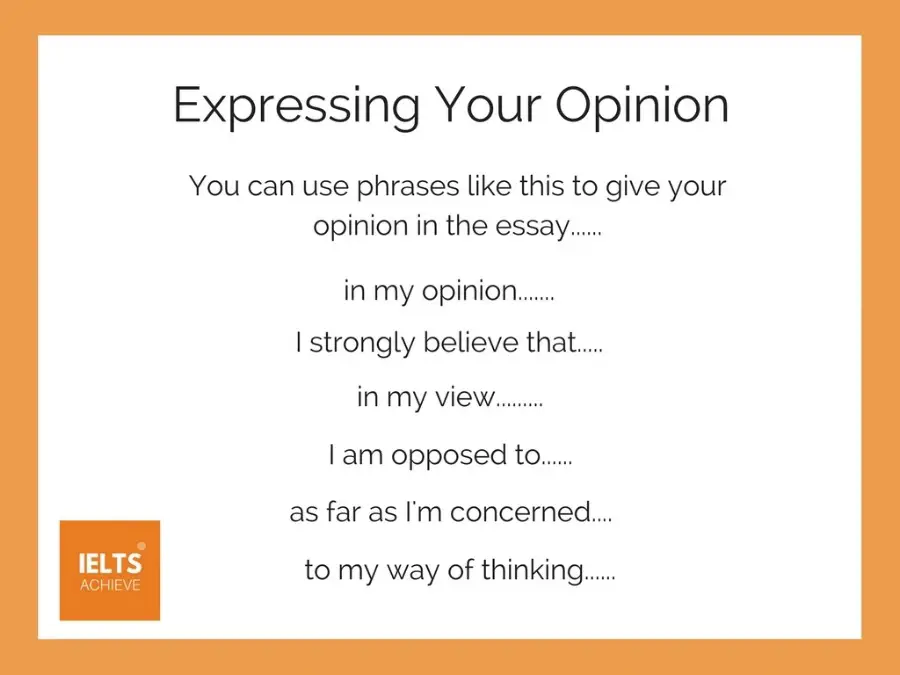
EXPRESSING YOUR OPINION >>
To get a high score in IELTS academic writing task 2, you should use as many different structures, collocations and idioms as you can.
SEQUENCING IDEAS >>
You can use phrases like these to make statements, for example; On the one hand sunbathing can give your body vitamin D, on the other hand, it can also be very dangerous for your health.
SAMPLE Discuss Both Points of View and Give your own opinion ESSAY >>
**All questions have been reported by students who have taken the IELTS exam.**
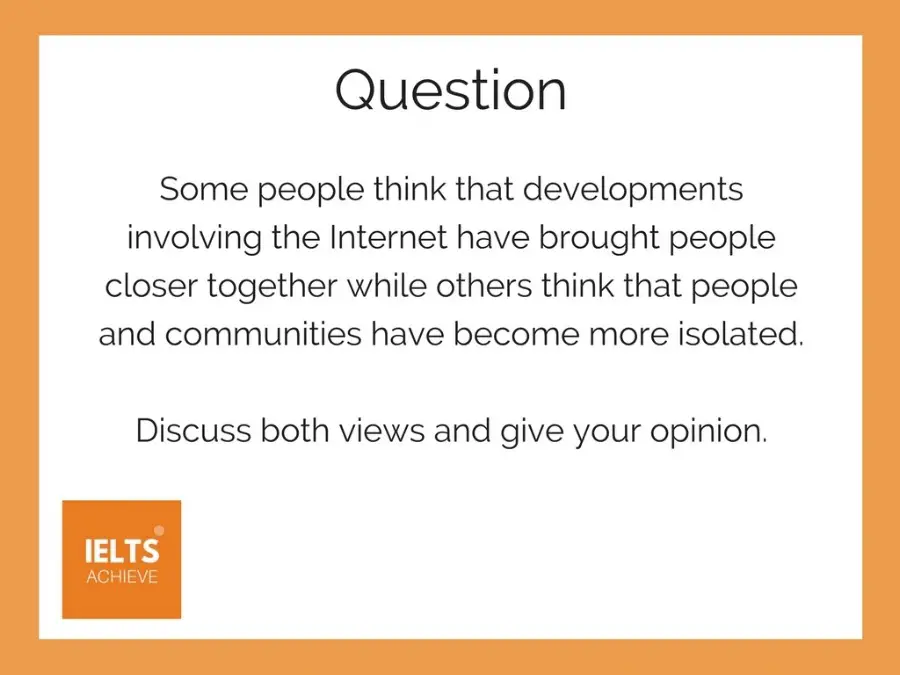
It is undeniable that modern technology has a huge influence on people’s lives. The use of the internet, for example, has become more common and some claim that it has been able to connect people who are far apart, while others argue that its use can lead to social isolation or confinement. This essay will discuss both views and state my own position.
Firstly, during the last two decades, there have been many tech developments and advancements, bringing convenience to all. One significant attribute of this modernization is the internet, while this technology has made our lives more convenient in many aspects, including our approach to communication. In the past, we only used mail or the telephone to send our messages across the globe, whereas today, the internet allows us to reach out to almost everyone in just a few seconds. The inconvenience of long distances is eliminated as we can talk and even see distant friends or relatives for an unlimited time. For example, the internet connects people whose relatives or families are abroad, through Facebook, Twitter or Skype anytime and anywhere.
Secondly, this technological development has its drawbacks, as it has been observed that some individuals tend to spend a lot of their time surfing the internet or on different social networking sites. Communities meet online via private Facebook groups, instead of in a community hall to discuss matters, since this does not allow them to socialise physically with people, they isolate themselves in this virtual world. Both teenagers and adults use much of their time online and this does not allow them to develop their interpersonal skills. For instance, a study from 2015 by The Social Media Explorer saw that over 93% of teenagers aged 16-19 have a social media presence, with more than three social accounts per person.
Thirdly, in my opinion, I believe that the internet can bring people closer together, as it can make both socialising and work much easier for those who travel. Communities can speak freely at any time, in groups, asking for help or advice, though it is up to the individuals to acknowledge how much time they are spending online and whether this is a cause for concern. Isolation cannot be blamed on the internet, as it is just a tool to use, the individual must be in charge of their own time. For example, a person who works from home online for many hours in the day should make sure they have adequate breaks and make time for socialising, as to not feel isolated or removed from their own community.
In conclusion, it is a fact that the internet has brought more convenience into society and allowed many people to be closer. However, people should take responsibility to balance the use of the internet so that other aspects of their lives will not become neglected.
(Word Count – 476 / Band Score 9)
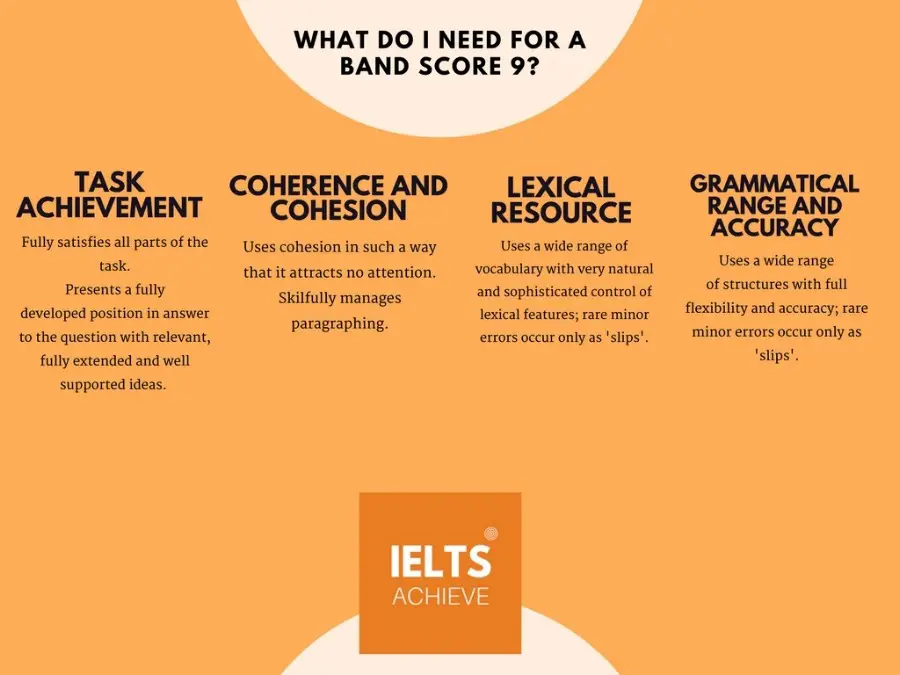
Task Achievement – The answer discusses both sides of the argument and ends with a clear opinion. the main body paragraphs are supported with relevant examples. The essay exceeds the word count, but all sentences are relevant and focussed.
Coherence and Cohesion – The answer has been divided into clear logical paragraphs and each main body paragraph only has one main idea. There are cohesive links between the main body paragraphs (Firstly, Secondly, Thirdly, In conclusion).
Lexical Resource – There is evidence of a wide range of vocabulary, with no errors in the text.
Grammatical Range and Accuracy – The answer has no grammatical errors. The sentences have a wide range of structures including relative clauses (in which...).
TIP >> Use each of the main body paragraphs (paragraphs 2 and 3) to discuss both views, giving examples that are relevant. Remember to give your opinion, state your opinion in the fourth paragraph. In the conclusion (paragraph 5), summarise your main points and state which view is more important.
WRITING TASK 2 BAND SCORE 9 CRITERIA >>
If you would like to view more high band score discussionessay examples please click the button below >
We hope you found this post helpful in helping you to study for the IELTS Test. Let us know in the comments or on the Facebook page if you have any questions. The best way to keep up to date with posts like this is to like us on Facebook, and then follow us onInstagramand Pinterest. We offer essay correction services, mock exams, and online courses. If you need help preparing for the IELTS Test, join the IELTS Achieve Academy and see how we can help you achieve your desired band score faster.
A detailed guide to this IELTS Writing Task 2 essay type, with structure templates, useful vocabulary, and techniques to achieve Band 7+.
Originally published December 2017. Last reviewed 3 July 2026.
In writing task 2 you will be asked to write a discursive essay (250 words minimum). You will be given a question asking you to give your opinion, discuss a problem or issue. You could also be asked to provide solutions, evaluate a problem, compare and contrast different ideas or challenge an idea. In this post, we will be focussing on how to write a problem/solution essay.
One of the first things you should do is read the marking criteria to see what the examiners expect. This is really important, as you need to know what they are looking for in the band 7+ boxes.
You should be able to give the examiners exactly what they want, in order to get a 7+ band score.
If you would like to purchase a 30 page PDF download that is easy to read and print out please take a look at the bookshop >
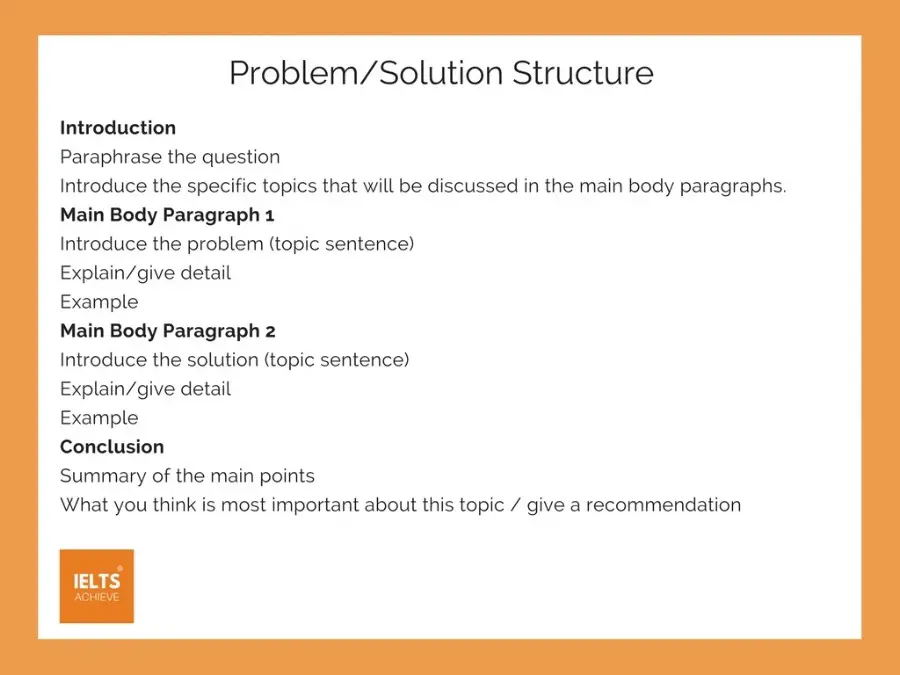
WRITING TASK 2 Problem/Solution STRUCTURE
The structure that I advise my students to use, will be sure to get you a band score 7+. You need to practice using this structure, with as many questions as you can, before sitting your IELTS test. This writing task 2 structure has been proven to be successful for my students and when perfected, can easily help you to achieve a high band score.
TIP >> Before you start writing, plan your ideas so that you can organise the information clearly. You must decide what you think is the main problem and what the specific solution to that problem is. Take 5 minutes and plan out your ideas and examples.
TIP >> It is very important that spend a full 40 minutes on this task as the score you get for writing task 2 is two-thirds of your total writing score. You also need to write a minimum of 250 words and use your own ideas.
TIP >> Remember to write in a formal tone, this is an academic essay, therefore your writing should be formal.
This is one possible way to structure your essay;
It is a 4-PARAGRAPH STRUCTURE >>
Paragraph 1 – The Introduction
This is the introduction to the essay and where you should start off by paraphrasing the question.
Do you understand what I mean, when I say ‘paraphrase’ the question?
This means that you rewrite the question in your own words using synonyms. You can’t just copy the question again or use the same words in the question. Paraphrase and show off your vocabulary knowledge by using synonyms. When practicing your essay writing, use an online thesaurus to help you. This is a great tool and can help you to learn many new words.
Then your next sentence should introduce the essay, this will tellthe examiner exactly what you will discuss in the main body paragraphs. For example, Firstly this essay will discuss……… Secondly, this essay will discuss…….
There are two sentences you need in the introduction >>
Paraphrase the question
Introduce the specific topics that will be discussed in the main body paragraphs.
Paragraph 2 – Main Body Paragraph 1
In this paragraph, you should describe a specific problem.
Start the paragraph by introducing the problem. This is where you need to have a topic sentence. The next sentence(s) should explain the problem, going into detail. The third sentence should give an example that supports the problem.
The example you give could be something from your own experience or made up – it is ok to make up something as the examiners will not fact check your information. They want to see your ability to use English at a certain level. You could make up an example from a report, journal, newspaper or University study.
This is how the paragraph should look >>
Introduce the problem (topic sentence)
Explain/give detail
Example
If you would like to purchase a 30 page PDF download that is easy to read and print out please take a look at the bookshop >
Paragraph 3 – Main Body Paragraph 2
In this paragraph, you should write about the solution.
Start the paragraph by introducing the solution. This is where you need to have a topic sentence. The next sentence(s) should explain the solution, going into detail. The third sentence should give an example.
The example you give could be something from your own experience or made up – it is ok to make up something as the examiners will not fact check your information. They want to see your ability to use English at a certain level. You could make up an example from a report, journal, newspaper or University study.
This is how the paragraph should look >>
Introduce the solution (topic sentence)
Explain/give detail
Example
Paragraph 4 – The Conclusion
In the fourth paragraph, you write the conclusion giving a summary of your main points and say what you think is most important about this topic and give a recommendation. You should not enter any new information or ideas in this paragraph.
Summary of the main points
What you think is most important about this topic / give a recommendation
Another possible way to structure your problem/solution essay is this;
Introduction
Problem 1 – Describe a specific problem and give a solution
Problem 2 – Describe another specific problem and give a solution
Problem 3 – Describe a third specific problem and give a solution
Conclusion
You will need to make a choice, either describe each problem and give a solution in the same paragraph, or split the information into separate paragraphs, with only one main idea in each of the main body paragraphs.
SAMPLE Problem/Solution ESSAY >>
**All questions have been reported by students who have taken the IELTS exam.**
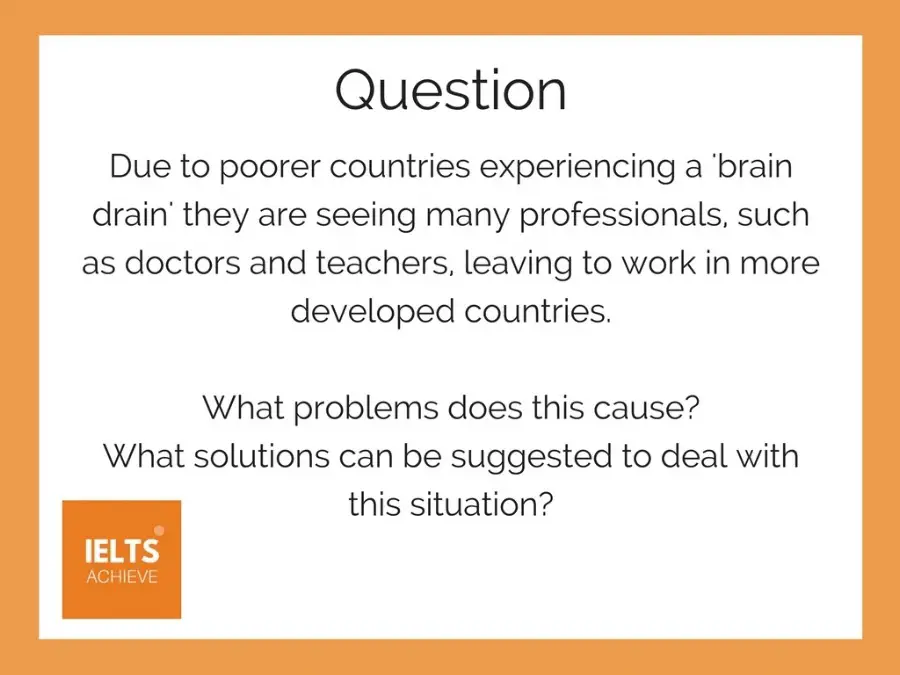
In many developing countries, there are a number of skilled academics leaving in search of better pay, increased socioeconomic benefits, and the chance to earn citizenship in a developed country. In this essay, I will examine the impact this has had on the more poverty stricken countries and suggest how this situation could be improved.
The foremost problem with skilled professionals, such as doctors and teachers leaving is that it deprives the country of people who are necessary to its survival. A shortage of doctors in hospitals could lead to them being severely understaffed, even though they have the trained doctors and nurses who are local and willing to work. In addition, some academic institutions will also suffer, with a lack of skilled teachers in highly desirable subjects, like maths, science and languages. Many professionals desire better pay and working conditions, leaving in search of a better lifestyle, so that they can earn a higher salary. For example, a study from Bucharest University showed that in Romania in 2014, 75% of graduates had applied to work in the UK and the USA.
A possible solution to this problem is for skilled professionals to enter into mandatory service in their origin country, before being able to migrate. Those who earn their qualifications from state universities should have to work in service to their country for a set amount of time, even though they are ready for the wider workplace. This would address the shortage of workers in hospitals and schools, meanwhile gaining experience, in order to give something back to their community and country. For instance, in Romania, it is common practice for graduates from state-funded university courses to work in areas where their services are needed for a minimum of two years before they are able to apply to work abroad.
In conclusion, with the rising demand for nurses, doctors and teachers in economically rich countries like the UK, more and more people are leaving their poor origin countries in search of better pay, working conditions and benefits. It is, therefore, necessary for governments to put appropriate schemes into place, with mandatory service for state-funded degree holders.
(Word Count = 362 / Band Score 9)
Task Achievement – The answer provides a paraphrased question, to begin with, followed by a relevant problem and solution. Both the problem and solution are fully supported in the main body paragraphs in the essay, with fully extended and well-supported ideas. the style of the writing is appropriate for an academic essay.
Coherence and Cohesion – The answer has been divided into clear logical paragraphs and each main body paragraph only has one main idea. There are cohesive links between the main body paragraphs and between most sentences. Examples are highlighted with discourse markers like – for example, and for instance. The conclusion gives a clear recommendation, which is linked to the information in the main body paragraphs.
Lexical Resource – There is evidence of a wide range of vocabulary, with no errors in the text.
Grammatical Range and Accuracy – The answer has no grammatical errors. The sentences have a wide range of structures.
TIP >> Remember to give both a problem and solution. Use each of the main body paragraphs to support your ideas, giving examples that are relevant. In the conclusion, summarise your main points and say what is important about the topic/give a recommendation.
WRITING TASK 2 BAND SCORE 9 CRITERIA >>
If you would like to view more high band score problem and solution essay examples please click below >
We hope you found this post helpful in helping you to study for the IELTS Test. Let us know in the comments or on the Facebook page if you have any questions. The best way to keep up to date with posts like this is to like us on Facebook, and then follow us onInstagramand Pinterest. We offer essay correction services, mock exams, and online courses. If you need help preparing for the IELTS Test, join the IELTS Achieve Academy and see how we can help you achieve your desired band score faster.
A detailed guide to this IELTS Writing Task 2 essay type, with structure templates, useful vocabulary, and techniques to achieve Band 7+.
Originally published December 2017. Last reviewed 3 July 2026.
In writing task 2 you will be asked to write a discursive essay (250 words minimum). You will be given a question asking you to give your opinion, and discuss a problem or issue. You could also be asked to provide solutions, evaluate a problem, compare and contrast different ideas or challenge an idea. In this post, we will be focusing on how to write a advantages/disadvantages essay.
One of the first things you should do is read the marking criteria to see what the examiners expect. This is really important, as you need to know what they are looking for in the band 7+ boxes.
You should be able to give the examiners exactly what they want, in order to get a 7+ band score.
Do you want to learn how to write an advantage/disadvantage essay faster and score a higher band score? Download our 24 page PDF resource that is designed to help you prepare systematically for a 7+ band Score.
The structure that I advise my students to use, will be sure to get you a band score of 7+. You need to practice using this structure, with as many questions as you can, before sitting your IELTS test. This writing task 2 structure has been proven to be successful for my students and when perfected, can easily help you to achieve a high band score.
TIP >> Before you start writing, plan your ideas so that you can organise the information clearly. You must decide what the main advantages and disadvantages are. Take 5 minutes and plan out your ideas, opinions and examples.
TIP >> It is very important that spend a full 40 minutes on this task as the score you get for writing task 2 is two-thirds of your total writing score. You also need to write a minimum of 250 words and use your own ideas.
TIP >> Remember to write in a formal tone, this is an academic essay, therefore your writing should be formal.
This is one possible way to structure your essay;
4-PARAGRAPH STRUCTURE >>
Paragraph 1 – The Introduction
This is the introduction to the essay and where you should start off by paraphrasing the question.
Do you understand what I mean, when I say ‘paraphrase’ the question?
This means that you rewrite the question in your own words using synonyms. You can’t just copy the question again or use the same words in the question. Paraphrase and show off your vocabulary knowledge by using synonyms. When practising your essay writing, use an online thesaurus to help you. This is a great tool and can help you to learn many new words.
Then your next sentence should introduce the essay, this will tellthe examiner exactly what you will discuss in the main body paragraphs. For example, Firstly this essay will discuss……… Secondly, this essay will discuss…….
There are two sentences you need in the introduction >>
Paraphrase the question
Introduce the specific advantages/disadvantages that will be discussed in the main body paragraphs.
Paragraph 2 – Main Body Paragraph 1
In this paragraph, you should describe the main advantage.
Start the paragraph by introducing the main advantage. This is where you need to have a topic sentence. The next sentence(s) should explain, going into detail. The third sentence should give an example that supports the advantage.
The example you give could be something from your own experience or made up – it is ok to make up something as the examiners will not fact check your information. They want to see your ability to use English at a certain level. You could make up an example from a report, journal, newspaper or University study.
This is how the paragraph should look >>
Introduce the advantage (topic sentence)
Explain/give detail
Example
Paragraph 3 – Main Body Paragraph 2
In this paragraph, you should write about the main disadvantage.
Start the paragraph by introducing the disadvantage. This is where you need to have a topic sentence. The next sentence(s) should explain, going into detail. The third sentence should give an example.
The example you give could be something from your own experience or made up – it is ok to make up something as the examiners will not fact check your information. They want to see your ability to use English at a certain level. You could make up an example from a report, journal, newspaper or University study.
This is how the paragraph should look >>
Introduce the disadvantage (topic sentence)
Explain/give detail
Example
Paragraph 4 – The Conclusion
In the fourth paragraph, you write the conclusion giving a summary of your main points and say what you think were the most important pros and cons. You should not enter any new information or ideas in this paragraph.
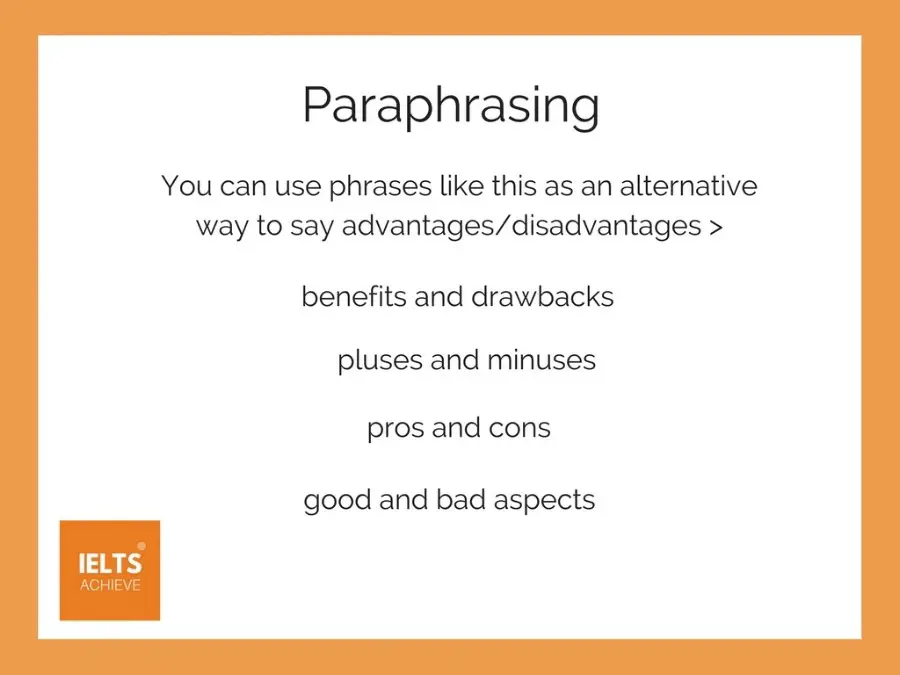
You can end your conclusion with a balancing statement that tells the reader why one side is better than the other. For example, using words like outweigh, balance out, compensate for, exceed and make up for.
Summary of the main points
What you think were the most important pros and cons?
Another possible way to structure your advantage/disadvantage essay is this;
You may want to add paragraphs to explain further advantages or disadvantages, but there should be only one main idea in each main body paragraph. Don’t list all of your advantages/disadvantages in one paragraph.
Introduction
Paragraph 1 – Describe an advantage
Paragraph 2 – Describe an advantage
Paragraph 3 – Describe a disadvantage
Conclusion
TIP >> If the question asks you if the advantages outweigh the disadvantages of something then your essay structure will change slightly. You should make sure you write about how one side is better than the other. You will also have to include this in your introduction. The side that you think outweighs the other should be written about first in main body paragraph 1. Followed by main body paragraph 2 – the more fragile argument.
TIP >> If the question asks you to write about advantages/disadvantages and give your opinion, then y
You need to add an extra paragraph that clearly states your opinion. You would also need to write about your opinion in the introduction.
SAMPLE Advantages/Disadvantages ESSAY >>
**All questions have been reported by students who have taken the IELTS exam.**
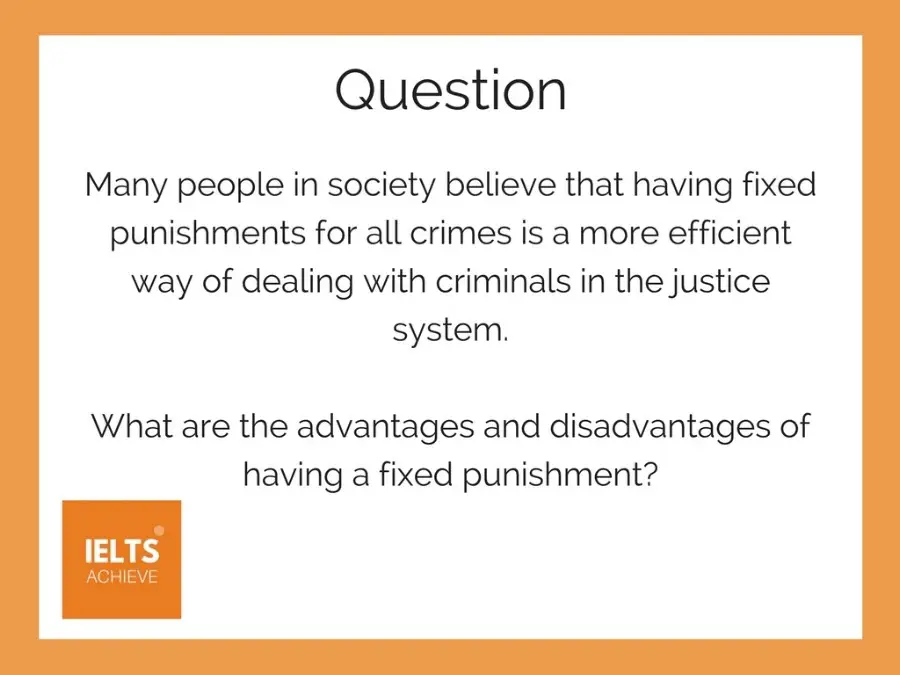
There is an ongoing debate on the merits of having a rigid discipline system in place for all crimes committed. This essay will firstly discuss, how having fixed punishments could lead to a more competent judiciary system as the biggest advantage. Secondly, this essay will discuss how this may lead to people being punished in the same way for both minor and major crimes as the primary disadvantage.
On the one hand, the main advantage of having a standardised punishment system could lead to a downward trend in crime, as the system would serve as a deterrent. This would allow the courts to easily hand out justice to all criminals, in order to make the judiciary system more powerful. For example, in some states in the USA, there are tough sanctions in place for criminals, including death by lethal injection. In 2014, the New York Times reported that up to 65% of criminals who were incarcerated for high-level crimes (murder, manslaughter) received the lethal injection.
On the other hand, the primary disadvantage of having fixed punishments is that people who have committed low-level crimes may also be given harsh sentences, in the same way as those who have been sentenced for high-level crimes. This may make the system unjust, as the punishment should befit the crime. For instance, a person who may have acted in self defence, should have their case heard in full, before being given a punishment befitting of someone who has been part of a violent act.
In conclusion, fixed punishment offers an interesting choice for effective crime deterrence and a faster judicial process. However, its inherent flaw in generalising all crime without carefully considering mitigating circumstances would compromise the very essence of justice and should warrant a closer study before fully implementing it to any modern judicial system.
(Word Count = 302 / Band Score 9)
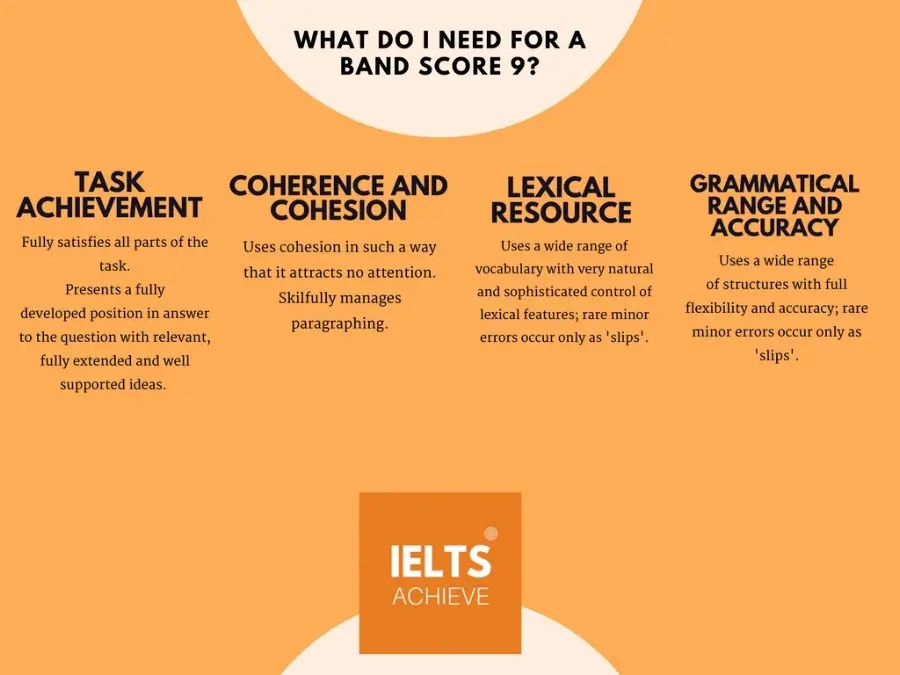
Task Achievement – The answer provides a paraphrased question, to begin with, followed by stating an advantage and a disadvantage. Both the advantages/disadvantages are fully supported in the main body paragraphs in the essay, with fully extended and well-supported ideas. the style of the writing is appropriate for an academic essay.
Coherence and Cohesion – The answer has been divided into clear logical paragraphs and each main body paragraph only has one main idea. There are cohesive links between the main body paragraphs and between most sentences. Examples are highlighted with discourse markers like – for example, and for instance.
Lexical Resource – There is evidence of a wide range of vocabulary, with no errors in the text.
Grammatical Range and Accuracy – The answer has no grammatical errors. The sentences have a wide range of structures.
TIP >> Remember to give both an advantage and a disadvantage. Use each of the main body paragraphs to support your ideas, giving examples that are relevant. In the conclusion, this is where you summarise your main points.
WRITING TASK 2 BAND SCORE 9 CRITERIA >>
If you would like to view more high band score advantages or disadvantageessay examples please click here.
We hope you found this post helpful in helping you to study for the IELTS Test. Let us know in the comments or on the Facebook page if you have any questions. The best way to keep up to date with posts like this is to like us on Facebook, and then follow us onInstagramand Pinterest. We offer essay correction services, mock exams, and online courses. If you need help preparing for the IELTS Test, join the IELTS Achieve Academy and see how we can help you achieve your desired band score faster.