We all know the simple don’ts of an interview such as don’t arrive late, don’t dress inappropriately and don’t show up looking unprepared. However, I have compiled a more in-depth Top 10 List of Don’ts derived from the feedback of industry companies and candidates alike.
1) Don’t mispronounce the names of those interviewing you. Double check the pronunciation of names with the receptionist or hiring manager prior to your interview. Getting names correct is a simple matter of courtesy and respect.
2) Don’t walk into the interview without knowing about the company. Do your homework and research the company prior to the interview. Visiting their website is a good place to start.
3) Don’t even think about answering your cell phone during the interview. It’s best to turn it off prior to entering the building.
4) Don’t make negative comments or remarks about your present or past employers. When explaining why you are seeking a change, communicate your rationale professionally.
5) Don’t answer questions with a simple “yes” or “no”. Explain and give details whenever possible. However, make sure you provide the details in a succinct and articulate manner.
6) Don’t expect your resume to close the deal. Sell yourself by providing more information and cite specific examples of how you have been successful at your current or past job(s).
7) Don’t pretend to know-it-all. If you don’t know the answer to a question, say so. Never pretend to know something or someone if you don’t.
8) Don’t inquire about salary, vacation, benefits, bonuses or retirement during the initial interview. This information will be provided at a later date if the process proceeds. If the interviewer asks about the salary you want, give a range based on your research of competitive rates. However, it might be best to indicate that you are more interested in the opportunity than a specific salary.
9) Don’t falsify application information. Most companies do background checks on candidates and any false information you provide will be exposed.
10) Don’t’ leave the interview without asking about the next steps in the process and don’t forget to write a thank-you note immediately after the interview.
Questions 15-20
Complete the sentences below.
Choose ONE WORD ONLY from the text for each answer.
Write your answer in boxes 15-20 on your answer sheet.
15. Before the interview make sure you.............................. the company.
16. Only say good things about your past employers, nothing ................................
17. Give good answers to questions with lots of ..................................
18. Include............................. of how you have used your skills in previous jobs.
19. It is better not to ask questions about the ....................................
20. Be honest, most places will do a ............................ check.
This course is suitable for people aged 16+ who work in high-hazard environments such as construction, manufacturing or agriculture.
It is also ideal for organisations whose needs assessment identifies a requirement for additional first aid training (e.g. due to having employees with a disability or medical condition).
It gives learners the skills and confidence to respond to a range of accidents and first aid emergencies they could encounter in the workplace.
Length
3 days
Time
09:00-17:00
Course content includes:
Our first aid at work course covers the content specified in the Health and Safety (First Aid) Regulations 1981.
It gives learners the first aid skills to help someone who:
is unresponsive and breathing
is unresponsive and not breathing (including the use of an automated external defibrillator/AED)
is choking
is bleeding
is suffering from shock
is burnt
feels faint
has been poisoned
has a head injury
has hypothermia or heat exhaustion
is having a medical emergency:
seizure
heart attack*
angina attack
stroke
asthma attack
severe allergic reaction
diabetic emergency
has an injury to a bone muscle or joint (including spinal injuries).
The course also includes information on:
dealing with an emergency:
assessing a casualty
monitoring a casualty
where to get help
electrical incidents
accident recording and reporting
control of substances hazardous to health (COSHH).
Each learner receives a training pack including a host of resources to help them practice the skills covered. The pack includes a course companion workbook, first aid manual, bandages and more.
Qualification
The HSE requires at least 18 training and contact hours for this course. Learners must attend all sessions to be eligible for assessment, which is done by continuous observation and questioning during the course.
On successful completion of this course, you will receive a first aid at work certificate which is valid for three years.
For best practice, we support the HSE recommendation to complete an annual first aid skills update.
Pre-requisites
Our courses offer a practical, hands-on approach that delivers the skills and confidence to use first aid skills in a real life situation. Learners must be physically able to carry out the practical elements of the course.
Questions 21-27
Answer the questions below.
Choose ONE OR TWO WORDS ONLY AND/OR A NUMBER from the text for each answer.
Write your answers in boxes 21-27 on your answer sheet.
21. What is the minimum age to enrol on the course?
22. Which position is the certificate intended for?
23. How many days does the course cover?
24. What does each participant receive during the course?
25. How many hours must the students attend in order to pass the course?
26. How long is the course certificate valid for?
27. What do the students have to be, so that they can manage the course?
For help to answer these questions with practice please read the posts below >>
We hope you found this post useful in helping you to study for the IELTS Test. If you have any questions please let us know in the comments below or on the Facebook page.
The best way to keep up to date with posts like this is to like us on Facebook, then follow us on Instagram and Pinterest.
If you need help preparing for the IELTS Test, join the IELTS Achieve Academy and see how we can assist you to achieve your desired band score. We offer an essay correction service, mock exams and online courses.
Answers >
Questions 15-20
15. research
16. negative
17. details
18. examples
19. salary
20. background
Questions 21-27
21. 16
22. One of the following - Construction/Manufacturing/Agriculture
Henry, the second son of King Henry VII and Elizabeth of York, was born on 28 June 1491 at Greenwich Palace. After the death of his elder brother Arthur in 1502, Henry became heir to the English throne.
B
When Henry VII died in 1509, this popular eighteen-year-old Prince, known for his love of hunting and dancing, became King Henry VIII. Soon after he obtained the papal dispensation required to allow him to marry his brother's widow, Catherine of Aragon. In the first years of his reign Henry VIII effectively relied on Thomas Wolsey to rule for him, and by 1515 Henry had elevated him to the highest role in government: Lord Chancellor. In 1521 Pope Leo X conferred the title of Defender of the Faith on Henry for his book 'Assertio Septem Sacramentorum', which affirmed the supremacy of the Pope in the face of the reforming ideals of the German theologian, Martin Luther.
C
Henry VIII's early military campaigns began when he joined Pope Julius II's Holy League against France in 1511. Wolsey proved himself to be an outstanding minister in his organisation of the first French campaign and while the Scots saw this war as an opportunity to invade England, they were defeated at Flodden in 1513. However, war with France ultimately proved expensive and unsuccessful. Henry VIII is known as the 'father of the Royal Navy.' When he became king there were five royal warships. By his death, he had built up a navy of around 50 ships. He refitted several vessels with the latest guns including the Mary Rose, which sank in 1545. Henry also built the first naval dock in Britain at Portsmouth and in 1546 he established the Navy Board. This set up the administrative machinery for the control of the fleet.
D
Henry was acutely aware of the importance of securing a male heir during his reign. He was worried that he had only one surviving child, Mary, to show for his marriage to Catherine, who was now in her 40s. So the king asked Cardinal Wolsey to appeal to Pope Clement VII for an annulment and it soon became clear he wanted to marry Anne Boleyn, who had been a lady-in-waiting to his first wife. But, unwilling to anger Catherine of Aragon's nephew – the most powerful ruler in Europe, the Holy Roman Emperor Charles V – the Pope refused. Thomas Wolsey's ascendancy was cut short by this failure. In 1533, Henry VIII broke with the church and married the now pregnant Anne Boleyn in a secret ceremony. Henry was excommunicated by the Pope. The English Reformation had begun.
E
After Wolsey's downfall, Thomas Cromwell became Henry's chief minister and earned the confidence of the King by helping him to break with Rome and establish Henry VIII as head of the Church of England. This act also brought him much needed wealth through the dissolution of the well-funded monasteries. Over four years Cromwell ordered that 800 monasteries be disbanded and their lands and treasures were taken for the crown. The cultural and social impact was significant, as much of the land was sold to the gentry and churches and monasteries were gutted and destroyed. Henry's personal religious beliefs remained Catholic, despite the growing number of people at court and in the nation who had adopted Protestantism.
F
In September 1533 Anne gave birth to a daughter, Elizabeth (the future Queen Elizabeth I). Henry had grown tired of her, and after two further pregnancies ended in miscarriages, she was arrested in 1536 on trumped up charges of adultery and publicly beheaded at the Tower of London. Henry's third marriage, this time to the lady-in-waiting, Jane Seymour, finally produced the son he so desperately desired with the birth of Edward in 1537. Jane Seymour died after childbirth and Henry ordered that she be granted a queen's funeral. In an attempt to establish ties with the German Protestant alliance, Thomas Cromwell arranged a marriage between the king and German princess Anne of Cleves. The marriage was a disaster and Henry divorced Anne a few months later. Henry blamed Cromwell for this mismatch and soon afterwards had him executed for treason.
G
The final years of his reign witnessed Henry VIII's physical decline and an increasing desire to appear all-powerful. Henry continued with fruitless and expensive campaigns against Scotland and France. In 1540, the ageing King married the teenage Catherine Howard. Their marriage was short-lived. It was alleged that she had a previous relationship with Henry's courtier Francis Dereham and an affair with another courtier Thomas Culpeper. Catherine was executed for adultery and treason in 1542. Henry's final marriage to Catherine Parr, who acted as a nurse, was more harmonious and she would go on to outlive him. Henry VIII died on 28 January 1547 and was succeeded by his son, Edward VI. He was buried next to Jane Seymour in St. George's Chapel at Windsor Castle.
Questions 35 - 37
Complete the summary below.
Choose NO MORE THAN TWO WORDS from the text for each answer.
Write your answers in boxes 35-37 on your answer sheet.
Who was Henry VIII?
Henry VIII was one of the most notable and memorable monarch's that England has seen. Much talked about throughout history, Henry VIII ascended to the throne when his father died and he was the only 35 .................................... He married his brother's widow Catherine of Aragon and took counsel from one of the more well-known figures in history 36 ................................................. Throughout his reign, Henry VIII was known for his many relationships, foremost with his second wife 37 .................................................... This relationship was the driving force behind Henry's break with Rome and the Catholic faith.
Questions 38-40
Complete the notes below.
Choose ONE WORD ONLY from the text for each answer.
Write your answers in boxes 38-40 on your answer sheet.
The Wives of Henry VIII
Catherine of Aragon was the first wife of Henry VIII, originally married to his brother.
His second wife was Anne Boleyn, mother of 38 ........................................ He grew tired of her and had her beheaded.
Moving on to Jane Seymour who gave Henry the son he so wanted, she died during childbirth.
Next was Anne of Cleaves, who was thought to have disappointed Henry with her appearance, however, she survived the marriage as it ended in 39 .............................................
After that, he married teenager Catherine Howard, who was much younger than him and was rumoured to have had many affairs.
Lastly he married Catherine Parr, who went on to 40 ....................................... him.
If you need help to answer these questions with extra practice please read the posts below >>
We hope you found this post useful in helping you to study for the IELTS Test. If you have any questions please let us know in the comments below or on the Facebook page.
The best way to keep up to date with posts like this is to like us on Facebook, then follow us on Instagram and Pinterest.
If you need help preparing for the IELTS Test, join the IELTS Achieve Academy and see how we can assist you to achieve your desired band score. We offer an essay correction service, mock exams and online courses.
Essential strategies and practice techniques for this IELTS Reading question type. Learn how to manage time and improve accuracy.
Originally published June 2017. Last reviewed 3 July 2026.
In this post, we will take a look at the reading skills you need to be successful in the IELTS Reading Test and how you can improve your skills.
There are 7 main reading skills you will use during your preparation for the IELTS Reading Test;
Previewing
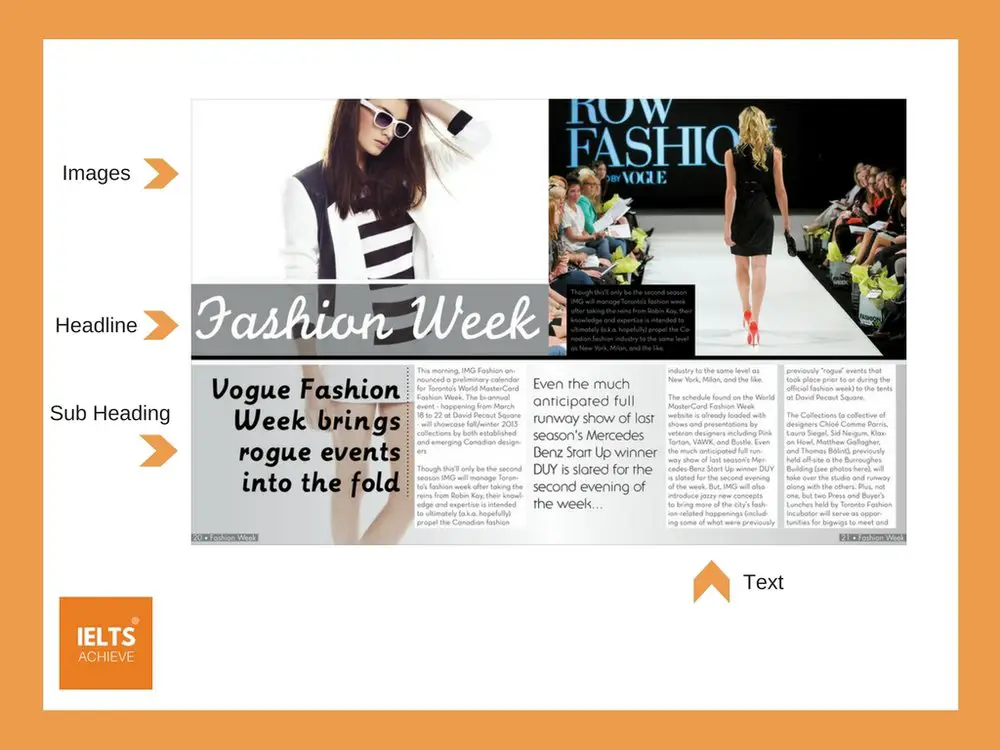
When you preview a text you look at the headings, the layout and any images to get an idea of what the text is about before you decide if you want to read it or not. For example, when you look at an article in a newspaper or a magazine, the headline and images give you an idea of what it is about. Previewing is an important skill to have because it helps you to foresee the content and this makes it easier to understand the text.
TIP >> Next time you read an article think about the headline, subheading and the images and think about the following questions - How do they draw you in to read more? How do they tell you what the article is about?
Predicting Content And Structure
This is when you use your knowledge and guess what a text is going to be about. For example, if you see an advert about adopting animals or donating to animal shelters, you would be able to guess the purpose of the text and the image(s) was to make you want to adopt an animal or help the shelters by donating money, therefore the vocabulary used would be related to this. Predicting is an important reading skill because you can make sense of a text when you already know about the topic.
TIP >>Practice by looking at adverts you see in magazines, online (blogs etc) and look at the vocabulary used and think about the following questions - How does it relate to the topic? How does it tell you about the purpose of the advert?
Source
Skimming
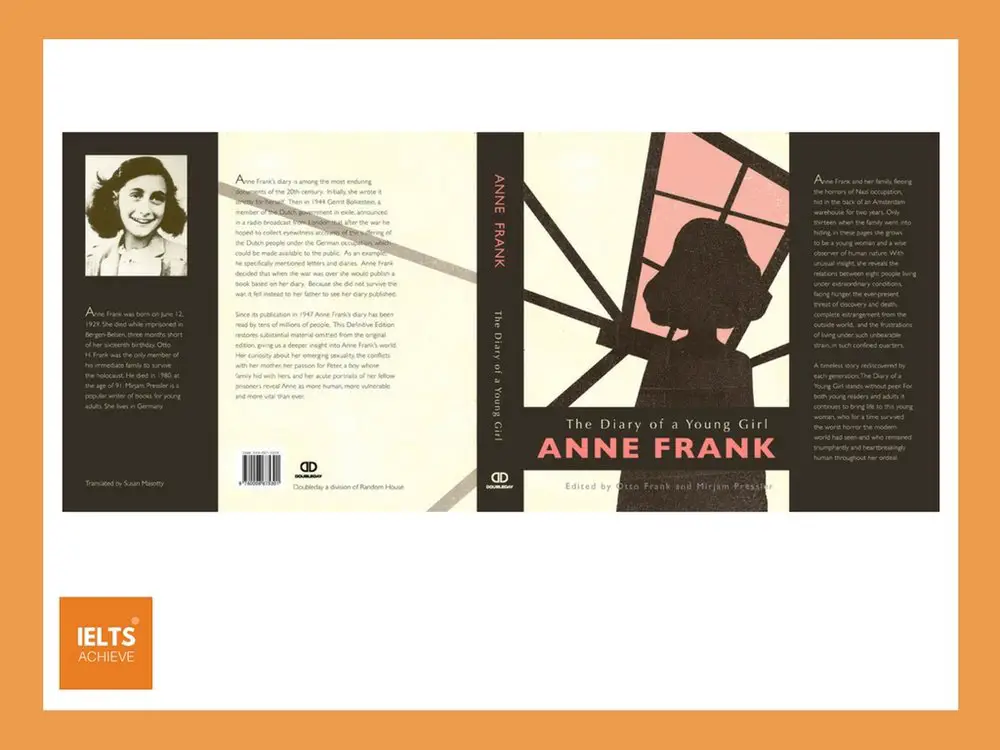
When you skim read a text for the main idea, you read the text quickly to get the general idea of the main topic. When you do this, you are looking for the main idea - not the specific details. For example, you may skim read the back cover of a book jacket to get an idea of what the book is about before you decide to read/buy the book. Skimming is an important skill because in the test you are time conscious, so you need to skim read texts in order to get the main idea, before locating specific information needed to answer questions.
TIP >> Practice skim reading by reading articles, reviews and summaries to get the main idea. Choose content that interests you, not only IELTS practice materials.
When you scan a text to find the information you also do this quite quickly to find what you need. You normally use this skill when you are looking for facts. For example, if you are looking for a train time or the departure gate you need at the airport, you scan the board's looking for the information. Therefore, you use this skill every day when looking at times, dates or places.
TIP >> Practice scanning by looking for information in timetables, the TV guide etc and find facts you need quickly.
Intensive Reading
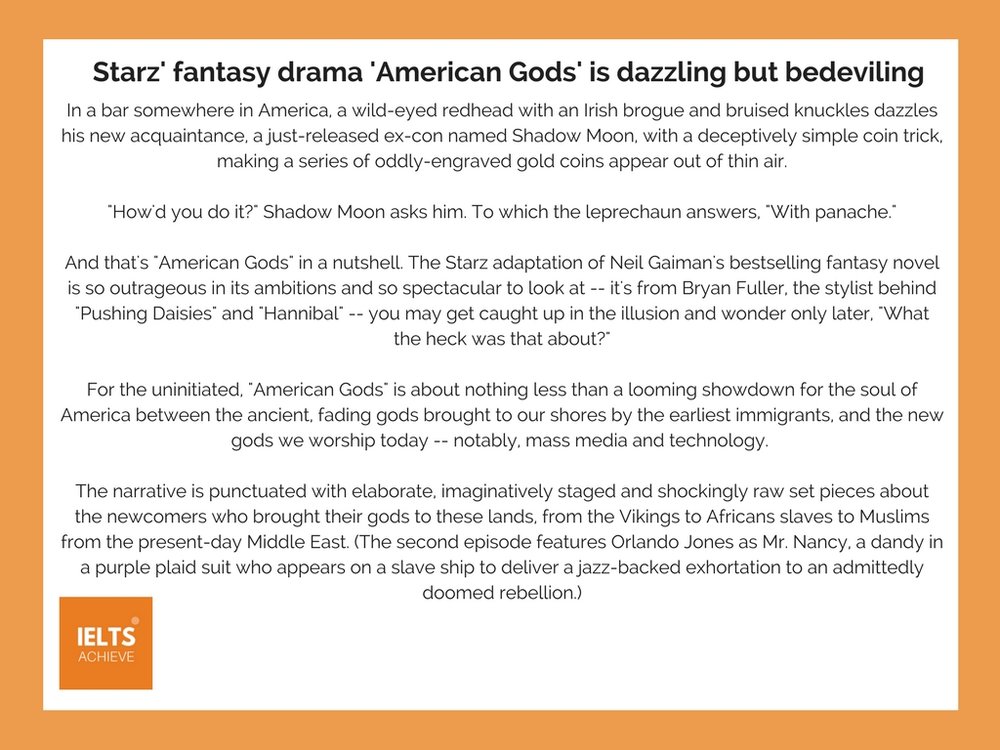
When you read a text carefully and study the information, this is intensive reading. You do this when the content is important. For example, if you had to fill out some important forms, like renewing your passport or filling out a tax return, you would read the instructions carefully, before filling out the forms. You need to read carefully for more detail when you need to understand the writer's meaning. For instance, when reading a tv show review, you might want to read it intensively to find out the details to see if you want to watch it or not.
TIP >> Read reviews and other texts you find interesting and study the content. Think about how detailed the information is, do you understand the writer's meaning?
Look at the review below of the TV Show 'American Gods' - How does the writer tell you what they think about the show?
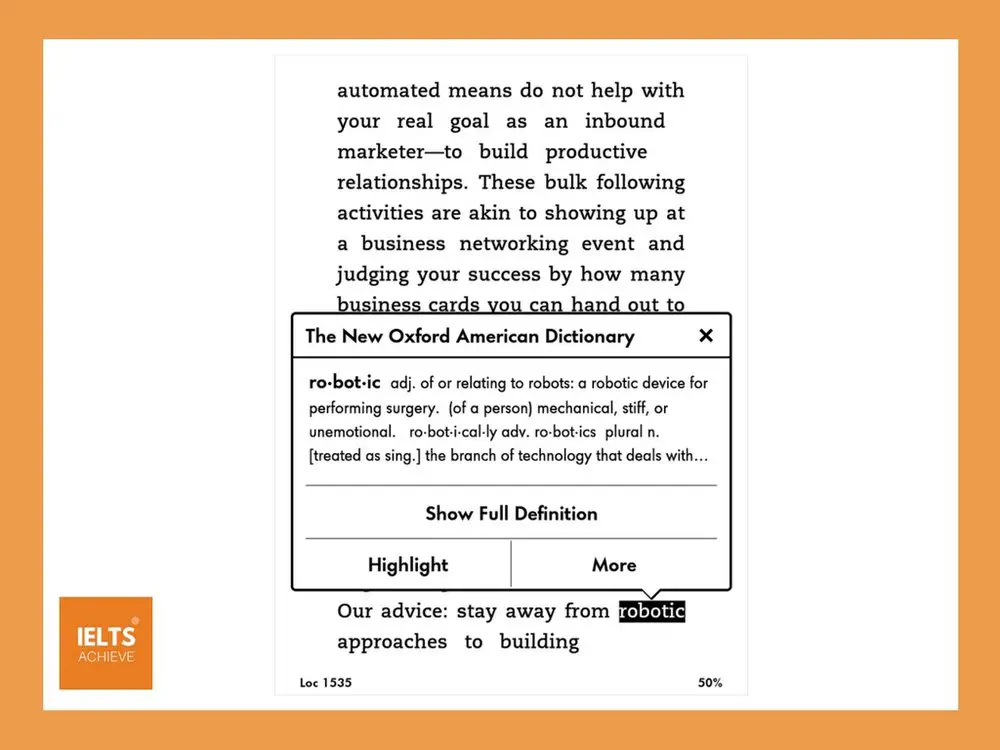
When you are reading and you come across a word or words you don't know, you can sometimes guess the meaning from the context they are in. If not then you will have to look up the meaning in a dictionary (although this is not allowed in the test). For instance, if you were reading a book and you saw a word you did not know, you might be able to work out the meaning from the context of that sentence or paragraph.
TIP >> When you read - keep a dictionary and a notebook with you and write down any words you do not know the meaning of. Alternatively, you can do this easily if you use your smartphone or Ipad. If you have an e-reader, the built-in dictionary will show you the meaning of the words once highlighted. This is so useful for learning new vocabulary.
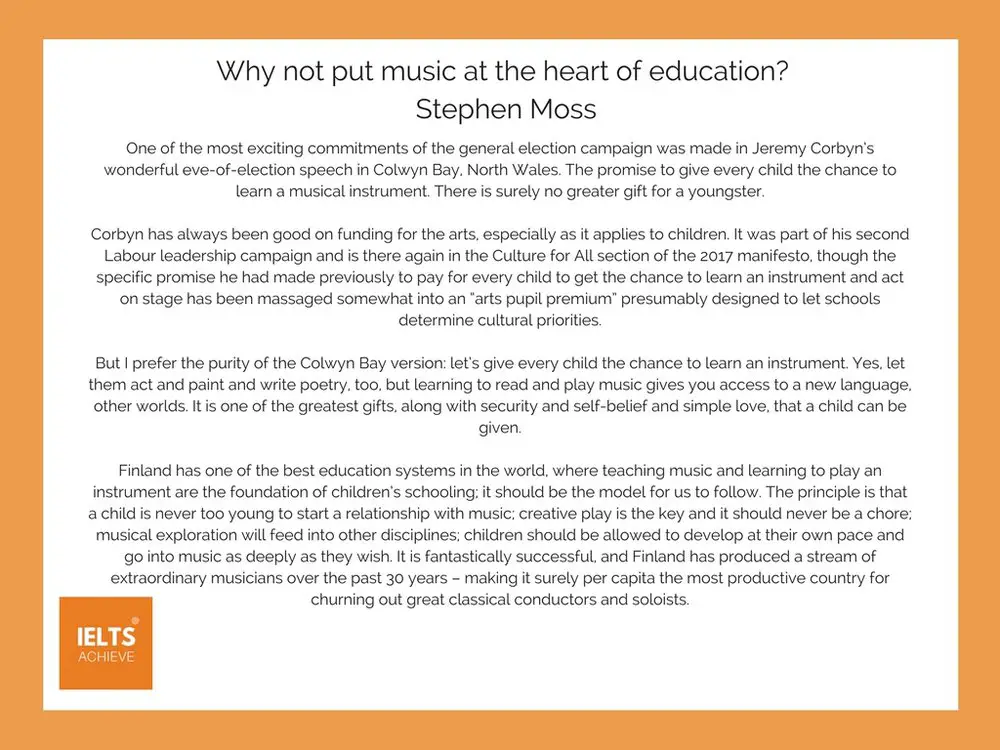
When you read a book, article etc, you should be able to understand how the writer feels or thinks about a subject. For example, in an article or blog about travelling, you may read views on certain places and how they feel when going there. This can help you to understand how they explain their opinions and views through the language they use. Understanding attitude and opinion are important skills because writers do not always clearly state how they think or feel.
TIP >> Read reviews or opinions from opinion sections of newspapers like The Guardian or The Washington Post. Think about how the writer shares their opinion - is it obvious? What language/vocabulary do they use? How can you tell what they are thinking or feeling?
Look at the opinion piece below from The Guardian - how does the writer share his opinion about the topic?
Read more - Read as much as you can in English, choose anything that interests you - not just IELTS practice materials. Read novels, magazines, news articles, blogs and anything else that holds your attention. Reading really helps with your writing, as you learn new vocabulary, grammar and understand how structures work.
Make a note of any new words - Write them down and look them up - this will help you to remember the words and their meaning.
Take note of the grammar - Think about the structures used, look at the sentences, the tenses and the punctuation.
Idea development - When reading news articles think about how the writer leads you through the information, how do they develop their ideas? How do they structure the writing? Where do they put the facts? The opinions?
Opinions - How do they share their opinions with the reader? What kind of language and structure do they use to do this?
Schedule some reading time - when you are travelling on your commute to work, lunchtime, before bed - try to fit in some reading.
We hope you found this post useful in helping you to study for the IELTS Test. If you have any questions please let us know in the comments below or on the Facebook page.
The best way to keep up to date with posts like this is to like us on Facebook, then follow us on Instagram and Pinterest.
If you need help preparing for the IELTS Test, join the IELTS Achieve Academy and see how we can assist you to achieve your desired band score. We offer an essay correction service, mock exams and online courses.
Comprehensive guide covering essential IELTS preparation strategies and techniques to help you achieve your target band score.
Originally published June 2017. Last reviewed 3 July 2026.
In this post, we will be looking at identifying information and the writer's views or claims,including true, false and not given and yes, no not given questions.
True, False, Not Given
In the IELTS Reading Test, common questions include true, false, not given. You will be asked to identify information in a text, then reading statements and deciding if they are true, false or not given.
When reading the text, you must concentrate and look for the following;
TRUE - this means that the statement agrees with the information in the text.
FALSE - This means that the information disagrees with the information in the text.
NOT GIVEN - this means that the information is not present in the text - so you cannot say if it is either true or false.
For the answer to be true, it must agree and be true to the information given in the text. Any information that is not shown in the text would be not given.
TEST QUESTION
In the IELTS test, the true, false, not given questions will look similar to the those below >>
Exercise 1
Read the text below (from the English History website) and decide if the statements are true, false or not given.
Mary, Queen of Scots was one of the most fascinating and controversial monarchs of 16th century Europe. At one time, she claimed the crowns of four nations – Scotland, France, England and Ireland. Her physical beauty and kind heart were acknowledged even by her enemies. Yet she lacked the political skills to rule successfully in Scotland. Her second marriage was unpopular and ended in murder and scandal; her third was even less popular and ended in forced abdication in favour of her infant son. She fled to England in 1568, hoping for the help of her cousin, Elizabeth I. Her presence was dangerous for the English queen, who feared Catholic plotting on Mary’s behalf. The two queens never met and Mary remained imprisoned for the next nineteen years. She was executed in 1587, only forty-four years old. By orders of the English government, all of her possessions were burned. In 1603, upon Elizabeth’s death, Mary’s son became king of England as James I.
True - if the statement agrees with the information
False - if the statement contradicts the information
Not Given - if there is no information present
10. Mary Queen of Scots was once the monarch of four different places.
11. Mary married her first husband Francis ii of France in 1558.
12. Mary and Queen Elizabeth 1st were good friends and met often.
13. After her death, Mary's son James 1st became the King of Scotland.
Answers at the bottom of the page.
TIP >> NOT GIVEN > The IELTS Reading Test is measuring your ability to be able to read a text and find information within it. Not about your general knowledge on the subject. If the information is not in the text - your answer would, therefore, be not given.
Exercise 2
Read the text below (from the English History website) and decide if the statements are true, false or not given.
Henry’s first wife, Katharine of Aragon, was the youngest child of the ‘Catholic Kings’ of Spain, Ferdinand and Isabella; she and Henry were married for over twenty years. His second wife, Anne Boleyn, was the daughter of an ambitious knight; she was executed after three years of marriage. His third wife, Jane Seymour, died after less than two years of marriage, having finally produced a son and heir for Henry. His fourth wife, Anne of Cleves, was divorced mere months after the wedding, for Henry found her unattractive and was already courting his fifth wife, Catherine Howard. Catherine was executed after less than two years of marriage and the king settled upon the twice-widowed Katharine Parr as his sixth wife. She outlived the mercurial king.
True - if the statement agrees with the information
False - if the statement contradicts the information
Not Given - if there is no information present
14. Henry's first wife Katharine of Aragon was the longest relationship he had with any of the wives.
15. Henry Viii favoured his second wife Anne Boleyn above all the others.
16.Henry Viii divorced Anne of Cleaves after a short time.
17. atherine Parr had two sons with Henry Viii before he died.
Answers at the bottom of the page.
Exercise 3
Read the text below (from the English History website) and decide if the statements are true, false or not given.
Elizabeth Tudor is considered by many to be the greatest monarch in English history. When she became queen in 1558, she was twenty-five years old, a survivor of scandal and danger, and considered illegitimate by most Europeans. She inherited a bankrupt nation, torn by religious discord, a weakened pawn between the great powers of France and Spain. She was only the third queen to rule England in her own right; the other two examples, her cousin Lady Jane Grey and half-sister Mary I, were disastrous. Even her supporters believed her position dangerous and uncertain. Her only hope, they counselled, was to marry quickly and lean upon her husband for support. But Elizabeth had other ideas.
She ruled alone for nearly half a century, lending her name to a glorious epoch in world history. She dazzled even her greatest enemies. Her sense of duty was admirable, though it came at a great personal cost. She was committed above all else to preserving English peace and stability; her genuine love for her subjects was legendary. Only a few years after her death in 1603, they lamented her passing. In her greatest speech to Parliament, she told them, ‘I count the glory of my crown that I have reigned with your love.’ And five centuries later, the worldwide love affair with Elizabeth Tudor continues.
‘Proud and haughty, as although she knows she was born of such a mother, she nevertheless does not consider herself to inferior degree to the Queen, whom she equals in self-esteem; nor does she believe herself less legitimate than her Majesty, alleging in her own favour that her mother would never cohabit with the King unless by way of marriage, with the authority of the Church….
She prides herself on her father and glories in him; everybody saying that she also resembles him more than the Queen does and he therefore always liked her and had her brought up in the same way as the Queen.’ the Venetian ambassador Giovanni Michiel describes Elizabeth; spring 1557.
Elizabeth Tudor was born on 7 September 1533 at Greenwich Palace. She was the daughter of King Henry VIII and his second wife, Anne Boleyn. Henry had defied the papacy and the Holy Roman Emperor to marry Anne, spurred on by love and the need for a legitimate male heir. And so Elizabeth’s birth was one of the most exciting political events in 16th-century European history; rarely had so much turmoil occurred on behalf of a mere infant. But the confident predictions of astrologers and physicians were wrong and the longed-for prince turned out to be a princess.
True - if the statement agrees with the information
False - if the statement contradicts the information
Not Given - if there is no information present
18. Queen Elizabeth 1st wanted to find a husband to share her royal responsibilities.
19. Queen Elizabeth 1st was loved by many.
20. Queen Elizabeth 1st was the only female heir to the throne.
21. Henry was determined to marry Anne Boleyn, driven by his affection and his longing for a son.
Answers at the bottom of the page.
What is the difference between true, false, not given and yes, no, not given questions?
There is a difference between the true, false, not given questions and the yes, no, not given questions.
The true, false, not given questions are asking you to look for information based on facts in the text.
The yes, no, not given questions are asking you to look for the writer's views or claims in the text.
Identifying The Writer's View or Claims
When the writer is giving their opinion, this is them expressing their view on a topic. If the writer presents something as a fact, then this is a claim. Therefore to find a claim or view in the text, you are required to read the text and use your own interpretation of it.
Not given still means that you cannot find any information in the text in relation to the statement.
Yes, No, Not Given
For these questions you will look at the following;
YES - if the statement agrees with the views or claims
NO - if the statement contradicts the views or claims
NOT GIVEN - it is impossible to say what the writer's views/claims are
TEST QUESTION
In the IELTS test, the yes, no, not given questions will look similar to the those below >>
Exercise 4
Read the text below (from the BBC English History website) and decide if the statements are yes, no or not given.
Viking Raids
Raids by seaborne Scandinavian pirates on sites in Britain, especially largely undefended monastic sites, began at the end of the eighth century AD.
By the end of the ninth century, there were large-scale settlements of Scandinavians in various parts of Britain, and they had achieved political domination over a significant territory.
Early in the 11th century, the king of Denmark became King of England as well. And in 1066 there were separate invasions by the king of Norway, Harald Hardrada, and Duke of Normandy, William, the latter the descendant of Scandinavian settlers in northern France.
Many monasteries in the north were destroyed, and with them any records of the raids.
Yet the most significant development of the period was an indirect result of Scandinavian involvement in the affairs of Britain - the emergence of two kingdoms of newly unified territories, England and Scotland.
In 793 AD, an anguished Alcuin of York wrote to the Higbald, the bishop of Lindisfarne and to Ethelred, King of Northumbria, bemoaning the unexpected attack on the monastery of Lindisfarne by Viking raiders, probably Norwegians sailing directly across the North Sea to Northumbria.
It is clear from the letter that Lindisfarne was not destroyed. Alcuin suggested that further attack might be averted by moral reform in the monastery.
Over the next few decades, many monasteries in the north were destroyed, and with them any records they might have kept of the raids. We know no historical details of the raids in Scotland, although they must have been extensive.
Iona was burnt in 802 AD, and 68 monks were killed in another raid in 806 AD. The remaining monks fled to Kells (County Meath, Ireland) with a gospel-book probably produced in Iona, but now known as the 'Book of Kells'.
Other monasteries in Scotland and northern England simply disappear from the record. Lindisfarne was abandoned, and the monks trailed around northern England with their greatest possession, the relics of St Cuthbert, until they found a home in Durham in 995 AD.
Skim the text and see if the statements below agree with the claims of the writer >>
YES - if the statement agrees with the views or claims
NO - if the statement contradicts the views or claims
NOT GIVEN - it is impossible to say what the writer's views/claims are
7. The most important part of that time was the evolution of two empires.
8. The fear that the Norwegians would cross the ocean and settle into the North of England.
9. The Vikings left with treasures including 'The Book of Kells'.
10. The Vikings ruined many places along the north coast in the UK including Bamburgh Castle.
Answers at the bottom of the page.
Exercise 5
Read the text below (from the BBC English History website) and decide if the statements are yes, no or not given.
The Home Front
The concept of a 'Home Front' - when civilians are mobilised en masse to support the war effort during a conflict - dates from World War One, as far as the British are concerned. It was re-activated in 1938 during the Munich crisis when civilians were encouraged to enrol in Air Raid Precautions (ARP) or the Auxiliary Fire Service (AFS).
Anticipating terror from the air
ARP was a reaction to the fear, shared throughout Europe in the 1930s, of the mass bombing of civilians from the air. In the 1930s, the government estimates calculated that 600,000 people would be killed and 1.2 million injured in air raids during a future war.
The evacuation had already been running for two days by the time war with Germany was announced on 3 September 1939. Throughout the war, three million people were moved beyond the reach of German bombers, in what became a fundamentally life-changing event for many. The internment of German and Austrian 'aliens' also commenced at the outbreak of war, and those considered high risks were interned immediately. Later, Italian aliens were 'rounded up' under Churchill's orders after Italy joined the war in June 1940.
'Doing your bit'
The nation's labour was once again mobilised, and to an even greater extent than World War One. Half a million women joined the uniformed services, and millions more worked in the factories and on the land. Both men (from 1939) and women (from 1941) were conscripted. Men were even conscripted into the coal mines - one in ten of those enlisted domestically.
Skim the text and see if the statements below agree with the claims of the writer >>
YES - if the statement agrees with the views or claims
NO - if the statement contradicts the views or claims
NOT GIVEN - it is impossible to say what the writer's views/claims are
11. Although many people were in the military services during World Wars 1 and 2 much more volunteered to help.
12. During the war, many people were displaced.
13. People from Italy were offered protection from the English government.
14. Women completed more roles during the war effort than men.
Answers at the bottom of the page.
REVIEW AND STRATEGY
The true, false, not given / yes, no, not givenquestions are common in the IELTS Reading Test, therefore you should practice and develop a strategy for answering.
TIP >> Read the instructions before you start reading the questions or the text. Take note if the questions are true, false, not given or yes, no, not given.
TIP >> Read the questions and the given text. For the yes, no, not given questionslook out for keywords that suggest the writer is sharing their view or opinion, like; always, occasionally, some or claimed.
TIP >> Skim read the text and match the statement to the correct part of the text.
TIP >> Check that the statement exactly matches the meaning of the text if you are going to say it is true (or yes). If it does not it is false (or no). If there is no information - it is not given.
TIP >> Answers are in the same order as the text, work your way through them. If you are going over and over looking for something, then it is most likely 'not given'. Don't waste lots of time looking for something that is not there.
TIP >> Be aware of synonyms and paraphrasing.
Answers >>
Exercise 1 Answers >>
10. True
11. Not Given
12. False
13. False
Exercise 2 Answers >>
14. True
15. Not Given
16. True
17. False
Exercise 3 Answers >>
18. False
19. True
20. Not Given
21. True
Exercise 4 Answers >>
7. Yes
8. Yes
9. No
10. Not Given
Exercise 5 Answers >>
11. Yes
12. Yes
13. No
14. Not Given
We hope you found this post useful in helping you to study for the IELTS Test. If you have any questions please let us know in the comments below or on the Facebook page.
The best way to keep up to date with posts like this is to like us on Facebook, then follow us on Instagram and Pinterest.
If you need help preparing for the IELTS Test, join the IELTS Achieve Academy and see how we can assist you to achieve your desired band score. We offer an essay correction service, mock exams and online courses.
Essential strategies and practice techniques for this IELTS Reading question type. Learn how to manage time and improve accuracy.
Originally published June 2017. Last reviewed 3 July 2026.
In this post, we will be looking at matching information.
For the matching information tasks, you should look at each phrase in the questions and then find the information or idea in the text. The order of the questions is not in the order of where you will find the information in the text. A skill that is important and will help you is skim reading.
Skim Reading
Skim reading is a skill that is used to locate information in a text quickly. It is often used to find the main ideas or the main points in a text. In the IELTS Reading Test, skim reading is a skill you should use when trying to find numbers or dates, a measurement, a reason, a finding, a description, a reaction, an account, a cause or an effect, a conclusion or a problem. It will help you to find the information you need to answer questions and it makes sure you know the overall meaning of the text.
Look at the sentences below, which ones have a number, a date, a description, a measurement, a finding, a reaction, a cause, an effect, a conclusion? (More than one type may apply to each sentence).
Skim read through to find the information >>
The Medical Journal of the American Research Institute last year published many articles relating to new developments in medicine.
By 2020, the number of people aged 60 years and older will outnumber children younger than 5 years.
Many people have been shocked by the number of cuts in the health system this year.
The government has made a huge mistake in failing to give nurses a pay rise for over 10 years, thus losing voters and support from that profession.
The impact of spending cuts in the NHS has seen many people suffer long waiting hours over a number of departments, increasing the wait time in A&E in some hospitals to over 4 hours.
Answers at the bottom of the page.
Matching Information
Look at the extracts from texts below and match them to the following information >>
An Effect
A Date
A Finding
An Account
People worldwide are living longer. Today, for the first time in history, most people can expect to live into their sixties and beyond. By 2050, the world’s population aged 60 years and older is expected to total 2 billion, up from 900 million in 2015.
According to The World Health Organisation (WHO), a longer life brings with it opportunities, not only for older people and their families but also for societies as a whole. Additional years provide the chance to pursue new activities such as further education, a new career or pursuing a long-neglected passion.
In fact, in the research paper on ageing by The World Health Organisation (WHO), there is, however, little evidence to suggest that older people today are experiencing their later years in better health than their parents. While rates of severe disability have declined in high-income countries over the past 30 years, there has been no significant change in mild to moderate disability over the same period.
If people can experience these extra years of life in good health and if they live in a supportive environment, their ability to do the things they value will be little different from that of a younger person. If these added years are dominated by declines in physical and mental capacity, the implications for older people and for society are more negative.
Below is an example of how a matching information question may look in the IELTS Reading test. In the examples given in this post, the texts are short, to give you an introduction to how to answer this type of question. In the test, the texts will be much longer with a word count of 1000+, you will need to skim read the whole text to find the answers you are looking for.
Read the information below and match the information, remember to skim read the text, don't read every word.
Diversity in older age (A) There is no ‘typical’ older person. Some 80 year-olds have physical and mental capacities similar to many 20 year-olds. Other people experience significant declines in physical and mental capacities at much younger ages. A comprehensive public health response must address this wide range of older people’s experiences and needs.
Health inequities (B) The diversity seen in older age is not random. A large part arises from people’s physical and social environments and the impact of these environments on their opportunities and health behaviour. The relationship we have with our environments is skewed by personal characteristics such as the family we were born into, our sex and our ethnicity, leading to inequalities in health. A significant proportion of the diversity in older age is due to the cumulative impact of these health inequities across the life course. Public health policy must be crafted to reduce, rather than reinforce, these inequities.
Outdated and ageist stereotypes (C) Older people are often assumed to be frail or dependent, and a burden to society. Public health, and society as a whole need to address these and other ageist attitudes, which can lead to discrimination, affect the way policies are developed and the opportunities older people have to experience Healthy Ageing.
Which paragraph contains the following information?
Write the correct letter A-C, in boxes 11-13 on your answer sheet.
11. A description of the way society views the elderly.
12. A reaction to the rights for the elderly living in our society.
13. The effect of our surroundings partnered with our own personality traits, which lead to health differences.
Answers at the bottom of the page.
How You Can Prepare = Read More
You should prepare as much as possible before your IELTS Test and that includes reading regularly. You can find good texts to read on various websites like the news sites listed in the Introduction to IELTS Reading post.
You should try to read around a range of topics, from health, the environment, technology, education, history and general interest articles. The IELTS articles will not cover politics or religion, so you can focus on other topics.
Some articles may seem challenging to read, but this is really good practice! Keep a notebook and write down any words you do not know the meaning of, then look them up and write the meaning in the book. This is a good way to learn new vocabulary.
REVIEW AND STRATEGY
The matching information questions are common in the IELTS Reading Test, therefore you should practice and develop a strategy for answering.
TIP >> Read the instructions before you start reading the text. Make sure you understand the questions.
TIP >> Skim read the text/paragraphs and get the main idea.
TIP >> Look at the questions and think about if they match up with any of the paragraphs. Is anything standing out to you?
TIP >> Choose your answers through an elimination process. Which ones do not fit? Which ones can you dismiss? Be attentive to synonyms and paraphrasing.
Task Answers >>
Skim reading exercise answers >>
A finding
A description
A reaction
A cause
An effect
Matching Information Answers (Task 1) >>
A Date
An Account
A Finding
An Effect
Matching Information Answers (Task 2) >>
11. C
12. A
13. B
We hope you found this post useful in helping you to study for the IELTS Test. If you have any questions please let us know in the comments below or on the Facebook page.
The best way to keep up to date with posts like this is to like us on Facebook, then follow us on Instagram and Pinterest.
If you need help preparing for the IELTS Test, join the IELTS Achieve Academy and see how we can assist you to achieve your desired band score. We offer an essay correction service, mock exams and online courses.