Step-by-step guide to answering this type of IELTS Writing Task 1 question. Covers structure, key language, and band-scoring criteria.
Originally published May 2018. Last reviewed 3 July 2026.
In this post, we will look at a Writing Task 1 Academic map essay example from the IELTS writing task 1 Academic Test. Students often ask if the questions are repeated year after year and the answer is no, but the type of map, process, graph or chart can be.
There are so many questions written each year, you may find you practice answering various questions on different topics. It is best practice to learn how to answer each one of the various types of writing task 1 questions, from bar charts, line graphs, maps, process etc.
If you would like to learn how to structure a map essay please click the button below >
Take a look at the IELTS Writing Task 1 Academic essay example below >>
*This map question and answer were provided by a student. IELTS Achieve did not design this question*
The map below shows the changes in an American town between 1948 and 2010.
Summarise the information by selecting and reporting the main features, and make comparisons where relevant.
The picture illustrates the noticeable changes that happened to an American town from 1948 and 2010.
Overall, there are slight changes that happened in the town within the 62 years as some structures were removed, while there are many establishments that had been added.
On the one hand, in the year 1948, the town was surrounded by trees while residential houses can be seen from the west and east of the town. The local supermarket is situated in the west area and the church is located in the south near to the canal, while there are established factories that can be seen in the northeast region.
On the other hand, after 62 years, some of the residential areas were replaced by commercial buildings. The church was also removed and as a replacement, a sports stadium was created. In addition, a local airport was also established in the area where the factories were once found. The canal was left untouched whereas, the supermarket was relocated to the area where once a small park was located.
Word count - 174 / Band score 8
Task Achievement - The answer provides a paraphrased question, to begin with, followed by an overview that gives the reader key information.
Coherence and Cohesion - The answer has been divided into clear logical paragraphs.
Lexical Resource - There is evidence of paraphrasing, synonyms and some less common words.
Grammatical Range and Accuracy - The answer has no grammatical errors. The sentences are mainly made up of multiple clauses and have a variety of structures.
We hope you found this post helpful in helping you to study for the IELTS Test. Let us know in the comments or on the Facebook page if you have any questions. The best way to keep up to date with posts like this is to like us on Facebook, and then follow us onInstagramand Pinterest. We offer essay correction services, mock exams, and online courses. If you need help preparing for the IELTS Test, join the IELTS Achieve Academy and see how we can help you achieve your desired band score faster.
Step-by-step guide to answering this type of IELTS Writing Task 1 question. Covers structure, key language, and band-scoring criteria.
Originally published May 2018. Last reviewed 3 July 2026.
In this post, we will look at a Writing Task 1 Academic map essay example from the IELTS writing task 1 Academic Test. Students often ask if the questions are repeated year after year and the answer is no, but the type of map, process, graph or chart can be.
There are so many questions written each year, you may find you practice answering various questions on different topics. It is best practice to learn how to answer each one of the various types of writing task 1 questions, from bar charts, line graphs, maps, process etc.
If you would like to learn how to structure a map essay please click the button below >
Take a look at the IELTS Writing Task 1 Academic essay example below >>
*This map question and answer were provided by a student. IELTS Achieve did not design this question*
The map below is of the town of Garlsdon. A new supermarket (S) is planned for the town. The map shows two possible sites for the supermarket.
Summarise the information by selecting and reporting the main features, and make comparisons where relevant.
The map illustrates the two possible locations for a planned supermarket in the town of Garlsdon.
Overall, there were two prospective areas that were being considered for the construction of a supermarket intended for the 65,000 people of Garlsdon.
On the one hand, the first location is in the north-west part of the town just about 12 km to Hindon which has 10,000 residents. The said area is in the middle of the main road and the railway respectively. In addition, there are industrial factories located at the opposite side of the road going to Hindon.
On the other hand, the second site is situated in the town centre, which is a no traffic zone. This is between 16 km to Bransdon with a population of 15,000 and 25 km to Cransdon with a total of 29,000 inhabitants. The first location would be better for a large supermarket, as it has direct road and railway access, the second site is in the centre of the town, which has been labelled as a no traffic zone, this could make it difficult for shoppers to access.
Word count 184 / Band score 8
Task Achievement - The answer provides a paraphrased question, to begin with, followed by an overview that gives the reader key information.
Coherence and Cohesion - The answer has been divided into clear logical paragraphs.
Lexical Resource - There is evidence of paraphrasing, synonyms and some less common words.
Grammatical Range and Accuracy - The answer has no grammatical errors. The sentences are mainly made up of multiple clauses and have a variety of structures.
We hope you found this post helpful in helping you to study for the IELTS Test. Let us know in the comments or on the Facebook page if you have any questions. The best way to keep up to date with posts like this is to like us on Facebook, and then follow us onInstagramand Pinterest. We offer essay correction services, mock exams, and online courses. If you need help preparing for the IELTS Test, join the IELTS Achieve Academy and see how we can help you achieve your desired band score faster.
Step-by-step guide to answering this type of IELTS Writing Task 1 question. Covers structure, key language, and band-scoring criteria.
Originally published May 2018. Last reviewed 3 July 2026.
In this post, we will look at a Writing Task 1 Academic map essay example from the IELTS writing task 1 Academic Test. Students often ask if the questions are repeated year after year and the answer is no, but the type of map, process, graph or chart can be.
There are so many questions written each year, you may find you practice answering various questions on different topics. It is best practice to learn how to answer each one of the various types of writing task 1 questions, from bar charts, line graphs, maps, process etc.
If you would like to learn how to structure a map essay please click the button below >
Take a look at the IELTS Writing Task 1 Academic essay example below >>
*This map question and answer were provided by a student. IELTS Achieve did not design this question*
The pictures describe the proposal to convert Foster road between SE 84TH and 85TH Avenue.
Overall, the road will be changed rapidly by the installation of different safety structures. The street at present has a small footpath on both sides and there are no trees. After the proposed development, there would be modifications that convert the street into a safer place for pedestrians.
Firstly, at present, the street has one main road, with street-lights and narrow walkways. If the street is developed, it will have a pedestrian crossing located in the southern part of the street near the gas station, which will include an island in the middle of the street, for safety.
Secondly, wider sidewalks would be implemented and a bicycle lane that will encourage the people to ride their bicycles rather than drive their vehicles. Lastly, they propose to plant several trees along the sides of the two streets that will provide shade for the people as well as offer cleaner air for all.
Word count - 166 / Band score 8
Task Achievement - The answer provides a paraphrased question, to begin with, followed by an overview that gives the reader key information.
Coherence and Cohesion - The answer has been divided into clear logical paragraphs.
Lexical Resource - There is evidence of paraphrasing, synonyms and some less common words.
Grammatical Range and Accuracy - The answer has no grammatical errors. The sentences are mainly made up of multiple clauses and have a variety of structures.
We hope you found this post helpful in helping you to study for the IELTS Test. Let us know in the comments or on the Facebook page if you have any questions. The best way to keep up to date with posts like this is to like us on Facebook, and then follow us onInstagramand Pinterest. We offer essay correction services, mock exams, and online courses. If you need help preparing for the IELTS Test, join the IELTS Achieve Academy and see how we can help you achieve your desired band score faster.
Step-by-step guide to answering this type of IELTS Writing Task 1 question. Covers structure, key language, and band-scoring criteria.
Originally published May 2018. Last reviewed 3 July 2026.
In this post, we will look at a Writing Task 1 Academic map essay example from the IELTS writing task 1 Academic Test. Students often ask if the questions are repeated year after year and the answer is no, but the type of map, process, graph or chart can be.
There are so many questions written each year, you may find you practice answering various questions on different topics. It is best practice to learn how to answer each one of the various types of writing task 1 questions, from bar charts, line graphs, maps, process etc.
If you would like to learn how to structure a map essay please click the button below >
Take a look at the IELTS Writing Task 1 Academic essay example below >>
*This map question and answer were provided by a student. IELTS Achieve did not design this question*
The two maps below show an island, before and after the construction of some tourist facilities.
Summarise the information by selecting and reporting the main features, and make comparisons where relevant.
The images show the changes on an island by building amenities for possible vacationers.
Overall, the island changed rapidly, as before development, the island was empty, with a beach and scattered palm trees. After the island had been developed, there were many new buildings, roads and a pier added, in order to attract tourists.
At first, the island was roughly 250 meters wide with a small beach located in the west. There were also areas for vegetation that were scattered around the area. Over a period of time, many facilities were constructed to make it more appealing to tourists. The accommodation units were built just beside the beach area and also in the middle section of the island. There were also footpaths constructed to help people to navigate the island smoothly.
After further development, tourists could swim at the beach located in the west of the island. A restaurant was built in the north of the island and just below a reception area was added. There are also vehicle tracks that connect both facilities. A pier was also constructed in the southern part of the island where sailboats can moor. Lastly, the eastern part of the island was not developed.
Word count - 200 / Band score 8
Task Achievement - The answer provides a paraphrased question, to begin with, followed by an overview that gives the reader key information.
Coherence and Cohesion - The answer has been divided into clear logical paragraphs.
Lexical Resource - There is evidence of paraphrasing, synonyms and some less common words.
Grammatical Range and Accuracy - The answer has no grammatical errors. The sentences are mainly made up of multiple clauses and have a variety of structures.
We hope you found this post helpful in helping you to study for the IELTS Test. Let us know in the comments or on the Facebook page if you have any questions. The best way to keep up to date with posts like this is to like us on Facebook, and then follow us onInstagramand Pinterest. We offer essay correction services, mock exams, and online courses. If you need help preparing for the IELTS Test, join the IELTS Achieve Academy and see how we can help you achieve your desired band score faster.
Step-by-step guide to answering this type of IELTS Writing Task 1 question. Covers structure, key language, and band-scoring criteria.
Originally published July 2017. Last reviewed 3 July 2026.
In this post, we will look at mapsin the listening test.
On maps there are many symbols/icons that are easily recognised. In the image below you will see many icons that are used in maps. How many do you know?
Vocabulary
In the maps questions, you will hear vocabulary that is specific to giving directions. They have their own common terms that you will become familiar with. Different prepositions are used for some explanations.
For example;
Across from the .......
........ is at the end of the street
At the junction of .................
On/at the corner of .....................
Near the entrance/exit to ............................
Just past/over the roundabout ..........................
............... at the next traffic light
.................. in the next street
Practice
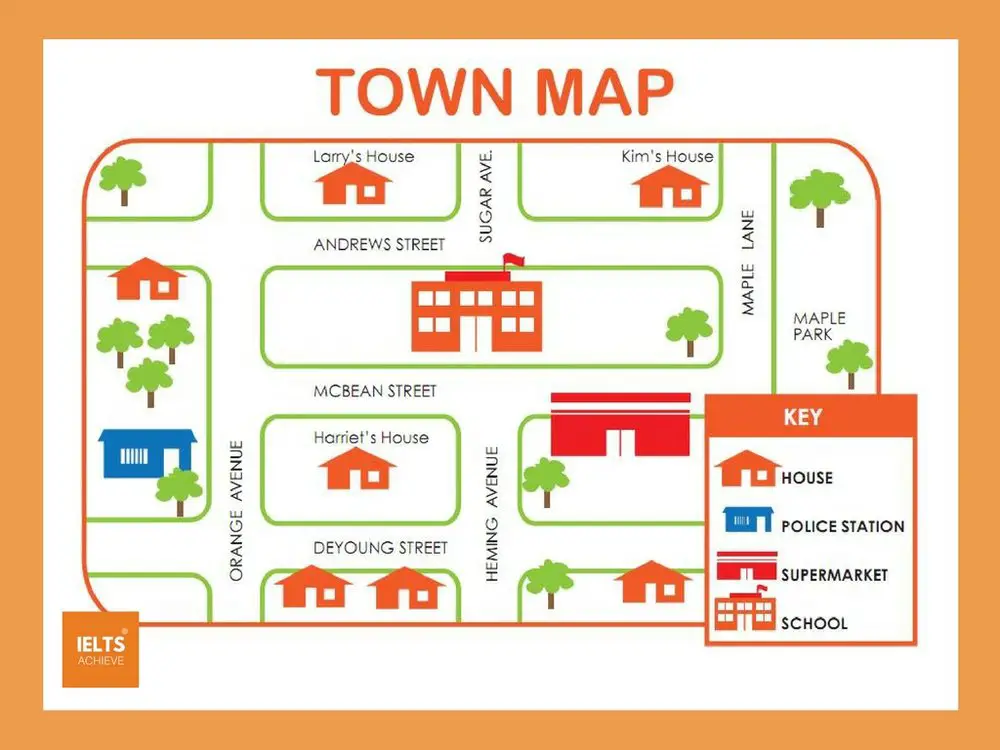
Look at the map below and see if you can answer the following questions >>
Is there a school near to the housing estate on Deyoung Street?
Is the supermarket on the right when you travel up Heming Avenue towards the school?
Is the police station on Maple Lane?
Where is Kim's house?
How would you get to Larry's house after leaving school?
How could you get to the park from Harriet's house?
Grammar
In the IELTS Listening Test, you will listen to directions and have to follow them in order to label places on a map.
When listening to the directions you will often hear the imperative, for example;
Turnright, then go straight ahead past the school. Walkalong Park Avenue.
Imperatives give an instruction, in this case, telling you what to do. They are also used in other parts of the IELTS test, for instance when you are writing or talking about something in a sequence; First, Then, Next, After that, Finally.
Directions can also use the second person singular form, for example;
When you see the school library, you turn right onto Russel Road.
Modal verbs can also be used in directions, for example;
At the roundabout, you can either go straight ahead or you could turn right and walk the longer route past the shopping area.
You could take the main street or turn left onto Brownie Road.
Prepositions
Prepositions of movement are used to show movement to or from a place.
For example;
to, through, across
When you use the word to it can show movement to a specific destination.
To get to the library you should go to Baker Street first, then take a right.
I moved to Greece in 1985.
She has gone to the shopping mall.
Through is used to show movement from one side of a confined space to the other.
The bus went through the tunnel
To get to the tennis courts you could cut through the library.
To visit the shopping mall's busiest area, you could walk through the main car park
The word across is used to show movement from one side to another.
To reach the supermarket you can go across Grant Street and turn right.
To get to the theatre she went across the walkway and turned left into Grimwald Street.
To reach the tennis courts, walk across the car park and enter the door on the right.
More prepositions of movement >>
along - the road
around - the park
away from - the busy road
back to - the library
down - the embankment
into - the shop
off - the bus
out of - the cinema
over - the road, bridge, hill etc
past - the supermarket
round - the football field
towards - the bakery
under - the bridge
up - the hill
The words at and in can be used to show the purpose of movement, for example;
The supermarket is at the end of the street, next to the large carpark.
The library is in a busy area, next to the main campus cafeteria.
Labelling A Map
Some questions will ask you to label a map. You will be given a list of places to match up with places that are numbered.
Question Example
Question 6-10
Label the map.
Choose five answers from the box and write letters A-H next to questions 6-10.
Review And Strategy
TIP >> The plans, maps and diagrams questions do not follow the order that you hear the information in the recording. Therefore it is important that you read the questions and familiarise yourself with the plan or map you are looking at before you start listening.
TIP >> Study the map and see where things are before listening to the recording. Marks can be lost if you do not do this and read the questions properly.
TIP >> Listen carefully for information but be wary of distractors.
TIP >> Make notes on the paper and draw lines to destinations etc. This may help you to locate information.
We hope you found this post useful in helping you to study for the IELTS Test. If you have any questions please let us know in the comments below or on the Facebook page.
The best way to keep up to date with posts like this is to like us on Facebook, then follow us on Instagram and Pinterest.
If you need help preparing for the IELTS Test, join the IELTS Achieve Academy and see how we can assist you to achieve your desired band score. We offer an essay correction service, mock exams and online courses.
Proven strategies for this IELTS Listening question type. Includes prediction techniques and common traps to avoid.
Originally published July 2017. Last reviewed 3 July 2026.
In this post, we will look at plansin the listening test.
Students will have to understand a description of a place and follow directions. You will probably be familiar with some of these plans, as you see them when you visit galleries, museums and other places like schools.
In section 2 you will probably hear a person talking about a topic that is not academic. It is usually someone talking about an event or showing them around a building.
The plans below are a bit more complex than those that you will see in the IELTS Listening Test. When you listen to the recording during the test, look out for the language of location. For example, next to, near, opposite, in front of etc.
TIP >> During the test make notes and/or mark the way on the question paper before transferring your answers at the end.
TIP >> Make sure you spell your answers correctly.
Question Example
Label the plan below.
Choose EIGHT answers from the box and write the correct letters A-I next to questions 11-15.
The Language of Location
To understand the description of a plan and to locate certain places you need to understand the language of location.
You should also be familiar with prepositions of place, such as in, at, on, by, next to, beside, near, between, among, behind, in front of, under, below, over, above, across, through, to, into, towards, onto and from.
For example, if we look at the plan above;
Gallery 1 is next to gallery 2.
Gallery 2 is beside gallery 3.
Gallery 6 is in front of gallery 7.
Labelling A Plan
In order to be able to label a plan, you must listen for a description or directions on the recording. You will most likely hear a person describing a plan or showing people around somewhere. You may be given a list of possible answers in a box or not.
The information you hear will be in the same order as the recording. You should study the plan carefully before listening so that you have an idea of where the options may be.
TIP >> You can cross out any options that you think are wrong and if you can't decide between two answers, write both down and make a choice later.
Question Example
Label the plan.
Write the correct letter. A-E, next to questions 11-15.
Distractors
A distractor is when you are given information that is wrong. This can lead you to choose the incorrect answer. They are common in the IELTS Listening tests, as they test your ability to choose the right information for the answers, by ignoring the wrong information.
The distractors will try to trick you into selecting the wrong answer, so you must listen carefully for specific information.
The distractors for this type of task might be more rooms etc on the plan or extra options in the list of possible answers.
Paraphrasing
The questions will paraphrase the information from the recording, or a speaker in the recording may paraphrase, so you will have to use your knowledge of synonyms, noticing any keywords and terms. Recognising and using synonyms shows the examiner that you have good vocabulary knowledge. Paraphrasing is a skill that is needed in all parts of the test.
Review And Strategy
TIP >> The plans, maps and diagrams questions do not follow the order that you hear the information in the recording. Therefore it is important that you read the questions and familiarise yourself with the plan or map you are looking at before you start listening.
TIP >> Study the map and see where things are before listening to the recording. Marks can be lost if you do not do this and read the questions properly.
TIP >> Listen carefully for information but be wary of distractors.
TIP >> Make notes on the paper and draw lines to destinations etc. This may help you to locate information.
We hope you found this post useful in helping you to study for the IELTS Test. If you have any questions please let us know in the comments below or on the Facebook page.
The best way to keep up to date with posts like this is to like us on Facebook, then follow us on Instagram and Pinterest.
If you need help preparing for the IELTS Test, join the IELTS Achieve Academy and see how we can assist you to achieve your desired band score. We offer an essay correction service, mock exams and online courses.