A complete model answer and preparation guide for this IELTS Speaking cue card topic. Includes key vocabulary, follow-up questions, and examiner-approved response strategies.
Originally published August 2017. Last reviewed 3 July 2026.
In this post, you will see a sample cue card question, high-level answer and feedback.
Model Answer
I’d like to talk about a place I visited with my parents when I was about 10 years old in 1990. We went to the Lake District in Cumbria one summer. This is a lovely place, full of green fields, hills and of course lakes. It was about a 2-hour drive from our house and one into the countryside, the surrounding areas just became more and more beautiful to see.
In the summer, it is the perfect weather for exploring the lakes, from Lake Windermere to Grasmere, we explored the surrounding areas, with a visit to Beatrix Potters house, which is a National Trust owned property and also to the poet William Wordsworth’s house. I was very interested in reading when I was younger and enjoyed visiting the former homes of these well-known writers.
There are also many hiking trails in the Lake District, over the fells and beyond. We walked a great deal, with a map and a compass to guide us and even stopped for a picnic on the top of a hill. I enjoyed walking in the hills, learning about each area and how to read a map.
I would definitely visit the Lakes again and would like to see how the areas have changed since I was last there. I would also like to visit Beatrix Potters house again, now that I am older, I think I would appreciate it more. She is a very inspiring author and illustrator and I love that she was inspired by the nature and animals around her. I would also like to stay in a hotel near to Lake Windermere and if the weather is good, hire a boat and sail around to enjoy the surrounding nature.
Feedback
This is a strong answer, as there are examples given of where, when and why. The topic has been fully discussed, with additional information added that was not prompted by the bullet points, with information being added, from the memories of visiting the places mentioned. There are various tenses and structures used, for the past and present. There is also evidence of collocations being used and a high level of vocabulary.
We hope you found this post useful in helping you to study for the IELTS Test. If you have any questions please let us know in the comments below or on the Facebook page.
The best way to keep up to date with posts like this is to like us on Facebook, then follow us on Instagram and Pinterest.
If you need help preparing for the IELTS Test, join the IELTS Achieve Academy and see how we can assist you to achieve your desired band score. We offer an essay correction service, mock exams and online courses.
A complete model answer and preparation guide for this IELTS Speaking cue card topic. Includes key vocabulary, follow-up questions, and examiner-approved response strategies.
Originally published August 2017. Last reviewed 3 July 2026.
In this post, you will see a sample cue card question, high-level answer and feedback.
Model Answer
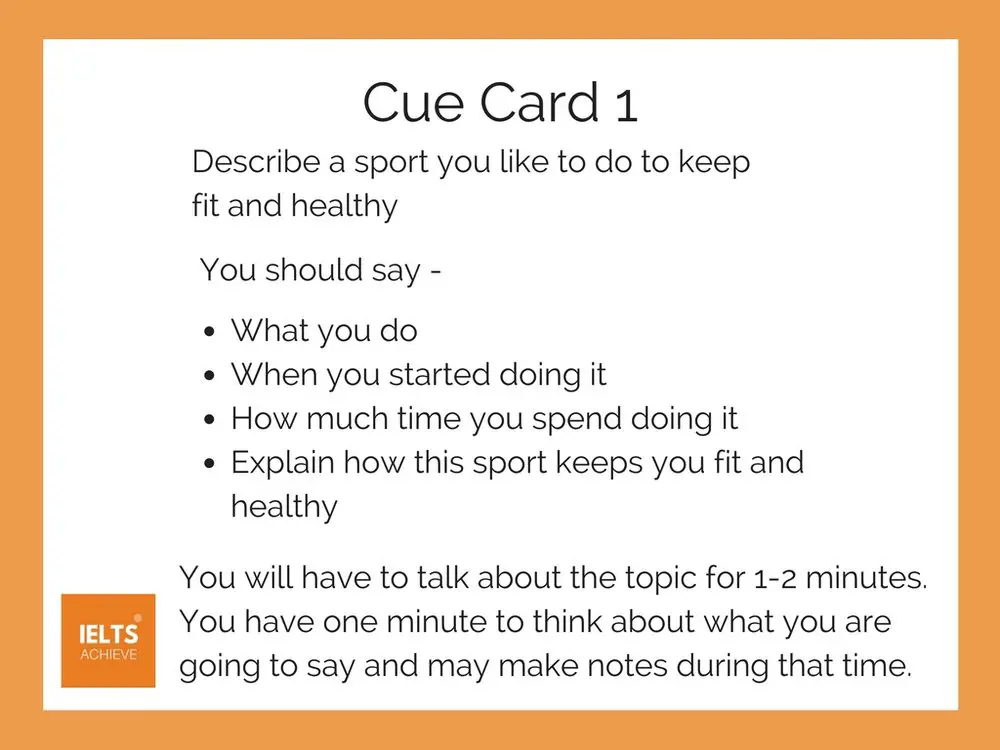
I think it’s important to exercise every day or at least three times per week, so I like to walk every morning and swim as often as I can. I learned to swim when I was at school and since then regularly visited the indoor pool, then when I moved to Spain I was going swimming nearly every day in the summer months. In the winter I like to go to an indoor pool, as it is heated and of course protects you from the elements outside.
There are many beaches close to my house, with crystal clear waters, surrounded by beautiful landscapes and hotels with large swimming pools, so I have a good choice of places to visit for a swim. I like to go to the pool when it is quiet, or the sea when it is calm. The clear salt waters are good for your health and it’s great to swim alongside the fish.
I used to go to a lot of classes in the UK, including Zumba and body combat. I had an accident during a body combat class and broke a bone in my foot, which meant that swimming and cycling were the only options open to me for a while. My doctor encouraged me to go swimming regularly, as he said the salt water would help my foot to heal and obviously to keep up my exercise routine. I really enjoyed swimming, so just kept doing it even after my foot had healed. Swimming keeps me fit and healthy as it is an all over body workout, using all of the muscles it is a great way to do cardiovascular exercise.
Feedback
This is a strong answer, as there is background given and the topic has been fully discussed.There are various tenses and structures used, for the past and present. The notes have prompts and keywords so that the topic could flow and include all of the given points from the cue card.
We hope you found this post useful in helping you to study for the IELTS Test. If you have any questions please let us know in the comments below or on the Facebook page.
The best way to keep up to date with posts like this is to like us on Facebook, then follow us on Instagram and Pinterest.
If you need help preparing for the IELTS Test, join the IELTS Achieve Academy and see how we can assist you to achieve your desired band score. We offer an essay correction service, mock exams and online courses.
Expert tips and strategies for this part of the IELTS Speaking test. Includes sample responses and key vocabulary for Band 7+.
Originally published August 2017. Last reviewed 3 July 2026.
In this post, see the top 6 speaking part 2 tips that will help you to achieve a band score 7 or above.
The IELTS Speaking Test Part 2 lasts 3-4 minutes.
After part 1 the examiner will give you a card or booklet with your question and related ideas you need to talk about.
1 minute >> You will be given 1 minute to make notes.
1-2 minutes >> You will talk about for 1-2 minutes about the topic on the cue card/booklet.
1-2 minutes >> After you have finished speaking, the examiner will ask you one or two questions relating to what you have just talked about.
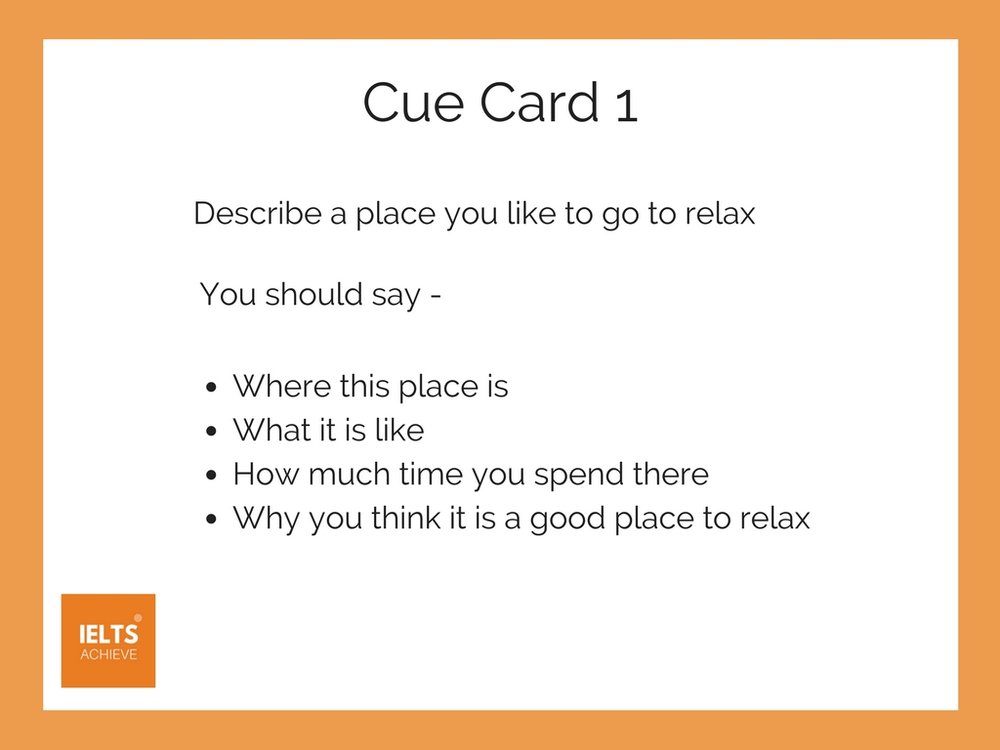
The cue card the examiner gives to you will look something like this >>
Some students admit to finding this part of the test difficult as they have to give a monologue for 1-2 minutes. They sometimes run out of ideas or start repeating themselves. Practising and developing a strategy can help to make sure that you have success in this area.
Read on for our top 6 tips for getting a high-level band score >>
SPEAKING Test Part 2 TIPS
TIP 1 >> Think of Ideas
When the examiner gives you the cue card during your speaking test, read the topic and the bullet points and think of ideas. It is better to think of a couple of relevant ideas, rather than too many ideas.
The bullet points on the cue card are there to help you to think of ideas so that you can develop an answer. However, you do not have to use those bullet points as a guide and can talk about anything you want in relation to the topic.
The cue card will give you the main topic, then list several bullet points below, stating ‘you should say‘ this means that it is optional. It is up to you, whether you wish to use those bullet points as a guide to help you, and add further information, or not. If there are any bullet points you do not wish to talk about, you may leave them out and talk about something else. As long as all of your ideas are related to the main topic and relevant, then you will still be able to gain a high-level band score.
TIP 2 >> Develop A Strategy
When planning your part 2 monologue, developing a strategy can help you to deliver a high-level answer.
When answering the question, try to be as honest as possible, telling the examiner your thoughts, feeling and opinions. Use examples from your past experiences and be sure to give your opinion. You are allowed to make up information for your monologue, but make sure that you are really confident about what you are saying, as this may lead you into difficulties.
Being honest about your thoughts, feelings, opinions and own experiences is the best way to expand on the topic and give plenty of information to the examiner.
TIP 5 >> Extend Your Answers
When giving your answer, try to make sure that it is not too short – think of ideas that will allow you to talk about the topic confidently for 1-2 minutes.
You can expand your answer by adding more detail and giving examples. Whatever topic you get, you will be able to think of something relevant and share your own thoughts, feelings, opinions and experiences. You can also give relevant examples that can support your points.
Think about the who, what, when, where and how, then think of the details, where you went, who you went with, how you got there, etc.
The answers in part 2 should not be too long either if the examiner feels as though you have gone over your time, they will stop you and ask an extension question.
TIP 6 >> Practice
Practice as much as possible with your native speaking IELTS teacher, a partner or friend. Take a look at past cue cards (see the other posts in this section) and practice answering those questions, making use of the 1-minute note taking time. Whatever you do, don’t memorise any answers, the examiner will see through this and they can give you a low score.
Time yourself and see how much you can say in 1-2 minutes, you may need to develop your answer further or learn to be more concise.
A good way to listen for errors is to record yourself speaking. Listen to your recording and notice any errors you have made, including grammar mistakes, pronunciation, intonation and fluency. Keep practising and use the posts in this section to help you.
I hope that all of these tips have been useful to you in your IELTS practice and preparation, please let me know your thoughts in the comments below >>
We hope you found this post useful in helping you to study for the IELTS Test. If you have any questions please let us know in the comments below or on the Facebook page.
The best way to keep up to date with posts like this is to like us on Facebook, then follow us on Instagram and Pinterest.
If you need help preparing for the IELTS Test, join the IELTS Achieve Academy and see how we can assist you to achieve your desired band score. We offer an essay correction service, mock exams and online courses.
Expert tips and strategies for this part of the IELTS Speaking test. Includes sample responses and key vocabulary for Band 7+.
Originally published August 2017. Last reviewed 3 July 2026.
This post will look at strategies for giving a high-level part 2 answer.
In part 2 the examiner will give you a cue card that could ask you to talk about any subject. this will normally include something about your daily life and own experiences. The talk you give should be honest and show the examiner your ability to use English well.
When giving your talk, try to make sure that it is not too short – use the 1 minute allowed to make notes to your advantage, looking at the keywords and using them as prompts.
Strategy
When working on a strategy for answering part 2, you need to think about how to extend your answer as much as you can, so that you don’t run out of ideas and things to say.
Include the following in your answers, so that you can develop more ideas as well as including the bullet points on the cue card (if you want);
Introduce the topic – I’d like to talk about……
Give some background information (describe it in physical terms)
The Past – say something about what you used to do / something you saw last year, etc (depending on the topic)
Give your thoughts and feelings
Include an example
Say something about the future – What will you do in the future / where would you like to visit, etc (depending on the topic)
If you practice with past cue cards and find yourself running out of ideas while talking, look at your notes and refer back to an earlier point, expand on it and keep talking, while you think of other things to say.
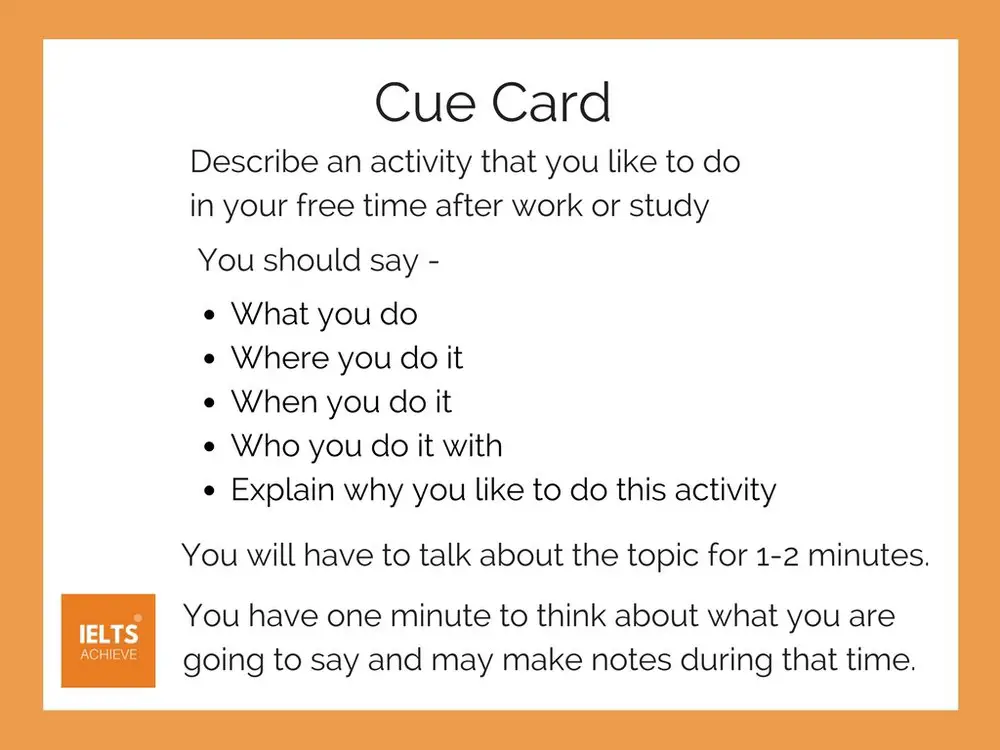
Cue Card Example
The bullet points on the cue card above ask obvious questions about the topic. However you don’t need to follow this to just the bullet points on the card, you can say whatever you want about the chosen topic. Some students follow the bullet points and get a high score, while others have said they ran out of ideas.
Here are some ideas/questions to answer, that you could include when making notes and planning your answer for this cue card >>
Introduce the activity (what it is) extend your answer and explain.
The location (where) – explain
Have you always done it? (When) have you just started doing it recently?
Describe – give a good description of the activity (include here who you do it with)
Give your opinion (why you like to do it).
Will you continue to do it in the future?
Model Answer
I’d like to talk about walking my dog, we recently rescued a dog who was found by our neighbour by the side of the road. At the time he was only around 4 weeks old and quite ill, he was covered in fleas, had a belly full of worms and various skin conditions. He soon became healthy after many vet visits and now has grown into a large healthy dog, who has a routine of walks at certain times every day to burn off his energy. We started his walking routine slowly when he was little, as he was scared of the park at first. He soon loved to go there and looks really happy with the freedom he has to be able to venture out on his own.
I normally walk him around my village in the morning before work for around 45 minutes. Then in the afternoons after work at around 7 pm we will visit the park, so he can run free. He loves to be able to run around and explore the park, meeting up with other dogs and playing. He enjoys running after people jogging and cycling, showing them that he can go faster than them. He also likes to have his photograph taken with tourists when they are posing next to monuments in the park.
In my opinion, walking with my dog is great exercise, as we walk together (or run) daily for at least 2 hours. This is good for both of us, as he can burn off his energy and I can also keep fit. I also think that getting away from my desk and breathing in the fresh air is beneficial for my health and to clear my mind. It helps to keep my mental health in check, by taking these walks and having the time to think about things. I will continue to walk my dog every day, taking him with me to various locations on the island, as he also enjoys the beach and the town park, but these areas are busy in the summer months, so he will have to wait until the autumn.
Feedback
This is a high-level answer, as there are concrete words being used to tell a story (the story of the dog and the relationship to the activity). Words and phrases are used to describe thoughts and feelings. The bullet points have been covered with the extra information given, which extends the answer.
Practice
Practice as much as you can with past cue cards and develop a good strategy for answering in 1-2 minutes. Practice with your speaking partner or native speaking IELTS teacher, who will help you to improve.
Have you been practising? Does this strategy help you? Let us know in the comments >>
We hope you found this post useful in helping you to study for the IELTS Test. If you have any questions please let us know in the comments below or on the Facebook page.
The best way to keep up to date with posts like this is to like us on Facebook, then follow us on Instagram and Pinterest.
If you need help preparing for the IELTS Test, join the IELTS Achieve Academy and see how we can assist you to achieve your desired band score. We offer an essay correction service, mock exams and online courses.
Proven strategies for this IELTS Listening question type. Includes prediction techniques and common traps to avoid.
Originally published August 2017. Last reviewed 3 July 2026.
Using the allocated time of 1 minute to make some notes before your talk can help you to organise your ideas.
The examiner will not look at your notes, they will only mark you on your spoken answer. You should practice making notes that will help you during your talk. This will allow you to;
Think in-depth about the topic.
Organise your ideas and improve coherence.
Give you more to talk about – improving fluency.
Don’t write too much when you are making notes, use the time you have to think and write down ideas and words. You need to be able to look at your notes and think of your next idea quickly so that your talk flows naturally.
You can use arrows to lead your eye to the next keywords, or group words together for each bullet point, or you can create a mind map around the topic.
You can also circle key words from the cue card questions – like where, when, what, how etc. Make sure you answer them in your notes, using the key words as headings.
Fluency And Coherence
The examiner will be assessing your fluency and coherence during the test, seeing how easy it is to follow what you are saying and being able to understand your ideas. Your notes can help you to organise and link your ideas together in a logical way.
One way of linking your ideas togetheris by using linking words and phrases, for example; after that, however, although, even though, because, also, but, firstly, secondly, etc. You can also connect your ideas by using pronouns. It is also really important to use a variety of language when you are speaking and don’t repeat the words on the cue card. To gain a high score in the speaking test you should also use collocations.
A collocation is made up of two or more words that are commonly used together in English. Think of collocations as words that usually go together. There are different kinds of collocations in English. Strong collocations are word pairings that are expected to come together, for instance;
To save time
To be prepared
To make progress
To do the cleaning
Take a risk
Do the homework
Organising Your Notes – Example 1
Read the cue card question below and give yourself one minute to make some notes >>
Making notes will help you to plan your ideas and give them some logical thought, for example;
Notes
What – Swimming/walking
When – Started when I was younger / now I live close to the sea/pools
How – In the summer months every day/winter indoor pools
How – Swimming is good exercise for all of the body – working all muscles/salt water is good
Model Answer
I think it’s important to exercise every day or at least three times per week, so I like to walk every morning and swim as often as I can. I learned to swim when I was at school and since then regularly visited the indoor pool, then when I moved to Greece I was going swimming nearly every day in the summer months. In the winter I like to go to an indoor pool, as it is heated and of course protects you from the elements outside.
There are many beaches close to my house, with crystal clear waters, surrounded by beautiful landscapes and hotels with large swimming pools, so I have a good choice of places to visit for a swim. I like to go to the pool when it is quiet, or the sea when it is calm. The clear salt waters are good for your health and it’s great to swim alongside the fish.
I used to go to a lot of classes in the UK, including Zumba and body combat. I had an accident during a body combat class and broke a bone in my foot, which meant that swimming and cycling were the only options open to me for a while. My doctor encouraged me to go swimming regularly, as he said the salt water would help my foot to heal and obviously to keep up my exercise routine. I really enjoyed swimming, so just kept doing it even after my foot had healed. Swimming keeps me fit and healthy as it is an all over body workout, using all of the muscles it is a great way to do cardiovascular exercise.
Feedback
This is a strong answer, as there is background given and the topic has been fully discussed.There are various tenses and structures used, for the past and present. The notes have prompts and keywords so that the topic could flow and include all of the given points from the cue card.
Organising Your Notes – Example 2
Read the cue card question below and give yourself one minute to make some notes >>
Another way to make notes is to underline, highlight or circle keywords that can be used as headings in your notes, for example;
Notes
Where – The Lake District
When – When I was around 10 years old /in 1990
What – Visited different lakes, national trust sites, Beatrix Potters House, Wordsworth’s house.
Would – Visit again – a good place in the summer, beautiful scenery.
Model Answer
I’d like to talk about a place I visited with my parents when I was about 10 years old in 1990. We went to the Lake District in Cumbria one summer. This is a lovely place, full of green fields, hills and of course lakes. It was about a 2-hour drive from our house and one into the countryside, the surrounding areas just became more and more beautiful to see.
In the summer, it is the perfect weather for exploring the lakes, from Lake Windermere to Grasmere, we explored the surrounding areas, with a visit to Beatrix Potters house, which is a National Trust owned property and also to the poet William Wordsworth’s house. I was very interested in reading when I was younger and enjoyed visiting the former homes of these well-known writers.
There are also many hiking trails in the Lake District, over the fells and beyond. We walked a great deal, with a map and a compass to guide us and even stopped for a picnic on the top of a hill. I enjoyed walking in the hills, learning about each area and how to read a map.
I would definitely visit the Lakes again and would like to see how the areas have changed since I was last there. I would also like to visit Beatrix Potters house again, now that I am older, I think I would appreciate it more. She is a very inspiring author and illustrator and I love that she was inspired by the nature and animals around her. I would also like to stay in a hotel near to Lake Windermere and if the weather is good, hire a boat and sail around to enjoy the surrounding nature.
Feedback
You can clearly see that the structure of the notes has been used to clearly lead the talk through the main points. The notes have been used as a prompt, with information being added, from the memories of visiting the places mentioned.
Your Turn
Now it is your turn! Try making some notes for the cue cards above and time yourself – no longer than 1 minute. Practice giving a talk for 1-2 minutes to your speaking partner and include all of the main points, using your notes as a prompt.
I hope this post has been helpful to you, let me know how your practice is going in the comments below >>
We hope you found this post useful in helping you to study for the IELTS Test. If you have any questions please let us know in the comments below or on the Facebook page.
The best way to keep up to date with posts like this is to like us on Facebook, then follow us on Instagram and Pinterest.
If you need help preparing for the IELTS Test, join the IELTS Achieve Academy and see how we can assist you to achieve your desired band score. We offer an essay correction service, mock exams and online courses.
Expert tips and strategies for this part of the IELTS Speaking test. Includes sample responses and key vocabulary for Band 7+.
Originally published August 2017. Last reviewed 3 July 2026.
In this post, we will be looking in-depth at part 2 of the speaking test.
The IELTS Speaking Test lasts 11-14 minutes.
The test has three parts, where you are interviewed by a trained examiner. You are not allowed to use a dictionary during the test. IELTS Academic and IELTS General students take the same test and it is marked in the same way.
PART 2 INFORMATION
Part 2 = 3-4 minutes – After part 1 the examiner will give you a card or booklet with your question and related ideas you need to talk about.
1 minute >> You will be given 1 minute to make notes.
1-2 minutes >> You will talk about for 1-2 minutes about the topic on the cue card/booklet.
1-2 minutes >> After you have finished speaking, the examiner will ask you one or two questions relating to what you have just talked about.
The topics might include;
Studying/Education
Hobbies/Sports
Family
What kind of movies, books, tv shows or music you like
What you like to eat / where you like to eat
Your job
Where you live
Daily life
Your own experiences
PART 2 QUESTIONS
The questions in part 2 will be about your daily life or experiences. Your answers should include your own thoughts, opinions and feelings.
Possible cue card questions >>
Does the question look difficult to you?
The bullet points are there to help you to extend your answer and be able to speak for 1-2 minutes on the topic. You can also say things about the topic, which are not bulleted on the cue card.
The topics on the cue cards mostly relate to daily life and your own experiences, so that you can think about an answer fairly quickly. You have 1 minute to make notes, so it is beneficial for you to be able to choose a specific idea/subject quickly.
There are hundreds of different cue cards, with new ones being added every year, so it will be difficult for you to memorise answers. You can prepare by reading past cue card questions and practising with a speaking partner or native speaking IELTS teacher.
Making Notes
Using the allocated time of 1 minute to make some notes before your talk can help you to organise your ideas. The examiner will not look at your notes, they will only mark you on your spoken answer. You should practice making notes that will help you during your talk. This will allow you to
Think in-depth about the topic.
Organise your ideas and improve coherence.
Give you more to talk about – improving fluency.
Don’t write too much when you are making notes, use the time you have to think and write down ideas and words. You need to be able to look at your notes and think of your next idea quickly so that your talk flows naturally. You can use arrows to lead your eye to the next keywords, or group words together for each bullet point.
You can also circle key words from the cue card questions – like where, when, what, how etc. Make sure you answer them in your notes, using the key words as headings.
How To Start
Instead of repeating the question on the cue card to the examiner, try to memorise a few phrases that will help you to start talking, for example;
Q: Describe a sport you enjoy.
A: I’d like to talk about Volleyball, which is a sport I like to play regularly……………..
Q: Describe a place you like to go on holiday.
A: I’d like to talk about Greece, which is a place I like to visit every year………
Q: Describe a teacher who influenced you.
A: I had several teachers who I thought were brilliant when I was at school, but the one that really stands out was my Art teacher, Mrs. Harris………..
Q: Talk about an article you recently read in a newspaper.
A: I read many articles daily, but one that stands out was about the rescue of animals during the recent Hurricane Harvey in Texas ………..
You can adapt the same structure repeatedly, or have a different approach for each question, it is up to you!
We hope you found this post useful in helping you to study for the IELTS Test. If you have any questions please let us know in the comments below or on the Facebook page.
The best way to keep up to date with posts like this is to like us on Facebook, then follow us on Instagram and Pinterest.
If you need help preparing for the IELTS Test, join the IELTS Achieve Academy and see how we can assist you to achieve your desired band score. We offer an essay correction service, mock exams and online courses.
Fluency and Coherence You should be able to speak without hesitation, have natural pauses, be able to order your ideas and connect them when telling a story.
Lexical Resource Be able to demonstrate the ability to use advanced vocabulary, synonyms, antonyms, intensifiers, collocations and idioms.
Grammatical Range and Accuracy Use complex senetences, connecting words, a variety of tenses, passive voice, conditionals.
Pronunciation Show that you can make individuals sounds, connecting sounds, word stress, sentence stress and intonation.
Do you know your own strengths and weaknesses? Do you practice speaking English regularly?
Hopefully, the answer to both of those questions is yes. You need to be able to identify your strengths and weaknesses so that you know where you need to improve, to reach the band score you want. Having lessons with a native speaking teacher is worth it so that they can identify your weaknesses and help you to work on them.
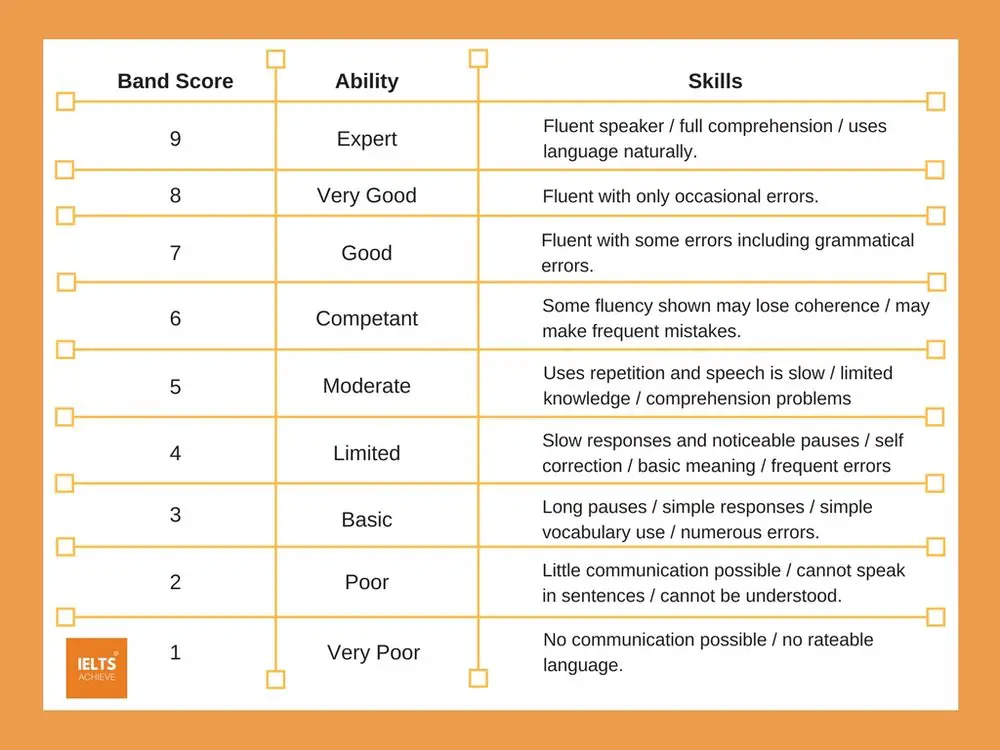
Looking at the table below, where would you say you are right now?
How can you start to improve?
Making a study plan and following it is a really great idea to get started. Read the sections below and get some ideas on how you can improve in all four areas of the IELTS Speaking Test marking criteria.
Fluency And Coherence
How can you improve Fluency and Coherence?
Practice with as many resources as you can for part 1, part 2 and part 3 questions. For parts 2 and 3 you should read the practice questions and see how well you understand them. Think of examples you can use in your answers and the structure of your answers. The part two answer should sound natural and be well structured, which can be challenging. In part 3 the answers should be extended and ideas should be linked.
Lexical Resource
How can you improve Lexical Resource?
For example, you could listen to podcasts and TED Talks, find a speaking partner to practice with and read some English news (online from the BBC News website or the Guardian) every night. You could also make vocabulary flashcards, listen to English music, listen to TED Talks and record yourself giving a summary of what you have heard. It is such a good idea to partner up with other IELTS students and practice speaking via Skype/Facetime etc. Take a look in the IELTS ACHIEVE Facebook group and meet someone you can start practising with.
Grammatical Range and Accuracy
How can you improve the Grammatical Range and Accuracy?
It is a good idea to record yourself speaking, answer some speaking mock questions, record yourself, then listen back to the recording and identify any errors you have made. You can check if your answer included the following:
Did you use the correct tense, did the verbs agree with the subjects?
Did you use complex sentences?
Did you use the passive voice and conditionals?
Did you use connecting words? Such as; before, after, because and although.
Alternatively, book lessons with a native speaking teacher and they will help you to improve.
Pronunciation
How can you improve Pronunciation?
One way to improve your pronunciation is to listen to native speakers, on the radio, tv or through TED Talks. Listen carefully to how the speakers pronounce words, how do they emphasise their points? Where do they place the word stress? Another way is to look up the pronunciation of words, practice saying them out loud and record yourself. You can then listen to the recording and see if you have made any errors. If you find it difficult to identify your own errors, then booking lessons with a native speaking English teacher who will correct you is the best way to improve.
Practice More
It’s fine to practice with past paper questions and other questions you may find online, but it is much better and beneficial for you to practice talking to people in real life. Say for example you have a friend who lives in the UK or the USA, make time to Skype with them and gossip! Or ask them to ask you some questions and give you feedback on how well you answered. Did they hear any errors? Could they understand you clearly? If you are already living in the UK (or another English speaking country) talk to friends, work colleagues etc about everyday subjects. Talk about the news ‘Did you see……. that story in the news? What did you think about it?…..’ Everyone has an opinion on popular news stories.
Just get talking about anything that interests you, so that you can practice.
Extend Your Answers
When you practice speaking to your partner, friends or work colleagues, practice extending your answers.
For example, if someone asks you:
What did you do at the weekend?
Answer 1 Nothing much, you?
Answer 2 I went to town on Saturday to have a look around, then had a coffee from my favourite coffee shop run by the hipsters next to Marks and Spencers. After that, I took my dog to the park where he played for a couple of hours with his friends. Finally, when it started to get dark, we went home and watched catch-up TV together on the sofa. On Sunday, I just relaxed, cleaned the house, then met some friends at the beach for a game of volleyball.
Answer 1 is not a good answer because it is short and doesn’t give away any information. Answer 2 is better because it answers the question, gives detail (extends) and includes components needed to score well on the marking criteria.
You need to show the examiner that you can answer the question, give more information (expand) and give an example. Even if that example is made up, that is ok as the examiner will not know (make it sound realistic though!).
What are you going to do to improve your speaking? Let us know in the comments below:
Expert tips and strategies for this part of the IELTS Speaking test. Includes sample responses and key vocabulary for Band 7+.
Originally published August 2017. Last reviewed 3 July 2026.
In the IELTS Speaking Test, you will be interviewed by an examiner for 11-14 minutes. The test has three parts and you are not allowed to use a dictionary. IELTS Academic and IELTS General students take the same test and it is marked in the same way.
Requirements from universities and immigration agencies vary. Most students will need at least a band score 6 for undergraduate study. For postgraduate study or immigration, a band score 7 is generally required.
One of the first things you should do is read the marking criteria to see what the examiners expect. This is really important, as you need to know what they are looking for in the band 7+ boxes.
You should be able to give the examiners exactly what they want, in order to get a 7+ band score.
In the IELTS Speaking Test, you will be assessed on the four main areas >>
Fluency and Coherence
Lexical resource
Grammatical Range and Accuracy
Pronunciation
What Is Your Level?
Look at the table below and according to the skill level where are you?
Think realistically about where your speaking level is at now and then plan how you can improve. Whether it is through self-study or having lessons with a native speaking English teacher, you must figure out a study plan that will allow you to improve.
Band Score 7 Marking Criteria >>
Fluency and Coherence
In this section, you must be able to:
‘Speaks at length without noticeable effort or loss of coherence. May demonstrate language related hesitation at times, or some self-repetition and/or self-correction. uses a range of connectives and discourse markers with some flexibility.’
This means that the student will be able to answer the question well, extending their answers, explaining and giving examples. Band score 7 students will be able to use discourse markers where it is appropriate.
Lexical Resource
In this section, you must be able to:
‘Uses vocabulary resource flexibly to discuss a variety of topics. Uses some less common and idiomatic vocabulary and shows some awareness of style and collocation, wit some inappropriate choices. Uses paraphrase effectively.’
This means that the student would be able to answer questions on a range of topics using a wide range of vocabulary. They would also be able to use idioms where appropriate, as well as collocations. Some minor errors are still permitted.
Grammatical Range and Accuracy
In this section, you must be able to:
‘Uses a range of complex structures with some flexibility. Frequently produces error-free sentences, though some grammatical mistakes persist.’
This means that the student will be able to use a variety of sentence structures and are able to form complex sentences. The majority of sentences would be error free, with some allowance for minor grammatical errors.
Pronunciation
In this section, you must be able to:
‘Shows all the positive features of Band 6 and some, but not all of the positive features of Band 8.’
The band 6 positive features include – ‘Uses a wide range of pronunciation features / Shows some effective use of features / Can generally be understood throughout.’
The band 8 positive features include – ‘Uses a wide range of pronunciation features / Sustains flexible use of features, with only occasional lapses. Is easy to understand throughout.’
This means that to score a band 7 the examiner must be able to understand the student clearly and that they talk in a natural sounding way. Make sure that you practice speaking in English about a range of topics, using word stress and intonation.
Band Score 8 Marking Criteria >>
Fluency and Coherence
In this section, you must be able to:
‘Speaks fluently with only occasional repetition or self-correction; hesitation is usually content related and only rarely to search for language. Develops topics coherently and appropriately.’
This meansthe student will be able to answer the question well, extending their answers, explaining and giving examples. Band score 8 students will be able to use discourse markers where it is appropriate. A band 8 student will be able to develop their answer to the question fully, giving a very well explained and detailed answer.
Lexical Resource
In this section, you must be able to:
‘Uses a wide vocabulary resource readily and flexibly to convey precise meaning. Uses less common and idiomatic vocabulary skilfully, with occasional inaccuracies. Uses paraphrase effectively as required.’
Band 8 students have a wealth of vocabulary and are able to use it well when speaking about almost any topic. They can use expressions and are able to use terms that are appropriate for the answer. The make hardly any errors when speaking.
Grammatical Range and Accuracy
In this section, you must be able to:
‘Uses a wide range of structures flexibly. Produces a majority of error-free sentences with only very occasional inappropriaces or basic/non-systematic errors.’
This means that the student will be able to use a variety of sentence structures and is able to form complex sentences. The majority of sentences will be error free, with some allowance for minor grammatical errors.
Pronunciation
In this section, you must be able to:
‘Uses a wide range of pronunciation features. Sustains flexible use of features, with only occasional lapses. Is easy to understand throughout; L1 accent has minimal effect on intelligibility.’
A band 8 student will be easy for the examiner to understand with minor errors. They will be able to talk with ease about all subjects, placing word stress where appropriate and using intonation naturally.
We hope you found this post useful in helping you to study for the IELTS Test. If you have any questions please let us know in the comments below or on the Facebook page.
The best way to keep up to date with posts like this is to like us on Facebook, then follow us on Instagram and Pinterest.
If you need help preparing for the IELTS Test, join the IELTS Achieve Academy and see how we can assist you to achieve your desired band score. We offer an essay correction service, mock exams and online courses.
Expert tips and strategies for this part of the IELTS Speaking test. Includes sample responses and key vocabulary for Band 7+.
Originally published August 2017. Last reviewed 3 July 2026.
In this post, we will look at the most common IELTS Speaking Topics.
It is hard to predict or plan for the type of topics that will come up in the speaking test. You should not try and rehearse memorised answers, as you never know what you might be asked.
According to research on past papers and from my past students, here is a list of common topics:
IELTS Speaking Part 1
In part 1 of the speaking test, you will be asked about familiar topics, such as your hobbies, family life and hometown. The list below shows the topics that may come up in the test.
Your country/Hometown
Family life
Friendship
Work
Education
Hobbies
Your Interests
Cinema/Movies
Reading/Books
Travel/Holidays
Shopping
Free time/Weekends
TV shows
Eating out/Restaurants
To practice with past question please take a look at Speaking Part 1 in more detail.
IELTS Speaking Part 2
In part two of the speaking test, you will get a cue card with a question that requires you to talk at length for 1-2 minutes. You are able to make notes for 1 minute to prepare. The list below shows the topics that may come up;
Health
Work
Education
Travel
The environment
A friend
A teacher
Something you own
Hobbies
Sports
Restaurants
Childhood
Technology
Party/Occasion
To practice with past question please take a look at Speaking Part 2 in more detail.
IELTS Speaking Part 3
In part 3 of the speaking test, you will go further into the topic relating to part 2. This will allow you to talk in-depth and offer your opinions and thoughts on the chosen subject. The list below shows the topics that may come up;
Travel
Education
Work
Health
Technology
The internet
Social Media
The environment
Healthy Eating/Lifestyle
Music
Crime/Justice
Sports
Hobbies
To practice with past questions please take a look at Speaking Part 3 in more detail.
Review And Strategy
It would be really hard to predict the topics that might come up on the speaking test, so you should continue to practice talking about everyday topics in English, as often as you can.
Remember that it is highly likely that the examiner will expect you to do the following if you wish to achieve a high band score:
To give your opinion
Talk about the past, present or future
Explain your views
Support your views with examples
Tell a story in your examples (logically)
Compare and contrast
I hope that you have found this post helpful if you have any questions please write them in the comments below.
Expert tips and strategies for this part of the IELTS Speaking test. Includes sample responses and key vocabulary for Band 7+.
Originally published August 2017. Last reviewed 3 July 2026.
In this post, you will see one of the most common IELTS speaking topics (Family) and sample answers.
Please remember that in the actual test you should give honest answers and talk about your own experiences, thoughts, feelings and opinions. Do not try to memorise answers, as the examiners will probably be able to guess and you will lose marks.
However, you are able to make up information to extend your answers, but be sure that you are confident when speaking about the chosen topic and that it is believable.
TIP >> Each answer should be at least 2-3 sentences long.
TIP >> Listen carefully to the question so that you answer in the correct tense.
TIP >> When answering a yes/no question – answer then give your reasons for your answer. You must extend your answer to gain more marks.
TIP >> Just relax and think of it as a regular conversation you are having, make eye contact and be positive.
Take a look at the questions and sample answers below on the topic of ‘Family‘ >>
Q: Could you tell me something about your family?
A: My family is quite small and most people live far away from each other. Some are at the top of the country and some at the bottom. More distant relatives live in France and Australia, so we don’t see them very often.
Q: Do you think it is good to live with grandparents?
A: In my opinion, living with your grandparents may be a way to save money and also to help to care for them. Perhaps they can’t do things they used to, like housework or cooking, so being able to help them would be a positive.
Q: What’s the women’s status in families?
A: Women are seen as the people in charge in most families, they have many roles within the family unit, often having qualifications and a career also. They are the carers, providers, mothers and managers.
Q: Do you think it good to be the only child in the family?
A: On the one hand, it could be a lonely existence when you are a small child but as you become older would start to enjoy having that space. On the other hand, they are missing out on the connection that you see between siblings.
Q: Is there any generation gap in your family?
A: There is a divide between the older members of the family and the young, with varying views on politics and religion which leads to misunderstandings.
Q: Do you like your family?
A: Yes of course! My immediate family – my parents are amazing people, kind, funny and caring. The other members of my family and my husbands family are all very lovely people, who have good times together.
Q: Who is your closest family member?
A: My mother is very close to me and we talk every day, often about trivial things like what our dogs have been doing. She likes to ask questions about my dog, to make sure he is being taken care of like a king!
Q: What are your parents like?
A: Very good, kind and funny people. They like to laugh, read, travel and like all of the same TV shows as me. They are very caring people too, helping in the community – for a children’s charity and to protect the environment.
We hope you found this post useful in helping you to study for the IELTS Test. If you have any questions please let us know in the comments below or on the Facebook page.
The best way to keep up to date with posts like this is to like us on Facebook, then follow us on Instagram and Pinterest.
If you need help preparing for the IELTS Test, join the IELTS Achieve Academy and see how we can assist you to achieve your desired band score. We offer an essay correction service, mock exams and online courses.