Proven strategies for this IELTS Listening question type. Includes prediction techniques and common traps to avoid.
Originally published July 2017. Last reviewed 3 July 2026.
In this post, we will look at how to follow a lecture or talkin the listening test.
The questions in the IELTS Listening Test will ask you to focus on the key points given by the speakers, so it is important for you to practice identifying the key points in a talk or lecture.
Exercise 1
Listen to the TED Talk below and answer the following questions >>
What are the key points?
Which of the following describes the main topic of the talk?
Explaining how the refugee crisis is growing
Describing how the refugee crisis is slowing down
How to rebuild places that have been destroyed by war
Answers are at the bottom of the page.
Exercise 2
You may be asked to complete a summary in the listening paper that summarises the content of the talk or lecture you have heard.
Listen to the lecture below (only once), then complete the summary >>
Write NO MORE THAN ONE WORD for each answer
Summary
Lead was used for years in many household items including 1. ………………………… It can cause many health issues including rashes, abdominal pains and 2. ………………………… The effects of this can be really serious in young children, as their brains are constantly growing at a fast rate. For them, it can cause 3. …………………………….. memory loss and behavioural issues. Lead can block chemical signals and weaken 4. …………………………………
Answers at the bottom of the page.
Exercise 3
Listen to the TED Talk below and answer the following questions >>
What is the purpose of the talk?
What illness did the speaker have?
How did she feel?
What was the name of her nurse?
What did the nurse believe?
What did they talk about?
How long did the speaker spend documenting nurses for her book?
What were the issues she looked at?
Who was the first nurse she met?
What did the Native American patient bring to the ICU?
Who was the second nurse?
Who was the third?
Where was he a nurse?
He is both a nurse and a _____?
Who is the fourth nurse she met?
What did she do to introduce therapy to her patients?
Answers at the bottom of the page.
REVIEW AND STRATEGY
TIP >> It is important that you read the questions and familiarise yourself with the content you are looking at before you start listening.
TIP >> Listen out for the speaker introducing themselves and the talk, this might help you to follow the information and focus.
TIP >> Listen carefully for information but be wary of distractors.
TIP >> Make short notes during the talk when listening for specific information.
Answers >>
Exercise 1
Key Points
The refugee crisis is growing.
The refugee children want to have an education.
Individual stories from refugees – are the examples given to support the seriousness of this crisis.
The public should invest in the future of refugees, with skills and education.
Main topic = Explaining how the refugee crisis is growing
Exercise 2
1. paint
2. anemia
3. headaches
4. neurones
Exercise 3
1. To give acknowledge and give credit to nurses
2. Breast cancer
3. Terrified and scared.
4. Joanne Staha
5. That her life will be back to normal again
6. They talked about her boyfriends, the plan to look for an apartment in New York and her reaction to chemotherapy
7. 5 years
8. Public health issues; ageing, wars, poverty and prisons
9. Bridget Kumbella
10. Bunch of feathers
11. Jason Short
12. Brian Mcmillion
13. Germany
14. Soldier
15. Sister Stephen
16. Baby animals like baby ducks and baby lambs.
We hope you found this post useful in helping you to study for the IELTS Test. If you have any questions please let us know in the comments below or on the Facebook page.
The best way to keep up to date with posts like this is to like us on Facebook, then follow us on Instagram and Pinterest.
If you need help preparing for the IELTS Test, join the IELTS Achieve Academy and see how we can assist you to achieve your desired band score. We offer an essay correction service, mock exams and online courses.
Essential strategies and practice techniques for this IELTS Reading question type. Learn how to manage time and improve accuracy.
Originally published July 2017. Last reviewed 3 July 2026.
In this post, we will look at multiple choice and matching questionsin the listening test.
Multiple Choice Questions
You may have read the information about multiple choice questions in the reading skills section and be familiar with the format.
In the IELTS Listening Test, multiple choice questions are testing your skills of understanding the main idea in the recording and your ability to listen for specific information.
Some multiple choice questions start with a question, that has (for example) three possible answers.
Some questions will ask you to select a few answers.
You may be asked to select three answers out of seven. Therefore it is really important that you listen carefully to the recording.
TIP >> You must make sure you read the question before beginning to listen to the recording so that you choose the right amount of answers and have an idea what you are listening for.
TIP >> You should also listen for distractors, as they are used a lot in the multiple choice and matching questions.
TIP >> Concentrate when you record your answers, students often make errors and that loses them marks.
Short Answer Multiple Choice Questions
The first type of multiple choice question you might see is a short answer question. In this type of question, you will see a statement and a number of different options to choose from.
TIP >> You will possibly hear all of the options in the recording, but be careful that you do not just choose the first option and think that it is correct.
TIP >>Vocabulary – look out for certain words like but, however, or though, as they suggest the speaker is going to offer some alternative information.
Question Example
Sentence Completion Multiple Choice Questions
The second type of multiple choice question you may see is a sentence completion question. You will be given an incomplete sentence and you will have to complete it choosing from a certain number of options.
These questions are longer than other questions you will see in the listening test. You should have a quick read through and highlight any keywords you see.
You should also be aware of paraphrasing, as the speaker will probably paraphrase and use synonyms.
Question Example
Multiple Options
Some questions will ask you to select a few options and you must choose the right amount of options (and the right information obviously) in order for your answers to be correct. Therefore it is really important that you read the question before you listen to the recording.
The speaker on the recording might talk through all of the options, so concentrate and listen out for words and phrases that could distract you. These are often in there to trick you into choosing the wrong answer.
TIP >> Try to relax, when students are under stress to choose the right answer then move on quickly, they often lose marks as they choose any option. If you do miss it, there is no harm in taking a guess rather than leaving a blank space.
Attitude And Opinion
In some of the recordings you will hear, you will listen to speakers discussing an issue, making a decision or making an agreement. This means that you will have to identify an opinion or an attitude.
Listen carefully and see how the speaker uses language to convey their opinion or attitude towards something.
For example;
I was reluctant …..
I was surprised……
I am feeling hopeful………..
I’m wary about that…………
I am doubtful………..
I feel confused……….
Matching Questions
In matching questions you will see two parts with information. The questions will be numbered and appear in order. This means that the questions will be in the order of the information given in the recording.
You will see a box alongside the question in which to choose options and these are given in a random order. It is a good idea to cross out any options you do not need.
REVIEW AND STRATEGY
TIP >> Read the instructions and questions before you start listening to the recording. What are you being asked to do? Familiarise yourself with the questions and think about the context.
TIP >> Look at the options you have been given and highlight any keywords.
TIP >> Listen carefully for information but be wary of distractors.
TIP >> Be aware of paraphrasing and synonyms.
TIP >> Listen to the information carefully and don’t just choose the first option you hear. The speaker will probably mention all of the options – so listen to all and keep looking at the list of options, to select the right ones.
TIP >> If you do miss an answer or were not sure, then it is ok to take a guess. This is better than leaving a blank space and you never know, you might answer correctly!
We hope you found this post useful in helping you to study for the IELTS Test. If you have any questions please let us know in the comments below or on the Facebook page.
The best way to keep up to date with posts like this is to like us on Facebook, then follow us on Instagram and Pinterest.
If you need help preparing for the IELTS Test, join the IELTS Achieve Academy and see how we can assist you to achieve your desired band score. We offer an essay correction service, mock exams and online courses.
Step-by-step guide to answering this type of IELTS Writing Task 1 question. Covers structure, key language, and band-scoring criteria.
Originally published July 2017. Last reviewed 3 July 2026.
In this post, we will look at diagramsin the listening test.
In the IELTS Listening test, you may see questions that ask you to label a diagram or process. The diagram may be a dissection of a machine or the different parts of a process.
When you listen to the speaker talk through the diagram or process, they will describe it in a logical way and explain everything clearly. You must follow the speaker and not think about your own knowledge of the subject.
TIP >> Listen out for the sequence of events – first, second, next, after that, finally.
TIP >> Be aware of paraphrasing during this part of the test.
Diagram Question
The question below shows a diagram with some parts labelled. The recording would talk you through the parts and their position. You would match up the answers to the correct part.
Question
Write the correct number, 1-5, next to Questions A-E.
Labelling Mechanical Parts
A question may ask you to label the parts of a machine or device.
Questions 1-5
Write the correct letter, A-F, next to questions 1-5 below.
Tachometer Drive Parts
Grammar
When you describe a process, you would use adverbs and prepositions of movement.
Prepositions used with the verb to be can be used to state the location of something.
For example;
The electrical cable is underneath the floor.
The water pipe is above the water tank.
Prepositions that show movement are sometimes combined with verbs other than to be.
For example;
The water was pumped out of the tank.
The wires were moved to another wall.
Prepositions of Movement
Prepositions of movement are used to show movement to or from a place.
For example;
to, through, across
When you use the word to it can show movement to a specific destination.
The pipe is going to reach the end of the house.
The pipe goes to the air conditioning unit.
Through is used to show movement from one side of a confined space to the other.
The cable went through the interior isolation.
The water pipe passes through the exterior of the house.
The word across is used to show movement from one side to another.
To reach the outside line, the pipe was passed across the roof.
To get to the outside patio the cable went across the room.
More prepositions of movement >>
along – the inside of……
around – the edge of……
away from – the tracks
back to – the machine
down – the side of…..
into – the heating element
off – the side of the wall
out of – the box
over – the table
past – the pipe
round – the side of the machine
towards – the area beneath the table
under – the fan
up – the main cable line
The words at and in can be used to show the purpose of movement, for example;
The long thin cable is at the bottom of the wall.
The ceiling fan is moving slowly in the other room.
Sequence
The words below can help you to connect the stages of the process you are writing about.
Sequencing helps you as the listener to understand the information clearly. This will also help you in Academic Writing Task 1 – Process.
Process
A question may ask you to label the stages of a process.
TIP >> Study the process before you listen to the recording and read the list of options.
REVIEW AND STRATEGY
TIP >> The plans, maps and diagrams questions do not follow the order that you hear the information in the recording. Therefore it is important that you read the questions and familiarise yourself with the diagram or process you are looking at before you start listening.
TIP >> Study the diagram or process and see where things are before listening to the recording. Marks can be lost if you do not do this and read the questions properly.
TIP >> Listen carefully for information but be wary of distractors.
TIP >> Make notes on the paper and draw lines etc. This may help you to locate information.
We hope you found this post useful in helping you to study for the IELTS Test. If you have any questions please let us know in the comments below or on the Facebook page.
The best way to keep up to date with posts like this is to like us on Facebook, then follow us on Instagram and Pinterest.
If you need help preparing for the IELTS Test, join the IELTS Achieve Academy and see how we can assist you to achieve your desired band score. We offer an essay correction service, mock exams and online courses.
Step-by-step guide to answering this type of IELTS Writing Task 1 question. Covers structure, key language, and band-scoring criteria.
Originally published July 2017. Last reviewed 3 July 2026.
In this post, we will look at mapsin the listening test.
On maps there are many symbols/icons that are easily recognised. In the image below you will see many icons that are used in maps. How many do you know?
Vocabulary
In the maps questions, you will hear vocabulary that is specific to giving directions. They have their own common terms that you will become familiar with. Different prepositions are used for some explanations.
For example;
Across from the …….
…….. is at the end of the street
At the junction of ……………..
On/at the corner of …………………
Near the entrance/exit to ……………………….
Just past/over the roundabout ……………………..
…………… at the next traffic light
……………… in the next street
Practice
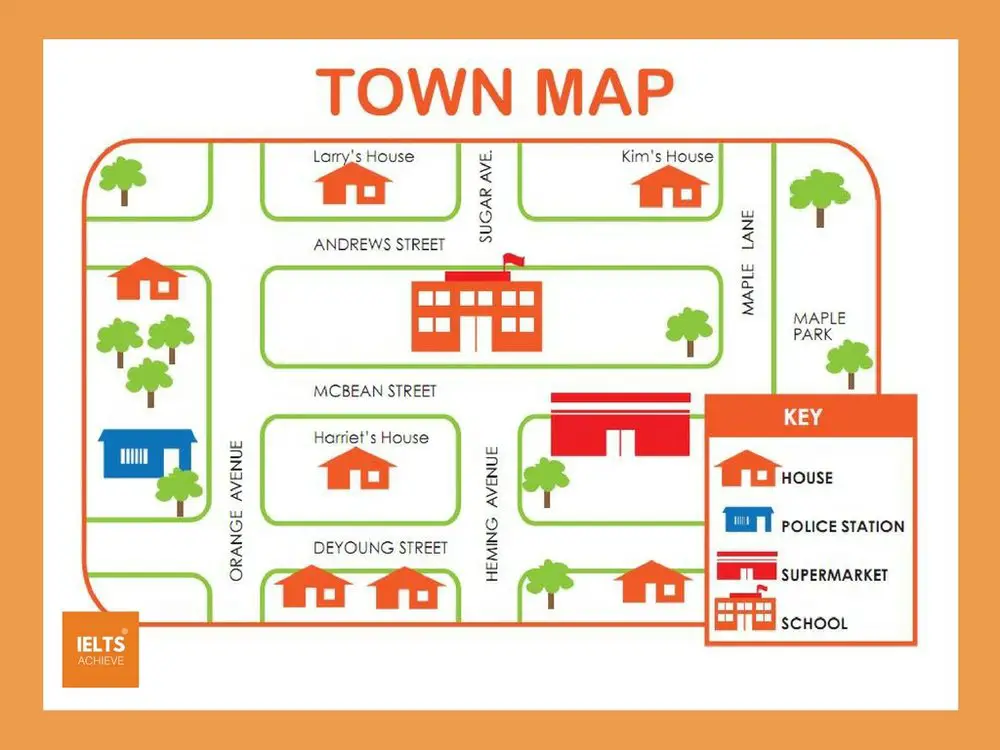
Look at the map below and see if you can answer the following questions >>
Is there a school near to the housing estate on Deyoung Street?
Is the supermarket on the right when you travel up Heming Avenue towards the school?
Is the police station on Maple Lane?
Where is Kim’s house?
How would you get to Larry’s house after leaving school?
How could you get to the park from Harriet’s house?
Grammar
In the IELTS Listening Test, you will listen to directions and have to follow them in order to label places on a map.
When listening to the directions you will often hear the imperative, for example;
Turnright, then go straight ahead past the school. Walkalong Park Avenue.
Imperatives give an instruction, in this case, telling you what to do. They are also used in other parts of the IELTS test, for instance when you are writing or talking about something in a sequence; First, Then, Next, After that, Finally.
Directions can also use the second person singular form, for example;
When you see the school library, you turn right onto Russel Road.
Modal verbs can also be used in directions, for example;
At the roundabout, you can either go straight ahead or you could turn right and walk the longer route past the shopping area.
You could take the main street or turn left onto Brownie Road.
Prepositions
Prepositions of movement are used to show movement to or from a place.
For example;
to, through, across
When you use the word to it can show movement to a specific destination.
To get to the library you should go to Baker Street first, then take a right.
I moved to Greece in 1985.
She has gone to the shopping mall.
Through is used to show movement from one side of a confined space to the other.
The bus went through the tunnel
To get to the tennis courts you could cut through the library.
To visit the shopping mall’s busiest area, you could walk through the main car park
The word across is used to show movement from one side to another.
To reach the supermarket you can go across Grant Street and turn right.
To get to the theatre she went across the walkway and turned left into Grimwald Street.
To reach the tennis courts, walk across the car park and enter the door on the right.
More prepositions of movement >>
along – the road
around – the park
away from – the busy road
back to – the library
down – the embankment
into – the shop
off – the bus
out of – the cinema
over – the road, bridge, hill etc
past – the supermarket
round – the football field
towards – the bakery
under – the bridge
up – the hill
The words at and in can be used to show the purpose of movement, for example;
The supermarket is at the end of the street, next to the large carpark.
The library is in a busy area, next to the main campus cafeteria.
Labelling A Map
Some questions will ask you to label a map. You will be given a list of places to match up with places that are numbered.
Question Example
Question 6-10
Label the map.
Choose five answers from the box and write letters A-H next to questions 6-10.
Review And Strategy
TIP >> The plans, maps and diagrams questions do not follow the order that you hear the information in the recording. Therefore it is important that you read the questions and familiarise yourself with the plan or map you are looking at before you start listening.
TIP >> Study the map and see where things are before listening to the recording. Marks can be lost if you do not do this and read the questions properly.
TIP >> Listen carefully for information but be wary of distractors.
TIP >> Make notes on the paper and draw lines to destinations etc. This may help you to locate information.
We hope you found this post useful in helping you to study for the IELTS Test. If you have any questions please let us know in the comments below or on the Facebook page.
The best way to keep up to date with posts like this is to like us on Facebook, then follow us on Instagram and Pinterest.
If you need help preparing for the IELTS Test, join the IELTS Achieve Academy and see how we can assist you to achieve your desired band score. We offer an essay correction service, mock exams and online courses.
Proven strategies for this IELTS Listening question type. Includes prediction techniques and common traps to avoid.
Originally published July 2017. Last reviewed 3 July 2026.
In this post, we will look at plansin the listening test.
Students will have to understand a description of a place and follow directions. You will probably be familiar with some of these plans, as you see them when you visit galleries, museums and other places like schools.
In section 2 you will probably hear a person talking about a topic that is not academic. It is usually someone talking about an event or showing them around a building.
The plans below are a bit more complex than those that you will see in the IELTS Listening Test. When you listen to the recording during the test, look out for the language of location. For example, next to, near, opposite, in front of etc.
TIP >> During the test make notes and/or mark the way on the question paper before transferring your answers at the end.
TIP >> Make sure you spell your answers correctly.
Question Example
Label the plan below.
Choose EIGHT answers from the box and write the correct letters A-I next to questions 11-15.
The Language of Location
To understand the description of a plan and to locate certain places you need to understand the language of location.
You should also be familiar with prepositions of place, such as in, at, on, by, next to, beside, near, between, among, behind, in front of, under, below, over, above, across, through, to, into, towards, onto and from.
For example, if we look at the plan above;
Gallery 1 is next to gallery 2.
Gallery 2 is beside gallery 3.
Gallery 6 is in front of gallery 7.
Labelling A Plan
In order to be able to label a plan, you must listen for a description or directions on the recording. You will most likely hear a person describing a plan or showing people around somewhere. You may be given a list of possible answers in a box or not.
The information you hear will be in the same order as the recording. You should study the plan carefully before listening so that you have an idea of where the options may be.
TIP >> You can cross out any options that you think are wrong and if you can’t decide between two answers, write both down and make a choice later.
Question Example
Label the plan.
Write the correct letter. A-E, next to questions 11-15.
Distractors
A distractor is when you are given information that is wrong. This can lead you to choose the incorrect answer. They are common in the IELTS Listening tests, as they test your ability to choose the right information for the answers, by ignoring the wrong information.
The distractors will try to trick you into selecting the wrong answer, so you must listen carefully for specific information.
The distractors for this type of task might be more rooms etc on the plan or extra options in the list of possible answers.
Paraphrasing
The questions will paraphrase the information from the recording, or a speaker in the recording may paraphrase, so you will have to use your knowledge of synonyms, noticing any keywords and terms. Recognising and using synonyms shows the examiner that you have good vocabulary knowledge. Paraphrasing is a skill that is needed in all parts of the test.
Review And Strategy
TIP >> The plans, maps and diagrams questions do not follow the order that you hear the information in the recording. Therefore it is important that you read the questions and familiarise yourself with the plan or map you are looking at before you start listening.
TIP >> Study the map and see where things are before listening to the recording. Marks can be lost if you do not do this and read the questions properly.
TIP >> Listen carefully for information but be wary of distractors.
TIP >> Make notes on the paper and draw lines to destinations etc. This may help you to locate information.
We hope you found this post useful in helping you to study for the IELTS Test. If you have any questions please let us know in the comments below or on the Facebook page.
The best way to keep up to date with posts like this is to like us on Facebook, then follow us on Instagram and Pinterest.
If you need help preparing for the IELTS Test, join the IELTS Achieve Academy and see how we can assist you to achieve your desired band score. We offer an essay correction service, mock exams and online courses.