Essential strategies and practice techniques for this IELTS Reading question type. Learn how to manage time and improve accuracy.
Originally published July 2017. Last reviewed 3 July 2026.
In this post, we will look at sentence completion questions in the listening test.
Similar to short-answer questions, sentence completion questions are designed to assess your ability to find specific information. You will have to choose the right words or keywords from a text to complete a sentence. The words will be in the text and when you write them, they must be grammatically correct.
The questions will paraphrase the information from the recording, or a speaker in the recording may paraphrase, so you will have to use your knowledge of synonyms, noticing any keywords and terms. Recognising and using synonyms shows the examiner that you have good vocabulary knowledge. Paraphrasing is a skill that is needed in all parts of the test.
A question might paraphrase an idea during the recording.
For example;
The trip we went on was meant to last five days.
The journey we took was supposed to be for just less than a week.
The place we visited first was beautiful.
The area we toured, to begin with, was stunning.
The shuttle bus took us from the hotel into the town.
We were provided with free transport to the metropolis.
Examples of Synonyms
Money = cost / price / cash / pay
Location = area / district / neighbourhood
Transport = carriage / transportation / shipment
Journey = adventure / expedition / exploring
An effect = consequence / development
A cause = motive / purpose
Grammatical Accuracy
Each sentence must be grammatically correct and complete with the word limit expressed in the instructions. Don’t use more words than you are allowed according to the instructions in the question.
For example, you may be asked to:
Write NO MORE THAN ONE WORD for each answer
Write NO MORE THAN ONE WORD AND/OR A NUMBER for each answer
Write NO MORE THAN TWO WORDS for each answer
If your answer does not follow the instructions given, it will be marked as incorrect.
Always read the questions before you listen to the recording and predict the type of words you would be able to use.
For example;
The Great North Run is on ……………………………….
Possible answers
An adverbial time phrase: The Great North Run is on – every year, once a year, in the summer.
A prepositional phrase that expresses a place: The Great North Run is on – in Newcastle, in the North-East, in the North.
Exercise 1
Read the questions first before you listen to the recording.
Write NO MORE THAN THREE WORDS AND/OR A NUMBER for each answer.
1. Running in the race was the well known male runner …………………………….
2. The race was on in the ………………………………
3. This is the ………………………………….
4. Taking part in the race are …………………………………………
Answers at the bottom of the page.
Exercise 2
For most of the sentence completion questions you have to complete the end of the question, but there are other questions that will ask you to fill in gaps in other places. This could be at the beginning or the middle of a sentence.
Read the questions first before you listen to the recording.
Write NO MORE THAN TWO WORDS for each answer.
1. Prince Harry came home with three ……………….. ……………………. people.
2. Prince Harry thinks that to him we are all the same and the people he worked with know him as ……………………. …………………………….. not just as a prince.
3. They want an …………………………… to …………………………. to themselves that they are the same people.
4. Prince Harry wants to make sure that the mood is ……………………………………. and that the everyone ……………………………. it.
Answers at the bottom of the page.
REVIEW AND STRATEGY
TIP >> Read the instructions and questions before you start listening to the recording. What are you being asked to do? Familiarise yourself with the questions and think about the context.
TIP >> Look at the information/options you have been given and highlight any keywords.
TIP >> Listen carefully for information but be wary of distractors.
TIP >> Be aware of paraphrasing and synonyms.
TIP >> If you do miss an answer or were not sure, then it is ok to take a guess. This is better than leaving a blank space and you never know, you might answer correctly!
Answers >>
Exercise 1
1. Mo Farah
2. the North East
3. the 36th Race
4. different nationalities
Exercise 2
1. seriously wounded
2. Captain Wales
3. opportunity / prove
4. electric / enjoy
We hope you found this post useful in helping you to study for the IELTS Test. If you have any questions please let us know in the comments below or on the Facebook page.
The best way to keep up to date with posts like this is to like us on Facebook, then follow us on Instagram and Pinterest.
If you need help preparing for the IELTS Test, join the IELTS Achieve Academy and see how we can assist you to achieve your desired band score. We offer an essay correction service, mock exams and online courses.
Comprehensive guide covering essential IELTS preparation strategies and techniques to help you achieve your target band score.
Originally published July 2017. Last reviewed 3 July 2026.
In this post, we will look at short answer questions in the listening test.
Short answer questions in the listening test, will require you to write no more than a set number of words and/or numbers. You will probably be given a limit, for example, ‘No more than two words and/or a number’. If you write more words than the instructions tell you to, your answer will be marked as incorrect.
The short answers only need keywords, meaning you will not be able to write a sentence. These questions are there to see how well you can find specific information and be able to recognise when some information is not needed.
It is really important that you read the instructions of the questions carefully, often when people do not read them and follow them correctly they lose marks. When you are asked to complete questions, you will also be enlightened as to what information you can put into the gaps.
Being able to provide accurate short answers in the listening test is really important in order for you to gain a high score.
For example, you may be asked to:
Write NO MORE THAN ONE WORD for each answer
Write NO MORE THAN ONE WORD AND/OR A NUMBER for each answer
Write NO MORE THAN TWO WORDS for each answer
If your answer does not follow the instructions given, it will be marked as incorrect.
In the IELTS listening test, you must listen for specific information and be able to recognise when some information is not needed.
Exercise 1
Look at the text below and provide an answer that is NO MORE THAN TWO WORDS.
Question – What did Segovia influence?
Spain will always hold a special place in my heart. It was the destination of my first international trip, and where I studied Spanish abroad and started to discover how much excitement the world had to offer.
My favourite part of that first trip was being able to explore smaller cities and towns in Spain that I wouldn’t have known about prior, and that is somewhat off the tourist path. I spent a month in Spain that summer, living in Salamanca and El Puerto de Santa Maria, and exploring the surrounding regions.
From Madrid, you can get to the city of Segovia in less than thirty minutes on the high-speed train, and I recommend getting out there. Famous for its Acazar and Roman aqueduct, Segovia is a gorgeous UNESCO World Heritage Site.
One thing that I found interesting about Segovia is that it’s said that Walt Disney drew inspiration from the majestic Acazar for the iconic Cinderella’s castle.
Answer at the bottom of the page.
Distractors
A distractor is when you are given information that is wrong. This can lead you to choose the incorrect answer. They are common in the IELTS Listening tests, as they test your ability to choose the right information for the answers, by ignoring the wrong information. The distractors will try to trick you into selecting the wrong answer, so you must listen carefully for specific information.
Exercise 2
Listen to the following sound clip which contains a number of distractors. Before you listen, take a look at the questions and think about the context. What words or phrases would you expect to hear? Can you predict?
Question
Write NO MORE THAN ONE WORD AND/OR A NUMBER for each answer.
1. What does he divide the meat into? ………………………..
2. What does he marinate the burgers with? ……………………………
Answers at the bottom of the page.
Practice Short Answer Questions
The IELTS listening test will allow you some time to read the questions before you listen to the recording. For the short answer questions, you should read the questions before you start and try to predict the answers, or what type of word would be appropriate for the answer.
Exercise 3
Read the following questions before listening to the sound clip.
Write NO MORE THAN THREE WORDS AND/OR A NUMBER to answer.
1. According to the author, what does she say about writing another Harry Potter novel? …………………………….
2. The author doesn’t want to write which book? ……………………………………..
3. Was Harry Potter one of the bestselling book series in? …………………………………
4. What is the author worth financially? ……………………………………
5. How does the author help children around the world? ……………………………………….
Answers at the bottom of the page.
Exercise 4
Short answer questions can be presented in other ways, for example asking you to listen to a recording and choose options.
Read the following questions before listening to the sound clip.
Write NO MORE THAN TWO WORDS AND/OR A NUMBER to answer.
1. What does the student need to improve?
A. ………………………….
B. ………………………….
2. What are the writer’s obligations to their readers?
A. ………………………….
B. ………………………….
Answers at the bottom of the page.
REVIEW AND STRATEGY
TIP >> Read the instructions and questions before you start listening to the recording. What are you being asked to do? Familiarise yourself with the questions and think about the context.
TIP >> Look at the questions/options you have been given and highlight any keywords.
TIP >> Listen carefully for information but be wary of distractors.
TIP >> Be aware of paraphrasing and synonyms.
TIP >> If you do miss an answer or were not sure, then it is ok to take a guess. This is better than leaving a blank space and you never know, you might answer correctly!
Answers >>
Exercise 1
Cinderella’s Castle
Exercise 2
1. 200g
2. Mustard
Exercise 3
1. Never say never
2. Harry Potter 8
3. History
4. 1 billion dollars
5. Through charity work
Exercise 4
1. A – clear development / B – first sentence
2. A – Readership / B – Thesis
We hope you found this post useful in helping you to study for the IELTS Test. If you have any questions please let us know in the comments below or on the Facebook page.
The best way to keep up to date with posts like this is to like us on Facebook, then follow us on Instagram and Pinterest.
If you need help preparing for the IELTS Test, join the IELTS Achieve Academy and see how we can assist you to achieve your desired band score. We offer an essay correction service, mock exams and online courses.
Step-by-step guide to answering this type of IELTS Writing Task 1 question. Covers structure, key language, and band-scoring criteria.
Originally published July 2017. Last reviewed 3 July 2026.
In the IELTS listening test, you may have to complete a flowchart, table, notes, a summary or a form. In this post, we will look at how you should answer these types of questions in more detail.
It is really important that you read the instructions of the questions carefully, often when people do not read them and follow them correctly they lose marks. When you are asked to complete questions, you will also be enlightened as to what information you can put into the gaps.
For example, you may be asked to:
Write NO MORE THAN ONE WORD for each answer
Write NO MORE THAN ONE WORD AND/OR A NUMBER for each answer
Write NO MORE THAN TWO WORDS for each answer
If your answer does not follow the instructions given, it will be marked as incorrect.
Lexical Resource
As the answers require you to follow strict instructions about how many words or numbers you can use in your answers, you may need to change the verbs to nouns, nouns to verbs or verb-adverb combinations to other words.
For example;
Once the ingredients had been added the mixture was pliable.
When you add the ingredients you will see the mixture start to change.
After adding the two main ingredients, the mixture was ready to be stirred.
Each example gives you the same idea, using different words. The listening test will test your ability to use language to show your understanding.
You must also be aware of synonyms and paraphrasing, as the words used in the listening test may say for example ‘travel’ and on the paper say ‘excursion’.
Completing A Flowchart
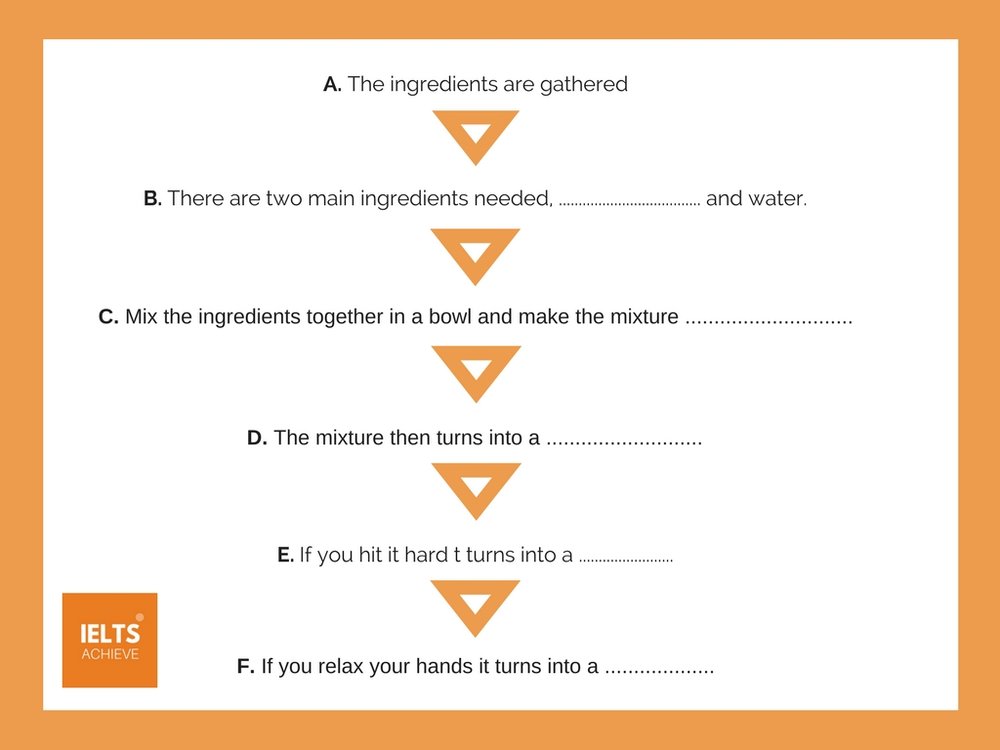
You may see a flowchart that requires you to listen to the recording and then fill in the missing words.
Look at the flowchart below, would you be able to guess the missing words before listening to the recording?
Example Flowchart Question
Write NO MORE THAN TWO WORDS for each answer.
Answers at the bottom of the page.
Notes
Notes are often numbered or organised with bullet points. They may also be organised by heading and subheading followed by the organised information.
You would hear information that will allow you to complete the notes by filling in the missing information.
Example Notes Question
Write NO MORE THAN THREE WORDS AND/OR A NUMBER for each answer.
History of The Acropolis
The Beginning
A temple to the goddess 31. …………………………
A symbol of culture and 32. ……………………………………..
Aesthetics
Full of decoration, the Parthenon was home to a detailed 33. ……………………………. above the columns.
The Parthenon had been built for 34. ……………………… years.
Under Attack
The Parthenon was attacked during 35. …………………….
Later on, Lord Elgin wanted to remove the 36. ………………………………….. and take them to England.
Completing A Table
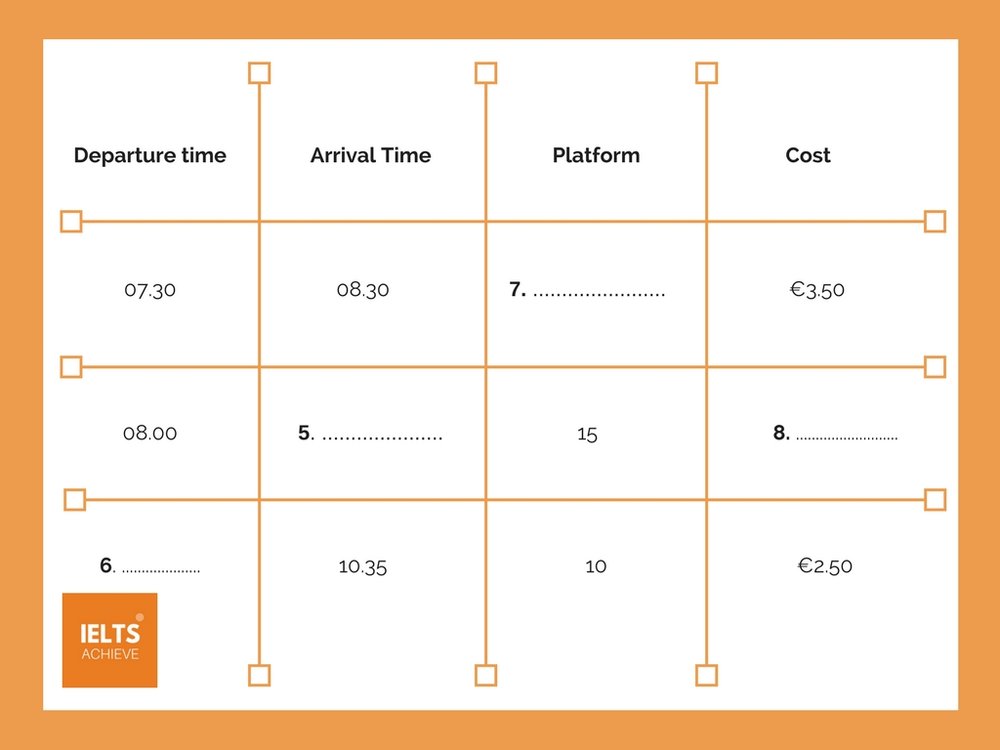
You may be asked to complete a table, with gaps for you to complete. The headings in the table will tell you the type of information you will hear and need to listen for. You may have a gap fill table or a task to complete a table with a list of words in a box to choose from.
To complete a table you will need to write words that you hear in the recording during the test. You will be given a number of words and/or numbers to write in the instructions.
Example Table Question
You would hear information during the test that will allow you to complete the table by filling in the missing words/numbers.
Complete Questions 5-8.
Write NO MORE THAN ONE WORD AND/OR A NUMBER.
Trains To Berwick
Completing A Summary
Summaries are seen often, from recommending a book, movie or even a restaurant, we summarise the events. When you see a summary question in the listening test, it will look similar to other summary exercises you have seen, including gap-fill questions. The summary answers do require you to show that your answers are grammatically correct.
You will hear information that will allow you to complete the summary by filling in the missing information.
Before listening to the sound clip you should read through the paragraph and try to predict the word that would be suitable for each gap.
Example Summary Question
Complete the summary below.
Choose ONE WORD ONLY from the passage for each answer.
How To Write A Speech
This is the second most important thing you need to do when you are creating your speech. The first thing you should do is understand what your 37. …………………………….. will be. How do you plan on getting people’s attention? You need to think of something that will link to the 38. ……………. this is the idea that you are trying to sell or the point you are making to your audience. The next thing you need to include is the 39. ……………………….. this would be the main points you are getting across. Next, you would have a call to action, telling them what you want them to do. Finally, you will 40. …………………………. and link this back to the opening.
Answers at the bottom of the page.
Completing A Form
You have probably filled out many forms during your life, for courses, official documents or job applications. In the listening test, you may see a form with missing information, which includes names, dates and numbers.
You would hear information in the test that will allow you to complete the form by filling in the missing information.
Before listening to the sound clip during the test you should read through the form and try to predict the word that would be suitable for each gap.
REVIEW AND STRATEGY
TIP >> Read the instructions and questions before you start listening to the recording. What are you being asked to do? Familiarise yourself with the questions and think about the context.
TIP >> Look at the information/options you have been given and highlight any keywords.
TIP >> Listen carefully for information but be wary of distractors.
TIP >> Be aware of paraphrasing and synonyms.
TIP >> If you do miss an answer or were not sure, then it is ok to take a guess. This is better than leaving a blank space and you never know, you might answer correctly!
Answers >>
Flowchart Answers >>
B – cornstarch
C – smooth
D – slime
E – solid
F – liquid
Notes Answers >>
31. Athena
32. refinement
33. frieze
34. 2000
35. 1687
36. marble friezes
Summary Answers >>
37. opening
38. premise
39. body
40. close
We hope you found this post useful in helping you to study for the IELTS Test. If you have any questions please let us know in the comments below or on the Facebook page.
The best way to keep up to date with posts like this is to like us on Facebook, then follow us on Instagram and Pinterest.
If you need help preparing for the IELTS Test, join the IELTS Achieve Academy and see how we can assist you to achieve your desired band score. We offer an essay correction service, mock exams and online courses.
Proven strategies for this IELTS Listening question type. Includes prediction techniques and common traps to avoid.
Originally published July 2017. Last reviewed 3 July 2026.
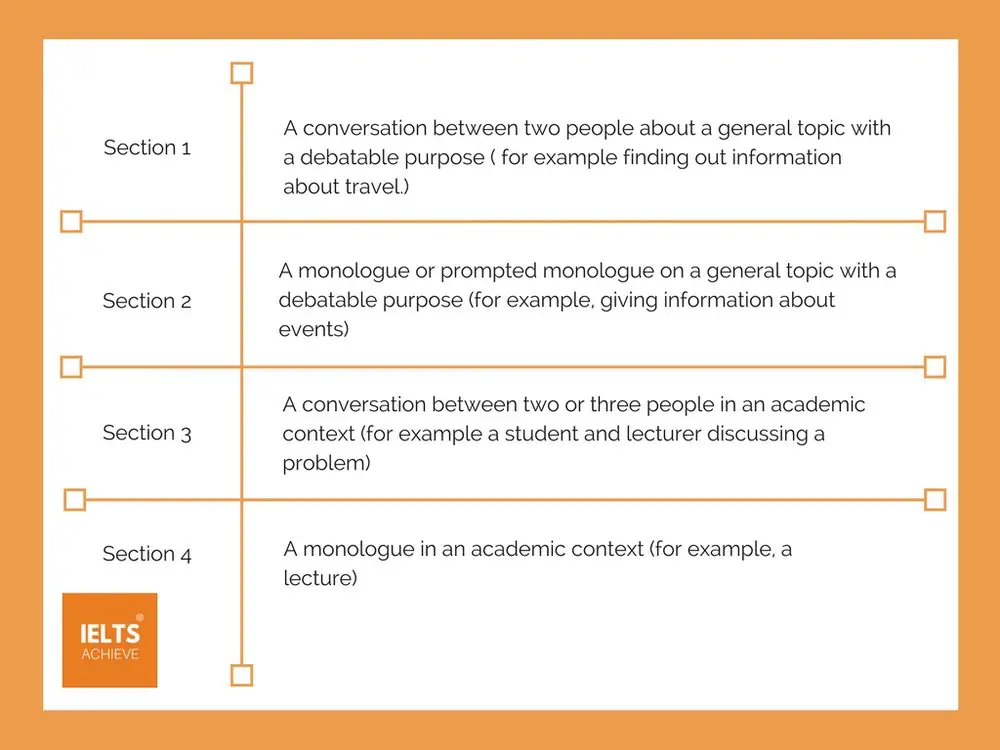
The IELTS Listening Test lasts 30 minutes, with an extra 10 minutes to transfer answers to the answer sheet. It is made up of four parts, with a total of 40 questions (10 per section).
During the test, the texts become more difficult, with part one being the easiest and part 4 the hardest. You will only hear each recording once, never more than that.
IELTS Academic and IELTS General students take the same test and it is marked in the same way.
What you will listen to
Sections 1 and 2 are set in a social context and sections 3 and 4 are set in an academic context.
You may hear one of the following;
A conversation between a travel agent and a customer
An introduction to animal science
A dialogue between three students in a cafe.
A lecture about climate change
A conversation between student and teacher.
Parts 1 and 2 of the Test
Parts 1 and 2 are set in a social context, with general topics.
In part 1 you will listen to a conversation between two people, during the conversation they will complete some sort of transaction. A common plot involves a customer who calls a company to find out specific information about a service or product.
In part 2 you will hear a monologue that provides some sort of information. A possible plot is a speaker giving a short presentation on a service or a guided tour.
Parts 3 and 4 of the Test
Parts 3 and 4 are set in an academic context, with specialised topics.
In part 3 you will most likely hear a student and teacher discussing an academic topic.
In part 4 you will probably hear a speech or a lecture, in an educational setting. it is likely to be a topic you will know little about, but simple enough for you to understand.
Who is speaking and what is the topic?
Listen to the sound clip and think about the context – you should try to think about the context as soon as you can, this will enable you to predict the communication and information that you will hear.
Read the following questions and answer them as you listen;
What is the format of the recording? (is it a monologue? a conversation?)
Who is speaking? (an expert? a sales representative? A lecturer?)
What is the topic? (A lecture? A request for information? A tour?)
Answers are at the bottom of the page.
Accents you will hear
During the test, you will likely hear a variety of English accents, not just those from Britain. You could hear accents from America, Canada, Australia and New Zealand.
it is a good idea to try and listen to these accents before you take your test, listening to the radio, watching movies or TV shows is a good way to become more used to those types of accents.
Task Types
During the test, you will have 10 questions for each section of the listening test. below are the task types you may find in any section.
Notes/summary/table/flowchart completion – To complete with a suitable word or words with a given word limit.
Multiple Choice – Choose an answer (could be one answer or two answers from A-C / A-E.
Short Answer Questions – answer questions within the given word limit.
Sentence Completion – Complete a sentence with the suitable word(s) within the given word limit.
Labelling a diagram, plan or map – Label the diagram, plan or map with suitable words or choose them from a box of possible answers.
Classification – Classify the information according to three different types of criteria (A, B or C). This could include names, dates or times.
Matching – Match a list of statements to a list of possible answers in a box, for example, people, theories or dates.
The information you hear will be in a logical order, that is the information given will appear in the same order as the recording. You will hear the information relating to the first question before you hear the information for the second and so on.
Sometimes, you may need to select an opinion from a list of options and the listed items are in a random order.
Spelling and Numbers
Be aware of you spelling during the test as misspelt words will cost you marks. Both US and UK spelling are allowed in the test, but any that are incorrect will be marked as incorrect. This is important for all spelling, but important for names and places too, make sure you spell them with a capital letter to get a correct answer.
At the end of the test when you transfer your answers to the answer sheet (10 mins) be careful with your spelling and make sure your answers are grammatically correct.
You should also be aware of numbers during the test, as they will likely be included in part 1 of the listening test. How well do you know your numbers?
52nd = ordinal number
65% = percentage
€35.00 = amount of money
365 – cardinal number
1980 – date
Do you also know currencies? from British Pounds £ to Euros € to US Dollars $?
Practice
Practice with a range of test papers you find online or from IELTS textbooks. You can find IELTS listening practice tests from the British Council . Try to complete the test in exam conditions (listening only once!)and go through your answers, checking the errors and looking back to see why you made those errors.
You should also aim to listen to English as often as you can, from the BBC News, TED Talks, movies, TV shows, documentaries etc in a variety of accents. Think about listening to different accents – American, Canadian, Australian, New Zealand as well as regional accents from the UK.
Answers >>
Who is speaking and what is the topic?
1. The recording is a monologue.
2. A female speaker who is promoting an exhibition.
3. This is a presentation to introduce an exhibition.
We hope you found this post useful in helping you to study for the IELTS Test. If you have any questions please let us know in the comments below or on the Facebook page.
The best way to keep up to date with posts like this is to like us on Facebook, then follow us on Instagram and Pinterest.
If you need help preparing for the IELTS Test, join the IELTS Achieve Academy and see how we can assist you to achieve your desired band score. We offer an essay correction service, mock exams and online courses.
You should spend around 20 minutes on Questions 1-13, which are based on reading text 1.
Questions 1-7
Text 1 has seven paragraphs, A-G.
Choose the correct heading for each paragraph from the list of headings below.
Write the correct number, i-x, in boxes 1-7 on your answer sheet.
List of Headings
i. New regulations
ii. New rules introduced for those that leave trash on the roads
iii. Environmental destruction
iv. Improving the Environment
v. Guidelines to be followed
vi. The consequences
vii. How wildlife is being affected
viii. The clean up has started
ix. Public incentives
x. The future of littering
1. Paragraph A ……………………………….
2. Paragraph B ……………………………….
3. Paragraph C ……………………………….
4. Paragraph D ……………………………….
5. Paragraph E ……………………………….
6. Paragraph F ……………………………….
7. Paragraph G ……………………………….
Government publishes new anti-littering strategy
A
Litter louts could be hit with £150 fines as part of ambitious new plans to tackle rubbish in England. Environment Secretary Andrea Leadsom unveiled the Government’s first Litter Strategy for England to reduce the near £800m burden to the taxpayer of clean-up costs. Under the new measures, the most serious litterers could be hit with the £150 fines, while vehicle owners could receive penalty notices when it can be proved litter was thrown from their car – even if it was discarded by somebody else.
B
The new motoring rules, which are already in force in London, make owners liable even if they didn’t throw the litter themselves.
Environment Secretary Andrea Leadsom said:
Litter is something that affects us all – blighting our countryside, harming our wildlife, polluting our seas, spoiling our towns, and giving visitors a poor impression of our country.
Our litter strategy will tackle this antisocial behaviour by building an anti-litter culture; making it easier for people to dispose of rubbish; and hitting litter louts in the pocket.
We want to be the first generation to leave our environment in a better state than we found it, and tackling litter is an important part of our drive to make the country a better place to live and visit.
C
Further new measures drawn up by the environment, transport and communities departments include:
Issuing new guidance for councils to be able to update the nation’s ‘binfrastructure’ through creative new designs and better distribution of public litter bins, making it easier for people to discard rubbish.
Stopping councils from charging householders for disposal of DIY household waste at civic amenity sites (rubbish dumps) – legally, household waste is supposed to be free to dispose of at such sites.
Recommending that offenders on community sentences, including people, caught fly-tipping, help councils clear up litter and fly-tipped waste.
Working with Highways England to target the 25 worst litter hotspots across our road network to deliver long-lasting improvements to cleanliness.
Creating a ‘green generation’ by educating children to lead the fight against litter through an increased number of Eco-Schools and boosting participation in national clean-up days.
Creating a new expert group to look at further ways of cutting the worst kinds of litter, including plastic bottles and drinks containers, cigarette ends and fast food packaging.
D
Communities Minister Marcus Jones said:
It’s time we consigned litter louts and fly-tippers to the scrap heap of history. Through our first ever National Litter Strategy we plan to do exactly that.
Our plans include targeting the worst litter hotspots, cracking down on litter louts with increased fines and getting people to bin their rubbish properly.
For too long a selfish minority have got away with spoiling our streets. It’s time we sent them a clear message – clean up or face having to cough up.
E
Transport Minister John Hayes said:
Litter on our roads is a major and costly problem to deal with. It makes our roads look messy, can threaten wildlife and even increase the risk of flooding by blocking drains.
To combat this needless blight on our landscape, I am working with Highways England to target the worst 25 litter hotspots on our road network, on which hundreds of thousands of sacks are collected every year with the clean-up bill running into millions of pounds.
By increasing fines and working with local authorities, the Government is taking decisive action to clean up our environment.
F
The strategy also outlines measures to protect seas, oceans and marine life from pollution. It builds on the success of the 5p plastic bag charge, which has led to a 40% decrease in bags found on the beach. Funding will also be made available to support innovative community-led projects to tackle litter that could turn local success stories into national initiatives.
G
The Government will follow the strategy with a new national anti-littering campaign in 2018, working with industry and the voluntary sector to drive behaviour change. The consultation on the new enforcement measures officially opens today. Guidance will then be issued to councils to accompany any new enforcement powers, to make sure they are targeted at cutting litter while preventing over-zealous enforcement or fines being used to raise revenue.
Questions 8-13
Complete the sentences below.
Choose NO MORE THAN TWO WORDS from the text for each answer.
Write your answers in boxes 8-13.
8. The litter removal costs close to 800m funded by the ………………………………………..
9. Combatting the litter problem now will help the ………………………………….. in the future.
10. Informing people about keeping the environment clean will start by …………………………………………..
11. As a punishment for littering, people will either have to ………………………………… or pay.
12. The success of having to pay for plastic bags has seen a ………………………………….. in bags found on the shore.
13. Officials will push this new regime and promote…………………………………………
If you need help to answer these questions with extra practice please read the posts below >>
We hope you found this post useful in helping you to study for the IELTS Test. If you have any questions please let us know in the comments below or on the Facebook page.
The best way to keep up to date with posts like this is to like us on Facebook, then follow us on Instagram and Pinterest.
If you need help preparing for the IELTS Test, join the IELTS Achieve Academy and see how we can assist you to achieve your desired band score. We offer an essay correction service, mock exams and online courses.