We all know the simple don’ts of an interview such as don’t arrive late, don’t dress inappropriately and don’t show up looking unprepared. However, I have compiled a more in-depth Top 10 List of Don’ts derived from the feedback of industry companies and candidates alike.
1) Don’t mispronounce the names of those interviewing you. Double check the pronunciation of names with the receptionist or hiring manager prior to your interview. Getting names correct is a simple matter of courtesy and respect.
2) Don’t walk into the interview without knowing about the company. Do your homework and research the company prior to the interview. Visiting their website is a good place to start.
3) Don’t even think about answering your cell phone during the interview. It’s best to turn it off prior to entering the building.
4) Don’t make negative comments or remarks about your present or past employers. When explaining why you are seeking a change, communicate your rationale professionally.
5) Don’t answer questions with a simple “yes” or “no”. Explain and give details whenever possible. However, make sure you provide the details in a succinct and articulate manner.
6) Don’t expect your resume to close the deal. Sell yourself by providing more information and cite specific examples of how you have been successful at your current or past job(s).
7) Don’t pretend to know-it-all. If you don’t know the answer to a question, say so. Never pretend to know something or someone if you don’t.
8) Don’t inquire about salary, vacation, benefits, bonuses or retirement during the initial interview. This information will be provided at a later date if the process proceeds. If the interviewer asks about the salary you want, give a range based on your research of competitive rates. However, it might be best to indicate that you are more interested in the opportunity than a specific salary.
9) Don’t falsify application information. Most companies do background checks on candidates and any false information you provide will be exposed.
10) Don’t’ leave the interview without asking about the next steps in the process and don’t forget to write a thank-you note immediately after the interview.
Questions 15-20
Complete the sentences below.
Choose ONE WORD ONLY from the text for each answer.
Write your answer in boxes 15-20 on your answer sheet.
15. Before the interview make sure you………………………… the company.
16. Only say good things about your past employers, nothing …………………………..
17. Give good answers to questions with lots of …………………………….
18. Include……………………….. of how you have used your skills in previous jobs.
19. It is better not to ask questions about the ………………………………
20. Be honest, most places will do a ………………………. check.
This course is suitable for people aged 16+ who work in high-hazard environments such as construction, manufacturing or agriculture.
It is also ideal for organisations whose needs assessment identifies a requirement for additional first aid training (e.g. due to having employees with a disability or medical condition).
It gives learners the skills and confidence to respond to a range of accidents and first aid emergencies they could encounter in the workplace.
Length
3 days
Time
09:00-17:00
Course content includes:
Our first aid at work course covers the content specified in the Health and Safety (First Aid) Regulations 1981.
It gives learners the first aid skills to help someone who:
is unresponsive and breathing
is unresponsive and not breathing (including the use of an automated external defibrillator/AED)
is choking
is bleeding
is suffering from shock
is burnt
feels faint
has been poisoned
has a head injury
has hypothermia or heat exhaustion
is having a medical emergency:
seizure
heart attack*
angina attack
stroke
asthma attack
severe allergic reaction
diabetic emergency
has an injury to a bone muscle or joint (including spinal injuries).
The course also includes information on:
dealing with an emergency:
assessing a casualty
monitoring a casualty
where to get help
electrical incidents
accident recording and reporting
control of substances hazardous to health (COSHH).
Each learner receives a training pack including a host of resources to help them practice the skills covered. The pack includes a course companion workbook, first aid manual, bandages and more.
Qualification
The HSE requires at least 18 training and contact hours for this course. Learners must attend all sessions to be eligible for assessment, which is done by continuous observation and questioning during the course.
On successful completion of this course, you will receive a first aid at work certificate which is valid for three years.
For best practice, we support the HSE recommendation to complete an annual first aid skills update.
Pre-requisites
Our courses offer a practical, hands-on approach that delivers the skills and confidence to use first aid skills in a real life situation. Learners must be physically able to carry out the practical elements of the course.
Questions 21-27
Answer the questions below.
Choose ONE OR TWO WORDS ONLY AND/OR A NUMBER from the text for each answer.
Write your answers in boxes 21-27 on your answer sheet.
21. What is the minimum age to enrol on the course?
22. Which position is the certificate intended for?
23. How many days does the course cover?
24. What does each participant receive during the course?
25. How many hours must the students attend in order to pass the course?
26. How long is the course certificate valid for?
27. What do the students have to be, so that they can manage the course?
For help to answer these questions with practice please read the posts below >>
We hope you found this post useful in helping you to study for the IELTS Test. If you have any questions please let us know in the comments below or on the Facebook page.
The best way to keep up to date with posts like this is to like us on Facebook, then follow us on Instagram and Pinterest.
If you need help preparing for the IELTS Test, join the IELTS Achieve Academy and see how we can assist you to achieve your desired band score. We offer an essay correction service, mock exams and online courses.
Answers >
Questions 15-20
15. research
16. negative
17. details
18. examples
19. salary
20. background
Questions 21-27
21. 16
22. One of the following – Construction/Manufacturing/Agriculture
Henry, the second son of King Henry VII and Elizabeth of York, was born on 28 June 1491 at Greenwich Palace. After the death of his elder brother Arthur in 1502, Henry became heir to the English throne.
B
When Henry VII died in 1509, this popular eighteen-year-old Prince, known for his love of hunting and dancing, became King Henry VIII. Soon after he obtained the papal dispensation required to allow him to marry his brother’s widow, Catherine of Aragon. In the first years of his reign Henry VIII effectively relied on Thomas Wolsey to rule for him, and by 1515 Henry had elevated him to the highest role in government: Lord Chancellor. In 1521 Pope Leo X conferred the title of Defender of the Faith on Henry for his book ‘Assertio Septem Sacramentorum’, which affirmed the supremacy of the Pope in the face of the reforming ideals of the German theologian, Martin Luther.
C
Henry VIII’s early military campaigns began when he joined Pope Julius II’s Holy League against France in 1511. Wolsey proved himself to be an outstanding minister in his organisation of the first French campaign and while the Scots saw this war as an opportunity to invade England, they were defeated at Flodden in 1513. However, war with France ultimately proved expensive and unsuccessful. Henry VIII is known as the ‘father of the Royal Navy.’ When he became king there were five royal warships. By his death, he had built up a navy of around 50 ships. He refitted several vessels with the latest guns including the Mary Rose, which sank in 1545. Henry also built the first naval dock in Britain at Portsmouth and in 1546 he established the Navy Board. This set up the administrative machinery for the control of the fleet.
D
Henry was acutely aware of the importance of securing a male heir during his reign. He was worried that he had only one surviving child, Mary, to show for his marriage to Catherine, who was now in her 40s. So the king asked Cardinal Wolsey to appeal to Pope Clement VII for an annulment and it soon became clear he wanted to marry Anne Boleyn, who had been a lady-in-waiting to his first wife. But, unwilling to anger Catherine of Aragon’s nephew – the most powerful ruler in Europe, the Holy Roman Emperor Charles V – the Pope refused. Thomas Wolsey’s ascendancy was cut short by this failure. In 1533, Henry VIII broke with the church and married the now pregnant Anne Boleyn in a secret ceremony. Henry was excommunicated by the Pope. The English Reformation had begun.
E
After Wolsey’s downfall, Thomas Cromwell became Henry’s chief minister and earned the confidence of the King by helping him to break with Rome and establish Henry VIII as head of the Church of England. This act also brought him much needed wealth through the dissolution of the well-funded monasteries. Over four years Cromwell ordered that 800 monasteries be disbanded and their lands and treasures were taken for the crown. The cultural and social impact was significant, as much of the land was sold to the gentry and churches and monasteries were gutted and destroyed. Henry’s personal religious beliefs remained Catholic, despite the growing number of people at court and in the nation who had adopted Protestantism.
F
In September 1533 Anne gave birth to a daughter, Elizabeth (the future Queen Elizabeth I). Henry had grown tired of her, and after two further pregnancies ended in miscarriages, she was arrested in 1536 on trumped up charges of adultery and publicly beheaded at the Tower of London. Henry’s third marriage, this time to the lady-in-waiting, Jane Seymour, finally produced the son he so desperately desired with the birth of Edward in 1537. Jane Seymour died after childbirth and Henry ordered that she be granted a queen’s funeral. In an attempt to establish ties with the German Protestant alliance, Thomas Cromwell arranged a marriage between the king and German princess Anne of Cleves. The marriage was a disaster and Henry divorced Anne a few months later. Henry blamed Cromwell for this mismatch and soon afterwards had him executed for treason.
G
The final years of his reign witnessed Henry VIII’s physical decline and an increasing desire to appear all-powerful. Henry continued with fruitless and expensive campaigns against Scotland and France. In 1540, the ageing King married the teenage Catherine Howard. Their marriage was short-lived. It was alleged that she had a previous relationship with Henry’s courtier Francis Dereham and an affair with another courtier Thomas Culpeper. Catherine was executed for adultery and treason in 1542. Henry’s final marriage to Catherine Parr, who acted as a nurse, was more harmonious and she would go on to outlive him. Henry VIII died on 28 January 1547 and was succeeded by his son, Edward VI. He was buried next to Jane Seymour in St. George’s Chapel at Windsor Castle.
Questions 35 – 37
Complete the summary below.
Choose NO MORE THAN TWO WORDS from the text for each answer.
Write your answers in boxes 35-37 on your answer sheet.
Who was Henry VIII?
Henry VIII was one of the most notable and memorable monarch’s that England has seen. Much talked about throughout history, Henry VIII ascended to the throne when his father died and he was the only 35 ……………………………… He married his brother’s widow Catherine of Aragon and took counsel from one of the more well-known figures in history 36 …………………………………………. Throughout his reign, Henry VIII was known for his many relationships, foremost with his second wife 37 ……………………………………………. This relationship was the driving force behind Henry’s break with Rome and the Catholic faith.
Questions 38-40
Complete the notes below.
Choose ONE WORD ONLY from the text for each answer.
Write your answers in boxes 38-40 on your answer sheet.
The Wives of Henry VIII
Catherine of Aragon was the first wife of Henry VIII, originally married to his brother.
His second wife was Anne Boleyn, mother of 38 …………………………………. He grew tired of her and had her beheaded.
Moving on to Jane Seymour who gave Henry the son he so wanted, she died during childbirth.
Next was Anne of Cleaves, who was thought to have disappointed Henry with her appearance, however, she survived the marriage as it ended in 39 ………………………………………
After that, he married teenager Catherine Howard, who was much younger than him and was rumoured to have had many affairs.
Lastly he married Catherine Parr, who went on to 40 ………………………………… him.
If you need help to answer these questions with extra practice please read the posts below >>
We hope you found this post useful in helping you to study for the IELTS Test. If you have any questions please let us know in the comments below or on the Facebook page.
The best way to keep up to date with posts like this is to like us on Facebook, then follow us on Instagram and Pinterest.
If you need help preparing for the IELTS Test, join the IELTS Achieve Academy and see how we can assist you to achieve your desired band score. We offer an essay correction service, mock exams and online courses.
Essential strategies and practice techniques for this IELTS Reading question type. Learn how to manage time and improve accuracy.
Originally published June 2017. Last reviewed 3 July 2026.
In this post, we will take a look at the reading skills you need to be successful in the IELTS Reading Test and how you can improve your skills.
There are 7 main reading skills you will use during your preparation for the IELTS Reading Test;
Previewing
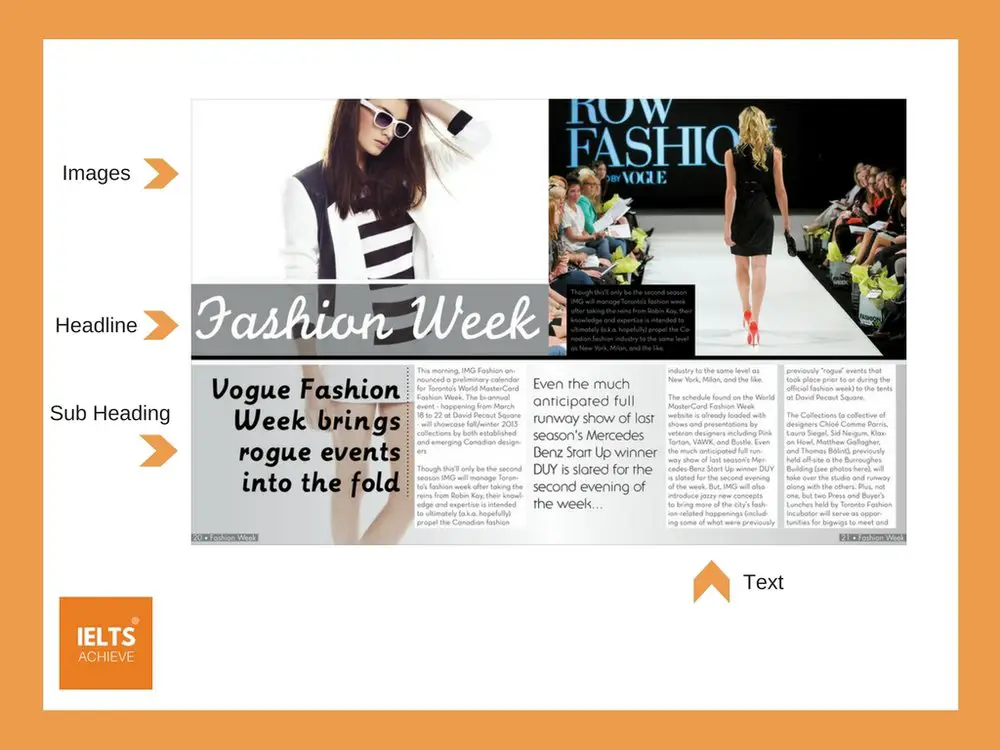
When you preview a text you look at the headings, the layout and any images to get an idea of what the text is about before you decide if you want to read it or not. For example, when you look at an article in a newspaper or a magazine, the headline and images give you an idea of what it is about. Previewing is an important skill to have because it helps you to foresee the content and this makes it easier to understand the text.
TIP >> Next time you read an article think about the headline, subheading and the images and think about the following questions – How do they draw you in to read more? How do they tell you what the article is about?
Predicting Content And Structure
This is when you use your knowledge and guess what a text is going to be about. For example, if you see an advert about adopting animals or donating to animal shelters, you would be able to guess the purpose of the text and the image(s) was to make you want to adopt an animal or help the shelters by donating money, therefore the vocabulary used would be related to this. Predicting is an important reading skill because you can make sense of a text when you already know about the topic.
TIP >>Practice by looking at adverts you see in magazines, online (blogs etc) and look at the vocabulary used and think about the following questions – How does it relate to the topic? How does it tell you about the purpose of the advert?
Source
Skimming
When you skim read a text for the main idea, you read the text quickly to get the general idea of the main topic. When you do this, you are looking for the main idea – not the specific details. For example, you may skim read the back cover of a book jacket to get an idea of what the book is about before you decide to read/buy the book. Skimming is an important skill because in the test you are time conscious, so you need to skim read texts in order to get the main idea, before locating specific information needed to answer questions.
TIP >> Practice skim reading by reading articles, reviews and summaries to get the main idea. Choose content that interests you, not only IELTS practice materials.
When you scan a text to find the information you also do this quite quickly to find what you need. You normally use this skill when you are looking for facts. For example, if you are looking for a train time or the departure gate you need at the airport, you scan the board’s looking for the information. Therefore, you use this skill every day when looking at times, dates or places.
TIP >> Practice scanning by looking for information in timetables, the TV guide etc and find facts you need quickly.
Intensive Reading
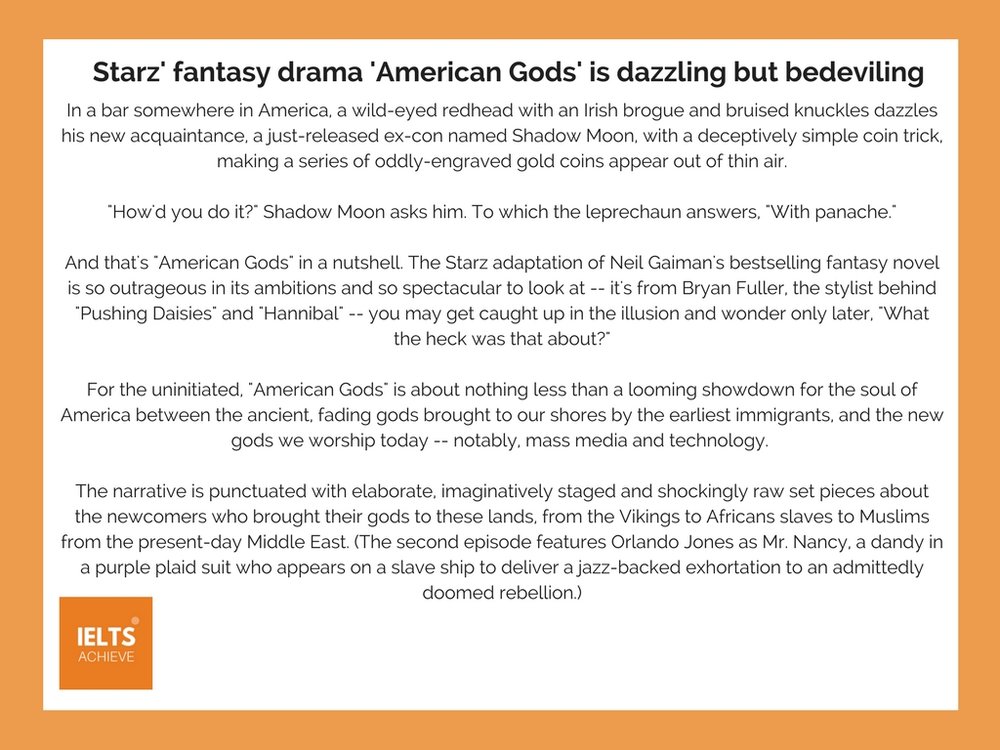
When you read a text carefully and study the information, this is intensive reading. You do this when the content is important. For example, if you had to fill out some important forms, like renewing your passport or filling out a tax return, you would read the instructions carefully, before filling out the forms. You need to read carefully for more detail when you need to understand the writer’s meaning. For instance, when reading a tv show review, you might want to read it intensively to find out the details to see if you want to watch it or not.
TIP >> Read reviews and other texts you find interesting and study the content. Think about how detailed the information is, do you understand the writer’s meaning?
Look at the review below of the TV Show ‘American Gods’ – How does the writer tell you what they think about the show?
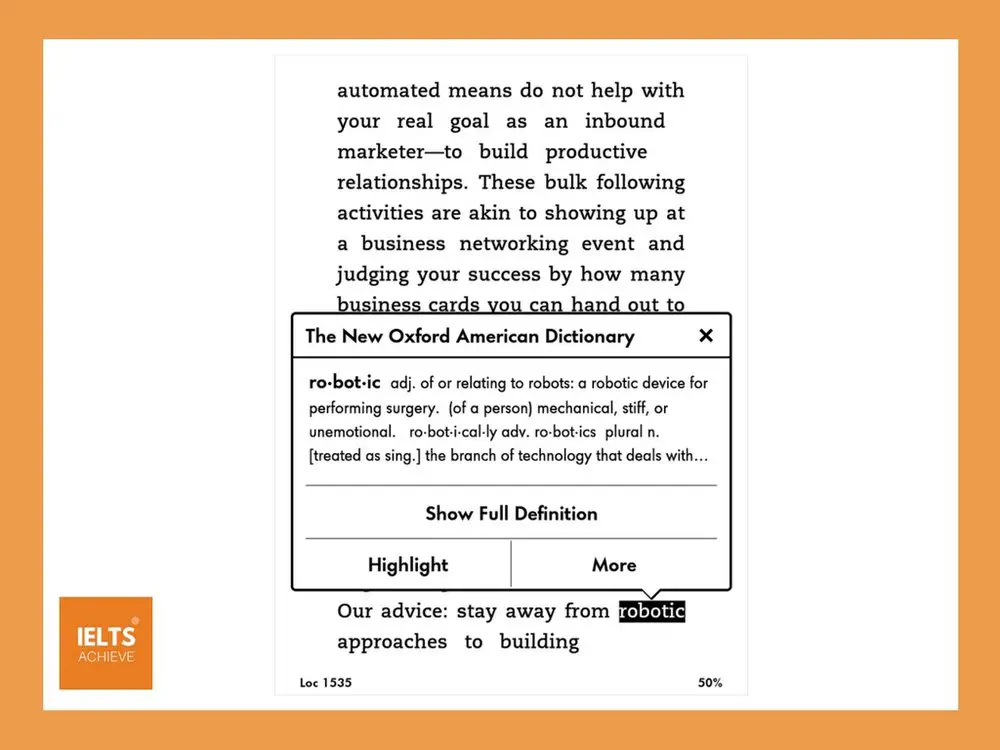
When you are reading and you come across a word or words you don’t know, you can sometimes guess the meaning from the context they are in. If not then you will have to look up the meaning in a dictionary (although this is not allowed in the test). For instance, if you were reading a book and you saw a word you did not know, you might be able to work out the meaning from the context of that sentence or paragraph.
TIP >> When you read – keep a dictionary and a notebook with you and write down any words you do not know the meaning of. Alternatively, you can do this easily if you use your smartphone or Ipad. If you have an e-reader, the built-in dictionary will show you the meaning of the words once highlighted. This is so useful for learning new vocabulary.
When you read a book, article etc, you should be able to understand how the writer feels or thinks about a subject. For example, in an article or blog about travelling, you may read views on certain places and how they feel when going there. This can help you to understand how they explain their opinions and views through the language they use. Understanding attitude and opinion are important skills because writers do not always clearly state how they think or feel.
TIP >> Read reviews or opinions from opinion sections of newspapers like The Guardian or The Washington Post. Think about how the writer shares their opinion – is it obvious? What language/vocabulary do they use? How can you tell what they are thinking or feeling?
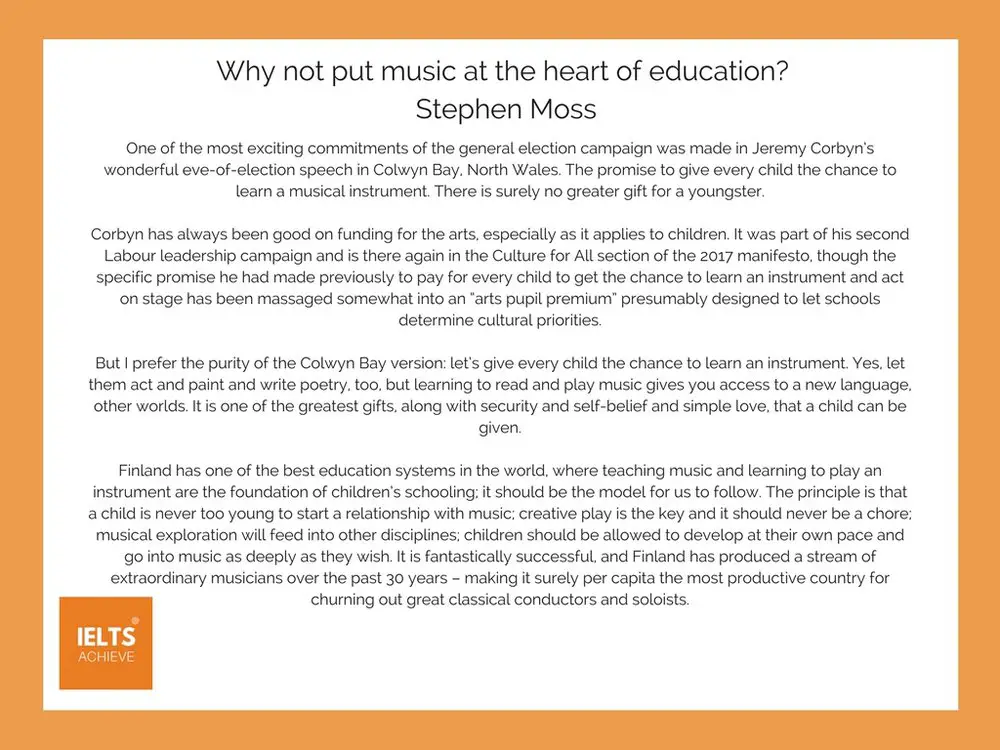
Look at the opinion piece below from The Guardian – how does the writer share his opinion about the topic?
Read more – Read as much as you can in English, choose anything that interests you – not just IELTS practice materials. Read novels, magazines, news articles, blogs and anything else that holds your attention. Reading really helps with your writing, as you learn new vocabulary, grammar and understand how structures work.
Make a note of any new words – Write them down and look them up – this will help you to remember the words and their meaning.
Take note of the grammar – Think about the structures used, look at the sentences, the tenses and the punctuation.
Idea development – When reading news articles think about how the writer leads you through the information, how do they develop their ideas? How do they structure the writing? Where do they put the facts? The opinions?
Opinions – How do they share their opinions with the reader? What kind of language and structure do they use to do this?
Schedule some reading time – when you are travelling on your commute to work, lunchtime, before bed – try to fit in some reading.
We hope you found this post useful in helping you to study for the IELTS Test. If you have any questions please let us know in the comments below or on the Facebook page.
The best way to keep up to date with posts like this is to like us on Facebook, then follow us on Instagram and Pinterest.
If you need help preparing for the IELTS Test, join the IELTS Achieve Academy and see how we can assist you to achieve your desired band score. We offer an essay correction service, mock exams and online courses.
Essential strategies and practice techniques for this IELTS Reading question type. Learn how to manage time and improve accuracy.
Originally published June 2017. Last reviewed 3 July 2026.
In this post, we will be looking at matching features.
In the IELTS Reading Test, you could be given questions that ask you to match features, often with texts that include theories or comments about people, places, years and things. To comprehend how to complete these questions, you need to be able to skim read.
The questions will not be ordered in the same way as the given text, the various options will be presented in a box and you will match them to the questions. There will be paraphrased information and more questions are given than needed to complete the task.
EXERCISE 1
The paragraphs for this practice exercise is from a text called “Giving blood in a time of crisis” from The World Health Organisation (WHO) website.
Read the questions, skim read the following text, and look for the important details;
Prakash Ghimire was just leaving his home in Kathmandu to travel to the airport when the shaking started.
Within a minute, a massive 7.8 magnitude earthquake – the worst to strike the region in more than 80 years – had laid waste to large parts of the city, wreaking destruction that would leave about 9000 people dead and another 22 000 injured.
Half an hour later, Dr Ghimire, a national professional officer at WHO’s country office in Nepal, was at the Health Ministry to join the team assembled at the health emergency operation centre. He was put in charge of coordinating the blood transfusion services, including the availability of blood and blood products in earthquake response operations.
“Immediately after the earthquake, we assembled and started taking stock of what had happened,” he says.
An initial assessment revealed extensive damage to the nation’s blood supply infrastructure. Out of about 100 blood transfusion centres, 9 were completely destroyed and 21 were partially damaged. The Central Blood Transfusion Service building in Kathmandu had large cracks in its walls and was deemed structurally unsound.
There were also deaths and injuries at two of the sites carrying out blood collection activities that day. One Nepal Red Cross staff member, one volunteer and seven donors had died, and others remained trapped in a collapsed donation centre, awaiting rescue.
But Nepal had long feared a devastating earthquake and had made some preparations. The country’s first solar-powered emergency blood transfusion service centre had been inaugurated just five days before the earthquake struck. The designers had predicted that power would be a significant problem after a natural disaster; the rooftop solar panels meant that this was not an issue.
Match the features >>
Prakash Ghimire
Dr Ghimire
Nepal
A. A nurse
B. Place of the earthquake
C. a doctor
D. a blood donor
E. Earthquake victim
Answers are at the bottom of the page.
Exercise 2
The paragraphs for this practice exercise is from a text called “Forgetting to wash your hands can cost lives“ from The World Health Organisation (WHO) website.
Read the questions, skim read the following text, and look for the important details;
When Bandana Das, a midwife in India, washes her hands it is not simply routine, it is a critical step in reducing infection and saving the lives of mothers and newborns.
“I have seen mothers discharged from the health facility and then come back to the same facility with severe infections and high temperatures,” says Bandana, the president of the Society of Midwives in India. “Many of these mothers do not survive.”
Worldwide, 30 000 women and 400 000 babies die every year from infections, such as puerperal sepsis, often caused by lack of water, sanitation and poor hand-washing practices. In an era of antimicrobial resistance, it is crucial that all midwives wash their hands at key moments – before and after touching a patient, before medical procedures, and after being exposed to bodily fluids.
However, up to 70% of health workers do not adhere to recommended hand hygiene practices, according to WHO.
In India and many low- and middle-income countries, practising good hand hygiene is not easy. Bandana, like many midwives in India, often does not have access to water, a toilet, or soap.
“In some places, water has been so dirty it is unusable,” she says. “It is very difficult to practice good hygiene in these circumstances.”
According to a WHO and UNICEF report, more than 1 in 3 health facilities in low- and middle-income countries do not have any access to water at all. When the reliability, safety, and distance of the water supply is taken into account, that ratio increases to 1 in 2.
Lack of water is only one challenge. Nearly 1 in 5 of these facilities do not have toilets and more than 1 in 3 does not have soap for hand washing. Clean water, functioning toilets and soap are all essential to protecting the lives of mothers and newborns during the time of birth.
Match the features >>
WHO and UNICEF
Bandana Das
Health workers
A. leads the way in good hygiene practices in India
B. wrote a report about the shortage of midwives in India
C. communicated information about some places having no water
D. often do not clean their hands
E. Performed tests on the water in India
Answers are at the bottom of the page.
REVIEW AND STRATEGY
The matching features questions are common in the IELTS Reading Test, therefore you should practice and develop a strategy for answering.
TIP >> Read the instructions before you start reading the text. Make sure you understand what the question is asking you to do.
TIP >> Read the names/ places first and scan the text to find them. You can underline/highlight them – they may be mentioned more than once.
TIP >> Look for the connection between their name and what they have achieved etc, that relates to the options. Be wary of synonyms and paraphrasing.
TIP >> Choose your answers through an elimination process. Which ones do not fit? Which ones can you dismiss?
Answers >>
Exercise 1 Answers >>
1 – E
2 – C
3 – B
Exercise 2 Answers >>
1 – C
2 – A
3 – D
We hope you found this post useful in helping you to study for the IELTS Test. If you have any questions please let us know in the comments below or on the Facebook page.
The best way to keep up to date with posts like this is to like us on Facebook, then follow us on Instagram and Pinterest.
If you need help preparing for the IELTS Test, join the IELTS Achieve Academy and see how we can assist you to achieve your desired band score. We offer an essay correction service, mock exams and online courses.
Essential strategies and practice techniques for this IELTS Reading question type. Learn how to manage time and improve accuracy.
Originally published June 2017. Last reviewed 3 July 2026.
The IELTS Reading Test lasts 60 minutes. It is made up of three parts, with a total of 40 questions. You are given no extra time to transfer your answers to the answer sheet. During the test, the texts become more difficult.
In the General Training test, the texts are not academic, they are about daily life, for example – advertisements, reviews or ‘how to’ articles. You may read something about preparing for a job interview or a review of places to visit when going abroad.
In the Academic test, all three texts are of an academic tone, for instance – scientific research or a historical article. The articles in the Academic reading test may include research about medical procedures or the future of medicine, the environment and climate change issues.
What do you need to do?
Find specific information in the texts. You will be looking for information, such as dates, names, places and costs.
Finding the purpose of a text, looking at the reasons behind the writing. Why did the author write this? What is the purpose of it? To share an opinion? Many people when they write are expressing their views, selling something, sharing news, suggesting, recommending something or reviewing something.
Separating the main idea of an article apart from other ideas. In a long text, there will be the main idea, that is supported by other ideas. It will be good practice for you to read articles and select the main idea, as well as the point of each paragraph.
Following an argument, looking for both sides, the for and against. When you are reading a text, think about – What is the key argument? What statement is the author making? Are they sharing their opinion?
Understand information in diagrams and tables. These are used to give specific information for a fast analysis. In the exam, you may have a table that you have to fill in, after finding the required information in an article.
Summaries and notes, a summary is a short review of something, you will often see this when looking for information about a book or movie, they will give you a short summary of what it is about. Notes can be in bullet form, with groups of words or single words, linked to a subject heading.
The main features of the text, knowing where the title is, the subheadings, the images and the main body of the text is important.
Text length, can in the Academic test go well over 1000 words. This is why it is important to learn how to skim read and locate specific information. In the General Training test, the texts are shorter, but you will also have to be able to skim read.
Being able to paraphrase and recognise paraphrasing is also very important. Many of the texts will paraphrase words – the questions may paraphrase using different words with the same meaning. Always read the questions before you start reading through the text.
How Can You Practice?
There are many websites and texts out there for you to practice with, but day to day you should try and read articles from news websites, science journals, history and of course general interest.
Here are some links to websites with articles you may find interesting;
For more help on each skill you should practice before the reading test, please take a look at the other posts in the reading section.
We hope you found this post useful in helping you to study for the IELTS Test. If you have any questions please let us know in the comments below or on the Facebook page.
The best way to keep up to date with posts like this is to like us on Facebook, then follow us on Instagram and Pinterest.
If you need help preparing for the IELTS Test, join the IELTS Achieve Academy and see how we can assist you to achieve your desired band score. We offer an essay correction service, mock exams and online courses.