Step-by-step guide to answering this type of IELTS Writing Task 1 question. Covers structure, key language, and band-scoring criteria.
Originally published May 2018. Last reviewed 3 July 2026.
In this post, we will look at a Writing Task 1 Academic process essay example from the IELTS writing task 1 Academic Test. Students often ask if the questions are repeated year after year and the answer is no, but the type of chart, graph or process can be.
There are so many questions written each year, you may find you practice answering various questions on different topics. It is best practice to learn how to answer each one of the various types of writing task 1 questions, from bar charts, line graphs, maps, process etc.
If you would like to learn how to structure a process essay please click the button below >
Take a look at the IELTS Writing Task 1 Academic essay example below >>
*This process question and answer were provided by a student. IELTS Achieve did not design this question*
The picture illustrates the process and production of milk, cheese, cream and butter for public consumption.
Overall, it can be observed that there are eight stages in this process, beginning with the cows grazing on grass in the field and ending with milk and dairy products being sold in the market.
First, cows are released in the field to graze on the grass, and then they are subjected to a milking machine twice a day for milk collection. Next, the milk is being stored in refrigeration storage on a daily basis. Following this, the milk is then collected and put into a tanker which then will be delivered to the dairy daily.
In the subsequent stage, the milk is being processed in the dairy into different milk products such as cheese, cream and butter, then the milk is then put through pasteurization and packaging. Finally, the milk and the dairy products are being delivered to supermarkets and shops for consumption.
Word count - 160 / Band score 8
Task Achievement - The answer provides a paraphrased question, to begin with, followed by an overview that gives the reader key information.
Coherence and Cohesion - The answer has been divided into clear logical paragraphs.
Lexical Resource - There is evidence of paraphrasing, synonyms and some less common words.
Grammatical Range and Accuracy - The answer has no grammatical errors. The sentences are mainly made up of multiple clauses and have a variety of structures.
We hope you found this post helpful in helping you to study for the IELTS Test. Let us know in the comments or on the Facebook page if you have any questions. The best way to keep up to date with posts like this is to like us on Facebook, and then follow us onInstagramand Pinterest. We offer essay correction services, mock exams, and online courses. If you need help preparing for the IELTS Test, join the IELTS Achieve Academy and see how we can help you achieve your desired band score faster.
Step-by-step guide to answering this type of IELTS Writing Task 1 question. Covers structure, key language, and band-scoring criteria.
Originally published May 2018. Last reviewed 3 July 2026.
In this post, we will look at a Writing Task 1 Academic process essay example How coffee is produced ad prepared for sale? from the IELTS writing task 1 Academic Test.
Students often ask if the questions are repeated year after year and the answer is no, but the type of chart, graph or process can be. There are so many questions written each year, you may find you practice answering various questions on different topics. It is best practice to learn how to answer each one of the various types of writing task 1 questions, from bar charts, line graphs, maps, process etc.
If you would like to learn how to structure a process essay please click the button below: How to write a process essay
Take a look at the IELTS Writing Task 1 Academic essay Process example below:
*This process question and answer were provided by a student. IELTS Achieve did not design this question*
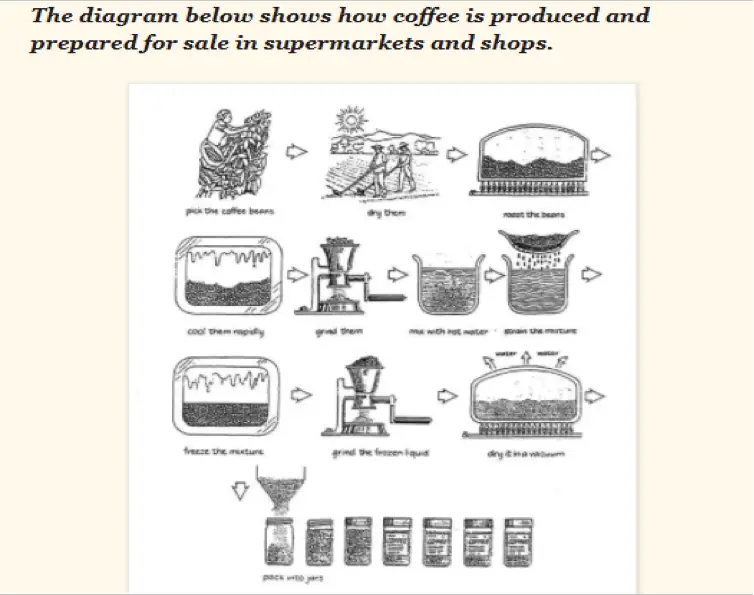
How coffee is produced ad prepared for sale?
The diagram below shows how coffee is produced and prepared for sale in supermarkets and shops.
Take a look at the model answer.
The picture describes the production of coffee and the preparation for delivery into different stores. Overall, there are 11 stages in manufacturing coffee. Beginning with picking up the coffee beans and ending with packaging and delivery for public consumption. First, the mature coffee beans are picked up in the coffee field. After that, the collected beans are then dried under the sun and then roasted in a roasting oven. Next, the roasted beans are placed in a cooling area to lower the temperature immediately. Afterwards, the coffee beans are then ground and then the mixture is later mixed with boiling water. In the subsequent stage, the mixture of water and ground coffee beans is then strained and placed in a freezer to chill. Consequently, the frozen liquid is subjected to a grinder and arranged in a drying vacuum to remove its water content. Finally, the dried ground coffee beans are being packed in a jar and they are being delivered to different stores.
Word count - 163 / Band score 80
Instructor Feedback on IELTS Process Question Essay: How Coffee is produced?
Task Achievement - The answer provides a paraphrased question, to begin with, followed by an overview that gives the reader key information.
Coherence and Cohesion - The answer has been divided into clear logical paragraphs.
Lexical Resource - There is evidence of paraphrasing, synonyms and some less common words.
Grammatical Range and Accuracy - The answer has no grammatical errors. The sentences are mainly made up of multiple clauses and have a variety of structures.
We hope you found this post helpful in helping you to study for the IELTS Test. Let us know in the comments or on the Facebook page if you have any questions. The best way to keep up to date with posts like this is to like us on Facebook, and then follow us onInstagramand Pinterest. We offer essay correction services, mock exams, and online courses. If you need help preparing for the IELTS Test, join the IELTS Achieve Academy and see how we can help you achieve your desired band score faster.
Step-by-step guide to answering this type of IELTS Writing Task 1 question. Covers structure, key language, and band-scoring criteria.
Originally published May 2018. Last reviewed 3 July 2026.
In this post, we will look at a Writing Task 1 Academic process essay example from the IELTS writing task 1 Academic Test. Students often ask if the questions are repeated year after year and the answer is no, but the type of chart, graph or process can be.
There are so many questions written each year, you may find you practice answering various questions on different topics. It is best practice to learn how to answer each one of the various types of writing task 1 questions, from bar charts, line graphs, maps, process etc.
If you would like to learn how to structure a process essay please click the button below >
Take a look at the IELTS Writing Task 1 Academic essay example below >>
*This process question and answer were provided by a student. IELTS Achieve did not design this question*
The diagram illustrates the procedure of how to recycle worn-out glass bottles.
Overall, it can be observed that there are three phases in recycling used glass bottles, beginning with the collection of wasted bottles and ending with the delivery of newly created bottles.
First, wasted glass bottles are gathered and put into a collection point and then these bottles will be transferred to a facility where they are placed into high-pressure water tanks to wash out dirt and impurities. Next, the bottles will be arranged and categorized into three colours (brown, green and clear).
In the subsequent stage, the bottles are then delivered to a glass factory where they will be smashed into small pieces. Then, the process continues by putting them into a burning furnace with temperatures ranging from 6000c up to 8000C and then a liquid is produced. Afterwards, the recycled liquid glass and new liquid glass will be combined and shaped in a glass mould. Finally, newly formed glasses are filled with products and delivered to different supermarkets.
Word count - 171 / Band score 8
Task Achievement - The answer provides a paraphrased question, to begin with, followed by an overview that gives the reader key information.
Coherence and Cohesion - The answer has been divided into clear logical paragraphs.
Lexical Resource - There is evidence of paraphrasing, synonyms and some less common words.
Grammatical Range and Accuracy - The answer has no grammatical errors. The sentences are mainly made up of multiple clauses and have a variety of structures.
We hope you found this post helpful in helping you to study for the IELTS Test. Let us know in the comments or on the Facebook page if you have any questions. The best way to keep up to date with posts like this is to like us on Facebook, and then follow us onInstagramand Pinterest. We offer essay correction services, mock exams, and online courses. If you need help preparing for the IELTS Test, join the IELTS Achieve Academy and see how we can help you achieve your desired band score faster.
Step-by-step guide to answering this type of IELTS Writing Task 1 question. Covers structure, key language, and band-scoring criteria.
Originally published May 2018. Last reviewed 3 July 2026.
In this post, we will look at a Writing Task 1 Academic process essay example from the IELTS writing task 1 Academic Test. Students often ask if the questions are repeated year after year and the answer is no, but the type of chart, graph or process can be.
There are so many questions written each year, you may find you practice answering various questions on different topics. It is best practice to learn how to answer each one of the various types of writing task 1 questions, from bar charts, line graphs, maps, process etc.
If you would like to learn how to structure a process essay please click the button below >
Take a look at the IELTS Writing Task 1 Academic essay example below >>
*This process question and answer were provided by a student. IELTS Achieve did not design this question*
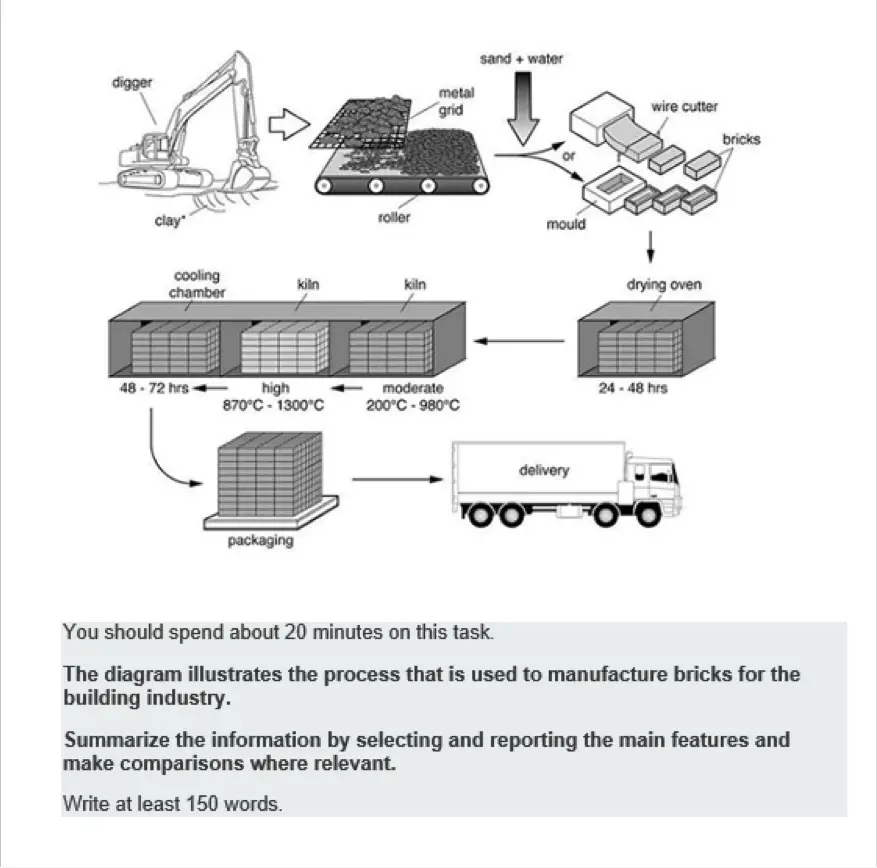
The picture shows the procedure of how to create bricks to be used in construction.
Overall, it can be observed that there are eight stages in the process, beginning with the digging of clay by the digger and ending with the bricks being delivered to different building sites.
To begin with, clay is collected by a bulldozer and then taken to a metal grid with a roller to press the clay and to incorporate sand and water. After this, the processed clay will then be subjected to a moulder or a wire cutter machine to form the clay into bricks.
In the subsequent stage, the newly formed brick will be placed in a drying oven where it will stay for about 24-48 hours. Next, the bricks will rest in two different chambers with temperatures ranging from 200 0C-9800C (1st chamber) and 8700C- 13000C ( 2nd chamber) respectively. Afterwards, the bricks will be exposed to a cooling chamber for about 48-72 hours and then later will be packed. Finally, the bricks are then stored and delivered to different construction sites.
Word count - 179 / Band score 8
Task Achievement - The answer provides a paraphrased question, to begin with, followed by an overview that gives the reader key information.
Coherence and Cohesion - The answer has been divided into clear logical paragraphs.
Lexical Resource - There is evidence of paraphrasing, synonyms and some less common words.
Grammatical Range and Accuracy - The answer has no grammatical errors. The sentences are mainly made up of multiple clauses and have a variety of structures.
We hope you found this post helpful in helping you to study for the IELTS Test. Let us know in the comments or on the Facebook page if you have any questions. The best way to keep up to date with posts like this is to like us on Facebook, and then follow us onInstagramand Pinterest. We offer essay correction services, mock exams, and online courses. If you need help preparing for the IELTS Test, join the IELTS Achieve Academy and see how we can help you achieve your desired band score faster.
Step-by-step guide to answering this type of IELTS Writing Task 1 question. Covers structure, key language, and band-scoring criteria.
Originally published May 2017. Last reviewed 3 July 2026.
A question on the IELTS academic writing test that is becoming more common, asks the candidate to write about and describe a process.
You may have a natural or a man made process question. In this post we will look at how to write this type of essay, with structure help, vocabulary and sample answers.
Writing Task 1 - Process Essay Structure >>
Paragraph 1 - Paraphrase the question
When writing your own introduction of one or two sentences paraphrase the question and add detail.
Paragraph 2 - Overview of the main features
You need to be able to give a broad summary of the information. This is best started with - Overall....... then giving details of the main features you can see. You can write this in one or two sentences, which describe the main features of the information that is presented in the process. Think about the number of stages that are in time order, what is happening at the beginning? What is happening at the end? How many stages are there?
Paragraph 3 - Specific details
Write about the process from the beginning, explaining what is happening throughout each stage.
Paragraph 4 - Specific details
Write about the process through to the end, including time connectors that lead the reader through each step of the process clearly.
TIP >> When describing a process you should write using the passive voice, focussing on the activities not the person who is doing them.
Time Connectors >>
The words below can help you to connect the stages of the process you are writing about.
Writing Task 1 Process Sample Essays >>
Here are two sample essay questions and answers for you to look at. Review the language used, the essay structure, the stages and how it has been written.
Sample Process Essay 1
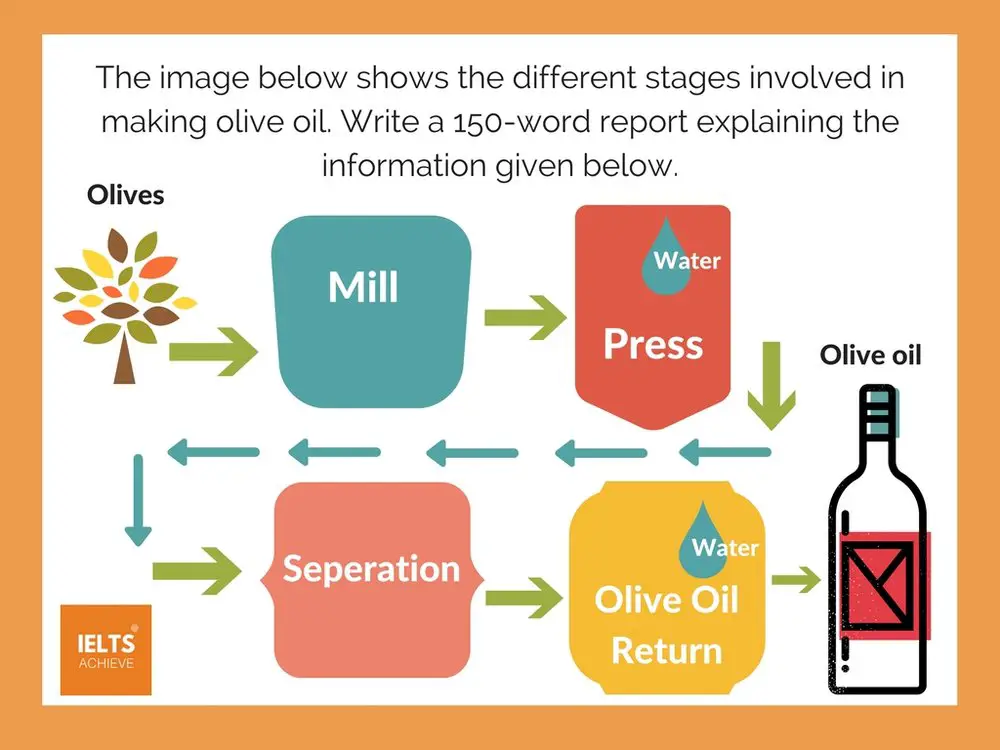
The diagram presents how olive is produced with the use of different equipment.
Overall, olive oil production involves four main stages and needs different equipment to achieve its desired appearance and flavour. The process starts with the breakdown of the olives after collection in a mill and culminates with storing the product in bottles until it is ready for consumption.
The process of making olive oil starts when olives are ground in a mill to create a paste. After the paste has been spread onto mats, this is transferred into a press where water is added. Following this procedure, the mashed olive paste is placed into a separation container where the oil goes through a natural separation process from vegetable waters.
After separation, the mixture goes into the olive oil return, where more water is added and wastewater is subsequently drained. Once this process has ended, the olive oil is ready to be bottled, where it is stored for a period of time known as the clarification stage. Finally, once this time has passed the oil is ready to be used.
(Word Count = 181 / Band Score 9)
Task Achievement - The answer provides relevant information, describing the process of how olive oil is made. The overview gives clear information, leading into the main body paragraphs.
Coherence and Cohesion - The answer has been divided into clear logical paragraphs, with clear cohesion between them with the addition of time connectors (after, following this, finally).
Lexical Resource - There is evidence of paraphrasing, synonyms and some less common words.
Grammatical Range and Accuracy - The answer has no grammatical errors. The sentences are mainly made up of multiple clauses and have a variety of structures. There are no spelling mistakes and punctuation is correct.
TIP >> Write a good overview, with how many stages the process has, starting with and ending with.
TIP >> Describe the process and lead the reader through it by using time connectors.
Sample Process Essay 2
The picture illustrates the process of making paper from the trees that have been collected.
Overall, it can be observed that there are eight stages in this process, beginning with the collection of trees from the forest and ending with the paper being made in the paper making machine.
To begin with, timber is collected from the forest and taken to be debarked. After the wood has been stripped bare, it enters the chipping machine, where it is chopped up into tiny pieces. From the chipping machine, the wood enters into three separate stages. First, the wood chips are put through the mechanical pulping process, where they are ground and smashed into pulp. Then they have a chemical pulping, going next into the hydra-pulper.
In the subsequent stage, the mixture goes through to be screened and cleaned, to filter any lumps or waste from the pulp. Lastly, the pulp is entered into the paper making machine, where it is pressed to make sheets of paper. The paper is then stored and stacked, ready for shipping and to be used.
(Word Count = 179 / Band Score 9)
Task Achievement - The answer provides relevant information, describing the process of how paper is made. The overview gives clear information, leading into the main body paragraphs.
Coherence and Cohesion - The answer has been divided into clear logical paragraphs, with clear cohesion between them with the addition of time connectors (first, then, subsequently).
Lexical Resource - There is evidence of paraphrasing, synonyms and some less common words.
Grammatical Range and Accuracy - The answer has no grammatical errors. The sentences are mainly made up of multiple clauses and have a variety of structures. There are no spelling mistakes and punctuation is correct.
TIP >> Write a good overview, with how many stages the process has, starting with and ending with.
TIP >> Describe the process and lead the reader through it by using time connectors.
Writing Task 1 Band Score 9 Criteria >>
We hope you found this post helpful in helping you to study for the IELTS Test. Let us know in the comments or on the Facebook page if you have any questions. The best way to keep up to date with posts like this is to like us on Facebook, and then follow us onInstagramand Pinterest. We offer essay correction services, mock exams, and online courses. If you need help preparing for the IELTS Test, join the IELTS Achieve Academy and see how we can help you achieve your desired band score faster.