Expert tips and strategies for this part of the IELTS Speaking test. Includes sample responses and key vocabulary for Band 7+.
Originally published September 2017. Last reviewed 3 July 2026.
This post will look at how to extend your part 3 answers.
In part 3 the examiner will ask you questions that relate to your cue card topic from part 2. The answers you give should give your opinion and show the examiner your ability to use English well.
The questions may include advantages and disadvantages, problems and solutions, how something will change in the future and how something may have changed from the past up until now. It is a good idea to read the news as much as you can and form opinions on common topics, like the environment, technology, education, health and work.
Try to make your answer around 3-5 sentences long, you don't want it to be too short or too long. Too long would be similar to a part 2 answer, which could lead you off the topic and onto something else. Too short and you will not be showing the examiner how well you can use English.
Take a look at the ways that you can extend your answers below, in the aim of getting you a higher score! >>
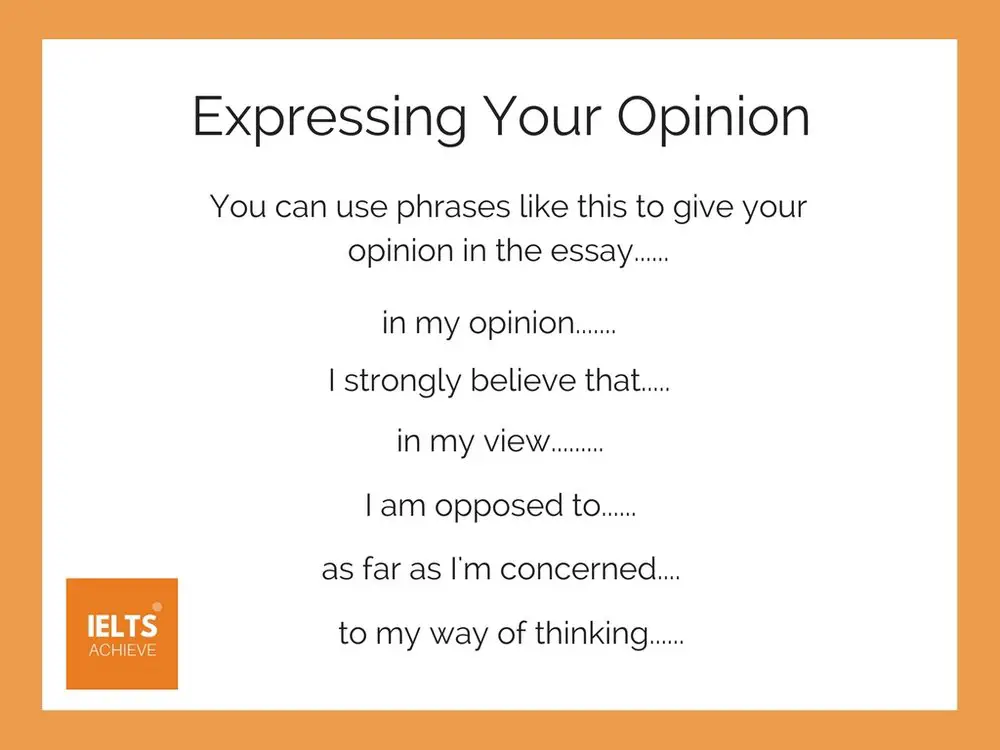
Express Your Opinion
Expand your answers with reasons.....give your opinion and say why you think that...... (depending on what you are being asked). You can use words like - for, because, since, as. For example;
Part 3 Question - How should students spend their summer vacations?
Answer - In my view, students should do something to benefit them during the summer break, as well as taking some time to relax. Since they have such a long period of time off in the summer months, there is enough time for them to have a holiday, as well as work to save money or intern. I think that gaining skills through work experience relevant to their studies, is a great way to utilise all of that time off.
Give Specific Examples
Support your answers with examples from your life, past experiences or from articles you have read on the subject. It is much better to do this then try to make something up, as you will be more confident giving an example that you have experienced. You can use - for example, for instance, such as, including. For example;
Part 3 Question - Is higher education too expensive in your country?
Answer - In my opinion, I think that the fees have risen too much in recent years. Expecting students to pay £9,000 per year for courses at many universities is really expensive. For example, my friend who has completed a masters degree, paid £10,000 to complete the course in one year, without funding from the government. The fees continue to rise, with many students opting to complete courses in a skilled trade rather than go down the academic route, mainly due to the costs involved.
Use Linking Words
You can extend your answers by giving contrasting details, using words like - but, however, although, even though, while, whereas.. etc. For example;
Part 3 Question - Should all students pay for their university education?
Answer - In my opinion, I think that students should be able to have a means tested university education, meaning that those whose family income is not enough to cover the costs, would have funding and bursaries from the government, whereas those who could afford it would have to pay the fees. However, this would perhaps create a divide between those who have money and those who do not.
Think About The Future
When the examiner asks you a question, think about the future - using the future tense. You can use will be/going to or in a hypothetical situation you can use would or could. For example;
Part 3 Question - How do you think people will travel in the future?
Answer - I've never given that much thought really! If I have to imagine what it will be like, I think that maybe some forms of travel would potentially become more luxurious and more expensive. For example, flights could become more expensive if some of the aeroplanes are made into luxurious cabins, with private areas for passengers. This could also happen on trains, with passengers able to buy more expensive tickets for their own cabin or fancy seating area. The next generation of travel may become high end and extravagant for those who want it.
PRACTICE
Practice as much as you can with a partner or your teacher, looking at past questions and working on your overall conversation. The best student answers are given naturally, giving opinions, explaining, and giving specific examples.
Think about the structures you need to use and the words that will help you to connect your information together. Take a look through the practice question and answers in this section to get some ideas.
Don't overcomplicate it by thinking of 'complex structures' and grammar that you need to use when you are answering.
Join our private Facebook Group and find people to start practising with! Sign up for our newsletter to receive the link, then join the group to meet other IELTS students.
We hope you found this post useful in helping you to study for the IELTS Test. If you have any questions please let us know in the comments below or on the Facebook page.
The best way to keep up to date with posts like this is to like us on Facebook, then follow us on Instagram and Pinterest.
If you need help preparing for the IELTS Test, join the IELTS Achieve Academy and see how we can assist you to achieve your desired band score. We offer an essay correction service, mock exams and online courses.
Expert tips and strategies for this part of the IELTS Speaking test. Includes sample responses and key vocabulary for Band 7+.
Originally published September 2017. Last reviewed 3 July 2026.
In this post, we will be looking in-depth at part 3 of the speaking test.
The IELTS Speaking Test lasts 11-14 minutes.
The test has three parts, where you are interviewed by a trained examiner. You are not allowed to use a dictionary during the test. IELTS Academic and IELTS General students take the same test and it is marked in the same way.
PART 3 INFORMATION
Part 3 = 3-4 minutes - A conversation between you and the examiner.
The examiner will lead the conversation by asking general questions, which relate to the topic/cue card used in part 2.
The questions asked will encourage you to share your thoughts, feeling and opinions. You are scored on your use of English, not on your general knowledge or opinions.
Part 3 Questions
Part 3 questions may seem difficult to answer, as they are less personal than questions in parts 1 and 2, they are more about society or the country as a whole. You should concentrate on giving your opinions and not worry so much about supporting them with facts.
Here is an example of a cue card question from part 2, followed by a part 3 question;
Part 2 Question
Describe one of your favourite possesions.
Part 3 Question
What kinds of objects do you think give status to people in your country?
Model Answer (High Level)
Personally, I think many people want to have the latest iPhone or other expensive gadgets to show off their status in society. Depending on the personal wealth of the individual, they may show their status through really expensive items, like cars, private planes or super yachts. In my country, it is quite common to see people wearing expensive clothes, using the latest gadgets and driving expensive luxury cars. it is also quite common in the summer months to see many yachts and super yachts. So in my opinion, luxury items seem to give prestige to some in my country.
Expressing Opinions
When giving your opinion, you can use the following idioms and structures;
Personally. I think that.....
In my opinion, I believe that......
As far as I'm concerned.......
If you ask me.......
In my view.....
In my experience........
I strongly believe that........
I have often felt that.........
Try answering the following part 3 questions >>
Q. Why do you think people go to restaurants when they want to celebrate something?
Q. Which are more popular in your country: fast food restaurants or traditional restaurants? Why do you think that is?
Q. Some people say that food in an expensive restaurant is always better than food in a cheap restaurant – would you agree?
Think about the points below when you are answering;
Allow your ideas to flow naturally.
Use linking words and phrases.
Use phrases that let the examiner know that you are expressing your opinion (see above).
Giving An Example
When you give your answer, include a specific example to gain more marks. You can mention something from your own personal experience, or something you have read about etc. You do not have to go into as much detail as you would for a part 2 answer, but a specific example can make your answer a high-level response.
Part 3 Question
Q. How should we educate children to protect the environment?
Model Answer (High-Level)
There are a number of ways that children can understand how to preserve the environment. For example, in school, they may complete projects where they have to clean up beach areas or learn about protecting animals. My friend teaches at a school and her students often organise beach litter collections. They remove waste from the beach, especially plastic bags and bottles, which can harm sea life, birds and other creatures. They do this as part of their environmental study programme.
Advantages / Disadvantages Questions
Common questions in part 3 look at both sides of an argument. You may see an advantage/disadvantage question, where you can bring your own personal experiences to be used as examples.
Part 3 Question
Q - What are the advantages and disadvantages of working in an open plan office space?
Model Answer (High-Level)
One of the benefits of working in this way is that you can easily talk to your colleagues. You can share ideas quickly and find out information without having to send a message or an email. In my opinion, working in an open plan office has the main disadvantage of being very noisy. This can affect your concentration levels, as the noise will distract you from your work. I used to work in an environment like this, which was very distracting and I found it so hard to concentrate. From my point of view, I think that there are more disadvantages to working in this type of environment.
Expressing more than one view
The examiners give high marks to those who can structure their answer well and use terms like; firstly (or first of all), secondly (second of all), thirdly and lastly. Similar to how you may structure a writing task answer, you can lead the examiner through your points using these linking words.
Part 3 Question
Q - What advantages do universities bring to society?
Model Answer (High Level)
In my opinion, going to university can bring many benefits to society, first of all, it can train people to have specialist knowledge that can benefit all, for instance, doctors, lawyers and architects. Secondly, when you learn specialist skills at university, you also learn how to interact with other people and work together. Lastly, having a skilled workforce can make both society and its systems better and continually striving to improve.
Linking Words
Using linking words and phrases will improve your band score, making your answer more coherent and natural.
I Don't Know The Answer
What should you do if you don't know the answer? Think about someone else's opinion or something you have read about and form an opinion quickly. You can say something like "I have never really thought about that to be honest" to buy yourself some time while you think of what to say. You could also use one of the following sentences;
Speaking off the top of my head....
I've never given that much thought.....
I don't have much of an opinion on this, because.....
I'm not really the right person to ask about this, because......
You need to show the examiner your use of English at a high level, not how impressive your opinions are, so by being honest and then discussing the question, you can expand and give your answer, for example;
Part 3 Question
Q - How do you think people will travel in the future?
Model Answer (High Level)
I've never given that much thought really! If I have to imagine what it will be like, I think that maybe some forms of travel will become more luxurious and more expensive. For example, flights might become more expensive if some of the aeroplanes are made into luxurious cabins, with private areas for passengers. This could also happen on trains, with passengers able to buy more expensive tickets for their own cabin or fancy seating area. The next generation of travel may become very high end and extravagant for those who want it.
What do you think of the answer? Even if you make something up, you need to show the examiner you have used English well to deliver your answer.
We hope you found this post useful in helping you to study for the IELTS Test. If you have any questions please let us know in the comments below or on the Facebook page.
The best way to keep up to date with posts like this is to like us on Facebook, then follow us on Instagram and Pinterest.
If you need help preparing for the IELTS Test, join the IELTS Achieve Academy and see how we can assist you to achieve your desired band score. We offer an essay correction service, mock exams and online courses.
Expert tips and strategies for this part of the IELTS Speaking test. Includes sample responses and key vocabulary for Band 7+.
Originally published August 2017. Last reviewed 3 July 2026.
In this post, you will see one of the most common IELTS speaking topics (Family) and sample answers.
Please remember that in the actual test you should give honest answers and talk about your own experiences, thoughts, feelings and opinions. Do not try to memorise answers, as the examiners will probably be able to guess and you will lose marks.
However, you are able to make up information to extend your answers, but be sure that you are confident when speaking about the chosen topic and that it is believable.
TIP >> Each answer should be at least 2-3 sentences long.
TIP >> Listen carefully to the question so that you answer in the correct tense.
TIP >> When answering a yes/no question - answer then give your reasons for your answer. You must extend your answer to gain more marks.
TIP >> Just relax and think of it as a regular conversation you are having, make eye contact and be positive.
Take a look at the questions and sample answers below on the topic of 'Family' >>
Q: Could you tell me something about your family?
A: My family is quite small and most people live far away from each other. Some are at the top of the country and some at the bottom. More distant relatives live in France and Australia, so we don't see them very often.
Q: Do you think it is good to live with grandparents?
A: In my opinion, living with your grandparents may be a way to save money and also to help to care for them. Perhaps they can't do things they used to, like housework or cooking, so being able to help them would be a positive.
Q: What’s the women’s status in families?
A: Women are seen as the people in charge in most families, they have many roles within the family unit, often having qualifications and a career also. They are the carers, providers, mothers and managers.
Q: Do you think it good to be the only child in the family?
A: On the one hand, it could be a lonely existence when you are a small child but as you become older would start to enjoy having that space. On the other hand, they are missing out on the connection that you see between siblings.
Q: Is there any generation gap in your family?
A: There is a divide between the older members of the family and the young, with varying views on politics and religion which leads to misunderstandings.
Q: Do you like your family?
A: Yes of course! My immediate family - my parents are amazing people, kind, funny and caring. The other members of my family and my husbands family are all very lovely people, who have good times together.
Q: Who is your closest family member?
A: My mother is very close to me and we talk every day, often about trivial things like what our dogs have been doing. She likes to ask questions about my dog, to make sure he is being taken care of like a king!
Q: What are your parents like?
A: Very good, kind and funny people. They like to laugh, read, travel and like all of the same TV shows as me. They are very caring people too, helping in the community - for a children's charity and to protect the environment.
We hope you found this post useful in helping you to study for the IELTS Test. If you have any questions please let us know in the comments below or on the Facebook page.
The best way to keep up to date with posts like this is to like us on Facebook, then follow us on Instagram and Pinterest.
If you need help preparing for the IELTS Test, join the IELTS Achieve Academy and see how we can assist you to achieve your desired band score. We offer an essay correction service, mock exams and online courses.
Expert tips and strategies for this part of the IELTS Speaking test. Includes sample responses and key vocabulary for Band 7+.
Originally published August 2017. Last reviewed 3 July 2026.
In this post, see the top 10 speaking part 1 tips that will help you to achieve a band score 7 or above.
The IELTS Speaking Test lasts 11-14 minutes.
The test has three parts, where you are interviewed by a trained examiner. You are not allowed to use a dictionary during the test. IELTS Academic and IELTS General students take the same test and it is marked in the same way.
PART 1 INFORMATION
To begin with, the examiner will introduce themselves to you, then ask you your name and for proof of identity.
Time:4-5 minutes You will be asked questions on familiar topics, like your hobbies, family, where you are from, what your hometown/city is like, etc.
The topics that are included:
Your studies/education
Hobbies/sports
Your family
What kind of movies, books, tv shows or music you like
What you like to eat / where you like to eat
Your job
Where you live
To view sample questions and answers on a variety of part 1 speaking topics, take a look at the other posts in this section.
Take a read through our top ten tips below, that will help you to gain a band score of 7 or above!
Speaking Tips
Tip 1: Be Prepared
As well as being prepared for the test questions on the day of your exam, you should also be aware of what to expect in terms of getting to the test centre and the beginning of the test. Arrive in plenty of time, so that you are not under pressure/late and have time to relax before the test.
The examiner will introduce themselves and ask you for your name and proof of identity (Passport etc), to begin with. They will also ask you where you are from, which requires a simple answer - this is more of a formality, so you don't have to extend your answer here, but simply state, for example; "I am from Romania' (or name the town/city etc you are from and where).
Take a look at this post for help with how to prepare for the speaking part 1 test..
Tip 2: Make A Good First Impression
Try to be relaxed and confident, having confidence will help you to do well in your test. Make eye contact with the examiner and answer any questions in a polite manner. Try to keep your body language friendly and open. Think of it as a natural conversation and try to stay calm, like you are talking to your IELTS teacher or practice partner.
Tip 3: Listen Carefully
Listen carefully to the examiner, so that you understand the questions and can answer in an appropriate way. You should also be listening for tenses - for example; "What TV Shows did you use to like as a child?' then you know that you should answer in the past tense - 'I used to watch.....'
You should also listen out for any yes/no questions and remember to answer and give reasons. Take a look at this post for help with how to answer those yes/no questions.
Tip 4: Show Enthusiasm
Show that you are interested in the questions by answering with enthusiasm, even if you are not really interested in the subject. Native speakers show enthusiasm by varying the pitch of their voice (intonation - the voice falls and rises) to show how they feel about something.
Listen to examples and think about how native speakers talk when answering questions, what happens to their voice? It gets higher when they are interested or excited by a subject and it falls when they are not happy or disinterested.
Watch the video clip below from the US TV show 'Friends' and see how the intonation falls and rises when the actors talk - can you notice the difference? How does it impact on what they are saying?
Tip 5: Extend Your Answers
When giving your answers, try to make sure that they are not too short - for example, if the examiner asks you what is your favourite TV show, saying 'I really like Peaky Blinders' is too short.
You can expand your answer by adding more detail of what it is about, and why you like it so much for example; 'I really like the BBC drama Peaky Blinders, it has an excellent cast and the writing keeps me interested in the story. There is lots of action, as the story is centred on a gangster family in 1920's Birmingham, who are up to no good!'.
The answers in part 1 should not be too long either, talking for 2 minutes or more is far too long, parts 2 and 3 will allow you to speak for a longer time and go into more detail.
You should aim to use more than one clause when you give your answers, for example;
Q: Do you work or study?
A: I work at the moment but I continue my studies at the same time. I continue to learn through courses and gain new qualifications every year, this means my knowledge is always up to date.
Take a look at this post for more information on how to extend your answers.
Tip 6: Be Confident
Show your confidence by speaking clearly and at a normal level. Don't speak too loudly or quietly, make sure the examiner can understand and hear your answers. Have faith in yourself, to answer whatever questions you get to the best of your ability.
When answering the questions, try to be as honest as possible, telling the examiner your thoughts, feeling and opinions, for example:
Q: Do you think vacations are becoming more and more important?
A: Yes, I think that many people are working longer hours and have more stress than ever placed upon them. taking a break is necessary to unwind and recharge so that they can let go of the stress and focus on their own well-being.
Tip 8: Study/Look at past questions and sample answers
Look at past questions and sample answers to get an idea of how you can extend your answers and the type of questions that come up. There are some speaking topics that are popular, regularly being used over and over, which include;
Your studies/education
Hobbies/sports
Your family
What kind of movies, books, tv shows or music you like
What you like to eat / where you like to eat
Your job
Where you live
You may also be asked questions about any topic, recently there have been questions about flowers and photography. Going back to tip 7 - be honest, answer any questions you get with honesty, telling the examiner your own opinions, thoughts and views. Do not memorise answers to recite to the examiner, they will be able to tell and ask you something else.
Tip 9: Read The Criteria
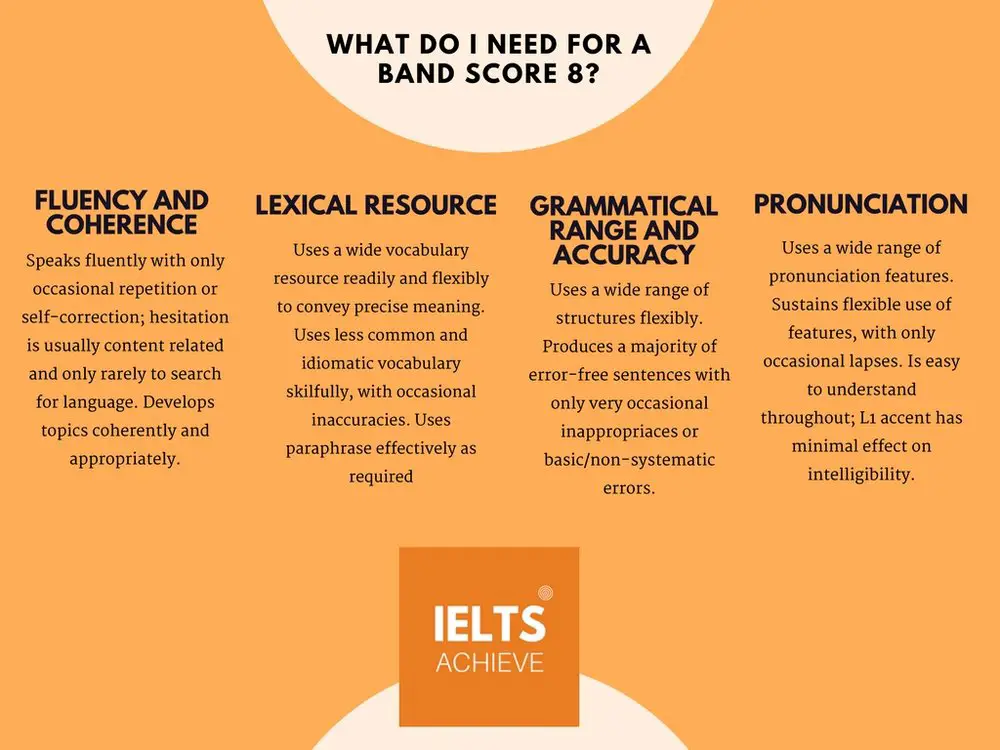
You should read through the marking criteria and be aware of what is required for a band score 7 or above. Many students do not do this and have no idea what they need to achieve in order to get the band score they want. Read it, understand it and aim to achieve it. Ask your IELTS teacher for help to understand it and to see the level you are at now.
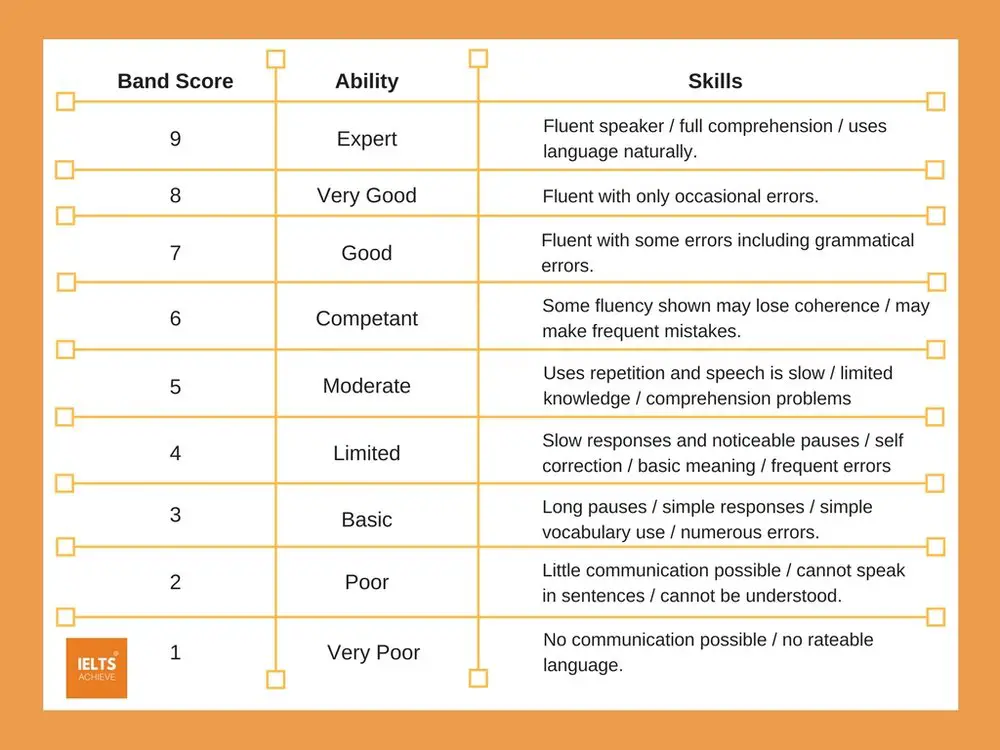
You should also read the scoring information to see how the band scores are given:
Tip 10: Practice
Practice as much as possible with your native speaking IELTS teacher, a partner or friend. Take a look at the most common topics (see the other posts in this section) and practice answering those questions. A good way to listen for errors is to record yourself speaking. Listen to your recording and notice any errors you have made, including grammar mistakes, pronunciation, intonation and fluency. Keep practising and use the posts in this section to help you.
Expert tips and strategies for this part of the IELTS Speaking test. Includes sample responses and key vocabulary for Band 7+.
Originally published August 2017. Last reviewed 3 July 2026.
In this post, we will be looking in-depth at part 1 of the speaking test.
The IELTS Speaking Test lasts 11-14 minutes.
The test has three parts, where you are interviewed by a trained examiner. You are not allowed to use a dictionary during the test. IELTS Academic and IELTS General students take the same test and it is marked in the same way.
PART 1 Information
To begin with, the examiner will introduce themselves to you, then ask you your name and for proof of identity.
4-5 minutes >> You will be asked questions on familiar topics, like your hobbies, family, where you are from, what your hometown/city is like, etc.
The topics might include;
Your studies/education
Hobbies/sports
Your family
What kind of movies, books, tv shows or music you like
What you like to eat / where you like to eat
Your job
Where you live
Part 1 Questions
The questions in part 1 will possibly be about your work or studies, hobbies, your family, where you live, hometown or where you live now. Your answers should include facts and your own opinions or feelings.
Possible questions >>
Do you live in a house or an apartment?
What do you do at the weekends?
Do you have any hobbies?
How often do you like to travel?
Where is a good place to visit in your hometown or city?
Do you go to the cinema often?
Example Q+A
Take a look at the questions below and the two possible answers, which one is better?
Question: Do you like to travel?
Answer 1: yes, I do.
Answer 2: Yes, I have been to many places in Europe, including Italy, Spain, Greece and the UK. In the future I would love to be able to visit and explore the USA, going to New York and perhaps driving through other states.
Which answer looks better to you?
Feedback: Answer 2!Why? The first answer does not fully answer the question and show off the students ability to speak English. In part one, your answer should be at least 2-3 sentences. The second answer is much better, giving background information (I have been to many places in Europe, including Italy, Spain, Greece and the UK.) and adding details (I would love to be able to visit and explore the USA).
Answering The Question
Make sure you answer the question fully, with correct tenses where appropriate.
Question: Do you enjoy going to the cinema?
Answer 1 - Kate: Yes, I do love going to the cinema and I always think it is good to go and see new movies, especially in the IMAX. On the other hand, I also like to watch movies in my house, as it is more comfortable.
Answer 2- Georgina: I went to the cinema last weekend. I was invited to go with a friend. She wanted to see the latest thriller.
Feedback: Georgina did not answer the question, she didn't make it clear whether she enjoyed going to the cinema, she used the past tense and the question was in the present tense. her answer was also short in length. Kate has a high-level answer, she answered the question using varied vocabulary, not just repeating the words the examiner had used. She also connected her ideas by using 'on the other hand' and used the present tense.
Yes/No Questions
When you hear a yes/no question, try to start your answer with one of the following phrases >>
I don't think so
not really
absolutely!
definitely!
I think so
not very often
most of the time
sometimes
yes, in general
For example for the following questions....the answers can be started with one of the phrases from above and expanded upon, you can add more detail or give an example. This is so you don't answer the question with a simple yes or no, which would not get you many marks.
Question: Do you use your phone or tablet every day?
Answer: Absolutely! I always check my phone for emails and texts, then of course to see social media.
Question: Is travelling important to you?
Answer: Definitely! It is something that I aim to do as often as I can, for example, next year I plan to visit Barcelona.
Question: Is reading important to you?
Answer: Not really, I don't have much time to read, I prefer to listen to music or watch netflix.
Preference Questions
Some part 1 questions may ask you about your preferences.
Can you see which is the better answer?
Question: Do you prefer travelling alone or in a group?
Answer 1 - Claire: I prefer to travel alone, I don't really like to be in a group.
Answer 2 - Susan: I haven't ever travelled on my own, I have always been with friends. It is so much fun to travel in a group, as you can share experiences and have a laugh with your friends. I think travelling alone in some parts of the world could be dangerous.
Feedback: Claire's answer is short and repeats too many words from the question. Susan's answer is better because she gives more detail and uses different words to the question, she also gives reasons for her preferences.
You can use the following phrases in your answers for a high-level answer >>
I like...... more than.....
It depends on.........
I like both...........and.............
My first choice would be ..............
I'd rather..............than....................
For example, 'I like both travelling on my own and with friends, because......' or 'I like travelling with friends more than on my own, because......'.
Using Would and Could
Some questions may ask you a hypothetical question, which invites you to use the words 'would' or 'could'.
Question: Where would you recommend a foreigner to visit in your country?
Answer 1 - Marco: I will tell them to visit the Vatican and to see the sights.
Answer 2 - Ricardo: I would highly recommend that they visit the galleries and museums when in Rome, especially in the Vatican. A great historical site to see is the Colosseum, a stunning example of architecture. I could also recommend visiting the Trevi Fountain and sampling some delicious ice cream!
Feedback: Marco's answer is short and does not use enough vocabulary. Ricardo expands on his answer, listing places to visit and uses the words 'would' and 'could' in his answer.
We hope you found this post useful in helping you to study for the IELTS Test. If you have any questions please let us know in the comments below or on the Facebook page.
The best way to keep up to date with posts like this is to like us on Facebook, then follow us on Instagram and Pinterest.
If you need help preparing for the IELTS Test, join the IELTS Achieve Academy and see how we can assist you to achieve your desired band score. We offer an essay correction service, mock exams and online courses.