⚡ TL;DRArrive early with valid ID and confirmation. For paper-based tests, bring pencils and erasers — for computer-based tests, everything is provided. The test runs Listening → Reading → Writing (no breaks between), then Speaking (same day or within 7 days). Manage your time strictly in Reading (20 min per passage) and Writing (20 min Task 1, 40 min Task 2). Never leave an answer blank.
Originally published July 2026. Last reviewed 3 July 2026.
Before Test Day
What to Bring
Valid passport or national ID — the same document you used to register. Expired or mismatched ID means you cannot sit the test and will not receive a refund.
Confirmation email or registration printout — with your candidate number and test centre address.
For paper-based tests: pencils (HB) and an eraser. Pens are not permitted for Listening and Reading answer sheets.
For computer-based tests: nothing else — pencils, notepaper, and headphones are provided at the centre.
What Not to Bring
Mobile phones, smartwatches, electronic devices, notes, books, and correction fluid are all prohibited inside the test room. Most centres provide lockers or a designated area for personal belongings, but valuables are left at your own risk. Food and drinks (except water in a clear bottle with no label) are generally not allowed inside the test room.
The Night Before
Prepare your documents and travel route the evening before. Eat a proper meal, avoid caffeine late in the day, and aim for seven to eight hours of sleep. Cramming the night before does not help — at this stage your English level is what it is, and rested focus will serve you better than last-minute vocabulary lists.
Arrival and Registration
Arrive at the test centre at least 30 minutes before the stated reporting time. Registration involves identity verification (photo and fingerprint at most centres), confirmation of your candidate number, and allocation of your seat. Late arrivals may not be admitted.
You will be assigned a seat and receive your test materials. Listen carefully to all instructions from the invigilator. If anything is unclear, ask before the test begins — you will not be able to ask questions once the test is in progress.
Test Order and Timing
Section
Duration
Questions
Notes
Listening
30 min + 10 min transfer time (paper) / 30 min (computer)
40
Audio plays once only. Paper test gives 10 min at the end to transfer answers to the answer sheet.
Reading
60 min
40
No extra transfer time. Write answers directly on the answer sheet as you go.
Writing
60 min
2 tasks
Task 1: 20 min (150+ words). Task 2: 40 min (250+ words). Task 2 is worth twice as much.
Speaking
11–14 min
3 parts
Face-to-face with an examiner. May be scheduled on the same day or up to 7 days before/after the written test.
⚠️ No Breaks: The Listening, Reading, and Writing sections are conducted back-to-back with no official breaks. The entire written test takes approximately 2 hours and 40 minutes. Use the bathroom before the test starts.
Section-by-Section Tips
Listening
Read ahead. Use the time before each section to read the questions. This tells you what information to listen for.
Write answers as you listen. Do not rely on memory — write the answer the moment you hear it.
Watch for distractors. Speakers sometimes give an answer and then correct themselves. The corrected answer is the right one.
Spelling counts. “Accomodation” instead of “accommodation” is marked wrong.
Never leave a blank. There is no penalty for wrong answers. Guess if you must.
Reading
Spend no more than 20 minutes per passage. Passage 3 is the hardest, so do not let Passage 1 eat your time.
Skim first, read second. Read the title, headings, and first sentence of each paragraph to understand the structure. Then tackle the questions.
Answers appear in order. For most question types, the answer to question 5 will appear in the text after the answer to question 4.
True/False/Not Given is not the same as your opinion. Base your answer strictly on what the text says, not what you know or believe.
Transfer answers immediately. Unlike Listening, there is no extra time at the end.
Writing
Start with Task 2. It is worth twice as much as Task 1. If you run out of time, it is better to have a complete Task 2 and an incomplete Task 1 than the reverse.
Plan before you write. Spend 3–5 minutes planning your essay structure. A clear plan prevents you from going off-topic or losing coherence.
Count your words. On paper, count the words on your first two lines, calculate your average per line, and use that to estimate. Falling below 150 or 250 words results in a penalty.
Leave 2–3 minutes to proofread. Catching basic grammatical errors in a final read-through can genuinely improve your score.
Do not memorise essays. Examiners are trained to detect memorised responses, and your score will be reduced.
Speaking
Part 1 (4–5 minutes): Short, direct answers to personal questions. Give 2–3 sentences per answer — not one word, not a monologue.
Part 2 (3–4 minutes): You receive a cue card and have 1 minute to prepare and 2 minutes to speak. Use the full 2 minutes. If you finish early, the examiner will ask a follow-up question, but using the full time shows fluency.
Part 3 (4–5 minutes): Abstract discussion questions related to the Part 2 topic. Express and justify opinions. Use phrases like “I believe this is because…” or “From my perspective…”
Do not worry about your accent. IELTS examiners are trained to understand a wide range of accents. Clarity and pronunciation matter; accent does not.
Self-correct naturally. If you make a mistake, correct it and move on. This demonstrates awareness and is viewed positively.
Common Mistakes to Avoid
Mistake
Why It Hurts
Solution
Spending too long on one Reading passage
Running out of time for the remaining passages
Set a 20-minute timer per passage
Writing under the minimum word count
Automatic score penalty
Practise estimating word count by line
Leaving Listening answers blank
Lost marks with zero chance of being right
Always guess — there is no negative marking
Using memorised Speaking responses
Examiners detect this and reduce fluency score
Prepare ideas and vocabulary, not scripts
Not checking spelling in Listening/Reading
Misspelled answers are marked wrong
Double-check spellings during transfer time
After the Test
Results are available 13 calendar days after the test for paper-based tests and 3–5 days for computer-based tests. You can view your results online through the test centre’s portal. Your Test Report Form (TRF) is valid for 2 years from the test date.
If you believe your score does not reflect your performance, you can request an Enquiry on Results (EOR) within 6 weeks of receiving your TRF. Fees apply but are refunded if your score changes. You can request a remark for one or more skills.
🔑 Key Takeaways
Bring your valid passport/ID and confirmation — nothing else is needed for computer-based tests.
Listening, Reading, and Writing are back-to-back with no breaks — use the bathroom beforehand.
In Reading, allocate exactly 20 minutes per passage and move on even if unfinished.
In Writing, start with Task 2 (worth double) and always meet the minimum word count.
Never leave a blank answer — there is no penalty for guessing.
In Speaking, self-correct naturally and use the full 2 minutes in Part 2.
Results come in 3–5 days (computer) or 13 days (paper); EOR requests are available within 6 weeks.
Frequently Asked Questions
Can I use a pen for the IELTS paper-based test?
You must use a pencil for the Listening and Reading answer sheets, as they are scanned by machine. For the Writing section, you may use either a pencil or a pen, though pencil is recommended so you can erase easily. For computer-based tests, this is not relevant as all answers are typed.
What happens if I arrive late to the IELTS test?
If you arrive after registration closes, you will not be allowed to sit the test and your test fee will not be refunded. Most centres close registration 15–30 minutes before the test starts. Always aim to arrive at least 30 minutes before the stated reporting time.
Is the Speaking test always on the same day?
Not always. The Speaking test may be scheduled on the same day as the written test or up to 7 days before or after it, depending on the test centre. You will be notified of your Speaking test date and time when you receive your confirmation. You cannot choose the date yourself.
Can I request extra time for IELTS?
Yes, if you have a documented medical condition, disability, or specific learning difficulty (such as dyslexia), you can apply for special arrangements including extra time. You must submit your application and supporting medical evidence to your test centre at least 6 weeks before your test date.
Comprehensive guide covering essential IELTS preparation strategies and techniques to help you achieve your target band score.
Originally published September 2020. Last reviewed 3 July 2026.
An immense mausoleum of white marble, built in Agra between 1631 and 1648 by order of the Mughal emperor Shah Jahan in memory of his favourite wife, the Taj Mahal is the jewel of Muslim art in India and one of the universally admired masterpieces of the world's heritage.
The Taj Mahal is located on the right bank of the Yamuna River in a vast Mughal garden that encompasses nearly 17 hectares, in the Agra District in Uttar Pradesh. It was built by Mughal Emperor Shah Jahan in memory of his wife Mumtaz Mahal with construction starting in 1632 AD and completed in 1648 AD, with the mosque, the guest house and the main gateway on the south, the outer courtyard and its cloisters were added subsequently and completed in 1653 AD. The existence of several historical and Quaranic inscriptions in Arabic script have facilitated setting the chronology of Taj Mahal. For its construction, masons, stone-cutters, inlayers, carvers, painters, calligraphers, dome builders and other artisans were requisitioned from the whole of the empire and also from the Central Asia and Iran. Ustad-Ahmad Lahori was the main architect of the Taj Mahal.
The Taj Mahal is considered to be the greatest architectural achievement in the whole range of Indo-Islamic architecture. Its recognised architectonic beauty has a rhythmic combination of solids and voids, concave and convex and light shadow; such as arches and domes further increases the aesthetic aspect. The colour combination of lush green scape reddish pathway and blue sky over it show cases the monument in ever changing tints and moods. The relief work in marble and inlay with precious and semi precious stones make it a monument apart.
The uniqueness of Taj Mahal lies in some truly remarkable innovations carried out by the horticulture planners and architects of Shah Jahan. One such genius planning is the placing of tomb at one end of the quadripartite garden rather than in the exact centre, which added rich depth and perspective to the distant view of the monument. It is also, one of the best examples of raised tomb variety. The tomb is further raised on a square platform with the four sides of the octagonal base of the minarets extended beyond the square at the corners. The top of the platform is reached through a lateral flight of steps provided in the centre of the southern side. The ground plan of the Taj Mahal is in perfect balance of composition, the octagonal tomb chamber in the centre, encompassed by the portal halls and the four corner rooms. The plan is repeated on the upper floor. The exterior of the tomb is square in plan, with chamfered corners. The large double storied domed chamber, which houses the cenotaphs of Mumtaz Mahal and Shah Jahan, is a perfect octagon in plan. The exquisite octagonal marble lattice screen encircling both cenotaphs is a piece of superb workmanship. It is highly polished and richly decorated with inlay work. The borders of the frames are inlaid with precious stones representing flowers executed with wonderful perfection. The hues and the shades of the stones used to make the leaves and the flowers appear almost real. The cenotaph of Mumtaz Mahal is in perfect centre of the tomb chamber, placed on a rectangular platform decorated with inlaid flower plant motifs. The cenotaph of Shah Jahan is greater than Mumtaz Mahal and installed more than thirty years later by the side of the latter on its west. The upper cenotaphs are only illusory and the real graves are in the lower tomb chamber (crypt), a practice adopted in the imperial Mughal tombs.
The four free-standing minarets at the corners of the platform added a hitherto unknown dimension to the Mughal architecture. The four minarets provide not only a kind of spatial reference to the monument but also give a three dimensional effect to the edifice.
The most impressive in the Taj Mahal complex next to the tomb, is the main gate which stands majestically in the centre of the southern wall of the forecourt. The gate is flanked on the north front by double arcade galleries. The garden in front of the galleries is subdivided into four quarters by two main walk-ways and each quarters in turn subdivided by the narrower cross-axial walkways, on the Timurid-Persian scheme of the walled in garden. The enclosure walls on the east and west have a pavilion at the centre.
The Taj Mahal is a perfect symmetrical planned building, with an emphasis of bilateral symmetry along a central axis on which the main features are placed. The building material used is brick-in-lime mortar veneered with red sandstone and marble and inlay work of precious/semi precious stones. The mosque and the guest house in the Taj Mahal complex are built of red sandstone in contrast to the marble tomb in the centre. Both the buildings have a large platform over the terrace at their front. Both the mosque and the guest house are the identical structures. They have an oblong massive prayer hall consist of three vaulted bays arranged in a row with central dominant portal. The frame of the portal arches and the spandrels are veneered in white marble. The spandrels are filled with flowery arabesques of stone intarsia and the arches bordered with rope molding.
Integrity is maintained in the intactness of tomb, mosque, guest house, main gate and the whole Taj Mahal complex. The physical fabric is in good condition and structural stability, nature of foundation, verticality of the minarets and other constructional aspects of Taj Mahal have been studied and continue to be monitored. To control the impact of deterioration due for atmospheric pollutants, an air control monitoring station is installed to constantly monitor air quality and control decay factors as they arise. To ensure the protection of the setting, the adequate management and enforcement of regulations in the extended buffer zone is needed. In addition, future development for tourist facilities will need to ensure that the functional and visual integrity of the property is maintained, particularly in the relationship with the Agra Fort.The tomb, mosque, guest house, main gate and the overall Taj Mahal complex have maintained the conditions of authenticity at the time of inscription. Although an important amount of repairs and conservation works have been carried out right from the British period in India these have not compromised to the original qualities of the buildings. Future conservation work will need to follow guidelines that ensure that qualities such as form and design continue to be preserved.
Taj Mahal Antonym Trivia Across and Down Worksheet Find the Antonym of the highlighted word from the word box. Complete the crossword puzzle. Antonyms are the words or phrases that represent the opposite meaning.
Taj Mahal Antonym trivia Worksheet Find the antonym of the highlighted word from the word box. Complete the crossword puzzle. Antonyms are the words or phrases that represent the opposite meaning.
Taj Mahal Synonym Antonym Worksheet Write a synonym and an antonym for each word. Use the words in the word box to fill the blanks. Antonyms are the words or phrases that represent the opposite meaning.Synonyms are the words or phrases that represent a similar meaning.
Taj Mahal Synonym Passage Worksheet Replace the words in the passage with appropriate synonyms. Synonyms are the words or phrases that represent a similar meaning.
Taj Mahal Synonym Trivia Across and Down Worksheet Find the Synonym of the highlighted word from the word box. Complete the crossword puzzle. Antonyms are the words or phrases that represent the opposite meaning.
Taj Mahal Synonym trivia Worksheet Complete the puzzle with the words that are synonyms to the hints. Synonyms are the words or phrases that represent a similar meaning.
A detailed guide to this IELTS Writing Task 2 essay type, with structure templates, useful vocabulary, and techniques to achieve Band 7+.
Originally published December 2017. Last reviewed 3 July 2026.
In this post, we will look at how you can make your writing task 2 essay clear for the examiner. Having a clear and easy to understand essay improves your score in coherence and cohesion. Creating a clear essay may sound like a simple thing to do, but many students often try too hard and end up with an essay that is confusing and difficult to follow. This obviously lowers your score if the examiner cannot understand what it is you are trying to say in your writing.
How To Write A Clear Essay
Here are 5 tips on how to write a clear essay >
1. Understand the Question
Read the question and understand it, look at the keywords and what it is asking you to do. What are the main issues and the sub-issues? Can you tell if it is an agree/disagree essay? What type of essay is it? These are all questions you should be able to answer from understanding the question. If you do not understand the question properly, you could present irrelevant information in your essay, which can lead to a confusing essay and lower marks.
When you are thinking of ideas for your essay, make sure they are specific. Don't write generally about the topic or try to stuff as many ideas as possible into the main body paragraphs. The main body paragraphs should each contain one main idea. If you present more than this, the paragraphs will become confusing for the examiner. The paragraphs should follow a certain structure, to ensure you gain marks for coherence and cohesion. If you have many ideas, you will not have time to explain them all and support them with examples. By choosing one main specific idea, explaining it, giving details and supporting with an example, this will make the information clear and easy to understand.
If the essay question asks you to give your opinion, then make sure you give it clearly in the writing. There are many ways to introduce your opinion, including using 'in my opinion, I believe that' or 'In my view'. If you don't give a clear opinion or state your position on the subject, then you can lose marks.
By reviewing and practising the essay structures for the various question types, you will be able to demonstrate to the examiner that you can structure an IELTS writing task 2 essay successfully. The marking criteria - coherence and cohesion for a band score 7 states 'logically organise information and ideas, there is clear progression throughout, uses a range of cohesive devices appropriately although there may be some under/overuse, presents a clear central topic within each paragraph', and for a band score 8 'sequences information and ideas logically, manages all aspects of cohesion well, uses paragraphing sufficiently and appropriately'. If you can organise your essay into clear easy to follow paragraphs, with cohesive devices and logical order, then you will be on your way to gaining a high band score.
Take a look at the structures needed for each type of Writing Task 2 essay here.
5. Vocabulary
The vocabulary you use in your essay also has a huge impact on how easy it is to read through and understand. When students try too hard, putting in high-level words they don't really know the meaning of and trying to fit in as many complex structures as possible, this makes an essay very difficult for the examiner to read and follow. When you read your essay over after you have finished, does it make sense to you? Can you clearly understand each part? It is very important that your essay clearly communicates your message in relation to the question. If you have many grammatical errors this can also make the essay hard to understand.
Here is an example of an essay that is not very clear due to grammatical errors, structure and vocabulary (this essay is a band score 5).
Can you list the errors?
How could you improve this essay?
Writing task 2 — Cause/Effect essay People in all modem societies use drugs, but today's youth are experimenting with both legal and illegal drugs, and at an early age. Some sociologists claim that parents and other members of society often set a bad example. Discuss the cause and effects of widespread drug abuse by young people. Make any recommendations you feel are necessary to help fight youth drug abuse.
Drug usage is very common in present-day population, however the teens starting to use legal and illegal products as well, at very young age. Usually a bad model, this is what some experts are saying. This essay will discuss some reasons why this has occurred and analyze the consequences of this worrying trend. One of the main causes of this problem is the stressful life of the people, some sever trauma or injury, but also an other reason can be a parent who had an addiction. Furthermore, in modern societies the street drugs and alcohol are very available even for the adolescents. A newspaper article shows that last year a Secret Service in New York made an investigation in 50 different schools and universities regarding to the drug consumption. The results were shocking: in 42 institutes they found a drug dealer.
The effects of this have been and will be very serious. Firstly the drug abuse can occur severe health problems like heart diseases, kidney or liver damage, abdominal pain, can weaken the immune system etc. Secondly can also damage the brain, causing for example behavior problems. While using drugs people are unable to do different activities well, or to think clear. This can lead to conflicts in families or between friends, and unfortunately sometimes can go into crime. In short, it is obvious that nowadays the usage of different psychotropic agents is widespread already in early age, and the effects of this are very tragically. The society should fight more and harder against drug abuse, the prevention programs could be much convincing, and the social media could help too, for example with more antidrug publicity.
If you would like to view more high band score essay examples please click the button below >
Good Example
Here is the re-written essay, can you see the difference? Is it easier to understand? This essay follows the following elements for a successful high scoring essay (this essay is a band score 8) >
Answers the question
Uses paraphrasing and synonyms
Follows the cause/effect essay structure
Uses logical paragraphing
Includes relevant ideas
Includes specific examples
Uses cohesive devices
Uses complex sentences
Has a wide variety of vocabulary
No grammatical errors
People in all modem societies use drugs, but today's youth are experimenting with both legal and illegal drugs, and at an early age. Some sociologists claim that parents and other members of society often set a bad example. Discuss the cause and effects of widespread drug abuse by young people. Make any recommendations you feel are necessary to help fight youth drug abuse.
Drug usage is very common in the present-day population as many adolescents are using these legal and illegal products, beginning in their childhood years. Some social academics think that adults are terrible role models because they are heavily influencing the behaviour of the young people around them. This essay will discuss the principal reason why this has occurred and analyze the main consequence of this worrying trend.
On the one hand, the primary cause of this issue is the stressful lives many of these young people are living in today’s society. Some may have terrible home lives, with absent parents, no stable accommodation or other traumatic events experienced on a daily basis. For many youngsters, they experiment with illegal drugs and alcohol, in order to escape from their present situations. These kinds of substances are readily available to children and teens, as they are eager to try drugs, or are pressured into it by their peers or family members. For example, an article from the New York Times in 2017 reported that in 50 state schools interviewed, over 90% of the students aged between 14-16 had experimented with a class A drug.
On the other hand, common substance abuse in adolescents can lead to one main consequence, which is health problems. Regularly using drugs, from prescription medication to hard drugs can have both short term and long terms health effects, including; heart disease, kidney or liver damage, abdominal pain and lead to a weaker immune system. Certain drugs can also cause brain damage, sometimes causing severe problems with the use of motor skills or nerves. For instance, a documentary filmed by the BBC in 2017, showed the effects of serious drug dependencies amongst teenagers aged between 16-19. One person interviewed had developed serious damage to the brain, as well as facial nerves, through the overuse of MDMA. This had left the teen with permanent facial twitching and psychosis. In addition, teens should be taught about the serious and harmful effects of taking drug in school. The students should learn about the damaging and lasting effects of taking recreational drugs, even though they may see them as a way to unwind or escapism. The health issues relating to drugs and alcohol should be explained with case studies given as a deterrent to any young people who are thinking about experimenting. For example, as part of the curriculum in Sixth Form Colleges in the UK, students are made to watch a series of documentaries about the dangers of drugs and alcohol, in order to learn about the risks. They listen to teenagers talk about their own bad experiences and the consequences of this. In conclusion, many teens are experimenting with common drugs from an early age, leading to heavy consequences like health issues, as they grow older. To combat this issue, more initiatives should be set forth through the school system, to create awareness of the risks involved.
We hope you found this post helpful in helping you to study for the IELTS Test. Let us know in the comments or on the Facebook page if you have any questions. The best way to keep up to date with posts like this is to like us on Facebook, and then follow us onInstagramand Pinterest. We offer essay correction services, mock exams, and online courses. If you need help preparing for the IELTS Test, join the IELTS Achieve Academy and see how we can help you achieve your desired band score faster.
Step-by-step guide to answering this type of IELTS Writing Task 1 question. Covers structure, key language, and band-scoring criteria.
Originally published December 2017. Last reviewed 3 July 2026.
In this post, we will look at the word count needed in the writing tasks. You should know that 250 words are the minimum for a writing task 2 essay and 150 words are minimal for writing task 1. If you write less than the word counts specified in the question, you will lose marks in task achievement, because you will not have completed one of the requirements for the task.
The examiner will count your words to check that you have the minimum word count. If you have not reached 250 and have, for example, 240 words they will mark your essay lower because of this. It is possible to write more than 250 words during the time allocated for the task 2 essay, however, you should be careful you do not run out of time and find that you cannot write a conclusion, or check over your work.
Test Instructions
On the writing test paper, the instructions will look something like this below (Taken from the British Council IELTS) >
The highlighted sections show you that the instructions state clearly that at least 150 words are required for Task 1 and at least 250 words are required for Task 2.
The question examples below are taken from a free resource available on The British Council's IELTS page. Take a look and download the free practice papers.
As you can see below, the highlighted section shows you that you have to write at least 150 words in Task 1.
TIP: Plan your work before you start to write, to make sure that all of the information you write in your essay is relevant. Do not write and write about anything and everything and go off-topic. It is more than possible to write a 250-word essay that is concise and to the point.
TIP: Check your word count during your IELTS essay preparation. Count the words (or if you are typing using the word count option) and see how many you are producing in 40 minutes for task 2 and 20 minutes for task 1.
TIP: Words that are hyphenated like in-depth or part-time will be counted as one word. prepositions like in, of, on and articles like the, a, at will all be counted. Punctuation, like commas, semi-colons and full stops (periods) will not be counted.
TIP: Practice writing your essay answers on the official writing answer sheet. This will allow you to practice counting your words to see how many you get in the time period allowed. You should aim to exceed the word count slightly so that you are sure you have met the minimum requirements.
Comprehensive guide covering essential IELTS preparation strategies and techniques to help you achieve your target band score.
Originally published December 2017. Last reviewed 3 July 2026.
In this post, we will look at how to think of ideas for writing task 2 questions. Many of my students struggle to think of ideas when faced with a question, especially when it is on a topic they feel they know little about.
They worry that their examples will not be relevant or they often find it difficult to think of any examples at all. I have marked many essays, where the student has said that they couldn't think of an example. You must practice thinking of ideas for various questions, finding a method that suits you. Everyone has different ways of learning and retaining information, so find out your preferred method and apply it.
Here are some ways that you can think of ideas for your writing task 2 essay :
Read More Materials
This is really obvious, to improve both vocabulary and knowledge reading is the best thing that you can do. If you are on Facebook, like the pages of well-known news sites, like BBC News, The Guardian, The Telegraph, The New York Times, The Economist, etc. This is a super-easy way to stay informed and read articles, as you scroll through your newsfeed.
Reading the news will give you many ideas for your essays when giving examples to my students I often say 'I read something about that the other day...'. Read around topics that come up again and again, like health, education, technology, the environment and crime. Also read articles that interest you, on art, movies and anything else. When you find words you do not know the meaning of, look them up and make a note. Most phones/tablets have a built-in dictionary, so it is very easy to look up the meaning of a word or cut and paste sections of an article.
Here are some news websites that you should take a look at regularly:
Before you start writing the essay, make a plan with your ideas in note form. When I plan any essays or blog posts I start by making a bullet list of my ideas. This helps me to visualise the information and organise it. It might not work for everyone, but it is a good way to start planning, getting those thoughts out onto the paper.
It might look something like this :
You could also create a mind map of your ideas, write a keyword in the middle of the page, then think about and link as many relevant ideas as possible.
Be Positive
Many students when they are given a question, straight away say 'I don't know anything about this topic...' almost shutting down before they have even started. If you have a question, with a topic that you feel you know little about, don't stress out and don't feel frustrated. Push yourself to generate ideas and keep it light and enjoyable. Negativity is death to creativity, meaning that if you have a negative mindset from the beginning, this will crush your ability to get those creative essay writing juices flowing!
When you are thinking of ideas and examples, you are allowed to be creative, making up statistics/data from an article or survey. As long as the example is relevant and believable.
Interact
Imagine you are talking about this question with someone. Sounds simple, think about reaching out and chatting with other people who engage you intellectually and creatively. If you were discussing this question with a friend or work colleague, what would you say/they say? Thinking about conversations with others can help you to generate ideas.
Reflection
Think about what you know about the question/topic already......
What have I read about or seen that stands out?
What do I know about this topic?
What did I read/see that could be used as an example?
What is the main issue?
Why is this happening?
Use your responses to these questions as writing prompts. For example, if you know that obesity is becoming a huge strain on the NHS because of the increase in costs, think about how you could turn that information into an example.
A detailed guide to this IELTS Writing Task 2 essay type, with structure templates, useful vocabulary, and techniques to achieve Band 7+.
Originally published December 2017. Last reviewed 3 July 2026.
In this post, I want to share with you hints, tips, do's and don'ts that will lead you to a band score of 7 or above on the Academic test. It is not an easy thing to do, as many of you probably know already!
It takes determination and motivation to study hard around work, family and any other commitments you may have.
Take a look at how you can try to get the best results possible in the IELTS exam:
Make a study plan
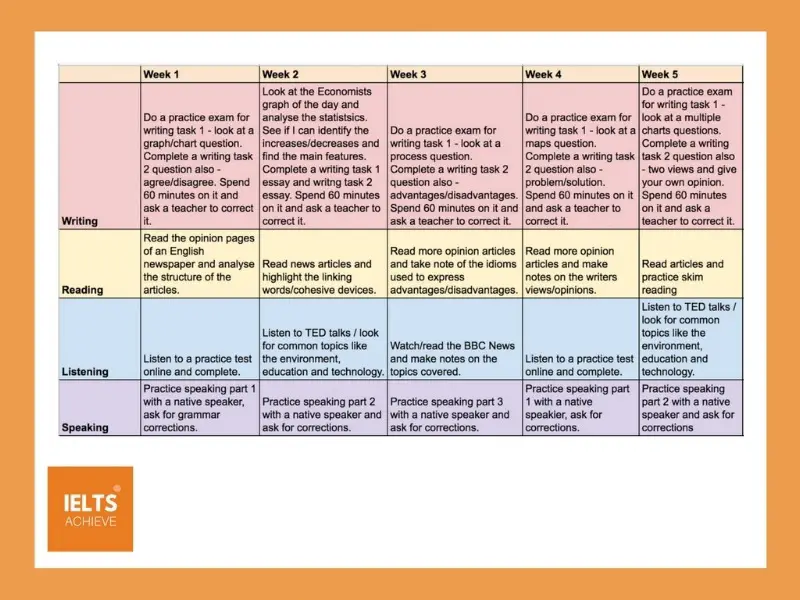
There are many ways in which you can prepare for your IELTS test, one way to start is to make a study plan. Focus on any weaknesses you may have and practice, getting a teacher to correct any essays or practice the speaking test with you. Many of the students I have taught who have scored a 7 or above have admitted to having studied for at least one hour per day.
Below is an example of a study plan, with each area of the exam covered. If you know that your main weakness is writing, spend more time on that - making sure you have an IELTS teacher correcting your work and giving you feedback. If you need to focus on vocabulary, practice and read as much as you can, especially for the Academic students who need to learn how to describe statistical trends.
Make your own study plan! Think about the following questions;
When is your exam?
How much time do you have to study each day or each week?
What areas do you need to focus on the most?
IELTS Writing Tips
Most students struggle with the writing test and require a lot of practice before test day. Read the writing task 1 and 2 posts on this website and study the different structures needed for different types of questions. Remember the following;
TIP 1: Read the question properly
Make sure you read it a few times and highlight any keywords. What is the question asking you to do? Do you have to give your opinion or not?
TIP 2: Make a plan before you start writing your essay.
Learn the structures needed and plan accordingly in your exam. Take a few minutes to do this, so you can easily write your essay, including all of the things you need.
TIP 3: Remember your essay structure
In writing task 2 remember how to structure the essay so that it becomes planted into your brain! Include an introduction, main body paragraph 1, main body paragraph 2 and a conclusion (this may change depending on the type of question, but this structure is the basic skeleton).
TIP 4: Don't overthink it
if you have ideas that are quite simple, that is fine. They don't have to be really deep and complex to get a high band score. For example - if asked to give reasons why so many people are obese these days - one reason is overeating easily available calorie-rich junk food. Think about what you know about the subject/topic and go from there. Have you read anything about it? or seen anything on the news or in a documentary? I remember watching a documentary about the top 20 most obese countries once. So I could use that as one of my examples. I also remember reading about how the costs are inflating the healthcare system and more of taxpayers money is being spent on that, rather on public services. So that could be another example to use in my essay. The point is that all examples should be relevant to the question, even if they are simple.
TIP 5: Vocabulary
Make sure you are using the right vocabulary in your essay. You might try to boast and show the examiner how many high-level words you know, which is fine if you know for sure that they fit into the sentence and have the right meaning.
TIP 6: Give your opinion when asked
in the essay or in the speaking test, when asked for your opinion, give it clearly. Use phrases like, in my opinion, in my view, I think that, I believe that.... and then explain.
TIP 7: Use cohesive devices
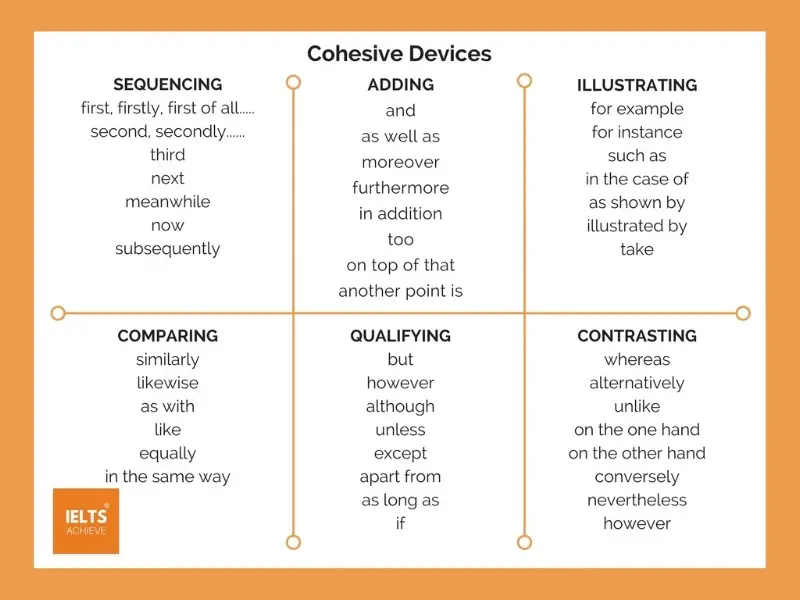
this can get you high marks when used in the writing and speaking test. Don't overdo it though! Overuse of these words can be a sure way to lose you marks. Words like - however, therefore, furthermore, in other words, for example, for instance, etc.
Planning for the big day!
When preparing for the day of the test, you should try to get there well on time. You must bring the same passport or ID card that you used on your application form. You also need to bring a pen, pencil and an eraser. You will not be allowed to take any electronic devices or a dictionary into the test area.
On the night before the test, read some English texts, similar to those you may read in the exam, for example, some opinion pieces from a newspaper. The Academic students could analyse graphs and charts as well or read over past assignments that have been corrected.
Things to do: You should also do the following:
Give yourself time to check over your work before the exam ends.
Highlight any keywords or numbers on the question paper.
Make notes on the question paper before you begin to write.
Always write in full sentences (no bullet points or unfinished sentences).
Paraphrase! Make sure you paraphrase the question.
Link your ideas together in writing task 2.
Support with relevant examples.
Read the question properly.
Things not to do: And please don't:
Use informal language
Repeat the sentences written on the exam paper
Spend more than 20 minutes on task 1
Overuse those linking words/cohesive devices - moreover, however, nowadays etc.