Visitors flock to Yorkshire because there is no place on earth like God’s Own County. It considers its food and drink reputation as now the best in Britain. Yorkshire boasts more Michelin-starred restaurants than anywhere else in the country (apart from the clogged streets of London and who wants to go there?).
The sheer beauty of the county, sometimes as unexpected as a dilapidated mill chimney stabbing up through a leaden sky, has inspired generations of painters: from John Atkinson Grimshaw’s moonscapes to the Victorian artists of the Staithes Group to David Hockney’s Yorkshire Wolds.
B
Cotswolds
The glorious, honey-coloured towns and villages of the Cotswolds look as if they have strayed into the 21st century from another era. The area is characterised by gentle dynamism, with lively galleries, vibrant festivals and a liberal endowment of intriguing museums.
Covering nearly 800 square miles across five counties (Wiltshire, Gloucestershire, Oxfordshire, Warwickshire and Worcestershire), this region of ‘wolds’, or rolling hills is the biggest of the 38 Areas of Outstanding Natural Beauty (AONB) in England and Wales.
C
Devon
Craggy coves and cream teas, surf breaks and strolls, picnics and pints in pub gardens – holidays in Devon are wholesome, simple and scenic. Most people are drawn to the magnificent beaches on the south and north coasts, but inland Devon has its appeal, too.
A visit here mixes two of life’s loveliest pleasures: good food and the great outdoors. Devon folk make the most of the rich larder of food on their doorstep. Lamb, venison, pheasant, pork and seafood are staples, and the county’s farmers’ markets are full of artisan producers selling delicious cider, apple juice, cheese and ice cream.
D
Lake District
Visit the Lake District for Britain’s finest scenery, greenest countryside and grandest views. Its picturesque patchwork of lakes, valleys, woodlands and fells make it one of the best places in Britain to get out and experience the great outdoors, whether it’s on a leisurely bike ride down country lanes or a day-long hike across the hills.
The Lake District also has numerous artistic and literary connections, most famously William Wordsworth, who was born in Cockermouth in 1770 and drew much of his poetic inspiration from the surrounding landscape. And while the weather is notoriously unpredictable (locals will tell you it’s not unusual to experience all four seasons in a single day), showers and racing clouds only emphasise the grandeur of the magnificent scenery.
E
Norfolk
Norfolk’s undulating countryside and sleepy, flint-built villages are perfect for gentle cycling, walking or touring by car. Stately homes, ruined castles, medieval churches and half-timbered wool towns with fascinating museums make for enjoyable days out.
Although East Anglia gets less rain than many other holiday destinations in the UK, northerly and easterly winds over the North Sea can keep temperatures low. But even on cold, bright days in winter, the beach car parks can be busy with dog-walkers and hikers.
F
Suffolk
The beaches fringing the curved Norfolk and Suffolk coastline are the chief draw for visitors to the region. Even on the busiest summer’s day, there is always space for games, kite flying or a quiet family picnic in the dunes. It’s also a wild landscape of dense pine forest, open heathland and great expanses of salt marsh.
Birdlife is astonishingly rich, and coastal wildflowers include yellow-horned poppies and purple-flowering sea pea, while the unique wetlands of the Broads, one of England’s 10 designated National Parks, is home to more than 400 rare species, including butterflies, dragonflies, moths and snails.
Questions 1-8
The text above has six descriptions of places to visit in England, A-F
Which description mentions the following information?
Write the correct letter, A-F, in boxes 1-8 on your answer sheet.
NB You may use any letter more than once.
1. Old architecture and cold temperatures.
2. Great beaches and plenty of places to eat good food.
3. Lots of creatures to see here, including birds and butterflies.
4. One of the largest places in England that has phenomenal beauty.
5. You can ride bikes or walk over hills.
6. The home of creative minds and amazing landscapes.
Women enjoy most freedoms today that men enjoy, and have joined the American workforce in droves to work as doctors, lawyers, teachers, designers, truck drivers and in many other professions. Discrimination against women still exists in various forms, particularly in the workplace. Women should know their rights as U.S. workers and take responsibility for helping to stop rights violations in the workplace.
History
Women have worked in some capacity in the U.S. since its inception, but only in menial jobs for very low pay. During World War I, women entered the workforce in higher numbers due to the shortage of men. It wasn’t until World War II that they went to work in force. During this period, women took positions formerly open only to men; 7 million women entered the workforce, 2 million of those in heavy industry. They still had no formal workplace rights until the passage of Title VII of the Civil Rights Act of 1964. This act states that employers may not discriminate against people on the basis of race, colour, religion, sex or national origin.
Significance
Title VII makes it illegal for employers to exclude qualified women from any available position. Employers would often hire less qualified men for positions to which women had applied. This law empowers women to sue if they feel a potential employer has excluded them from a position based on gender.
President John F. Kennedy signed the Equal Pay Act in 1963, which states that employers must pay women the same amount they would pay a man in the same position. In the past, companies paid women far less than their male counterparts for the same position. Women can sue their employers if they can prove that a male in the same position earns higher wages. Both of these laws significantly increase the status of women in the workforce.
Types
Women’s rights in the workplace include many facets, such as the right to work if pregnant. An employer cannot exclude a woman from a position due to pregnancy as long as she can perform satisfactorily. Employers cannot refuse to hire any person due to marital status, gender or age.
In addition, an employee of any company where a woman works may not sexually harass the woman in any way. This includes a hostile work environment where the woman must endure sexual comments, touching or materials, as well as unwanted sexual advances that put her in fear of losing her job if she does not comply. Women should report all advances of this sort to the Equal Employment Opportunity Commission or a supervisor.
Benefits
Because of workplace rights, women enjoy the freedom to work in almost any position they choose. They join the armed forces, work as cab drivers, own businesses and become executives in large corporations. As the financial status of women increases, so does the welfare of their families, children and the nation.
Considerations
According to Sexual Harassment Support, a nonprofit support group for victims of sexual harassment, only 5 percent to 15 percent of victims of workplace sexual harassment report these violations to their employers or proper authorities for fear of ridicule, losing their jobs or not being believed. All victims of sexual harassment should seriously consider reporting it. Taking this step protects America’s workforce from workplace rights violations.
Questions 9-14
Do the following statements agree with the information given in the text above?
In boxes 9-14 on your answer sheet, write
True – if the statement agrees with the information
False – if the statement contradicts the information
Not Given – if there is no information present
9. During world war 2 there were more women working than men.
10. Women now earn at least 10 times more than men in certain roles.
11. Discrimination towards women still happens in the present day.
12. A small number of women report sexual harassment in the workplace.
13. Women have no rights to work if they are pregnant.
14. Women are the highest paid CEO’s in the USA.
For help to answer these questions with practice please read the posts below >>
We hope you found this post useful in helping you to study for the IELTS Test. If you have any questions please let us know in the comments below or on the Facebook page.
The best way to keep up to date with posts like this is to like us on Facebook, then follow us on Instagram and Pinterest.
If you need help preparing for the IELTS Test, join the IELTS Achieve Academy and see how we can assist you to achieve your desired band score. We offer an essay correction service, mock exams and online courses.
Essential strategies and practice techniques for this IELTS Reading question type. Learn how to manage time and improve accuracy.
Originally published May 2018. Last reviewed 3 July 2026.
Practice the reading test section below or purchase an easy to print out PDF, which includes all 3 test sections for Reading Test 4 here.
There is also an IELTS General Training Practice Test PDF download that includes all 4 practice tests.
With each test, you get the following >
PDF for each section of the reading test.
PDF explaining the reading test band scores.
PDF example of a reading test answer sheet.
READING SECTION 2 – QUESTIONS 15-29
You are advised to spend 20 minutes on Questions 15-29.
Questions 15-21:
Look at the article ‘Reasons Why You Should Join a Student Organization ‘. Why should you join an organization?
Write the appropriate letter A-G in boxes 15-21 on your answer sheet. You may use each letter more than once.
15. You would like to make connections that could help you to find a job. 16. You want to learn how to communicate with others. 17. You would like an opportunity to learn your strengths. 18. You would like to practice your skills, without risks. 19. You want to meet other people from all over the world. 20. You are interested in using the information you have learned in lessons. 21. You want to meet some people and work together.
Joining a student organization presents many opportunities to learn more about yourself, your goals, and your strengths. You can learn from how other students handle certain situations and test your current knowledge. You can also find out what you’re good at, whether that’s multitasking, staying organized, generating ideas, or serving others. This self-awareness will be beneficial for your future career.
B. You’ll develop soft skills.
Soft skills are essential “people skills” — they’re the skills that allow us to effectively interact with others, like communication, attitude, and work ethic. Participating in a student organization not only teaches you these skills but also helps you broaden and improve those you already have. You’ll learn the best way to communicate with both individuals and large groups, and you’ll gain emotional intelligence as you develop new relationships.
C. You’ll learn how to work with a team.
Knowing how to work well with a team is an essential skill for any career. Being in a student organization teaches you how to do this by putting you in situations where you are required to take advice from others, as well as give your own.
D. You’ll get networking opportunities.
Another great benefit of student organizations (and graduate programs as a whole) is that you get the opportunity to network. Meeting new students, making connections, and building relationships will all help down the line when you’re looking for a job. Because you’re all part of the same organization, you know the people you’re meeting have at least a few of the same interests as you, so their connections will be valuable. Corbett said:
“Many of our organizations are professionally-focused and host several events with alumni or panel discussions with local professionals. These events are excellent opportunities for the student leaders, and can often lead to a potential internship or employment opportunities in the future!”
E. You’ll gain practical experience in a safe environment.
Participating in a club or an organization based around your particular area of study will give you practical experience within that field. And what’s great about student clubs is that while you learn to use skills like project management, event planning, and fundraising, you get to test them out in a safe environment where making mistakes are OK. Everyone is there to support you, so there’s no fear in messing up or being wrong.
F. You’ll be able to use the skills you’ve learned in class.
“As business students, you are able to apply classroom experience in your student organizations, and also develop leadership and life skills that help you become more effective in classroom team projects.”
Corbett also mentioned that being part of an organization allows you to put all of those things you’ve been learning in class to the test in real-world situations. You’ll get to learn what works and what doesn’t, and you’ll be able to take that knowledge back to the classroom, and then, of course, along with you in a future career.
G. You’ll learn how to engage with diverse groups of people.
Chances are, the organization you choose to participate in will include a diverse group of people — you’ll be faced with the same situation in the working world! Learning how different people respond and react to certain situations will help you develop your skills in presenting and implementing ideas. Corbett said student organizations can also provide you with the opportunity to learn about different cultural backgrounds.
Questions 22-29:
Read the article on International Students House and look at the statements below. In boxes 22-29 on your answer sheet write:
T if the statement is true F if the statement is false NG if the information is not given in the passage
22. The club has long-term dormitory accommodation. 23. Membership must be renewed monthly. 24. The club provides subsidised restaurant meals. 25. The club is open to non-members on Tuesday evenings. 26. STA Travel help finance the Students Adviser. 27. The services of the Students Adviser are free to all club members. 28. You must make an appointment to see the Students Adviser. 29. There will be a surcharge for accommodation over the Christmas period.
International Students House
International Students House is a unique club and accommodation centre for British and overseas students in London. It is located in the heart of London’s West End and is close to all public transport facilities
ACCOMMODATION » comfortable accommodation for up to 450 people in single, twin, 3/4 bedded and multi-bedded rooms » 44 self-contained flats for married students and families. » long and short stays welcomed.
MEMBERSHIP Club membership is open to all full-time students, professional trainees, student nurses and au pairs. Membership costs are kept to an absolute minimum to enable the widest possible access. You can join for as little as one month and for up to one year at a time. Membership entitles you to use the various facilities of the House. It has:
* restaurants * student bars and coffee shop * study rooms * clubs and societies * aerobics and fitness training * discos, dance, jazz and cinema * travel and excursions and much more!
The best way to check out all we have on offer is to drop in any Tuesday evening between 7.15 pm and 8.30 pm for Open House in the Club Room. This is an opportunity for you to meet the staff and other club members, enjoy a free cup of coffee and find out all about what’s going on. You can take advantage of special membership offers. (Useful tip: bring along 3 passport size photographs if you wish to take out membership.)
ADVICE SERVICE Thanks to the support of STA Travel and in association with LCOS (the London Conference on Overseas Students) International Students House now provides the service of an International Students Adviser. This new welfare service is open to all students at London’s bona-fide academic institutions. It aims to provide welfare support to help students overcome any personal or practical difficulties they may be experiencing whilst studying in Britain. One of the key features of the Advice Service is that the Adviser can be seen during the evenings until about 8 pm, Monday to Thursday.
CHRISTMAS & NEW YEAR Unable to get home for Christmas? How about joining in the fun at International Students House! Check out our special programme of activity taking place over the Christmas period. Even come and stay – the House will be offering reduced accommodation rates for students wishing to spend a few days in London over Christmas. We’ll also have an exciting New Year’s Eve party so come and join us and ring in the new year in the spirit of internationalism.
We hope you found this post useful in helping you to study for the IELTS Test. If you have any questions please let us know in the comments below or on the Facebook page.
The best way to keep up to date with posts like this is to like us on Facebook, then follow us on Instagram and Pinterest.
If you need help preparing for the IELTS Test, join the IELTS Achieve Academy and see how we can assist you to achieve your desired band score. We offer an essay correction service, mock exams and online courses.
Answers >
Questions 15-21
15. D 16. B 17. A 18. E 19. G 20. F 21. C
Questions 21-29
22. T 23. F 24. NG 25. T 26. T 27. NG 28. NG 29. NG
Essential strategies and practice techniques for this IELTS Reading question type. Learn how to manage time and improve accuracy.
Originally published May 2018. Last reviewed 3 July 2026.
Practice the reading test section below or purchase an easy to print out PDF, which includes all 3 test sections for Reading Test 4 here.
There is also an IELTS General Training Practice Test PDF download that includes all 4 practice tests.
With each test, you get the following >
PDF for each section of the reading test.
PDF explaining the reading test band scores.
PDF example of a reading test answer sheet.
READING SECTION 3 – QUESTIONS 30-41
Recycling Glass
A – Recycling Glass
Most glass bottles and jars produced in the United States now contain at least 27% recycled glass – which also saves on energy to produce glass made from new materials. Some glass cannot be made into other products, or doing so is not economically feasible. If your local recycler doesn’t participate in glass recycling, it’s due to the market for that glass being very small or non-existent. However, if glass recycling is available, it’s important to keep in mind as you recycle that even small amounts of some materials mixed in can contaminate entire loads. Find out more about the types of glass and how they are recycled below.
B – Clear Glass
About 61% of glass containers produced in this country are clear. Clear glass is made of a combination of silica (sand), soda ash, and limestone. Marketing professionals often prefer clear glass containers because they make the product inside visible. However, the clear glass may cause some products to degrade because of light exposure. That’s why about 39% of the glass produced is coloured. Clear glass is sometimes used for beverages. More often, it’s used to package solids or thick liquids, such as pasta sauce, that may not be sensitive to light.
C – Brown Glass
About 31% of glass containers produced in this country are brown in colour. To produce brown glass, the manufacturer adds nickel, sulfur and carbon to molten glass. The “brown” in the glass cannot be removed. Thus, brown bottles can be used only to make other brown bottles. Brown glass protects the container’s contents from direct sunlight, thus preserving freshness and flavour. It is the most common colour used for beer bottles.
D – Green Glass
About 7% of glass containers produced in this country are green in colour. To produce green glass, the manufacturer adds iron, chromium or copper to molten glass. Green glass comes in a variety of shades. The “green” cannot be removed. Thus, green bottles can be used only to make other green bottles. Green glass helps keep sunlight and temperature from affecting the contents, which explains why it is often used in the manufacture of wine bottles.
E – More About Recycling Glass
The glass is taken to a manufacturing or recycling plant where it is broken up into smaller pieces known as “cullet.” The cullet is crushed, sorted, cleaned, and prepared to be mixed with other raw materials. When the glass is produced from virgin materials, it requires high temperatures to melt and combine all the ingredients. Since cullet melts at a lower temperature, the more of it you add to a batch of raw materials, the less energy needed to melt it.
Ceramics such as coffee cups and plates present a problem in the glass-making process because they can weaken the glass. Even a small amount of ceramics can contaminate a whole batch of glass and cost the glassmaker millions of dollars.
F – What Not To Recycle
Not all glass can be recycled. The following items should not be placed in your recycling bin:
Any glass contaminated with stones, dirt, and food waste
Ceramics, such as dishware, ovenware, and decorative items.
Heat-resistant glass, such as Pyrex.
Mixed colours of broken glass.
Mirror or window glass.
Metal or plastic caps and lids.
Crystal.
Light bulbs: Find out how to recycle here.
Cathode-ray tubes (CRTs) found in some televisions and computer monitors. Find out how to recycle here.
Questions 30-36
Complete the summary below of the first two paragraphs of the Reading Passage.
Choose ONE OR TWO WORDS from the Reading Passage for each answer.
Write your answers in boxes 30-36 on your answer sheet.
not all (30)………………… can be used again and made into other objects. This must be, separated and cleaned before recycling and if any of the different types of glass are mixed, they can (31) …………………….. large amounts of the product. Transparent glass is often used by many (32)……………………… as they are pleasing to look at and easy to use when trying to sell products to customers. This type of glass is made from three different materials combined, including; (33)……………., (34)………………….. and (35)…………………….. Using see-through containers for some items may cause them to deteriorate, so more often (36) ……………………… glass is used.
Questions 37-41
Look at paragraphs C, D, E and F and, using the information in the passage, complete the flow chart below.
Write your answers in boxes 37-41 on your answer sheet. Use ONE OR TWO WORDS for each answer.
We hope you found this post useful in helping you to study for the IELTS Test. If you have any questions please let us know in the comments below or on the Facebook page.
The best way to keep up to date with posts like this is to like us on Facebook, then follow us on Instagram and Pinterest.
If you need help preparing for the IELTS Test, join the IELTS Achieve Academy and see how we can assist you to achieve your desired band score. We offer an essay correction service, mock exams and online courses.
Essential strategies and practice techniques for this IELTS Reading question type. Learn how to manage time and improve accuracy.
Originally published May 2018. Last reviewed 3 July 2026.
Practice the reading test section below or purchase an easy to print out PDF, which includes all 3 test sections for Reading Test 4 here.
There is also an IELTS General Training Practice Test PDF download that includes all 4 practice tests.
With each test, you get the following >
PDF for each section of the reading test.
PDF explaining the reading test band scores.
PDF example of a reading test answer sheet.
Reading Section 1 – Questions 1-14
Read the text below and answer Questions 1-8
Your Moulex Iron
A Filling the reservoir
Your iron is designed to function using tap water. However, it will last longer if you use distilled water.
— Always unplug the iron before filling the reservoir. — Always empty the reservoir after use.
B Temperature and steam control
Your Moulex iron has two buttons which control the intensity of heat produced by the iron. You can, therefore, adjust the temperature of the iron and the amount of steam being given off depending upon the type of fabric being ironed.
— Turn the steam control to the desired intensity. — Turn the thermostat control to the desired temperature.
Important: If your iron produces droplets of water instead of giving off steam, your temperature control is set too low.
CSpray button
This button activates a jet of cold water which allows you to iron out any unintentional creases. Press the button for one second.
D Pressing button
This button activates a super shot of steam which momentarily gives you an additional 40g of steam when needed.
Important: Do not use this more than five successive times.
ESuits etc.
It is possible to use this iron in a vertical position so that you can remove creases from clothes on coat hangers or from curtains. Turning the thermostat control and the steam button to maximum, hold the iron in a vertical position close to the fabric but without touching it. Hold down the pressing button for a maximum of one second. The steam produced is not always visible but is still able to remove creases.
Important:Hold the iron at a sufficient distance from silk and wool to avoid all risk of scorching Do not attempt to remove creases from an item of clothing that is being worn, always use a coat hanger.
F Auto-clean
In order that your iron does not become furred up, Moulex has integrated an auto-clean system and we advise you to use it very regularly (1-2 times per month).
— Turn the steam control to the off position. — Fill the reservoir and turn the thermostat control to maximum. — As soon as the indicator light goes out, unplug the iron and, holding it over the sink, turn the steam control to auto-clean. Any calcium deposits will be washed out by the steam. Continue the procedure until the reservoir is empty.
Questions 1-4:
Match the pictures below to the appropriate section in the instructions.
Write the correct letter A-F in boxes 1-4 on your answer sheet.
Questions 5-8
Answer the following questions on the Moulex iron using NO MORE THAN THREE WORDS. Write your answers in boxes 5-8 on your answer sheet.
5. What sort of water is you advised to use? 6. What factor makes you decide on the quantity of steam to use? 7. What should you do if your iron starts to drip water? 8. What could damage your iron if you do not clean it?
Read the information below and answer Questions 9-14.
Classic Tours – Coach Break Information
Luggage We ask you to keep luggage down to one medium-sized suitcase per person, but a small holdall can also be taken on board the coach.
Seat Allocation Requests for particular seats can be made on most coach breaks when booking, but since allocations are made on a first come first served basis, early booking is advisable. When bookings are made with us you will be offered the best seats that are available on the coach at that time.
Travel Documents When you have paid your deposit we will send to you all the necessary documents and labels, so that you receive them in good time before the coach break departure date. Certain documents, for example, air or boat tickets, may have to be retained and your driver or courier will then issue them to you at the relevant point.
Special Diets If you require a special diet you must inform us at the time of booking with a copy of the diet. This will be notified to the hotel or hotels on your coach break, but on certain coach breaks the hotels used are tourist class and whilst offering value for money within the price range, they may not have the full facilities to cope with special diets. Any extra costs incurred must be paid to the hotel by yourself before departure from the hotel.
Accommodation Many of our coach-breaks now include, within the price, accommodation with private facilities, and this will be indicated on the coach break page. Other coach breaks have a limited number of rooms with private facilities which, subject to availability, can be reserved and guaranteed at the time of booking — the supplementary charge shown in the price panel will be added to your account. On any coach break, there are only a limited number of single rooms. When a single room is available it may be subject to a supplementary charge and this will be shown on the brochure page.
Entertainment Some of our hotels arrange additional entertainment which could include music, dancing, film shows, etc. The nature and frequency of the entertainment presented is at the discretion of the hotel and therefore not guaranteed and could be withdrawn if there is a lack of demand or insufficient numbers in the hotel.
Questions 9-14:
Choose the appropriate letters A-D and write them in boxes 9-14 on your answer sheet.
9. If you want to sit at the front of the coach –
A ask when you get on the coach. B arrive early on the departure date. C book your seat well in advance. D avoid travelling at peak times.
10. Your air tickets –
A will be sent to your departure point. B must be collected before leaving. C will be enclosed with other documents. D may be held by your coach driver.
11. If you need a special diet you should –
A inform the hotel when you arrive. B pay extra with the booking. C tell the coach company. D book tourist class.
12. It may be necessary to pay extra for –
A a bathroom. B boat tickets. C additional luggage. D entertainment.
13. Entertainment is available – A at all hotels. B if there is the demand. C upon request. D for an additional cost.
14. With every booking, Classic Tours guarantee you will be able to –
A request high-quality meals. B take hand luggage on the coach. C use your own personal bathroom. D see a film if you want to.
For help to answer these questions with practice please read the posts below >>
We hope you found this post useful in helping you to study for the IELTS Test. If you have any questions please let us know in the comments below or on the Facebook page.
The best way to keep up to date with posts like this is to like us on Facebook, then follow us on Instagram and Pinterest.
If you need help preparing for the IELTS Test, join the IELTS Achieve Academy and see how we can assist you to achieve your desired band score. We offer an essay correction service, mock exams and online courses.
Answers >
Questions 1-8
1. D 2. A 3. C 4. E 5. distilled (water) 6. the (type of) fabric 7. turn up// increase the temperature 8. calcium deposits//furring up
Essential strategies and practice techniques for this IELTS Reading question type. Learn how to manage time and improve accuracy.
Originally published May 2018. Last reviewed 3 July 2026.
Practice the reading test section below or purchase an easy to print out PDF, which includes all 3 test sections for Reading Test 4 here.
There is also an IELTS General Training Practice Test PDF download that includes all 4 practice tests.
With each test, you get the following >
PDF for each section of the reading test.
PDF explaining the reading test band scores.
PDF example of a reading test answer sheet.
READING SECTION 2 – QUESTIONS 15-27
Read the text below and answer Questions 15-20.
The Benefits of Having A Business Mentor
Introduction: If you’re starting your own business, you probably need a mentor. This is a business person who volunteers to give their time to help somebody else with their work – particularly somebody who is new to the business. They have a wealth of experience they are willing to share, perhaps from setting up and running their own company. The mentor’s role is to support, develop, stimulate and challenge. However, business mentors won’t solve your problems for you or tell you what to do: they will talk things over with you, rather than acting as consultants. Many people while setting up their first business have found that a mentor can have a very positive effect on its success.
Why business mentoring is important: If you have a gap in your knowledge or experience, then mentoring could work very well for you. For example, you may have a great concept for a business but need a bit of assistance to turn it into a successful venture.
A mentor can provide you with a number of benefits, such as:
• guidance on developing and improving your business • help with decisions – particularly difficult ones • ideas for new products or services, or for working practices that will improve your efficiency • tips for your business that are gained from practical experience • access to a network of contacts with other business people
A business mentor can also help you to:
• develop key business skills • improve your problem-solving abilities • build confidence • work on your personal development
Face-to-face business mentoring: If you decide that face-to-face business mentoring is right for you, mentor and mentee should decide in advance on the nature of the relationship.
You will need to agree on the degree of involvement that suits you both. Some mentors and mentees work extremely closely, keeping in touch with each other most weeks or even most days. In the majority of cases, however, a mentor will provide help with every few weeks or months. In either case, they might meet, speak on the phone, or exchange emails.
You should also agree on a level of structure to suit you both. Mentoring can be a very formal process with regular meetings which follow a specific agenda and work towards a specific set of goals. It can also be quite a casual arrangement, where the mentee calls on the mentor as and when problems or questions arise.
Questions 15-20
Complete the sentences below.
Choose ONE WORD ONLY from the text for each answer.
Write your answer in boxes 15-20 on your answer sheet.
A mentor 15……………………….. to help a new business person.
Mentors have a different role from 16…………………………
A mentor can:
• help you turn your idea into a successful business • assist when you need to make 17………………………… • suggest how your business can increase it’s 18………………………… • introduce you to a business network • help you to develop your skills, abilities and provide you with more 19…………………………
To be agreed:
• how much 20……………………….. the mentor should have
• how much structure the mentoring process should have.
Read the text below and answer Questions 21-27.
A Planning Process For Middle Sized Projects
Any business project – such as reducing energy costs, or improving efficiency – needs to be planned, and time spent planning will save far more time later on.
The typical stages of this planning process are explained below.
Your first task is to spot what needs to be done. Examine your firm’s current position, perhaps making a formal analysis of its strengths and weaknesses. Then think about how you might improve that position: what opportunities are there for achieving this?
The next step is to decide precisely what the aim of your plan is. This is best expressed in a simple single sentence, to ensure that it is clear and sharp in your mind. Doing this helps you to avoid wasting effort on irrelevant side issues.
Next, you should work out how to do it. It is tempting just to grasp the first idea that comes to mind, but it is better to consider a wide range of options: this way, you may come up with less obvious but better solutions.
Once you have explored the options available to you, the selection of which option to use is the next step. If you have the time and resources, you might decide to evaluate all options, carrying out some planning, such as cost, for each. Normally you will not have this luxury.
You already have a broad idea of what your project will consist of. Now is the time to work out the full details, identifying the most efficient and effective method of carrying it out, including answering the questions of ‘who’, ‘what’ and ‘when’.
The next stage is to review your plan and decide whether it will work satisfactorily. This evaluation enables you to change to another option that might be more successful or to accept that no plan is needed.
Once you have finished your plan and decided that it will work satisfactorily, it is time for implementation. Your plan will cover how this is to be done.
Once you have achieved a plan, you can close the project. At this point, it is often worth assessing the project to see whether there are any lessons that you can learn.
Questions 21-27
Choose ONE OR TWO WORDS ONLY AND/OR A NUMBER from the text for each answer.
Write your answers in boxes 21-27 on your answer sheet.
Complete the flow-chart below.
Suggested stages in a planning process >
For help to answer these questions with practice please read the posts below >>
We hope you found this post useful in helping you to study for the IELTS Test. If you have any questions please let us know in the comments below or on the Facebook page.
The best way to keep up to date with posts like this is to like us on Facebook, then follow us on Instagram and Pinterest.
If you need help preparing for the IELTS Test, join the IELTS Achieve Academy and see how we can assist you to achieve your desired band score. We offer an essay correction service, mock exams and online courses.
Essential strategies and practice techniques for this IELTS Reading question type. Learn how to manage time and improve accuracy.
Originally published May 2018. Last reviewed 3 July 2026.
Practice the reading test section below or purchase an easy to print out PDF, which includes all 3 test sections for Reading Test 4 here.
There is also an IELTS General Training Practice Test PDF download that includes all 4 practice tests.
With each test, you get the following >
PDF for each section of the reading test.
PDF explaining the reading test band scores.
PDF example of a reading test answer sheet.
READING SECTION 3 – QUESTIONS 28-40
The Penny Black
It might not have looked very impressive, but the Penny Black, now 170 years old, was the first stamp to be created and it launched the modem postal system in Britain.
Before 1840 and the arrival of the Penny Black, you had to be rich and patient to use the Royal Mail. Delivery was charged according to the miles travelled and the number of sheets of paper used; a 2-page letter sent from Edinburgh to London, for example, would have cost 2 shillings, or more than £7 in today’s money. And when the top-hatted letter carrier came to deliver it, it was the recipient who had to pay for the postage. Letter writers employed various ruses to reduce the cost, doing everything possible to cram more words onto a page. Nobody bothered with heavy envelopes; instead, letters would be folded and sealed with wax. You then had to find a post office – there were no pillar boxes – and hope your addressee didn’t live in one of the several rural areas which were not served by the system. If you were lucky, your letter would arrive (it could take days) without being read or censored.
The state of mail had been causing concern throughout the 1830s, but it was Rowland Hill, an inventor, teacher and social reformer from Kidderminster, who proposed a workable plan for change. Worried that a dysfunctional, costly service would stifle communication just as Britain was in the swing of its second industrial revolution, he believed reform would ease the distribution of ideas and stimulate trade and business, delivering the same promise as the new railways.
Hill’s proposal for the penny post, which meant any letter weighing less than half an ounce (14 grams) could be sent anywhere in Britain for about 30p in today’s money, was so radical that the Postmaster General, Lord Lichfield, said, ‘Of all the wild and visionary schemes which I ever heard of, it is the most extravagant.’ Lord Lichfield spoke for an establishment not convinced of the need for poor people to post anything. But merchants and reformers backed Hill. Soon the government told him to make his scheme work. And that meant inventing a new type of currency.
Hill quickly settled on ‘a bit of paper covered at the back with a glutinous wash which the user might, by applying a little moisture, attach to the back of a letter’. Stamps would be printed in sheets of 240 that could be cut using scissors or a knife. Perforations would not arrive until 1854. The idea stuck, and in August 1839 the Treasury launched a design competition open to ‘all artists, men of science and the public in general’. The new stamp would need to be resistant to forgery, and so it was a submission by one Mr Cheverton that Hill used as the basis for one of the most striking designs in history. Cheverton, who worked as a sculptor and an engineer, determined that a portrait of Queen Victoria, engraved for a commemorative coin when she was a 15-year-old princess, was detailed enough to make copying difficult, and recognisable enough to make fakes easy to spot. The words ‘Postage’ and ‘One Penny’ was added alongside flourishes and ornamental stars. Nobody thought to add the word ‘Britain’, as it was assumed that the stamps would solely be put to domestic use.
With the introduction of the new postal system, the Penny Black was an instant hit, and printers struggled to meet demand. By the end of 1840, more than 160 million letters had been sent – more than double the previous year. It created more work for the post office, whose reform continued with the introduction of red letter boxes, new branches and more frequent deliveries, even to the remotest address, but its lasting impact on society was more remarkable.
Hill and his supporters rightly predicted that cheaper post would improve the ‘diffusion of knowledge’. Suddenly, someone in Scotland could be reached by someone in London within a day or two. And as literacy improved, sections of society that had been disenfranchised found a voice.
Tristram Hunt, a historian, values the ‘flourishing of correspondence’ that followed the arrival of stamps. ‘While I was writing my biography of Friedrich Engels I could read the letters he and Marx sent between Manchester and London,’ he says. ‘They wrote to each other three times a day, pinging ideas back and forth so that you can almost follow a real-time correspondence.’
The penny post also changed the nature of the letter. Weight-saving tricks such as cross-writing began to die out, while the arrival of envelopes built confidence among correspondents that mail would not be stolen or read. And so people wrote more private things – politically or commercially sensitive information or love letters. ‘In the early days of the penny post, there was still concern about theft,’ Hunt says. ‘Engels would still send Marx money by ripping up five-pound notes and sending the pieces in different letters.’ But the probity of the postal system became a great thing and it came to be expected that your mail would not be tampered with.
For all its brilliance, the Penny Black was technically a failure. At first, post offices used red ink to cancel stamps so that they could not be used again. But the ink could be removed. When in 1842, it was determined that black ink would be more robust, the colour of the Penny Black became a sort of browny red, but Hill’s brainchild had made its mark.
Questions 28-30
Choose the correct letter, A, B, C or D.
Write the correct letter in boxes 28-30 on your answer sheet.
28. One of the characteristics of the postal service before the 1840s was that
A. postmen were employed by various organisations.
B. letters were restricted to a certain length.
C. distance affected the price of postage.
D. the price of delivery kept going up.
29. Letter writers in the 1830s
A. was not responsible for the cost of delivery.
B. tried to fit more than one letter into an envelope.
C. could only send letters to people living in cities.
D. knew all letters were automatically read by postal staff.
30. What does the text say about Hill in the 1830s?
A. He was the first person to express concern about the postal system.
B. He considered it would be more efficient for mail to be delivered by rail.
C. He felt that postal service reform was necessary for commercial development.
D. His plan received support from all the important figures of the day.
Questions 31-34
Look at the following statements (Questions 31-34) and the list of people below.
Match each statement with the correct person, A, B , C or D.
Write the correct letter, A, B, C or D, in boxes 31-34 on your answer sheet.
NB You may use any letter more than once.
31. His inspiration came from a particular picture. 32. He claimed that the postal system would lead to the spread of information. 33. He organised the creation of the first stamp. 34. He expressed doubts about the plans to change the postal service.
List of People
A. Rowland Hill
B. Lord Lichfield
C. Cheverton
D. Tristram Hunt
Questions 35-40
Complete the notes below.
Choose NO MORE THAN TWO WORDS from the passage for each answer.
Write your answers in boxes 35-40 on your answer sheet.
The Penny Black
• The design came about as a result of a competition organised by the 35 ……………………
• Based on an engraving of Queen Victoria featured on a 36 …………………….
• Apart from the Queen’s face, the stamp had just three words and pictures of 37……………………. as decoration
• No mention of 38……………………. as the plan was for stamps to be for domestic use only
• The 39……………………., which was applied to indicate that the stamp had been used, proved to be ineffective
• In 1842, the 40……………………. of the stamp was changed.
If you need help to answer these questions with extra practice please read the posts below >>
We hope you found this post useful in helping you to study for the IELTS Test. If you have any questions please let us know in the comments below or on the Facebook page.
The best way to keep up to date with posts like this is to like us on Facebook, then follow us on Instagram and Pinterest.
If you need help preparing for the IELTS Test, join the IELTS Achieve Academy and see how we can assist you to achieve your desired band score. We offer an essay correction service, mock exams and online courses.
Step-by-step guide to answering this type of IELTS Writing Task 1 question. Covers structure, key language, and band-scoring criteria.
Originally published May 2018. Last reviewed 3 July 2026.
In this post, we will look at a Writing Task 1 Academic process essay example from the IELTS writing task 1 Academic Test. Students often ask if the questions are repeated year after year and the answer is no, but the type of chart, graph or process can be.
There are so many questions written each year, you may find you practice answering various questions on different topics. It is best practice to learn how to answer each one of the various types of writing task 1 questions, from bar charts, line graphs, maps, process etc.
If you would like to learn how to structure a process essay please click the button below >
Take a look at the IELTS Writing Task 1 Academic essay example below >>
*This process question and answer were provided by a student. IELTS Achieve did not design this question*
The picture illustrates the process and production of milk, cheese, cream and butter for public consumption.
Overall, it can be observed that there are eight stages in this process, beginning with the cows grazing on grass in the field and ending with milk and dairy products being sold in the market.
First, cows are released in the field to graze on the grass, and then they are subjected to a milking machine twice a day for milk collection. Next, the milk is being stored in refrigeration storage on a daily basis. Following this, the milk is then collected and put into a tanker which then will be delivered to the dairy daily.
In the subsequent stage, the milk is being processed in the dairy into different milk products such as cheese, cream and butter, then the milk is then put through pasteurization and packaging. Finally, the milk and the dairy products are being delivered to supermarkets and shops for consumption.
Word count – 160 / Band score 8
Task Achievement – The answer provides a paraphrased question, to begin with, followed by an overview that gives the reader key information.
Coherence and Cohesion – The answer has been divided into clear logical paragraphs.
Lexical Resource – There is evidence of paraphrasing, synonyms and some less common words.
Grammatical Range and Accuracy – The answer has no grammatical errors. The sentences are mainly made up of multiple clauses and have a variety of structures.
We hope you found this post helpful in helping you to study for the IELTS Test. Let us know in the comments or on the Facebook page if you have any questions. The best way to keep up to date with posts like this is to like us on Facebook, and then follow us onInstagramand Pinterest. We offer essay correction services, mock exams, and online courses. If you need help preparing for the IELTS Test, join the IELTS Achieve Academy and see how we can help you achieve your desired band score faster.
Step-by-step guide to answering this type of IELTS Writing Task 1 question. Covers structure, key language, and band-scoring criteria.
Originally published May 2018. Last reviewed 3 July 2026.
In this post, we will look at a Writing Task 1 Academic process essay example How coffee is produced ad prepared for sale? from the IELTS writing task 1 Academic Test.
Students often ask if the questions are repeated year after year and the answer is no, but the type of chart, graph or process can be. There are so many questions written each year, you may find you practice answering various questions on different topics. It is best practice to learn how to answer each one of the various types of writing task 1 questions, from bar charts, line graphs, maps, process etc.
If you would like to learn how to structure a process essay please click the button below: How to write a process essay
Take a look at the IELTS Writing Task 1 Academic essay Process example below:
*This process question and answer were provided by a student. IELTS Achieve did not design this question*
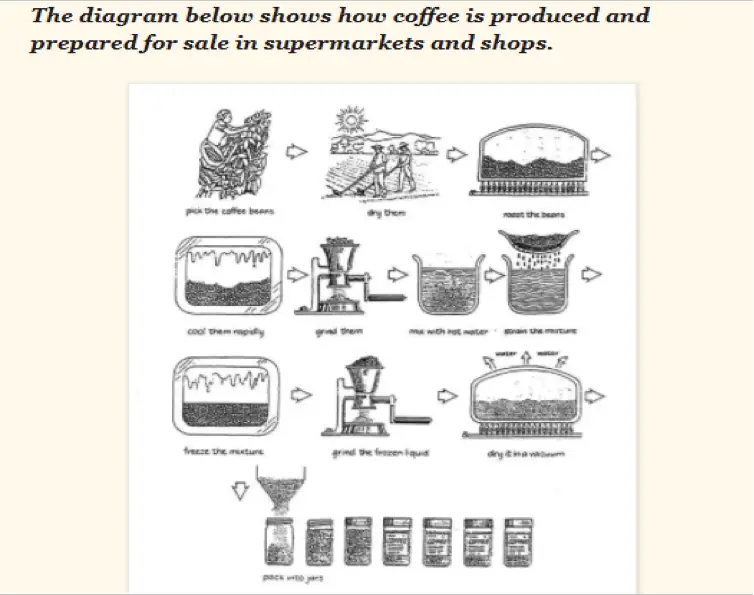
How coffee is produced ad prepared for sale?
The diagram below shows how coffee is produced and prepared for sale in supermarkets and shops.
Take a look at the model answer.
The picture describes the production of coffee and the preparation for delivery into different stores. Overall, there are 11 stages in manufacturing coffee. Beginning with picking up the coffee beans and ending with packaging and delivery for public consumption. First, the mature coffee beans are picked up in the coffee field. After that, the collected beans are then dried under the sun and then roasted in a roasting oven. Next, the roasted beans are placed in a cooling area to lower the temperature immediately. Afterwards, the coffee beans are then ground and then the mixture is later mixed with boiling water. In the subsequent stage, the mixture of water and ground coffee beans is then strained and placed in a freezer to chill. Consequently, the frozen liquid is subjected to a grinder and arranged in a drying vacuum to remove its water content. Finally, the dried ground coffee beans are being packed in a jar and they are being delivered to different stores.
Word count – 163 / Band score 80
Instructor Feedback on IELTS Process Question Essay: How Coffee is produced?
Task Achievement – The answer provides a paraphrased question, to begin with, followed by an overview that gives the reader key information.
Coherence and Cohesion – The answer has been divided into clear logical paragraphs.
Lexical Resource – There is evidence of paraphrasing, synonyms and some less common words.
Grammatical Range and Accuracy – The answer has no grammatical errors. The sentences are mainly made up of multiple clauses and have a variety of structures.
We hope you found this post helpful in helping you to study for the IELTS Test. Let us know in the comments or on the Facebook page if you have any questions. The best way to keep up to date with posts like this is to like us on Facebook, and then follow us onInstagramand Pinterest. We offer essay correction services, mock exams, and online courses. If you need help preparing for the IELTS Test, join the IELTS Achieve Academy and see how we can help you achieve your desired band score faster.
Step-by-step guide to answering this type of IELTS Writing Task 1 question. Covers structure, key language, and band-scoring criteria.
Originally published May 2018. Last reviewed 3 July 2026.
In this post, we will look at a Writing Task 1 Academic process essay example from the IELTS writing task 1 Academic Test. Students often ask if the questions are repeated year after year and the answer is no, but the type of chart, graph or process can be.
There are so many questions written each year, you may find you practice answering various questions on different topics. It is best practice to learn how to answer each one of the various types of writing task 1 questions, from bar charts, line graphs, maps, process etc.
If you would like to learn how to structure a process essay please click the button below >
Take a look at the IELTS Writing Task 1 Academic essay example below >>
*This process question and answer were provided by a student. IELTS Achieve did not design this question*
The diagram illustrates the procedure of how to recycle worn-out glass bottles.
Overall, it can be observed that there are three phases in recycling used glass bottles, beginning with the collection of wasted bottles and ending with the delivery of newly created bottles.
First, wasted glass bottles are gathered and put into a collection point and then these bottles will be transferred to a facility where they are placed into high-pressure water tanks to wash out dirt and impurities. Next, the bottles will be arranged and categorized into three colours (brown, green and clear).
In the subsequent stage, the bottles are then delivered to a glass factory where they will be smashed into small pieces. Then, the process continues by putting them into a burning furnace with temperatures ranging from 6000c up to 8000C and then a liquid is produced. Afterwards, the recycled liquid glass and new liquid glass will be combined and shaped in a glass mould. Finally, newly formed glasses are filled with products and delivered to different supermarkets.
Word count – 171 / Band score 8
Task Achievement – The answer provides a paraphrased question, to begin with, followed by an overview that gives the reader key information.
Coherence and Cohesion – The answer has been divided into clear logical paragraphs.
Lexical Resource – There is evidence of paraphrasing, synonyms and some less common words.
Grammatical Range and Accuracy – The answer has no grammatical errors. The sentences are mainly made up of multiple clauses and have a variety of structures.
We hope you found this post helpful in helping you to study for the IELTS Test. Let us know in the comments or on the Facebook page if you have any questions. The best way to keep up to date with posts like this is to like us on Facebook, and then follow us onInstagramand Pinterest. We offer essay correction services, mock exams, and online courses. If you need help preparing for the IELTS Test, join the IELTS Achieve Academy and see how we can help you achieve your desired band score faster.
Step-by-step guide to answering this type of IELTS Writing Task 1 question. Covers structure, key language, and band-scoring criteria.
Originally published May 2018. Last reviewed 3 July 2026.
In this post, we will look at a Writing Task 1 Academic process essay example from the IELTS writing task 1 Academic Test. Students often ask if the questions are repeated year after year and the answer is no, but the type of chart, graph or process can be.
There are so many questions written each year, you may find you practice answering various questions on different topics. It is best practice to learn how to answer each one of the various types of writing task 1 questions, from bar charts, line graphs, maps, process etc.
If you would like to learn how to structure a process essay please click the button below >
Take a look at the IELTS Writing Task 1 Academic essay example below >>
*This process question and answer were provided by a student. IELTS Achieve did not design this question*
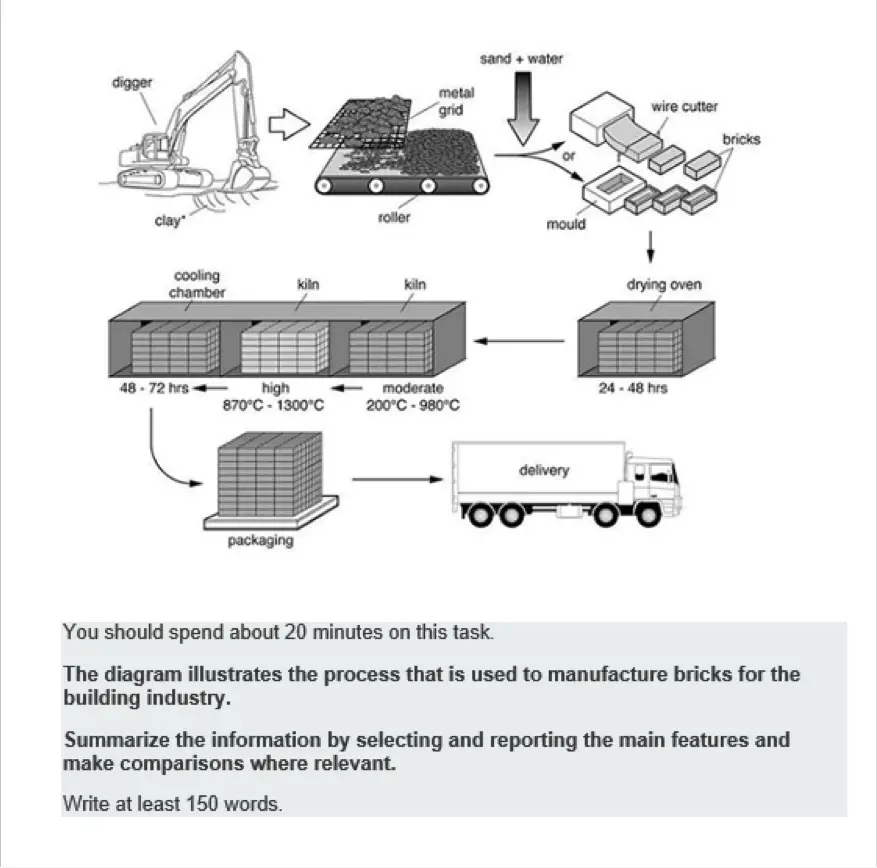
The picture shows the procedure of how to create bricks to be used in construction.
Overall, it can be observed that there are eight stages in the process, beginning with the digging of clay by the digger and ending with the bricks being delivered to different building sites.
To begin with, clay is collected by a bulldozer and then taken to a metal grid with a roller to press the clay and to incorporate sand and water. After this, the processed clay will then be subjected to a moulder or a wire cutter machine to form the clay into bricks.
In the subsequent stage, the newly formed brick will be placed in a drying oven where it will stay for about 24-48 hours. Next, the bricks will rest in two different chambers with temperatures ranging from 200 0C-9800C (1st chamber) and 8700C- 13000C ( 2nd chamber) respectively. Afterwards, the bricks will be exposed to a cooling chamber for about 48-72 hours and then later will be packed. Finally, the bricks are then stored and delivered to different construction sites.
Word count – 179 / Band score 8
Task Achievement – The answer provides a paraphrased question, to begin with, followed by an overview that gives the reader key information.
Coherence and Cohesion – The answer has been divided into clear logical paragraphs.
Lexical Resource – There is evidence of paraphrasing, synonyms and some less common words.
Grammatical Range and Accuracy – The answer has no grammatical errors. The sentences are mainly made up of multiple clauses and have a variety of structures.
We hope you found this post helpful in helping you to study for the IELTS Test. Let us know in the comments or on the Facebook page if you have any questions. The best way to keep up to date with posts like this is to like us on Facebook, and then follow us onInstagramand Pinterest. We offer essay correction services, mock exams, and online courses. If you need help preparing for the IELTS Test, join the IELTS Achieve Academy and see how we can help you achieve your desired band score faster.