Comprehensive guide covering essential IELTS preparation strategies and techniques to help you achieve your target band score.
Originally published March 2023. Last reviewed 3 July 2026.
Comparative adjectives are used to compare two things or people, highlighting their similarities or differences. In this guide, we will discuss the proper usage of comparative adjectives in English grammar.
Comparative structures for similarities
A. Using ‘as … as’ with a normal adjective
John is as tall as Luke (= they are the same height).
The red shirt is as expensive as the blue shirt (= they are the same price).
B. Using ‘not as … as’ to indicate dissimilarity
Lucy is not as tall as Helena (= Helena is taller than Lucy).
Paris is not as big as London (= London is bigger than Paris).
Comparative structures for differences
A. Using a comparative adjective with ‘than’
France is bigger than Scotland.
Luke is taller than Lucy.
Your book is more interesting than my book.
B. Modifying comparisons with adverbs
Making the comparison stronger
Canada is far bigger than Scotland.
Your book is much more interesting than my book.
Amanda is a lot younger than Julie.
Making the comparison less strong
This exercise is a little more difficult than that exercise.
C. Using ‘less … than’ to show lesser degree
Scotland is less big than France.
Lucy is less tall than Luke.
My book is less interesting than your book.
D. Showing change with ‘comparative and comparative’ or ‘more and more adjective’
That child is getting taller and taller.
The climate is getting hotter and hotter.
This city is becoming more and more crowded.
Practice Questions
Write a sentence comparing the intelligence of two animals using ‘as … as’.
Write a sentence comparing the beauty of two places using ‘not as … as’.
Write a sentence comparing the weight of two objects using a comparative adjective with ‘than’.
Write a sentence comparing the spiciness of two dishes, making the comparison less strong.
Write a sentence showing change in the popularity of a TV show using ‘more and more adjective’.
Write a sentence comparing the busyness of two streets using ‘less … than’.
Write a sentence comparing the loudness of two sounds using a comparative adjective with ‘than’.
Write a sentence comparing the cleanliness of two rooms, making the comparison stronger.
Write a sentence showing change in the level of pollution in a city using ‘more and more adjective’.
Write a sentence comparing the heights of two buildings using ‘as … as’.
Answers:
The dolphin is as intelligent as the chimpanzee.
The desert is not as beautiful as the tropical rainforest.
The iron bar is heavier than the wooden plank.
The curry is a little spicier than the soup.
The TV show is becoming more and more popular.
The side street is less busy than the main road.
The thunder is louder than the rain.
The kitchen is much cleaner than the garage.
The city is becoming more and more polluted.
The Empire State Building is as tall as the Willis Tower.
Practice Questions:
The cat is _____ as the dog. ( fast)
The bicycle is _____ the motorcycle. (inexpensive)
The elephant is _____ the mouse. (heavy)
This coffee is _____ the other one. ( not bitter)
The traffic in the city is becoming _____ . (congested)
This road is _____ the highway. (less crowd)
Mount Everest is _____ Mount Kilimanjaro. (tall)
The countryside is _____ the city. (peaceful)
The days are becoming _____ as summer approaches. (long)
The two books are _____ in terms of their content. ( informative)
Comprehensive guide covering essential IELTS preparation strategies and techniques to help you achieve your target band score.
Originally published March 2023. Last reviewed 3 July 2026.
Figures of speech are expressive tools used in writing and speech to convey meaning beyond their literal sense. They are often employed to create vivid imagery, emphasize a point, or inject humor. In this article, we explore 25 types of figures of speech, offering definitions, examples, and practice questions to help you understand and apply these rhetorical devices in your own writing or communication.
Simile
A simile is a figure of speech that compares two different things using the words “like” or “as.”
Example: Her smile is as bright as the sun.
Practice Question: Create a simile comparing a person’s eyes to a natural element.
Answer: His eyes sparkled like stars in the night sky.
Metaphor
A metaphor is a figure of speech that compares two different things by stating that one is the other.
Example: Time is a thief.
Practice Question: Create a metaphor comparing a person’s heart to a type of container.
Answer: Her heart is a treasure chest of kindness.
Personification
Personification is a figure of speech that attributes human qualities or characteristics to non-human entities, such as animals or inanimate objects.
Example: The wind whispered through the trees.
Practice Question: Personify a volcano.
Answer: The volcano angrily spewed lava and ash, as if punishing the land below.
Metonymy
Metonymy is a figure of speech in which one word or phrase is replaced by another that is closely associated with it.
Example: The White House announced a new policy (referring to the U.S. government).
Practice Question: Use metonymy to describe a decision made by a company’s leadership.
Answer: The boardroom decided to invest in new technology.
Apostrophe
Apostrophe is a figure of speech in which the speaker directly addresses an absent person, an abstract idea, or an inanimate object.
Example:”Hello, Sunshine! Thank you for brightening my day.”
Practice Question: Use apostrophe to address a lost opportunity.
Answer: O missed opportunity, how you haunt me with thoughts of what could have been.
Hyperbole
Hyperbole is a figure of speech that uses exaggeration for emphasis or effect.
Example: I’m so hungry I could eat a horse.
Practice Question: Use hyperbole to describe a person’s intelligence.
Answer: She’s so smart, she could probably read minds if she wanted to.
Synecdoche
Synecdoche is a figure of speech in which a part represents the whole, or vice versa.
Example: All hands on deck (referring to sailors or workers).
Practice Question: Use synecdoche to describe a busy restaurant.
Answer: The kitchen was filled with pots and pans working tirelessly to serve the hungry patrons.
Transferred Epithets
A transferred epithet is a figure of speech in which an adjective is used to describe a noun, but the adjective is more closely related to another noun in the sentence.
Example: Sleepless nights (instead of “nights when you can’t sleep”).
Practice Question: Use a transferred epithet to describe a person who works long hours.
Answer: She endured endless, exhausting days at the office.
Euphemism
Euphemism is a figure of speech that replaces a harsh or offensive term with a more gentle or polite one.
Example: “Passed away” instead of “died.”
Practice Question: Create a euphemism for being fired from a job.
Answer: She was relieved of her duties.
Irony or Sarcasm
Irony is a figure of speech in which the intended meaning of a word or expression is opposite to its usual or literal meaning. Sarcasm is a form of irony often used to mock or convey contempt.
Example: Saying “Oh, great!” when something goes wrong.
Practice Question: Use irony or sarcasm to describe a failed plan.
Answer: Well, that went exactly as planned, didn’t it?
Pun
A pun is a figure of speech that uses a play on words, typically involving words with multiple meanings or words that sound similar.
Example: “I’m reading a book on anti-gravity. It’s impossible to put down.”
Practice Question: Create a pun about a cat.
Answer: The cat was feline quite fine today.
Epigram
An epigram is a brief, witty statement or poem, often with a surprising or satirical twist.
Example: “I can resist everything except temptation.” – Oscar Wilde
Practice Question: Write an epigram about procrastination.
Answer: Procrastination is the art of keeping up with yesterday.
Antithesis
Antithesis is a figure of speech that juxtaposes two opposing or contrasting ideas, often in parallel structure.
Example: “It was the best of times, it was the worst of times.” – Charles Dickens
Practice Question: Create a sentence using antithesis about love and hate.
Answer: Love’s gentle touch can heal the deepest wounds, while hate’s cruel grasp can shatter the strongest bonds.
Oxymoron
An oxymoron is a figure of speech that combines two contradictory terms or ideas.
Example: Deafening silence
Practice Question: Create an oxymoron about time.
Answer: Fleeting eternity
Litotes
Litotes is a figure of speech that uses understatement or double negatives to emphasize a positive quality or statement.
Example: “She’s not the brightest bulb in the box” (to suggest someone is not very smart).
Practice Question: Use litotes to describe a person who is extremely attractive.
Answer: They’re not exactly hard on the eyes.
Interrogation
Interrogation is a figure of speech in which a rhetorical question is asked, not to seek information, but to make a point or create emphasis.
Example: “What’s in a name? That which we call a rose by any other name would smell as sweet.” – William Shakespeare
Practice Question: Use interrogation to emphasize the importance of kindness.
Answer: Does not the warmth of kindness melt even the coldest heart?
Exclamation
Exclamation is a figure of speech that expresses strong emotion or surprise through exclamatory words or phrases.
Example: “Oh, the humanity!”
Practice Question: Use an exclamation to express admiration for a beautiful landscape.
Answer: What a breathtaking view!
Climax
Climax is a figure of speech in which ideas or phrases are arranged in ascending order of importance or intensity.
Example: “I came, I saw, I conquered.” – Julius Caesar
Practice Question: Write a sentence using climax to describe personal growth.
Answer: She learned, she struggled, she triumphed.
Anticlimax or Bathos
Anticlimax is a figure of speech in which the ideas or phrases are arranged in descending order of importance, often to create humor or highlight the trivial.
Example: “He has seen the ravages of war, the damage from hurricanes, and the mess after a toddler’s birthday party.”
Practice Question: Use anticlimax to describe a day that started well but ended poorly.
Answer: He woke up refreshed, enjoyed a delicious breakfast, and then spilled coffee on his shirt.
Alliteration
Alliteration is a figure of speech in which the same consonant sound is repeated at the beginning of words in close succession.
Example: Peter Piper picked a peck of pickled peppers.
Practice Question: Write a sentence using alliteration about a snake.
Answer: The slithering snake silently slid through the soft sand.
Onomatopoeia
Onomatopoeia is a figure of speech that uses words that imitate the sounds they describe.
Example: Buzz, hiss, sizzle
Practice Question: Write a sentence using onomatopoeia to describe a rainy day.
Answer: The raindrops pitter-pattered on the windowpane.
Circumlocution
Circumlocution is a figure of speech that uses more words than necessary to describe something or someone, often to be intentionally vague or evasive.
Example: “The person responsible for the preparation of food” (instead of “the cook”).
Practice Question: Use circumlocution to describe a teacher.
Answer: The individual tasked with imparting knowledge and guiding young minds.
Tautology or Pleonasm
Tautology is a figure of speech in which the same idea is expressed more than once, often using different words but adding no clarity or emphasis.
Example: “The two of them were alone together.”
Practice Question: Write a sentence using tautology about a successful business.
Answer: The thriving business was successful and prosperous.
Paradox
A paradox is a figure of speech in which a statement appears to be self-contradictory or illogical but reveals a deeper truth.
Example: “This statement is false.”
Practice Question: Write a paradox about wisdom.
Answer: The more you know, the more you realize how little you know.
Understatement
Understatement is a figure of speech in which the significance or impact of something is deliberately minimized, often for ironic or humorous effect.
Example: Describing a hurricane as “a little windy.”
Practice Question: Use understatement to describe winning the lottery.
Answer: Winning the lottery is a nice little bonus.
Frequently Asked Questions (FAQs)
What is the purpose of figures of speech?
Figures of speech are used to create vivid imagery, emphasize a point, or inject humor in writing or speech. They can make the language more engaging and memorable.
Are figures of speech only used in poetry?
While figures of speech are commonly used in poetry, they can also be found in prose, speeches, and everyday language.
Can I use multiple figures of speech in a single sentence or piece of writing?
Yes, you can use multiple figures of speech, but it’s important to use them effectively and avoid overloading your writing with too many rhetorical devices, which can make it difficult to understand.
How can I improve my use of figures of speech in my writing?
Practice is key. Try incorporating different figures of speech into your writing, and study examples from literature and speeches to see how others have used them effectively.
How do figures of speech contribute to the overall meaning of a text?
Figures of speech can enhance the meaning of a text by providing emphasis, creating imagery, or conveying emotions. They can help the reader or listener better understand the intended message, and often make the text more memorable and engaging.
What is the difference between a metaphor and a simile?
A metaphor is a figure of speech that directly compares two unlike things, while a simile uses the words “like” or “as” to make a comparison. For example, “Life is a roller coaster” (metaphor) and “Life is like a roller coaster” (simile).
How do I identify figures of speech in a text?
To identify figures of speech in a text, look for unusual or creative uses of language that involve comparisons, exaggeration, repetition, or other rhetorical devices. Familiarizing yourself with different types of figures of speech and their definitions will also help you recognize them more easily.
Can using figures of speech make my writing more persuasive?
Yes, figures of speech can make your writing more persuasive by emphasizing important points, evoking emotions, and creating memorable imagery. However, it’s essential to use them judiciously and in moderation to maintain clarity and avoid overwhelming your audience.
What is the difference between irony and sarcasm?
The irony is a figure of speech in which the intended meaning is opposite to the literal meaning of the words, while sarcasm is a form of irony often used to mock or ridicule someone or something. Sarcasm is typically more biting and direct, whereas irony can be more subtle.
How do I choose the right figure of speech for my writing?
The right figure of speech will depend on your intended message, tone, and audience. Consider the effect you want to achieve, and choose a figure of speech that will help convey your meaning or evoke the desired emotion. Experiment with different figures of speech and be mindful of their impact on your writing.
Comprehensive guide covering essential IELTS preparation strategies and techniques to help you achieve your target band score.
Originally published March 2023. Last reviewed 3 July 2026.
Adjectives and adverbs are essential components of English grammar that help to describe and provide additional information about nouns, pronouns, verbs, adjectives, and other adverbs. This guide will provide you with a thorough understanding of adjectives and adverbs, their uses, common mistakes, and tips for mastering their usage in your writing and speech.
Understanding Adjectives and Adverbs
Adjectives
Adjectives are words used to describe or modify nouns (people, places, things, or ideas) and pronouns. They provide more information about the qualities, characteristics, or features of the noun or pronoun they are describing.
There are two main ways to use adjectives:
Before the noun (attributive position): In this case, the adjective directly precedes the noun it modifies. Examples:
The red ball rolled away.
She has a friendly personality.
After a linking verb (predicative position): In this case, the adjective comes after a linking verb, such as ‘be’, ‘become’, ‘seem’, ‘feel’, ‘taste’, ‘look’, ‘sound’, or ‘smell’. Examples:
The ball is red.
She seems friendly.
Adverbs
Adverbs are words used to describe or modify verbs, adjectives, or other adverbs. They provide more information about the manner, time, place, frequency, degree, or other circumstances of the action or state they describe.
Adverbs are often created by adding ‘ly’ to an adjective, but some adverbs do not follow this rule, and some adjectives end in ‘ly’ without being adverbs.
Examples:
Adverbs modifying verbs:
She quickly ran to the store. (Manner)
He will soon arrive. (Time)
They live nearby. (Place)
She always takes her vitamins. (Frequency)
He almost finished the race. (Degree)
Adverbs modifying adjectives:
The incredibly talented musician played a beautiful piece.
It was a quite difficult puzzle.
Adverbs modifying other adverbs:
She finished the test very quickly.
He drives too fast.
It’s important to note that some adverbs have irregular forms, and some adjectives ending in ‘ly’ do not have adverbial forms. In such cases, a phrase like “in a … way” is used instead.
Examples:
Fast (adjective): That’s a fast car.
Fast (adverb): She runs fast.
Friendly (adjective): She has a friendly smile.
In a friendly way (adverbial phrase): She greeted me in a friendly way.
Comparative and Superlative Forms
Comparative and superlative forms of adjectives and adverbs are used to compare different degrees or levels of quality among two or more people, things, or actions. These forms help us indicate which item possesses a quality to a greater or lesser extent, or to the greatest or least extent of all items being compared.
Comparative Forms
Comparative forms are used to compare two people, things, or actions. We usually form the comparative by adding ‘-er’ to the adjective or adverb, or by using ‘more’ before the adjective or adverb.
Examples:
Adjectives:
She is taller than her sister. (Adding ‘-er’)
The painting is more beautiful than the photograph. (Using ‘more’)
Adverbs:
He runs faster than her. (Adding ‘-er’)
She sings more loudly than her friend. (Using ‘more’)
Superlative Forms
Superlative forms are used to compare three or more people, things, or actions. We usually form the superlative by adding ‘-est’ to the adjective or adverb, or by using ‘most’ before the adjective or adverb.
Examples:
Adjectives:
She is the tallest person in the class. (Adding ‘-est’)
That is the most beautiful painting I have ever seen. (Using ‘most’)
Adverbs:
He runs the fastest among his friends. (Adding ‘-est’)
She sings the most loudly in the choir. (Using ‘most’)
Keep in mind that some adjectives and adverbs have irregular comparative and superlative forms, such as ‘good’ (better, best), ‘bad’ (worse, worst), and ‘well’ (better, best).
Adjective and Adverb Clauses and Phrases
Adjective and adverb clauses and phrases provide additional information about nouns and verbs, respectively. They help make sentences more detailed and expressive.
Adjective Clauses
Adjective clauses, also known as relative clauses, are dependent clauses that provide additional information about a noun or pronoun. These clauses are introduced by relative pronouns (who, whom, whose, which, that) or relative adverbs (when, where, why).
Example:
The house that is painted blue belongs to my aunt. (The adjective clause describes the house.)
Adverb Clauses
Adverb clauses are dependent clauses that provide additional information about a verb, adjective, or adverb. These clauses are introduced by subordinating conjunctions, such as although, because, if, since, when, and while.
Example:
She will study until she knows all the material. (The adverb clause describes when she will study.)
Adjective Phrases
Adjective phrases are groups of words that function as adjectives but do not contain a subject and a verb. An adjective phrase consists of a single adjective or an adjective with accompanying modifiers, such as adverbs, determiners, or prepositional phrases.
Example:
The extremely tired man sat down. (The adjective phrase describes the man.)
Adverb Phrases
Adverb phrases are groups of words that function as adverbs but do not contain a subject and a verb. An adverb phrase consists of a single adverb or an adverb with accompanying modifiers, such as adverbs, determiners, or prepositional phrases.
Example:
She finished her work very quickly. (The adverb phrase describes how she finished her work.)
Common Mistakes with Adjectives and Adverbs
Mistakes with adjectives and adverbs can affect the clarity and correctness of a sentence. Understanding these common errors can help you avoid them in your writing and speaking.
1. Using Adjectives Instead of Adverbs
Adjectives are used to describe nouns, while adverbs are used to describe verbs, adjectives, or other adverbs. Using an adjective where an adverb is needed can lead to confusion.
Incorrect: She sings beautiful. Correct: She sings beautifully.
2. Double Negatives with Adverbs
Using a negative adverb with a negative verb can create a double negative, which can be unclear or convey the opposite meaning of what is intended.
Incorrect: He hardly knows nothing about the topic. Correct: He hardly knows anything about the topic.
3. Incorrect Comparative and Superlative Forms
Using the wrong form of an adjective or adverb in a comparison can lead to confusion or incorrect meaning.
Incorrect: She is the more intelligent of the two. Correct: She is the more intelligent of the two.
4. Misplacing Adverbs
The position of an adverb in a sentence can affect its meaning. Be sure to place adverbs close to the words they modify to avoid confusion.
Incorrect: She only wants to eat vegetables. Correct: She wants to eat only vegetables.
5. Confusing Adjectives and Adverbs with Similar Forms
Some adjectives and adverbs have similar forms, but different meanings. Be aware of these words and use them correctly.
Examples:
Good (adjective) vs. well (adverb)
Late (adjective and adverb) vs. lately (adverb)
By recognizing and avoiding these common mistakes, you can improve the clarity and correctness of your writing and speaking.
Tips for Using Adjectives and Adverbs Effectively
Using adjectives and adverbs effectively can enhance your writing and speaking, making it more engaging, precise, and expressive. Here are some tips to help you use these parts of speech to their full potential:
1. Be Specific
Choose adjectives and adverbs that convey precise and vivid descriptions, rather than relying on generic or overused words.
Example:
Instead of “She is happy,” try “She is ecstatic.”
2. Use Moderation
While adjectives and adverbs can enhance your writing, overusing them can make your text feel cluttered and difficult to read. Use them judiciously, focusing on the most important details or actions.
Example:
Instead of “The large, gray, stone, ancient castle,” try “The ancient, stone castle.”
3. Place Adverbs Carefully
The position of an adverb can affect the meaning of the sentence. Ensure that your adverbs are placed close to the words they modify, and be mindful of how their position can alter the intended meaning.
Example:
Instead of “She only wants to eat vegetables,” try “She wants to eat only vegetables.”
4. Vary Your Word Choices
Using a variety of adjectives and adverbs can make your writing more engaging and prevent it from sounding repetitive. Consider using synonyms, antonyms, or different degrees of comparison to convey your message.
Example:
Instead of “The car is fast,” try “The car is speedy.”
5. Proofread and Revise
After writing or preparing a speech, take the time to review your work and ensure that you have used adjectives and adverbs correctly. Check for common mistakes, such as using adjectives instead of adverbs, and make revisions as needed.
By following these tips and practicing your writing and speaking skills, you can become more adept at using adjectives and adverbs effectively, enhancing your communication and expression.
Practice Questions and Answers
To help you better understand and apply your knowledge of adjectives and adverbs, here are some practice questions and answers:
Question 1: Identify the adjective(s) and adverb(s) in the following sentence:
The young, cheerful girl sang beautifully at the concert.
Answer 1:
Adjective(s): young, cheerful
Adverb(s): beautifully
Question 2: Correct the following sentence if necessary:
He drives careful on the slippery road.
Answer 2:
He drives carefully on the slippery road.
Question 3: Choose the correct form of the adjective or adverb in parentheses:
She plays the piano (good/well).
Answer 3:
She plays the piano well.
Question 4: Complete the following sentence with an appropriate adjective or adverb:
The cat climbed the tree (quick/quickly) to escape the dog.
Answer 4:
The cat climbed the tree quickly to escape the dog.
Question 5: Rewrite the following sentence using an adverb clause:
She finished her homework. Then she went to the party.
Answer 5:
She went to the party after she finished her homework.
Practicing with questions like these can help solidify your understanding of adjectives and adverbs, and improve your ability to use them correctly in your writing and speaking.
Recap and Key Takeaways
Adjectives and adverbs play crucial roles in adding details, making comparisons, and providing clarity in our writing and speech. To recap what we’ve learned:
Adjectives describe nouns and pronouns, and can appear before nouns or after linking verbs.
Adverbs describe verbs, adjectives, or other adverbs, and often end in ‘-ly’.
Comparative and Superlative Forms are used to compare different degrees or levels of a quality.
Adjective and Adverb Clauses and Phrases are dependent clauses and groups of words that provide additional information about nouns and verbs, respectively.
Be aware of common mistakes involving adjectives and adverbs, such as using adjectives instead of adverbs, misplacing adverbs, and using incorrect comparative and superlative forms.
Use adjectives and adverbs effectively by being specific, using moderation, placing adverbs carefully, varying your word choices, and proofreading your work.
Practice your understanding of adjectives and adverbs through exercises and real-life applications.
By understanding the functions and proper usage of adjectives and adverbs, you can enrich your writing and speaking, making your communication more engaging, precise, and expressive.
Comprehensive guide covering essential IELTS preparation strategies and techniques to help you achieve your target band score.
Originally published March 2023. Last reviewed 3 July 2026.
English grammar can be challenging, especially when it comes to understanding and using the various tenses. Tenses are crucial for expressing time accurately, and mastering them is essential for effective communication. In this comprehensive guide, we will explore the 16 tenses in English grammar, providing you with the formula and examples for each tense. By understanding and practicing these tenses, you’ll be better equipped to express yourself confidently and clearly in a variety of situations, whether you’re a student, a professional, or simply looking to improve your English language skills. So, let’s dive in and learn the essential tenses that will elevate your command of the English language!
Present Tenses:
Simple Present Tense
Formula: Subject + base form of the verb The simple present tense is used to express habits, general facts, and recurring events. It’s also used to describe actions that are happening right now, but only when talking about the future. Examples: She plays soccer every weekend. The sun rises in the east. Birds fly in the sky.
Present Continuous Tense
Formula: Subject + am/is/are + present participle (base form of the verb + -ing) The present continuous tense is used to describe actions or events that are happening right now or are in progress at the time of speaking. Examples: She is playing soccer right now. They are watching a movie. We are studying for the exam.
Present Perfect Tense
Formula: Subject + has/have + past participle (third form of the verb) The present perfect tense is used to describe actions or events that have been completed at an unspecified time in the past, or actions that started in the past and continue in the present. Examples: She has played soccer before. They have watched that movie. We have studied this topic in class.
Present Perfect Continuous Tense
Formula: Subject + has/have + been + present participle (base form of the verb + -ing) The present perfect continuous tense is used to describe actions or events that started in the past and continue up to the present, focusing on the duration or ongoing nature of the action. Examples: She has been playing soccer for two hours. They have been watching the movie since it started. We have been studying for the exam all day.
Past Tenses:
Simple Past Tense
Formula: Subject + past form of the verb The simple past tense is used to describe actions or events that happened in the past and have been completed. Examples: She played soccer yesterday. The movie started at 7 pm. They visited the museum last week.
Past Continuous Tense
Formula: Subject + was/were + present participle (base form of the verb + -ing) The past continuous tense is used to describe actions or events that were in progress at a specific time in the past. Examples: She was playing soccer when it started to rain. They were watching a movie when the power went out. We were studying for the exam when the fire alarm rang.
Past Perfect Tense
Formula: Subject + had + past participle (third form of the verb) The past perfect tense is used to describe actions or events that were completed before another action or event in the past. Examples: She had played soccer before she joined the team. They had watched the movie before we arrived. We had studied the topic before the test.
Past Perfect Continuous Tense
Formula: Subject + had been + present participle (base form of the verb + -ing) The past perfect continuous tense is used to describe actions or events that were in progress before another action or event in the past. Examples: She had been playing soccer for two hours when it started to rain. They had been watching the movie when the power went out. We had been studying for the exam when the fire alarm rang.
Future Tenses:
Simple Future Tense
Formula: Subject + will + base form of the verb The simple future tense is used to describe actions or events that will happen in the future. Examples: She will play soccer tomorrow. They will travel to Europe next month. The meeting will start at 9 am.
Future Continuous Tense
Formula: Subject + will be + present participle (base form of the verb + -ing) The future continuous tense is used to describe actions or events that will be in progress at a specific time in the future. Examples: She will be playing soccer at 3 pm tomorrow. They will be watching a movie when we arrive. We will be studying for the exam when you call.
Future Perfect Tense
Formula: Subject + will have + past participle (third form of the verb) The future perfect tense is used to describe actions or events that will be completed before another action or event in the future. Examples: She will have played soccer by the time we arrive. They will have watched the movie before we get there. We will have studied the topic before the exam.
Future Perfect Continuous Tense
Formula: Subject + will have been + present participle (base form of the verb + -ing) The future perfect continuous tense is used to describe actions or events that will be in progress before another action or event in the future. Examples: She will have been playing soccer for two hours by the time we arrive. They will have been watching the movie for an hour when we get there. We will have been studying for the exam all week by the time it starts.
Conditional Tenses (which can also be classified as present, past, or future depending on the context):
Simple Conditional Tense (First Conditional)
Formula: If + Subject + present simple verb, Subject + will + base form of the verb The simple conditional tense (first conditional) is used to describe possible future actions or events that depend on another condition being met. Examples: If she plays soccer, she will become stronger. If they watch the movie, they will enjoy it. If we study for the exam, we will pass.
Conditional Continuous Tense (Second Conditional)
Formula: If + Subject + past simple verb, Subject + would/could/might + base form of the verb The conditional continuous tense (second conditional) is used to describe hypothetical situations or events that are unlikely to happen or are imaginary. Examples: If she played soccer professionally, she would be famous. If they watched the movie, they might like it. If we studied harder, we could pass the exam.
Conditional Perfect Tense (Third Conditional)
Formula: If + Subject + had + past participle (third form of the verb), Subject + would/could/might have + past participle (third form of the verb) The conditional perfect tense (third conditional) is used to describe actions or events in the past that did not happen because a condition was not met. Examples: If she had played soccer yesterday, she would have been tired. If they had watched the movie, they would have understood the references. If we had studied for the exam, we might have passed.
Mixed Conditional Tense
Formula: If + Subject + past perfect verb, Subject + would/could/might + present continuous verb The mixed conditional tense is used to describe a combination of conditions from the second and third conditional tenses. Examples: If she had practiced more, she would be playing soccer professionally now. If they had seen the movie, they might be discussing it right now. If we had studied harder, we could be passing the exam today.
Comprehensive guide covering essential IELTS preparation strategies and techniques to help you achieve your target band score.
Originally published March 2023. Last reviewed 3 July 2026.
Verbs are an essential part of the English language, and they can be broadly categorized into two types: action verbs and linking verbs. While action verbs express actions, linking verbs connect the subject to additional information about its state or condition. In this guide, we will discuss linking verbs in detail, their characteristics, usage, and differences from action verbs. We will also provide practice questions with answers to help you test your understanding of linking verbs.
Characteristics of Linking Verbs:
Linking verbs connect the subject to additional information about its state or condition. They do not express actions like action verbs. Some linking verbs are stative, describing a state of being or condition, such as “be” and “seem”. Others can also be used as non-stative linking verbs in certain contexts, such as “get” and “turn”.
Usage of Linking Verbs:
Linking verbs are commonly used in everyday language to describe the state or condition of the subject. They can also be used as predicate nominatives or predicate adjectives. A predicate nominative renames or identifies the subject, while a predicate adjective describes the subject.
Differences from Action Verbs:
Linking verbs and action verbs differ in their function. While linking verbs connect the subject to additional information, action verbs express actions. For example, “She walked to the store” uses an action verb, while “She seems tired” uses a linking verb.
Practice Questions:
Identify the linking verb in the following sentence: “The coffee smells amazing.”
Is “appear” a linking verb in the sentence, “She appeared confident during her presentation”?
Name three linking verbs that are always used as linking verbs in English.
What is the difference between a linking verb and an action verb?
In the sentence, “The sun feels warm on my skin”, is “feels” a linking verb or an action verb?
Write a sentence using a non-stative linking verb.
Identify the predicate nominative in the following sentence: “My favorite color is blue.”
Is “grow” a linking verb in the sentence, “The plants are growing quickly”?
Write a sentence using a stative linking verb.
In the sentence, “He seems tired today”, is “seems” a linking verb or an action verb?
Answers:
The linking verb in the sentence is “smells”.
Yes, “appear” is a linking verb in the sentence.
The three linking verbs that are always used as linking verbs in English are “be”, “seem”, and “become”.
The main difference between a linking verb and an action verb is that a linking verb connects the subject to additional information, while an action verb expresses an action.
“Feels” is a linking verb in the sentence.
Example of a sentence using a non-stative linking verb: “The sky turned pink during the sunset.”
The predicate nominative in the sentence is “blue”.
Yes, “grow” is a linking verb in the sentence.
Example of a sentence using a stative linking verb: “The ocean smells salty and refreshing.”
“Seems” is a linking verb in the sentence.
By understanding the characteristics and usage of linking verbs, you can improve your writing and communication skills. By identifying linking verbs in sentences, you can construct
Comprehensive guide covering essential IELTS preparation strategies and techniques to help you achieve your target band score.
Originally published March 2023. Last reviewed 3 July 2026.
Understanding subject-verb agreement is essential for mastering English grammar. Subject-verb agreement refers to the concept that the verb in a sentence must agree in number with the subject. In other words, singular subjects require singular verbs, while plural subjects require plural verbs. This article provides a comprehensive overview of subject-verb agreement rules, along with clear examples and 25 practice exercises to help you solidify your understanding. By the end of this article, you will have a strong foundation in subject-verb agreement and be better prepared to communicate effectively in English.
A cat sleeps on the couch. (singular subject and verb)
Cats sleep on the couch. (plural subject and verb)
When two subjects are connected by “and,” use a plural verb.
Examples:
Sally and Tom are friends. (two subjects joined by “and,” plural verb)
Apples and oranges are fruits. (two plural subjects joined by “and,” plural verb)
If a compound subject with “and” sounds singular, use a singular verb.
Examples:
Peanut butter and jelly is a popular sandwich. (compound subject sounds singular, singular verb)
Spaghetti and meatballs is a delicious dish. (compound subject sounds singular, singular verb)
The verb should agree with the main subject, not the nearest subject.
Examples:
The group of students is going on a field trip. (main subject: group, singular verb)
The list of items is on the table. (main subject: list, singular verb)
When subjects are connected by phrases like “as well as,” “along with,” “with,” “together with,” or “in addition to,” the verb should agree with the first subject.
Examples:
The teacher, along with the students, is attending the workshop. (main subject: teacher, singular verb)
The books, in addition to the magazines, are on the shelf. (main subject: books, plural verb)
When subjects are connected by “either-or,” “neither-nor,” “not only – but also,” or “or,” the verb should agree with the nearest subject.
Examples:
Either the teacher or the students are responsible. (nearest subject: students, plural verb)
Neither the students nor the teacher is available. (nearest subject: teacher, singular verb)
Singular verbs are used with “either,” “neither,” “none,” “everyone,” “someone,” “anyone,” “many a,” “more than one.”
Examples:
None of the books is interesting. (singular verb)
Everyone in the class has completed the assignment. (singular verb)
Many a person has faced this challenge. (singular verb)
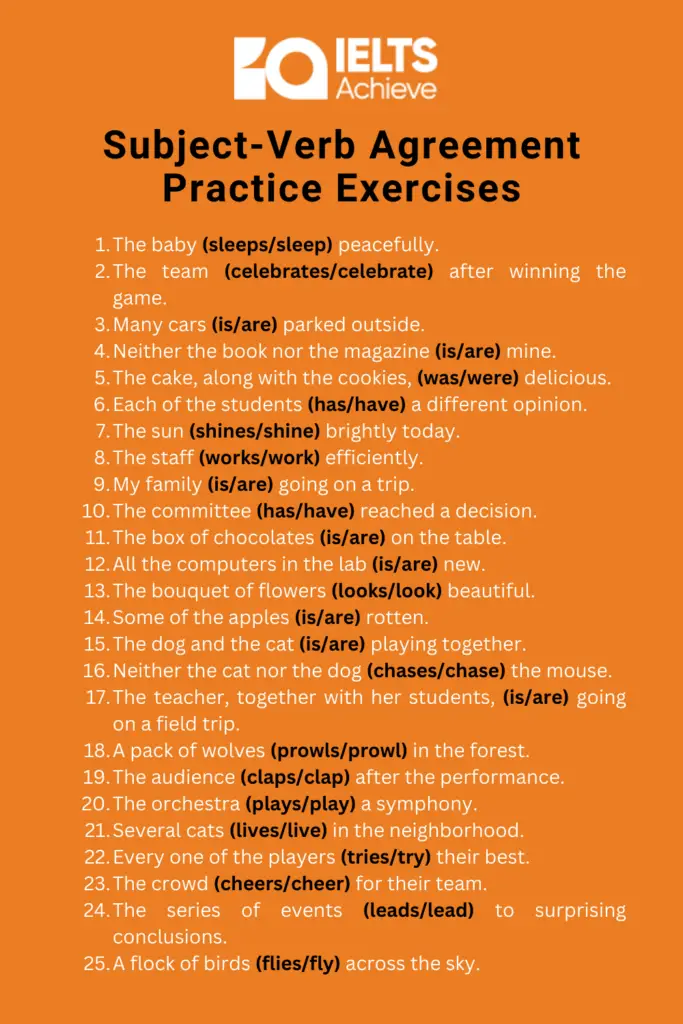
Subject-Verb Agreement Practice Exercises:
The baby (sleeps/sleep) peacefully.
The team (celebrates/celebrate) after winning the game.
Many cars (is/are) parked outside.
Neither the book nor the magazine (is/are) mine.
The cake, along with the cookies, (was/were) delicious.
Each of the students (has/have) a different opinion.
The sun (shines/shine) brightly today.
The staff (works/work) efficiently.
My family (is/are) going on a trip.
The committee (has/have) reached a decision.
The box of chocolates (is/are) on the table.
All the computers in the lab (is/are) new.
The bouquet of flowers (looks/look) beautiful.
Some of the apples (is/are) rotten.
The dog and the cat (is/are) playing together.
Neither the cat nor the dog (chases/chase) the mouse.
The teacher, together with her students, (is/are) going on a field trip.
A pack of wolves (prowls/prowl) in the forest.
The audience (claps/clap) after the performance.
The orchestra (plays/play) a symphony.
Several cats (lives/live) in the neighborhood.
Every one of the players (tries/try) their best.
The crowd (cheers/cheer) for their team.
The series of events (leads/lead) to surprising conclusions.
A flock of birds (flies/fly) across the sky.
Subject-Verb Agreement Practice Exercises: Answers
Essential strategies and practice techniques for this IELTS Reading question type. Learn how to manage time and improve accuracy.
Originally published December 2022. Last reviewed 3 July 2026.
A. In Thailand, elephants are revered as a national symbol, but even there, the survival of great mammals is at risk. A century ago, more than 100,000 elephants worked in the Thai timber industry or roamed the forests. Today the number of elephants in captivity is just 2,500 and there are even fewer in the wild. Illegal hunting has taken a toll. Deforestation and the banning of logging have removed the elephants’ chief source of employment.
B. Recently, on the site of a former government logging camp, the Thai elephant conservation centre has been established. It is home to more than one hundred elephants retrenched from the logging industry. An American elephant specialist and his team have come up with an ingenious career alternative for these redundant employees. A select group of the centre’s residents have been chosen to play in the world’s first elephant orchestra. The project was initiated to create income for the operation of the Elephant Conservation centre.
C. The orchestra currently has twelve members, selected for their musical aptitude and motivation. They are aged seven to eighteen and play a variety of percussion and wind instruments in the Thai tradition – rentals which look like xylophones, slit drums, harmonicas, a bow bass, a gong and a thundersheet. The instruments are ‘elephant sized’ and specially designed to be played with trunks. Early in the project the organisers were unsure how the elephants would respond to musical training. Then one morning they were awakened to the sound of harmonicas.The elephants had picked up the instruments on their own and were wandering through the forest playing enthusiastically.
D. Making music comes naturally to elephants. They have huge brains and are highly sociable creatures. Their hearing is much better than their sight and they use a wide range of vocalisations.In performance, they stand in a line and prompted by the trainers, play their instruments. A strong sense of rhythm is evident as they flap their ears to the beat, swish their tails and generally rock back and forth. Some add to the melody with their own trumpeting. As the conductor paces up and down orchestrating proceedings, a trunk can sometimes be seen imitating the movement of his arm.
E. The elephants aren’t forced to learn complex patterns, so playing the instruments is quite easy. Commands are given only to indicate when to start and when to stop. The rest of the time, the players have the time to improvise. According to the trainers, the elephants love their work. The modest plan initially was to teach the elephants just to hit the instruments and then overdub those sounds with other music. But after only five practice sessions, a decision was made to record the performances intact with just the human noises removed. The players improvise distinct metres and melodies, then vary and repeat them.The resulting music is meditative, deliberate and delicate and it is real elephant music. Western listeners often describe it as ‘haunting’. To some ears it may seem monotonous but anyone not knowing they were listening to elephant music would assume that humans were playing.The first CD, classical in style, has sold well, so soon there will be a pop techno and country versions in production.
F. Playing music is not the only creative form of activity the elephants of the centre engage in. For several years now, a number of residents have been painting. They use acrylic paints on large canvases and have a preference for broad strokes and bold colours. Last year, elephant paintings helped raise over $25,000 at charity auctions internationally. These art sales together with profits from the CD are helping to fund the centre’s operations. The proceeds go towards an orphanage, hospital and mobile veterinary clinic for elephants and to support the training school.
G. Animal rights’ advocates might object to these non-traditional occupations for elephants. But, Thai elephants have always had to work for a living. If they weren’t playing music or painting pictures, they would be dragging logs or carrying tourists. Given those choices, playing music and painting are not such bad options.
Questions 1-6
The passage The Elephant Orchestra’ has paragraphs labelled (A-G).In which paragraph can the following information be found? Use only ONE letter for each answer. Note: You may use each letter more than once.
1 Description of the type of music produced by the elephants………………….. 2 Details of how the income generated is used………………….. 3 Description of the musical instruments………………….. 4 Forthcoming projects for the orchestra………………….. 5 Situation of elephants in Thailand………………….. 6 How the orchestra got started…………………..
Questions 7 – 11
Complete the summary. Choose your answers from the list below. Note: There are more words than spaces so you will not use them all. You may use any word more than once.
In order to raise funds for the Thai Elephant Centre a number of creative 7___________________have been developed, including the first Elephant Orchestra. The elephants play a variety of instruments and their 8 ———————–are being sold to 9 ________________income. These intelligent animals also produce paintings, which have been sold at international auctions. The 10 ——————support an orphanage, hospital and 11————— facility.
List of Words
painting projected music initiatives occupation proceeds production generate recordings training
Question 12
Choose the correct letter A-D.
12. What is the main idea of this passage?
A. Elephants can be trained to do unusual tricks. B Creative projects can help to save endangered species. C Elephants have large brains. D Intelligent animals should not be forced to work.
Complete the sentences below with the words from the paragraph.
13. Making music comes ………….. to elephants. 14. Animal rights’ advocates might object to these ……………………. for elephants.
A detailed guide to this IELTS Writing Task 2 essay type, with structure templates, useful vocabulary, and techniques to achieve Band 7+.
Originally published December 2022. Last reviewed 3 July 2026.
A new study conducted for the World Bank by Murdoch University’s Institute for Science and Technology Policy (ISTP) has demonstrated that public transport is more efficient than cars. The study compared the proportion of wealth poured into transport by thirty-seven cities around the world. This included both the public and private costs of building, maintaining and using a transport system.
The study found that the Western Australian city of Perth is a good example of a city with minimal public transport. As a result, 17% of its wealth went into transport costs. Some European and Asian cities, on the other hand, spent as little as 5%. Professor Peter Newman, ISTP Director, pointed out that these more efficient cities were able to put the difference into attracting industry and jobs or creating a better place to live.
According to Professor Newman, the larger Australian city of Melbourne is a rather unusual city in this sort of comparison. He describes it as two cities: ‘A European city surrounded by a car-dependent one’. Melbourne’s large tram network has made car use in the inner city much lower, but the outer suburbs have the same car-based structure as most other Australian cities. The explosion in demand for accommodation in the inner suburbs of Melbourne suggests a recent change in many people’s preferences as to where they live.
Newman says this is a new, broader way of considering public transport issues. In the past, the case for public transport has been made on the basis of environmental and social justice considerations rather than economics. Newman, however, believes the study demonstrates that ‘the auto-dependent city model is inefficient and grossly inadequate in economic as well as environmental terms’.
Bicycle use was not included in the study but Newman noted that the two most ‘bicycle friendly’ cities considered – Amsterdam and Copenhagen – were very efficient, even though their public transport systems were ‘reasonable but not special’.
It is common for supporters of road networks to reject the models of cities with good public transport by arguing that such systems would not work in their particular city. One objection is climate. Some people say their city could not make more use of public transport because it is either too hot or too cold. Newman rejects this, pointing out that public transport has been successful in both Toronto and Singapore and, in fact, he has checked the use of cars against climate and found ‘zero correlation’.
When it comes to other physical features, road lobbies are on stronger ground. For example, Newman accepts it would be hard for a city as hilly as Auckland to develop a really good rail network. However, he points out that both Hong Kong and Zurich have managed to make a success of their rail systems, heavy and light respectively, though there are few cities in the world as hilly.
A. In fact, Newman believes the main reason for adopting one sort of transport over another is politics: ‘The more democratic the process, the more public transport is favored.’ He considers Portland, Oregon, a perfect example of this. Some years ago, federal money was granted to build a new road. However, local pressure groups forced a referendum over whether to spend the money on light rail instead. The rail proposal won and the railway worked spectacularly well. In the years that have followed, more and more rail systems have been put in, dramatically changing the nature of the city. Newman notes that Portland has about the same population as Perth and had a similar population density at the time.
B. In the UK, travel times to work had been stable for at least six centuries, with people avoiding situations that required them to spend more than half an hour travelling to work. Trains and cars initially allowed people to live at greater distances without taking longer to reach their destination. However, public infrastructure did not keep pace with urban sprawl, causing massive congestion problems which now make commuting times far higher.
C. There is a widespread belief that increasing wealth encourages people to live farther out where cars are the only viable transport. The example of European cities refutes that. They are–often wealthier than their American counterparts but have not generated the same level of car use. In Stockholm, car use has actually fallen in recent years as the city has become larger and wealthier. A new study makes this point even more starkly. Developing cities in Asia, such as Jakarta and Bangkok, make more use of the car than wealthy Asian cities such as Tokyo and Singapore. In cities that developed later, the World Bank and Asian Development Bank discouraged the building of public transport and people have been forced to rely on cars -creating the massive traffic jams that characterize those cities.
D. Newman believes one of the best studies on how cities built for cars might be converted to rail use is The Urban Village report, which used Melbourne as an example. It found that pushing everyone into the city centre was not the best approach. Instead, the proposal advocated the creation of urban villages at hundreds of sites, mostly around railway stations.
E. It was once assumed that improvements in telecommunications would lead to more dispersal in the population as people were no longer forced into cities. However, the ISTP team’s research demonstrates that the population and job density of cities rose or remained constant in the 1980s after decades of decline. The explanation for this seems to be that it is valuable to place people working in related fields together. ‘The new world will largely depend on human creativity, and creativity flourishes where people come together face-to-face.’
Questions 1-5
Reading Passage has five marked paragraphs, A-E. Choose the correct heading for each paragraph from the list of headings below. Write the correct number, i-viii, in boxes 1-5 on your answer sheet.
List of Headings
i Avoiding an overcrowded centre ii A successful exercise in people power iii The benefits of working together in cities iv Higher incomes need not mean more cars v Economic arguments fail to persuade vi The impact of telecommunications on population distribution vii Increases in travelling time viii Responding to arguments against public transport
Questions 6-10
Do the following statements agree with the information given in Reading Passage? In boxes 6-10 on your answer sheet, write TRUE if the statement agrees with the information FALSE if the statement contradicts the information NOT GIVEN if there is no information on this
6. The ISTP study examined public and private systems in every city of the world. 7. TRUEFALSENOT GIVEN Efficient cities can improve the quality of life for their inhabitants. 8. An inner-city tram network is dangerous for car drivers. 9. In Melbourne, people prefer to live in the outer suburbs. 10 Cities with high levels of bicycle usage can be efficient even when public transport is only averagely good.
Questions 11-13
Look at the following cities ( Questions 11-13) and the list of descriptions below. Match each city with the correct description, A-F. Write the correct letter, A-F, in boxes 11-13 on your answer sheet.
List of Descriptions
A successfully uses a light rail transport system in hilly environment B successful public transport system despite cold winters C profitably moved from road to light rail transport system D hilly and inappropriate for rail transport system E heavily dependent on cars despite widespread poverty F inefficient due to a limited public transport system
Advantages of Public Transport- IELTS Reading Answers
Essential strategies and practice techniques for this IELTS Reading question type. Learn how to manage time and improve accuracy.
Originally published December 2022. Last reviewed 3 July 2026.
PASSAGE
A. John Franklin (1786-1847) was the most famous vanisher of the Victorian era. He joined the Navy as a midshipman at the age of 14, and fought in the battles of Copenhagen and Trafalgar. When peace with the French broke out, he turned his attention to Arctic exploration, and in particular to solving the conundrum of the Northwest Passage, the mythical clear-water route which would, if it existed, link the Atlantic and the Pacific Oceans above the northern coast of the American continent. The first expedition Franklin led to the Arctic was an arduous overland journey from Hudson Bay to the shores of the so-called Polar Ocean east of the Coppermine River. Between 1819 and 1822, Franklin and his twenty-strong team covered 5550 miles on foot. Their expedition was a triumph of surveying-they managed to chart hundreds of miles of previously unknown coastline.
B There followed a career as a travel writer and salon-goer (’the man who ate his boots’ was Franklin’s tag-line), a second long Arctic expedition, and a controversial spell as Governor of Van Diemen’s Land. Then, in May 1845, Franklin set off with two ships-the Erebus and the Terror—and 129 men on the voyage that would kill him. In July, the convoy was seen by two whalers, entering Lancaster Sound. Nothing more would be heard of it for 14 years. Had the ships sunk or been iced in? Were the men dead, or in need of rescue? Or had they broken through to the legendary open polar sea, beyond the ’ice barrier’?
C In his personal correspondence and in his published memoirs, Franklin comes across as a man dedicated to the external duties of war and exploration, who kept introspection and self-analysis to a minimum. His blandness makes him an amenably malleable subject for a novelist, and Sten Nadolny has taken full advantage of this licence. Most important, he has endowed his John Franklin with a defining character trait for which there is no historical evidence: (‘slowness’, or ‘calmness’).
D Slowness influences not only Franklin’s behaviour but also his vision, his thought and his speech. The opening scene of The Discovery of Slowness (The Discovery of Slowness by Sten Nadolny) -depicts Franklin as a young boy, playing catch badly because his reaction time is too slow. Despite the bullying of his peers, Franklin resolves not to fall into step with ‘their way of doing things. For Nadolny, Franklin’s fatal fascination with the Arctic stems from his desire to find an environment suited to his peculiar slowness.
E He describes Franklin as a boy dreaming of the ‘open water and the time without hours and days’ which exist in the far north, and of finding in the Arctic a place ‘where nobody would find him too slow’. Ice is a slow mover. Ice demands a corresponding patience from those who venture onto it. The explorers who have thrived at high latitudes and at high altitudes haven’t usually been men of great speed. They have tended instead to demonstrate unusual self-possession, a considerable capacity for boredom, and a talent for what the Scots call ‘tholing’, the uncomplaining endurance of suffering.
F These were all qualities which the historical Franklin possessed in abundance, and so Nadolny’s concentration and exaggeration of them isn’t unreasonable. Even as an adult, his slowness of thought means that he is unable to speak fluently, so he memorises entire fleets of words and batteries of response’, and speaks a languid, bric-a-brac language. In the Navy, his method of thinking first and acting later initially provokes mockery from his fellow sailors. But Franklin persists in doing things his way, and gradually earns the respect of those around him. To a commodore who tells him to speed up his report of an engagement, he replies: ‘When I tell something, sir, I use my own rhythm.’ A lieutenant says approvingly of him:‘Because Franklin is so slow, he never loses time.’
G Since it was first published in Germany in 1983, The Discovery of Slowness has sold more than a million copies and been translated into 15 languages. It has been named as one of German literature’s twenty ‘contemporary classics’, and it has been adopted as a manual and manifesto by European pressure groups and institutions representing causes as diverse as sustainable development, the Protestant Church, management science, motoring policy and pacifism.
H The various groups that have taken the novel up have one thing in common: a dislike of the high-speed culture of Postmodernity. Nadolny’s Franklin appeals to them because he is immune to ‘the compulsion to be constantly occupied’, and to the idea that ‘someone was better if he could do the same thing fast.’ Several Germanchurches have used him in their symposia and focus groups as an example of peacefulness, piety and selfconfidence. A centre scheme (a ‘march of slowness’ or ‘of the slow’), inspired by the novel. Nadolny has appeared as a guest speaker for RIO, a Lucernebased organisation which aims to reconcile management principles with ideas of environmental sustainability. The novel has even become involved in the debate about speed limits oil German roads. Drive down an autobahn today, and you will see large road-side signs proclaiming ‘tranquillity’ or ‘unhurriedness’, a slogan which deliberately plays off the title of the novel.
I A management journal in the US described The Discovery of Slowness as a ‘major event not only for connoisseurs of fine historical fiction, but also for those of us who concern themselves with leadership, communication and systems-thinking, issues’. It’s easy to see where the attraction lies for the management crowd. The novel is crammed with quotations about timeefficiency, punctiliousness and profitability: “As a rule, there are always three points in time:the right one, the lost one and the premature one.”What did too late mean? They hadn’t waited for it long enough, that’s what it meant.’
QUESTIONS
Questions 27-32
Reading Passage 1 has seven paragraphs A-H. Which paragraph contains the following information? Write the correct letter A-H, in boxes 27-32 on your answer sheet. NB You may use any letter more than once.
27 What was Sir John Franklin’s occupation before he went on career of the arctic exploration?
28 A story John Franklin reacted strangely when he met bullies by other children.
29 Reason of popularity for the book The Discovery of Slowness
30 A depiction that Sten Nadolny’s biography on John Franklin is not much based on facts.
31 The particular career Sir John Franklin took after his expedition unmatched before.
32 what is the central scheme and environment conveyed by the book The Discovery of Slowness
Questions 33-36
Complete the Summary paragraph described below. In boxes 33-36 on your answer sheet, write the correct answer with one word chosen from the box below.
Summary
In his personal correspondence to and in his published memoirs by Sten Nadolny, John Franklin was depicted as a man dedicated to the exploration, and the word of “slowness” was used to define his 33 ………………. ; when Franklin was in his childhood, his determination to the 34 ………………. of the schoolboys was too slow for him to fall into step. And Franklin was said to be a boy dreaming finding in a place he could enjoy the 35 ………………. in the Arctic. Later in 20th,His biography of discovery of slowness has been adopted as a 36 ………………. as for the movement such as sustainable development, or management science, motoring policy.
A. exploration
B. blandness
C. personality
D. policy
E. pressure
F. guidebook
G. management
H. timelessness
I. sports
J. bully
K. evidence
Questions 37-40
Choose the correct letter, A, B, C or D. Write your answers in boxes 37-40 on your answer sheet.
37 why does the author mention “the ice is a slow mover” in the geological arctic, to demonstrate the idea
A of the difficulties Franklin conquered B that Franklin had a dream since his childhood C of fascination with the Arctic exploration D that explorer like Franklin should possess the quality of being patient
38 When Franklin was on board with sailors, how did he speak to his follow sailors
A he spoke in a way mocking his followers B he spoke a bric-a-brac language to show his languish attitude C he spoke in the words and phrases he previously memorized D he spoke in a rhythmical tune to save chatting time
39 His effort to overcome his slowness in marine time life had finally won the
A understanding of his personality better B capacity for coping with boredom C respect for him as he insisted to overcome his difficulties D the valuable time he can use to finish a report
40 why is the book The Discovery of Slowness sold more than a million copies
A it contains aspects of the life people would like to enjoy B it contains the information for the flag language applied in ships it induces a debate about speed limits German D it contains the technique for symposia German churches
John Franklin: “the discovery of the slowness” Reading Answers
Essential strategies and practice techniques for this IELTS Reading question type. Learn how to manage time and improve accuracy.
Originally published December 2022. Last reviewed 3 July 2026.
A. The world’s first wild algae biodiesel, produced in New Zealand by Aquaflow Bionomic Corporation, was successfully test-driven in Wellington by the Minister for Energy and Climate Change Issues, David Parker. In front of a crowd of invited guests, media and members of the public, the Minister filled up a diesel-powered Land Rover with Aquaflow B5 blend bio-diesel and then drove the car around the forecourt of Parliament Buildings in Central Wellington. Green Party co-leader, Jeanette Fitzsimons was also on board. Marlborough-based Aquaflow announced on May 2006 that it had produced the world’s first bio-diesel derived from wild microalgae sourced from local sewage ponds.
B. “We believe we are the first company in the world to test drive a car powered by wild algae-based biodiesel. This will come as a surprise to some international bio-diesel industry people who believe that this break-through is still years away,” explains Aquaflow spokesperson Barrie Leay. “A bunch of inventive Kiwis and an Aussie have developed this fuel in just over a year”, he comments. “This is a huge opportunity for New Zealand and a great credit to the team of people who saw the potential in this technology from day one.”
C. Bio-diesel based on algae could eventually become a sustainable, low cost, cleaner-burning fuel alternative for New Zealand, powering family cars, trucks, buses and boats. It can also be used for other purposes such as heating or distributed electricity generation. There is now a global demand for billions of litres of biodiesel per year. Algae are also readily available and produced in huge volumes in nutrient-rich waste streams such as at the settling ponds of Effluent Management Systems (EMS). It is a renewable indigenous resource ideally suited to the production of fuel and other useful by-products. The breakthrough comes after technology start-up, Aquaflow, agreed to undertake a pilot with Marlborough District Council late last year to extract algae from the settling ponds of its EMS based in Blenheim. By removing the main contaminant to use as a fuel feedstock, Aquaflow is also helping clean up the council’s water discharge – a process known as bio-remediation. Dairy farmers, and many food processors too, can benefit in similar ways by applying the harvesting technology to their nutrient-rich waste streams.
D. Blended with conventional mineral diesel, bio-diesel can run vehicles without the need for vehicle modifications. Fuel derived from algae can also help meet the Government B5 (5% blended) target, with the prospect of this increase over time as bio-fuel production increases. “Our next step is to increase capacity to produce one million litres of bio-diesel from the Marlborough sewage ponds over the next year,” says Leay. Aquaflow will launch a prospectus pre-Christmas as the company has already attracted considerable interest from potential investors. The test drive bio-diesel was used successfully in a static engine test at Massey University’s Wellington campus on Monday, December 11.
E. Today Algae are used by humans in many ways; for example, as fertilizers, soil conditioners and livestock feed. Aquatic and microscopic species are cultured in clear tanks or ponds and are either harvested or used to treat effluents pumped through the ponds. Algaculture on a large scale is an important type of aquaculture in some places. Naturally growing seaweeds are an important source of food, especially in Asia. They provide many vitamins including A, B, B2, B6, niacin and C, and are rich in iodine, potassium, iron, magnesium and calcium. In addition, commercially cultivated microalgae, including both Algae and Cyan-bacteria, are marketed as nutritional supplements, such as Spirulina, Chlorella and the Vitamin-C supplement, Dunaliella, high in beta-carotene. Algae are national foods of many nations: China consumes more than 70 species, including fat choy, a cyanobacterium considered a vegetable; Japan, over 20 species. The natural pigments produced by algae can be used as an alternative to chemical dyes and colouring agents.
F. Algae are the simplest plant organisms that convert sunlight and carbon dioxide in the air around us into stored energy through the well-understood process of photosynthesis. Algae are rich in lipids and other combustible elements and Aquaflow is developing technology that will allow these elements to be extracted in a cost-effective way. The proposed process is the subject of a provisional patent. Although algae are good at taking most of the nutrients out of sewage, too many algae can taint the water and make it smell. So, councils have to find a way of cleaning up the excess algae in their sewage outflows and then either dispose of it or find alternative uses for it. And that’s where Aquaflow comes in.
G. Unlike some bio-fuels which require crops to be specially grown and thereby compete for land use with food production, and use other scarce resources of fuel, chemicals and fertilisers, the source for algae-based biodiesel already exists extensively and the process produces a sustainable net energy gain by capturing free solar energy from the sun.
Questions 1 – 5
Reading Passage contains seven paragraphs A-G. Which paragraph states the following information? Write the appropriate letter A-G, in boxes 1-5 on your answer sheet. NB: You may use any letter more than once.
1. It is unnecessary to modify vehicles driven by bio-diesel. 2. Some algae are considered edible plants. 3. Algae could be part of a sustainable and recycled source. 4. Algae biodiesel is superior to other bio-fuels in a lot of ways. 5. Overgrown algae also can be a potential threat to the environment.
Questions 6 – 10
Complete the following summary of the paragraphs of Reading Passage. Using NO MORE THAN TWO WORDS from the Reading Passage for each answer. Write your answers in boxes 6-10 on your answer sheet.
Bio-diesel based on algae could become a substitute for 6 ___________ in New Zealand. It could be used to 7 ___________ vehicles such as cars and boats. As a result, billions of litres of bio-diesel are required worldwide each year. Algae can be obtained from 8 ___________ with nutrient materials. With the technology breakthrough, algae is extracted and the 9 ___________s removed from the settling ponds. Dairy farmers and many food processors can adopt such 10___________technology.
Questions 11 – 13
Choose words from the passage to answer the questions 11-13. Write NO MORE THAN THREE WORDS for each answer.
11. What environmental standard would biodiesel vehicles meet? 12. What is the immediate plan for the coming years for Aquaflow? 13. Through what kind of process do algae obtain and store energy?
Solution Table: Aqua Product: New Zealand’s Algae Biodiesel