Step-by-step guide to answering this type of IELTS Writing Task 1 question. Covers structure, key language, and band-scoring criteria.
Originally published May 2018. Last reviewed 3 July 2026.
In this post, we will look at a Writing Task 1 Academic bar chart essay example from the IELTS writing task 1 Academic Test. Students often ask if the questions are repeated year after year and the answer is no, but the type of chart or graph can be.
There are so many questions written each year, you may find you practice answering various questions on different topics. It is best practice to learn how to answer each one of the various types of writing task 1 questions, from bar charts, line graphs, maps, process etc.
If you would like to learn how to structure a charts and graphs essay please click the button below >
Take a look at the IELTS Writing Task 1 Academic essay example below >>
*This chart question and answer were provided by a student. IELTS Achieve did not design this bar chart question*
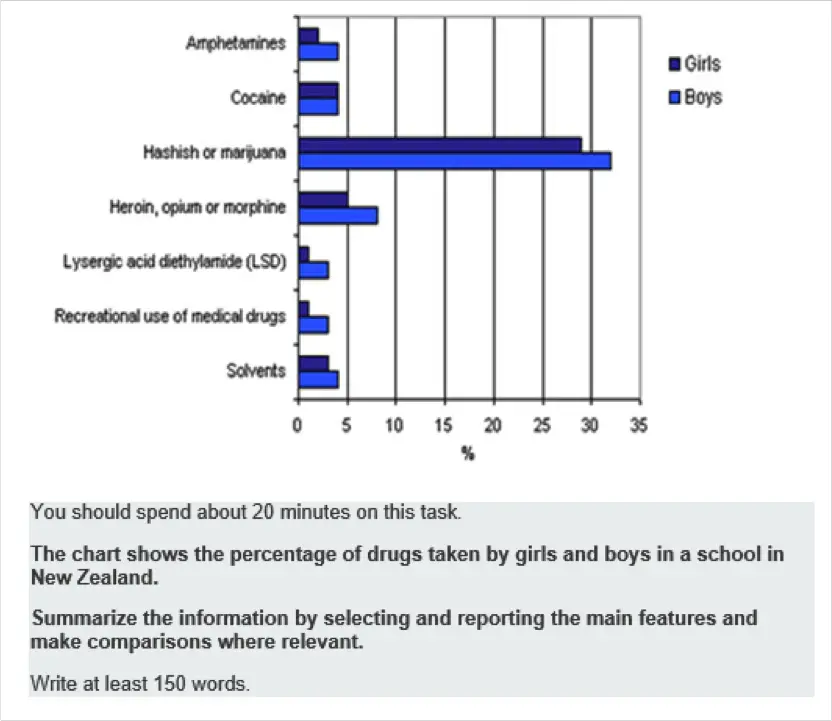
The bar chart illustrates the comparative statistics of seven addictive medicines used by male and female students in New Zealand. The units of measurement are in percentage.
Overall, marijuana or hashish claimed the top spot from both genders whereas lysergic acid diethylamide (LSD) and recreational use of medical drugs shared the lowest percentage of both male and female students.
On the one hand, marijuana or hashish received the highest percentage of both the female students (with nearly 30%) and from the male students (with almost 32%). Lesser used drugs are heroin, opium and morphine with 5% of the girls and closely 9% of the boys.
On the other hand, almost 5 % of the males and 4.5% of the females used solvents whereas both genders preferred to use cocaine which was equally tied at 4%. Amphetamines were also included on the list, with 3% from the girls and almost 5% from the boys.
Finally, lysergic acid diethylamide and the use of recreational drugs tied at the lowest spot with only 2% from the female students and around 3.5% from the male students.
Word count - 182 / Band score 8
Task Achievement - The answer provides a paraphrased question, to begin with, followed by an overview that gives the reader key information.
Coherence and Cohesion - The answer has been divided into clear logical paragraphs.
Lexical Resource - There is evidence of paraphrasing, synonyms and some less common words.
Grammatical Range and Accuracy - The answer has no grammatical errors. The sentences are mainly made up of multiple clauses and have a variety of structures.
We hope you found this post helpful in helping you to study for the IELTS Test. Let us know in the comments or on the Facebook page if you have any questions. The best way to keep up to date with posts like this is to like us on Facebook, and then follow us onInstagramand Pinterest. We offer essay correction services, mock exams, and online courses. If you need help preparing for the IELTS Test, join the IELTS Achieve Academy and see how we can help you achieve your desired band score faster.
Step-by-step guide to answering this type of IELTS Writing Task 1 question. Covers structure, key language, and band-scoring criteria.
Originally published May 2018. Last reviewed 3 July 2026.
In this post, we will look at a Writing Task 1 Academic bar chart essay example from the IELTS writing task 1 Academic Test. Students often ask if the questions are repeated year after year and the answer is no, but the type of chart or graph can be.
There are so many questions written each year, you may find you practice answering various questions on different topics. It is best practice to learn how to answer each one of the various types of writing task 1 questions, from bar charts, line graphs, maps, process etc.
If you would like to learn how to structure a charts and graphs essay please click the button below >
Take a look at the IELTS Writing Task 1 Academic essay example below >>
*This chart question and answer were provided by a student. IELTS Achieve did not design this bar chart question*
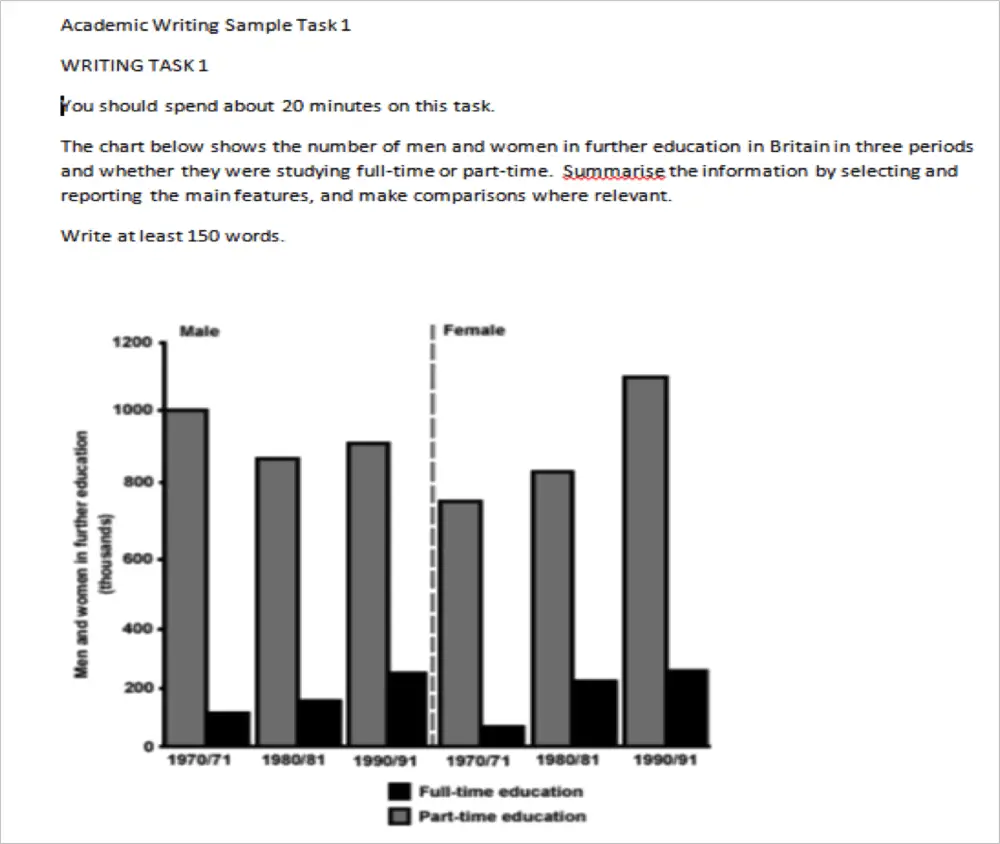
The bar chart illustrates comparative statistics on the number of males and females who underwent further education, studying in full time and in part-time education in Britain in the years; 1970-1971, 1980-1981 and 1990-1991. The number of students was measured in thousands.
Overall, part-time education had the highest number of enrollees in all three periods from both men and women while in full-time education, the highest number of students can be seen in the time period of 1990-1991 where both sexes had an equal amount of enrollees.
On the one hand, the graph shows that part-time education was consistently high, never below the 800 thousand mark in males and 600 thousand marks in females, even though the trend differs from both genders. According to the data, males had the highest part-time enrollees in 1970-1971 (1000 thousand) then the trend fluctuated and rose again over the next three year period 1980-81 (900 thousand) and 1990-91 (950 thousand), while in the female part-time enrollees they had an upward trend as the years went by with 750 thousand in 1970-71, 800 thousand students in 1980-81 and the highest peak of almost 1150 thousand students by the period of 1990-91.
On the other hand, the bar chart reveals that both genders in full-time education experienced an increasing number of students within the three time periods. Male students started at below 200 thousand in 1970-71 and rose steadily until they reached 200 thousand in 1990-91, the same can be said in the number of females enrolled, they started from 50 thousand in 1970-1971 and gradually rose as the years passed by until reaching 200 thousand female students in 1990-1991.
Word count - 274 / Band score - 8
Task Achievement - The answer provides a paraphrased question, to begin with, followed by an overview that gives the reader key information.
Coherence and Cohesion - The answer has been divided into clear logical paragraphs.
Lexical Resource - There is evidence of paraphrasing, synonyms and some less common words.
Grammatical Range and Accuracy - The answer has no grammatical errors. The sentences are mainly made up of multiple clauses and have a variety of structures.
We hope you found this post helpful in helping you to study for the IELTS Test. Let us know in the comments or on the Facebook page if you have any questions. The best way to keep up to date with posts like this is to like us on Facebook, and then follow us onInstagramand Pinterest. We offer essay correction services, mock exams, and online courses. If you need help preparing for the IELTS Test, join the IELTS Achieve Academy and see how we can help you achieve your desired band score faster.
Step-by-step guide to answering this type of IELTS Writing Task 1 question. Covers structure, key language, and band-scoring criteria.
Originally published May 2018. Last reviewed 3 July 2026.
In this post, we will look at a Writing Task 1 Academic bar chart essay example from the IELTS writing task 1 Academic Test. Students often ask if the questions are repeated year after year and the answer is no, but the type of chart or graph can be.
There are so many questions written each year, you may find you practice answering various questions on different topics. It is best practice to learn how to answer each one of the various types of writing task 1 questions, from bar charts, line graphs, maps, process etc.
If you would like to learn how to structure a charts and graphs essay please click the button below >
Take a look at the IELTS Writing Task 1 Academic essay example below >>
*This chart question and answer were provided by a student. IELTS Achieve did not design this bar chart question*
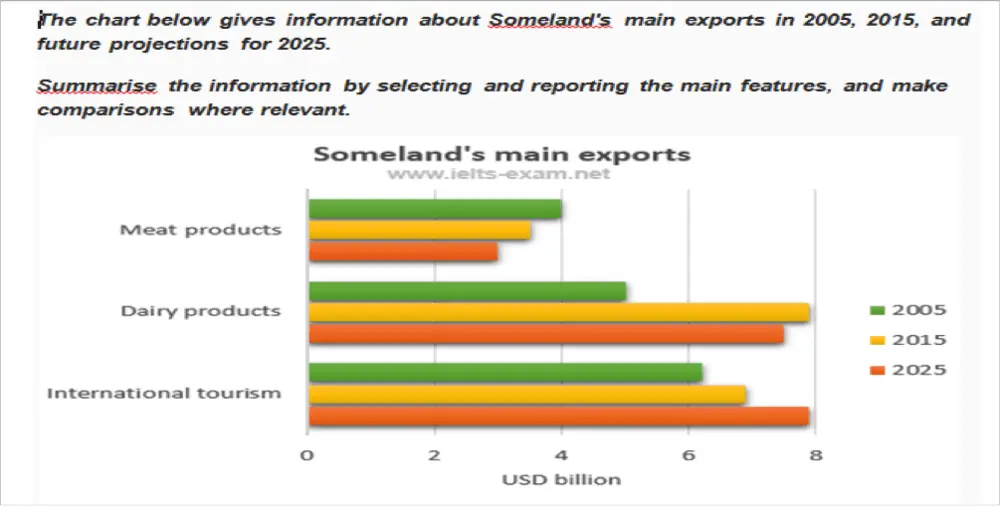
The bar chart describes comparative statistics on the number of products exported by Someland in 2005 and 2015 and its projected exports for 2025. The units were measured in USD billion.
Overall, the most profitable export Someland had from 2005 and 2015 was from international tourism, while the lowest can be seen in meat produce. It can also be seen in the data that by 2025 they are still expecting that international travels will dominate the Someland export industry whereas meat produce will still bring in the least amount of revenue.
On the one hand, the graph shows that International tourism was consistently high, with nearly 6.5 billion USD earned in 2005 and almost 7 billion USD in 2015. Similarly, this can be said in dairy products where roughly 5 million USD and approximately 8 million USD was grossed in 2005 and 2015 respectively. Meat products started at 4 million USD dollars in 2005 but decreased after 10 years (3.5 million USD, 2015).
On the other hand, a projected study was also included in the data, where they are expecting an increase by 2025 in International tourism which could receive 8 million USD, while decreases in both dairy products (7.5 billion USD) and meat products (3 billion USD) are also expected.
Word count - 211 / Band Score 8
Task Achievement - The answer provides a paraphrased question, to begin with, followed by an overview that gives the reader key information.
Coherence and Cohesion - The answer has been divided into clear logical paragraphs.
Lexical Resource - There is evidence of paraphrasing, synonyms and some less common words.
Grammatical Range and Accuracy - The answer has no grammatical errors. The sentences are mainly made up of multiple clauses and have a variety of structures.
We hope you found this post helpful in helping you to study for the IELTS Test. Let us know in the comments or on the Facebook page if you have any questions. The best way to keep up to date with posts like this is to like us on Facebook, and then follow us onInstagramand Pinterest. We offer essay correction services, mock exams, and online courses. If you need help preparing for the IELTS Test, join the IELTS Achieve Academy and see how we can help you achieve your desired band score faster.
Step-by-step guide to answering this type of IELTS Writing Task 1 question. Covers structure, key language, and band-scoring criteria.
Originally published October 2017. Last reviewed 3 July 2026.
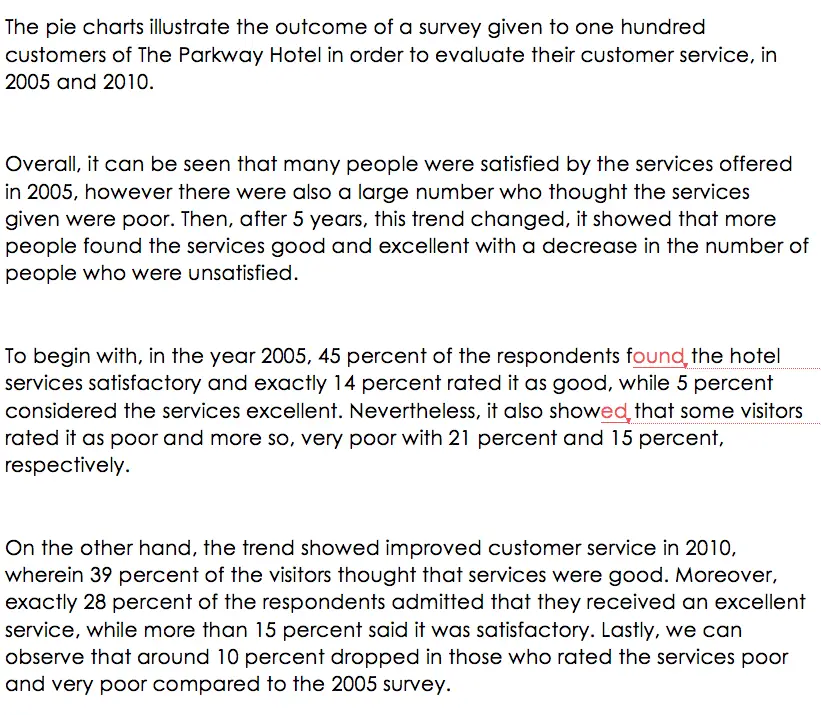
In this post, you will be able to view an essay example from a past student, with the corrections and feedback highlighted in red.
Most of the students studying for the IELTS Test have said they find the IELTS Writing Tasks difficult. I have corrected hundreds of task 1 and 2 essays on various topics, giving estimated band scores and detailed feedback. There are also suggestions on how to improve for a higher band score. Take a look at this student essay example and see how it compares to your own writing.
Writing Task 1 Question
Here is the task 1 essay with corrections, suggestions, feedback and an estimated band score >>
Do you want to get your essays corrected by a highly experienced IELTS teacher? Then take a look at our writing correction service.
We hope you found this post useful in helping you to study for the IELTS Test. If you have any questions please let us know in the comments below or on the Facebook page.
The best way to keep up to date with posts like this is to like us on Facebook, then follow us on Instagram and Pinterest.
What Band 9 Means for Task 1 Academic
A Band 9 response in IELTS Writing Task 1 Academic demonstrates a high level of competence across all four assessment criteria: Task Achievement, Coherence and Cohesion, Lexical Resource, and Grammatical Range and Accuracy.
Task Achievement at Band 9
The response fully satisfies all requirements, presents a clear overview, and accurately selects and reports key features with well-chosen supporting detail.
Coherence and Cohesion at Band 9
Information and ideas are logically organised with clear progression throughout. Paragraphing is managed skillfully, and cohesive devices are used appropriately.
How to Achieve Band 9
Analyse the visual data carefully: Spend 2-3 minutes identifying the main trends, key features, and notable comparisons before writing.
Write a clear overview: Summarise the most significant patterns in 2-3 sentences without including specific data.
Select and group information: Present data in logical paragraphs organised by trend, category, or time period.
Use accurate data: Reference specific numbers, percentages, and dates from the visual to support your descriptions.
Vary your language: Use a range of vocabulary for describing trends (increased, rose sharply, remained stable, declined gradually).
Originally published on IELTS Achieve. Last reviewed 3 July 2026.
Step-by-step guide to answering this type of IELTS Writing Task 1 question. Covers structure, key language, and band-scoring criteria.
Originally published June 2017. Last reviewed 3 July 2026.
In this post, I want to share with you the 8 tips that you should remember in order to have IELTS Academic writing task 1 success!
There is a lot of information out there for you to read and remember, but during lessons with my students I always repeat the same things and those that choose to listen and study hard achieve the band score they need (7+!)
So here are the 8 tips for writing task 1 success!
1. Understand the question
Make sure that you read the question properly a few times, so that you fully understand what it is asking you to do. I often read essays where the student has misunderstood the question. This is not good for your score if you do this during your test. So always read the question and make sure that you understand what it is asking you to do.
The questions in writing task 1 normally say 'report the main features and make any comparisons'. Look for those main features and if you can make any comparisons. You can highlight information on the paper/question before you start to write your essay. Practice as much as possible beforehand, using various academic writing task 1 questions and an approved essay structure.
2. Practice the essay structure
The structure that I advise my students to use, changes slightly depending on which question they have for writing task 1.
However, it has a core structure, that if used well, will be sure to get you a band score 7+. You need to practice using this structure, with as many questions as you can, before sitting your IELTS test. This writing task 1 structure has been proven to be successful for my students and when perfected, can easily help you to achieve a high band score.
3. Create an effective overview
The overview is the most important paragraph in the writing task 1 essay and without one, you will lose marks. this will affect your score and your ability to gain a band score 7 or higher. Practice writing an overview of different types of questions.
4. Use the right language
In the writing task 1 section of this website, you will find language help in most of the posts. It is important to use the right language when writing your essays. This can affect your band score, so it is worth studying and practising as much as possible.
For example, you should be able to paraphrase the question using synonyms, use signposting language (Overall, the line graph shows that..) and linking words(however, in contrast, one the one hand, on the other hand, therefore, in addition, etc). You should also be able to describe change and for the maps questions describe locations this will gain you marks in the lexical resource part of the marking criteria.
5. Know the Grammar
Think about the grammar you are using, if the question features change over a period of time, then make sure you use the correct tense when writing about those changes. For example, if a figure is projected to increase over a period of ten years up until the year 2022, you use the future tense >> 'The price of oil will continue to increase up to £50billion dollars by the year 2022'. Practice with these types of question, so that you can use the past, present and future tenses.
When practising you can use 'Grammarly' which checks your work as you type, this will help you with spelling, punctuation and grammar errors.
6. Know the content
You need to able to report neutrally on the visual information presented to you. You should not include any opinion on the data, only report the data and trends that you can see.
It is a good idea to spend a minute or two looking at your chart/graph and circling/highlighting any information that is important.
For example, think about the following questions:
What is being measured and how?
Is it in percentages? Millions? Degrees? (for the temperature)
Then think about the timing - is it over the period of one year? Five? or Ten?
Can you make any comparisons?
7. Be selective
The question will ask you to 'report the main features and make any comparisons' so look for those main features - any highs/lows etc. Don't write about every piece of information that you can see. This will lose your essay marks and affect your band score.
You need to practice highlighting the main features/any comparisons that you can see and plan your essay around those. Then practice writing in 20 minutes, you do not want to spend too much time on writing task 1, as writing task 2 has more weight in the marks.
8. Can you read it?
When practising writing your essays, check if you can read you own handwriting afterwards. If you find it difficult to read, then so will everyone else! Make it neat and easy to read, this is important so that the examiner can read your writing clearly. The advice from The British Council does say that candidates are allowed to write entirely in capital letters if they wish. This may make your writing easier to read.
It is also important that you separate the paragraphs, and don't just have one big block of text. This will lose you marks in the test, therefore you can skip a line on the paper, to show that a new paragraph has been started. In the marking criteria, you do get marks for 'logically organises information and ideas' (Band score 7) so it is important to show that you have organised your information into logical paragraphs. Take a look at the essay structure to see how to organise those paragraphs well.