Step-by-step guide to answering this type of IELTS Writing Task 1 question. Covers structure, key language, and band-scoring criteria.
Originally published May 2017. Last reviewed 3 July 2026.
This post will help you to write a successful process essay, there is a model answer for you to compare your work to at the end of the post.
Remember that your essay should have a minimum of 150 words and ideally should be completed in 20 minutes.
Process Essay Structure
The writing task 1 essay should be as follows:
Sample Question: Process
Read the question below carefully, what can you see in the information given?
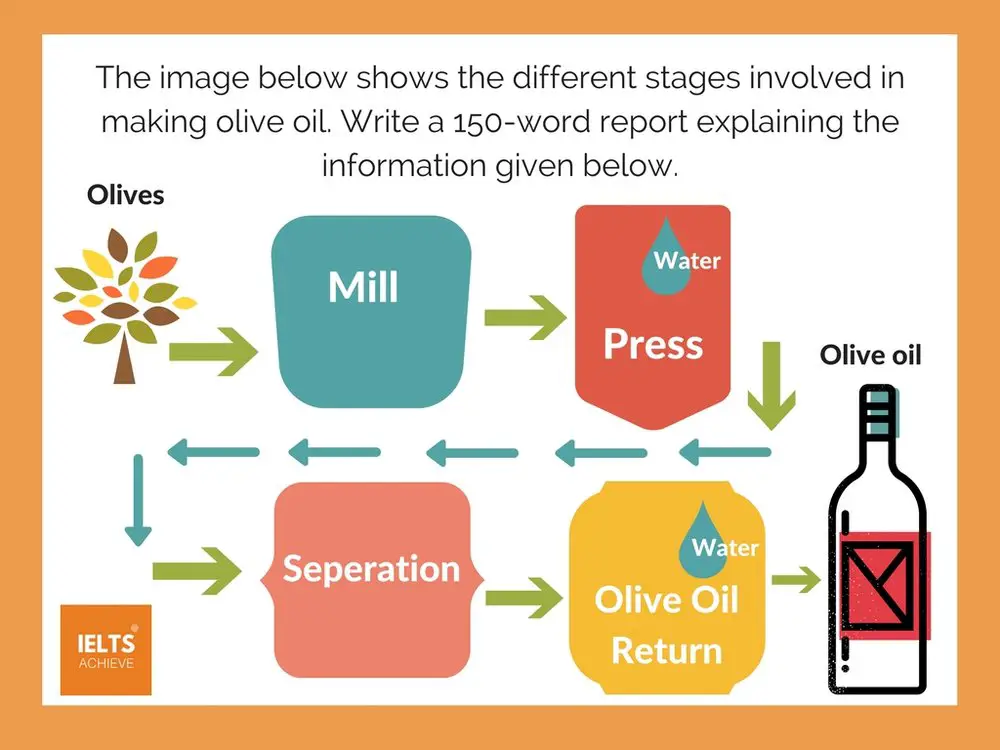
The image below shows the different stages involved in making olive oil. Write a 150-word report explaining the information given below.
STEP 1 – WRITE THE INTRODUCTION
Write your own introduction of one or two sentences, paraphrasing the question, using synonyms where you can.
STEP 2 – WRITE AN OVERVIEW
Write the overview – start this paragraph with the word ‘Overall...’ and write one or two sentences which describe the stages of the process. You can say how many stages are included in the process, how it begins and how it ends.
STEP 3 – WRITE THE MAIN BODY PARAGRAPHS
Write two main body paragraphs, going into detail and giving specific information about the process. Remember to use time connectors (after, next, following this, subsequently, finally, etc) to lead the examiner through each stage of the process.
STEP 4 – CHECK YOUR WORK
When you have completed the essay, check it for any errors, spelling or grammar. Then check to see if you have included linking words that connect the information together, making it easy to read. For example, using the word ‘Overall..’ at the beginning of the overview paragraph. You can also use words like – on the one hand, on the other hand, furthermore, however, in addition, finally etc.
MODEL ANSWER for Process
To view more model answer for a similar question please click the link below:
The diagram presents how olive is produced with the use of different equipment.
Overall, olive oil production involves four main stages and needs different equipment to achieve its desired appearance and flavour. The process starts with the breakdown of the olives after collection in a mill and culminates with storing the product in bottles until it is ready for consumption.
The process of making olive oil starts when olives are ground in a mill to create a paste. After the paste has been spread onto mats, this is transferred into a press where water is added. Following this procedure, the mashed olive paste is placed into a separation container where the oil goes through a natural separation process from vegetable waters.
After separation, the mixture goes into the olive oil return, where more water is added and wastewater is subsequently drained. Once this process has ended, the olive oil is ready to be bottled, where it is stored for a period of time known as the clarification stage. Finally, once this time has passed the oil is ready to be used.
Step-by-step guide to answering this type of IELTS Writing Task 1 question. Covers structure, key language, and band-scoring criteria.
Originally published May 2017. Last reviewed 3 July 2026.
A question on the IELTS academic writing test that is becoming more common, asks the candidate to write about and describe a process.
You may have a natural or a man made process question. In this post we will look at how to write this type of essay, with structure help, vocabulary and sample answers.
Writing Task 1 – Process Essay Structure >>
Paragraph 1 – Paraphrase the question
When writing your own introduction of one or two sentences paraphrase the question and add detail.
Paragraph 2 – Overview of the main features
You need to be able to give a broad summary of the information. This is best started with – Overall.…… then giving details of the main features you can see. You can write this in one or two sentences, which describe the main features of the information that is presented in the process. Think about the number of stages that are in time order, what is happening at the beginning? What is happening at the end? How many stages are there?
Paragraph 3 – Specific details
Write about the process from the beginning, explaining what is happening throughout each stage.
Paragraph 4 – Specific details
Write about the process through to the end, including time connectors that lead the reader through each step of the process clearly.
TIP >> When describing a process you should write using the passive voice, focussing on the activities not the person who is doing them.
Time Connectors >>
The words below can help you to connect the stages of the process you are writing about.
Writing Task 1 Process Sample Essays >>
Here are two sample essay questions and answers for you to look at. Review the language used, the essay structure, the stages and how it has been written.
Sample Process Essay 1
The diagram presents how olive is produced with the use of different equipment.
Overall, olive oil production involves four main stages and needs different equipment to achieve its desired appearance and flavour. The process starts with the breakdown of the olives after collection in a mill and culminates with storing the product in bottles until it is ready for consumption.
The process of making olive oil starts when olives are ground in a mill to create a paste. After the paste has been spread onto mats, this is transferred into a press where water is added. Following this procedure, the mashed olive paste is placed into a separation container where the oil goes through a natural separation process from vegetable waters.
After separation, the mixture goes into the olive oil return, where more water is added and wastewater is subsequently drained. Once this process has ended, the olive oil is ready to be bottled, where it is stored for a period of time known as the clarification stage. Finally, once this time has passed the oil is ready to be used.
(Word Count = 181 / Band Score 9)
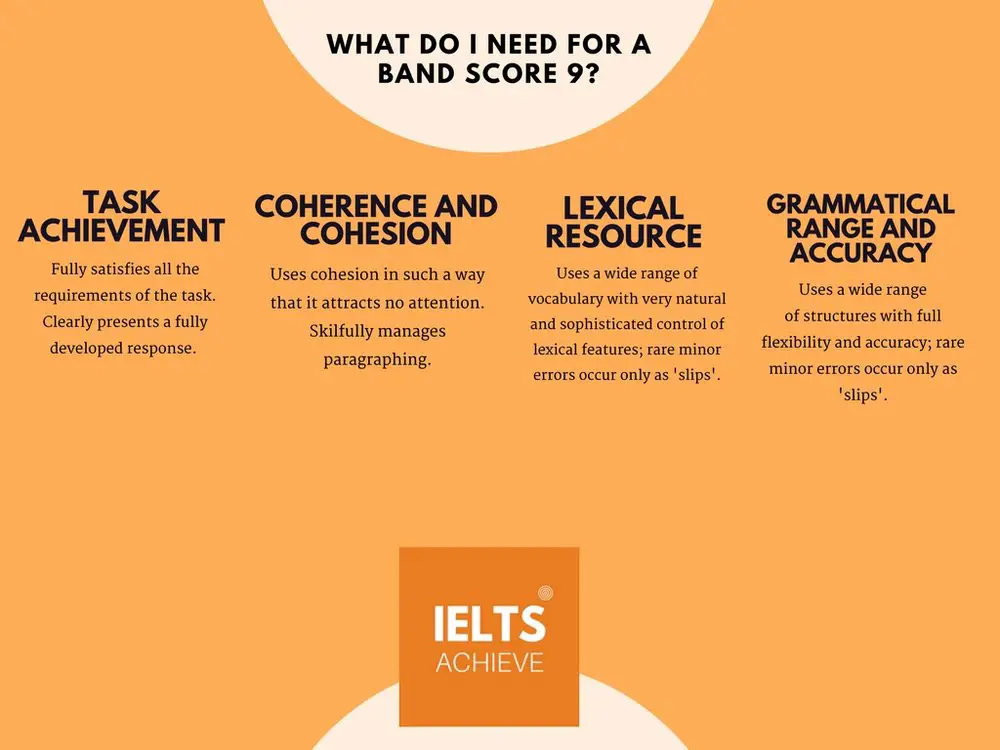
Task Achievement – The answer provides relevant information, describing the process of how olive oil is made. The overview gives clear information, leading into the main body paragraphs.
Coherence and Cohesion – The answer has been divided into clear logical paragraphs, with clear cohesion between them with the addition of time connectors (after, following this, finally).
Lexical Resource – There is evidence of paraphrasing, synonyms and some less common words.
Grammatical Range and Accuracy – The answer has no grammatical errors. The sentences are mainly made up of multiple clauses and have a variety of structures. There are no spelling mistakes and punctuation is correct.
TIP >> Write a good overview, with how many stages the process has, starting with and ending with.
TIP >> Describe the process and lead the reader through it by using time connectors.
Sample Process Essay 2
The picture illustrates the process of making paper from the trees that have been collected.
Overall, it can be observed that there are eight stages in this process, beginning with the collection of trees from the forest and ending with the paper being made in the paper making machine.
To begin with, timber is collected from the forest and taken to be debarked. After the wood has been stripped bare, it enters the chipping machine, where it is chopped up into tiny pieces. From the chipping machine, the wood enters into three separate stages. First, the wood chips are put through the mechanical pulping process, where they are ground and smashed into pulp. Then they have a chemical pulping, going next into the hydra-pulper.
In the subsequent stage, the mixture goes through to be screened and cleaned, to filter any lumps or waste from the pulp. Lastly, the pulp is entered into the paper making machine, where it is pressed to make sheets of paper. The paper is then stored and stacked, ready for shipping and to be used.
(Word Count = 179 / Band Score 9)
Task Achievement – The answer provides relevant information, describing the process of how paper is made. The overview gives clear information, leading into the main body paragraphs.
Coherence and Cohesion – The answer has been divided into clear logical paragraphs, with clear cohesion between them with the addition of time connectors (first, then, subsequently).
Lexical Resource – There is evidence of paraphrasing, synonyms and some less common words.
Grammatical Range and Accuracy – The answer has no grammatical errors. The sentences are mainly made up of multiple clauses and have a variety of structures. There are no spelling mistakes and punctuation is correct.
TIP >> Write a good overview, with how many stages the process has, starting with and ending with.
TIP >> Describe the process and lead the reader through it by using time connectors.
Writing Task 1 Band Score 9 Criteria >>
We hope you found this post helpful in helping you to study for the IELTS Test. Let us know in the comments or on the Facebook page if you have any questions. The best way to keep up to date with posts like this is to like us on Facebook, and then follow us onInstagramand Pinterest. We offer essay correction services, mock exams, and online courses. If you need help preparing for the IELTS Test, join the IELTS Achieve Academy and see how we can help you achieve your desired band score faster.
Step-by-step guide to answering this type of IELTS Writing Task 1 question. Covers structure, key language, and band-scoring criteria.
Originally published May 2017. Last reviewed 3 July 2026.
A question on the IELTS academic writing test that is becoming more common, asks the candidate to write about more than one chart or diagram.
You may have a pie chart and a table, a bar chart and a line graph, or any combination of charts. In this post we will look at how to write this type of essay, with structure help, vocabulary and sample answers.
When writing your own introduction of one or two sentences paraphrase the question and add detail.
Paragraph 2 – Overview of the main features
You need to be able to give a broad summary of the information. This is best started with – Overall……. then giving details of the main features you can see. You can write this in one or two sentences, which describe the main features of the information that is presented in the charts. Think about the main features that you can see in chart number 1, and then write about the main features you can see in chart number 2. You should then make any comparisons if relevant.
Paragraph 3 – Specific details of the main features in chart number 1
Write about the specific details that you can see – looking closely at the main features of chart number 1 and include detail, then make any comparisons if relevant.
Paragraph 4 – Specific details of the main features in chart number 2
Write about the specific details that you can see – looking closely at the main features of chart number 2 and include detail, then make any comparisons if relevant.
Writing Task 1 Multiple Charts Sample Essays >>
Here are two sample essay questions and answers for you to look at. Review the language used, the essay structure, the information gathered and how it has been written.
Sample Multiple Chart Essay 1
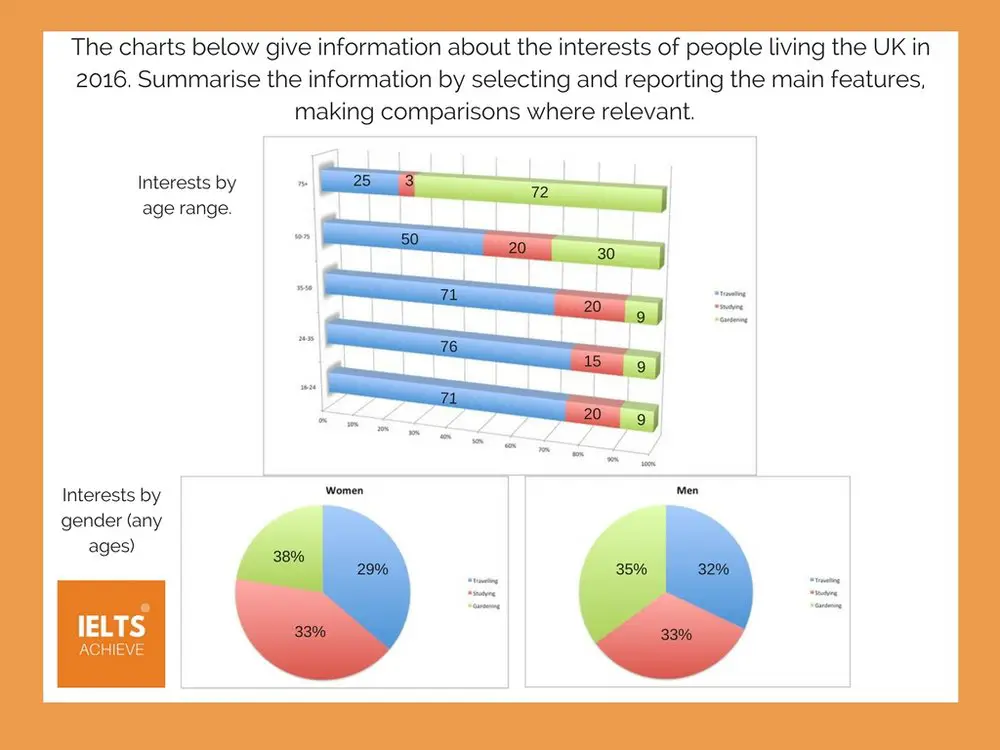
The charts both show relevant data about the interests, of people living in the UK in 2016. Moreover, the two charts represent males and females of all ages and their interests by gender, while the bar chart displays the exact level of interests according to the current age range from 16 to 75+ years.
Overall, there is a common pattern in regards to the percentage of activities between both genders and it is evidenced that there are both women and men who enjoy studying and gardening. The bar chart shows that there are high numbers of young people aged 24-50 who are interested in travelling.
On the one hand, there is a massive difference between the population who are 50-75 years old and the 75+ years regarding their interest in gardening (72%). However, the age groups with the most desire to travel in 2016 are those aged between 24-35 (76%). Furthermore, there are similar numbers of people who are interested in travelling between the age ranges of 16-24 to 35-50 (71%), which is currently expressed in the proportional bar chart.
On the other hand, there is evidence of a smaller percentage of women (29%) who want to travel compared to men (32%). People of both genders who enjoy gardening, with a contrast of 38% for women and 35% for men. Finally, both males and females are equal in their passion for studying. (33%).
(Word Count = 233 / Band Score 9)
Task Achievement – The answer provides relevant information, summarising the interests by age range and then interests by gender. The main features are given and comparisons made, with the relevant information given.
Coherence and Cohesion – The answer has been divided into clear logical paragraphs, with clear cohesion between them with the addition of linking words (overall, on the one hand, on the other hand, finally, however, furthermore).
Lexical Resource – There is evidence of paraphrasing, synonyms and some less common words.
Grammatical Range and Accuracy – The answer has no grammatical errors. The sentences are mainly made up of multiple clauses and have a variety of structures. There are no spelling mistakes.
TIP >> Remember to compare the information given, but focus on one idea in each main body paragraph.
TIP >> Remember to include numbers / stats / data in the main body paragraphs. This may seem obvious but many students do not include this.
Sample Multiple Chart Essay 2
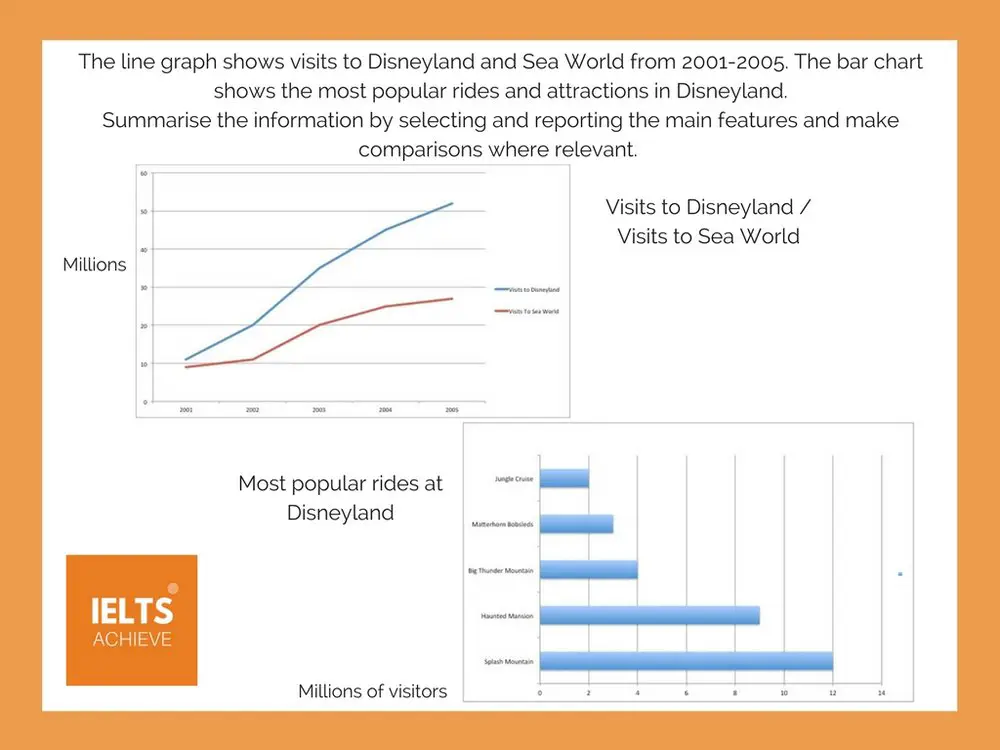
The line graph reflects the number of people who travelled to Disneyland and Sea World between 2001 and 2005, while the bar chart illustrates the most popular rides people visited at Disneyland. Units are measured in millions of people.
Overall, the line graph shows that there was an increase in the number of visits to Disneyland compared to Sea World in the period given. However, the bar chart shows that Splash Mountain was the most popular ride taken.
Initially, we can observe that in the year 2001 there are a small number of people who travelled to Sea World (9 million). This increased slowly during the following years to nearly 30 million people in 2005. The number of people who visited Disneyland was slightly higher (12 million). In 2003, around 20 million entered Disneyland, this progressed continuously, reaching to over 50 million people in 2005.
Furthermore, the second graph clearly shows that over 12 million people visited Splash Mountain. The second most popular ride visited was the Haunted Mansion (8.5 million). Big Thunder Mountain and Matterhorn Bobsleds had around 4 million and 3 million people visiting respectively. The least amount of travellers visited the Jungle Cruise (2 million).
(Word Count = 198 / Band Score 9)
Task Achievement – The answer provides relevant information, giving a clear overview and then describing the specific features in the main body paragraphs. The information is relevant to the question.
Coherence and Cohesion – The answer has been divided into clear logical paragraphs, with clear cohesion between them with the addition of linking words (overall, initially, furthermore).
Lexical Resource – There is evidence of paraphrasing, synonyms and some less common words.
Grammatical Range and Accuracy – The answer has no grammatical errors. The sentences are mainly made up of multiple clauses and have a variety of structures. There are no spelling mistakes and punctuation is correct.
TIP >> Remember to compare the information given, but focus on one idea in each main body paragraph.
TIP >> Remember to include numbers / stats / data in the main body paragraphs. This may seem obvious but many students do not include this.
Writing Task 1 Band Score 9 Criteria >>
We hope you found this post useful in helping you to study for the IELTS Test. If you have any questions please let us know in the comments below or on the Facebook page.
The best way to keep up to date with posts like this is to like us on Facebook, then follow us on Instagram and Pinterest.
If you need help preparing for the IELTS Test, join the IELTS Achieve Academy and see how we can assist you to achieve your desired band score. We offer an essay correction service, mock exams and online courses.
Step-by-step guide to answering this type of IELTS Writing Task 1 question. Covers structure, key language, and band-scoring criteria for Academic and General Training candidates.
Originally published May 2017. Last reviewed 3 July 2026.
The IELTS Academic Writing Test has two separate writing tasks in 60 minutes. For each part, you will receive a question paper and an answer sheet. You can make notes on the question paper, only the text on the answer sheet will be marked by the examiner. You can write your answers in pen or pencil and correct when necessary. You cannot use a dictionary or any electronic devices.
IELTS Academic and General Training students do different tests for part 1 but complete the same test for part 2. There are many resources to help you prepare for part 2 here.
You must answer both tasks and it is recommended that you spend 20 minutes on task 1 and 40 minutes on task 2. Part 2 is twice as important as your score for part 1. Writing task 1 has a minimum word count of 150 words and you must write an essay. Writing task 2 has a minimum word count of 250, you must write a discursive essay, you will be given an opinion, problem or issue that you need to discuss.
Requirements from universities and immigration agencies vary. Most students will need at least a band score 6 for undergraduate study. For postgraduate study or immigration, a band score 7 is generally required.
In Academic Writing Task 1, you will be asked to write a short essay (150 words minimum) on a given chart, graph, process diagram or map. Each one has a slightly different essay structure, you can learn about those structures in the other posts in the writing task 1 section.
Writing Task 1 Marking Criteria
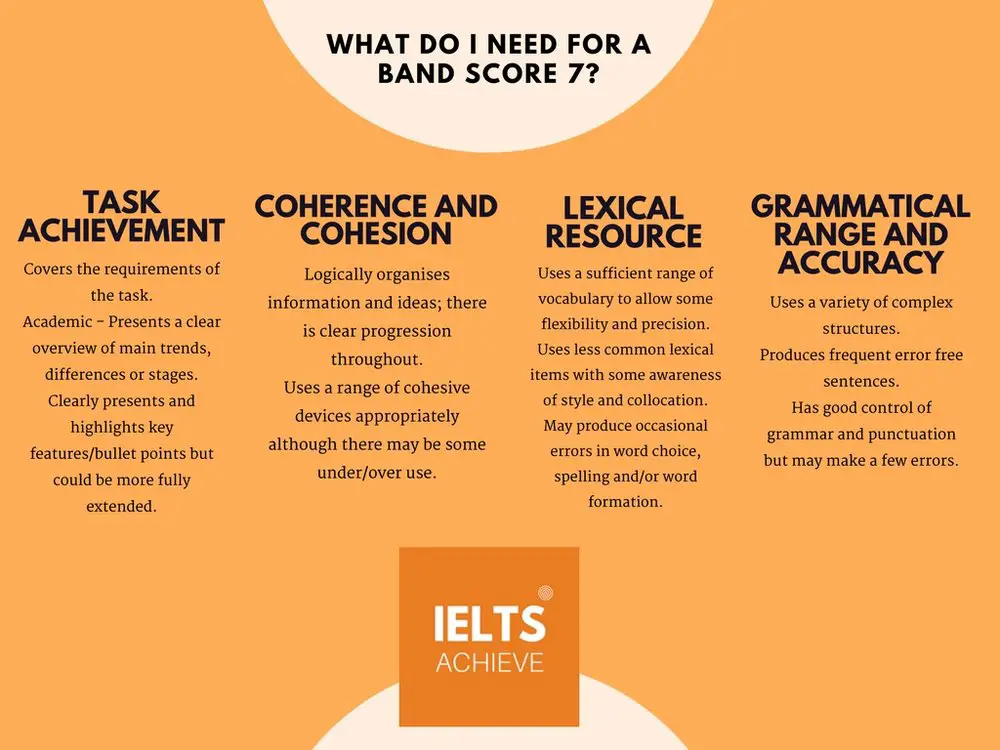
One of the first things you should do is read the marking criteria to see what the examiners expect. This is really important, as you need to know what they are looking for in the band 7+ boxes.
You should be able to give the examiners exactly what they want, in order to get a 7+ band score.
In the IELTS writing task 1 essay, you will be assessed on the four main areas >>
Task Achievement
Coherence and Cohesion
Lexical Resource
Grammatical Range and Accuracy
Let me break it down for you…….
Task Achievement
In this section, you must be able to ‘present a clear overview of the main trends, differences or stages’ this means that you are able to select the relevant information in the graph/chart. This should be very clear in your answer.
Coherence and Cohesion
In this section, you must produce an answer that can be easily understood by the reader (the examiner!). The criteria states that you should be able to ‘logically organises information and ideas; there is clear progression throughout’ this means that you have organised your information in easy to read paragraphs and the paragraphs have a good structure. The criterion also states that you should ‘uses a range of cohesive devices appropriately although there may be some under/overuse’. This refers to the use of linking words – such as; firstly, secondly, overall, one the one hand, on the other hand, furthermore, therefore, etc.
Lexical Resource
In this section the examiner will be looking at your vocabulary, making sure the words you have used are correct for this type of task. In the criteria, it states ‘uses a sufficient range of vocabulary to allow some flexibility and precision’. It is therefore important for you to study terms and keywords that can help you to gain a 7+ score in this task.
Grammatical Range and Accuracy
You have to write clear error-free sentences in this essay, as many grammatical or spelling errors will make the writing unclear and hard to follow. You also need to show that you have used the appropriate sentence structures, necessary for a formal academic essay. In the marking criteria, it states ‘uses a variety of complex structures, produces frequent error-free sentences, has good control of grammar and punctuation but may make a few errors’.
Writing Task 1 Structure
The structure that I advise my students to use, changes slightly depending on which question they have for writing task 1. However, it has a core structure, that if used well, will be sure to get you a band score 7+. You need to practice using this structure, with as many questions as you can, before sitting your IELTS test. This writing task 1 structure has been proven to be successful for my students and when perfected, can easily help you to achieve a high band score.
It is a 4-paragraph structure >>
Paragraph 1
This is the introduction to the essay and where you should start off by paraphrasing the question.
Do you understand what I mean, when I say ‘paraphrase’ the question?
This means that you rewrite the question in your own words using synonyms. You can’t just copy the question again or use the same words in the question. Paraphrase and show off your vocabulary knowledge by using synonyms. When practising your essay writing, use an online thesaurus to help you. This is a great tool and can help you to learn many new words.
Paragraph 2
This is the overview paragraph.
What is an overview? I hear you say.
An overview is where you clearly write about the general information you can see in the graph/chart. You give the examiner a clear overview of the main features and you can make comparisons if you can see any. You don’t have to mention any numbers/data/stats here; this information should be in the next two paragraphs.
Things you should look for >>
Focus on what the main features are
Look at the highest and lowest numbers
See if there has been a substantial growth or decline in a particular category
If there are a few categories, check if there is an obvious way to group them together into just two or three groups.
Look for one or two categories, which break the pattern set by all of the others.
Sometimes there are several different main features, which you can identify. You can circle the key information on the question paper before you start to write about your main features.
Paragraph 3
In the third paragraph, you write about the important details of the first main feature.
This is where you can give supporting details and write about the numbers, percentages or monetary values. You enter all of the stats/data needed to support your main feature.
You can also write about any comparisons that you can see.
Paragraph 4
In the fourth paragraph, you write about the important details of the second main feature.
This is where you continue to give supporting details and write about the numbers, percentages or monetary values. You enter all of the stats/data needed to support your second main feature.
You can also write about any comparisons that you can see.
You can’t get more points if you write more than 150 words, so should avoid writing too much. You should also be careful that you only spend around 20 minutes on this task, as writing task 2 is harder and more important in regards to the score.
There are practice tests you can download from the British Council.
We hope you found this post useful in helping you to study for the IELTS Test. If you have any questions please let us know in the comments below or on the Facebook page.
The best way to keep up to date with posts like this is to like us on Facebook, then follow us on Instagram and Pinterest.
If you need help preparing for the IELTS Test, join the IELTS Achieve Academy and see how we can assist you to achieve your desired band score. We offer an essay correction service, mock exams and online courses.