Essential strategies and practice techniques for this IELTS Reading question type. Learn how to manage time and improve accuracy.
Originally published June 2017. Last reviewed 3 July 2026.
In this post, we will be looking at matching features.
In the IELTS Reading Test, you could be given questions that ask you to match features, often with texts that include theories or comments about people, places, years and things. To comprehend how to complete these questions, you need to be able to skim read.
The questions will not be ordered in the same way as the given text, the various options will be presented in a box and you will match them to the questions. There will be paraphrased information and more questions are given than needed to complete the task.
EXERCISE 1
The paragraphs for this practice exercise is from a text called "Giving blood in a time of crisis" from The World Health Organisation (WHO) website.
Read the questions, skim read the following text, and look for the important details;
Prakash Ghimire was just leaving his home in Kathmandu to travel to the airport when the shaking started.
Within a minute, a massive 7.8 magnitude earthquake – the worst to strike the region in more than 80 years – had laid waste to large parts of the city, wreaking destruction that would leave about 9000 people dead and another 22 000 injured.
Half an hour later, Dr Ghimire, a national professional officer at WHO’s country office in Nepal, was at the Health Ministry to join the team assembled at the health emergency operation centre. He was put in charge of coordinating the blood transfusion services, including the availability of blood and blood products in earthquake response operations.
“Immediately after the earthquake, we assembled and started taking stock of what had happened,” he says.
An initial assessment revealed extensive damage to the nation’s blood supply infrastructure. Out of about 100 blood transfusion centres, 9 were completely destroyed and 21 were partially damaged. The Central Blood Transfusion Service building in Kathmandu had large cracks in its walls and was deemed structurally unsound.
There were also deaths and injuries at two of the sites carrying out blood collection activities that day. One Nepal Red Cross staff member, one volunteer and seven donors had died, and others remained trapped in a collapsed donation centre, awaiting rescue.
But Nepal had long feared a devastating earthquake and had made some preparations. The country’s first solar-powered emergency blood transfusion service centre had been inaugurated just five days before the earthquake struck. The designers had predicted that power would be a significant problem after a natural disaster; the rooftop solar panels meant that this was not an issue.
Match the features >>
Prakash Ghimire
Dr Ghimire
Nepal
A. A nurse
B. Place of the earthquake
C. a doctor
D. a blood donor
E. Earthquake victim
Answers are at the bottom of the page.
Exercise 2
The paragraphs for this practice exercise is from a text called "Forgetting to wash your hands can cost lives" from The World Health Organisation (WHO) website.
Read the questions, skim read the following text, and look for the important details;
When Bandana Das, a midwife in India, washes her hands it is not simply routine, it is a critical step in reducing infection and saving the lives of mothers and newborns.
"I have seen mothers discharged from the health facility and then come back to the same facility with severe infections and high temperatures,” says Bandana, the president of the Society of Midwives in India. “Many of these mothers do not survive."
Worldwide, 30 000 women and 400 000 babies die every year from infections, such as puerperal sepsis, often caused by lack of water, sanitation and poor hand-washing practices. In an era of antimicrobial resistance, it is crucial that all midwives wash their hands at key moments – before and after touching a patient, before medical procedures, and after being exposed to bodily fluids.
However, up to 70% of health workers do not adhere to recommended hand hygiene practices, according to WHO.
In India and many low- and middle-income countries, practising good hand hygiene is not easy. Bandana, like many midwives in India, often does not have access to water, a toilet, or soap.
"In some places, water has been so dirty it is unusable,” she says. "It is very difficult to practice good hygiene in these circumstances."
According to a WHO and UNICEF report, more than 1 in 3 health facilities in low- and middle-income countries do not have any access to water at all. When the reliability, safety, and distance of the water supply is taken into account, that ratio increases to 1 in 2.
Lack of water is only one challenge. Nearly 1 in 5 of these facilities do not have toilets and more than 1 in 3 does not have soap for hand washing. Clean water, functioning toilets and soap are all essential to protecting the lives of mothers and newborns during the time of birth.
Match the features >>
WHO and UNICEF
Bandana Das
Health workers
A. leads the way in good hygiene practices in India
B. wrote a report about the shortage of midwives in India
C. communicated information about some places having no water
D. often do not clean their hands
E. Performed tests on the water in India
Answers are at the bottom of the page.
REVIEW AND STRATEGY
The matching features questions are common in the IELTS Reading Test, therefore you should practice and develop a strategy for answering.
TIP >> Read the instructions before you start reading the text. Make sure you understand what the question is asking you to do.
TIP >> Read the names/ places first and scan the text to find them. You can underline/highlight them - they may be mentioned more than once.
TIP >> Look for the connection between their name and what they have achieved etc, that relates to the options. Be wary of synonyms and paraphrasing.
TIP >> Choose your answers through an elimination process. Which ones do not fit? Which ones can you dismiss?
Answers >>
Exercise 1 Answers >>
1 - E
2 - C
3 - B
Exercise 2 Answers >>
1 - C
2 - A
3 - D
We hope you found this post useful in helping you to study for the IELTS Test. If you have any questions please let us know in the comments below or on the Facebook page.
The best way to keep up to date with posts like this is to like us on Facebook, then follow us on Instagram and Pinterest.
If you need help preparing for the IELTS Test, join the IELTS Achieve Academy and see how we can assist you to achieve your desired band score. We offer an essay correction service, mock exams and online courses.
Essential strategies and practice techniques for this IELTS Reading question type. Learn how to manage time and improve accuracy.
Originally published June 2017. Last reviewed 3 July 2026.
In this post, we will be looking at matching sentence endings.
In the IELTS Reading Test, you could be given questions that ask you to match sentence endings, often with many combinations that include incorrect sentences. To comprehend how to complete these questions, you need to see how ideas are connected in the texts.
You should read the first half of the sentence and then look through the text to find the information. After that read through the section of the text and choose the relevant sentence ending. There will be more sentence endings given than needed to complete the task.
Before trying the practice questions below, see if you can match the following sentence endings, only using your logic and knowledge of grammar >>
When I turn the key
If you turn the tap on
The child obesity rate
The hospital service
Substance abuse in teens
A. is steadily growing in high-income countries
B. creates many illnesses and problems
C. the door opens
D. reported cuts to spending in 2017
E. water flows out
F. reported they had been successful
Answers are at the bottom of the page.
TEST QUESTION
In the IELTS test, the matching sentence endings questions will look similar to this example below >>
The paragraphs for the practice exercises are from a text called "Obesity and Overweight" from The World Health Organisation (WHO) website.
Exercise 1
What causes obesity and overweight?
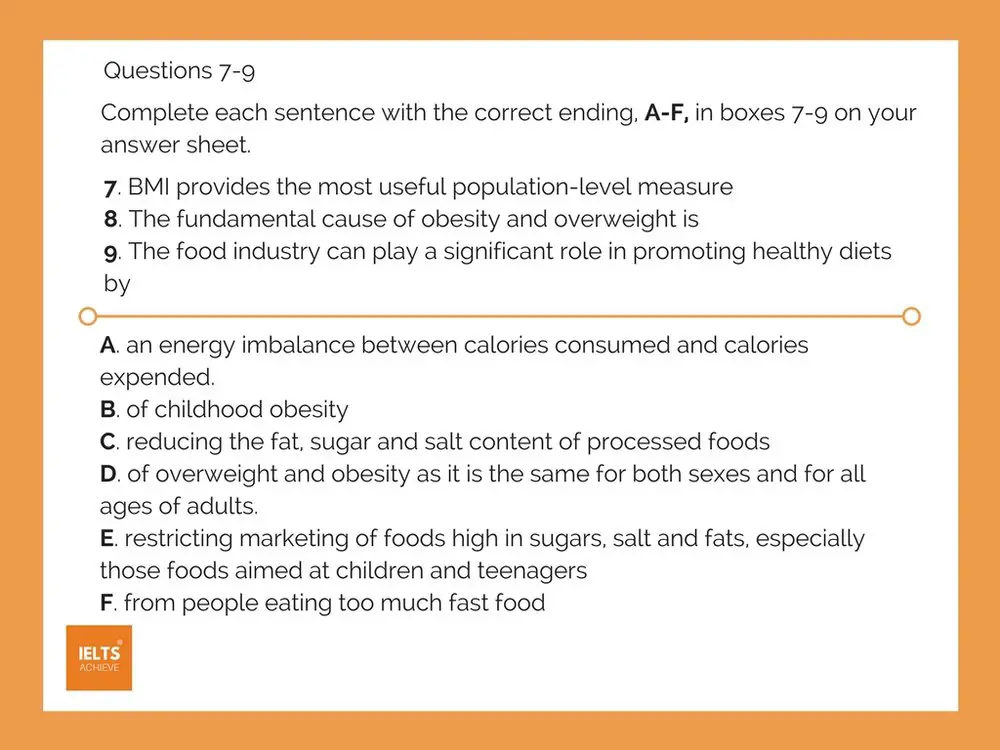
The fundamental cause of obesity and overweight is an energy imbalance between calories consumed and calories expended. Globally, there has been:
an increased intake of energy-dense foods that are high in fat; and
an increase in physical inactivity due to the increasingly sedentary nature of many forms of work, changing modes of transportation, and increasing urbanisation.
Changes in dietary and physical activity patterns are often the result of environmental and societal changes associated with the development and lack of supportive policies in sectors such as health, agriculture, transport, urban planning, environment, food processing, distribution, marketing, and education.
Match the sentence endings >>
Weight issues are created when
Having a job where you are sitting for long periods of time or no exercise in your regular routine can
The situation around you can affect your
A. the number of calories burned are not the same as the calories that have been eaten
B. health and the lifestyle that you have
C. a person consumes too much fast food
D. lead to weight gain, because of less movement
E. make a person gain weight and go out less
F. outlook on life, which affects your daily diet and exercise routine
Answers are at the bottom of the page.
Exercise 2
How can overweight and obesity be reduced?
Overweight and obesity, as well as their related noncommunicable diseases, are largely preventable. Supportive environments and communities are fundamental in shaping people’s choices, by making the choice of healthier foods and regular physical activity the easiest choice (the choice that is the most accessible, available and affordable), and therefore preventing overweight and obesity.
At the individual level, people can:
limit energy intake from total fats and sugars;
increase consumption of fruit and vegetables, as well as legumes, whole grains and nuts; and
engage in a regular physical activity (60 minutes a day for children and 150 minutes spread through the week for adults).
Individual responsibility can only have its full effect where people have access to a healthy lifestyle. Therefore, at the societal level, it is important to support individuals in following the recommendations above, through sustained implementation of evidence-based and population-based policies that make regular physical activity and healthier dietary choices available, affordable and easily accessible to everyone, particularly to the poorest individuals. An example of such a policy is a tax on sugar-sweetened beverages.
Match the sentence endings >>
Being overweight
People can
Society must
A. offer help to those who are overweight, making sure that healthy diet options and regular activities are easily accessible
B. can be stopped, by making changes and receiving help from the community
C. is caused by being irresponsible
D. watch what they eat
E. be careful with their daily eating habits, making sure they consume a healthy amount of fruits and vegetables
F. promote a sugar tax on all unhealthy foods
Answers are at the bottom of the page.
Exercise 3
What are common health consequences of overweight and obesity?
Raised BMI is a major risk factor for noncommunicable diseases such as:
cardiovascular diseases (mainly heart disease and stroke), which were the leading cause of death in 2012;
diabetes;
musculoskeletal disorders (especially osteoarthritis – a highly disabling degenerative disease of the joints);
some cancers (including endometrial, breast, ovarian, prostate, liver, gallbladder, kidney, and colon).
The risk for these noncommunicable diseases increases, with increases in BMI.
Childhood obesity is associated with a higher chance of obesity, premature death and disability in adulthood. But in addition to increased future risks, obese children experience breathing difficulties, increased risk of fractures, hypertension, early markers of cardiovascular disease, insulin resistance and psychological effects.
Match the sentence endings >>
Eventual exposure
Being obese at a young age
The dangerous circumstances surrounding obesity
A. can lead to early death
B. are higher when a person's BMI is immense
C. can make it tough for a young person at school
D. can lead to children struggling to breathe and other complications
E. projects a future of obesity and ongoing serious health issues
F. to the health issues caused by obesity can cause a number of diseases
Answers are at the bottom of the page.
REVIEW AND STRATEGY
The matching sentence endings are common in the IELTS Reading Test, therefore you should practice and develop a strategy for answering.
TIP >> Read the instructions before you start reading the text, partial sentences or the sentence endings.
TIP >> Read the partial sentences first and the sentence endings.
TIP >> Skim read the text and look for any clear answers.
TIP >> Choose your answers through an elimination process. Which ones do not fit? Which ones can you dismiss? Be attentive to synonyms and paraphrasing.
Answers >>
Practice Questions Answers >>
1 - C
2 - E
3 - A
4 - D
5 - B
Exercise 1 Answers >>
1 - A
2 - D
3. F
Exercise 2 Answers >>
1 - B
2 - E
3 - A
Exercise 3 Answers >>
1 - D
2 - E
3 - B
We hope you found this post useful in helping you to study for the IELTS Test. If you have any questions please let us know in the comments below or on the Facebook page.
The best way to keep up to date with posts like this is to like us on Facebook, then follow us on Instagram and Pinterest.
If you need help preparing for the IELTS Test, join the IELTS Achieve Academy and see how we can assist you to achieve your desired band score. We offer an essay correction service, mock exams and online courses.