Step-by-step guide to answering this type of IELTS Writing Task 1 question. Covers structure, key language, and band-scoring criteria.
Originally published October 2017. Last reviewed 3 July 2026.
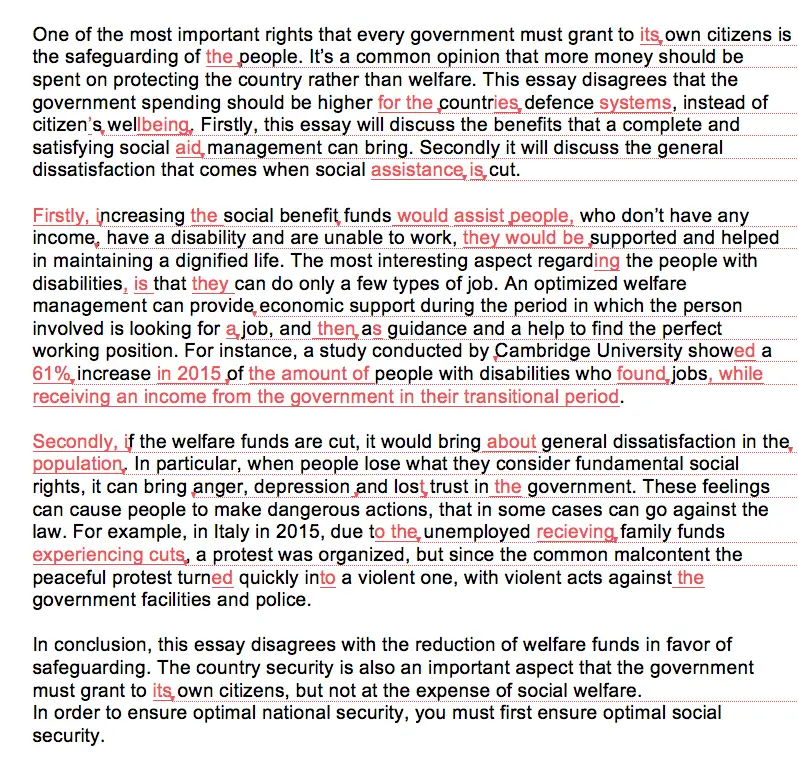
In this post, you will be able to view an essay example from a past student, with the corrections and feedback highlighted in red.
Most of the students studying for the IELTS Test have said they find the IELTS Writing Tasks difficult. I have corrected hundreds of task 1 and 2 essays on various topics, giving estimated band scores and detailed feedback. There are also suggestions on how to improve for a higher band score. Take a look at this student essay example and see how it compares to your own writing.
Writing Task 1 Question
Here is the task 1 essay with corrections, suggestions, feedback and an estimated band score >>
Do you want to get your essays corrected by a highly experienced IELTS teacher? Then take a look at our writing correction service.
We hope you found this post useful in helping you to study for the IELTS Test. If you have any questions please let us know in the comments below or on the Facebook page.
The best way to keep up to date with posts like this is to like us on Facebook, then follow us on Instagram and Pinterest.
What Band 6 Means for Task 1 Academic
A Band 6 response in IELTS Writing Task 1 Academic demonstrates developing competence across all four assessment criteria: Task Achievement, Coherence and Cohesion, Lexical Resource, and Grammatical Range and Accuracy.
Task Achievement at Band 6
The response addresses the requirements, presents an overview (though it may be unclear), and presents key features adequately, though some may be inadequately covered.
Coherence and Cohesion at Band 6
Information is arranged coherently with clear overall progression. Cohesive devices are used effectively but may be mechanical or faulty at times.
How to Achieve Band 6
Analyse the visual data carefully: Spend 2-3 minutes identifying the main trends, key features, and notable comparisons before writing.
Write a clear overview: Attempt to summarise the overall trends, even if briefly.
Select and group information: Try to organise data into coherent groups rather than listing every detail.
Use accurate data: Reference specific numbers, percentages, and dates from the visual to support your descriptions.
Vary your language: Use a range of vocabulary for describing trends (increased, rose sharply, remained stable, declined gradually).
Official Band Descriptor Criteria at Band 6
The table below summarises what IELTS examiners look for at Band 6 across all four marking criteria for Writing Task 1 Academic, according to the band descriptors published jointly by the British Council, IDP: IELTS Australia, and Cambridge Assessment English (2024).
Criterion
Band 6 Descriptor Summary
Task Achievement
Addresses the task requirements though some details may be irrelevant or inaccurate; presents an overview with some key features highlighted.
Coherence & Cohesion
Arranges information coherently with clear overall progression; uses cohesive devices effectively though with some inaccuracy or repetition.
Lexical Resource
Uses an adequate range of vocabulary for the task; attempts less common vocabulary with some inaccuracy; makes some errors in spelling or word formation.
Grammatical Range & Accuracy
Uses a mix of simple and complex sentences; makes some errors in grammar and punctuation which rarely reduce communication.
How to Move Beyond Band 6
Focus on selecting and comparing the most significant data points rather than listing every detail. Examiners reward the ability to identify what matters most.
Expand your vocabulary for describing trends and comparisons. Replace overused words such as “increased” and “decreased” with alternatives like “surged,” “declined,” “fluctuated,” or “remained stable.”
Aim for greater accuracy in complex sentence structures. Practise using relative clauses, participle phrases, and conditional structures without grammatical errors.
Key Takeaways
Band 6 represents a competent performance: the task is addressed, ideas are organised, and communication is generally effective despite some errors (IELTS band descriptors, British Council, IDP, and Cambridge, 2024).
The main barriers between Band 6 and Band 7 are precision in data selection, more sophisticated vocabulary use, and consistently accurate complex grammar.
Regular timed practice with a variety of Task 1 question types builds the speed and flexibility needed to reach Band 7.
Originally published on IELTS Achieve. Last reviewed 3 July 2026.
A detailed guide to this IELTS Writing Task 2 essay type, with structure templates, useful vocabulary, and techniques to achieve Band 7+.
Originally published October 2017. Last reviewed 3 July 2026.
In this post, you will be able to view an essay example from a past student, with the corrections and feedback highlighted in red.
Most of the students studying for the IELTS Test have said they find the IELTS Writing Tasks difficult. I have corrected hundreds of task 1 and 2 essays on various topics, giving estimated band scores and detailed feedback. There are also suggestions on how to improve for a higher band score. Take a look at this student essay example and see how it compares to your own writing.
Writing Task 2 Question
“A government has a responsibility to its citizens to ensure their safety. Therefore, some people think that the government should increase spending on defence but spend less on social benefits. To what extent do you agree?”
Here is the task 2 essay with corrections, suggestions, feedback and an estimated band score >>
Do you want to get your essays corrected by a highly experienced IELTS teacher? Then take a look at our writing correction service.
We hope you found this post useful in helping you to study for the IELTS Test. If you have any questions please let us know in the comments below or on the Facebook page.
The best way to keep up to date with posts like this is to like us on Facebook, then follow us on Instagram and Pinterest.
What Band 6 Means for Task 2
Band 6 in IELTS Writing Task 2 reflects adequate competence across the four assessment criteria. Understanding these criteria helps you identify exactly what to improve.
Task Response at Band 6
The response addresses the task, though some aspects may be more fully covered than others. Main ideas are relevant but may lack focus or supporting detail in places.
Coherence and Cohesion at Band 6
Information is arranged with some progression. Paragraphing is used but may not always be logical. Cohesive devices are present but may be mechanical.
How to Improve Beyond Band 6
Plan before writing: Spend 5 minutes outlining your position, main ideas, and supporting points.
Develop your ideas more: Each body paragraph should have a clear topic sentence, explanation, example, and link back to the question.
Proofread: Reserve 2-3 minutes at the end to check for grammar errors, spelling mistakes, and unclear sentences.
Practise under timed conditions: Write complete essays in 40 minutes to build speed and confidence.
Originally published on IELTS Achieve. Last reviewed 3 July 2026.
Step-by-step guide to answering this type of IELTS Writing Task 1 question. Covers structure, key language, and band-scoring criteria.
Originally published October 2017. Last reviewed 3 July 2026.
In this post, you will be able to view an essay example from a past student, with the corrections and feedback highlighted in red.
Most of the students studying for the IELTS Test have said they find the IELTS Writing Tasks difficult. I have corrected hundreds of task 1 and 2 essays on various topics, giving estimated band scores and detailed feedback. There are also suggestions on how to improve for a higher band score. Take a look at this student essay example and see how it compares to your own writing.
Writing Task 1 Question
Here is the task 1 essay with corrections, suggestions, feedback and an estimated band score >>
Do you want to get your essays corrected by a highly experienced IELTS teacher? Then take a look at our writing correction service.
We hope you found this post useful in helping you to study for the IELTS Test. If you have any questions please let us know in the comments below or on the Facebook page.
The best way to keep up to date with posts like this is to like us on Facebook, then follow us on Instagram and Pinterest.
What Band 5.5 Means for Task 1 Academic
A Band 5.5 response in IELTS Writing Task 1 Academic demonstrates developing competence across all four assessment criteria: Task Achievement, Coherence and Cohesion, Lexical Resource, and Grammatical Range and Accuracy.
Task Achievement at Band 5.5
The response partially addresses the requirements with some attempt at an overview, but key features may be inadequately covered or unclear.
Coherence and Cohesion at Band 5.5
The response shows some organisation but may lack overall progression. Cohesive devices may be inadequate, inaccurate, or overused.
How to Achieve Band 5.5
Analyse the visual data carefully: Spend 2-3 minutes identifying the main trends, key features, and notable comparisons before writing.
Write a clear overview: Attempt to summarise the overall trends, even if briefly.
Select and group information: Try to organise data into coherent groups rather than listing every detail.
Use accurate data: Reference specific numbers, percentages, and dates from the visual to support your descriptions.
Vary your language: Use a range of vocabulary for describing trends (increased, rose sharply, remained stable, declined gradually).
Official Band Descriptor Criteria at Band 5.5
The table below summarises what IELTS examiners look for at Band 5.5 across all four marking criteria for Writing Task 1 Academic, according to the band descriptors published jointly by the British Council, IDP: IELTS Australia, and Cambridge Assessment English (2024).
Criterion
Band 5.5 Descriptor Summary
Task Achievement
Partially addresses the task requirements; the overview may be unclear or missing key features; data or key stages may be inaccurately described.
Coherence & Cohesion
Information is organised with some coherence but overall progression may be unclear; cohesive devices may be faulty or mechanical.
Lexical Resource
Uses a limited range of vocabulary; errors in word choice and spelling may cause difficulty for the reader.
Grammatical Range & Accuracy
Uses a limited range of structures; attempts complex sentences but with frequent errors; errors in grammar and punctuation may cause some difficulty.
How to Move Beyond Band 5.5
Practise identifying and clearly stating the overall trend or key pattern before writing about specific data points. Every Task 1 response must include an overview paragraph.
Use a wider range of linking words and transition phrases (for example, “by contrast,” “similarly,” “whereas”) to connect ideas more naturally across sentences.
Study model answers at Band 6 and 7 to observe how data is grouped logically rather than described point by point in chronological order.
Key Takeaways
A Band 5.5 response shows a partial attempt at the task but typically lacks a clear overview or accurate data selection, according to the published IELTS band descriptors (British Council, IDP, and Cambridge, 2024).
Moving from Band 5.5 to Band 6 or above requires stronger organisation, more precise vocabulary for describing data, and fewer grammatical errors in complex sentences.
Practise with official Cambridge IELTS past papers and compare your answers to published model responses to calibrate your understanding of what the examiner expects.
Originally published on IELTS Achieve. Last reviewed 3 July 2026.
A detailed guide to this IELTS Writing Task 2 essay type, with structure templates, useful vocabulary, and techniques to achieve Band 7+.
Originally published October 2017. Last reviewed 3 July 2026.
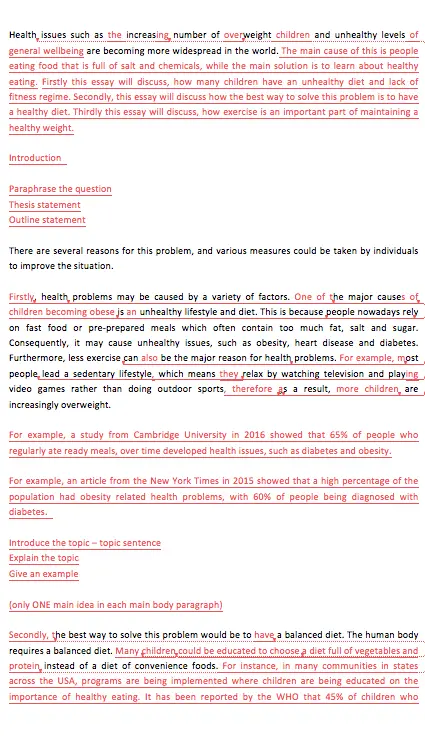
In this post, you will be able to view an essay example from a past student, with the corrections and feedback highlighted in red.
Most of the students studying for the IELTS Test have said they find the IELTS Writing Tasks difficult. I have corrected hundreds of task 1 and 2 essays on various topics, giving estimated band scores and detailed feedback. There are also suggestions on how to improve for a higher band score. Take a look at this student essay example and see how it compares to your own writing.
Writing Task 2 Question
“Childhood obesity is becoming a serious problem in many countries. Explain the main causes and effects of this problem, and suggest some possible solutions.”
Here is the task 2 essay before corrections >>
Here is the task 2 essay with corrections, suggestions, feedback and an estimated band score >>
Do you want to get your essays corrected by a highly experienced IELTS teacher? Then take a look at our writing correction service.
We hope you found this post useful in helping you to study for the IELTS Test. If you have any questions please let us know in the comments below or on the Facebook page.
The best way to keep up to date with posts like this is to like us on Facebook, then follow us on Instagram and Pinterest.
What Band 4.5 Means for Task 2
Band 4.5 in IELTS Writing Task 2 reflects limited competence across the four assessment criteria. Understanding these criteria helps you identify exactly what to improve.
Task Response at Band 4.5
The response only partially addresses the task. The position may be unclear, and main ideas are difficult to identify or are not sufficiently developed.
Coherence and Cohesion at Band 4.5
Ideas are not clearly organised. Paragraphing may be absent or confusing. Cohesive devices are limited or repetitive.
How to Improve Beyond Band 4.5
Plan before writing: Spend 5 minutes outlining your position, main ideas, and supporting points.
Develop your ideas more: Each body paragraph should have a clear topic sentence, explanation, example, and link back to the question.
Proofread: Reserve 2-3 minutes at the end to check for grammar errors, spelling mistakes, and unclear sentences.
Practise under timed conditions: Write complete essays in 40 minutes to build speed and confidence.
Originally published on IELTS Achieve. Last reviewed 3 July 2026.
Expert tips and strategies for this part of the IELTS Speaking test. Includes sample responses and key vocabulary for Band 7+.
Originally published September 2017. Last reviewed 3 July 2026.
In this post, you will see one of the most common IELTS speaking topics for part 3 (Travel) and sample answers.
Please remember that in the actual test you should give honest answers and talk about your own experiences, thoughts, feelings and opinions. Do not try to memorise answers, as the examiners will probably be able to guess and you will lose marks.
However, you are able to make up information to extend your answers, but be sure that you are confident when speaking about the chosen topic and that it is believable.
TIP >> Listen to the questions the examiner asks you and think about the structure of the question. Are they asking your for your opinion? or to say how something has changed from the past to the present?
TIP >> Learn about the most commonly asked question types used in the part 3 questions. This will help you to identify how you should respond and what to look out for when you are practising.
TIP >> It is common for many people to say ‘I don’t know’ or to lose focus when they get a question they know little about. Always answer the questions and if you feel as though you don’t know about the topic, then buy yourself some time by saying; ‘I haven’t really thought about that before…. but in my opinion……’ then give your opinion, etc.
TIP >> Don’t try to answer the questions as quickly as possible, take your time and answer them to the best of your ability. Give your opinion, the reasoning behind it and support with specific examples.
Take a look at the questions and sample answers below on the topic of ‘Travel‘ >>
Q: How easy is it to travel around your country?
A: It is really straightforward to travel anywhere you want to go, whether it is in the country or to visit other countries. There are airports in every major city, national rail lines and nation bus services. The flights are often good value and make it convenient for people to travel to other countries. There are good roads too, which means that you can easily travel in your own car to anywhere you want to go.
Q: Which method of travel do you consider safest?
A: I think that I consider flying to be the most secure way to get around. When you take a flight, everything is so well organised by the airport, air traffic control and other departments, that you know you are in good hands. I prefer travelling this way above going on a train, a boat or in the car, as more accidents happen on those types of transport.
Q: Has travel become safer in recent years?
A: Actually, I think that travel has become safer because of the many terrorist attacks we have seen in the air and on the ground. Airport security has become more intense, with more checks on each person and biometrics introduced. There are also more checks on vehicles, on national train services and on public transport. This is an important measure to take, because of the dreadful attacks that have occurred recently. In the past, the rules were more relaxed, with some airports waving people through without proper papers or identity cards.
Q: What are the pros and cons of low-cost air travel?
A: The main benefit of low-priced air tickets is that people can afford to visit more places around the world. Other benefits may include, travelling more frequently and saving money. The drawbacks, however, are that these airlines often add on extra charges for baggage and food. The prices of food and drink onboard the aircraft is high, along with any other extras that were not included in the flight price. They also have many cancellations and very uncomfortable seats.
Q: How do you think people will travel in the future?
A: I think more people will opt to take a train to get to where they want to go. Some people enjoy a lengthy train ride as this gives them time to relax and unwind. I think they will make ‘super’ trains, with deluxe cabins and luxury facilities, encouraging travellers to want to travel by train on long journeys. Already in China, they have designed double-decker trains and luxury fast trains, with an idea to transport more people in higher quality surroundings in the future.
We hope you found this post useful in helping you to study for the IELTS Test. If you have any questions please let us know in the comments below or on the Facebook page.
The best way to keep up to date with posts like this is to like us on Facebook, then follow us on Instagram and Pinterest.
If you need help preparing for the IELTS Test, join the IELTS Achieve Academy and see how we can assist you to achieve your desired band score. We offer an essay correction service, mock exams and online courses.