Step-by-step guide to answering this type of IELTS Writing Task 1 question. Covers structure, key language, and band-scoring criteria.
Originally published May 2017. Last reviewed 3 July 2026.
A question on the IELTS academic writing test that is becoming more common, asks the candidate to write about and describe a process.
You may have a natural or a man made process question. In this post we will look at how to write this type of essay, with structure help, vocabulary and sample answers.
Writing Task 1 – Process Essay Structure >>
Paragraph 1 – Paraphrase the question
When writing your own introduction of one or two sentences paraphrase the question and add detail.
Paragraph 2 – Overview of the main features
You need to be able to give a broad summary of the information. This is best started with – Overall.…… then giving details of the main features you can see. You can write this in one or two sentences, which describe the main features of the information that is presented in the process. Think about the number of stages that are in time order, what is happening at the beginning? What is happening at the end? How many stages are there?
Paragraph 3 – Specific details
Write about the process from the beginning, explaining what is happening throughout each stage.
Paragraph 4 – Specific details
Write about the process through to the end, including time connectors that lead the reader through each step of the process clearly.
TIP >> When describing a process you should write using the passive voice, focussing on the activities not the person who is doing them.
Time Connectors >>
The words below can help you to connect the stages of the process you are writing about.
Writing Task 1 Process Sample Essays >>
Here are two sample essay questions and answers for you to look at. Review the language used, the essay structure, the stages and how it has been written.
Sample Process Essay 1
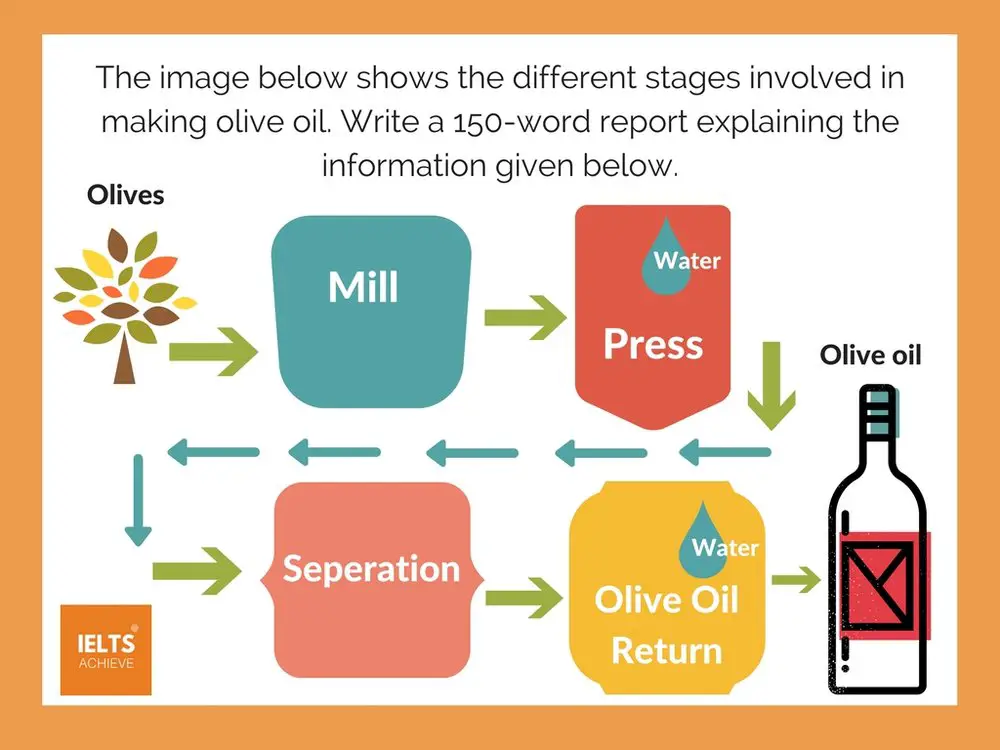
The diagram presents how olive is produced with the use of different equipment.
Overall, olive oil production involves four main stages and needs different equipment to achieve its desired appearance and flavour. The process starts with the breakdown of the olives after collection in a mill and culminates with storing the product in bottles until it is ready for consumption.
The process of making olive oil starts when olives are ground in a mill to create a paste. After the paste has been spread onto mats, this is transferred into a press where water is added. Following this procedure, the mashed olive paste is placed into a separation container where the oil goes through a natural separation process from vegetable waters.
After separation, the mixture goes into the olive oil return, where more water is added and wastewater is subsequently drained. Once this process has ended, the olive oil is ready to be bottled, where it is stored for a period of time known as the clarification stage. Finally, once this time has passed the oil is ready to be used.
(Word Count = 181 / Band Score 9)
Task Achievement – The answer provides relevant information, describing the process of how olive oil is made. The overview gives clear information, leading into the main body paragraphs.
Coherence and Cohesion – The answer has been divided into clear logical paragraphs, with clear cohesion between them with the addition of time connectors (after, following this, finally).
Lexical Resource – There is evidence of paraphrasing, synonyms and some less common words.
Grammatical Range and Accuracy – The answer has no grammatical errors. The sentences are mainly made up of multiple clauses and have a variety of structures. There are no spelling mistakes and punctuation is correct.
TIP >> Write a good overview, with how many stages the process has, starting with and ending with.
TIP >> Describe the process and lead the reader through it by using time connectors.
Sample Process Essay 2
The picture illustrates the process of making paper from the trees that have been collected.
Overall, it can be observed that there are eight stages in this process, beginning with the collection of trees from the forest and ending with the paper being made in the paper making machine.
To begin with, timber is collected from the forest and taken to be debarked. After the wood has been stripped bare, it enters the chipping machine, where it is chopped up into tiny pieces. From the chipping machine, the wood enters into three separate stages. First, the wood chips are put through the mechanical pulping process, where they are ground and smashed into pulp. Then they have a chemical pulping, going next into the hydra-pulper.
In the subsequent stage, the mixture goes through to be screened and cleaned, to filter any lumps or waste from the pulp. Lastly, the pulp is entered into the paper making machine, where it is pressed to make sheets of paper. The paper is then stored and stacked, ready for shipping and to be used.
(Word Count = 179 / Band Score 9)
Task Achievement – The answer provides relevant information, describing the process of how paper is made. The overview gives clear information, leading into the main body paragraphs.
Coherence and Cohesion – The answer has been divided into clear logical paragraphs, with clear cohesion between them with the addition of time connectors (first, then, subsequently).
Lexical Resource – There is evidence of paraphrasing, synonyms and some less common words.
Grammatical Range and Accuracy – The answer has no grammatical errors. The sentences are mainly made up of multiple clauses and have a variety of structures. There are no spelling mistakes and punctuation is correct.
TIP >> Write a good overview, with how many stages the process has, starting with and ending with.
TIP >> Describe the process and lead the reader through it by using time connectors.
Writing Task 1 Band Score 9 Criteria >>
We hope you found this post helpful in helping you to study for the IELTS Test. Let us know in the comments or on the Facebook page if you have any questions. The best way to keep up to date with posts like this is to like us on Facebook, and then follow us onInstagramand Pinterest. We offer essay correction services, mock exams, and online courses. If you need help preparing for the IELTS Test, join the IELTS Achieve Academy and see how we can help you achieve your desired band score faster.
Step-by-step guide to answering this type of IELTS Writing Task 1 question. Covers structure, key language, and band-scoring criteria.
Originally published May 2017. Last reviewed 3 July 2026.
One of the questions you may have on your IELTS writing task 1 test is a maps question. These are not as common as the charts, but it is worth practising.
In this post, we will look at how to structure your essay for this type of question, how to describe both the general and specific changes, vocabulary and sample answers.
There are a few different types of map question, one will ask you to describe a map in the present, you may be asked to describe two maps, one in the present and one in the future and lastly you may be given a question that asks you describe two maps, one in the past and one in the present.
These questions will require you to show your knowledge of vocabulary and grammar, using the correct tense. You will also use the passive in your writing.
Writing Task 1 – Maps Essay Structure >>
Paragraph 1 – Paraphrase the question
When writing your own introduction of one or two sentences paraphrase the question and add detail.
Paragraph 2 – Overview of the main features
You need to be able to give a broad summary of the information. This is best started with – Overall……. then giving details of the main features you can see. You can write this in one or two sentences, which describe the main features of the information that is presented in the maps. Think about the main changes that you can see have they improved anything? Have they built anything in an area that was the countryside before? Have there been any dramatic changes?
Paragraph 3 – Specific details of the main features
Write about the specific details that you can see – looking closely at the main features and include detail, then make any comparisons if relevant.
Paragraph 4 – Specific details of the main features
Write about the specific details that you can see – looking closely at the main features and include detail, then make any comparisons if relevant.
Describing Changes To A Map >>
Look carefully at the maps you have in front of you (above), have there been a lot of changes? What are the main changes?
The maps are normally labelled for you, with buildings, features and sometimes locations. Below is an example of how to describe changes;
Since 2010, all of the buildings on the Liverpool John Moores University campus have changed. There are quite a few improvements to both buildings and access.
Providing More Detail >>
Describe more differences between the maps, looking at the past and the present. What has stayed the same and what has changed?
The library has been renovated to include IT facilities.
The former chemistry, biology and physics blocks have been demolished and replaced with one large science block.
The car park has been removed and a brand new lecture theatre constructed.
The admin building has been made smaller, to allow better footpath access.
The large car park seen in 2010 has been converted into a bus station.
How To Describe General Changes >>
The words and phrases below can help you to describe the general changes you can see in the maps, for example;
Over the period of 2010 to the present, the area had gradually changed.
The campus changed rapidly, during the six-year period.
During the six-year period, many buildings had been renovated.
Over the last 6 years, there was a large area of redevelopment near the science blocks.
Choose two or three noticeable differences in the map and write a statement for each similar to the examples above, this will become your overview paragraph.
TIP >> Remember that you must report the information you see objectively, you don’t give your opinions or any extra unnecessary information.
How To Describe Locations >>
When describing where things are on the map, it is better to use north, south, east, west, rather than say to the right or to the left. For example;
The library to the north-west of the campus was renovated.
The admin building to the south-east of the campus was relocated.
The small car park to the north-east of the campus was redeveloped into a lecture theatre.
The large car park to the south-west of the campus was constructed into a bus station.
Writing Task 1 Maps Sample Essays >>
Here are two sample essay questions and answers for you to look at. Review the language used, the essay structure, the information gathered and how it has been written. The two essays you see here are from former students who passed their IELTS tests in 2017.
Sample Map Essay 1
The map represents the city of Leeds including two areas, which were suggested as a potential place to build a new shopping mall. The sites are named S1 and S2.
Overall, both of the areas are situated within close proximity of the city centre, although S1 is located in the north of the city centre and S2 is in the south.
On the one hand, area S1 is near to a road, a river and a railway, which form the boundary of the S1 site. Part of a residential area can be found to the north-west of S1’s territory. If the shopping mall is to built on S1, it will be close to this large housing estate, therefore providing easy access to the residents and those who live/work in the city centre. S1 also has easy transport links, being close to both the railway line and the road.
On the other hand, a road on the west side makes up the boundaries of the S2 area and one of the forks in the road forms the northern border. A railway passes through the S2 area and on the right side of this railway there is an industrial estate. S2 is closer to the industrial area than the housing estate. The main road runs through the city and is close to both sites, providing good access. However, a large golf course and park are in the west of the city, which would stop this area from being used as a site.
(Word Count = 250 / Band Score 9)
Task Achievement – The answer provides relevant information, summarising why each site would or would not be ideal for the shopping mall location. The areas are both described in detail, with the relevant information given.
Coherence and Cohesion – The answer has been divided into clear logical paragraphs, with clear cohesion between them with the addition of linking words (overall, on the one hand, on the other hand, therefore).
Lexical Resource – There is evidence of paraphrasing, synonyms and some less common words. They have used words such as transport links, northern border and residential area, that are not included on the map.
Grammatical Range and Accuracy – The answer has no grammatical errors. The sentences are mainly made up of multiple clauses and have a variety of structures. There are no spelling mistakes and punctuation is correct.
TIP >> Remember to compare the areas you are looking at and identify the main changes that you can see. Think about why those things seem important and if there is a common theme. This will help you to gain a high score.
The images show how the planned new improvements will not only change the look but also improve the functionality of Park Avenue.
Overall, the most important change will be the addition of safety measures and the appearance of foliage amid the initial monotonous city design. The sidewalks will be wider on both sides of the road and bicycle lanes will be added, while a pedestrian crossing will also be constructed at the bottom of the street. The crossing will have an island where pedestrians can wait.
The wider sidewalks will ensure that people can enjoy their strolls and joggers will have a place to run without bumping into each other. The bike lanes reduce traffic problems that might arise, when cyclists are caught in traffic or when they try to move fast on the sidewalks. So this change raises the degree of safety and comfort for everyone.
The new pedestrian crossing is making the area safe for the community and is very clear for drivers. This will be safer for people to cross the road, as before there was no safe way of crossing the road. The trees planted, will not only improve the aesthetics of the area but will help to reduce CO2 emissions and offer some welcomed shade during hot summer days.
(Word Count = 213 / Band Score 9)
Task Achievement – The answer provides relevant information, summarising the changes. The suggested changes have been described throughout the essay. They are given a clear breakdown in the overview, with further explanations in the main body paragraphs, not only of the change but of their purpose and function.
Coherence and Cohesion – The answer has been divided into clear logical paragraphs, with the detail of safety measures and how it will affect the environment.
Lexical Resource – There is evidence of paraphrasing, synonyms and some less common words. They have used words that are not included on the map.
Grammatical Range and Accuracy – The answer has no grammatical errors. The sentences are have a variety of structures. There are no spelling mistakes and punctuation is correct. The tenses used are clear when referencing the present and the future.
TIP >> Remember to compare the maps you are looking at and identify the main changes that you can see. Think about why those things seem important and if there is a common theme. This will help you to gain a high score.
Writing Task 1 Band Score 9 Criteria >>
We hope you found this post useful in helping you to study for the IELTS Test. If you have any questions please let us know in the comments below or on the Facebook page.
The best way to keep up to date with posts like this is to like us on Facebook, then follow us on Instagram and Pinterest.
If you need help preparing for the IELTS Test, join the IELTS Achieve Academy and see how we can assist you to achieve your desired band score. We offer an essay correction service, mock exams and online courses.