Expert tips and strategies for this part of the IELTS Speaking test. Includes sample responses and key vocabulary for Band 7+.
Originally published August 2017. Last reviewed 3 July 2026.
In this post, we will be looking in-depth at part 1 of the speaking test.
The IELTS Speaking Test lasts 11-14 minutes.
The test has three parts, where you are interviewed by a trained examiner. You are not allowed to use a dictionary during the test. IELTS Academic and IELTS General students take the same test and it is marked in the same way.
PART 1 Information
To begin with, the examiner will introduce themselves to you, then ask you your name and for proof of identity.
4-5 minutes >> You will be asked questions on familiar topics, like your hobbies, family, where you are from, what your hometown/city is like, etc.
The topics might include;
Your studies/education
Hobbies/sports
Your family
What kind of movies, books, tv shows or music you like
What you like to eat / where you like to eat
Your job
Where you live
Part 1 Questions
The questions in part 1 will possibly be about your work or studies, hobbies, your family, where you live, hometown or where you live now. Your answers should include facts and your own opinions or feelings.
Possible questions >>
Do you live in a house or an apartment?
What do you do at the weekends?
Do you have any hobbies?
How often do you like to travel?
Where is a good place to visit in your hometown or city?
Do you go to the cinema often?
Example Q+A
Take a look at the questions below and the two possible answers, which one is better?
Question: Do you like to travel?
Answer 1: yes, I do.
Answer 2: Yes, I have been to many places in Europe, including Italy, Spain, Greece and the UK. In the future I would love to be able to visit and explore the USA, going to New York and perhaps driving through other states.
Which answer looks better to you?
Feedback: Answer 2!Why? The first answer does not fully answer the question and show off the students ability to speak English. In part one, your answer should be at least 2-3 sentences. The second answer is much better, giving background information (I have been to many places in Europe, including Italy, Spain, Greece and the UK.) and adding details (I would love to be able to visit and explore the USA).
Answering The Question
Make sure you answer the question fully, with correct tenses where appropriate.
Question: Do you enjoy going to the cinema?
Answer 1 – Kate: Yes, I do love going to the cinema and I always think it is good to go and see new movies, especially in the IMAX. On the other hand, I also like to watch movies in my house, as it is more comfortable.
Answer 2- Georgina: I went to the cinema last weekend. I was invited to go with a friend. She wanted to see the latest thriller.
Feedback: Georgina did not answer the question, she didn’t make it clear whether she enjoyed going to the cinema, she used the past tense and the question was in the present tense. her answer was also short in length. Kate has a high-level answer, she answered the question using varied vocabulary, not just repeating the words the examiner had used. She also connected her ideas by using ‘on the other hand’ and used the present tense.
Yes/No Questions
When you hear a yes/no question, try to start your answer with one of the following phrases >>
I don’t think so
not really
absolutely!
definitely!
I think so
not very often
most of the time
sometimes
yes, in general
For example for the following questions….the answers can be started with one of the phrases from above and expanded upon, you can add more detail or give an example. This is so you don’t answer the question with a simple yes or no, which would not get you many marks.
Question: Do you use your phone or tablet every day?
Answer: Absolutely! I always check my phone for emails and texts, then of course to see social media.
Question: Is travelling important to you?
Answer: Definitely! It is something that I aim to do as often as I can, for example, next year I plan to visit Barcelona.
Question: Is reading important to you?
Answer: Not really, I don’t have much time to read, I prefer to listen to music or watch netflix.
Preference Questions
Some part 1 questions may ask you about your preferences.
Can you see which is the better answer?
Question: Do you prefer travelling alone or in a group?
Answer 1 – Claire: I prefer to travel alone, I don’t really like to be in a group.
Answer 2 – Susan: I haven’t ever travelled on my own, I have always been with friends. It is so much fun to travel in a group, as you can share experiences and have a laugh with your friends. I think travelling alone in some parts of the world could be dangerous.
Feedback: Claire’s answer is short and repeats too many words from the question. Susan’s answer is better because she gives more detail and uses different words to the question, she also gives reasons for her preferences.
You can use the following phrases in your answers for a high-level answer >>
I like…… more than…..
It depends on………
I like both………..and………….
My first choice would be …………..
I’d rather…………..than………………..
For example, ‘I like both travelling on my own and with friends, because……’ or ‘I like travelling with friends more than on my own, because……’.
Using Would and Could
Some questions may ask you a hypothetical question, which invites you to use the words ‘would’ or ‘could’.
Question: Where would you recommend a foreigner to visit in your country?
Answer 1 – Marco: I will tell them to visit the Vatican and to see the sights.
Answer 2 – Ricardo: I would highly recommend that they visit the galleries and museums when in Rome, especially in the Vatican. A great historical site to see is the Colosseum, a stunning example of architecture. I could also recommend visiting the Trevi Fountain and sampling some delicious ice cream!
Feedback: Marco’s answer is short and does not use enough vocabulary. Ricardo expands on his answer, listing places to visit and uses the words ‘would’ and ‘could’ in his answer.
We hope you found this post useful in helping you to study for the IELTS Test. If you have any questions please let us know in the comments below or on the Facebook page.
The best way to keep up to date with posts like this is to like us on Facebook, then follow us on Instagram and Pinterest.
If you need help preparing for the IELTS Test, join the IELTS Achieve Academy and see how we can assist you to achieve your desired band score. We offer an essay correction service, mock exams and online courses.
Key grammar structures needed for IELTS. Learn how to use these correctly to improve your band score.
Originally published July 2017. Last reviewed 3 July 2026.
In this post, we will be looking in-depth at tenses.
In the IELTS Speaking Test, the examiner will probably ask you questions that will require you to answer with the correct tense, while also giving additional information.
Listen for the tenses in the questions, as this is the tense you should use in your answer. You should be able to understand if the question is about the past, the present or the future. Think about using related tenses when giving more information if relevant.
For example, the examiner might ask you;
What are your future career plans?
I would like to study for a Master’s and go much further academically, in the next 3-5 years. I had previously studied creative writing as part of my university course. I have a huge interest in seeing where my creativity could take me. I want to be able to write novels in the future, preferably non-fiction.
What tenses are used in the answer?
TIP >> The questions asked is an opportunity for you to talk about your own experiences, with examples. A simple answer will not gain you a high band score. You must extend your answer giving more information to show off your vocabulary and grammar knowledge.
The Past Simple
The past simple and the past continuous are commonly used to describe events in the past.
The past simple is used to express something that happened a past point in time. Remember to always use a past time expression, or a clear contextual clue when using the past simple. If you do not indicate when something happened, use the present perfect for unspecified past.
This tense is often used with the following time expressions:
… ago
… in + year / month
…yesterday
…last week/month/year… when …
Examples;
Positive
Subject + Past Tense + object(s) + time Expression
I went to the beach yesterday.
Negative
Subject + did + not (didn’t) + verb + object(s) + time Expression
They didn’t join us for lunch yesterday.
Question
(Question Word) + did + subject + verb + object(s) + time Expression
When did you buy that jacket?
The Past Continuous
The past continuous tense is used to describe what was happening at a specific moment in the past. Do not use this form when referring to longer periods of time in the past such as ‘last May’, ‘three years ago’, etc.
This tense is often used with the following time expressions:
… at 6.30, four o’clock, etc.
Examples;
Positive
Subject + was / were + verb + ing + object(s) + time Expression
We were meeting with Lana at one o’clock yesterday afternoon.
Negative
Subject + was / were + not (wasn’t, weren’t) + verb + ing + object(s) + time Expression
They weren’t playing volleyball at two o’clock on Sunday.
Question
(Question Word) + was / were + subject + verb + ing + object(s) + time Expression
What were you doing at three-thirty yesterday afternoon?
The Present Simple
The present simple is used to express daily routines and habits. Adverbs of frequency such as ‘usually’, ‘sometimes’, ‘rarely’, etc. are often used with the present simple.
This tense is often used with the following time expressions:
always, usually, sometimes, etc.
… every day
… on Sundays, Tuesdays, etc.
Positive
Subject + Present Tense + object(s) + time Expression
Jamie usually, takes a train to college.
Negative
Subject + do / does + not (don’t / doesn’t) + verb + object(s) + time Expression
They don’t often go to London.
Question
(Question Word) + do / does + subject + verb + object(s) + time Expression
How often do you play volleyball?
The Present Continuous
One use of the present continuous tense is for action that is occurring at the moment of speaking. Remember that only action verbs can take the continuous form.
This tense is often used with the following time expressions:
… at the moment
… now
… today
… this morning/afternoon/evening
Positive
Subject + be + verb + ing + object(s) + time Expression
She’s watching a movie now
Negative
Subject + be + not (isn’t, aren’t) + verb + ing + object(s) + time Expression
They aren’t having food this morning.
Question
(Question Word) + be + subject + verb + ing + object(s) + time Expression
What are you doing?
The Present Continuous (for events)
One use of the present continuous tense is for scheduled future events. This is especially useful when talking about appointments and meetings.
This tense is often used with the following time expressions:
… tomorrow
… on Friday, Monday, etc.
… today
… this morning/afternoon/evening
… next week/month
… in December, March, etc.
Positive
Subject + be + verb + ing + object(s) + time Expression
I’m meeting Tom at seven o’clock this evening.
Negative
Subject + be + not (isn’t, aren’t) + verb + ing + object(s) + time Expression
Shelley isn’t attending the study group on Friday.
Question
(Question Word) + be + subject + verb + ing + object(s) + time Expression
When are you discussing the essay with Tom?
Present Question and Answer Example >>
Question >> What do you like about your town/city?
I really enjoy the culture here, the architecture and the atmosphere. The historical town was built by the Venetians, which makes the architecture of the streets similar to many places in Italy. There are also many great restaurants to visit, from places in the centre of the town to others next to the sea. My favourite restaurant is a busy place on the corner of a narrow street that serves traditional Greek food and it is always busy. A new place has opened up next to the sea and I want to go and eat there next week.
The answer tells the examiner about the present and mentions future plans – A new place has opened up next to the sea and I want to go and eat there next week. The answer uses the present simple and the present continuous.
The Future Simple
The future simple refers to a time later than now and expresses facts or certainty. In the IELTS Speaking Test, it is likely that if you are asked a question about the future it will be a prediction. For example, asking you about your plans after your studies, where you will go on your next holiday and other possible situations.
The future with ‘will’ is used for a number of situations:
Used for Predictions
It will rain this week.
It will be really hot tomorrow.
Used for Plans
The future with ‘going to’ is used to express planned events or intentions.
These events or intentions are decided on before the moment of speaking.
Jamie is going to study Nursing.
Where are they going to stay when they visit?
Future Question and Answer Example >>
Question >> What do you think you will be doing in five years time?
In five years I would like to have a senior position in the hospital I work in. I am enjoying working there and I’m trying my best to progress further. I will continue to work in my chosen area of paediatrics, as I really enjoy working with children and helping them to get better. I want to be able to have a more senior role in the future so that I can have more of a say in decision-making and take on more responsibility.
Can you see the tenses used?
The present continuous >I am enjoying working there and I’m trying my best to progress further.
The present simple > I want to be able to have a more senior role in the future so that I can have more of a say in decision-making and take on more responsibility. (This describes her long-term plans)
The future simple >I will continue to work in my chosen area of paediatrics, as I really enjoy working with children and helping them to get better.
We hope you found this post useful in helping you to study for the IELTS Test. If you have any questions please let us know in the comments below or on the Facebook page.
The best way to keep up to date with posts like this is to like us on Facebook, then follow us on Instagram and Pinterest.
If you need help preparing for the IELTS Test, join the IELTS Achieve Academy and see how we can assist you to achieve your desired band score. We offer an essay correction service, mock exams and online courses.
Expert tips and strategies for this part of the IELTS Speaking test. Includes sample responses and key vocabulary for Band 7+.
Originally published July 2017. Last reviewed 3 July 2026.
In this post, we will be looking in-depth at fluency and coherence.
While you are preparing for your IELTS Speaking Test it is important that you understand the marking criteria. Fluency and coherence count for 25% of your speaking score, therefore it is vital that you understand what the examiner wants.
Fluent >> Able to express oneself easily and articulately / smoothly graceful and effortless.
Coherent >> Logical and consistent.
When you are speaking, you want to show the examiner that you can talk about topics easily, without long pauses and repetition. You also want to show them that you can organise your ideas in a logical way.
Fluent Speech
When you are fluently able to speak you can talk at a normal pace, pause occasionally for emphasis and self-correct.
Some students find themselves speaking too fast or repeating words and phrases, which is something you should avoid doing.
You should aim to practice speaking in English as often as possible and for those of you already living in the UK (or another English speaking country) take the opportunity to talk to friends or colleagues. You can ask them to ask you questions to help you practice and they can also give you some feedback!
Some questions they could ask you >>
What did you do last night? / or at the weekend?
Did you see the latest episode of …. (insert TV show name) what did you think of it?
When was the last time you went to the cinema?
Are you going on holiday this year? Where are you going?
Have you read any good books recently?
Did you see/read about… (insert news story) what did you think about that?
You should answer with full sentences and avoid repeating the question back to them.
Speaking Coherently
When you are answering questions you should organise the information logically, starting at the beginning, describing /explaining and concluding.
For example, read the text below >>
I read a good book the other day about this woman who gets on the same train every day. It starts with this woman getting fired from her job, then getting the train home. Actually, it starts with her on the train then explaining that she got fired. There are blanks in her memory. She likes to look at a house when the train passes and the woman that lives there. She can’t remember things. She drinks a lot. My friend told me to read this book. The book was fast paced and interesting. I enjoyed it. I read it on the plane last month when I went on holiday.
Here it is again but organised in a more logical way >>
I read a really good book when I went on holiday last month after my friend had recommended it to me. It was a thriller, with a woman who had an abusive relationship and a drinking problem, that had been fired from her job. She rides the tube every day pretending to go to work and she is intrigued by a house she sees. She envies the woman who lives there and the story develops from there. Then, she gets involved with the woman’s story putting together the gaps in her own memory and begins to see how her own life is connected. This book was fast paced and interesting!
Do you think the second paragraph is more logical?
Can you see the difference?
The events in the book/movie etc should be explained in logical order.
Using Cohesive Devices
Your ideas should be in logical order but also connected by cohesive devices.
For example, if you were telling a story about your educational background it could look like this >>
I started school at 5 years old. I went to secondary school when I was 12. I left that school at 18. I went to university for three years. I graduated with honours. I had training. I work in my chosen field.
Introducing cohesive devices will make it sound more natural and explain the order of events in a logical sounding way >>
Firstly, I started school at 5 years old, then I went to secondary school when I was 12. However, I left that school at 18. After that, I went to university for three years, where I graduated with honours. In addition to that, I had further training. Now, I finally work in my chosen field.
Take a look at the cohesive devices below, the words and phrases here will help you to organise your ideas >>
Sequencing
You can also use sequencing to express your ideas in a logical way, take a look at the words and phrases below >>
Practice
Practice answering these questions below using cohesive devices and sequencing >>
What do you think are the main reasons that students in recent years like to take a gap year?
What are the advantages and disadvantages of young people using social media?
Do you agree or disagree with the idea that technology is developing faster than the public think?
Is it a good idea to try out new restaurants recommended by friends?
What did you do last weekend
Can you use any of the following words or phrases in your answers?
Firstly / secondly……
Then
After that
Overall
However
In addition
Therefore
For example
For instance
On the one hand
On the other hand
Finally
Now
We hope you found this post useful in helping you to study for the IELTS Test. If you have any questions please let us know in the comments below or on the Facebook page.
The best way to keep up to date with posts like this is to like us on Facebook, then follow us on Instagram and Pinterest.
If you need help preparing for the IELTS Test, join the IELTS Achieve Academy and see how we can assist you to achieve your desired band score. We offer an essay correction service, mock exams and online courses.
Curated resources to boost your IELTS preparation. Practise with authentic English materials used by successful candidates.
Originally published July 2017. Last reviewed 3 July 2026.
In this post, we will take a look at my top 5 picks from TED Talks.
Listening to talks or lectures will really help you to develop your listening skills for the IELTS Listening Test. Listening to something that interests you can make studying more fun and can raise your enthusiasm. If you just practised listening with IELTS test papers you might get bored and lose interest. Dividing up your listening practice into sections, where you study both listening test papers and other sources will be helpful.
Listening to various sources like TED Talks, will not only help you to develop your listening skills but also to improve your use of general English. Non-native speakers often develop their language skills by watching TV shows or movies. For more academic content, listening to TED Talks or TED-Ed is a great way to listen to different accents and test your listening abilities.
Take a look at my top 5 TED Talks below and let me know what you think in the comments!
1. Do Schools Kill Creativity? – By Sir Ken Robinson
This talk is not only saying a lot about the education systems around the world but the speaker is very funny. When I first watched this video, I was laughing so much and I thought that he was not only an excellent public speaker, engaging with the audience but he supported his key points with really funny moving stories. I also share his views about the arts being seen as lesser subjects in schools and colleges and I am hopeful that one day that mindset will change.
Listen to the talk and see what you think, make some notes on the following questions >>
What are the key points?
What do you think of the speaker?
Did you enjoy the talk?
What is his opinion on the school systems?
How did the talk make you feel?
Did you write down any unknown vocabulary?
2. What I saw In The War – Janine Di Giovanni
Listen to the talk and see what you think, make some notes on the following questions >>
What are the key points?
What do you think of the speaker?
Did you enjoy the talk?
How did the talk make you feel?
Did you write down any unknown vocabulary?
3. The Man Behind Tesla, SpaceX, SolarCity by Elon Musk
Listen to the talk between two people and see what you think, make some notes on the following questions >>
What are the key points?
Do they agree or disagree on anything?
How well did you understand the content?
Did you write down any unknown vocabulary?
4. Rethinking Infidelity… A Talk For Anyone Who Has Ever Loved By Esther Perel
Ester Perel is a Psychotherapist and her talks are very popular!
Listen to the talk below and see what you think, make some notes on the following questions >>
What are the key points?
How well did you understand the content?
Did you enjoy the talk?
Did you write down any unknown vocabulary?
5. How Fake News Does Real Harm By Stephanie Busari
Listen to the talk below and see what you think, make some notes on the following questions >>
What are the key points?
How well did you understand the content?
Did you enjoy the talk?
Did you write down any unknown vocabulary?
We hope you found this post useful in helping you to study for the IELTS Test. If you have any questions please let us know in the comments below or on the Facebook page.
The best way to keep up to date with posts like this is to like us on Facebook, then follow us on Instagram and Pinterest.
If you need help preparing for the IELTS Test, join the IELTS Achieve Academy and see how we can assist you to achieve your desired band score. We offer an essay correction service, mock exams and online courses.
Proven strategies for this IELTS Listening question type. Includes prediction techniques and common traps to avoid.
Originally published July 2017. Last reviewed 3 July 2026.
The IELTS Listening Test lasts 30 minutes, with an extra 10 minutes to transfer answers to the answer sheet. It is made up of four parts, with a total of 40 questions (10 per section).
During the test, the texts become more difficult, with part one being the easiest and part 4 the hardest. You will only hear each recording once, never more than that.
IELTS Academic and IELTS General students take the same test and it is marked in the same way.
What you will listen to
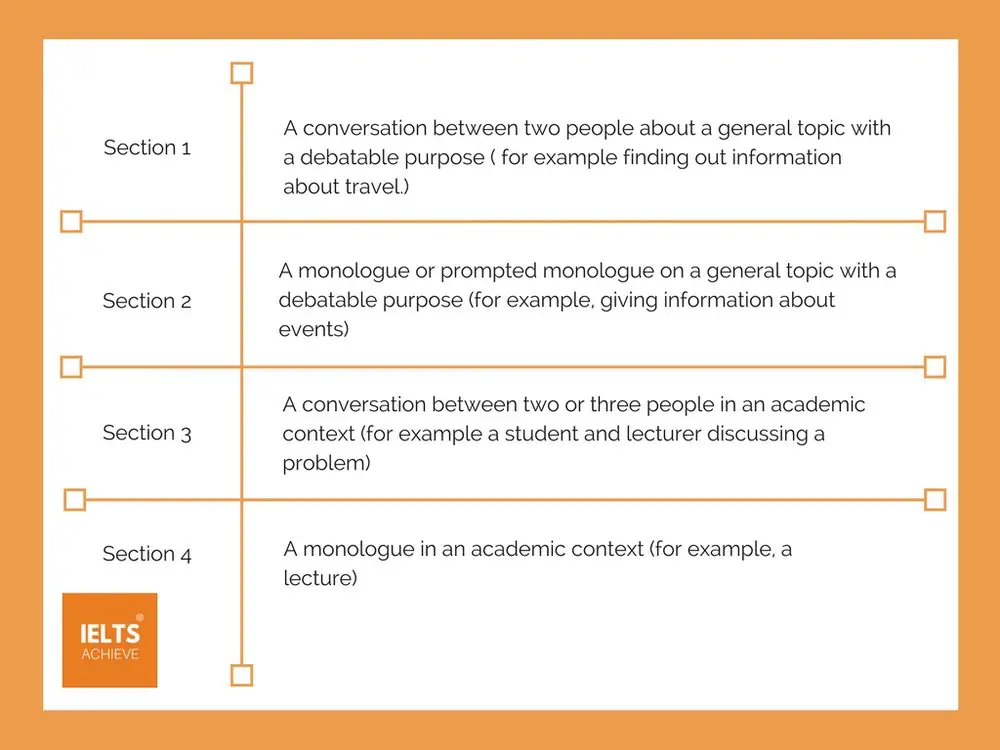
Sections 1 and 2 are set in a social context and sections 3 and 4 are set in an academic context.
You may hear one of the following;
A conversation between a travel agent and a customer
An introduction to animal science
A dialogue between three students in a cafe.
A lecture about climate change
A conversation between student and teacher.
Parts 1 and 2 of the Test
Parts 1 and 2 are set in a social context, with general topics.
In part 1 you will listen to a conversation between two people, during the conversation they will complete some sort of transaction. A common plot involves a customer who calls a company to find out specific information about a service or product.
In part 2 you will hear a monologue that provides some sort of information. A possible plot is a speaker giving a short presentation on a service or a guided tour.
Parts 3 and 4 of the Test
Parts 3 and 4 are set in an academic context, with specialised topics.
In part 3 you will most likely hear a student and teacher discussing an academic topic.
In part 4 you will probably hear a speech or a lecture, in an educational setting. it is likely to be a topic you will know little about, but simple enough for you to understand.
Who is speaking and what is the topic?
Listen to the sound clip and think about the context – you should try to think about the context as soon as you can, this will enable you to predict the communication and information that you will hear.
Read the following questions and answer them as you listen;
What is the format of the recording? (is it a monologue? a conversation?)
Who is speaking? (an expert? a sales representative? A lecturer?)
What is the topic? (A lecture? A request for information? A tour?)
Answers are at the bottom of the page.
Accents you will hear
During the test, you will likely hear a variety of English accents, not just those from Britain. You could hear accents from America, Canada, Australia and New Zealand.
it is a good idea to try and listen to these accents before you take your test, listening to the radio, watching movies or TV shows is a good way to become more used to those types of accents.
Task Types
During the test, you will have 10 questions for each section of the listening test. below are the task types you may find in any section.
Notes/summary/table/flowchart completion – To complete with a suitable word or words with a given word limit.
Multiple Choice – Choose an answer (could be one answer or two answers from A-C / A-E.
Short Answer Questions – answer questions within the given word limit.
Sentence Completion – Complete a sentence with the suitable word(s) within the given word limit.
Labelling a diagram, plan or map – Label the diagram, plan or map with suitable words or choose them from a box of possible answers.
Classification – Classify the information according to three different types of criteria (A, B or C). This could include names, dates or times.
Matching – Match a list of statements to a list of possible answers in a box, for example, people, theories or dates.
The information you hear will be in a logical order, that is the information given will appear in the same order as the recording. You will hear the information relating to the first question before you hear the information for the second and so on.
Sometimes, you may need to select an opinion from a list of options and the listed items are in a random order.
Spelling and Numbers
Be aware of you spelling during the test as misspelt words will cost you marks. Both US and UK spelling are allowed in the test, but any that are incorrect will be marked as incorrect. This is important for all spelling, but important for names and places too, make sure you spell them with a capital letter to get a correct answer.
At the end of the test when you transfer your answers to the answer sheet (10 mins) be careful with your spelling and make sure your answers are grammatically correct.
You should also be aware of numbers during the test, as they will likely be included in part 1 of the listening test. How well do you know your numbers?
52nd = ordinal number
65% = percentage
€35.00 = amount of money
365 – cardinal number
1980 – date
Do you also know currencies? from British Pounds £ to Euros € to US Dollars $?
Practice
Practice with a range of test papers you find online or from IELTS textbooks. You can find IELTS listening practice tests from the British Council . Try to complete the test in exam conditions (listening only once!)and go through your answers, checking the errors and looking back to see why you made those errors.
You should also aim to listen to English as often as you can, from the BBC News, TED Talks, movies, TV shows, documentaries etc in a variety of accents. Think about listening to different accents – American, Canadian, Australian, New Zealand as well as regional accents from the UK.
Answers >>
Who is speaking and what is the topic?
1. The recording is a monologue.
2. A female speaker who is promoting an exhibition.
3. This is a presentation to introduce an exhibition.
We hope you found this post useful in helping you to study for the IELTS Test. If you have any questions please let us know in the comments below or on the Facebook page.
The best way to keep up to date with posts like this is to like us on Facebook, then follow us on Instagram and Pinterest.
If you need help preparing for the IELTS Test, join the IELTS Achieve Academy and see how we can assist you to achieve your desired band score. We offer an essay correction service, mock exams and online courses.
When studying for the IELTS Reading Test, it is important that you take the time to learn how to increase your reading speed, if you are aiming for a band score 7 or higher. During the reading test, you will have texts to read comprising of 1000+ words each. You will not have enough time in the 60 minutes given to read and understand every word in detail. Therefore you must practice with sample tests and learn how to skim read, scan and speed up!
Skimming and Scanning
The differences between skim reading and scanning are;
Skimming – a text quickly for the main ideas.
Scanning – looking through a text for specific details.
Skim reading a text means to read it quickly to find the main idea, it will also show you how the information has been organised. With practice, you should be able to skim read around 100 words in 30/40 seconds.
Scanning a text for specific details is another important skill to develop, as this can help you to find information quickly, like dates, numbers or names.
For more in-depth information on skimming and scanning please take a look at this post.
Speed Reading
Learning how to increase your reading time will give you many advantages in the reading test, including being able to get a higher band score.
By practising speed reading, you will understand the main ideas quickly and be able to locate the information you need in order to answer the questions. Here are some tips to help you to get started >>
TIP 1 >> Cover It Up
Use a blank sheet of paper to cover the words as you read down the page. this can help to stop your eyes from jumping back to text you have already read.
TIP 2 >> Use A Pencil/Pen To Guide You
Try following the words on the page with a pencil or pen, it can help to increase the speed that you go through the text.
TIP 3 >> Time Yourself
Try timing yourself when you are reading practice texts, how much can you go through in 30/40 seconds? How much of that did you understand?
TIP 4 >> Set Goals
Start practising with sample texts and see how much you can read in two minutes, three minutes or five. then, cut that time down less and less and see how much information from the texts you can remember.
TIP 5 >> Look After Yourself
Know when you work best and set aside some time to prepare. If you work best in the mornings (or evenings), set some time to practice in a quiet environment if you can. Rest those eyes and have a break after 30/60 minutes.
Exercise 1
Read the text below taken from an article on the BBC News Website. There are four paragraphs, each with around 100 words.
Using a timer – read through the text to understand the main idea
After only 30 seconds start reading the next paragraph
A
“Mean-spirited” and “wrong-headed” is how teachers’ leaders have described Theresa May’s plan to scrap free school meals for infant pupils in England. And perhaps to some, it may seem bullish to deny the youngest kids a free lunch, even if free breakfast is on offer. The move has sparked taunts of “May, the meals snatcher” – reminiscent of Margaret Thatcher’s infamous cancelling of free school milk. But to Theresa May’s Conservatives, it was a policy that no longer added up. The party does not believe “a free school lunch for every child in the first three years of primary school… is a sensible use of public money”.
B
It’s one of those tough decisions – but a free breakfast, cheap at a 10th of the price, now seems a more desirable alternative to the Conservatives – although the value of the free-lunch scheme has never been assessed. For some, the idea – brought in by the coalition government in 2014 – was always too expensive. It was very much a Liberal Democrat policy and plans were announced by Nick Clegg at his party’s conference in 2013. It was not long before his man in the education department, the then schools minister David Laws, was accused of understating the costs of the policy itself.
C
They say the pressures on their budgets are much more about the unfunded extra costs of teachers’ pay, pensions and national contributions. Valentine Mulholland, head of policy at the National Association of Head Teachers, said: “After the nightmare of bringing this policy in at breakneck speed and all the capital funding spent to upgrade kitchens and dining facilities, it’s pretty sad to see this U-turn.” A BBC News Freedom of Information request just six months before it was due to come into force, in September 2014, found 2,700 primary schools needed new catering facilities before they could even think about offering free meals to all infant pupils.
D
Mr Courtney’s claim may seem alarmist to some, but it will ring true for many teachers, who often raise the issue of pupil hunger. Nicky Gillhespie, the school business manager at Cheam Fields Primary, said things were very different before her school introduced free school meals.”We had children coming in with nothing. “There were some who’d been given a pound by their parents to stop and get something in the sweet shop for lunch on the way to school,” she said. The school in Cheam, south London, had no kitchen when the free school meals pledge was made and dinners were driven over to the school by a catering firm.
Questions
Look at the questions below and answer without looking back at the paragraphs for detail, try to remember where you read this information >>
Question 1.1
A – At the beginning
B – In the middle
C – At the end
1. A comparison of school meals now and in the past
2. Many kitchens and canteens had been renovated
3. Some pupils were given little money to buy food/snacks
Skim read the paragraphs for the answers to the following questions >>
Question 1.2
Which of the titles below would be most appropriate for this article?
A. Children’s school dinners are badly prepared
B. Free school dinners are no longer an option
C. Why free school dinners are soon to be forgotten
D. Why kids love free school lunches
Question 1.3
Which of the following describes the writer’s tone in this article extract?
A. She is giving a neutral account
B. She is showing how shocked she is that school dinners may no longer be free
C. She shows her enthusiasm for the government’s response to school dinners
D. She doubts that the situation will change in the future
Answers are at the bottom of the page.
Review and Strategy
TIP >> Skim read the text for the main idea – don’t worry if you do not understand all of it, read what you need to answer the questions and move on.
TIP >> Know your timing for each question – three texts with 20 minutes each – including transfer time. Answer the easier questions first, so that you can spend a little longer on the hard questions. The easier questions should come first, as the texts get progressively more difficult.
TIP >> Read the instructions before you do anything – understand what you have to look for before you start reading the questions and the text.
TIP >> Use your other reading skills to help you to increase your reading speed and get the best band score possible!
Answers >>
Question 1.1
A – 1
B – 2
C – 3
Question 1.2
C
Question 1.3
A
We hope you found this post useful in helping you to study for the IELTS Test. If you have any questions please let us know in the comments below or on the Facebook page.
The best way to keep up to date with posts like this is to like us on Facebook, then follow us on Instagram and Pinterest.
If you need help preparing for the IELTS Test, join the IELTS Achieve Academy and see how we can assist you to achieve your desired band score. We offer an essay correction service, mock exams and online courses.