Proven strategies for this IELTS Listening question type. Includes prediction techniques and common traps to avoid.
Originally published July 2017. Last reviewed 3 July 2026.
In this post, we will take a look at the 5 main listening skills you need to have to be successful in the IELTS Listening Test.
It's a wonderful idea for you to not only practice with IELTS Listening Tests online but also to listen to talks, podcasts, audiobooks, documentaries, tv shows, the news and movies. Listening to something that you are interested in during your preparation will make you enjoy it more! This will not only help you to develop your listening skills but also to improve your use of general English. Non-native speakers often develop their language skills by watching TV shows or movies. For more academic content, listening to TED Talks or TED-Ed is a great way to listen to different accents and test your listening abilities.
Take a look at the skills needed in this post and practice using the exercises, see how much information you can focus on and how much of it you can understand. There are multiple-choice questions for most of the videos if you visit the TEd-Ed website. Links are underneath each section.
1. Prediction
During your IELTS Listening test preparation, you should aim to practice predicting the answers before you start listening to the recording. Read through the questions and think about the context, what is the main subject? A teacher talking to students? Are the students asking for essay feedback? Get an idea of what the main subject is before you start to listen so that you know what you are listening out for.
Predicting is an important skill to have, it helps you to foresee the content and this makes it easier to understand the speaker.
TIP >> Practice with IELTS test papers and also with talks from TED-Ed, where you can practice predicting answers with multiple-choice questions.
Listen to the talk below from TED-Ed, and answer these questions: Visit the website for multiple-choice questions.
How do kidney stones grow in the first place?
Why are they so painful to get out?
2. Take Short Notes
Taking short notes during your listening practice will help you to determine the right answers. In the test, you are allowed to make notes on the exam paper, so it makes sense to do this during your preparation too. It is particularly useful in the maps, plans and diagrams questions, where you may need to draw lines after listening to directions.
TIP: Listen to a talk/lecture and make short notes on the content.
Listen to the talk below from TED-Ed, and make short notes to answer this question: Visit the website for multiple-choice questions.
How can various compounds impact the way we physically feel, think, and even behave?
3. Synonyms and Paraphrasing
Being able to paraphrase and recognise paraphrasing is also very important. Many of the speakers will paraphrase - the questions may paraphrase using different words with the same meaning (synonyms). Always read the questions before you start listening to the recording.
TIP: Practice by listening to a talk/lecture and writing down any vocabulary you do not know. Then look up the words and keep a note of the meaning. Keeping a vocabulary notebook is a great idea, to help you to learn new words.
Listen to the talk below from TED-Ed, and make a note of any words you do not know, look for the meaning of the words and check for synonyms in a thesaurus. Visit the website for multiple-choice questions.
4. Recognising Sequencing
When you hear someone talking through a process or a lecture they are about to give, they will most likely use sequencing, for example, words like; first of all, secondly, next, after that and finally. When you hear these words you know where you are in the talk and what the speaker is going to say next. It will make it much easier for you to find your answers in the recording if you can recognise the sequence of events.
TIP: Listen out for the language of sequencing when you listen to a talk/lecture.
Listen to the talk below from TED-Ed, and make a note of the sequencing words used. Visit the website for multiple-choice questions.
How does the speaker talk you through the process?
Do they sign post certain steps with words you recognise?
5. Understanding Opinion and Attitude
You should be able to understand how the speaker feels or thinks about a subject. For example, in a talk about travelling, you may hear views on certain places and how they feel when going there. This can help you to understand how they explain their opinions and views through the language they use.
TIP: Listen to a talk/lecture and think about how the speaker is thinking and feeling. Make notes and consider the vocabulary they are using.
Listen to the talk below from TED Talks, and see if you can answer the questions below;
How does the speaker feel about allowing children to be creative in school?
How does he share his opinion on the subject?
What vocabulary does he use to give his opinion? I think.... / In my view etc
How does the speaker support his opinions? with examples?
What kind of examples does he share?
What is his overall attitude to the education system?
Proven strategies for this IELTS Listening question type. Includes prediction techniques and common traps to avoid.
Originally published July 2017. Last reviewed 3 July 2026.
In this post, we will take a look at how you can practice using your listening skills so that you can be super successful in the IELTS Listening test.
There are 5 main tips that you can follow to make sure that you are improving not only your listening skills but also your General English.
Take a look and try out the practice exercises!
1. Give It Your Full Attention
When you listen to something, a practice test, youtube videos, audiobooks or podcasts etc, try to be fully focused on what you are hearing. Don't allow yourself to become distracted. If you have other things on your mind and you tend to zone in and out, try to sort out things you need to do before you start your listening practice and preparation.
When listening, pay your full attention to the words used and the tone of voice. This will help you to find out the information you need.
Listen to the TED Talk below and think about the following questions >>
What story does the speaker tell about his sister?
What is the reason he wakes up every morning?
How do people measure their happiness?
What examples does the speaker give to support his points?
Should we work harder in order to be happy?
2. Pick Up Key Points
Many people lose focus when someone has been talking for more than one minute. It is really easy for our attention to drift away and start thinking about other things, making us miss out on information the speaker has given.
Try to stay focussed and listen out for key points the speaker is giving to you. For example, if you are listening to a TED talk, think about the key points you have heard and make some notes.
Listen to the TED Talk below and think about the key points >>
3. Practice Active Listening
Focus completely on whatever you are listening to and what the person is saying. A good exercise to do for practice is to sit down with a friend and practice giving feedback on what they have been saying. You should focus on their words, grammar and how they give you their information. Doing this will make you think about the information they are giving you in much more depth, focus on the specifics.
Active listening will help you to think about understanding pronunciation, vocabulary, grammar and structure.
Listen to the TED Talk below and think about the following >>
Pronunciation
Vocabulary
Grammar
Structure
4. Be Curious
Be a curious learner and listen to more than just the IELTS practice tests. Look for opportunities to practice your listening skills in other places, such as listening to podcasts, TED talks, the news, tv shows, documentaries or audiobooks. Always be on the lookout for interesting things you can listen to.
Take a look at the links below and listen to some great content:
When you listen to a TED talk or the news, for example, think about the views of the speaker, how do they feel about the issues? What are their thoughts on the subjects that are being discussed? Being able to recognise the attitude and opinion of the speaker are necessary to be successful in the IELTS Listening Test.
Look out for the language they use to convey their opinions to the audience and how you pick up on that, what type of vocabulary do they use? How do they tell the audience what they think?
Watch the video below from TED Talks, can you answer the following questions?
How does the speaker feel about the refugee crisis?
What language does the speaker use to convey his opinions to the audience?
Essential strategies and practice techniques for this IELTS Reading question type. Learn how to manage time and improve accuracy.
Originally published June 2017. Last reviewed 3 July 2026.
In this post, see the top 5 reading tips that will help you to achieve a band score 7 or above.
In the IELTS Reading Test for both the General Training and the Academic, the skills needed are the same. The main difference of these tests is the type of texts the students will read. In the General Training Reading Test, the students will read both long and short texts taken from newspapers, flyers, timetables, etc. The Academic students will have 3 long texts that will progressively get more difficult. They will be taken from journals, newspapers, books etc.
You will have 40 questions to answer in 60 minutes, with no extra time to transfer your answers to the answer sheet.
Here is a list of the different types of IELTS reading questions:
Always make sure that you read the instructions before you start looking at the questions or text. The instructions for the reading test are very specific - meaning if you don't follow them exactly you will lose marks.
For example, if the instructions say to only write one word - then look for one-word answers. If you write more than that your answer will be marked as incorrect. The same goes for two-word answers or three, look for the amount of words or numbers that you are allowed to write.
TIP 2: Be Aware Of Timing
Ideally, you should spend around 20 minutes or just under on each text as you have 60 minutes to complete the reading test. In that 20 minutes - look at one text, answer the questions, transfer them to the answer sheet and check them. It is important that you leave yourself enough time to transfer your answers onto the answer sheet and check them.
Practice as much as you can with sample tests, looking at those that challenge you as well as other texts that you find slightly easier. The more difficult texts can take more time, so be aware of how much time you spend on those, practising skimming and scanning skills to increase your reading speed.
TIP 3: Answer Every Question
Try to answer every question, even if you are not 100% sure of the answer. Many students report leaving gaps on their answer sheet because they did not know the answer or they ran out of time. You can try your best to answer each and every question.
TIP 4: Forget What You Know Already
The IELTS Reading Test is testing your ability to understand information in the texts you are given. So don't think about your previous knowledge on the topic, only focus on the text in front of you.
TIP 5: Paraphrasing, Synonyms And Vocabulary
It is really important to study all forms of English when studying for the IELTS Test, looking at how a text is paraphrased, learning new words and using synonyms. Reading more will definitely help you to develop your vocabulary knowledge, as well as recognising synonyms.
When you are studying, use an online thesaurus to check for synonyms and meanings and if you are reading longer complex texts, keep a notebook of words you do not know and their meaning. You will also see how ideas are connected, which can help you in the writing tasks also.
Step-by-step guide to answering this type of IELTS Writing Task 1 question. Covers structure, key language, and band-scoring criteria.
Originally published June 2017. Last reviewed 3 July 2026.
In this post, I want to share with you the 8 tips that you should remember in order to have IELTS Academic writing task 1 success!
There is a lot of information out there for you to read and remember, but during lessons with my students I always repeat the same things and those that choose to listen and study hard achieve the band score they need (7+!)
So here are the 8 tips for writing task 1 success!
1. Understand the question
Make sure that you read the question properly a few times, so that you fully understand what it is asking you to do. I often read essays where the student has misunderstood the question. This is not good for your score if you do this during your test. So always read the question and make sure that you understand what it is asking you to do.
The questions in writing task 1 normally say 'report the main features and make any comparisons'. Look for those main features and if you can make any comparisons. You can highlight information on the paper/question before you start to write your essay. Practice as much as possible beforehand, using various academic writing task 1 questions and an approved essay structure.
2. Practice the essay structure
The structure that I advise my students to use, changes slightly depending on which question they have for writing task 1.
However, it has a core structure, that if used well, will be sure to get you a band score 7+. You need to practice using this structure, with as many questions as you can, before sitting your IELTS test. This writing task 1 structure has been proven to be successful for my students and when perfected, can easily help you to achieve a high band score.
3. Create an effective overview
The overview is the most important paragraph in the writing task 1 essay and without one, you will lose marks. this will affect your score and your ability to gain a band score 7 or higher. Practice writing an overview of different types of questions.
4. Use the right language
In the writing task 1 section of this website, you will find language help in most of the posts. It is important to use the right language when writing your essays. This can affect your band score, so it is worth studying and practising as much as possible.
For example, you should be able to paraphrase the question using synonyms, use signposting language (Overall, the line graph shows that..) and linking words(however, in contrast, one the one hand, on the other hand, therefore, in addition, etc). You should also be able to describe change and for the maps questions describe locations this will gain you marks in the lexical resource part of the marking criteria.
5. Know the Grammar
Think about the grammar you are using, if the question features change over a period of time, then make sure you use the correct tense when writing about those changes. For example, if a figure is projected to increase over a period of ten years up until the year 2022, you use the future tense >> 'The price of oil will continue to increase up to £50billion dollars by the year 2022'. Practice with these types of question, so that you can use the past, present and future tenses.
When practising you can use 'Grammarly' which checks your work as you type, this will help you with spelling, punctuation and grammar errors.
6. Know the content
You need to able to report neutrally on the visual information presented to you. You should not include any opinion on the data, only report the data and trends that you can see.
It is a good idea to spend a minute or two looking at your chart/graph and circling/highlighting any information that is important.
For example, think about the following questions:
What is being measured and how?
Is it in percentages? Millions? Degrees? (for the temperature)
Then think about the timing - is it over the period of one year? Five? or Ten?
Can you make any comparisons?
7. Be selective
The question will ask you to 'report the main features and make any comparisons' so look for those main features - any highs/lows etc. Don't write about every piece of information that you can see. This will lose your essay marks and affect your band score.
You need to practice highlighting the main features/any comparisons that you can see and plan your essay around those. Then practice writing in 20 minutes, you do not want to spend too much time on writing task 1, as writing task 2 has more weight in the marks.
8. Can you read it?
When practising writing your essays, check if you can read you own handwriting afterwards. If you find it difficult to read, then so will everyone else! Make it neat and easy to read, this is important so that the examiner can read your writing clearly. The advice from The British Council does say that candidates are allowed to write entirely in capital letters if they wish. This may make your writing easier to read.
It is also important that you separate the paragraphs, and don't just have one big block of text. This will lose you marks in the test, therefore you can skip a line on the paper, to show that a new paragraph has been started. In the marking criteria, you do get marks for 'logically organises information and ideas' (Band score 7) so it is important to show that you have organised your information into logical paragraphs. Take a look at the essay structure to see how to organise those paragraphs well.
Step-by-step guide to answering this type of IELTS Writing Task 1 question. Covers structure, key language, and band-scoring criteria.
Originally published May 2017. Last reviewed 3 July 2026.
This post will help you to write a successful line graph essay, there is a model answer for you to compare your work to at the end of the post.
Remember that your essay should have a minimum of 150 words and ideally should be completed in 20 minutes.
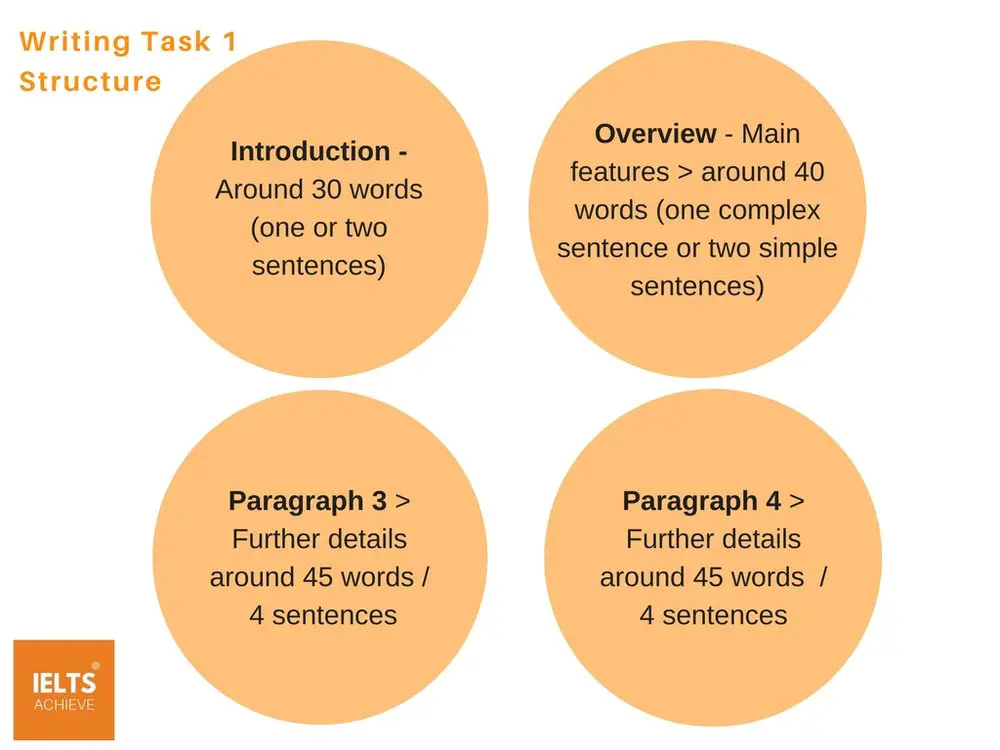
Line Graph Essay Structure
The writing task 1 essay should be as follows:
Sample Question: Line Graph
Read the question below carefully, what can you see in the information given?
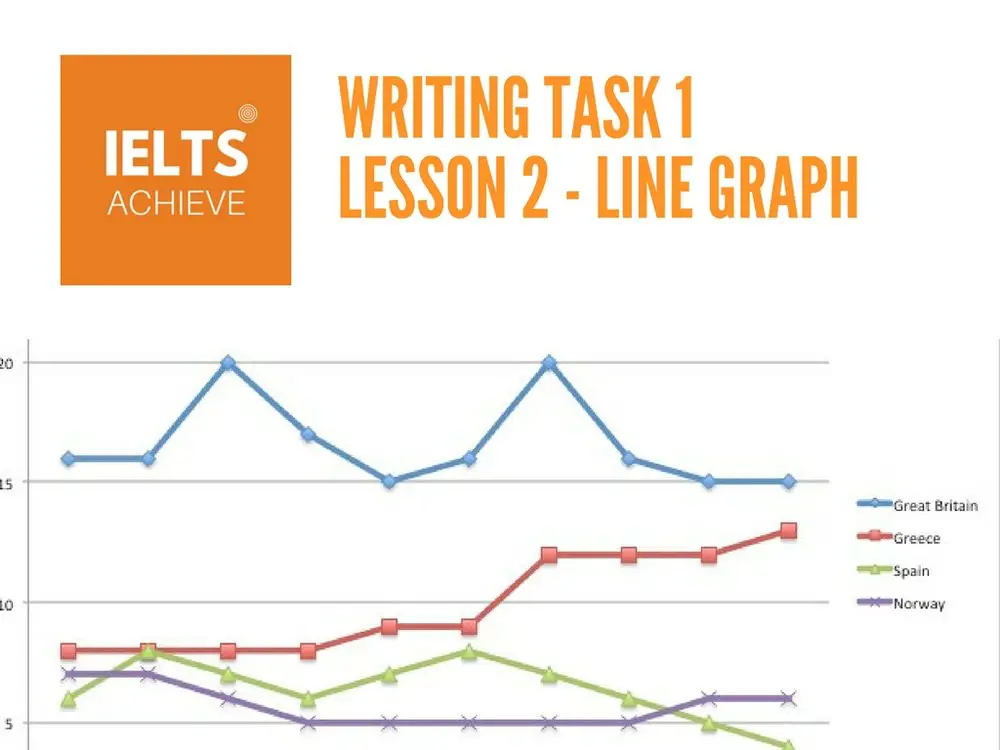
The line graph shows burglaries per thousand in four countries between 2000 and 2009. Summarise the information by selecting and reporting the main features and make comparisons where relevant.
STEP 1 - WRITE THE INTRODUCTION
Write your own introduction of one or two sentences, paraphrasing the question, using synonyms where you can.
STEP 2 - WRITE AN OVERVIEW
Write the overview - start this paragraph with the word 'Overall...' and write one or two sentences which describe the main features of the information presented in the line graph.
STEP 3 - WRITE THE MAIN BODY PARAGRAPHS
Write two main body paragraphs, going into detail and giving specific information about the graph. Remember to include data to support your findings. For example, look for the highs and lows and any major increases or decreases over time.
STEP 4 - CHECK YOUR WORK
When you have completed the essay, check it for any errors, spelling or grammar. Then check to see if you have included linking words that connect the information together, making it easy to read. For example, using the word 'Overall..' at the beginning of the overview paragraph. You can also use words like - on the one hand, on the other hand, furthermore, however, in addition, finally etc.
Model Answer for Line graph essay
To view more model answer for similar question please click the link below:
The graph illustrates comparative statistics on the number of burglaries in four countries (Great Britain, Greece, Spain and Norway) over a 10-year period (2000-2009). The units of thefts were measured in thousands.
Overall, the highest recurrence of burglary was in Great Britain, which was fairly high from 2000-2009 in comparison to the other countries, while the lowest incidence when the study began in 2000 was in Spain. It can be seen that in 2009 Spain reported slightly lower figures than the other four countries.
The graph shows that Great Britain’s burglaries were consistently high, never below the 20,000 mark, though the trend fluctuates over the 10-year period. According to the data, the country experienced the highest number of thefts during 2002 (20,000) and 2006 (20,000). However, it experienced its lowest amount stolen in 2009 at approximately 15,000.
Similarly, Spain experienced fluctuating trends, but on the opposite side of the spectrum as it reported the least amount of burglaries in 2000 (6,000) with frequency varying over the years and finally reporting a decline in 2009 (4,000). However, other notable statistics are Greece’s upward trend in the number of burglaries, which started in 2000 (8,000) and finally peaked at 14,000 during 2009. Norway is also noteworthy for having considerably low thefts over the course of 10 years compared to the other countries, dropping sharply in 2003, but increasing slightly from there, finally peaking at 6,000 slightly higher than Spain.