Essential strategies and practice techniques for this IELTS Reading question type. Learn how to manage time and improve accuracy.
Originally published April 2023. Last reviewed 3 July 2026.
Video Games and Violence
For quite some time now, video games that involve significant amounts of violence have been blamed for growing numbers of violence by young people, the demographic most likely to play these games. Debate about this has even reached the courts, with both sides of the argument claiming that the scientific literature supports their opinions. Some experts involved have proclaimed that the debate is scientifically settled and that only people holding personal concerns and biases oppose these established truths.
Scientifically, two competing social theories have been formulated about the potential effects of video game violence. The first is that video games increase violence because they teach players how to be violent and reinforce violent tendencies. The second theory is that video games have a possibly beneficial effect, because they provide a socially acceptable outlet for the release of aggression and thereby promote better mental health.
Articles reviewing the effects of video games on general populations have found links between playing violent video games and changes in behaviour, and/or thought process, with some finding that people who played realistic violent games for 45 minutes had a greater increase in violent and aggressive feelings than persons who played unrealistic violent video games or non-violent video games for the same period. What seems clear though is that certain populations are more at risk and/or are more likely to play violent video games than others.
Studies suggest that at-risk individuals are usually male, have pre-existing personality disorders or traits, for example a conduct disorder, have pre-existing mental health conditions, have had difficult or traumatic upbringings, and are insecure with poor self-esteem. Children with attention deficit disorder were also seen to be at a higher risk of showing addictive behaviour to violent video games and that violent video games might be a significant risk variable for aggressive behaviour in persons who already have aggressive personality traits.
There are, of course, plenty of other groups of people (probably the majority of users) who play and enjoy video games, with or without violence, that have no character disorders at all. Another recent key report which relied on parents’ self-report of their children’s video game playing behaviours suggest that spending a large amount of time playing violent video games was correlated with troublesome behaviour and poor academic achievement. The same study also indicated that children who played more educational games had more positive outcomes.
What is interesting is that the comic book debate of the 1950’s is eerily similar when compared to the current debate about the effects of video games on children. In 1954, the US Senate Subcommittee on Juvenile Delinquency held hearings on the effects of comic books on America’s youth. The primary focus of the Senate hearings was ‘crime and horror’ comic books, some of which graphically showed horrific images, such as dismembered bodies.
Concerns were voiced that these comics would lead to a decline in public morals, an increase in violence and aggression, an increase in general lawlessness, and societal disrespect and deterioration. Medical and social science experts became involved in the debate, writing articles in reputable journals. Many of the concerns that dominate the current video game debate were also expressed and it could show the frequently experienced perception that violent behaviour is always more prevalent in the present than in the past and that people just search for a scapegoat on which to blame it.
Although many articles have suggested a connection between violent video games and aggression, several studies have found no such relationship. One study in fact showed that non-gamers and excessive gamers both had lower self-reported mental wellness scores than low to moderate gamers. This finding suggests that excessive playing may be detrimental, but that there are some protective and non-harmful consequences to playing in moderation.
This finding is in line with social theory, which suggests that video games, like sports, may provide an outlet for individuals to work through aggression and, therefore, have better mental functioning and overall lower levels of aggression. The same study pointed to the positive attributes of violent video game playing, such as improved visual-spatial coordination, increased peripheral attention, and increased decision-making capabilities. People who play a lot of video games also generally have better overall computer skills than people who do not.
Another study examining the multivariate risk issues for youth violence showed that the most common positive predictors of youth violence were delinquent peer influences, antisocial personality traits, depression, and parents or guardians who use psychological abuse in family relationships. The factors that were not found to be predictive of youth violence included neighbourhood quality, parental use of domestic physical violence in intimate relationships, and exposure to violent television or video games.
A recent neurological study provided further evidence that video games do not increase violent behaviour by users. The study examined whether there was a change in brain imaging that suggested a loss of distinction between virtual and actual violence in players of violent video games compared with controls. What was found was that the ability to differentiate automatically between real and virtual violence was not diminished by a long-term history of violent video game play, and nor were gamers’ neural responses to real violence subject to desensitization processes. This would indicate that video games do not cause people to lose their grip on what is real in comparison with what is fantasy.
Many questions are raised by the split nature of the scientific literature regarding violence and video games and it should also be remembered that a correlation does not prove a causation. Stakeholders need to examine the current video game debate in order to decide how to sensibly influence social policy.
Questions 27-33
Do the following statements agree with the information given in the text?
TRUE if the statement agrees with the information
FALSE if the statement contradicts the information
NOT GIVEN if there is no information on this
27 Violent video games are most likely to be played by people in their youth and middle age.
28 It has been claimed that people, who still feel the effects of violent video games are not decided and clear, have vested interests in the debate.
29 lt is claimed that men and women are more or less equally threatened by the effects of violent video games.
30 One study has found a link between usage of violent video games and poor school performance.
31 Various violent video games are based on stories previously published in comic books.
32 Some of the comic books of the 1950’s had shocking images of mutilated people.
33 It has been claimed that violence has always been present in society and video games are just the latest thing to blame it on.
Questions 34-39
Write NO MORE THAN THREE WORDS from the text for each answer.
Studies Defending the Use of Violent Video Games
Study 1
Non-gamers and excessive gamers had similar grading in terms of 34………….It shows excessive gaming can have protective effects.Similar ideas in social theory – users can rid themselves of 35……. and therefore have a better mental condition.Gaming can improve visual spatial coordination, peripheral attention, 36………. and computer skills.
Study 2
It examined the various risk factors for youth violence – peers, personality, depression and psychological abuse.Non-factors were 37…………., violence at home and violent TV and video games.
Study 3
A neurological study examining variations in 38…………. when users interacted with virtual and real violence.Results showed that users’ differentiation between virtual or real violence was not affected by the use of violent video games.The 39………… with regards to real violence in users’ neural reactions were also not affected.It shows video games do not affect people’s perceptions of what is real or what is fantasy.
Question 40
Choose the correct letter, A, B, C or D.
40 What is the writer’s purpose in the reading passage?
A To defend the use of violent video game usage.
B To discourage people from using violent video games.
C To examine examples of violence by users of violent video games.
D To review what has been discovered about the effects of violent video games.
Essential strategies and practice techniques for this IELTS Reading question type. Learn how to manage time and improve accuracy.
Originally published April 2023. Last reviewed 3 July 2026.
Private Space
A It’s a remarkable achievement: the question is no longer ‘How can we send humans into space?’ but ‘How can we keep them there?’. Spaceflight is reaching a turning point where new technologies in engine development, better understanding of aerodynamics and materials for body construction are making spaceflight possible for private industry.
B The history of space exploration, until relatively recently, has been one of big government-backed projects like the Space Shuttle, Mars Landers and Long March rockets. But the most recent launches to the International Space Station (ISS) have been very special for at least three reasons. Firstly, along with 450 kg of scientific equipment, food and clothes, the rocket was carrying ice cream for the three space station astronauts. Secondly, the rocket was unmanned, being guided into docking position and back to earth again by remote control and automated systems. Finally, the rocket was commissioned from a private company by NASA.
C When the privately owned rocket delivered its goods to the ISS, it marked a milestone in the evolution of space flight and vindicated NASA’s decision to delegate routine supply flights to the space station. The flight has been a long time in development. It started with President George W Bush announcing his Vision for Space Exploration, calling for the ISS to be completed. Under the next President, America’s Space Shuttles were retired, leaving NASA with no other choice but to look for alternative methods of supplying the ISS. The initiative was part of an effort to commercialise the space industry in order to decrease costs and spread the investment in the industry across a wider group than governments.
D The initiative had many attractions for NASA. By outsourcing to the private sector the routine business of taking food and equipment to and from low-earth orbit, NASA can theoretically free up money to do things that it really wants to prioritise: missions such as sending astronauts to Mars and landing on asteroids by the 2030s. Now that the Space Exploration Technologies Corporation (spaceX) has proved that private enterprise can be players in space exploration, firms are pouring money into developing new spacecraft built to transport cargo, to mine asteroids and to carry passengers into space.
E In the last half of the twentieth century only government-backed agencies like NASA and Russia’s ROSCOSMOS were capable of running space programmes due to the gigantic investment costs and uncertain payoffs. However, SpaceX and similar companies are proving that the former conditions are no longer relevant as new solutions are coming to light. Commercial companies like Boeing are able to raise large sums of money to run these projects.
Furthermore, as the firms are running cargo and taxi services to lower orbits, the break-even point is lower, the technology is cheaper and they have the benefit of years of experience in commercial aviation and space flight. Opening space programmes to the commercial sector has the additional advantage of generating more solutions to old problems. An analogy is the invention of the Internet. When the technology went into the commercial sector, no one could have envisioned the development of social network sites. Likewise, no one can predict where commercial enterprise will take the space industry.
F The uncertainty surrounding where the space industry will end up is a problem as well as an asset and it is unsettling private investors who like to invest in relatively certain prospects. At the moment the industry is dominated by big-spending billionaires like the owner of SpaceX. In addition, the relatively small number of companies in the area could pose a problem in the future. The commercial space industry is still very new and there is no guarantee that progress will be smoother. For one thing, no one is sure that the business model is sound: government is still the major, if not only, customer available to the private space companies.
The other problem is that space travel is high risk: the loss of space shuttles Challenger in 1986 and Columbia in 2003 illustrates that even the most carefully planned launches have unavoidable risks associated with them. The question is what would happen to the industry if another accident occurred. Finally, many space experts are doubtful that, even if private industry takes over the ‘taxi’ role for low-orbit missions, NASA will be able to achieve its ambitions, given its squeezed budgets and history of being used for political purposes. Furthermore, NASA may have created another space race, this time between government and private industry. If NASA doesn’t go to Mars or the asteroid belt, its private competitors certainly have plans to do so.
G In spite of all of these risks, many argue that it is critical for the private sector and federal government to work together to push further into space.
Questions 1-6
The passage has six paragraphs labelled A-F.
Which paragraph contains the following information?
Write the correct letter A-F in boxes 1-6 on your answer sheet.
1 NASA being able to spend money on important projects ……….
2 events leading to the commercialisation of spaceflight ……….
3 new developments that have made spaceflight more accessible ……….
4 an automated rocket that successfully completed a mission ……….
5 the great dangers of space travel ……….
6 new answers being found to previous questions ……….
Questions 7-11
Choose the correct letter, A, B, C or D.
7 Which is NOT mentioned as making private space flight possible?
A new methods of constructing the rockets
B modern substances from which to build the rockets
C understanding better how air moves round objects
D new methods of making space suits
8 Why are the recent launches special?
A Their destination was the International Space Station.
B They carried clothes.
C They were not managed by a private company.
D The rocket is not owned by a government.
9 In order to make NASA look for other spaceflight providers, the US government
A invested in private space companies.
B started to build the international space station.
C stopped using the Space Shuttle.
D allowed private companies to fly into space.
10 Private companies
A need to reduce the cost of space projects.
B have social network sites.
C are able to fly rockets at high orbits.
D act as ferries to and from the space station.
11 At present, the private space industry is characterised by
A uncertainty about how to make profits.
B companies controlled by individuals.
C companies too small to raise the amount of money needed.
D government interference.
Questions 12-17
Complete the summary below.
Choose NO MORE THAN TWO WORDS from the passage for each answer.
Write your answers in boxes 12-17 on your answer sheet.
There are a number of problems with commercial space projects. To start with, the 12……… might not be sound. There is also great 13……….. attached to space flight – what would happen if there was another 14……..? Experts doubt whether NASA can fulfil its 15……….. as it has often been under 16…………. pressure. Moreover, the development may lead to a 17………… between NASA and the private space industry.
Essential strategies and practice techniques for this IELTS Reading question type. Learn how to manage time and improve accuracy.
Originally published April 2023. Last reviewed 3 July 2026.
A Neurologists tend to divide the experience of love into three distinct categories: attraction, lust, and attachment. The combination of all three can make for an intoxicating and lasting bond, but they have not always experienced together. Frequently, for example, we lust after those with whom we have no desire of having a long-term relationship; at other times, we feel ‘attached’ to people in the sense of being drawn to them emotionally or spiritually, but not drawn to them physically.
It is accurate to describe these as ‘stages’ of love — lust tends to come first, then attraction, which lasts for months or years, and finally attachment, which can keep people together for decades. These are separate chemical substrates, so they can overlap; however, evidence suggests that attraction has a limited lifespan.
B Lust is typically experienced soon after puberty. This is when estrogen and testosterone — the underlying chemical substrates for lust in women and men respectively — activate themselves in our bodies for the first time. The primary purpose of lust is believed to be procreation, and the experience is one of feeling physically drawn, or even ‘pulled’ towards another person. Pheromones, physical attractiveness, and our socialized predispositions for what we seek in a mate are the factors that activate the sensation of lust. Despite the strength, it can have over our psyche, lust on its own is a very fleeting experience. It can firmly steer people together for their initial encounters, but it has no power to keep them there.
C If the relationship is to last, something called attraction must take place. The attraction is the intoxicating sensation experienced in the initial period of knowing someone. The ‘symptoms’ include dizziness, flushed skin, and a loss of appetite and sleep. These are a result of a chemical cocktail of dopamine and norepinephrine that PEA — a transmitter chemical — unleashes into the bloodstream when attraction takes place.
Dopamine is responsible for the blissful feelings of self- confidence, joy, and motivation that new love brings about; norepinephrine, similar to adrenaline, brings about palpitations and anxiety. The attraction has more staying power than lust; while its intensity fades after a few weeks, the effect of the PEA transmission can continue for some time between eighteen months and four years. After that, our bodies build up a natural tolerance.
D At this stage, a transition to a phase called attachment can occur. The ‘rush’ of attraction is replaced by endorphins like oxytocin and vasopressin that feel like a gentle, warm sort of pleasantness — a safe feeling that calms the mind, numbs pain, and soothes anxiety. This is a much more pleasant feeling in which to spend an extended period of time — potentially, forty, fifty or more years, depending on when you meet your partner.
It allows you to live your life with someone, without their being the central obsession of your life. Unfortunately, there is no guarantee that PEA transmission will evolve into the endorphin stage — in many instances, it will be replaced by a feeling of emptiness and dissatisfaction. It is not a coincidence that peak divorce rates occur at between four and seven years, as PEA transmission wears away and attachment does not materialize in many people’s brains.
E Even neurologists agree that chemistry isn’t everything. There are numerous other factors such as culture and personality, for which science may never have an explanation. While dopamine is bliss, however, ignorance is not — neurology has much to contribute to satisfaction in our personal lives. It may not be a good idea to commit to marriage or spending the rest of your life with someone if you still feel the blissful rush of PEA transmission, for example.
Once your brain has succumbed to the warming opiates of oxytocin and vasopressin, this will be a safer commitment. Attachment brings other needs to the foreground, however; while people enjoy the security that attachment brings about, they do not lose their desires for either lust or attraction. Losing the ability to give your partner the rush of PEA transmission, while knowing that he may feel this for other people, can bring about jealousy and anxiety in people. Acknowledging and discussing these insecurities can alleviate them as it is likely that, to some extent, both partners will be feeling them.
Questions 27-33
Choose NO MORE THAN TWO WORDS AND/OR A NUMBER from the passage for each answer.
Lust
Attraction
Attachment
Designed to encourage 27 ……………..
Two chemicals are released through a third one called PEA.
Chemicals in the brain work to reduce physical and mental suffering, and calm 31 …………
Generated by natural scent, look and 28 ……………..
29………….. is a feel-good chemical, norepinephrine, brings about elevated heart rate and nervousness.
Separate chemical processes mean PEA transmission does not always progress to 32 …………….. There is a relationship between 33 ……………… and the failure of attachment to occur.
Has weak staying power
Can last for up to 30 ……………..
—
Questions 34-39
Do the following statements agree with the views of the writer in the Reading Passage ?
YES if the statement agrees with the views of the writer
NO if the statement contradicts the views of the writer
NOT GIVEN if it is impossible to say what the writer thinks about this
34 We cannot explain all romantic decisions based on chemical processes.
35 Knowing about brain chemistry can actually harm our happiness.
36 Long-term relationship commitments should be made after attraction has faded.
37 Relationship insecurities fade away once the attachment phase begins.
38 Growing resistance to PEA transmission is experienced as mental anguish.
39 Talking about the effects of PEA resistance on a relationship can make anxiety worse.
Question 40
Choose the correct letter, A, B, C, or D.
40 Which is the most suitable title for the Reading Passage?
Essential strategies and practice techniques for this IELTS Reading question type. Learn how to manage time and improve accuracy.
Originally published July 2017. Last reviewed 3 July 2026.
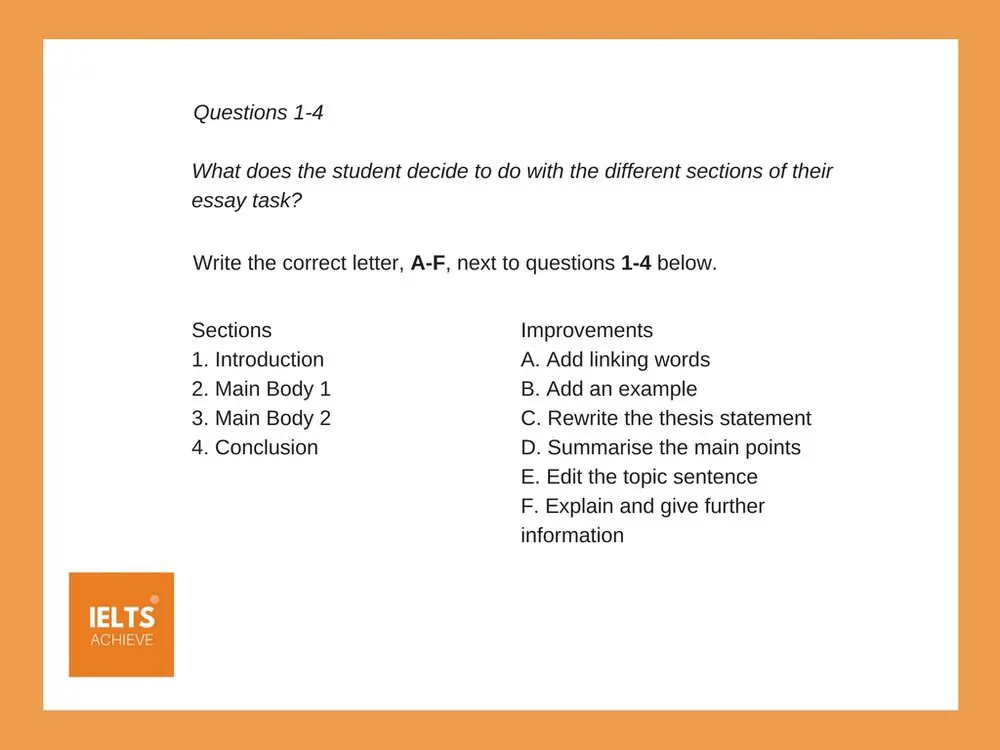
In this post, we will look at multiple choice and matching questionsin the listening test.
Multiple Choice Questions
You may have read the information about multiple choice questions in the reading skills section and be familiar with the format.
In the IELTS Listening Test, multiple choice questions are testing your skills of understanding the main idea in the recording and your ability to listen for specific information.
Some multiple choice questions start with a question, that has (for example) three possible answers.
Some questions will ask you to select a few answers.
You may be asked to select three answers out of seven. Therefore it is really important that you listen carefully to the recording.
TIP >> You must make sure you read the question before beginning to listen to the recording so that you choose the right amount of answers and have an idea what you are listening for.
TIP >> You should also listen for distractors, as they are used a lot in the multiple choice and matching questions.
TIP >> Concentrate when you record your answers, students often make errors and that loses them marks.
Short Answer Multiple Choice Questions
The first type of multiple choice question you might see is a short answer question. In this type of question, you will see a statement and a number of different options to choose from.
TIP >> You will possibly hear all of the options in the recording, but be careful that you do not just choose the first option and think that it is correct.
TIP >>Vocabulary – look out for certain words like but, however, or though, as they suggest the speaker is going to offer some alternative information.
Question Example
Sentence Completion Multiple Choice Questions
The second type of multiple choice question you may see is a sentence completion question. You will be given an incomplete sentence and you will have to complete it choosing from a certain number of options.
These questions are longer than other questions you will see in the listening test. You should have a quick read through and highlight any keywords you see.
You should also be aware of paraphrasing, as the speaker will probably paraphrase and use synonyms.
Question Example
Multiple Options
Some questions will ask you to select a few options and you must choose the right amount of options (and the right information obviously) in order for your answers to be correct. Therefore it is really important that you read the question before you listen to the recording.
The speaker on the recording might talk through all of the options, so concentrate and listen out for words and phrases that could distract you. These are often in there to trick you into choosing the wrong answer.
TIP >> Try to relax, when students are under stress to choose the right answer then move on quickly, they often lose marks as they choose any option. If you do miss it, there is no harm in taking a guess rather than leaving a blank space.
Attitude And Opinion
In some of the recordings you will hear, you will listen to speakers discussing an issue, making a decision or making an agreement. This means that you will have to identify an opinion or an attitude.
Listen carefully and see how the speaker uses language to convey their opinion or attitude towards something.
For example;
I was reluctant …..
I was surprised……
I am feeling hopeful………..
I’m wary about that…………
I am doubtful………..
I feel confused……….
Matching Questions
In matching questions you will see two parts with information. The questions will be numbered and appear in order. This means that the questions will be in the order of the information given in the recording.
You will see a box alongside the question in which to choose options and these are given in a random order. It is a good idea to cross out any options you do not need.
REVIEW AND STRATEGY
TIP >> Read the instructions and questions before you start listening to the recording. What are you being asked to do? Familiarise yourself with the questions and think about the context.
TIP >> Look at the options you have been given and highlight any keywords.
TIP >> Listen carefully for information but be wary of distractors.
TIP >> Be aware of paraphrasing and synonyms.
TIP >> Listen to the information carefully and don’t just choose the first option you hear. The speaker will probably mention all of the options – so listen to all and keep looking at the list of options, to select the right ones.
TIP >> If you do miss an answer or were not sure, then it is ok to take a guess. This is better than leaving a blank space and you never know, you might answer correctly!
We hope you found this post useful in helping you to study for the IELTS Test. If you have any questions please let us know in the comments below or on the Facebook page.
The best way to keep up to date with posts like this is to like us on Facebook, then follow us on Instagram and Pinterest.
If you need help preparing for the IELTS Test, join the IELTS Achieve Academy and see how we can assist you to achieve your desired band score. We offer an essay correction service, mock exams and online courses.