Expert tips and strategies for this part of the IELTS Speaking test. Includes sample responses and key vocabulary for Band 7+.
Originally published August 2017. Last reviewed 3 July 2026.
In this post, see the top 10 speaking part 1 tips that will help you to achieve a band score 7 or above.
The IELTS Speaking Test lasts 11-14 minutes.
The test has three parts, where you are interviewed by a trained examiner. You are not allowed to use a dictionary during the test. IELTS Academic and IELTS General students take the same test and it is marked in the same way.
PART 1 INFORMATION
To begin with, the examiner will introduce themselves to you, then ask you your name and for proof of identity.
Time:4-5 minutes You will be asked questions on familiar topics, like your hobbies, family, where you are from, what your hometown/city is like, etc.
The topics that are included:
Your studies/education
Hobbies/sports
Your family
What kind of movies, books, tv shows or music you like
What you like to eat / where you like to eat
Your job
Where you live
To view sample questions and answers on a variety of part 1 speaking topics, take a look at the other posts in this section.
Take a read through our top ten tips below, that will help you to gain a band score of 7 or above!
Speaking Tips
Tip 1: Be Prepared
As well as being prepared for the test questions on the day of your exam, you should also be aware of what to expect in terms of getting to the test centre and the beginning of the test. Arrive in plenty of time, so that you are not under pressure/late and have time to relax before the test.
The examiner will introduce themselves and ask you for your name and proof of identity (Passport etc), to begin with. They will also ask you where you are from, which requires a simple answer - this is more of a formality, so you don't have to extend your answer here, but simply state, for example; "I am from Romania' (or name the town/city etc you are from and where).
Take a look at this post for help with how to prepare for the speaking part 1 test..
Tip 2: Make A Good First Impression
Try to be relaxed and confident, having confidence will help you to do well in your test. Make eye contact with the examiner and answer any questions in a polite manner. Try to keep your body language friendly and open. Think of it as a natural conversation and try to stay calm, like you are talking to your IELTS teacher or practice partner.
Tip 3: Listen Carefully
Listen carefully to the examiner, so that you understand the questions and can answer in an appropriate way. You should also be listening for tenses - for example; "What TV Shows did you use to like as a child?' then you know that you should answer in the past tense - 'I used to watch.....'
You should also listen out for any yes/no questions and remember to answer and give reasons. Take a look at this post for help with how to answer those yes/no questions.
Tip 4: Show Enthusiasm
Show that you are interested in the questions by answering with enthusiasm, even if you are not really interested in the subject. Native speakers show enthusiasm by varying the pitch of their voice (intonation - the voice falls and rises) to show how they feel about something.
Listen to examples and think about how native speakers talk when answering questions, what happens to their voice? It gets higher when they are interested or excited by a subject and it falls when they are not happy or disinterested.
Watch the video clip below from the US TV show 'Friends' and see how the intonation falls and rises when the actors talk - can you notice the difference? How does it impact on what they are saying?
Tip 5: Extend Your Answers
When giving your answers, try to make sure that they are not too short - for example, if the examiner asks you what is your favourite TV show, saying 'I really like Peaky Blinders' is too short.
You can expand your answer by adding more detail of what it is about, and why you like it so much for example; 'I really like the BBC drama Peaky Blinders, it has an excellent cast and the writing keeps me interested in the story. There is lots of action, as the story is centred on a gangster family in 1920's Birmingham, who are up to no good!'.
The answers in part 1 should not be too long either, talking for 2 minutes or more is far too long, parts 2 and 3 will allow you to speak for a longer time and go into more detail.
You should aim to use more than one clause when you give your answers, for example;
Q: Do you work or study?
A: I work at the moment but I continue my studies at the same time. I continue to learn through courses and gain new qualifications every year, this means my knowledge is always up to date.
Take a look at this post for more information on how to extend your answers.
Tip 6: Be Confident
Show your confidence by speaking clearly and at a normal level. Don't speak too loudly or quietly, make sure the examiner can understand and hear your answers. Have faith in yourself, to answer whatever questions you get to the best of your ability.
When answering the questions, try to be as honest as possible, telling the examiner your thoughts, feeling and opinions, for example:
Q: Do you think vacations are becoming more and more important?
A: Yes, I think that many people are working longer hours and have more stress than ever placed upon them. taking a break is necessary to unwind and recharge so that they can let go of the stress and focus on their own well-being.
Tip 8: Study/Look at past questions and sample answers
Look at past questions and sample answers to get an idea of how you can extend your answers and the type of questions that come up. There are some speaking topics that are popular, regularly being used over and over, which include;
Your studies/education
Hobbies/sports
Your family
What kind of movies, books, tv shows or music you like
What you like to eat / where you like to eat
Your job
Where you live
You may also be asked questions about any topic, recently there have been questions about flowers and photography. Going back to tip 7 - be honest, answer any questions you get with honesty, telling the examiner your own opinions, thoughts and views. Do not memorise answers to recite to the examiner, they will be able to tell and ask you something else.
Tip 9: Read The Criteria
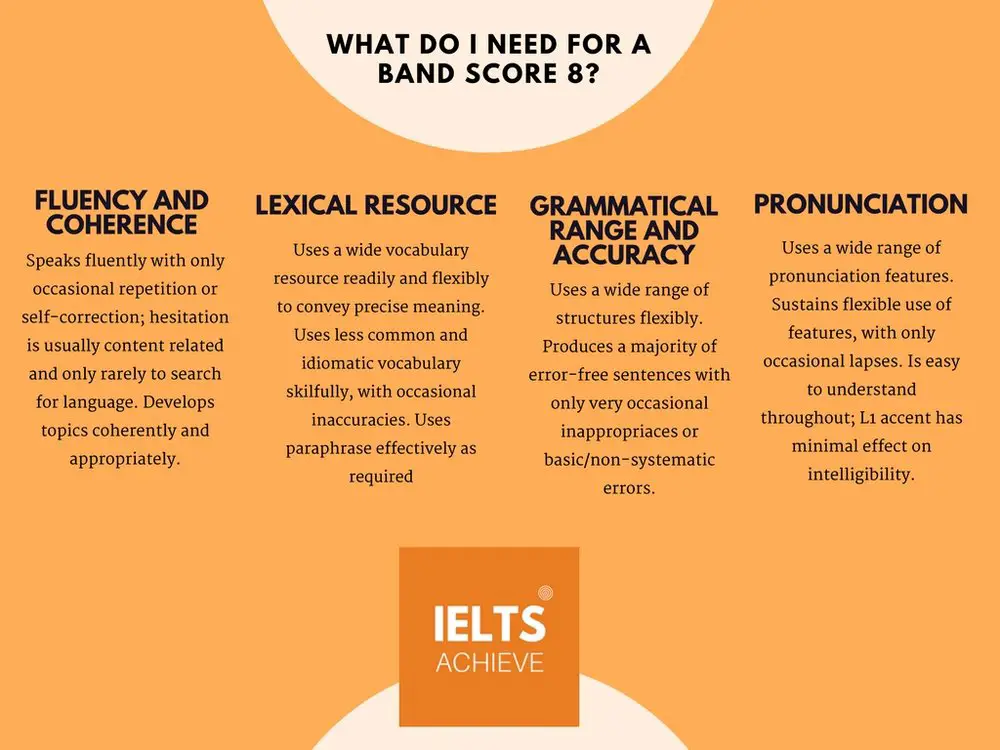
You should read through the marking criteria and be aware of what is required for a band score 7 or above. Many students do not do this and have no idea what they need to achieve in order to get the band score they want. Read it, understand it and aim to achieve it. Ask your IELTS teacher for help to understand it and to see the level you are at now.
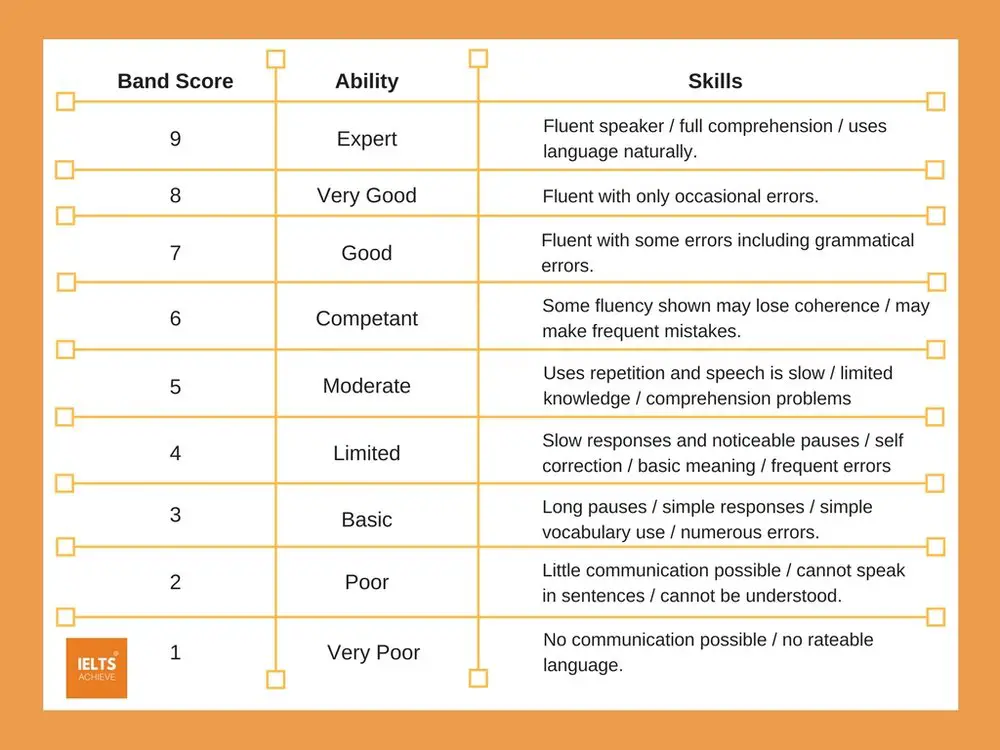
You should also read the scoring information to see how the band scores are given:
Tip 10: Practice
Practice as much as possible with your native speaking IELTS teacher, a partner or friend. Take a look at the most common topics (see the other posts in this section) and practice answering those questions. A good way to listen for errors is to record yourself speaking. Listen to your recording and notice any errors you have made, including grammar mistakes, pronunciation, intonation and fluency. Keep practising and use the posts in this section to help you.
Expert tips and strategies for this part of the IELTS Speaking test. Includes sample responses and key vocabulary for Band 7+.
Originally published August 2017. Last reviewed 3 July 2026.
This post will look at how to extend your part 1 answers.
In part 1 the examiner will ask you about familiar topics, like your home, hometown, hobbies and work. The answers you give should be honest and show the examiner your ability to use English well.
When giving your answers, try to make sure that they are not too short - for example, if the examiner asks you 'What is your favourite TV show?', saying 'I really like Peaky Blinders' is too short.
You can expand your answer by adding more detail of what it is about, and why you like it so much for example; 'I really like the BBC drama Peaky Blinders, it has an excellent cast and the writing keeps me interested in the story. There is lots of action, as the story is centred on a ganster family in 1920's Birmingham, who are up to no good!'.
The answers in part 1 should not be too long either, talking for 2 minutes or more is far too long, parts 2 and 3 will allow you to speak for a longer time and go into more detail.
You should aim to use more than one clause when you give your answers, for example;
Q: Do you work or study?
A: I work at the moment but I continue my studies at the same time. I continue to learn through courses and gain new qualifications every year, this means my knowledge is always up to date.
Take a look at the ways that you can extend your answers below, in the aim of getting you a higher score! >>
Be Honest
When answering the questions, try to be as honest as possible, telling the examiner your thoughts, feeling and opinions, for example;
Q: Do you think vacations are becoming more and more important?
A: Yes, I think that many people are working longer hours and have more stress than ever placed upon them. taking a break is necessary to unwind and recharge so that they can let go of the stress and focus on their own well-being.
Give Details (Contrast)
You can extend your answers by giving contrasting details, using words like - but, however, although, even though, while, whereas.. etc. For example;
Q: Do you use the Internet for your studies?
A: Yes, I do research online, reading articles from trusted resources. However, there is a lot of information out there, so you need to be able to separate the good from the bad.
You can also add more details into your answer by using the words with, and, another, also, next - for example;
Q: Do you enjoy your work?
A: Yes I do, it is always exciting to meet new students and to help them on their learning journey. Writing is also a fun way to let my imagination free and to research topics that interest me, like interior design, architecture and fine art.
You may also be asked to contrast an opinion or opinions of others where these words - but, however, although, even though, while, whereas.. etc. would also be appropriate to use. For example;
Q: What do you like/dislike about your job?
A: The thing I like most about my job is being able to help people achieve their goals. I also like the flexibility, as I am responsible for my own schedule. However, I don't like the number of hours I sometimes work, but it can be necessary.
Compare
You can make comparisons thinking about things you used to enjoy or used to do but now enjoy/do something different. You can use words like - similarly, likewise, also, like, same as, similar to... For example;
Q: What sports do you like? (Why?)
A: I used to enjoy classes like Zumba and body combat but now really enjoy swimming and running. Swimming and running are great ways to stay fit as they allow me to experience nature, as well as exercise.
Give a reason why
Expand your answers with reasons.....why you do or do not like something etc (depending on what you are being asked). You can use words like - for, because, since, as. For example;
Q: Why are vacations important to you?
A: Because they are much needed during certain times of the year, for example when the weather becomes too hot to bear or I feel as though I need a break from work. They help me to relax and de-stress from everything.
Q: What’s your favourite weather? (Why?)
A: I prefer warm days at around 24/25 degrees with clear blue skies and the sun, since this is good for walking my dog and to enjoy the outdoors without being too uncomfortable.
Think about the future
When the examiner asks you a question, think about the future - using the future tense and what you would like to do in the future. You can use will be/going to or in a hypothetical situation you can use would or could. For example;
Q: What will you do in the future? (work related)
A: In the future, I would like to be able to expand my teaching responsibilities and to have more student groups. I also want to write a book, a fiction novel or two!
Q: If you could take a vacation anywhere in the world, where would you go? Why? (travel)
A: I would like to visit a pretty place with snow, lots and lots of snow, somewhere like Canada or maybe even in the mountains in Greece during the winter months. In the future, I would like to go skiing, try snowboarding and stay in a well-decorated log cabin, with a large real fireplace.
Give examples
Support your answers with examples from your life or past experiences. It is much better to do this then try to make something up, as you will be more confident giving an example that you have experienced. You can use - for example, for instance, such as, including. For example;
Q: How often do you buy something in a shop?
A: That depends on what it is, for example, I will go the shop every day to buy freshly baked bread. For other groceries, it may be once a week and for other items, such as clothes it will be less often.
Q: Does the weather ever affect what you do?
A: Yes, plans change according to the weather, for instance, if there is a heavy downpour I will not be able to walk my dog or to go shopping in town.
Regularity
You can extend your answers by using words to show how often you do something. Use words like - never, often, sometimes, all the time, usually. For example;
Q: How often do you swim?
A: I usually go swimming every day or at least three times per week. This allows me to do some exercise in the water which is good for my overall health.
Practice
Practice as much as you can with a partner or your teacher, looking at past questions and working on your overall conversation. The best student answers are given naturally, explaining, giving detail and being honest.
Think about the structures you need to use and the words that will help you to connect your information together. Take a look through the practice question and answers in this section to get some ideas.
Don't overcomplicate it by thinking of 'complex structures' and grammar that you need to use when you are answering.
Join our private Facebook Group and find people to start practising with! Sign up for our newsletter to receive the link, then join the group to meet other IELTS students.
We hope you found this post useful in helping you to study for the IELTS Test. If you have any questions please let us know in the comments below or on the Facebook page.
The best way to keep up to date with posts like this is to like us on Facebook, then follow us on Instagram and Pinterest.
If you need help preparing for the IELTS Test, join the IELTS Achieve Academy and see how we can assist you to achieve your desired band score. We offer an essay correction service, mock exams and online courses.
Expert tips and strategies for this part of the IELTS Speaking test. Includes sample responses and key vocabulary for Band 7+.
Originally published July 2017. Last reviewed 3 July 2026.
In this post, we will be looking in-depth at English pronunciation.
While you are preparing for your IELTS Speaking Test it is important that you understand the marking criteria. Pronunciation counts for 25% of your speaking score, therefore it is vital that you understand what the examiner wants. Getting individual sounds correct is really important in order to gain a band score of 5 or higher. You will be able to achieve a higher score if you can demonstrate your ability to form individual sounds correctly; word stress, sentence stress, intonation (pitch), pausing and chunking, elision (dropping individual sounds), assimilation (changing individual sounds when you speak quickly) and linking (moving sounds from the end of one word to the beginning of the next).
In the IELTS Speaking Test, any form of pronunciation from British, American, Canadian, Australian etc is accepted.
Pronunciation
Pronunciation is the act or manner of speaking a word. Many words in English are not pronounced the way they are spelt, and some sounds can be represented by more than one combination of letters.
One of the most important aspects of the IELTS Speaking Test is pronunciation. Without clear pronunciation, it is difficult to make yourself understood. Native speakers emphasise the most important words in a sentence by pronouncing them slowly and loudly. Have you ever noticed this?
Word Stress
When you are speaking English the words you stress can change the underlying meaning of a sentence.
For example: look at the following sentence: I don't think that is a good idea.
This simple sentence can have many levels of meaning based on the word you stress. Consider the meaning of the following sentences with the stressed word in bold. Read each sentence aloud and give a strong stress to the word in bold:
I don't think that is a good idea. Meaning - other people might think it is a good idea.
I don't think that is a good idea. Meaning - it's not true that I think it is a good idea.
I don't think that is a good idea. Meaning - I'm not sure if it is a good idea.
“There is a great deal of evidence that native speakers rely very much on the stress pattern of words when they are listening. In fact, experiments have demonstrated that often when a native speaker mishears a word, it is because the foreigner has put the stress in the wrong place, not because he or she mispronounced the sound of the word.”— Joanne Kenworthy, Teaching English Pronunciation. Longman, 1987
Punctuation
Use punctuation to help your pronunciation by adding a pause after each period, comma, semicolon or colon. By using punctuation to guide you when you pause, you will begin to speak in a more natural manner.
For example: I'm going to visit my friends in London. They have a beautiful house in Chelsea, so I'm staying with them for one week.
In this example, pause after 'London' and 'Chelsea'. This will help anyone who's listening to you follow you more easily. On the other hand, if you rush through the sentences, where the periods and commas (and other punctuation marks) would be, your pronunciation will sound unnatural and it will be difficult for listeners to follow your thoughts.
Intonation
Intonation is the act of raising and the lowering of the voice when speaking. In other words, intonation refers to the voice rising and falling. We use the pitch of our voice to change the meaning of what we are saying.
For example: Look at the questions below and then say them out loud, raising your voice on the last words, this allows the listener to know you are asking them a question:
Raising Your Voice at the End of a Question If the question is a yes / no question, the voice rises at the end of a question. Do you like living in Greece? Have you lived here for a long time? Did you visit any of the Ionian Islands last month?
Falling Voice at the End of a Question If the question is an information question - in other words, if you are asking a question with 'where', 'when', 'what', 'which', 'why', 'what / which kind of..', and questions with 'how' - let your voice fall at then end of a question.
Where are you going to stay on holiday this year?
When did you leave your town?
How long have you lived in the UK?
When using a question to clarify some information, let your voice rise to let the listener know that you expect more information.
Jane isn't going to be at the restaurant, is she?
You understand your position here, don't you?
We aren't expected to finish the assignment by Tuesday, are we?
We also use a specific type of intonation when using commas in a list.
For example: John enjoys playing volleyball, swimming, kayaking, and quad biking. In this example, the voice rises after each item on the list. For the final item, let the voice fall. In other words, 'volleyball', 'swimming', and 'kayaking' all rise in intonation. The final activity, 'quad biking', falls in intonation.
Practice with a few more examples;
We bought some gluten-free pasta, bananas, orange juice and potatoes.
Maria wants to go to New York, Barcelona, Rome, and Athens.
Expert tips and strategies for this part of the IELTS Speaking test. Includes sample responses and key vocabulary for Band 7+.
Originally published July 2017. Last reviewed 3 July 2026.
In this post, we will be looking in-depth at fluency and coherence.
While you are preparing for your IELTS Speaking Test it is important that you understand the marking criteria. Fluency and coherence count for 25% of your speaking score, therefore it is vital that you understand what the examiner wants.
Fluent >> Able to express oneself easily and articulately / smoothly graceful and effortless.
Coherent >> Logical and consistent.
When you are speaking, you want to show the examiner that you can talk about topics easily, without long pauses and repetition. You also want to show them that you can organise your ideas in a logical way.
Fluent Speech
When you are fluently able to speak you can talk at a normal pace, pause occasionally for emphasis and self-correct.
Some students find themselves speaking too fast or repeating words and phrases, which is something you should avoid doing.
You should aim to practice speaking in English as often as possible and for those of you already living in the UK (or another English speaking country) take the opportunity to talk to friends or colleagues. You can ask them to ask you questions to help you practice and they can also give you some feedback!
Some questions they could ask you >>
What did you do last night? / or at the weekend?
Did you see the latest episode of .... (insert TV show name) what did you think of it?
When was the last time you went to the cinema?
Are you going on holiday this year? Where are you going?
Have you read any good books recently?
Did you see/read about... (insert news story) what did you think about that?
You should answer with full sentences and avoid repeating the question back to them.
Speaking Coherently
When you are answering questions you should organise the information logically, starting at the beginning, describing /explaining and concluding.
For example, read the text below >>
I read a good book the other day about this woman who gets on the same train every day. It starts with this woman getting fired from her job, then getting the train home. Actually, it starts with her on the train then explaining that she got fired. There are blanks in her memory. She likes to look at a house when the train passes and the woman that lives there. She can't remember things. She drinks a lot. My friend told me to read this book. The book was fast paced and interesting. I enjoyed it. I read it on the plane last month when I went on holiday.
Here it is again but organised in a more logical way >>
I read a really good book when I went on holiday last month after my friend had recommended it to me. It was a thriller, with a woman who had an abusive relationship and a drinking problem, that had been fired from her job. She rides the tube every day pretending to go to work and she is intrigued by a house she sees. She envies the woman who lives there and the story develops from there. Then, she gets involved with the woman's story putting together the gaps in her own memory and begins to see how her own life is connected. This book was fast paced and interesting!
Do you think the second paragraph is more logical?
Can you see the difference?
The events in the book/movie etc should be explained in logical order.
Using Cohesive Devices
Your ideas should be in logical order but also connected by cohesive devices.
For example, if you were telling a story about your educational background it could look like this >>
I started school at 5 years old. I went to secondary school when I was 12. I left that school at 18. I went to university for three years. I graduated with honours. I had training. I work in my chosen field.
Introducing cohesive devices will make it sound more natural and explain the order of events in a logical sounding way >>
Firstly, I started school at 5 years old, then I went to secondary school when I was 12. However, I left that school at 18. After that, I went to university for three years, where I graduated with honours. In addition to that, I had further training. Now, I finally work in my chosen field.
Take a look at the cohesive devices below, the words and phrases here will help you to organise your ideas >>
Sequencing
You can also use sequencing to express your ideas in a logical way, take a look at the words and phrases below >>
Practice
Practice answering these questions below using cohesive devices and sequencing >>
What do you think are the main reasons that students in recent years like to take a gap year?
What are the advantages and disadvantages of young people using social media?
Do you agree or disagree with the idea that technology is developing faster than the public think?
Is it a good idea to try out new restaurants recommended by friends?
What did you do last weekend
Can you use any of the following words or phrases in your answers?
Firstly / secondly......
Then
After that
Overall
However
In addition
Therefore
For example
For instance
On the one hand
On the other hand
Finally
Now
We hope you found this post useful in helping you to study for the IELTS Test. If you have any questions please let us know in the comments below or on the Facebook page.
The best way to keep up to date with posts like this is to like us on Facebook, then follow us on Instagram and Pinterest.
If you need help preparing for the IELTS Test, join the IELTS Achieve Academy and see how we can assist you to achieve your desired band score. We offer an essay correction service, mock exams and online courses.
Expert tips and strategies for this part of the IELTS Speaking test. Includes sample responses and key vocabulary for Band 7+.
Originally published July 2017. Last reviewed 3 July 2026.
The IELTS Speaking Test lasts 11-14 minutes.
The test has three parts, where you are interviewed by a trained examiner. You are not allowed to use a dictionary during the test. IELTS Academic and IELTS General students take the same test and it is marked in the same way.
The three parts of the test are as follows;
IELTS Speaking Part 1
Duration: 4-5 minutes
You will be asked questions on familiar topics, like your hobbies, family, where you are from, what your hometown/city is like, etc.
The topics might include;
Your studies/education
Hobbies/sports
Your family
What kind of movies, books, tv shows or music you like
What you like to eat / where you like to eat
Your job
Where you live
IELTS Speaking Part 2
Duration:3-4 minutes
First, the examiner will give you one minute to think about the question and make notes. Next, you will speak for 1-2 minutes uninterrupted. Then the examiner will ask you a further two or three questions about what you have said.
For example: you might be asked a question like this on your cue card >>
"Describe an interesting place you have visited"
You should say;
When you visited?
What you did when you were there?
What activities you could do there?
Would you recommend it to others?
IELTS Speaking Part 3
Duration:4-5 minutes
The examiner will ask you further questions related to the question topic from part 2. This will give you the opportunity to discuss more abstract ideas.
The cue card used as an example above was asking you about a place you had visited. Further questions might include;
Why do you think the tourist industry is growing?
How do people choose a destination for their holiday?
Some people like to take a package holiday, while others prefer to explore and organise the trip themselves, why is this?
IELTS Speaking Criteria
The IELTS Speaking Test is designed for you to be able to talk about, describe and explain your own experiences and opinions.
You will be assessed on the following criteria;
Fluency and Coherence
Lexical Resource
Grammatical Range and Accuracy
Pronunciation
It is important that you take the time to read the IELTS Speaking Band Descriptors and familiarise yourself with what is expected for the higher scoring bands. Like other parts of the test, you will be given a band score from 0-9. With the academic students aiming for a band score of 7, the criteria is as follows;
Non-native speakers who can express themselves on most subjects but frequently pause to think of words or ideas, mostly get a band score 5 or 6. Native speakers would be expected to get an 8.5 or 9.
The examiner is looking for your ability to speak English well, expressing your own opinions and feelings. Your score will be lower than a 7 if you make frequent mistakes or the examiner has trouble understanding you and what you are trying to say.
Requirements from universities and immigration agencies vary. Most students will need at least a band score 6 for undergraduate study. For postgraduate study or immigration, a band score 7 is generally required.