Fluency and Coherence You should be able to speak without hesitation, have natural pauses, be able to order your ideas and connect them when telling a story.
Lexical Resource Be able to demonstrate the ability to use advanced vocabulary, synonyms, antonyms, intensifiers, collocations and idioms.
Grammatical Range and Accuracy Use complex senetences, connecting words, a variety of tenses, passive voice, conditionals.
Pronunciation Show that you can make individuals sounds, connecting sounds, word stress, sentence stress and intonation.
Do you know your own strengths and weaknesses? Do you practice speaking English regularly?
Hopefully, the answer to both of those questions is yes. You need to be able to identify your strengths and weaknesses so that you know where you need to improve, to reach the band score you want. Having lessons with a native speaking teacher is worth it so that they can identify your weaknesses and help you to work on them.
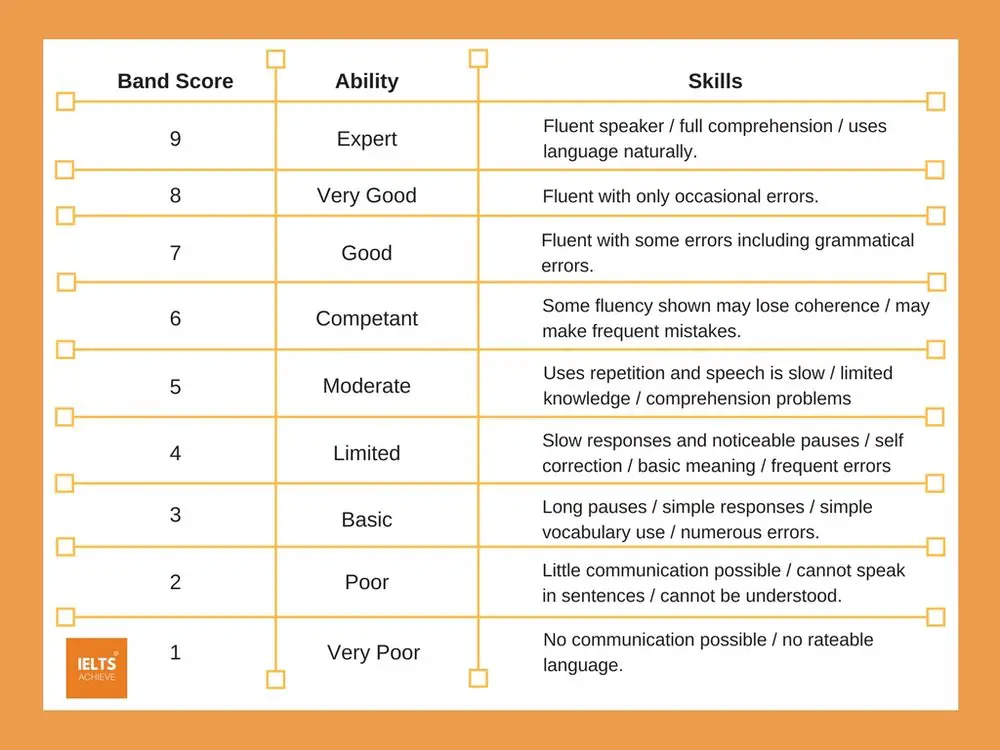
Looking at the table below, where would you say you are right now?
How can you start to improve?
Making a study plan and following it is a really great idea to get started. Read the sections below and get some ideas on how you can improve in all four areas of the IELTS Speaking Test marking criteria.
Fluency And Coherence
How can you improve Fluency and Coherence?
Practice with as many resources as you can for part 1, part 2 and part 3 questions. For parts 2 and 3 you should read the practice questions and see how well you understand them. Think of examples you can use in your answers and the structure of your answers. The part two answer should sound natural and be well structured, which can be challenging. In part 3 the answers should be extended and ideas should be linked.
Lexical Resource
How can you improve Lexical Resource?
For example, you could listen to podcasts and TED Talks, find a speaking partner to practice with and read some English news (online from the BBC News website or the Guardian) every night. You could also make vocabulary flashcards, listen to English music, listen to TED Talks and record yourself giving a summary of what you have heard. It is such a good idea to partner up with other IELTS students and practice speaking via Skype/Facetime etc. Take a look in the IELTS ACHIEVE Facebook group and meet someone you can start practising with.
Grammatical Range and Accuracy
How can you improve the Grammatical Range and Accuracy?
It is a good idea to record yourself speaking, answer some speaking mock questions, record yourself, then listen back to the recording and identify any errors you have made. You can check if your answer included the following:
Did you use the correct tense, did the verbs agree with the subjects?
Did you use complex sentences?
Did you use the passive voice and conditionals?
Did you use connecting words? Such as; before, after, because and although.
Alternatively, book lessons with a native speaking teacher and they will help you to improve.
Pronunciation
How can you improve Pronunciation?
One way to improve your pronunciation is to listen to native speakers, on the radio, tv or through TED Talks. Listen carefully to how the speakers pronounce words, how do they emphasise their points? Where do they place the word stress? Another way is to look up the pronunciation of words, practice saying them out loud and record yourself. You can then listen to the recording and see if you have made any errors. If you find it difficult to identify your own errors, then booking lessons with a native speaking English teacher who will correct you is the best way to improve.
Practice More
It's fine to practice with past paper questions and other questions you may find online, but it is much better and beneficial for you to practice talking to people in real life. Say for example you have a friend who lives in the UK or the USA, make time to Skype with them and gossip! Or ask them to ask you some questions and give you feedback on how well you answered. Did they hear any errors? Could they understand you clearly? If you are already living in the UK (or another English speaking country) talk to friends, work colleagues etc about everyday subjects. Talk about the news 'Did you see....... that story in the news? What did you think about it?.....' Everyone has an opinion on popular news stories.
Just get talking about anything that interests you, so that you can practice.
Extend Your Answers
When you practice speaking to your partner, friends or work colleagues, practice extending your answers.
For example, if someone asks you:
What did you do at the weekend?
Answer 1 Nothing much, you?
Answer 2 I went to town on Saturday to have a look around, then had a coffee from my favourite coffee shop run by the hipsters next to Marks and Spencers. After that, I took my dog to the park where he played for a couple of hours with his friends. Finally, when it started to get dark, we went home and watched catch-up TV together on the sofa. On Sunday, I just relaxed, cleaned the house, then met some friends at the beach for a game of volleyball.
Answer 1 is not a good answer because it is short and doesn't give away any information. Answer 2 is better because it answers the question, gives detail (extends) and includes components needed to score well on the marking criteria.
You need to show the examiner that you can answer the question, give more information (expand) and give an example. Even if that example is made up, that is ok as the examiner will not know (make it sound realistic though!).
What are you going to do to improve your speaking? Let us know in the comments below:
Expert tips and strategies for this part of the IELTS Speaking test. Includes sample responses and key vocabulary for Band 7+.
Originally published August 2017. Last reviewed 3 July 2026.
In the IELTS Speaking Test, you will be interviewed by an examiner for 11-14 minutes. The test has three parts and you are not allowed to use a dictionary. IELTS Academic and IELTS General students take the same test and it is marked in the same way.
Requirements from universities and immigration agencies vary. Most students will need at least a band score 6 for undergraduate study. For postgraduate study or immigration, a band score 7 is generally required.
One of the first things you should do is read the marking criteria to see what the examiners expect. This is really important, as you need to know what they are looking for in the band 7+ boxes.
You should be able to give the examiners exactly what they want, in order to get a 7+ band score.
In the IELTS Speaking Test, you will be assessed on the four main areas >>
Fluency and Coherence
Lexical resource
Grammatical Range and Accuracy
Pronunciation
What Is Your Level?
Look at the table below and according to the skill level where are you?
Think realistically about where your speaking level is at now and then plan how you can improve. Whether it is through self-study or having lessons with a native speaking English teacher, you must figure out a study plan that will allow you to improve.
Band Score 7 Marking Criteria >>
Fluency and Coherence
In this section, you must be able to:
'Speaks at length without noticeable effort or loss of coherence. May demonstrate language related hesitation at times, or some self-repetition and/or self-correction. uses a range of connectives and discourse markers with some flexibility.'
This means that the student will be able to answer the question well, extending their answers, explaining and giving examples. Band score 7 students will be able to use discourse markers where it is appropriate.
Lexical Resource
In this section, you must be able to:
'Uses vocabulary resource flexibly to discuss a variety of topics. Uses some less common and idiomatic vocabulary and shows some awareness of style and collocation, wit some inappropriate choices. Uses paraphrase effectively.'
This means that the student would be able to answer questions on a range of topics using a wide range of vocabulary. They would also be able to use idioms where appropriate, as well as collocations. Some minor errors are still permitted.
Grammatical Range and Accuracy
In this section, you must be able to:
'Uses a range of complex structures with some flexibility. Frequently produces error-free sentences, though some grammatical mistakes persist.'
This means that the student will be able to use a variety of sentence structures and are able to form complex sentences. The majority of sentences would be error free, with some allowance for minor grammatical errors.
Pronunciation
In this section, you must be able to:
'Shows all the positive features of Band 6 and some, but not all of the positive features of Band 8.'
The band 6 positive features include - 'Uses a wide range of pronunciation features / Shows some effective use of features / Can generally be understood throughout.'
The band 8 positive features include - 'Uses a wide range of pronunciation features / Sustains flexible use of features, with only occasional lapses. Is easy to understand throughout.'
This means that to score a band 7 the examiner must be able to understand the student clearly and that they talk in a natural sounding way. Make sure that you practice speaking in English about a range of topics, using word stress and intonation.
Band Score 8 Marking Criteria >>
Fluency and Coherence
In this section, you must be able to:
'Speaks fluently with only occasional repetition or self-correction; hesitation is usually content related and only rarely to search for language. Develops topics coherently and appropriately.'
This meansthe student will be able to answer the question well, extending their answers, explaining and giving examples. Band score 8 students will be able to use discourse markers where it is appropriate. A band 8 student will be able to develop their answer to the question fully, giving a very well explained and detailed answer.
Lexical Resource
In this section, you must be able to:
'Uses a wide vocabulary resource readily and flexibly to convey precise meaning. Uses less common and idiomatic vocabulary skilfully, with occasional inaccuracies. Uses paraphrase effectively as required.'
Band 8 students have a wealth of vocabulary and are able to use it well when speaking about almost any topic. They can use expressions and are able to use terms that are appropriate for the answer. The make hardly any errors when speaking.
Grammatical Range and Accuracy
In this section, you must be able to:
'Uses a wide range of structures flexibly. Produces a majority of error-free sentences with only very occasional inappropriaces or basic/non-systematic errors.'
This means that the student will be able to use a variety of sentence structures and is able to form complex sentences. The majority of sentences will be error free, with some allowance for minor grammatical errors.
Pronunciation
In this section, you must be able to:
'Uses a wide range of pronunciation features. Sustains flexible use of features, with only occasional lapses. Is easy to understand throughout; L1 accent has minimal effect on intelligibility.'
A band 8 student will be easy for the examiner to understand with minor errors. They will be able to talk with ease about all subjects, placing word stress where appropriate and using intonation naturally.
We hope you found this post useful in helping you to study for the IELTS Test. If you have any questions please let us know in the comments below or on the Facebook page.
The best way to keep up to date with posts like this is to like us on Facebook, then follow us on Instagram and Pinterest.
If you need help preparing for the IELTS Test, join the IELTS Achieve Academy and see how we can assist you to achieve your desired band score. We offer an essay correction service, mock exams and online courses.
Expert tips and strategies for this part of the IELTS Speaking test. Includes sample responses and key vocabulary for Band 7+.
Originally published August 2017. Last reviewed 3 July 2026.
In this post, we will look at the most common IELTS Speaking Topics.
It is hard to predict or plan for the type of topics that will come up in the speaking test. You should not try and rehearse memorised answers, as you never know what you might be asked.
According to research on past papers and from my past students, here is a list of common topics:
IELTS Speaking Part 1
In part 1 of the speaking test, you will be asked about familiar topics, such as your hobbies, family life and hometown. The list below shows the topics that may come up in the test.
Your country/Hometown
Family life
Friendship
Work
Education
Hobbies
Your Interests
Cinema/Movies
Reading/Books
Travel/Holidays
Shopping
Free time/Weekends
TV shows
Eating out/Restaurants
To practice with past question please take a look at Speaking Part 1 in more detail.
IELTS Speaking Part 2
In part two of the speaking test, you will get a cue card with a question that requires you to talk at length for 1-2 minutes. You are able to make notes for 1 minute to prepare. The list below shows the topics that may come up;
Health
Work
Education
Travel
The environment
A friend
A teacher
Something you own
Hobbies
Sports
Restaurants
Childhood
Technology
Party/Occasion
To practice with past question please take a look at Speaking Part 2 in more detail.
IELTS Speaking Part 3
In part 3 of the speaking test, you will go further into the topic relating to part 2. This will allow you to talk in-depth and offer your opinions and thoughts on the chosen subject. The list below shows the topics that may come up;
Travel
Education
Work
Health
Technology
The internet
Social Media
The environment
Healthy Eating/Lifestyle
Music
Crime/Justice
Sports
Hobbies
To practice with past questions please take a look at Speaking Part 3 in more detail.
Review And Strategy
It would be really hard to predict the topics that might come up on the speaking test, so you should continue to practice talking about everyday topics in English, as often as you can.
Remember that it is highly likely that the examiner will expect you to do the following if you wish to achieve a high band score:
To give your opinion
Talk about the past, present or future
Explain your views
Support your views with examples
Tell a story in your examples (logically)
Compare and contrast
I hope that you have found this post helpful if you have any questions please write them in the comments below.
Expert tips and strategies for this part of the IELTS Speaking test. Includes sample responses and key vocabulary for Band 7+.
Originally published August 2017. Last reviewed 3 July 2026.
In this post, you will see one of the most common IELTS speaking topics (Family) and sample answers.
Please remember that in the actual test you should give honest answers and talk about your own experiences, thoughts, feelings and opinions. Do not try to memorise answers, as the examiners will probably be able to guess and you will lose marks.
However, you are able to make up information to extend your answers, but be sure that you are confident when speaking about the chosen topic and that it is believable.
TIP >> Each answer should be at least 2-3 sentences long.
TIP >> Listen carefully to the question so that you answer in the correct tense.
TIP >> When answering a yes/no question - answer then give your reasons for your answer. You must extend your answer to gain more marks.
TIP >> Just relax and think of it as a regular conversation you are having, make eye contact and be positive.
Take a look at the questions and sample answers below on the topic of 'Family' >>
Q: Could you tell me something about your family?
A: My family is quite small and most people live far away from each other. Some are at the top of the country and some at the bottom. More distant relatives live in France and Australia, so we don't see them very often.
Q: Do you think it is good to live with grandparents?
A: In my opinion, living with your grandparents may be a way to save money and also to help to care for them. Perhaps they can't do things they used to, like housework or cooking, so being able to help them would be a positive.
Q: What’s the women’s status in families?
A: Women are seen as the people in charge in most families, they have many roles within the family unit, often having qualifications and a career also. They are the carers, providers, mothers and managers.
Q: Do you think it good to be the only child in the family?
A: On the one hand, it could be a lonely existence when you are a small child but as you become older would start to enjoy having that space. On the other hand, they are missing out on the connection that you see between siblings.
Q: Is there any generation gap in your family?
A: There is a divide between the older members of the family and the young, with varying views on politics and religion which leads to misunderstandings.
Q: Do you like your family?
A: Yes of course! My immediate family - my parents are amazing people, kind, funny and caring. The other members of my family and my husbands family are all very lovely people, who have good times together.
Q: Who is your closest family member?
A: My mother is very close to me and we talk every day, often about trivial things like what our dogs have been doing. She likes to ask questions about my dog, to make sure he is being taken care of like a king!
Q: What are your parents like?
A: Very good, kind and funny people. They like to laugh, read, travel and like all of the same TV shows as me. They are very caring people too, helping in the community - for a children's charity and to protect the environment.
We hope you found this post useful in helping you to study for the IELTS Test. If you have any questions please let us know in the comments below or on the Facebook page.
The best way to keep up to date with posts like this is to like us on Facebook, then follow us on Instagram and Pinterest.
If you need help preparing for the IELTS Test, join the IELTS Achieve Academy and see how we can assist you to achieve your desired band score. We offer an essay correction service, mock exams and online courses.
Expert tips and strategies for this part of the IELTS Speaking test. Includes sample responses and key vocabulary for Band 7+.
Originally published August 2017. Last reviewed 3 July 2026.
In this post, you will see one of the most common IELTS speaking topics (TV) and sample answers.
Please remember that in the actual test you should give honest answers and talk about your own experiences, thoughts, feelings and opinions. Do not try to memorise answers, as the examiners will probably be able to guess and you will lose marks.
However, you are able to make up information to extend your answers, but be sure that you are confident when speaking about the chosen topic and that it is believable.
TIP >> Each answer should be at least 2-3 sentences long.
TIP >> Listen carefully to the question so that you answer in the correct tense.
TIP >> When answering a yes/no question - answer then give your reasons for your answer. You must extend your answer to gain more marks.
TIP >> Just relax and think of it as a regular conversation you are having, make eye contact and be positive.
Take a look at the questions and sample answers below on the topic of 'TV' >>
Q: Do you often watch TV?
A: Yes, perhaps for an hour or two most nights, depending on my schedule. I like to catch up on TV shows I am watching or I might watch a movie before going to sleep.
Q: What types of TV programme are popular in your country?
A: I think that soap operas are very popular, with a central love story. There is often betrayals and deceit as the main obstacles in the way of the main characters coming together.
Q: What (types of) programmes did you watch when you were a child?
A: I used to watch teen dramas, like Beverly Hills 90210, Baywatch and Heartbreak High. I also like watching some Australian soap operas also that were popular, for example, Neighbours and Home and Away.
Q: What’s your favourite TV program?
A: I have so many! One of my favourites though is British drama Peaky Blinders, about a family in Birmingham in the 1920's. It has excellent actors, good writing and lots of action. I also like the TV shows Vikings, Game of Thrones and Reign. Period dramas are the best!
Q: When do you usually watch TV?
A: Late at night in the summer months maybe for an hour, but in the winter months I watch a few hours because I am in the house more often.
Q: Do you think TV has changed in the past few decades?
A: Yes, I think that it has become more accessible due to smart TV's being connected to Netflix, Amazone Prime and other providers. Netflix can be connected to any device, so watching your favourite shows is easy. There are so many TV shows now that have good actors and are well written.
Q: Has television changed your life in any way?
A: It is something that I enjoy, but I couldn't say it has changed my life. It is something that is there to pass the time, like reading. I like to watch TV to relax and sometimes as background noise if I am cooking.
We hope you found this post useful in helping you to study for the IELTS Test. If you have any questions please let us know in the comments below or on the Facebook page.
The best way to keep up to date with posts like this is to like us on Facebook, then follow us on Instagram and Pinterest.
If you need help preparing for the IELTS Test, join the IELTS Achieve Academy and see how we can assist you to achieve your desired band score. We offer an essay correction service, mock exams and online courses.
Expert tips and strategies for this part of the IELTS Speaking test. Includes sample responses and key vocabulary for Band 7+.
Originally published August 2017. Last reviewed 3 July 2026.
In this post, you will see one of the most common IELTS speaking topics (technology) and sample answers.
Please remember that in the actual test you should give honest answers and talk about your own experiences, thoughts, feelings and opinions. Do not try to memorise answers, as the examiners will probably be able to guess and you will lose marks.
However, you are able to make up information to extend your answers, but be sure that you are confident when speaking about the chosen topic and that it is believable.
TIP >> Each answer should be at least 2-3 sentences long.
TIP >> Listen carefully to the question so that you answer in the correct tense.
TIP >> When answering a yes/no question - answer then give your reasons for your answer. You must extend your answer to gain more marks.
TIP >> Just relax and think of it as a regular conversation you are having, make eye contact and be positive.
Take a look at the questions and sample answers below on the topic of 'technology' >>
Q: Do you use emails?
A: Yes of course! I use email every day to communicate with friends, family and work. I rely on it for work, talking to students, clients and booking appointments. Without it, I would not be able to do very much!
Q: Are they popular in your country?
A: They are popular all over the world, as the digital revolution has taken over. People rely on emails to communicate, to send and receive information.
Q: Do you think they are going to replace letters in the future? Why?
A: I think so because it is an instant way of getting information. People do not have the time now to wait 3-5 days for a letter to be delivered (or longer) so use emails frequently.
Q: Are you interested in robots? Why?
A: Yes, I know they are being developed right now to be intelligent and read about them in the news so that they can communicate and perform tasks. I read an article recently about how two robots developed their own language of code, which was interesting.
Q: Do you like robots to work at your home?
A: Not really, after reading the article about the google robots communicating in a language they had developed. If they can do that without human programming it makes you think about what else they could do!
Q: Do you want to take a car which robot is the driver?
A: No, I think that it would be difficult for a robot to navigate roads when they do not know what to expect. driving situations are always different, things happen that you cannot predict.
Q: Will robots replace human beings in the workplace completely?
A: No, in my opinion, I think that robots may be able to complete some jobs but obviously not all. How can they be programmed to think like a human? They are not human and do not have the compassion and humanity that we need for most jobs in society.
Q: Do you enjoy using technology?
A: Yes, it makes my working life really easy, I use my computer every day. I love that it is convenient and that everything can be accessed online.
Q: Do you use the Internet for your studies?
A: Yes, I do research online, reading articles from trusted resources. However, there is a lot of information out there, so you need to be able to separate the good from the bad.
Q: Do you have your own computer?
A: Yes, I have and I use it for hours every day, it is very high speed which I love and it makes my working day feel easy and uncomplicated. I rely on my computer a lot, so it was a really good investment.
We hope you found this post useful in helping you to study for the IELTS Test. If you have any questions please let us know in the comments below or on the Facebook page.
The best way to keep up to date with posts like this is to like us on Facebook, then follow us on Instagram and Pinterest.
If you need help preparing for the IELTS Test, join the IELTS Achieve Academy and see how we can assist you to achieve your desired band score. We offer an essay correction service, mock exams and online courses.