Comprehensive guide covering essential IELTS preparation strategies and techniques to help you achieve your target band score.
Originally published March 2023. Last reviewed 3 July 2026.
Understanding subject-verb agreement is essential for mastering English grammar. Subject-verb agreement refers to the concept that the verb in a sentence must agree in number with the subject. In other words, singular subjects require singular verbs, while plural subjects require plural verbs. This article provides a comprehensive overview of subject-verb agreement rules, along with clear examples and 25 practice exercises to help you solidify your understanding. By the end of this article, you will have a strong foundation in subject-verb agreement and be better prepared to communicate effectively in English.
A cat sleeps on the couch. (singular subject and verb)
Cats sleep on the couch. (plural subject and verb)
When two subjects are connected by "and," use a plural verb.
Examples:
Sally and Tom are friends. (two subjects joined by "and," plural verb)
Apples and oranges are fruits. (two plural subjects joined by "and," plural verb)
If a compound subject with "and" sounds singular, use a singular verb.
Examples:
Peanut butter and jelly is a popular sandwich. (compound subject sounds singular, singular verb)
Spaghetti and meatballs is a delicious dish. (compound subject sounds singular, singular verb)
The verb should agree with the main subject, not the nearest subject.
Examples:
The group of students is going on a field trip. (main subject: group, singular verb)
The list of items is on the table. (main subject: list, singular verb)
When subjects are connected by phrases like "as well as," "along with," "with," "together with," or "in addition to," the verb should agree with the first subject.
Examples:
The teacher, along with the students, is attending the workshop. (main subject: teacher, singular verb)
The books, in addition to the magazines, are on the shelf. (main subject: books, plural verb)
When subjects are connected by "either-or," "neither-nor," "not only – but also," or "or," the verb should agree with the nearest subject.
Examples:
Either the teacher or the students are responsible. (nearest subject: students, plural verb)
Neither the students nor the teacher is available. (nearest subject: teacher, singular verb)
Singular verbs are used with "either," "neither," "none," "everyone," "someone," "anyone," "many a," "more than one."
Examples:
None of the books is interesting. (singular verb)
Everyone in the class has completed the assignment. (singular verb)
Many a person has faced this challenge. (singular verb)
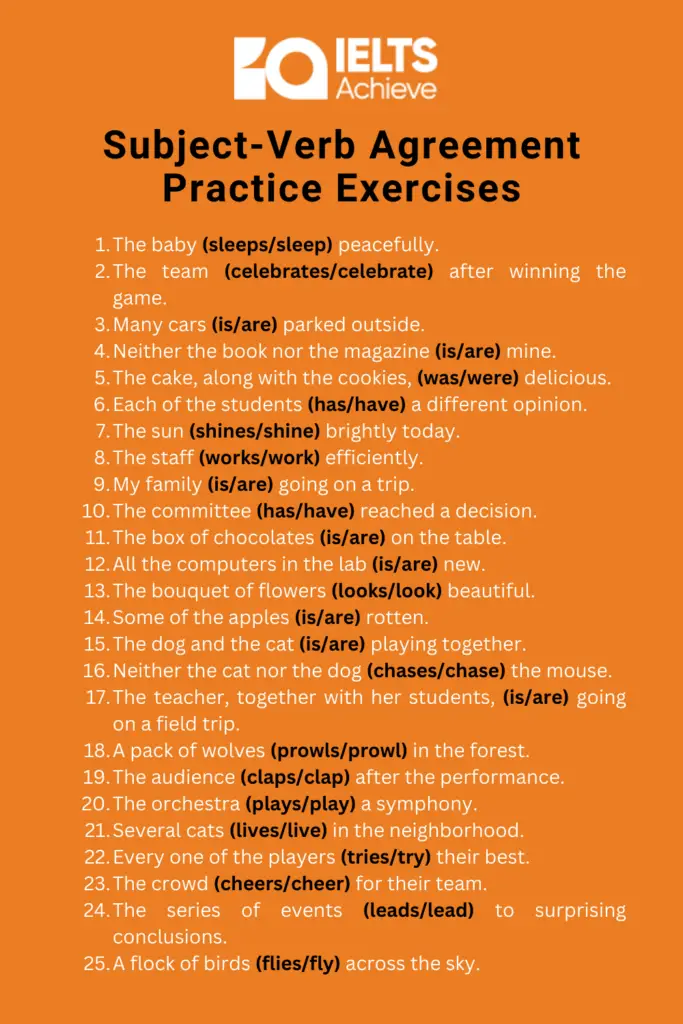
Subject-Verb Agreement Practice Exercises:
The baby (sleeps/sleep) peacefully.
The team (celebrates/celebrate) after winning the game.
Many cars (is/are) parked outside.
Neither the book nor the magazine (is/are) mine.
The cake, along with the cookies, (was/were) delicious.
Each of the students (has/have) a different opinion.
The sun (shines/shine) brightly today.
The staff (works/work) efficiently.
My family (is/are) going on a trip.
The committee (has/have) reached a decision.
The box of chocolates (is/are) on the table.
All the computers in the lab (is/are) new.
The bouquet of flowers (looks/look) beautiful.
Some of the apples (is/are) rotten.
The dog and the cat (is/are) playing together.
Neither the cat nor the dog (chases/chase) the mouse.
The teacher, together with her students, (is/are) going on a field trip.
A pack of wolves (prowls/prowl) in the forest.
The audience (claps/clap) after the performance.
The orchestra (plays/play) a symphony.
Several cats (lives/live) in the neighborhood.
Every one of the players (tries/try) their best.
The crowd (cheers/cheer) for their team.
The series of events (leads/lead) to surprising conclusions.
A flock of birds (flies/fly) across the sky.
Subject-Verb Agreement Practice Exercises: Answers
Comprehensive guide covering essential IELTS preparation strategies and techniques to help you achieve your target band score.
Originally published October 2020. Last reviewed 3 July 2026.
The site consists of an exceptional urban setting encompassing the key natural elements that have shaped and inspired the development of the city: from the highest points of the Tijuca National Park’s mountains down to the sea. They also include the Botanical Gardens, established in 1808, Corcovado Mountain with its celebrated statue of Christ, and the hills around Guanabara Bay, including the extensive designed landscapes along Copacabana Bay which have contributed to the outdoor living culture of this spectacular city. Rio de Janeiro is also recognized for the artistic inspiration it has provided to musicians, landscapers and urbanists.
The city of Rio de Janeiro, shaped by interaction with mountains and sea, lies in the narrow strip of alluvial plain between Guanabara Bay and the Atlantic Ocean. Its exceptionally dramatic landscape is punctuated by a series of forested mountains that tower over the city, rising to the uppermost peak of the Tijuca massif at 1,021 m high, and cascading down to the coast where the steep cone shapes of Sugar Loaf (Pão de Açúcar), Urca, Cara de Cão and Corcovado frame the wide sweeps of Guanabara Bay that shelters Rio de Janeiro from the Atlantic Ocean.
Cradled between these mountains and Guanabara Bay, the urban landscape of the city has been shaped by significant historical events, influenced by a diversity of cultures, is perceived to be of great beauty, and is celebrated in the arts, through painting and poetry in particular.
The property encompasses all the key natural, structural elements that have constrained and inspired the development of the city. These stretch from the highest points of the mountains of the Tijuca National Park with its restored Atlantic forest, down to the sea, and include the Botanical Gardens established in 1808, Corcovado mountain, with its statue of Christ, and the chain of dramatic steep green hills, Sugar Loaf, Pico, Leme and Glória, around Guanabara Bay, as well as the extensive designed landscapes on reclaimed land along Copacabana Bay which, together with Flamengo and other parks, have contributed to the outdoor living culture of the city.
The boundary includes all the best view points to appreciate the way nature has been shaped to become a significant cultural part of the city as well as the Guanabara Bay system of historic fortifications that gave Rio de Janeiro the character of a fortified city.
The city’s densest buildings sit on the narrow strips of alluvial land between the mountains and the sea laid out in irregular clusters of tall white blocks which contrast vividly with the green vegetation of the mountains and the blue of the sea. None of these buildings are included in the property, but a significant number are included in the buffer zone.
The property encompass all the key natural, structural elements that have constrained and inspired the development of the city of Rio, stretching from the highest points of the Tijuca mountains down to the sea, and including the chain of dramatic steep green hills around the Guanabara Bay, as well as the extensive designed landscapes on reclaimed land around the Bay, that have contributed to the outdoor living culture of the city.
None of these elements is under threat, although the interface between these natural elements and the built-up city is vulnerable to urban pressures, the higher peaks are marred by a profusion of antennae and the Rodrigo da Freitas Lagoon (in the buffer zone) and the sea are subject to a degree of water pollution.
The mountains and open green areas of the Tijuca National Park, together with Corcovado and the hills around the Guanabara Bay still retain a similar combination of forest and open observation points as at the time of colonisation and allow access to vistas of the city from many high vantage points that demonstrate very clearly the extraordinary fusion between culture and nature in the way the city has developed.
The Botanical Gardens have retained their original neoclassical design with its special alignments and the fortresses keep alive the memory of the Portuguese settlements, engraved and described by the travellers that navigated the marine routes that focused on Rio de Janeiro.
The landscape designs of Burle Marx around almost the entire coast of Guanabara Bay, comprising Flamengo Park and the redesign of Copacabana beach conserve entirely the landscape morphology of their original designs and still confer high social benefits to the city. However, in some instances elements of the designed landscape are vulnerable to incremental change – such as the paving and planting along Copacabana and Flamengo Park, where missing trees and mosaics need replacing, and in the Botanical Garden where the Imperial Palms along the main avenue are dead and need replacing.
Christ the RedeemerAntonym Trivia Across and Down Worksheet
Find the Antonym of the highlighted word from the word box. Complete the crossword puzzle. Antonyms are the words or phrases that represent the opposite meaning.
Christ the RedeemerAntonym trivia Worksheet
Find the antonym of the highlighted word from the word box. Complete the crossword puzzle. Antonyms are the words or phrases that represent the opposite meaning.
Christ the RedeemerSynonym Antonym Worksheet
Write a synonym and an antonym for each word. Use the words in the word box to fill the blanks. Antonyms are the words or phrases that represent the opposite meaning. Synonyms are words or phrases that represent a similar meaning.
Christ the RedeemerSynonym Passage Worksheet
Replace the words in the passage with appropriate synonyms. Synonyms are words or phrases that represent a similar meaning.
Christ the RedeemerSynonym Trivia Across and Down Worksheet
Find the Synonym of the highlighted word from the word box. Complete the crossword puzzle. Antonyms are the words or phrases that represent the opposite meaning.
Christ the RedeemerSynonym trivia Worksheet
Complete the puzzle with the words that are synonyms to the hints.Synonyms are the words or phrases that represent a similar meaning.
Download the IELTS Practice Worksheet with Answer. Christ the Redeemer IELTS WorkSheet
Comprehensive guide covering essential IELTS preparation strategies and techniques to help you achieve your target band score.
Originally published October 2020. Last reviewed 3 July 2026.
Founded, according to legend, by Romulus and Remus in 753 BC, Rome was first the centre of the Roman Republic, then of the Roman Empire, and it became the capital of the Christian world in the 4th century. The World Heritage site, extended in 1990 to the walls of Urban VIII, includes some of the major monuments of antiquity such as the Forums, the Mausoleum of Augustus, the Mausoleum of Hadrian, the Pantheon, Trajan’s Column and the Column of Marcus Aurelius, as well as the religious and public buildings of papal Rome.
The World Heritage property encompasses the whole historic centre of Rome within the city walls at their widest extent in the 17th century, as well as the Basilica of St. Paul’s Outside the Walls. The property, complex and stratified, includes outstanding archaeological areas integrated in the urban fabric, which result in a highly distinguished ensemble. Founded on the banks of the Tiber river in 753 B.C., according to legend, by Romulus and Remus, Rome was first the centre of the Roman Republic, then of the Roman Empire, and in the fourth century, became the capital of the Christian world. Ancient Rome was followed, from the 4th century on, by Christian Rome. The Christian city was built on top of the ancient city, reusing spaces, buildings and materials. From the 15th century on, the Popes promoted a profound renewal of the city and its image, reflecting the spirit of the Renaissance classicism and, later, of the Baroque. From its foundation, Rome has continually been linked with the history of humanity. As the capital of an empire which dominated the Mediterranean world for many centuries, Rome became thereafter the spiritual capital of the Christian world.
The World Heritage property Historic Centre of Rome, the Properties of the Holy See in that City Enjoying Extraterritorial Rights and San Paolo Fuori le Mura, contains all the essential elements needed to express its Outstanding Universal Value. The property encompasses the whole historic centre of Rome, first inscribed on the World Heritage List in 1980 and extended in 1990 to the walls of Urban VIII, to the Holy See’s extraterritorial properties, and to the Basilica of Saint Paul’s Outside the Walls, thereby ensuring the complete representation of the values previously recognized. The property, marked by a complex stratification, includes some of the most important artistic achievements in the history of humanity, such as the archaeological areas, the Christian Basilicas, and the masterpieces of Renaissance and Baroque art. The property is exposed to a number of threats, including development and environmental pressures, decay of historic buildings, natural disasters, visitor and tourism pressure, and changes in the social and economic framework of the city centre. There are also risks of vandalism and terrorism. All these are being addressed by the site managers.
The historic city, which has constantly changed throughout the centuries, today has a multifaceted and distinctive image. From the 19th century on, a careful and thorough policy has been implemented to protect its monumental and archaeological heritage, inspiring an intense activity of restoration, based on principles and laws born of scholarly discussions which were first tested here (restoration of the Colosseum, the Arch of Titus, etc.). Conservation work in Rome has gradually passed from individual monuments to the entire historic fabric of the city, leading to provisions for the protection of urban areas, which made it possible to maintain the integrity of an immense historic district. In Rome there is the Istituto Centrale del Restauro (now Istituto Superiore per la Conservazione e il Restauro), a prestigious international study centre which played a key role in drafting the Venice Restoration Charter and which helped to define conservation methodologies and tools. The city, centre of civilization from earliest times, today remains an extremely lively hub for meetings and exchange; it has a rich cultural, social and economic life, as well as being a leading destination for pilgrims and tourists. Rome, in all its activity, considers it a priority to preserve its outstanding cultural heritage and to ensure the effective protection of its authenticity.
Colosseum Antonym Trivia Across and Down Worksheet
Find the Antonym of the highlighted word from the word box. Complete the crossword puzzle. Antonyms are the words or phrases that represent the opposite meaning.
Colosseum Antonym trivia Worksheet
Find the antonym of the highlighted word from the word box. Complete the crossword puzzle. Antonyms are the words or phrases that represent the opposite meaning.
Colosseum Synonym Antonym Worksheet
Write a synonym and an antonym for each word. Use the words in the word box to fill the blanks. Antonyms are the words or phrases that represent the opposite meaning. Synonyms are words or phrases that represent a similar meaning.
Colosseum Synonym Passage Worksheet
Replace the words in the passage with appropriate synonyms. Synonyms are words or phrases that represent a similar meaning.
Colosseum Synonym Trivia Across and Down Worksheet
Find the Synonym of the highlighted word from the word box. Complete the crossword puzzle.Antonyms are the words or phrases that represent the opposite meaning.
Colosseum Synonym trivia Worksheet
Complete the puzzle with the words that are synonyms to the hints.Synonyms are the words or phrases that represent a similar meaning.
Download the IELTS Practice Worksheet with Answer. Colosseum IELTS WorkSheet
Comprehensive guide covering essential IELTS preparation strategies and techniques to help you achieve your target band score.
Originally published October 2020. Last reviewed 3 July 2026.
This sacred site was one of the greatest Mayan centres of the Yucatán peninsula. Throughout its nearly 1,000-year history, different peoples have left their mark on the city. The Maya and Toltec vision of the world and the universe is revealed in their stone monuments and artistic works. The fusion of Mayan construction techniques with new elements from central Mexico make Chichen-Itza one of the most important examples of the Mayan-Toltec civilization in Yucatán. Several buildings have survived, such as the Warriors’ Temple, El Castillo, and the circular observatory known as El Caracol.The town of Chichen-Itza was established during the Classic period close to two natural cavities (cenotes or chenes), which gave the town its name "At the edge of the well of the Itzaes". The cenotes facilitated tapping the underground waters of the area. The dates for this settlement vary according to subsequent local accounts: one manuscript gives 415-35 A.D., while others mention 455 A.D. The town that grew up around the sector known as Chichen Viejo already boasted important monuments of great interest: the Nunnery, the Church, Akab Dzib, Chichan Chob, the Temple of the Panels, and the Temple of the Deer. They were constructed between the 6th and the 10th centuries in the characteristic Maya style then popular both in the northern and southern areas of the Puuc hills. The second settlement of Chichen-Itza, and the most important for historians, corresponded to the migration of Toltec warriors from the Mexican plateau towards the south during the 10th century. According to the most common version, the King of Tula, Ce Acatl Topiltzin Quetzalcoatl, or Kukulkan as the Maya translated the name, reportedly took the city between 967 A.D. and 987 A.D. Following the conquest of Yucatán, a new style blending the Maya and Toltec traditions developed, symbolizing the phenomenon of acculturation. Chichen-Itza is a clear illustration of this fusion. Specific examples are, in the group of buildings to the south, the Caracol, a circular stellar observatory whose spiral staircase accounts for its name, and, to the north, El Castillo (also known as the Temple of Kukulkan). Surrounding El Castillo are terraces where the major monumental complexes were built: on the north-west are the Great Ball Court, Tzompantli or the Skull Wall, the temple known as the Jaguar Temple, and the House of Eagles; on the north-east are the Temple of the Warriors, the Group of the Thousand Columns, the Market and the Great Ball Court; on the south-west is the Tomb of the High Priest. After the 13th century, no major monuments seem to have been constructed at Chichen-Itza and the city rapidly declined after around 1440 A.D. The ruins were not excavated until 1841 A.D. Passage Source: World Heritage Site UNESCO
Chichen-Itza Antonym Trivia Across and Down Worksheet
Find the Antonym of the highlighted word from the word box. Complete the crossword puzzle. Antonyms are the words or phrases that represent the opposite meaning.
Chichen-Itza Antonym trivia Worksheet
Find the antonym of the highlighted word from the word box. Complete the crossword puzzle. Antonyms are the words or phrases that represent the opposite meaning.
Chichen-Itza Synonym Antonym Worksheet
Write a synonym and an antonym for each word. Use the words in the word box to fill the blanks. Antonyms are the words or phrases that represent the opposite meaning. Synonyms are words or phrases that represent a similar meaning.
Chichen-Itza Synonym Passage Worksheet
Replace the words in the passage with appropriate synonyms. Synonyms are words or phrases that represent a similar meaning.
Chichen-Itza Synonym Trivia Across and Down Worksheet
Find the Synonym of the highlighted word from the word box. Complete the crossword puzzle.Antonyms are the words or phrases that represent the opposite meaning.
Chichen-Itza Synonym trivia Worksheet
Complete the puzzle with the words that are synonyms to the hints.Synonyms are the words or phrases that represent a similar meaning.
Download the IELTS Practice Worksheet with Answer. Chichen-Itza IELTS WorkSheet
Comprehensive guide covering essential IELTS preparation strategies and techniques to help you achieve your target band score.
Originally published September 2020. Last reviewed 3 July 2026.
An immense mausoleum of white marble, built in Agra between 1631 and 1648 by order of the Mughal emperor Shah Jahan in memory of his favourite wife, the Taj Mahal is the jewel of Muslim art in India and one of the universally admired masterpieces of the world's heritage.
The Taj Mahal is located on the right bank of the Yamuna River in a vast Mughal garden that encompasses nearly 17 hectares, in the Agra District in Uttar Pradesh. It was built by Mughal Emperor Shah Jahan in memory of his wife Mumtaz Mahal with construction starting in 1632 AD and completed in 1648 AD, with the mosque, the guest house and the main gateway on the south, the outer courtyard and its cloisters were added subsequently and completed in 1653 AD. The existence of several historical and Quaranic inscriptions in Arabic script have facilitated setting the chronology of Taj Mahal. For its construction, masons, stone-cutters, inlayers, carvers, painters, calligraphers, dome builders and other artisans were requisitioned from the whole of the empire and also from the Central Asia and Iran. Ustad-Ahmad Lahori was the main architect of the Taj Mahal.
The Taj Mahal is considered to be the greatest architectural achievement in the whole range of Indo-Islamic architecture. Its recognised architectonic beauty has a rhythmic combination of solids and voids, concave and convex and light shadow; such as arches and domes further increases the aesthetic aspect. The colour combination of lush green scape reddish pathway and blue sky over it show cases the monument in ever changing tints and moods. The relief work in marble and inlay with precious and semi precious stones make it a monument apart.
The uniqueness of Taj Mahal lies in some truly remarkable innovations carried out by the horticulture planners and architects of Shah Jahan. One such genius planning is the placing of tomb at one end of the quadripartite garden rather than in the exact centre, which added rich depth and perspective to the distant view of the monument. It is also, one of the best examples of raised tomb variety. The tomb is further raised on a square platform with the four sides of the octagonal base of the minarets extended beyond the square at the corners. The top of the platform is reached through a lateral flight of steps provided in the centre of the southern side. The ground plan of the Taj Mahal is in perfect balance of composition, the octagonal tomb chamber in the centre, encompassed by the portal halls and the four corner rooms. The plan is repeated on the upper floor. The exterior of the tomb is square in plan, with chamfered corners. The large double storied domed chamber, which houses the cenotaphs of Mumtaz Mahal and Shah Jahan, is a perfect octagon in plan. The exquisite octagonal marble lattice screen encircling both cenotaphs is a piece of superb workmanship. It is highly polished and richly decorated with inlay work. The borders of the frames are inlaid with precious stones representing flowers executed with wonderful perfection. The hues and the shades of the stones used to make the leaves and the flowers appear almost real. The cenotaph of Mumtaz Mahal is in perfect centre of the tomb chamber, placed on a rectangular platform decorated with inlaid flower plant motifs. The cenotaph of Shah Jahan is greater than Mumtaz Mahal and installed more than thirty years later by the side of the latter on its west. The upper cenotaphs are only illusory and the real graves are in the lower tomb chamber (crypt), a practice adopted in the imperial Mughal tombs.
The four free-standing minarets at the corners of the platform added a hitherto unknown dimension to the Mughal architecture. The four minarets provide not only a kind of spatial reference to the monument but also give a three dimensional effect to the edifice.
The most impressive in the Taj Mahal complex next to the tomb, is the main gate which stands majestically in the centre of the southern wall of the forecourt. The gate is flanked on the north front by double arcade galleries. The garden in front of the galleries is subdivided into four quarters by two main walk-ways and each quarters in turn subdivided by the narrower cross-axial walkways, on the Timurid-Persian scheme of the walled in garden. The enclosure walls on the east and west have a pavilion at the centre.
The Taj Mahal is a perfect symmetrical planned building, with an emphasis of bilateral symmetry along a central axis on which the main features are placed. The building material used is brick-in-lime mortar veneered with red sandstone and marble and inlay work of precious/semi precious stones. The mosque and the guest house in the Taj Mahal complex are built of red sandstone in contrast to the marble tomb in the centre. Both the buildings have a large platform over the terrace at their front. Both the mosque and the guest house are the identical structures. They have an oblong massive prayer hall consist of three vaulted bays arranged in a row with central dominant portal. The frame of the portal arches and the spandrels are veneered in white marble. The spandrels are filled with flowery arabesques of stone intarsia and the arches bordered with rope molding.
Integrity is maintained in the intactness of tomb, mosque, guest house, main gate and the whole Taj Mahal complex. The physical fabric is in good condition and structural stability, nature of foundation, verticality of the minarets and other constructional aspects of Taj Mahal have been studied and continue to be monitored. To control the impact of deterioration due for atmospheric pollutants, an air control monitoring station is installed to constantly monitor air quality and control decay factors as they arise. To ensure the protection of the setting, the adequate management and enforcement of regulations in the extended buffer zone is needed. In addition, future development for tourist facilities will need to ensure that the functional and visual integrity of the property is maintained, particularly in the relationship with the Agra Fort.The tomb, mosque, guest house, main gate and the overall Taj Mahal complex have maintained the conditions of authenticity at the time of inscription. Although an important amount of repairs and conservation works have been carried out right from the British period in India these have not compromised to the original qualities of the buildings. Future conservation work will need to follow guidelines that ensure that qualities such as form and design continue to be preserved.
Taj Mahal Antonym Trivia Across and Down Worksheet Find the Antonym of the highlighted word from the word box. Complete the crossword puzzle. Antonyms are the words or phrases that represent the opposite meaning.
Taj Mahal Antonym trivia Worksheet Find the antonym of the highlighted word from the word box. Complete the crossword puzzle. Antonyms are the words or phrases that represent the opposite meaning.
Taj Mahal Synonym Antonym Worksheet Write a synonym and an antonym for each word. Use the words in the word box to fill the blanks. Antonyms are the words or phrases that represent the opposite meaning.Synonyms are the words or phrases that represent a similar meaning.
Taj Mahal Synonym Passage Worksheet Replace the words in the passage with appropriate synonyms. Synonyms are the words or phrases that represent a similar meaning.
Taj Mahal Synonym Trivia Across and Down Worksheet Find the Synonym of the highlighted word from the word box. Complete the crossword puzzle. Antonyms are the words or phrases that represent the opposite meaning.
Taj Mahal Synonym trivia Worksheet Complete the puzzle with the words that are synonyms to the hints. Synonyms are the words or phrases that represent a similar meaning.
Comprehensive guide covering essential IELTS preparation strategies and techniques to help you achieve your target band score.
Originally published December 2017. Last reviewed 3 July 2026.
In this post, we will look at how to use complex sentences in your IELTS writing task 2 essay. Being able to include complex sentences in your writing is important because it shows the examiner that you know how to use them effectively. This can increase your band score in the grammatical range and accuracysection.
In order to gain a band score 7, you need to be able to show the examiner that you can 'use a variety of complex structures'. For the higher band scores of 8, you need to 'use a wide range of structures' and for a band score 9 'use a wide range of structures with full flexibility and accuracy'. This means that you should include complex sentences in your essay, but you do not have to make all of your sentences complex.
What Is A Complex Sentence?
Complex sentences are when two or more basic sentences are joined together, using connecting words. Below you will see four simple sentences:
Simple Sentences
Communities meet online via private Facebook groups.
People no longer meet up in a community hall to discuss matters.
Many people do not socialise physically with others.
People like to isolate themselves in a virtual world.
If you wrote all of your sentences like this in the essay, you would gain a low band score. Therefore, you take the basic sentences like those above and make them into complex sentences by joining them together. Take a look at the example below where you can see the word 'since' joins the sentences together;
Complex Sentence Example
Communities meet online via private Facebook groups, instead of in a community hall to discuss matters, since this does not allow them to socialise physically with people, they isolate themselves in this virtual world.
Where do I use them in my essay?
In your writing task 2 essay, you can use a complex sentence in any part of the essay. Here we will look at how they can be used to explain your main idea in your main body paragraphs. Your first sentence can be a basic sentence, that introduces the main topic, followed by a complex sentence that explains the main idea, then an example, which can contain a mixture of simple and complex sentences. Think of it like this;
Main Body Paragraph
Simple sentence (introduce your topic)
Complex sentence (explain your topic/main idea)
Complex sentence (example)
Take a look at this example below from a discussion essay;
Firstly, during the last two decades, there have been many tech developments and advancements, bringing convenience to all. One significant attribute of this modernization is the internet, while this technology has made our lives more convenient in many aspects, including our approach to communication. In the past, we only used mail or the telephone to send our messages across the globe, whereas today, the internet allows us to reach out to almost everyone in just a few seconds. The inconvenience of long distances is eliminated as we can talk and even see distant friends or relatives for an unlimited time. For example, the internet connects people whose relatives or families are abroad, through Facebook, Twitter or Skype anytime and anywhere.
If we break it up you can see how it has been structured;
The first sentence - introduces the topic and is simple >
Firstly, during the last two decades, there have been many tech developments and advancements, bringing convenience to all.
The second part of the paragraph is more complex and gives the reader an explanation of the main topic. The words highlighted in bold connect the clauses and make the sentences complex >
One significant attribute of this modernization is the internet, while this technology has made our lives more convenient in many aspects, including our approach to communication. In the past, we only used mail or the telephone to send our messages across the globe, whereas today, the internet allows us to reach out to almost everyone in just a few seconds. The inconvenience of long distances is eliminated as we can talk and even see distant friends or relatives for an unlimited time.
The third part of the paragraph is the example and it is a complex sentence, connected by the words highlighted in bold >
For example, the internet connects people whose relatives or families are abroad, through Facebook, Twitter or Skype in order to contact them anytime and anywhere.
Clauses - A clause is the key element of a sentence.
A clause is a group of words that contains a subject and a verb. It can form part of a sentence or a complete simple sentence. Clauses can be main or subordinate and they can behave like adjectives or adverbs.
Main Clauses - Also known as an independent clause, the main clause includes a subject and a verb and expresses a complete thought. Main clauses are the same as simple sentences because they have to make sense on their own.
Example- The dog (subject) played (verb).
Subordinate Clauses - A subordinate clause (also called a dependent clause) contains a subject and a verb but it does not make sense on its own. It depends on the main clause for its meaning. Subordinate clauses often explain or add more information about where or when things happen, or how they are done. relative and adverbial clauses are types of subordinate clauses.
Example - Because the dog (subject) was lazy (verb).
Relative Clauses - Relative clauses are also known as adjective clauses, and they are a type of subordinate clause. Like adjectives and adjectival phrases, relative clauses describe nouns and pronouns. Unlike adjectives, they can only be placed after the noun or pronoun they are modifying. Relative clauses always start with one of the relative pronouns who, whom, whose, which or that, which acts as the subject or the object of the clause.
Examples
Subject > which was (verb) excellent (adjective)
Object > which the dog (subject) did (verb) every day (adverbial phrase)
Adverbial Clauses - An adverbial clause is a type of subordinate clause that behaves like an adverb. It gives additional information about how, when where and why something is happening. Adverbial clauses start with subordinators such as because, although, after, while, as and until.
Examples
Why? as (subordinator) the dog (subject) wanted (verb) food (object)
When? after (subordinator) the dog (subject) had eaten (verb) food (object)
Sentence Structures
Simple Sentences
A simple sentence is the same as the main clause. it must have a subject and one main verb and it must express a single idea. The subject is the person or thing that does the action (the verb), but one subject can be made up of more than one person or thing. Most simple sentences also include an object, which is the person or thing receiving the action.
Example
The student and his friends enjoyed the library field trip.
Compound Sentences
Compound sentences are made up of two or more main clauses, but no subordinate clauses. The main clauses are linked using conjunctions and the resulting sentence conveys different ideas of equal importance. Compound sentences are a useful way of connecting two or more ideas of equal importance. They help to improve the flow of a piece of writing as many successive simple sentences can be uncomfortable to read. to make most compound sentences, two main clauses, each containing a subject and a verb are joined together using a coordinating conjunction such as and, but or so. A comma is used before the coordinating conjunction to separate the two clauses.
Example
John is a student who loves to study English grammar, and he also reads many science fiction books.
Complex Sentences
A complex sentence is made up of a main clause and one or more subordinate clauses. The subordinate clause depends on the main clause for its meaning. Complex sentences are useful because they can be used to indicate that one idea is more important than another. The secondary idea is contained in a subordinate clause, which has a subject and a verb but does not make sense without the main clause to which it is attached. Subordinate clauses add information to main clauses.
Examples
John put his hat on because he was cold.
The couple allowed their dog to sleep on their bed, although they managed to have very little sleep.
Preparing For Your IELTS Test
Please practice writing IELTS essays and using complex sentences in your work before your test day. Some students try to write complex sentences, which then turn into very hard to understand sentences. They somehow get the word order muddled up and the writing becomes confusing. Don't allow this to happen, check your work and practice, using essay examples to guide you.
Even better - have lessons or essay corrections with an experienced teacher, who can help you to understand how to structure your essay, make it clear and include all of the necessary elements to pass with a high band score.
We hope you found this post useful in helping you to study for the IELTS Test. If you have any questions please let us know in the comments below or on the Facebook page.
The best way to keep up to date with posts like this is to like us on Facebook, then follow us on Instagram and Pinterest.
If you need help preparing for the IELTS Test, join the IELTS Achieve Academy and see how we can assist you to achieve your desired band score. We offer an essay correction service, mock exams and online courses.
If you would like to purchase a 16 page PDF download that is easy to read and print out please take a look at the bookshop >