Comprehensive guide covering essential IELTS preparation strategies and techniques to help you achieve your target band score.
Originally published March 2023. Last reviewed 3 July 2026.
English grammar can be challenging, especially when it comes to understanding and using the various tenses. Tenses are crucial for expressing time accurately, and mastering them is essential for effective communication. In this comprehensive guide, we will explore the 16 tenses in English grammar, providing you with the formula and examples for each tense. By understanding and practicing these tenses, you'll be better equipped to express yourself confidently and clearly in a variety of situations, whether you're a student, a professional, or simply looking to improve your English language skills. So, let's dive in and learn the essential tenses that will elevate your command of the English language!
Present Tenses:
Simple Present Tense
Formula: Subject + base form of the verb The simple present tense is used to express habits, general facts, and recurring events. It's also used to describe actions that are happening right now, but only when talking about the future. Examples: She plays soccer every weekend. The sun rises in the east. Birds fly in the sky.
Present Continuous Tense
Formula: Subject + am/is/are + present participle (base form of the verb + -ing) The present continuous tense is used to describe actions or events that are happening right now or are in progress at the time of speaking. Examples: She is playing soccer right now. They are watching a movie. We are studying for the exam.
Present Perfect Tense
Formula: Subject + has/have + past participle (third form of the verb) The present perfect tense is used to describe actions or events that have been completed at an unspecified time in the past, or actions that started in the past and continue in the present. Examples: She has played soccer before. They have watched that movie. We have studied this topic in class.
Present Perfect Continuous Tense
Formula: Subject + has/have + been + present participle (base form of the verb + -ing) The present perfect continuous tense is used to describe actions or events that started in the past and continue up to the present, focusing on the duration or ongoing nature of the action. Examples: She has been playing soccer for two hours. They have been watching the movie since it started. We have been studying for the exam all day.
Past Tenses:
Simple Past Tense
Formula: Subject + past form of the verb The simple past tense is used to describe actions or events that happened in the past and have been completed. Examples: She played soccer yesterday. The movie started at 7 pm. They visited the museum last week.
Past Continuous Tense
Formula: Subject + was/were + present participle (base form of the verb + -ing) The past continuous tense is used to describe actions or events that were in progress at a specific time in the past. Examples: She was playing soccer when it started to rain. They were watching a movie when the power went out. We were studying for the exam when the fire alarm rang.
Past Perfect Tense
Formula: Subject + had + past participle (third form of the verb) The past perfect tense is used to describe actions or events that were completed before another action or event in the past. Examples: She had played soccer before she joined the team. They had watched the movie before we arrived. We had studied the topic before the test.
Past Perfect Continuous Tense
Formula: Subject + had been + present participle (base form of the verb + -ing) The past perfect continuous tense is used to describe actions or events that were in progress before another action or event in the past. Examples: She had been playing soccer for two hours when it started to rain. They had been watching the movie when the power went out. We had been studying for the exam when the fire alarm rang.
Future Tenses:
Simple Future Tense
Formula: Subject + will + base form of the verb The simple future tense is used to describe actions or events that will happen in the future. Examples: She will play soccer tomorrow. They will travel to Europe next month. The meeting will start at 9 am.
Future Continuous Tense
Formula: Subject + will be + present participle (base form of the verb + -ing) The future continuous tense is used to describe actions or events that will be in progress at a specific time in the future. Examples: She will be playing soccer at 3 pm tomorrow. They will be watching a movie when we arrive. We will be studying for the exam when you call.
Future Perfect Tense
Formula: Subject + will have + past participle (third form of the verb) The future perfect tense is used to describe actions or events that will be completed before another action or event in the future. Examples: She will have played soccer by the time we arrive. They will have watched the movie before we get there. We will have studied the topic before the exam.
Future Perfect Continuous Tense
Formula: Subject + will have been + present participle (base form of the verb + -ing) The future perfect continuous tense is used to describe actions or events that will be in progress before another action or event in the future. Examples: She will have been playing soccer for two hours by the time we arrive. They will have been watching the movie for an hour when we get there. We will have been studying for the exam all week by the time it starts.
Conditional Tenses (which can also be classified as present, past, or future depending on the context):
Simple Conditional Tense (First Conditional)
Formula: If + Subject + present simple verb, Subject + will + base form of the verb The simple conditional tense (first conditional) is used to describe possible future actions or events that depend on another condition being met. Examples: If she plays soccer, she will become stronger. If they watch the movie, they will enjoy it. If we study for the exam, we will pass.
Conditional Continuous Tense (Second Conditional)
Formula: If + Subject + past simple verb, Subject + would/could/might + base form of the verb The conditional continuous tense (second conditional) is used to describe hypothetical situations or events that are unlikely to happen or are imaginary. Examples: If she played soccer professionally, she would be famous. If they watched the movie, they might like it. If we studied harder, we could pass the exam.
Conditional Perfect Tense (Third Conditional)
Formula: If + Subject + had + past participle (third form of the verb), Subject + would/could/might have + past participle (third form of the verb) The conditional perfect tense (third conditional) is used to describe actions or events in the past that did not happen because a condition was not met. Examples: If she had played soccer yesterday, she would have been tired. If they had watched the movie, they would have understood the references. If we had studied for the exam, we might have passed.
Mixed Conditional Tense
Formula: If + Subject + past perfect verb, Subject + would/could/might + present continuous verb The mixed conditional tense is used to describe a combination of conditions from the second and third conditional tenses. Examples: If she had practiced more, she would be playing soccer professionally now. If they had seen the movie, they might be discussing it right now. If we had studied harder, we could be passing the exam today.
Comprehensive guide covering essential IELTS preparation strategies and techniques to help you achieve your target band score.
Originally published March 2023. Last reviewed 3 July 2026.
Verbs are an essential part of the English language, and they can be broadly categorized into two types: action verbs and linking verbs. While action verbs express actions, linking verbs connect the subject to additional information about its state or condition. In this guide, we will discuss linking verbs in detail, their characteristics, usage, and differences from action verbs. We will also provide practice questions with answers to help you test your understanding of linking verbs.
Characteristics of Linking Verbs:
Linking verbs connect the subject to additional information about its state or condition. They do not express actions like action verbs. Some linking verbs are stative, describing a state of being or condition, such as "be" and "seem". Others can also be used as non-stative linking verbs in certain contexts, such as "get" and "turn".
Usage of Linking Verbs:
Linking verbs are commonly used in everyday language to describe the state or condition of the subject. They can also be used as predicate nominatives or predicate adjectives. A predicate nominative renames or identifies the subject, while a predicate adjective describes the subject.
Differences from Action Verbs:
Linking verbs and action verbs differ in their function. While linking verbs connect the subject to additional information, action verbs express actions. For example, "She walked to the store" uses an action verb, while "She seems tired" uses a linking verb.
Practice Questions:
Identify the linking verb in the following sentence: "The coffee smells amazing."
Is "appear" a linking verb in the sentence, "She appeared confident during her presentation"?
Name three linking verbs that are always used as linking verbs in English.
What is the difference between a linking verb and an action verb?
In the sentence, "The sun feels warm on my skin", is "feels" a linking verb or an action verb?
Write a sentence using a non-stative linking verb.
Identify the predicate nominative in the following sentence: "My favorite color is blue."
Is "grow" a linking verb in the sentence, "The plants are growing quickly"?
Write a sentence using a stative linking verb.
In the sentence, "He seems tired today", is "seems" a linking verb or an action verb?
Answers:
The linking verb in the sentence is "smells".
Yes, "appear" is a linking verb in the sentence.
The three linking verbs that are always used as linking verbs in English are "be", "seem", and "become".
The main difference between a linking verb and an action verb is that a linking verb connects the subject to additional information, while an action verb expresses an action.
"Feels" is a linking verb in the sentence.
Example of a sentence using a non-stative linking verb: "The sky turned pink during the sunset."
The predicate nominative in the sentence is "blue".
Yes, "grow" is a linking verb in the sentence.
Example of a sentence using a stative linking verb: "The ocean smells salty and refreshing."
"Seems" is a linking verb in the sentence.
By understanding the characteristics and usage of linking verbs, you can improve your writing and communication skills. By identifying linking verbs in sentences, you can construct
Comprehensive guide covering essential IELTS preparation strategies and techniques to help you achieve your target band score.
Originally published March 2023. Last reviewed 3 July 2026.
Understanding subject-verb agreement is essential for mastering English grammar. Subject-verb agreement refers to the concept that the verb in a sentence must agree in number with the subject. In other words, singular subjects require singular verbs, while plural subjects require plural verbs. This article provides a comprehensive overview of subject-verb agreement rules, along with clear examples and 25 practice exercises to help you solidify your understanding. By the end of this article, you will have a strong foundation in subject-verb agreement and be better prepared to communicate effectively in English.
A cat sleeps on the couch. (singular subject and verb)
Cats sleep on the couch. (plural subject and verb)
When two subjects are connected by "and," use a plural verb.
Examples:
Sally and Tom are friends. (two subjects joined by "and," plural verb)
Apples and oranges are fruits. (two plural subjects joined by "and," plural verb)
If a compound subject with "and" sounds singular, use a singular verb.
Examples:
Peanut butter and jelly is a popular sandwich. (compound subject sounds singular, singular verb)
Spaghetti and meatballs is a delicious dish. (compound subject sounds singular, singular verb)
The verb should agree with the main subject, not the nearest subject.
Examples:
The group of students is going on a field trip. (main subject: group, singular verb)
The list of items is on the table. (main subject: list, singular verb)
When subjects are connected by phrases like "as well as," "along with," "with," "together with," or "in addition to," the verb should agree with the first subject.
Examples:
The teacher, along with the students, is attending the workshop. (main subject: teacher, singular verb)
The books, in addition to the magazines, are on the shelf. (main subject: books, plural verb)
When subjects are connected by "either-or," "neither-nor," "not only – but also," or "or," the verb should agree with the nearest subject.
Examples:
Either the teacher or the students are responsible. (nearest subject: students, plural verb)
Neither the students nor the teacher is available. (nearest subject: teacher, singular verb)
Singular verbs are used with "either," "neither," "none," "everyone," "someone," "anyone," "many a," "more than one."
Examples:
None of the books is interesting. (singular verb)
Everyone in the class has completed the assignment. (singular verb)
Many a person has faced this challenge. (singular verb)
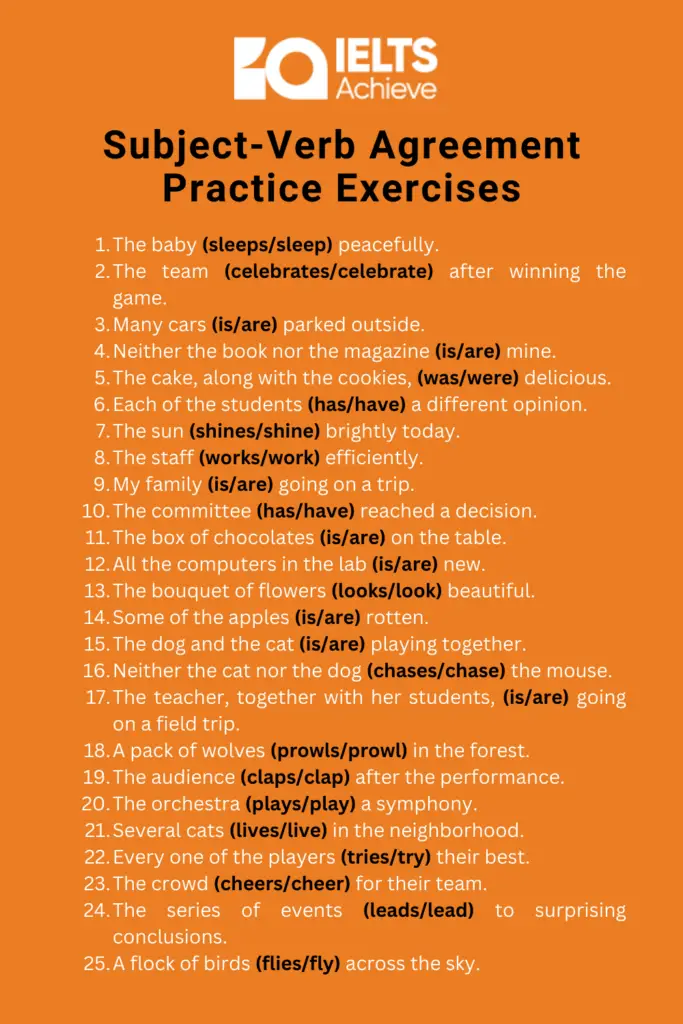
Subject-Verb Agreement Practice Exercises:
The baby (sleeps/sleep) peacefully.
The team (celebrates/celebrate) after winning the game.
Many cars (is/are) parked outside.
Neither the book nor the magazine (is/are) mine.
The cake, along with the cookies, (was/were) delicious.
Each of the students (has/have) a different opinion.
The sun (shines/shine) brightly today.
The staff (works/work) efficiently.
My family (is/are) going on a trip.
The committee (has/have) reached a decision.
The box of chocolates (is/are) on the table.
All the computers in the lab (is/are) new.
The bouquet of flowers (looks/look) beautiful.
Some of the apples (is/are) rotten.
The dog and the cat (is/are) playing together.
Neither the cat nor the dog (chases/chase) the mouse.
The teacher, together with her students, (is/are) going on a field trip.
A pack of wolves (prowls/prowl) in the forest.
The audience (claps/clap) after the performance.
The orchestra (plays/play) a symphony.
Several cats (lives/live) in the neighborhood.
Every one of the players (tries/try) their best.
The crowd (cheers/cheer) for their team.
The series of events (leads/lead) to surprising conclusions.
A flock of birds (flies/fly) across the sky.
Subject-Verb Agreement Practice Exercises: Answers
Essential strategies and practice techniques for this IELTS Reading question type. Learn how to manage time and improve accuracy.
Originally published December 2022. Last reviewed 3 July 2026.
A. In Thailand, elephants are revered as a national symbol, but even there, the survival of great mammals is at risk. A century ago, more than 100,000 elephants worked in the Thai timber industry or roamed the forests. Today the number of elephants in captivity is just 2,500 and there are even fewer in the wild. Illegal hunting has taken a toll. Deforestation and the banning of logging have removed the elephants’ chief source of employment.
B. Recently, on the site of a former government logging camp, the Thai elephant conservation centre has been established. It is home to more than one hundred elephants retrenched from the logging industry. An American elephant specialist and his team have come up with an ingenious career alternative for these redundant employees. A select group of the centre’s residents have been chosen to play in the world’s first elephant orchestra. The project was initiated to create income for the operation of the Elephant Conservation centre.
C. The orchestra currently has twelve members, selected for their musical aptitude and motivation. They are aged seven to eighteen and play a variety of percussion and wind instruments in the Thai tradition – rentals which look like xylophones, slit drums, harmonicas, a bow bass, a gong and a thundersheet. The instruments are ‘elephant sized’ and specially designed to be played with trunks. Early in the project the organisers were unsure how the elephants would respond to musical training. Then one morning they were awakened to the sound of harmonicas.The elephants had picked up the instruments on their own and were wandering through the forest playing enthusiastically.
D. Making music comes naturally to elephants. They have huge brains and are highly sociable creatures. Their hearing is much better than their sight and they use a wide range of vocalisations.In performance, they stand in a line and prompted by the trainers, play their instruments. A strong sense of rhythm is evident as they flap their ears to the beat, swish their tails and generally rock back and forth. Some add to the melody with their own trumpeting. As the conductor paces up and down orchestrating proceedings, a trunk can sometimes be seen imitating the movement of his arm.
E. The elephants aren’t forced to learn complex patterns, so playing the instruments is quite easy. Commands are given only to indicate when to start and when to stop. The rest of the time, the players have the time to improvise. According to the trainers, the elephants love their work. The modest plan initially was to teach the elephants just to hit the instruments and then overdub those sounds with other music. But after only five practice sessions, a decision was made to record the performances intact with just the human noises removed. The players improvise distinct metres and melodies, then vary and repeat them.The resulting music is meditative, deliberate and delicate and it is real elephant music. Western listeners often describe it as ‘haunting’. To some ears it may seem monotonous but anyone not knowing they were listening to elephant music would assume that humans were playing.The first CD, classical in style, has sold well, so soon there will be a pop techno and country versions in production.
F. Playing music is not the only creative form of activity the elephants of the centre engage in. For several years now, a number of residents have been painting. They use acrylic paints on large canvases and have a preference for broad strokes and bold colours. Last year, elephant paintings helped raise over $25,000 at charity auctions internationally. These art sales together with profits from the CD are helping to fund the centre’s operations. The proceeds go towards an orphanage, hospital and mobile veterinary clinic for elephants and to support the training school.
G. Animal rights’ advocates might object to these non-traditional occupations for elephants. But, Thai elephants have always had to work for a living. If they weren’t playing music or painting pictures, they would be dragging logs or carrying tourists. Given those choices, playing music and painting are not such bad options.
Questions 1-6
The passage The Elephant Orchestra’ has paragraphs labelled (A-G).In which paragraph can the following information be found? Use only ONE letter for each answer. Note: You may use each letter more than once.
1 Description of the type of music produced by the elephants………………….. 2 Details of how the income generated is used………………….. 3 Description of the musical instruments………………….. 4 Forthcoming projects for the orchestra………………….. 5 Situation of elephants in Thailand………………….. 6 How the orchestra got started…………………..
Questions 7 – 11
Complete the summary. Choose your answers from the list below. Note: There are more words than spaces so you will not use them all. You may use any word more than once.
In order to raise funds for the Thai Elephant Centre a number of creative 7___________________have been developed, including the first Elephant Orchestra. The elephants play a variety of instruments and their 8 ———————–are being sold to 9 ________________income. These intelligent animals also produce paintings, which have been sold at international auctions. The 10 ——————support an orphanage, hospital and 11————— facility.
List of Words
painting projected music initiatives occupation proceeds production generate recordings training
Question 12
Choose the correct letter A-D.
12. What is the main idea of this passage?
A. Elephants can be trained to do unusual tricks. B Creative projects can help to save endangered species. C Elephants have large brains. D Intelligent animals should not be forced to work.
Complete the sentences below with the words from the paragraph.
13. Making music comes ………….. to elephants. 14. Animal rights’ advocates might object to these ……………………. for elephants.
A detailed guide to this IELTS Writing Task 2 essay type, with structure templates, useful vocabulary, and techniques to achieve Band 7+.
Originally published December 2022. Last reviewed 3 July 2026.
A new study conducted for the World Bank by Murdoch University's Institute for Science and Technology Policy (ISTP) has demonstrated that public transport is more efficient than cars. The study compared the proportion of wealth poured into transport by thirty-seven cities around the world. This included both the public and private costs of building, maintaining and using a transport system.
The study found that the Western Australian city of Perth is a good example of a city with minimal public transport. As a result, 17% of its wealth went into transport costs. Some European and Asian cities, on the other hand, spent as little as 5%. Professor Peter Newman, ISTP Director, pointed out that these more efficient cities were able to put the difference into attracting industry and jobs or creating a better place to live.
According to Professor Newman, the larger Australian city of Melbourne is a rather unusual city in this sort of comparison. He describes it as two cities: 'A European city surrounded by a car-dependent one'. Melbourne's large tram network has made car use in the inner city much lower, but the outer suburbs have the same car-based structure as most other Australian cities. The explosion in demand for accommodation in the inner suburbs of Melbourne suggests a recent change in many people's preferences as to where they live.
Newman says this is a new, broader way of considering public transport issues. In the past, the case for public transport has been made on the basis of environmental and social justice considerations rather than economics. Newman, however, believes the study demonstrates that 'the auto-dependent city model is inefficient and grossly inadequate in economic as well as environmental terms'.
Bicycle use was not included in the study but Newman noted that the two most 'bicycle friendly' cities considered - Amsterdam and Copenhagen - were very efficient, even though their public transport systems were 'reasonable but not special'.
It is common for supporters of road networks to reject the models of cities with good public transport by arguing that such systems would not work in their particular city. One objection is climate. Some people say their city could not make more use of public transport because it is either too hot or too cold. Newman rejects this, pointing out that public transport has been successful in both Toronto and Singapore and, in fact, he has checked the use of cars against climate and found 'zero correlation'.
When it comes to other physical features, road lobbies are on stronger ground. For example, Newman accepts it would be hard for a city as hilly as Auckland to develop a really good rail network. However, he points out that both Hong Kong and Zurich have managed to make a success of their rail systems, heavy and light respectively, though there are few cities in the world as hilly.
A. In fact, Newman believes the main reason for adopting one sort of transport over another is politics: 'The more democratic the process, the more public transport is favored.' He considers Portland, Oregon, a perfect example of this. Some years ago, federal money was granted to build a new road. However, local pressure groups forced a referendum over whether to spend the money on light rail instead. The rail proposal won and the railway worked spectacularly well. In the years that have followed, more and more rail systems have been put in, dramatically changing the nature of the city. Newman notes that Portland has about the same population as Perth and had a similar population density at the time.
B. In the UK, travel times to work had been stable for at least six centuries, with people avoiding situations that required them to spend more than half an hour travelling to work. Trains and cars initially allowed people to live at greater distances without taking longer to reach their destination. However, public infrastructure did not keep pace with urban sprawl, causing massive congestion problems which now make commuting times far higher.
C. There is a widespread belief that increasing wealth encourages people to live farther out where cars are the only viable transport. The example of European cities refutes that. They are-often wealthier than their American counterparts but have not generated the same level of car use. In Stockholm, car use has actually fallen in recent years as the city has become larger and wealthier. A new study makes this point even more starkly. Developing cities in Asia, such as Jakarta and Bangkok, make more use of the car than wealthy Asian cities such as Tokyo and Singapore. In cities that developed later, the World Bank and Asian Development Bank discouraged the building of public transport and people have been forced to rely on cars -creating the massive traffic jams that characterize those cities.
D. Newman believes one of the best studies on how cities built for cars might be converted to rail use is The Urban Village report, which used Melbourne as an example. It found that pushing everyone into the city centre was not the best approach. Instead, the proposal advocated the creation of urban villages at hundreds of sites, mostly around railway stations.
E. It was once assumed that improvements in telecommunications would lead to more dispersal in the population as people were no longer forced into cities. However, the ISTP team's research demonstrates that the population and job density of cities rose or remained constant in the 1980s after decades of decline. The explanation for this seems to be that it is valuable to place people working in related fields together. 'The new world will largely depend on human creativity, and creativity flourishes where people come together face-to-face.'
Questions 1-5
Reading Passage has five marked paragraphs, A-E. Choose the correct heading for each paragraph from the list of headings below. Write the correct number, i-viii, in boxes 1-5 on your answer sheet.
List of Headings
i Avoiding an overcrowded centre ii A successful exercise in people power iii The benefits of working together in cities iv Higher incomes need not mean more cars v Economic arguments fail to persuade vi The impact of telecommunications on population distribution vii Increases in travelling time viii Responding to arguments against public transport
Questions 6-10
Do the following statements agree with the information given in Reading Passage? In boxes 6-10 on your answer sheet, write TRUE if the statement agrees with the information FALSE if the statement contradicts the information NOT GIVEN if there is no information on this
6. The ISTP study examined public and private systems in every city of the world. 7. TRUEFALSENOT GIVEN Efficient cities can improve the quality of life for their inhabitants. 8. An inner-city tram network is dangerous for car drivers. 9. In Melbourne, people prefer to live in the outer suburbs. 10 Cities with high levels of bicycle usage can be efficient even when public transport is only averagely good.
Questions 11-13
Look at the following cities ( Questions 11-13) and the list of descriptions below. Match each city with the correct description, A-F. Write the correct letter, A-F, in boxes 11-13 on your answer sheet.
List of Descriptions
A successfully uses a light rail transport system in hilly environment B successful public transport system despite cold winters C profitably moved from road to light rail transport system D hilly and inappropriate for rail transport system E heavily dependent on cars despite widespread poverty F inefficient due to a limited public transport system
Advantages of Public Transport- IELTS Reading Answers