Expert tips and strategies for this part of the IELTS Speaking test. Includes sample responses and key vocabulary for Band 7+.
Originally published September 2017. Last reviewed 3 July 2026.
In this post, you will see one of the most common IELTS speaking topics for part 3 (Travel) and sample answers.
Please remember that in the actual test you should give honest answers and talk about your own experiences, thoughts, feelings and opinions. Do not try to memorise answers, as the examiners will probably be able to guess and you will lose marks.
However, you are able to make up information to extend your answers, but be sure that you are confident when speaking about the chosen topic and that it is believable.
TIP >> Listen to the questions the examiner asks you and think about the structure of the question. Are they asking your for your opinion? or to say how something has changed from the past to the present?
TIP >> Learn about the most commonly asked question types used in the part 3 questions. This will help you to identify how you should respond and what to look out for when you are practising.
TIP >> It is common for many people to say ‘I don’t know’ or to lose focus when they get a question they know little about. Always answer the questions and if you feel as though you don’t know about the topic, then buy yourself some time by saying; ‘I haven’t really thought about that before…. but in my opinion……’ then give your opinion, etc.
TIP >> Don’t try to answer the questions as quickly as possible, take your time and answer them to the best of your ability. Give your opinion, the reasoning behind it and support with specific examples.
Take a look at the questions and sample answers below on the topic of ‘Travel‘ >>
Q: How easy is it to travel around your country?
A: It is really straightforward to travel anywhere you want to go, whether it is in the country or to visit other countries. There are airports in every major city, national rail lines and nation bus services. The flights are often good value and make it convenient for people to travel to other countries. There are good roads too, which means that you can easily travel in your own car to anywhere you want to go.
Q: Which method of travel do you consider safest?
A: I think that I consider flying to be the most secure way to get around. When you take a flight, everything is so well organised by the airport, air traffic control and other departments, that you know you are in good hands. I prefer travelling this way above going on a train, a boat or in the car, as more accidents happen on those types of transport.
Q: Has travel become safer in recent years?
A: Actually, I think that travel has become safer because of the many terrorist attacks we have seen in the air and on the ground. Airport security has become more intense, with more checks on each person and biometrics introduced. There are also more checks on vehicles, on national train services and on public transport. This is an important measure to take, because of the dreadful attacks that have occurred recently. In the past, the rules were more relaxed, with some airports waving people through without proper papers or identity cards.
Q: What are the pros and cons of low-cost air travel?
A: The main benefit of low-priced air tickets is that people can afford to visit more places around the world. Other benefits may include, travelling more frequently and saving money. The drawbacks, however, are that these airlines often add on extra charges for baggage and food. The prices of food and drink onboard the aircraft is high, along with any other extras that were not included in the flight price. They also have many cancellations and very uncomfortable seats.
Q: How do you think people will travel in the future?
A: I think more people will opt to take a train to get to where they want to go. Some people enjoy a lengthy train ride as this gives them time to relax and unwind. I think they will make ‘super’ trains, with deluxe cabins and luxury facilities, encouraging travellers to want to travel by train on long journeys. Already in China, they have designed double-decker trains and luxury fast trains, with an idea to transport more people in higher quality surroundings in the future.
We hope you found this post useful in helping you to study for the IELTS Test. If you have any questions please let us know in the comments below or on the Facebook page.
The best way to keep up to date with posts like this is to like us on Facebook, then follow us on Instagram and Pinterest.
If you need help preparing for the IELTS Test, join the IELTS Achieve Academy and see how we can assist you to achieve your desired band score. We offer an essay correction service, mock exams and online courses.
Expert tips and strategies for this part of the IELTS Speaking test. Includes sample responses and key vocabulary for Band 7+.
Originally published September 2017. Last reviewed 3 July 2026.
In this post, you will see one of the most common IELTS speaking topics for part 3 (Restaurants) and sample answers.
Please remember that in the actual test you should give honest answers and talk about your own experiences, thoughts, feelings and opinions. Do not try to memorise answers, as the examiners will probably be able to guess and you will lose marks.
However, you are able to make up information to extend your answers, but be sure that you are confident when speaking about the chosen topic and that it is believable.
TIP >> Listen to the questions the examiner asks you and think about the structure of the question. Are they asking your for your opinion? or to say how something has changed from the past to the present?
TIP >> Learn about the most commonly asked question types used in the part 3 questions. This will help you to identify how you should respond and what to look out for when you are practising.
TIP >> It is common for many people to say ‘I don’t know’ or to lose focus when they get a question they know little about. Always answer the questions and if you feel as though you don’t know about the topic, then buy yourself some time by saying; ‘I haven’t really thought about that before…. but in my opinion……’ then give your opinion, etc.
TIP >> Don’t try to answer the questions as quickly as possible, take your time and answer them to the best of your ability. Give your opinion, the reasoning behind it and support with specific examples.
Take a look at the questions and sample answers below on the topic of ‘Restaurants‘ >>
Q. Why do you think people go to restaurants when they want to celebrate something?
A: In my opinion, I think that dressing up to go somewhere with your friends and family is a great way to celebrate a special event. Booking a table in a favoured restaurant is a one way to have a night out and socialise for a birthday or other occasion. This takes the party out of your own hands so that everyone can enjoy the food and not have to do any of the work themselves. Restaurants have a good atmosphere and you can pre-order cakes or other desserts which may be popular if you are celebrating a birthday.
Q. Which are more popular in your country: fast food restaurants or traditional restaurants? Why do you think that is?
A: Where I live, traditional restaurants are favoured because the people who live here and come to visit want to enjoy the home-cooked food of the Med. They want to try delicious dishes prepared with the local produce. The restaurants here are mainly family-owned, with all of the ingredients used bought on the island. Fast food restaurants do not do very well here, with only one available in the town centre. This is mainly frequented by teenagers, as it is cheap.
Q. Some people say that food in an expensive restaurant is always better than food in a cheap restaurant – would you agree?
A: Not really, as I think it depends on where you go and who is cooking it. Everyone has their own personal tastes and if you like a place that serves good food at a good price, then it will be very popular. For example, you might visit a fish restaurant right on the beach, which serves deliciously cooked fresh fish with seasonal vegetables. This could be a small taverna with basic decor and a low-cost menu. This might be quite cheap in comparison to some other so-called ‘a la carte’ restaurants, where the food is very expensive, comes in small portions and does not always live up to expectations.
Q. Do you think there will be a greater choice of food available in shops in the future, or will there be less choice?
A: I think there will continue to be more choice, as the supermarkets seem to be getting bigger and bigger. There is a supermarket next to my parent’s house which is as big as the airport building. The sheer number of products on offer is amazing, they even have employees on roller skates working there, so that they can find what you are looking for and assist you faster.
Q. What effects has modern technology had on the way food is produced?
A: In my view, the way that food is produced now has become quite disgusting with the use of machines and added ingredients. Processed food is so bad for you, yet it is frequently produced and sold in all of the supermarkets. They make it fast, for people who want to cook it fast and eat it fast. This is a process which is against the principles of having a good diet and having the time to enjoy the food. Machines can manufacture food, with all sorts of additional ingredients, which as you can see is creating problems for people.
Q. How important is it for a country to be able to grow all the food it needs, without importing any from other countries?
A: It is definitely something that should be done, I think that when a country can supply the people who live or visit there with fresh natural produce, the lifestyle is much healthier. For example in Greece, they produce fresh vegetables grown in farms there, meat from local farmers and olive oil. They have one of the healthiest diets in the world, with older people living longer. When a country brings food in from other places, the cost goes up and often you don’t really know what is in it, or how the animals were treated.
We hope you found this post useful in helping you to study for the IELTS Test. If you have any questions please let us know in the comments below or on the Facebook page.
The best way to keep up to date with posts like this is to like us on Facebook, then follow us on Instagram and Pinterest.
If you need help preparing for the IELTS Test, join the IELTS Achieve Academy and see how we can assist you to achieve your desired band score. We offer an essay correction service, mock exams and online courses.
A complete model answer and preparation guide for this IELTS Speaking cue card topic. Includes key vocabulary, follow-up questions, and examiner-approved response strategies.
Originally published September 2017. Last reviewed 3 July 2026.
In this post, you will see a sample cue card question, high-level answer and feedback.
MODEL ANSWER
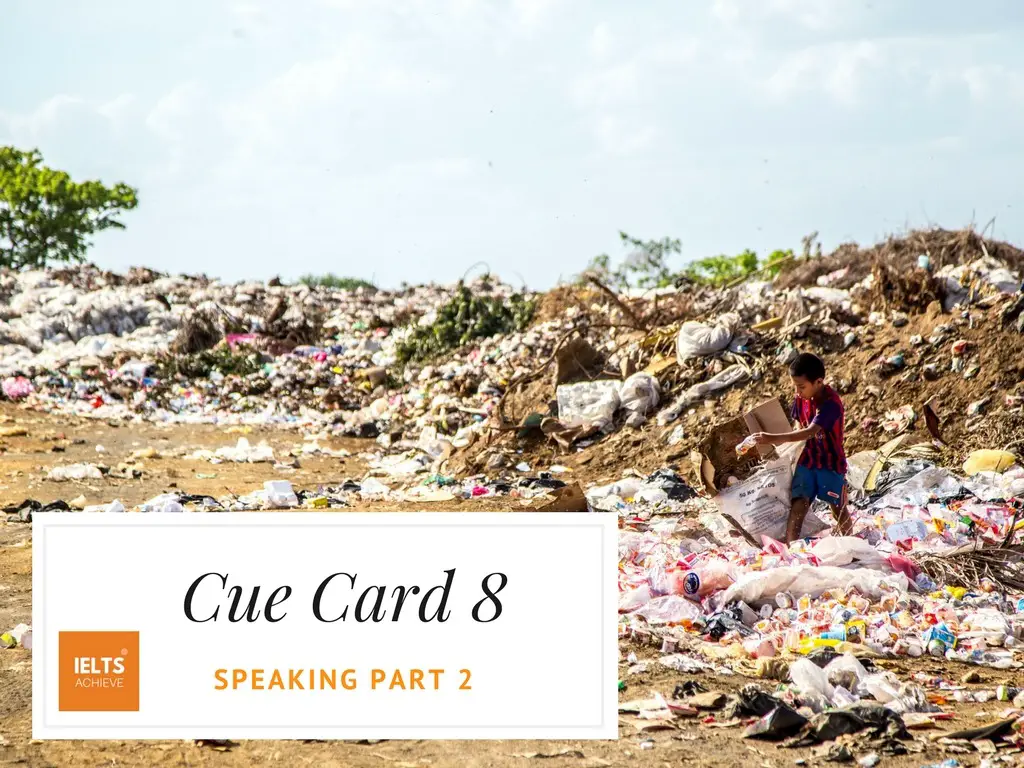
I’d like to talk about the litter problem that we have where I live. When you walk around your village, go into the town, visit monuments or any places really, there is always litter lying on the ground. Even though there are many rubbish bins in places that you pass, people still leave litter on the streets or anywhere they want. This is a huge problem for the environment, as animals can hurt themselves and obviously it looks terrible.
The main reason that this is such an issue, is that there are hundreds, maybe thousands of tourists that come here every year, leaving litter. The bins provided in many areas are quite small, often overflowing so much that there is a huge pile of growing litter right next to the bin. They are not emptied often enough in busy areas, causing a problem. this leads to stray animals inspecting the contents of the trash and makes the area look bad. The litter left behind in some areas, like next to ancient ruins or monuments is just carelessness from tourists. I have seen broken glass, bottles, papers and coffee cups all next to a very well known monument here on the island. I have collected litter to put into the bin, especially if it is broken glass and my dog is with me.
The people on the island are always complaining about the litter problem here, with demonstrations in town. The litter is not collected, sometimes for over a week and rubbish bins start to overflow. Sometimes the garbage collectors go on strike, leaving mountains of rubbish growing every day. This is a real issue, especially with so many tourists visiting the island each year.
To solve this problem, the authorities should provide more bins in built up areas and empty the trash daily. They could also put more signs up saying not to litter and perhaps introduce strict fines for those who do, for example, in the UK there are hefty fines for littering. They need to make people aware that it is not allowed and wrong to leave litter anywhere, making the place look untidy and harming the environment. If the local authorities can make some changes in the short term, then the whole of the island environment and famous well known areas will benefit in the long term.
FEEDBACK
This is a high-level answer, as there are concrete words being used to describe the problem. Words and phrases are used to describe thoughts and feelings about this problem. The bullet points have been covered with the extra information given (examples), which extends the answer. A solution is offered to combat this problem, with good use of vocabulary and collocations.
We hope you found this post useful in helping you to study for the IELTS Test. If you have any questions please let us know in the comments below or on the Facebook page.
The best way to keep up to date with posts like this is to like us on Facebook, then follow us on Instagram and Pinterest.
If you need help preparing for the IELTS Test, join the IELTS Achieve Academy and see how we can assist you to achieve your desired band score. We offer an essay correction service, mock exams and online courses.
Expert tips and strategies for this part of the IELTS Speaking test. Includes sample responses and key vocabulary for Band 7+.
Originally published September 2017. Last reviewed 3 July 2026.
In this post, you will see one of the most common IELTS speaking topics for part 3 (Music) and sample answers.
Please remember that in the actual test you should give honest answers and talk about your own experiences, thoughts, feelings and opinions. Do not try to memorise answers, as the examiners will probably be able to guess and you will lose marks.
However, you are able to make up information to extend your answers, but be sure that you are confident when speaking about the chosen topic and that it is believable.
TIP >> Listen to the questions the examiner asks you and think about the structure of the question. Are they asking your for your opinion? or to say how something has changed from the past to the present?
TIP >> Learn about the most commonly asked question types used in the part 3 questions. This will help you to identify how you should respond and what to look out for when you are practising.
TIP >> It is common for many people to say ‘I don’t know’ or to lose focus when they get a question they know little about. Always answer the questions and if you feel as though you don’t know about the topic, then buy yourself some time by saying; ‘I haven’t really thought about that before…. but in my opinion……’ then give your opinion, etc.
TIP >> Don’t try to answer the questions as quickly as possible, take your time and answer them to the best of your ability. Give your opinion, the reasoning behind it and support with specific examples.
Take a look at the questions and sample answers below on the topic of ‘Music‘ >>
Q: What kind of music is popular in your country?
A: In my country, there are many different types of music that people like to listen to. Pop music is always fashionable and so is folk music. People have many different tastes and there are always concerts for classical, rock, pop and folk. Traditional music is still much loved for weddings and baptism celebrations, as well as village festivals in the summer months.
Q: What do old people like to listen to?
A: They like to hear music from when they were younger, traditional music and sometimes classical. I don’t think they like to listen to pop songs or anything heavy, maybe they listen to the radio but something that is more relaxing. For instance, my grandma like to listen to a radio station that has a mixed programme of stories, interviews, plays and classical music.
Q: Do you play any musical instruments?
A: Yes, I play the piano and I started to learn when I was about 6 years old. I had lessons every Saturday in my house from a great teacher called Mr Haris. I loved learning and developing my skills. I like to play classical music and at Christmas love paying traditional Christmas carols. I think that it is important for children to learn how to play an instrument if they like it of course. It can help them to develop creative skills and give them much enjoyment.
Q: What might be the best age to start learning to play a musical instrument?
A: In my view starting to learn when you are young is the best option. Children’s minds are so impressionable when they are young, they retain information and soak it up like a sponge. They can develop their musical skills and see if they have a talent for it. if you start learning later in life, it will probably be more difficult to find the time, to have lessons and to practice.
We hope you found this post useful in helping you to study for the IELTS Test. If you have any questions please let us know in the comments below or on the Facebook page.
The best way to keep up to date with posts like this is to like us on Facebook, then follow us on Instagram and Pinterest.
If you need help preparing for the IELTS Test, join the IELTS Achieve Academy and see how we can assist you to achieve your desired band score. We offer an essay correction service, mock exams and online courses.
Expert tips and strategies for this part of the IELTS Speaking test. Includes sample responses and key vocabulary for Band 7+.
Originally published September 2017. Last reviewed 3 July 2026.
In this post, you will see one of the most common IELTS speaking topics for part 3 (Sport) and sample answers.
Please remember that in the actual test you should give honest answers and talk about your own experiences, thoughts, feelings and opinions. Do not try to memorise answers, as the examiners will probably be able to guess and you will lose marks.
However, you are able to make up information to extend your answers, but be sure that you are confident when speaking about the chosen topic and that it is believable.
TIP >> Listen to the questions the examiner asks you and think about the structure of the question. Are they asking your for your opinion? or to say how something has changed from the past to the present?
TIP >> Learn about the most commonly asked question types used in the part 3 questions. This will help you to identify how you should respond and what to look out for when you are practising.
TIP >> It is common for many people to say ‘I don’t know’ or to lose focus when they get a question they know little about. Always answer the questions and if you feel as though you don’t know about the topic, then buy yourself some time by saying; ‘I haven’t really thought about that before…. but in my opinion……’ then give your opinion, etc.
TIP >> Don’t try to answer the questions as quickly as possible, take your time and answer them to the best of your ability. Give your opinion, the reasoning behind it and support with specific examples.
Take a look at the questions and sample answers below on the topic of ‘Sport‘ >>
Q: Why are some sports fans so passionate?
A: I think that they really connect with the sport and their hometown, so it has a special meaning for them. I know that in my home city, the people who live there are so supportive of the football team and they have a huge following. They are so proud of the team and love the fact that they are ambassadors for the city, representing it on an international level.
Q: Is there any violence at sporting events in your country?
A: Unfortunately, there is, and there now has to be a heavy police presence at most football games. The worst cases in the past have been the home games, when the neighbouring city rivals play and the fans want to cause trouble, by fighting and causing harm to city property. The police deploy the horse guards to keep the peace and sometimes send in the armed police if things get really bad. I always avoid going into the city if I know there are any football games on that day.
Q: Should athletes be better role models?
A: I think so yes, many people including children look up to these sports stars and when they do reckless things, it has an impact. For example, if they are seen driving dangerously in their sports cars, then people seem to think this is ok and that other people can act like this. There are good role models there too, for instance, David Beckham does a lot for charity and has a children’s football academy.
Q: What benefits do international sporting events bring?
A: They can bring a huge influx of tourism into the country, boosting the economy. This has happened many times recently with the recent boxing match in Las Vegas is an example, many people visited and wanted to see that fight. I think that they also promote the country they are in, allowing people to see what it is like if the event is televised.
Q: Is it important for a country to win lots of medals?
A: I haven’t really thought about that before, but I think that it does give a country status and can help to raise its profile in the media. For example, when the UK wins any gold medals, it is always heavily promoted in the news and those athletes are given star status. They help to raise the profile of the country and show other places that they can win and be on top.
We hope you found this post useful in helping you to study for the IELTS Test. If you have any questions please let us know in the comments below or on the Facebook page.
The best way to keep up to date with posts like this is to like us on Facebook, then follow us on Instagram and Pinterest.
If you need help preparing for the IELTS Test, join the IELTS Achieve Academy and see how we can assist you to achieve your desired band score. We offer an essay correction service, mock exams and online courses.