Essential strategies and practice techniques for this IELTS Reading question type. Learn how to manage time and improve accuracy.
Originally published June 2017. Last reviewed 3 July 2026.
The IELTS Reading Test lasts 60 minutes. It is made up of three parts, with a total of 40 questions. You are given no extra time to transfer your answers to the answer sheet. During the test, the texts become more difficult.
In the General Training test, the texts are not academic, they are about daily life, for example – advertisements, reviews or ‘how to’ articles. You may read something about preparing for a job interview or a review of places to visit when going abroad.
In the Academic test, all three texts are of an academic tone, for instance – scientific research or a historical article. The articles in the Academic reading test may include research about medical procedures or the future of medicine, the environment and climate change issues.
What do you need to do?
Find specific information in the texts. You will be looking for information, such as dates, names, places and costs.
Finding the purpose of a text, looking at the reasons behind the writing. Why did the author write this? What is the purpose of it? To share an opinion? Many people when they write are expressing their views, selling something, sharing news, suggesting, recommending something or reviewing something.
Separating the main idea of an article apart from other ideas. In a long text, there will be the main idea, that is supported by other ideas. It will be good practice for you to read articles and select the main idea, as well as the point of each paragraph.
Following an argument, looking for both sides, the for and against. When you are reading a text, think about – What is the key argument? What statement is the author making? Are they sharing their opinion?
Understand information in diagrams and tables. These are used to give specific information for a fast analysis. In the exam, you may have a table that you have to fill in, after finding the required information in an article.
Summaries and notes, a summary is a short review of something, you will often see this when looking for information about a book or movie, they will give you a short summary of what it is about. Notes can be in bullet form, with groups of words or single words, linked to a subject heading.
The main features of the text, knowing where the title is, the subheadings, the images and the main body of the text is important.
Text length, can in the Academic test go well over 1000 words. This is why it is important to learn how to skim read and locate specific information. In the General Training test, the texts are shorter, but you will also have to be able to skim read.
Being able to paraphrase and recognise paraphrasing is also very important. Many of the texts will paraphrase words – the questions may paraphrase using different words with the same meaning. Always read the questions before you start reading through the text.
How Can You Practice?
There are many websites and texts out there for you to practice with, but day to day you should try and read articles from news websites, science journals, history and of course general interest.
Here are some links to websites with articles you may find interesting;
For more help on each skill you should practice before the reading test, please take a look at the other posts in the reading section.
We hope you found this post useful in helping you to study for the IELTS Test. If you have any questions please let us know in the comments below or on the Facebook page.
The best way to keep up to date with posts like this is to like us on Facebook, then follow us on Instagram and Pinterest.
If you need help preparing for the IELTS Test, join the IELTS Achieve Academy and see how we can assist you to achieve your desired band score. We offer an essay correction service, mock exams and online courses.
Proven strategies for this IELTS Listening question type. Includes prediction techniques and common traps to avoid.
Originally published June 2017. Last reviewed 3 July 2026.
In this post, we will look at how to write a formal letter.
A formal letter is written when you need to write to a company or organisation where you do not know the person to whom you are addressing. Sometimes these letters are addressed to a person of importance, who you do not know, in which case the person’s name and the title are used – ‘Dear Prime Minister May….’
A formal greeting > Dear Sir or Madam, Dear Sirs, Dear HR Manager
When signing off the letter, ‘Yours truly’, ‘Sincerely yours’ and ‘Yours faithfully’ would be used for semi-formal or formal letters.
Here is an example of a formal letter structure >>
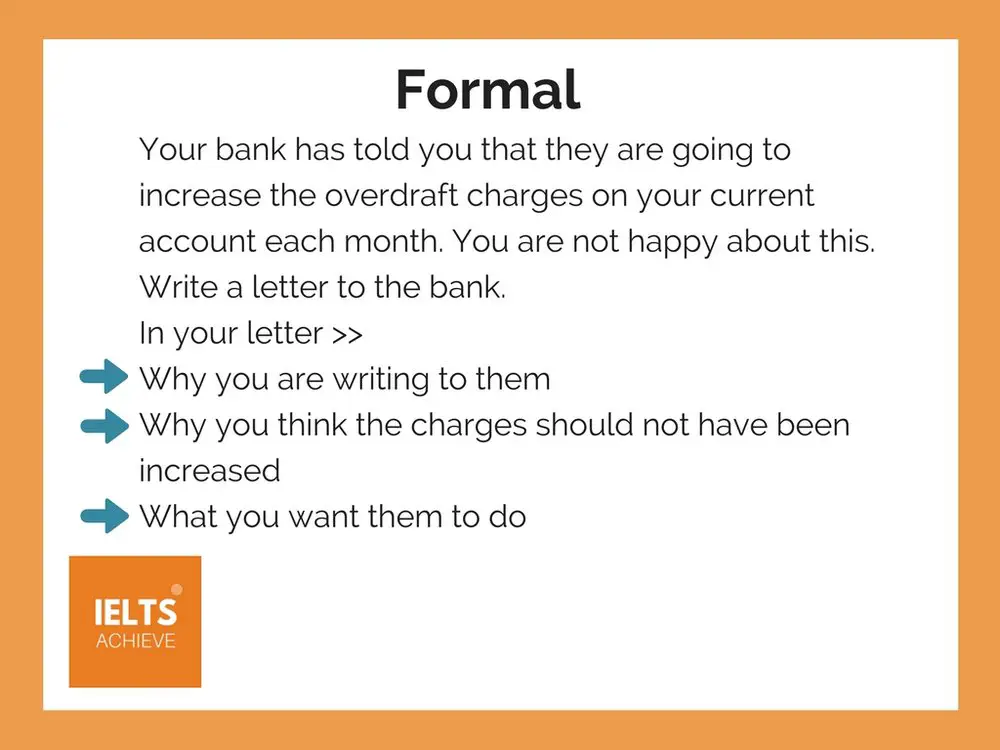
FORMAL QUESTION EXAMPLE >>
Write at least 150 words
You do not need to write any addresses
Begin your letter with ‘Dear…..”
TIP >> A formal letter would be written to someone that you don’t know. That is why when you start writing when you don’t know their name, you would write ‘Dear Sir/Madam….’
Model Answer >>
Dear Sir/Madam,
I am writing to you because I recently received a letter from you detailing the new overdraft charges that are going to be put into place next month.
As you will be aware I have a large overdraft currently exceeding £10,000 and the new charges will make it near impossible to pay off. I have had an account with your bank for over ten years and have never seen an increase in charges, such as those presented now.
I am aware that increased charges on large sums of money that have been borrowed are important in levying profits for your business. The increase that has been proposed of paying 5% on top of the regular amount of £350 in charges each month will become a large and difficult amount to repay.
I would, therefore, like you to write to me and explain why such a large increase has been planned. If you are unable to offer a response that is justifiable to both the bank and me, then I will have no choice but to complain to the Financial Ombudsman Service.
I await your response.
Yours faithfully,
Mr John Bell.
(Word Count – 192 / Band Score 9)
This letter covers the three main points in the task – why he is writing to the bank, why the charges should not have been increased and what he wants them to do.
It has been clearly organised with each key point being written about in a separate paragraph.
Paragraph 1 – Explains why he is writing to the bank
Paragraph 2 – Details of why the charges should not have been increased
Paragraph 3 – States what he wants them to do
The tone of the letter is formal and therefore appropriate as it is being sent to a person you do not know from a business. The language used makes sure the letter is polite (Dear Sir or Madam……I am aware that……I await your response……Yours faithfully).
There is also evidence of a range of sentence structures, no grammatical or spelling errors
We hope you found this post useful in helping you to study for the IELTS Test. If you have any questions please let us know in the comments below or on the Facebook page.
The best way to keep up to date with posts like this is to like us on Facebook, then follow us on Instagram and Pinterest.
If you need help preparing for the IELTS Test, join the IELTS Achieve Academy and see how we can assist you to achieve your desired band score. We offer an essay correction service, mock exams and online courses.
Proven strategies for this IELTS Listening question type. Includes prediction techniques and common traps to avoid.
Originally published June 2017. Last reviewed 3 July 2026.
In this post, we will look at how to write a semi-formal letter.
A semi-formal letter is written to someone that you know by name and with whom you have a professional or business relationship with, for instance; your teacher, accountant, landlord, etc. The surname should be used when addressing them – Dear Mrs.Thomas, Dear Mr Jones.
A semi-formal greeting > Dear Mr Hopkins, Dear Mrs Thomas
When signing off the letter, ‘Yours truly’, ‘Sincerely yours’ and ‘Yours faithfully’ would be used for semi-formal or formal letters. In semi-formal letters, you can also use – ‘With best wishes’ and ‘With regards’.
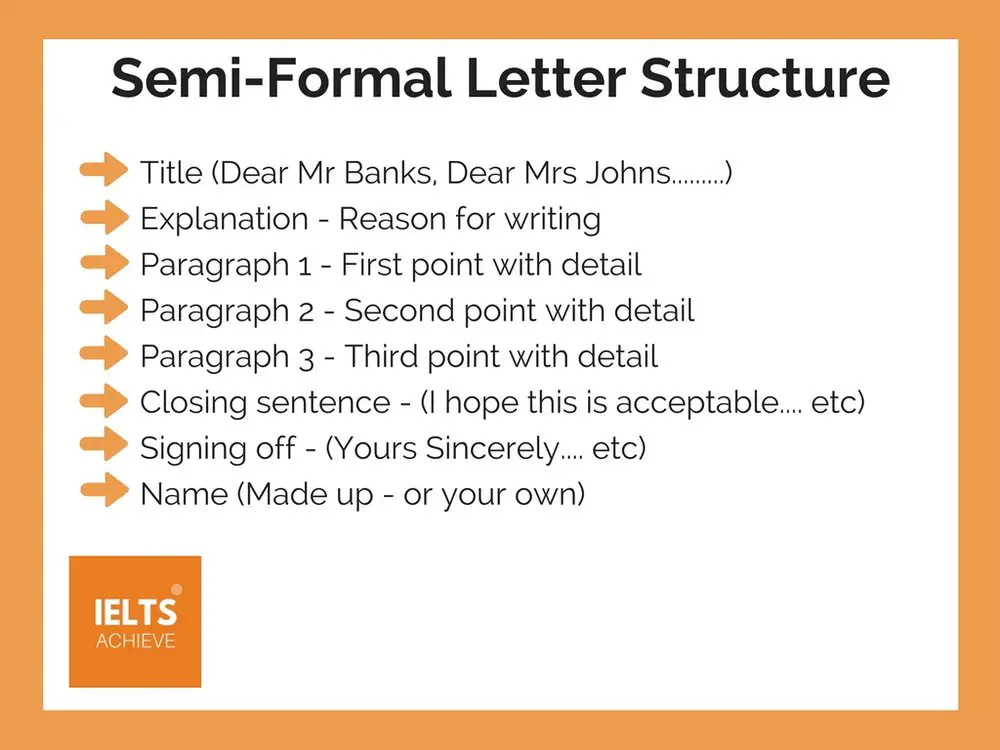
Here is an example of a semi-formal letter structure >>
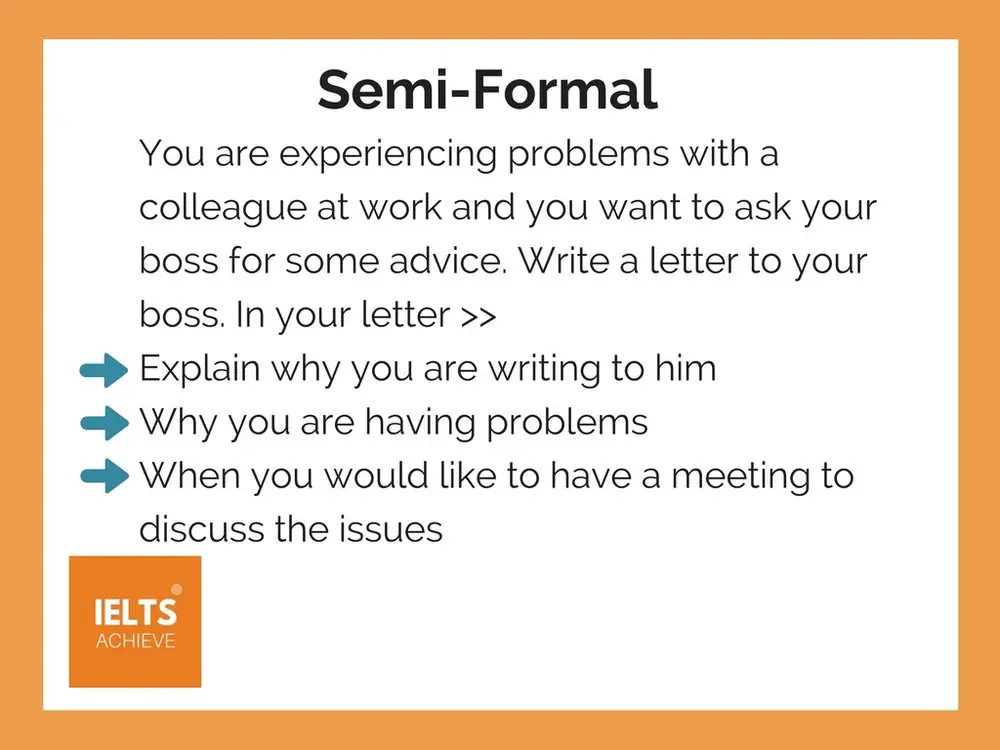
Semi-formal Question Example >>
You must include the information that is required, in this example, you have to make a request, for a meeting with your boss to discuss a problem at work with another colleague. It is semi-formal because it is someone that the letter writer knows, but it is not a close friend.
Write at least 150 words
You do not need to write any addresses
Begin your letter with ‘Dear…..”
Model Answer >>
Dear Mrs Amble
I am writing to you to request a meeting, to discuss some issues that have arisen with a member of my team.
I have been working with Ronnie Smith for over a year now and while he was a model member of the team, he has now become distant and irritable. Last week he disappeared during a very important lesson and reappeared over three hours later with no explanation. When confronted he made a flimsy excuse for his whereabouts.
I can assure you that I have been very flexible and understanding over previous time management issues, however, his erratic behaviour is becoming more frequent. I would like to meet with you on Wednesday 15th at 3 pm and examine the best way to approach this situation.
I hope this is an acceptable time to meet, please contact me at the earliest opportunity to re-arrange if there is a problem.
Yours Sincerely,
Steve King.
(Word Count – 156 / Band Score 9)
This letter covers the three main points in the task – why he is writing to her, gives further details of the problem in the second paragraph and in the final paragraph when he would like to have a meeting to discuss it further.
It has been clearly organised with each key point being written about in a separate paragraph.
Paragraph 1 – Explains why he is writing to the boss
Paragraph 2 – Details of the issue/problem
Paragraph 3 – Gives dates/time that they can arrange a meeting
The tone of the letter is polite and therefore appropriate as it is being sent to a work colleague (I am writing to you to request…..I can assure you….please contact me at the earliest opportunity)
There is also evidence of a range of sentence structures, no grammatical or spelling errors.
We hope you found this post useful in helping you to study for the IELTS Test. If you have any questions please let us know in the comments below or on the Facebook page.
The best way to keep up to date with posts like this is to like us on Facebook, then follow us on Instagram and Pinterest.
If you need help preparing for the IELTS Test, join the IELTS Achieve Academy and see how we can assist you to achieve your desired band score. We offer an essay correction service, mock exams and online courses.
Proven strategies for this IELTS Listening question type. Includes prediction techniques and common traps to avoid.
Originally published June 2017. Last reviewed 3 July 2026.
In this post, we will look at how to write an informal letter.
An informal letter is the type of letter you would write to a friend or family member. First names are used, or family terms, for example; Dear mum, Dear Uncle Tom, Dear Dad, etc.
An informal greeting > Dear Sarah, My dear friend, Dear Aunt Clare
When signing off the letter, you can use – ‘With best wishes’ and ‘With regards’. ‘Hope to see you soon!’ is a very informal way to close the letter.
Here is an example of an informal letter structure >>
Informal Question Example >>
You must include the information that is required, think about a detailed scenario – a name for the friend, some information about the bicycle and a preferred time to meet. Use your imagination and think about what you would include when writing this letter.
Write at least 150 words
You do not need to write any addresses
Begin your letter with ‘Dear…..”
TIP >> The informal letter question will normally have the word ‘friend’ in it. Asking you to write a letter to a friend is a key piece of information, telling you that the letter should be written in an informal style.
Model Answer >>
Dear Anna,
I hope you are doing well.
I am doing great, though things have been a bit stressful at the moment because we are packing for our move next week.
There are some things that we can’t take with us because we have nowhere to store them in the new house. This, unfortunately, includes my bicycle. I hardly use it now, so want to try and sell it and thought that you might be interested in taking a look. I can offer you a really good price and know that you wanted one a while ago.
It is a women’s bicycle with a cream frame and black wheels. It has a large black basket on the front, great for carrying groceries or other items, a bell, working front and back lights and brakes that are in fantastic condition. There is also a bike lock that comes with it.
We are planning to move into the new house on Friday next week. If you would like to come over and view the bike, I will be in on Monday 19th or Tuesday 20th after 6 pm. That will give me time to advertise it online if you are not interested.
Let me know which day you would like to see the bike and we can have a good catch up. I look forward to hearing from you.
See you soon!
Maggie.
(Word Count – 231 / Band Score 9)
This letter covers the three main points in the task about the bicycle – why it is being sold, a description and dates that the friend can view it.
It has been clearly organised with each key point being written about in a separate paragraph.
Paragraph 1 – Explains why the bicycle is for sale
Paragraph 2 – Describes the bicycl
Paragraph 3 – Gives dates/time that the friend can view the bicycle
The tone of the letter is informal and therefore appropriate as it is being sent to a friend (Hope you are doing well…..have a good catch up….see you soon!)
There is also evidence of a range of sentence structures, no grammatical or spelling errors.
We hope you found this post useful in helping you to study for the IELTS Test. If you have any questions please let us know in the comments below or on the Facebook page.
The best way to keep up to date with posts like this is to like us on Facebook, then follow us on Instagram and Pinterest.
If you need help preparing for the IELTS Test, join the IELTS Achieve Academy and see how we can assist you to achieve your desired band score. We offer an essay correction service, mock exams and online courses.
Step-by-step guide to answering this type of IELTS Writing Task 1 question. Covers structure, key language, and band-scoring criteria.
Originally published June 2017. Last reviewed 3 July 2026.
The General Training Writing test has two separate writing tasks in 60 minutes. For each part, you will receive a question paper and an answer sheet. You can make notes on the question paper, only the text on the answer sheet will be marked by the examiner. You can write your answers in pen or pencil and correct when necessary. You cannot use a dictionary or any electronic devices.
IELTS Academic and General Training students do different tests for part 1, but complete the same test for part 2. There are many resources to help you prepare for part 2 here.
You must answer both tasks and it is recommended that you spend 20 minutes on task 1 and 40 minutes on task 2. Part 2 is twice as important as your score for part 1. Writing task 1 has a minimum word count of 150 words and you must write a letter. Writing task 2 has a minimum word count of 250, you must write a discursive essay, you will be given an opinion, problem or issue that you need to discuss.
Requirements from universities and immigration agencies vary. Most students will need at least a band score 6 for undergraduate study. For postgraduate study or immigration, a band score 7 is generally required.
Marking Criteria
One of the first things you should do is read the marking criteria to see what the examiners expect. This is really important, as you need to know what they are looking for in the band 7+ boxes.
The information in the test question will tell you what to write about. To achieve a high Task Achievement score, you must write about all of the points in the letter and make sure everything is relevant. To improve your score for Coherence and Cohesion, use the information in the question to plan and organise your ideas clearly. To achieve a high score in the Lexical Resource, you should use synonyms and avoid copying words from the question. In Grammatical Range and Accuracy, make sure you check through your work for any grammatical and spelling errors.
Task Achievement
Does your letter answer all parts of the question?
Are your ideas relevant?
Coherence and Cohesion
Are your ideas well organised, clear and well connected?
Lexical Resource
Have you repeated any words?
Have you copied any words from the question?
Grammatical Range and Accuracy
Have you made any grammatical/spelling/punctuation errors?
Have you used a variety of sentence structures?
Have you used the right tenses?
TIP >> Leave at least 2/3 minutes to check your work before you finish this task.
TIP >> In IELTS writing task 1 for the General Training, students only need to write the greeting ‘Dear…’, the body text, the complimentary close (for example – yours sincerely) and their name. Addresses should NOT be included.
TIP >> You do not get more points for writing more than 150 words. You should only spend 20 minutes on this task as writing task 2 is harder and worth twice as much in terms of the score.
Letter Writing
In the General Training Task 1, you will be asked to write a letter. The letter must be written in the correct style, for example;
Informal – writing to a friend or family member (someone you know well)
Semi Formal – if you were writing for a work colleague (someone you know)
Formal – if you are writing to a business or local newspaper (a person you do not know)
Each type of letter will use different language, meaning it will both begin and end in a different way. When given a question, you will identify which type of letter you need to write by identifying the language in the question.
The letter questions will feature different content, which tells you if the letter is going to be informal, semi-formal or formal. Here is a list >>
Information request – any style
Making arrangements – formal
Applications – formal
Invitations – personal/semi-formal
Complaints – formal
Personal – informal
The following are examples of three different types of letters >>
Informal Letter Question >>
Write at least 150 words
You do not need to write any addresses
Begin your letter with ‘Dear…..”
TIP >> The informal letter question will normally have the word ‘friend’ in it. Asking you to write a letter to a friend is a key piece of information, telling you that the letter should be written in an informal style.
Semi Formal Letter Question >>
Write at least 150 words
You do not need to write any addresses
Begin your letter with ‘Dear…..”
TIP >> A semi-formal letter is often to someone that you know like a work colleague.
Formal Letter Question >>
Write at least 150 words
You do not need to write any addresses
Begin your letter with ‘Dear…..”
TIP >> A formal letter would be written to someone that you don’t know. That is why when you start writing when you don’t know their name, you would write ‘Dear Sir/Madam….’
There are practice tests you can download from the British Council.
We hope you found this post useful in helping you to study for the IELTS Test. If you have any questions please let us know in the comments below or on the Facebook page.
The best way to keep up to date with posts like this is to like us on Facebook, then follow us on Instagram and Pinterest.
If you need help preparing for the IELTS Test, join the IELTS Achieve Academy and see how we can assist you to achieve your desired band score. We offer an essay correction service, mock exams and online courses.