Essential strategies and practice techniques for this IELTS Reading question type. Learn how to manage time and improve accuracy.
Originally published June 2017. Last reviewed 3 July 2026.
In this post, we will be looking at matching sentence endings.
In the IELTS Reading Test, you could be given questions that ask you to match sentence endings, often with many combinations that include incorrect sentences. To comprehend how to complete these questions, you need to see how ideas are connected in the texts.
You should read the first half of the sentence and then look through the text to find the information. After that read through the section of the text and choose the relevant sentence ending. There will be more sentence endings given than needed to complete the task.
Before trying the practice questions below, see if you can match the following sentence endings, only using your logic and knowledge of grammar >>
When I turn the key
If you turn the tap on
The child obesity rate
The hospital service
Substance abuse in teens
A. is steadily growing in high-income countries
B. creates many illnesses and problems
C. the door opens
D. reported cuts to spending in 2017
E. water flows out
F. reported they had been successful
Answers are at the bottom of the page.
TEST QUESTION
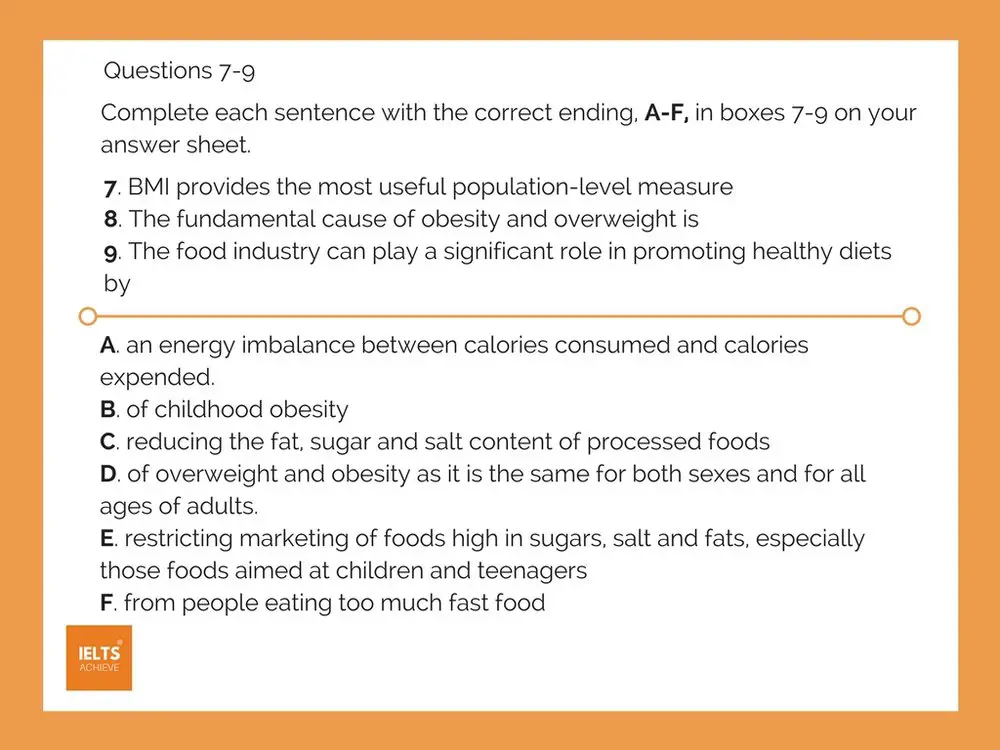
In the IELTS test, the matching sentence endings questions will look similar to this example below >>
The paragraphs for the practice exercises are from a text called “Obesity and Overweight” from The World Health Organisation (WHO) website.
Exercise 1
What causes obesity and overweight?
The fundamental cause of obesity and overweight is an energy imbalance between calories consumed and calories expended. Globally, there has been:
an increased intake of energy-dense foods that are high in fat; and
an increase in physical inactivity due to the increasingly sedentary nature of many forms of work, changing modes of transportation, and increasing urbanisation.
Changes in dietary and physical activity patterns are often the result of environmental and societal changes associated with the development and lack of supportive policies in sectors such as health, agriculture, transport, urban planning, environment, food processing, distribution, marketing, and education.
Match the sentence endings >>
Weight issues are created when
Having a job where you are sitting for long periods of time or no exercise in your regular routine can
The situation around you can affect your
A. the number of calories burned are not the same as the calories that have been eaten
B. health and the lifestyle that you have
C. a person consumes too much fast food
D. lead to weight gain, because of less movement
E. make a person gain weight and go out less
F. outlook on life, which affects your daily diet and exercise routine
Answers are at the bottom of the page.
Exercise 2
How can overweight and obesity be reduced?
Overweight and obesity, as well as their related noncommunicable diseases, are largely preventable. Supportive environments and communities are fundamental in shaping people’s choices, by making the choice of healthier foods and regular physical activity the easiest choice (the choice that is the most accessible, available and affordable), and therefore preventing overweight and obesity.
At the individual level, people can:
limit energy intake from total fats and sugars;
increase consumption of fruit and vegetables, as well as legumes, whole grains and nuts; and
engage in a regular physical activity (60 minutes a day for children and 150 minutes spread through the week for adults).
Individual responsibility can only have its full effect where people have access to a healthy lifestyle. Therefore, at the societal level, it is important to support individuals in following the recommendations above, through sustained implementation of evidence-based and population-based policies that make regular physical activity and healthier dietary choices available, affordable and easily accessible to everyone, particularly to the poorest individuals. An example of such a policy is a tax on sugar-sweetened beverages.
Match the sentence endings >>
Being overweight
People can
Society must
A. offer help to those who are overweight, making sure that healthy diet options and regular activities are easily accessible
B. can be stopped, by making changes and receiving help from the community
C. is caused by being irresponsible
D. watch what they eat
E. be careful with their daily eating habits, making sure they consume a healthy amount of fruits and vegetables
F. promote a sugar tax on all unhealthy foods
Answers are at the bottom of the page.
Exercise 3
What are common health consequences of overweight and obesity?
Raised BMI is a major risk factor for noncommunicable diseases such as:
cardiovascular diseases (mainly heart disease and stroke), which were the leading cause of death in 2012;
diabetes;
musculoskeletal disorders (especially osteoarthritis – a highly disabling degenerative disease of the joints);
some cancers (including endometrial, breast, ovarian, prostate, liver, gallbladder, kidney, and colon).
The risk for these noncommunicable diseases increases, with increases in BMI.
Childhood obesity is associated with a higher chance of obesity, premature death and disability in adulthood. But in addition to increased future risks, obese children experience breathing difficulties, increased risk of fractures, hypertension, early markers of cardiovascular disease, insulin resistance and psychological effects.
Match the sentence endings >>
Eventual exposure
Being obese at a young age
The dangerous circumstances surrounding obesity
A. can lead to early death
B. are higher when a person’s BMI is immense
C. can make it tough for a young person at school
D. can lead to children struggling to breathe and other complications
E. projects a future of obesity and ongoing serious health issues
F. to the health issues caused by obesity can cause a number of diseases
Answers are at the bottom of the page.
REVIEW AND STRATEGY
The matching sentence endings are common in the IELTS Reading Test, therefore you should practice and develop a strategy for answering.
TIP >> Read the instructions before you start reading the text, partial sentences or the sentence endings.
TIP >> Read the partial sentences first and the sentence endings.
TIP >> Skim read the text and look for any clear answers.
TIP >> Choose your answers through an elimination process. Which ones do not fit? Which ones can you dismiss? Be attentive to synonyms and paraphrasing.
Answers >>
Practice Questions Answers >>
1 – C
2 – E
3 – A
4 – D
5 – B
Exercise 1 Answers >>
1 – A
2 – D
3. F
Exercise 2 Answers >>
1 – B
2 – E
3 – A
Exercise 3 Answers >>
1 – D
2 – E
3 – B
We hope you found this post useful in helping you to study for the IELTS Test. If you have any questions please let us know in the comments below or on the Facebook page.
The best way to keep up to date with posts like this is to like us on Facebook, then follow us on Instagram and Pinterest.
If you need help preparing for the IELTS Test, join the IELTS Achieve Academy and see how we can assist you to achieve your desired band score. We offer an essay correction service, mock exams and online courses.
Essential strategies and practice techniques for this IELTS Reading question type. Learn how to manage time and improve accuracy.
Originally published June 2017. Last reviewed 3 July 2026.
In this post, we will be looking at matching headings.
The matching heading questions normally ask you to match a list of headings to paragraphs. The texts given can consist of six to nine paragraphs.
When you see this type of task, you should;
Quickly read the headings and underline/highlight any keywords.
Skim read the text – so you understand the overall meaning
Read the first paragraph and see if any headings match up
Choose the best heading for the paragraph (read again if needed)
Repeat this strategy for every paragraph
This strategy above allows you to choose the heading appropriate for each paragraph by going through a process of elimination.
What is a heading?
A paragraph heading sums up the paragraph as a whole, not just parts of it. Try not to match up words in the heading with words you see in the paragraph, that could lead you to make an incorrect choice. The heading should apply to all information written about in the paragraph, not just parts of it.
When you look at the heading choices you may think that more than one could match up with different paragraphs, but you need to look closer to see which option is the best fit. You should take the time to practice matching headings to paragraphs, summing up the main idea, not just trying to match the words.
Test Question
In the IELTS test, the matching headings questions will look similar to the those below and it will appear before a text, not after it >>
The paragraphs for the practice exercises are from a text called “Adolescents: health risks and solutions” from The World Health Organisation (WHO) website.
All answers are at the bottom of the page.
Exercise 1
Read the following headings and then skim read the text, choose the heading that supports the main idea of each paragraph >>
What topic do all of the headings have in common? Underline/highlight and keywords.
i. The future of mental health
ii. Violence has a wide scope in urban areas
iii. Support is on offer for youths surviving violent backgrounds
iv. The cause of female and male violence
v. The future of mental health in the school system and beyond
vi. Conflict prevention methods should be used to promote harmony
vii. Knowledge of assaults on women and men
A
Depression is the third leading cause of illness and disability among adolescents, and suicide is the third leading cause of death in older adolescents (15–19 years). Violence, poverty, humiliation and feeling devalued can increase the risk of developing mental health problems.
B
Building life skills in children and adolescents and providing them with psychosocial support in schools and other community settings can help promote good mental health. Programmes to help strengthen the ties between adolescents and their families are also important. If problems arise, they should be detected and managed by competent and caring health workers.
C
Violence is a leading cause of death in older adolescent males. Interpersonal violence represents 43% of all adolescent male deaths in LMICs in the WHO Americas Region. Globally, 1 in 10 girls under the age of 20 years reports experiencing sexual violence.
D
Promoting nurturing relationships between parents and children early in life, providing training in life skills, and reducing access to alcohol and firearms can help to prevent injuries and deaths due to violence. Effective and empathetic care for adolescent survivors of violence and ongoing support can help deal with the physical and psychological consequences.
TIP >> Don’t try to match the words in the headings to the words in the text. You need to focus on the whole idea in each paragraph.
TIP >> Try and narrow the choices down when you are completing the task – through an elimination process. Look at paragraph A and decide which headings do connect with it, which ones do not?
Exercise 2
Read the following headings and then skim read the text, choose the heading that supports the main idea of the paragraph >>
i. The detrimental effects of alcohol abuse
ii. How young people are affected by bad drinking habits
iii. Drinking alcohol can create many health problems
A
Harmful drinking among adolescents is a major concern in many countries. It reduces self-control and increases risky behaviours, such as unsafe sex or dangerous driving. It is a primary cause of injuries (including those due to road traffic accidents), violence (especially by a partner) and premature deaths. It can also lead to health problems in later life and affect life expectancy. Setting a minimum age for buying and consuming alcohol and regulating how alcoholic drinks are targeted at the younger market are among the strategies for reducing harmful drinking.
Exercise 3
Read the following headings and then skim read the text, choose the heading that supports the main idea of the paragraph >>
i. How to have a healthy diet
ii. The key to being healthy at a young age
iii. An insight to the eating habits and daily activities of young people
B
Developing healthy eating and exercise habits in adolescence are foundations for good health in adulthood. Reducing the marketing of foods high in saturated fats, trans-fatty acids, free sugars, or salt and providing access to healthy foods and opportunities to engage in physical activity are important for all but especially children and adolescents. Yet available survey data indicate that fewer than 1 in every 4 adolescents meets the recommended guidelines for physical activity: 60 minutes of moderate to vigorous physical activity daily.
Exercise 4
Read the following headings and then skim read the text, choose the heading that supports the main idea of the paragraph >>
i. Observations of cigarette use amongst young people in modern society
ii. The problems associated with smoking
iii. How to stop people from smoking
C
The vast majority of people using tobacco today began doing so when they were adolescents. Prohibiting the sale of tobacco products to minors and increasing the price of tobacco products through higher taxes, banning tobacco advertising and ensuring smoke-free environments are crucial. Globally, at least 1 in 10 adolescents aged 13 to 15 years uses tobacco, although there are areas where this figure is much higher. Cigarette smoking seems to be decreasing among younger adolescents in some high-income countries.
Exercise 5
Read the following headings and then skim read the text, choose the heading that supports the main idea of the paragraph >>
i. The history of HIV
ii. An understanding of the current status of HIV in minors
iii. Problems associated with HIV
D
More than 2 million adolescents are living with HIV. Although the overall number of HIV-related deaths is down 30% since the peak in 2006 estimates suggest that HIV deaths among adolescents are rising. This increase, which has been predominantly in the WHO African Region, may reflect the fact that although more children with HIV survive into adolescence, they do not all then get the care and support they need to remain in good health and prevent transmission. In sub-Saharan Africa, only 10% of young men and 15% of young women aged 15 to 24 are aware of their HIV status.
Exercise 6
Read the following headings and then skim read the text, choose the heading that supports the main idea of the paragraph >>
i. The health issues relating to the youth of today
ii. Problems affecting adolescents in modern society
iii. The most common health issues that stop young people from reaching their full potential
E
Around 1.2 billion people, or 1 in 6 of the world’s population, are adolescents aged 10 to 19. Most are healthy, but there is still substantial premature death, illness, and injury among adolescents. Illnesses can hinder their ability to grow and develop to their full potential. Alcohol or tobacco use, lack of physical activity, unprotected sex and/or exposure to violence can jeopardise not only their current health, but also their health as adults, and even the health of their future children.
REVIEW AND STRATEGY
The matching headings questions are common in the IELTS Reading Test, therefore you should practice and develop a strategy for answering.
TIP >> Read the instructions before you start reading the text. Make sure you understand the question.
TIP >> Skim read each paragraph and get the main idea of each one.
TIP >> Look at the headings and highlight any keywords you can see, then match them up if you see anything clear.
TIP >> Choose your answers through an elimination process. Which ones do not fit? Which ones can you dismiss? Be attentive to synonyms and paraphrasing.
Answers >>
Exercise 1 – Answers >>
A = iv
B = v
C = vii
D = vi
Exercise 2 – Answers >>
A = ii
Exercise 3 – Answers >>
B = iii
Exercise 4 – Answers >>
C = i
Exercise 5 – Answers >>
D = ii
Exercise 6 – Answers >>
E = i
We hope you found this post useful in helping you to study for the IELTS Test. If you have any questions please let us know in the comments below or on the Facebook page.
The best way to keep up to date with posts like this is to like us on Facebook, then follow us on Instagram and Pinterest.
If you need help preparing for the IELTS Test, join the IELTS Achieve Academy and see how we can assist you to achieve your desired band score. We offer an essay correction service, mock exams and online courses.
Essential strategies and practice techniques for this IELTS Reading question type. Learn how to manage time and improve accuracy.
Originally published June 2017. Last reviewed 3 July 2026.
In this post, we will be looking at matching information.
For the matching information tasks, you should look at each phrase in the questions and then find the information or idea in the text. The order of the questions is not in the order of where you will find the information in the text. A skill that is important and will help you is skim reading.
Skim Reading
Skim reading is a skill that is used to locate information in a text quickly. It is often used to find the main ideas or the main points in a text. In the IELTS Reading Test, skim reading is a skill you should use when trying to find numbers or dates, a measurement, a reason, a finding, a description, a reaction, an account, a cause or an effect, a conclusion or a problem. It will help you to find the information you need to answer questions and it makes sure you know the overall meaning of the text.
Look at the sentences below, which ones have a number, a date, a description, a measurement, a finding, a reaction, a cause, an effect, a conclusion? (More than one type may apply to each sentence).
Skim read through to find the information >>
The Medical Journal of the American Research Institute last year published many articles relating to new developments in medicine.
By 2020, the number of people aged 60 years and older will outnumber children younger than 5 years.
Many people have been shocked by the number of cuts in the health system this year.
The government has made a huge mistake in failing to give nurses a pay rise for over 10 years, thus losing voters and support from that profession.
The impact of spending cuts in the NHS has seen many people suffer long waiting hours over a number of departments, increasing the wait time in A&E in some hospitals to over 4 hours.
Answers at the bottom of the page.
Matching Information
Look at the extracts from texts below and match them to the following information >>
An Effect
A Date
A Finding
An Account
People worldwide are living longer. Today, for the first time in history, most people can expect to live into their sixties and beyond. By 2050, the world’s population aged 60 years and older is expected to total 2 billion, up from 900 million in 2015.
According to The World Health Organisation (WHO), a longer life brings with it opportunities, not only for older people and their families but also for societies as a whole. Additional years provide the chance to pursue new activities such as further education, a new career or pursuing a long-neglected passion.
In fact, in the research paper on ageing by The World Health Organisation (WHO), there is, however, little evidence to suggest that older people today are experiencing their later years in better health than their parents. While rates of severe disability have declined in high-income countries over the past 30 years, there has been no significant change in mild to moderate disability over the same period.
If people can experience these extra years of life in good health and if they live in a supportive environment, their ability to do the things they value will be little different from that of a younger person. If these added years are dominated by declines in physical and mental capacity, the implications for older people and for society are more negative.
Below is an example of how a matching information question may look in the IELTS Reading test. In the examples given in this post, the texts are short, to give you an introduction to how to answer this type of question. In the test, the texts will be much longer with a word count of 1000+, you will need to skim read the whole text to find the answers you are looking for.
Read the information below and match the information, remember to skim read the text, don’t read every word.
Diversity in older age (A) There is no ‘typical’ older person. Some 80 year-olds have physical and mental capacities similar to many 20 year-olds. Other people experience significant declines in physical and mental capacities at much younger ages. A comprehensive public health response must address this wide range of older people’s experiences and needs.
Health inequities (B) The diversity seen in older age is not random. A large part arises from people’s physical and social environments and the impact of these environments on their opportunities and health behaviour. The relationship we have with our environments is skewed by personal characteristics such as the family we were born into, our sex and our ethnicity, leading to inequalities in health. A significant proportion of the diversity in older age is due to the cumulative impact of these health inequities across the life course. Public health policy must be crafted to reduce, rather than reinforce, these inequities.
Outdated and ageist stereotypes (C) Older people are often assumed to be frail or dependent, and a burden to society. Public health, and society as a whole need to address these and other ageist attitudes, which can lead to discrimination, affect the way policies are developed and the opportunities older people have to experience Healthy Ageing.
Which paragraph contains the following information?
Write the correct letter A-C, in boxes 11-13 on your answer sheet.
11. A description of the way society views the elderly.
12. A reaction to the rights for the elderly living in our society.
13. The effect of our surroundings partnered with our own personality traits, which lead to health differences.
Answers at the bottom of the page.
How You Can Prepare = Read More
You should prepare as much as possible before your IELTS Test and that includes reading regularly. You can find good texts to read on various websites like the news sites listed in the Introduction to IELTS Reading post.
You should try to read around a range of topics, from health, the environment, technology, education, history and general interest articles. The IELTS articles will not cover politics or religion, so you can focus on other topics.
Some articles may seem challenging to read, but this is really good practice! Keep a notebook and write down any words you do not know the meaning of, then look them up and write the meaning in the book. This is a good way to learn new vocabulary.
REVIEW AND STRATEGY
The matching information questions are common in the IELTS Reading Test, therefore you should practice and develop a strategy for answering.
TIP >> Read the instructions before you start reading the text. Make sure you understand the questions.
TIP >> Skim read the text/paragraphs and get the main idea.
TIP >> Look at the questions and think about if they match up with any of the paragraphs. Is anything standing out to you?
TIP >> Choose your answers through an elimination process. Which ones do not fit? Which ones can you dismiss? Be attentive to synonyms and paraphrasing.
Task Answers >>
Skim reading exercise answers >>
A finding
A description
A reaction
A cause
An effect
Matching Information Answers (Task 1) >>
A Date
An Account
A Finding
An Effect
Matching Information Answers (Task 2) >>
11. C
12. A
13. B
We hope you found this post useful in helping you to study for the IELTS Test. If you have any questions please let us know in the comments below or on the Facebook page.
The best way to keep up to date with posts like this is to like us on Facebook, then follow us on Instagram and Pinterest.
If you need help preparing for the IELTS Test, join the IELTS Achieve Academy and see how we can assist you to achieve your desired band score. We offer an essay correction service, mock exams and online courses.
Essential strategies and practice techniques for this IELTS Reading question type. Learn how to manage time and improve accuracy.
Originally published June 2017. Last reviewed 3 July 2026.
In this post, we will look at short answer questions and sentence completion.
Short Answer Questions
Short answer questions in the test, will require you to write no more than a set number of words. You will probably be given a word limit, for example, ‘No more than two words and/or a number’. If you write more words than the instructions tell you to, your answer will be marked as incorrect. The short answers only need keywords, meaning you will not be able to write a sentence. These questions are there to see how well you can find specific information.
When you are answering short answer questions, underline/highlight the keywords that will help you to find the information you need. You can also underline any words that you think are suitable in relation to the information you need to find.
You also need to be aware of synonyms and paraphrasing – look for words that have the same meaning, don’t just look for words that are exactly the same.
Take a look at the examples below, the words in italics are what you need to find out, the key terms are in bold.
On which date was the medical research on asthma first published?
Which news article was eventually discussed by the media in more detail?
Read the following passage and answer the questions with no more than two words.
Approximately 90% of visually impaired people live in developing countries.
People aged 50 and over
About 65 % of all people who are visually impaired are aged 50 and older, while this age group comprises about 20 % of the world’s population. With an increasing elderly population in many countries, more people will be at risk of visual impairment due to chronic eye diseases and ageing processes.
Children below age 15
An estimated 19 million children are visually impaired. Of these, 12 million children are visually impaired due to refractive errors, a condition that could be easily diagnosed and corrected. 1.4 million are irreversibly blind for the rest of their lives and need visual rehabilitation interventions for a full psychological and personal development.
TIP >> When answering the question, use the keywords in bold to help you find the text and the word in italics to find the information you need for the answer.
TIP >> You must use the word limit stated in the instructions – DO NOT go over this.
Questions >>
How many people have sight problems over the age of 50?
How many young people have vision and sight problems?
Which situation can quickly be changed for the better in young children?
Answers are at the bottom of the page.
Sentence Completion
Similar to short-answer questions, sentence completion questions are designed to assess your ability to find specific information. You will have to choose the right words or keywords from a text to complete a sentence. The words will be in the text and when you write them, they must be grammatically correct.
The sentence will paraphrase the information from the text, so you will have to use your knowledge of synonyms, underlining or highlighting any keywords and terms. Paraphrasing is a skill that is needed in all parts of the test.
Read the following passage and answer the questions with no more than one word.
Leishmaniasis is caused by a protozoa parasite from over 20 Leishmania species and is transmitted to humans by the bite of infected female phlebotomine sandflies. Over 90 sandfly species are known to transmit Leishmania parasites. There are 3 main forms of the disease:
Visceral leishmaniasis (VL), also known as kala-azar is fatal if left untreated in over 95% of cases. It is characterised by irregular bouts of fever, weight loss, enlargement of the spleen and liver, and anaemia. It is highly endemic in the Indian subcontinent and in East Africa. An estimated 50 000 to 90 000 new cases of VL occur worldwide each year. In 2015, more than 90% of new cases reported to WHO occurred in 7 countries: Brazil, Ethiopia, India, Kenya, Somalia, South Sudan and Sudan. The kala-azar elimination programmes in South-East Asia are making sustained progress towards elimination, and cases are declining in the three major endemic countries: Bangladesh, India and Nepal.
Cutaneous leishmaniasis (CL) is the most common form of leishmaniasis and causes skin lesions, mainly ulcers, on exposed parts of the body, leaving life-long scars and serious disability. About 95% of CL cases occur in the Americas, the Mediterranean basin, the Middle East and Central Asia. Over two-thirds of new CL cases occur in 6 countries: Afghanistan, Algeria, Brazil, Colombia, Iran (The Islamic Republic of) and the Syrian Arab Republic. An estimated 0.6 million to 1 million new cases occur worldwide annually.
Mucocutaneous leishmaniasis leads to the partial or total destruction of mucous membranes of the nose, mouth and throat. Over 90% of mucocutaneous leishmaniasis cases occur in Bolivia (the Plurinational State of), Brazil, Ethiopia and Peru.
Questions >>
The disease is passed on to people from the poison carried by the ………………. Sandflies.
One strain of the disease can cause death if it is ………………………
Another strain of the disease can cause skin problems and ulcers, leaving people with marks and sometimes even a severe…………….
One of the deadliest strains of this disease attacks the …………………. membranes located in the upper part of the body.
Answers are at the bottom of the page.
REVIEW AND STRATEGY
The short answer questions and sentence completion questions are common in the IELTS Reading Test, therefore you should practice and develop a strategy for answering.
Short Answer Questions Strategy
TIP >> Read the instructions before you start to read the questions or the text.
TIP >> The answers will be in the same order as the questions.
TIP >> Check the word limit – make sure you do not go over it.
TIP >> Try to find the information byscanning quicklyuntil you locate the part of the text with the information you are looking for.
TIP >> Check your spelling, make sure you have spelt the word or words correctly.
TIP >> Look for any keywords and see how they may have been paraphrased in the questions. knowing and understanding paraphrasing and synonyms will help you to reach a high score over all parts of the IELTS test.
Sentence Completion Strategy
TIP >> Read the instructions beforeyou start to read the questions or the text. Check that you understand what you have to do.
TIP >> The answers will be in the same order as the questions.
TIP >> Check the word limit – make sure you do not go over it. How many words do you have to find?
TIP >> Read the incomplete sentences then try to find the missing words in the text by skim reading (scanning through it quickly).
TIP >> Check your spelling, make sure you have spelt the word or words correctly.
TIP >> Look for any keywords and see how they may have been paraphrased in the questions. knowing and understanding paraphrasing and synonyms will help you to reach a high score over all parts of the IELTS test.
Short Answer Questions >> Answers
about 65%
19 million
refractive errors
Sentence Completion Answers >>
female
untreated
disability
mucous
We hope you found this post useful in helping you to study for the IELTS Test. If you have any questions please let us know in the comments below or on the Facebook page.
The best way to keep up to date with posts like this is to like us on Facebook, then follow us on Instagram and Pinterest.
If you need help preparing for the IELTS Test, join the IELTS Achieve Academy and see how we can assist you to achieve your desired band score. We offer an essay correction service, mock exams and online courses.
Step-by-step guide to answering this type of IELTS Writing Task 1 question. Covers structure, key language, and band-scoring criteria.
Originally published June 2017. Last reviewed 3 July 2026.
In this post, we will look at flowcharts, notes, tables, summaries and diagrams. It is very important that you will be able to >>
Understand information in flowcharts, diagrams and tables. These are used to give specific information for a fast analysis. In the test, you may have a table that you have to fill in, after finding the required information in an article.
Summaries and notes, a summary is a short review of something, you will often see this when looking for information about a book or movie, they will give you a short summary of what it is about. Notes can be in bullet form, with groups of words or single words, linked to a subject heading.
Read The Questions / Instructions
Before you start to read the information presented to you, first you must read the questions/instructions and think about the amount and type of information you can enter. If your answer does not follow the instructions given, then it will be marked as incorrect.
For example, you may be asked to;
Write no more than one word for each answer
Write no more than one word and/or a number for each answer
Write no more than two words for each answer
Write no more than three words for each answer
Finding Words In The Text
When reading information in a text you will be looking for specific information, that you can write onto a diagram, table or flowchart. This means you will use words that are in the text, paying close attention to the spelling. It is ok to copy words straight from the text, other forms of the word will be marked incorrect.
Read through the questions and skim read the text, can you answer the questions?
Dementia is a syndrome – usually of a chronic or progressive nature – in which there is deterioration in cognitive function (i.e. the ability to process thought) beyond what might be expected from normal ageing. It affects memory, thinking, orientation, comprehension, calculation, learning capacity, language, and judgement. Consciousness is not affected. The impairment in cognitive function is commonly accompanied, and occasionally preceded, by deterioration in emotional control, social behaviour, or motivation.
Dementia is a ……………….. which is usually continuous and gradual.
It can affect many cognitive functions, including ………………………………, …………………., or ………………….
According to the notes, dementia sufferers …………………… is not damaged.
Dementia can affect the ability to remember, awareness, direction and ………………
Answers >> Are at the bottom of the page.
Flowcharts
A flowchart is a graphic that shows the events of a process, normally in sequence. In the IELTS test, the flowchart questions are similar to the notes questions, but with arrows to tell you the sequence. When you read through the given text, the information presented may not be in the order of the flowchart.
Take a look at the information below and see if you can find the one-word answers that are missing…..
Climate change
Over the last 50 years, human activities – particularly the burning of fossil fuels – have released sufficient quantities of carbon dioxide and other greenhouse gases to trap additional heat in the lower atmosphere and affect the global climate. In the last 130 years, the world has warmed by approximately 0.85oC. Each of the last 3 decades has been successively warmer than any preceding decade since 18501. Sea levels are rising, glaciers are melting and precipitation patterns are changing. Extreme weather events are becoming more intense and frequent.
Answers >> Are at the bottom of the page.
Diagrams
There are different types of diagrams that you may see, including labelling a plan, or a design. The other types could be something from the natural world or a technical drawing. You may also see a diagram, for example, to read a text about the human body and then label parts of the body, using one-word (or more) answers from the text.
You may have a diagram that requires labelling from a selection of words in a box, try to understand what is happening in the diagram and where those words would fit. On the other hand, you may have a diagram that relates to a text you have to read and locate information relating to the diagram. Make sure you check how many words you need to write in the spaces, as writing too many will lose marks. Start with the most obvious and move on, if you are finding information in a text, read through quickly and don’t waste time trying to read the whole text and understand it.
The information you will see in a table can be looked at quickly, by looking at the headings and the information in each row. The tables present information, for example, a timetable, exam results or in this case below, IELTS band scores.
Look at the table above, and see if you can answer the following questions >>
What do you need to score in listening to get a band score of 7?
What do you need to score in Academic reading to get a band score of 8?
What do you need to score in General Reading for a band score of 6?
Answers >> Are at the bottom of the page.
Summaries
A summary is a brief explanation of the main points on a topic. You will use and see many summaries all of the time, from reading what a movie is about or a book, you summarise the story or events. When you see a summary of the reading test, quickly highlight or underline the keywords and think about paraphrasing.
Asthma is a major non-communicable disease characterised by recurrent attacks of breathlessness and wheezing, which vary in severity and frequency from person to person. Symptoms may occur several times in a day or week in affected individuals, and for some people become worse during physical activity or at night. During an asthma attack, the lining of the bronchial tubes swells, causing the airways to narrow and reducing the flow of air into and out of the lungs. Recurrent asthma symptoms frequently cause sleeplessness, daytime fatigue, reduced activity levels and school and work absenteeism. Asthma has a relatively low fatality rate compared to other chronic diseases.
Choose one word only for each answer.
The severity of Asthma varies in each person, some may have many …………. and others few.
Due to physical activities or in the evening, many sufferers say that they become…………….
When an attack happens, the air that flows into the lungs is restricted, with the ……………. becoming smaller.
Asthma does not cause many deaths in comparison to other ……………….. illnesses.
Answers >> Are at the bottom of the page.
REVIEW AND STRATEGY
The flowcharts, notes, tables, summaries and diagrams are common in the IELTS Reading Test, therefore you should practice and develop a strategy for answering.
TIP >> Read the instructions before you start reading the text. Make sure you understand the question.
TIP >> Study the diagram/flowchart and see how many words you need to write. For summaries, notes and tables, skim read and get the main idea.
TIP >> Highlight any keywords or labels you can see, then match them up if you see anything that stands out to you.
TIP >> Choose your answers carefully, be attentive to synonyms and paraphrasing and check your spelling.
Answers From All Exercises >>
Notes Answers >>
syndrome
deterioration in emotional control, social behaviour or motivation.
consciousness
comprehension
Flowchart Answers >>
carbon dioxide
decades
extreme
Diagram Answers >>
7. Spinal Nerve
8. Spinal Cord
9. Vertebra
10. Spinal Cord
Table Answers >>
33-35
36-37
26-30
Summary Answers >>
symptoms
worse
airways
chronic
We hope you found this post useful in helping you to study for the IELTS Test. If you have any questions please let us know in the comments below or on the Facebook page.
The best way to keep up to date with posts like this is to like us on Facebook, and then follow us on Instagram and Pinterest.
If you need help preparing for the IELTS Test, join the IELTS Achieve Academy and see how we can assist you to achieve your desired band score. We offer an essay correction service, mock exams, and online courses.