Expert tips and strategies for this part of the IELTS Speaking test. Includes sample responses and key vocabulary for Band 7+.
Originally published August 2017. Last reviewed 3 July 2026.
This post will look at strategies for giving a high-level part 2 answer.
In part 2 the examiner will give you a cue card that could ask you to talk about any subject. this will normally include something about your daily life and own experiences. The talk you give should be honest and show the examiner your ability to use English well.
When giving your talk, try to make sure that it is not too short – use the 1 minute allowed to make notes to your advantage, looking at the keywords and using them as prompts.
Strategy
When working on a strategy for answering part 2, you need to think about how to extend your answer as much as you can, so that you don’t run out of ideas and things to say.
Include the following in your answers, so that you can develop more ideas as well as including the bullet points on the cue card (if you want);
Introduce the topic – I’d like to talk about……
Give some background information (describe it in physical terms)
The Past – say something about what you used to do / something you saw last year, etc (depending on the topic)
Give your thoughts and feelings
Include an example
Say something about the future – What will you do in the future / where would you like to visit, etc (depending on the topic)
If you practice with past cue cards and find yourself running out of ideas while talking, look at your notes and refer back to an earlier point, expand on it and keep talking, while you think of other things to say.
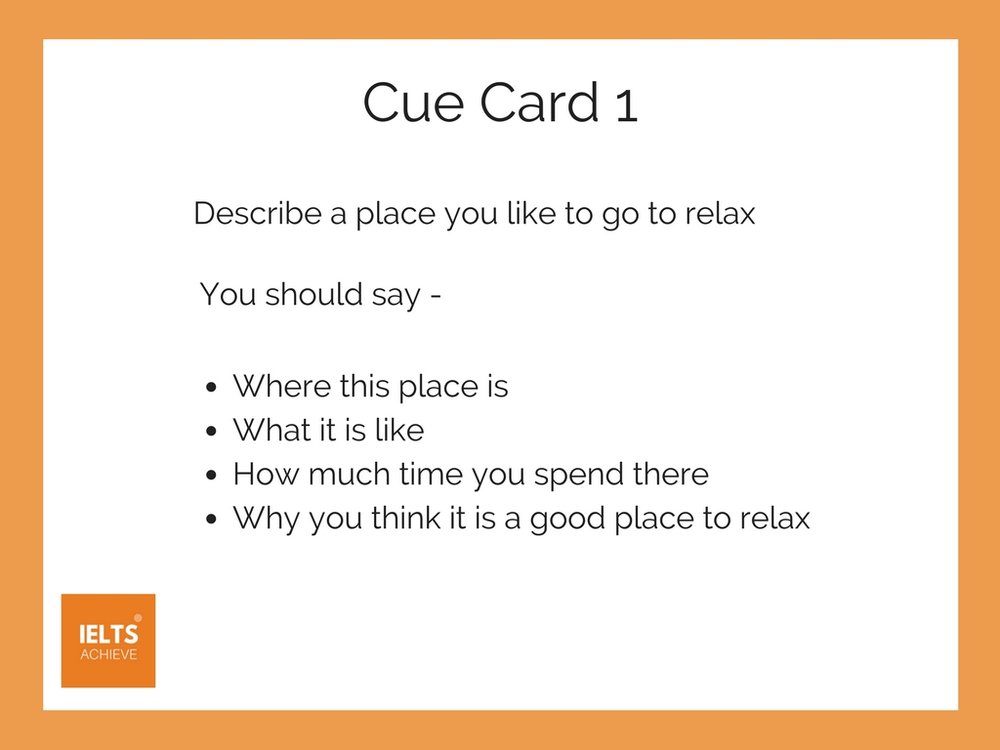
Cue Card Example
The bullet points on the cue card above ask obvious questions about the topic. However you don’t need to follow this to just the bullet points on the card, you can say whatever you want about the chosen topic. Some students follow the bullet points and get a high score, while others have said they ran out of ideas.
Here are some ideas/questions to answer, that you could include when making notes and planning your answer for this cue card >>
Introduce the activity (what it is) extend your answer and explain.
The location (where) – explain
Have you always done it? (When) have you just started doing it recently?
Describe – give a good description of the activity (include here who you do it with)
Give your opinion (why you like to do it).
Will you continue to do it in the future?
Model Answer
I’d like to talk about walking my dog, we recently rescued a dog who was found by our neighbour by the side of the road. At the time he was only around 4 weeks old and quite ill, he was covered in fleas, had a belly full of worms and various skin conditions. He soon became healthy after many vet visits and now has grown into a large healthy dog, who has a routine of walks at certain times every day to burn off his energy. We started his walking routine slowly when he was little, as he was scared of the park at first. He soon loved to go there and looks really happy with the freedom he has to be able to venture out on his own.
I normally walk him around my village in the morning before work for around 45 minutes. Then in the afternoons after work at around 7 pm we will visit the park, so he can run free. He loves to be able to run around and explore the park, meeting up with other dogs and playing. He enjoys running after people jogging and cycling, showing them that he can go faster than them. He also likes to have his photograph taken with tourists when they are posing next to monuments in the park.
In my opinion, walking with my dog is great exercise, as we walk together (or run) daily for at least 2 hours. This is good for both of us, as he can burn off his energy and I can also keep fit. I also think that getting away from my desk and breathing in the fresh air is beneficial for my health and to clear my mind. It helps to keep my mental health in check, by taking these walks and having the time to think about things. I will continue to walk my dog every day, taking him with me to various locations on the island, as he also enjoys the beach and the town park, but these areas are busy in the summer months, so he will have to wait until the autumn.
Feedback
This is a high-level answer, as there are concrete words being used to tell a story (the story of the dog and the relationship to the activity). Words and phrases are used to describe thoughts and feelings. The bullet points have been covered with the extra information given, which extends the answer.
Practice
Practice as much as you can with past cue cards and develop a good strategy for answering in 1-2 minutes. Practice with your speaking partner or native speaking IELTS teacher, who will help you to improve.
Have you been practising? Does this strategy help you? Let us know in the comments >>
We hope you found this post useful in helping you to study for the IELTS Test. If you have any questions please let us know in the comments below or on the Facebook page.
The best way to keep up to date with posts like this is to like us on Facebook, then follow us on Instagram and Pinterest.
If you need help preparing for the IELTS Test, join the IELTS Achieve Academy and see how we can assist you to achieve your desired band score. We offer an essay correction service, mock exams and online courses.
Expert tips and strategies for this part of the IELTS Speaking test. Includes sample responses and key vocabulary for Band 7+.
Originally published August 2017. Last reviewed 3 July 2026.
In this post, we will be looking in-depth at part 2 of the speaking test.
The IELTS Speaking Test lasts 11-14 minutes.
The test has three parts, where you are interviewed by a trained examiner. You are not allowed to use a dictionary during the test. IELTS Academic and IELTS General students take the same test and it is marked in the same way.
PART 2 INFORMATION
Part 2 = 3-4 minutes – After part 1 the examiner will give you a card or booklet with your question and related ideas you need to talk about.
1 minute >> You will be given 1 minute to make notes.
1-2 minutes >> You will talk about for 1-2 minutes about the topic on the cue card/booklet.
1-2 minutes >> After you have finished speaking, the examiner will ask you one or two questions relating to what you have just talked about.
The topics might include;
Studying/Education
Hobbies/Sports
Family
What kind of movies, books, tv shows or music you like
What you like to eat / where you like to eat
Your job
Where you live
Daily life
Your own experiences
PART 2 QUESTIONS
The questions in part 2 will be about your daily life or experiences. Your answers should include your own thoughts, opinions and feelings.
Possible cue card questions >>
Does the question look difficult to you?
The bullet points are there to help you to extend your answer and be able to speak for 1-2 minutes on the topic. You can also say things about the topic, which are not bulleted on the cue card.
The topics on the cue cards mostly relate to daily life and your own experiences, so that you can think about an answer fairly quickly. You have 1 minute to make notes, so it is beneficial for you to be able to choose a specific idea/subject quickly.
There are hundreds of different cue cards, with new ones being added every year, so it will be difficult for you to memorise answers. You can prepare by reading past cue card questions and practising with a speaking partner or native speaking IELTS teacher.
Making Notes
Using the allocated time of 1 minute to make some notes before your talk can help you to organise your ideas. The examiner will not look at your notes, they will only mark you on your spoken answer. You should practice making notes that will help you during your talk. This will allow you to
Think in-depth about the topic.
Organise your ideas and improve coherence.
Give you more to talk about – improving fluency.
Don’t write too much when you are making notes, use the time you have to think and write down ideas and words. You need to be able to look at your notes and think of your next idea quickly so that your talk flows naturally. You can use arrows to lead your eye to the next keywords, or group words together for each bullet point.
You can also circle key words from the cue card questions – like where, when, what, how etc. Make sure you answer them in your notes, using the key words as headings.
How To Start
Instead of repeating the question on the cue card to the examiner, try to memorise a few phrases that will help you to start talking, for example;
Q: Describe a sport you enjoy.
A: I’d like to talk about Volleyball, which is a sport I like to play regularly……………..
Q: Describe a place you like to go on holiday.
A: I’d like to talk about Greece, which is a place I like to visit every year………
Q: Describe a teacher who influenced you.
A: I had several teachers who I thought were brilliant when I was at school, but the one that really stands out was my Art teacher, Mrs. Harris………..
Q: Talk about an article you recently read in a newspaper.
A: I read many articles daily, but one that stands out was about the rescue of animals during the recent Hurricane Harvey in Texas ………..
You can adapt the same structure repeatedly, or have a different approach for each question, it is up to you!
We hope you found this post useful in helping you to study for the IELTS Test. If you have any questions please let us know in the comments below or on the Facebook page.
The best way to keep up to date with posts like this is to like us on Facebook, then follow us on Instagram and Pinterest.
If you need help preparing for the IELTS Test, join the IELTS Achieve Academy and see how we can assist you to achieve your desired band score. We offer an essay correction service, mock exams and online courses.
Essential strategies and practice techniques for this IELTS Reading question type. Learn how to manage time and improve accuracy.
Originally published August 2017. Last reviewed 3 July 2026.
In this post, you will see one of the most common IELTS speaking topics (reading) and sample answers.
Please remember that in the actual test you should give honest answers and talk about your own experiences, thoughts, feelings and opinions. Do not try to memorise answers, as the examiners will probably be able to guess and you will lose marks.
However, you are able to make up information to extend your answers, but be sure that you are confident when speaking about the chosen topic and that it is believable.
TIP >> Each answer should be at least 2-3 sentences long.
TIP >> Listen carefully to the question so that you answer in the correct tense.
TIP >> When answering a yes/no question – answer then give your reasons for your answer. You must extend your answer to gain more marks.
TIP >> Just relax and think of it as a regular conversation you are having, make eye contact and be positive.
Take a look at the questions and sample answers below on the topic of ‘reading‘ >>
Q: Do you like to read books?
A: Yes, I love to read and try to read as often as I can. I have an e-reader and have more than 600 books in my library.
Q: What type of books do you like to read?
A: Mostly romance, I am a huge fan of old English classic literature, like Jane Austen or Charlotte Bronte. I also like to read modern romance, with Mills and Boon often slipping into my holiday reading list.
Q: Do you ever visit the library?
A: Not really, I used to when I was a student and as a teacher, but now it is so easy to buy books online and either have them delivered to your home or downloaded onto your e-reader. I am very forgetful, so always ended up with fines from the library for late returns!
Q: Do you prefer reading books or watching films?
A: I much prefer to read books, because I like to get lost in a story. It is a great way to fuel your imagination and to go somewhere else for a short period of time. You focus on the characters and the details given to you. Watching a movie does not often hold my attention in the same way.
We hope you found this post useful in helping you to study for the IELTS Test. If you have any questions please let us know in the comments below or on the Facebook page.
The best way to keep up to date with posts like this is to like us on Facebook, then follow us on Instagram and Pinterest.
If you need help preparing for the IELTS Test, join the IELTS Achieve Academy and see how we can assist you to achieve your desired band score. We offer an essay correction service, mock exams and online courses.