A detailed guide to this IELTS Writing Task 2 essay type, with structure templates, useful vocabulary, and techniques to achieve Band 7+.
Originally published December 2017. Last reviewed 3 July 2026.
In writing task 2 you will be asked to write a discursive essay (250 words minimum). You will be given a question asking you to give your opinion, discuss a problem or issue. You could also be asked to provide solutions, evaluate a problem, compare and contrast different ideas or challenge an idea. In this post, we will be focussing on how to write a problem/solution essay.
One of the first things you should do is read the marking criteria to see what the examiners expect. This is really important, as you need to know what they are looking for in the band 7+ boxes.
You should be able to give the examiners exactly what they want, in order to get a 7+ band score.
If you would like to purchase a 30 page PDF download that is easy to read and print out please take a look at the bookshop >
WRITING TASK 2 Problem/Solution STRUCTURE
The structure that I advise my students to use, will be sure to get you a band score 7+. You need to practice using this structure, with as many questions as you can, before sitting your IELTS test. This writing task 2 structure has been proven to be successful for my students and when perfected, can easily help you to achieve a high band score.
TIP >> Before you start writing, plan your ideas so that you can organise the information clearly. You must decide what you think is the main problem and what the specific solution to that problem is. Take 5 minutes and plan out your ideas and examples.
TIP >> It is very important that spend a full 40 minutes on this task as the score you get for writing task 2 is two-thirds of your total writing score. You also need to write a minimum of 250 words and use your own ideas.
TIP >> Remember to write in a formal tone, this is an academic essay, therefore your writing should be formal.
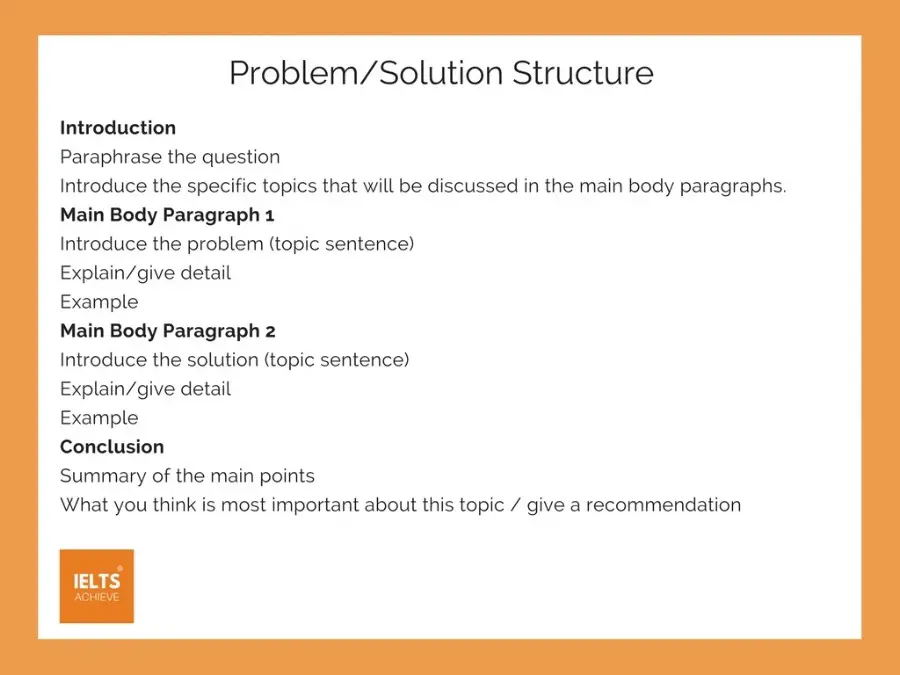
This is one possible way to structure your essay;
It is a 4-PARAGRAPH STRUCTURE >>
Paragraph 1 – The Introduction
This is the introduction to the essay and where you should start off by paraphrasing the question.
Do you understand what I mean, when I say ‘paraphrase’ the question?
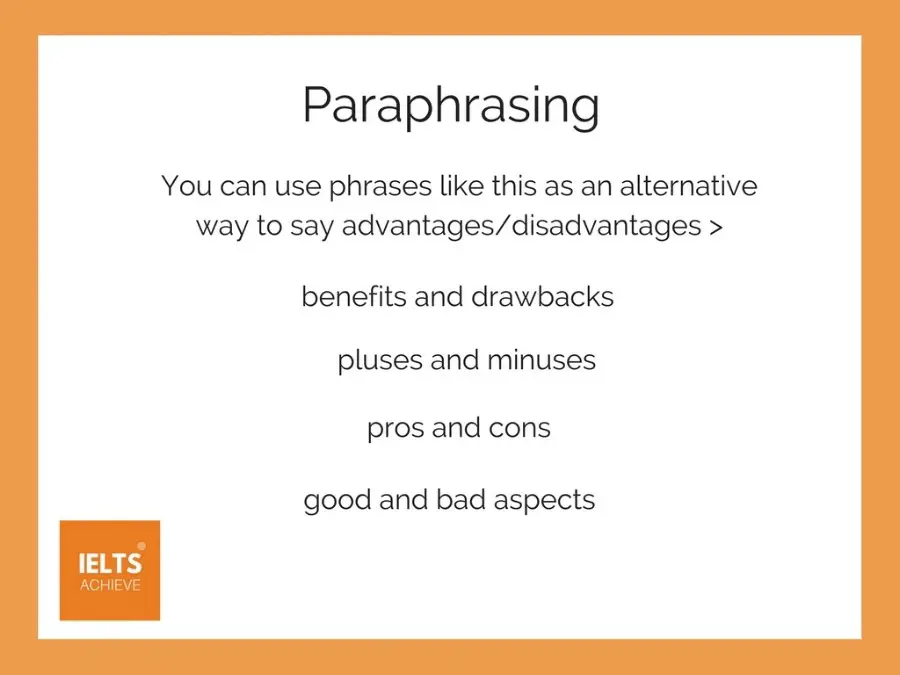
This means that you rewrite the question in your own words using synonyms. You can’t just copy the question again or use the same words in the question. Paraphrase and show off your vocabulary knowledge by using synonyms. When practicing your essay writing, use an online thesaurus to help you. This is a great tool and can help you to learn many new words.
Then your next sentence should introduce the essay, this will tellthe examiner exactly what you will discuss in the main body paragraphs. For example, Firstly this essay will discuss……… Secondly, this essay will discuss…….
There are two sentences you need in the introduction >>
Paraphrase the question
Introduce the specific topics that will be discussed in the main body paragraphs.
Paragraph 2 – Main Body Paragraph 1
In this paragraph, you should describe a specific problem.
Start the paragraph by introducing the problem. This is where you need to have a topic sentence. The next sentence(s) should explain the problem, going into detail. The third sentence should give an example that supports the problem.
The example you give could be something from your own experience or made up – it is ok to make up something as the examiners will not fact check your information. They want to see your ability to use English at a certain level. You could make up an example from a report, journal, newspaper or University study.
This is how the paragraph should look >>
Introduce the problem (topic sentence)
Explain/give detail
Example
If you would like to purchase a 30 page PDF download that is easy to read and print out please take a look at the bookshop >
Paragraph 3 – Main Body Paragraph 2
In this paragraph, you should write about the solution.
Start the paragraph by introducing the solution. This is where you need to have a topic sentence. The next sentence(s) should explain the solution, going into detail. The third sentence should give an example.
The example you give could be something from your own experience or made up – it is ok to make up something as the examiners will not fact check your information. They want to see your ability to use English at a certain level. You could make up an example from a report, journal, newspaper or University study.
This is how the paragraph should look >>
Introduce the solution (topic sentence)
Explain/give detail
Example
Paragraph 4 – The Conclusion
In the fourth paragraph, you write the conclusion giving a summary of your main points and say what you think is most important about this topic and give a recommendation. You should not enter any new information or ideas in this paragraph.
Summary of the main points
What you think is most important about this topic / give a recommendation
Another possible way to structure your problem/solution essay is this;
Introduction
Problem 1 – Describe a specific problem and give a solution
Problem 2 – Describe another specific problem and give a solution
Problem 3 – Describe a third specific problem and give a solution
Conclusion
You will need to make a choice, either describe each problem and give a solution in the same paragraph, or split the information into separate paragraphs, with only one main idea in each of the main body paragraphs.
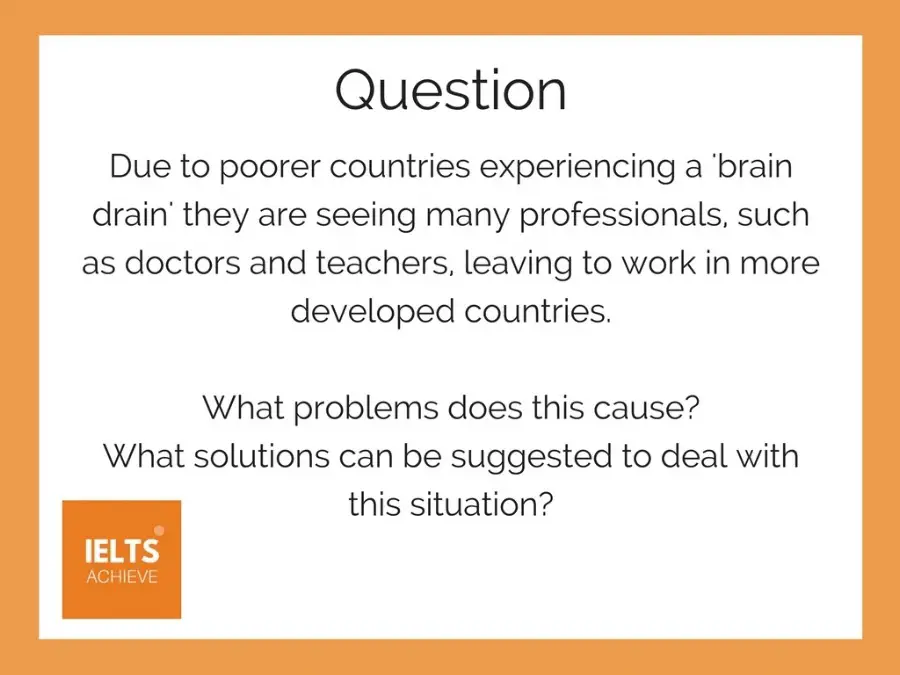
SAMPLE Problem/Solution ESSAY >>
**All questions have been reported by students who have taken the IELTS exam.**
In many developing countries, there are a number of skilled academics leaving in search of better pay, increased socioeconomic benefits, and the chance to earn citizenship in a developed country. In this essay, I will examine the impact this has had on the more poverty stricken countries and suggest how this situation could be improved.
The foremost problem with skilled professionals, such as doctors and teachers leaving is that it deprives the country of people who are necessary to its survival. A shortage of doctors in hospitals could lead to them being severely understaffed, even though they have the trained doctors and nurses who are local and willing to work. In addition, some academic institutions will also suffer, with a lack of skilled teachers in highly desirable subjects, like maths, science and languages. Many professionals desire better pay and working conditions, leaving in search of a better lifestyle, so that they can earn a higher salary. For example, a study from Bucharest University showed that in Romania in 2014, 75% of graduates had applied to work in the UK and the USA.
A possible solution to this problem is for skilled professionals to enter into mandatory service in their origin country, before being able to migrate. Those who earn their qualifications from state universities should have to work in service to their country for a set amount of time, even though they are ready for the wider workplace. This would address the shortage of workers in hospitals and schools, meanwhile gaining experience, in order to give something back to their community and country. For instance, in Romania, it is common practice for graduates from state-funded university courses to work in areas where their services are needed for a minimum of two years before they are able to apply to work abroad.
In conclusion, with the rising demand for nurses, doctors and teachers in economically rich countries like the UK, more and more people are leaving their poor origin countries in search of better pay, working conditions and benefits. It is, therefore, necessary for governments to put appropriate schemes into place, with mandatory service for state-funded degree holders.
(Word Count = 362 / Band Score 9)
Task Achievement – The answer provides a paraphrased question, to begin with, followed by a relevant problem and solution. Both the problem and solution are fully supported in the main body paragraphs in the essay, with fully extended and well-supported ideas. the style of the writing is appropriate for an academic essay.
Coherence and Cohesion – The answer has been divided into clear logical paragraphs and each main body paragraph only has one main idea. There are cohesive links between the main body paragraphs and between most sentences. Examples are highlighted with discourse markers like – for example, and for instance. The conclusion gives a clear recommendation, which is linked to the information in the main body paragraphs.
Lexical Resource – There is evidence of a wide range of vocabulary, with no errors in the text.
Grammatical Range and Accuracy – The answer has no grammatical errors. The sentences have a wide range of structures.
TIP >> Remember to give both a problem and solution. Use each of the main body paragraphs to support your ideas, giving examples that are relevant. In the conclusion, summarise your main points and say what is important about the topic/give a recommendation.
WRITING TASK 2 BAND SCORE 9 CRITERIA >>
If you would like to view more high band score problem and solution essay examples please click below >
We hope you found this post helpful in helping you to study for the IELTS Test. Let us know in the comments or on the Facebook page if you have any questions. The best way to keep up to date with posts like this is to like us on Facebook, and then follow us onInstagramand Pinterest. We offer essay correction services, mock exams, and online courses. If you need help preparing for the IELTS Test, join the IELTS Achieve Academy and see how we can help you achieve your desired band score faster.
A detailed guide to this IELTS Writing Task 2 essay type, with structure templates, useful vocabulary, and techniques to achieve Band 7+.
Originally published December 2017. Last reviewed 3 July 2026.
In writing task 2 you will be asked to write a discursive essay (250 words minimum). You will be given a question asking you to give your opinion, and discuss a problem or issue. You could also be asked to provide solutions, evaluate a problem, compare and contrast different ideas or challenge an idea. In this post, we will be focusing on how to write a advantages/disadvantages essay.
One of the first things you should do is read the marking criteria to see what the examiners expect. This is really important, as you need to know what they are looking for in the band 7+ boxes.
You should be able to give the examiners exactly what they want, in order to get a 7+ band score.
Do you want to learn how to write an advantage/disadvantage essay faster and score a higher band score? Download our 24 page PDF resource that is designed to help you prepare systematically for a 7+ band Score.
The structure that I advise my students to use, will be sure to get you a band score of 7+. You need to practice using this structure, with as many questions as you can, before sitting your IELTS test. This writing task 2 structure has been proven to be successful for my students and when perfected, can easily help you to achieve a high band score.
TIP >> Before you start writing, plan your ideas so that you can organise the information clearly. You must decide what the main advantages and disadvantages are. Take 5 minutes and plan out your ideas, opinions and examples.
TIP >> It is very important that spend a full 40 minutes on this task as the score you get for writing task 2 is two-thirds of your total writing score. You also need to write a minimum of 250 words and use your own ideas.
TIP >> Remember to write in a formal tone, this is an academic essay, therefore your writing should be formal.
This is one possible way to structure your essay;
4-PARAGRAPH STRUCTURE >>
Paragraph 1 – The Introduction
This is the introduction to the essay and where you should start off by paraphrasing the question.
Do you understand what I mean, when I say ‘paraphrase’ the question?
This means that you rewrite the question in your own words using synonyms. You can’t just copy the question again or use the same words in the question. Paraphrase and show off your vocabulary knowledge by using synonyms. When practising your essay writing, use an online thesaurus to help you. This is a great tool and can help you to learn many new words.
Then your next sentence should introduce the essay, this will tellthe examiner exactly what you will discuss in the main body paragraphs. For example, Firstly this essay will discuss……… Secondly, this essay will discuss…….
There are two sentences you need in the introduction >>
Paraphrase the question
Introduce the specific advantages/disadvantages that will be discussed in the main body paragraphs.
Paragraph 2 – Main Body Paragraph 1
In this paragraph, you should describe the main advantage.
Start the paragraph by introducing the main advantage. This is where you need to have a topic sentence. The next sentence(s) should explain, going into detail. The third sentence should give an example that supports the advantage.
The example you give could be something from your own experience or made up – it is ok to make up something as the examiners will not fact check your information. They want to see your ability to use English at a certain level. You could make up an example from a report, journal, newspaper or University study.
This is how the paragraph should look >>
Introduce the advantage (topic sentence)
Explain/give detail
Example
Paragraph 3 – Main Body Paragraph 2
In this paragraph, you should write about the main disadvantage.
Start the paragraph by introducing the disadvantage. This is where you need to have a topic sentence. The next sentence(s) should explain, going into detail. The third sentence should give an example.
The example you give could be something from your own experience or made up – it is ok to make up something as the examiners will not fact check your information. They want to see your ability to use English at a certain level. You could make up an example from a report, journal, newspaper or University study.
This is how the paragraph should look >>
Introduce the disadvantage (topic sentence)
Explain/give detail
Example
Paragraph 4 – The Conclusion
In the fourth paragraph, you write the conclusion giving a summary of your main points and say what you think were the most important pros and cons. You should not enter any new information or ideas in this paragraph.
You can end your conclusion with a balancing statement that tells the reader why one side is better than the other. For example, using words like outweigh, balance out, compensate for, exceed and make up for.
Summary of the main points
What you think were the most important pros and cons?
Another possible way to structure your advantage/disadvantage essay is this;
You may want to add paragraphs to explain further advantages or disadvantages, but there should be only one main idea in each main body paragraph. Don’t list all of your advantages/disadvantages in one paragraph.
Introduction
Paragraph 1 – Describe an advantage
Paragraph 2 – Describe an advantage
Paragraph 3 – Describe a disadvantage
Conclusion
TIP >> If the question asks you if the advantages outweigh the disadvantages of something then your essay structure will change slightly. You should make sure you write about how one side is better than the other. You will also have to include this in your introduction. The side that you think outweighs the other should be written about first in main body paragraph 1. Followed by main body paragraph 2 – the more fragile argument.
TIP >> If the question asks you to write about advantages/disadvantages and give your opinion, then y
You need to add an extra paragraph that clearly states your opinion. You would also need to write about your opinion in the introduction.
SAMPLE Advantages/Disadvantages ESSAY >>
**All questions have been reported by students who have taken the IELTS exam.**
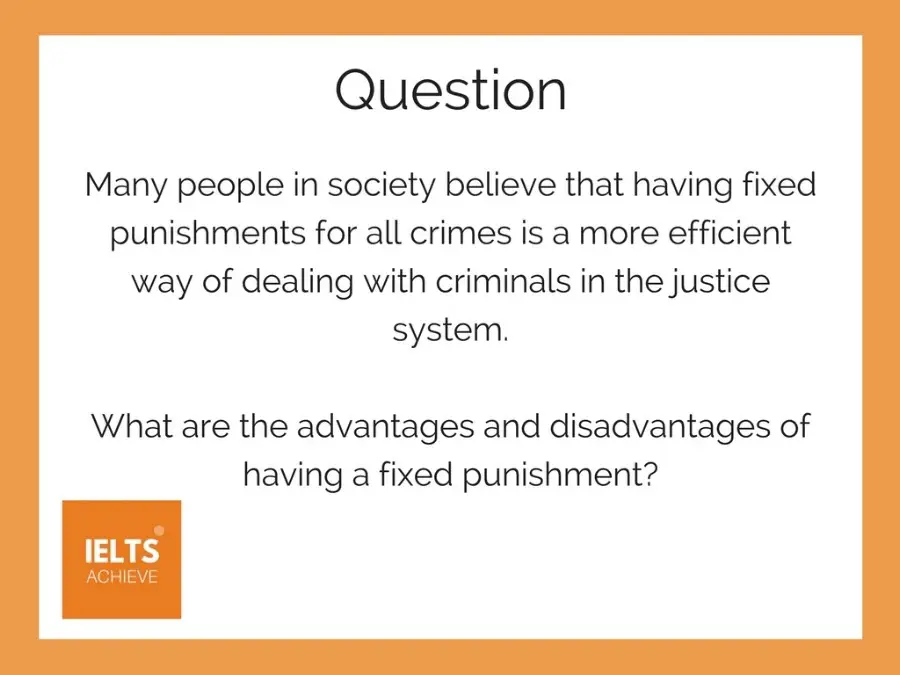
There is an ongoing debate on the merits of having a rigid discipline system in place for all crimes committed. This essay will firstly discuss, how having fixed punishments could lead to a more competent judiciary system as the biggest advantage. Secondly, this essay will discuss how this may lead to people being punished in the same way for both minor and major crimes as the primary disadvantage.
On the one hand, the main advantage of having a standardised punishment system could lead to a downward trend in crime, as the system would serve as a deterrent. This would allow the courts to easily hand out justice to all criminals, in order to make the judiciary system more powerful. For example, in some states in the USA, there are tough sanctions in place for criminals, including death by lethal injection. In 2014, the New York Times reported that up to 65% of criminals who were incarcerated for high-level crimes (murder, manslaughter) received the lethal injection.
On the other hand, the primary disadvantage of having fixed punishments is that people who have committed low-level crimes may also be given harsh sentences, in the same way as those who have been sentenced for high-level crimes. This may make the system unjust, as the punishment should befit the crime. For instance, a person who may have acted in self defence, should have their case heard in full, before being given a punishment befitting of someone who has been part of a violent act.
In conclusion, fixed punishment offers an interesting choice for effective crime deterrence and a faster judicial process. However, its inherent flaw in generalising all crime without carefully considering mitigating circumstances would compromise the very essence of justice and should warrant a closer study before fully implementing it to any modern judicial system.
(Word Count = 302 / Band Score 9)
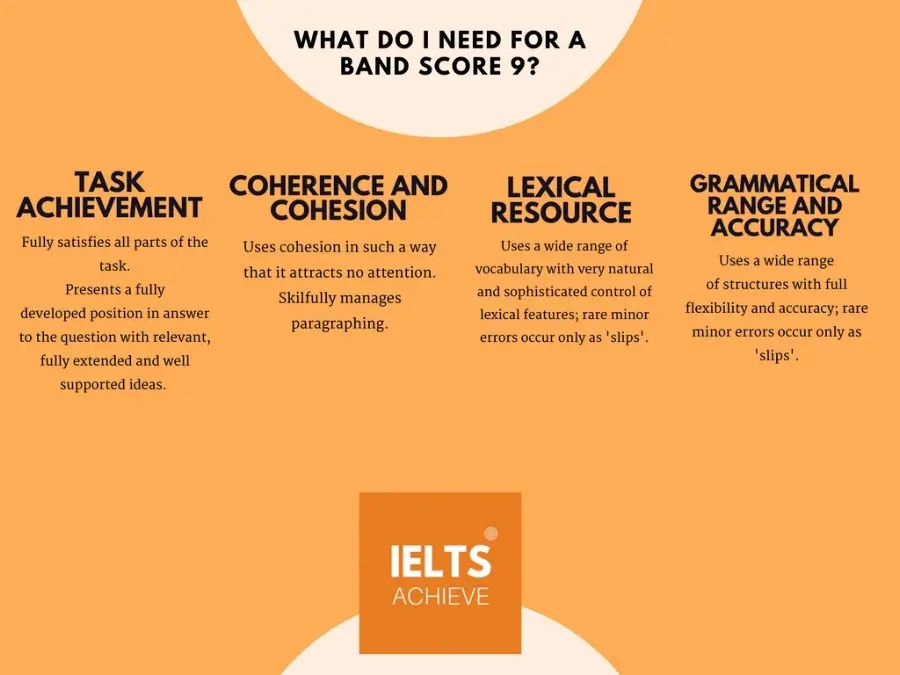
Task Achievement – The answer provides a paraphrased question, to begin with, followed by stating an advantage and a disadvantage. Both the advantages/disadvantages are fully supported in the main body paragraphs in the essay, with fully extended and well-supported ideas. the style of the writing is appropriate for an academic essay.
Coherence and Cohesion – The answer has been divided into clear logical paragraphs and each main body paragraph only has one main idea. There are cohesive links between the main body paragraphs and between most sentences. Examples are highlighted with discourse markers like – for example, and for instance.
Lexical Resource – There is evidence of a wide range of vocabulary, with no errors in the text.
Grammatical Range and Accuracy – The answer has no grammatical errors. The sentences have a wide range of structures.
TIP >> Remember to give both an advantage and a disadvantage. Use each of the main body paragraphs to support your ideas, giving examples that are relevant. In the conclusion, this is where you summarise your main points.
WRITING TASK 2 BAND SCORE 9 CRITERIA >>
If you would like to view more high band score advantages or disadvantageessay examples please click here.
We hope you found this post helpful in helping you to study for the IELTS Test. Let us know in the comments or on the Facebook page if you have any questions. The best way to keep up to date with posts like this is to like us on Facebook, and then follow us onInstagramand Pinterest. We offer essay correction services, mock exams, and online courses. If you need help preparing for the IELTS Test, join the IELTS Achieve Academy and see how we can help you achieve your desired band score faster.
A detailed guide to this IELTS Writing Task 2 essay type, with structure templates, useful vocabulary, and techniques to achieve Band 7+.
Originally published December 2017. Last reviewed 3 July 2026.
In this post, I want to share with you hints, tips, do’s and don’ts that will lead you to a band score of 7 or above on the Academic test. It is not an easy thing to do, as many of you probably know already!
It takes determination and motivation to study hard around work, family and any other commitments you may have.
Take a look at how you can try to get the best results possible in the IELTS exam:
Make a study plan
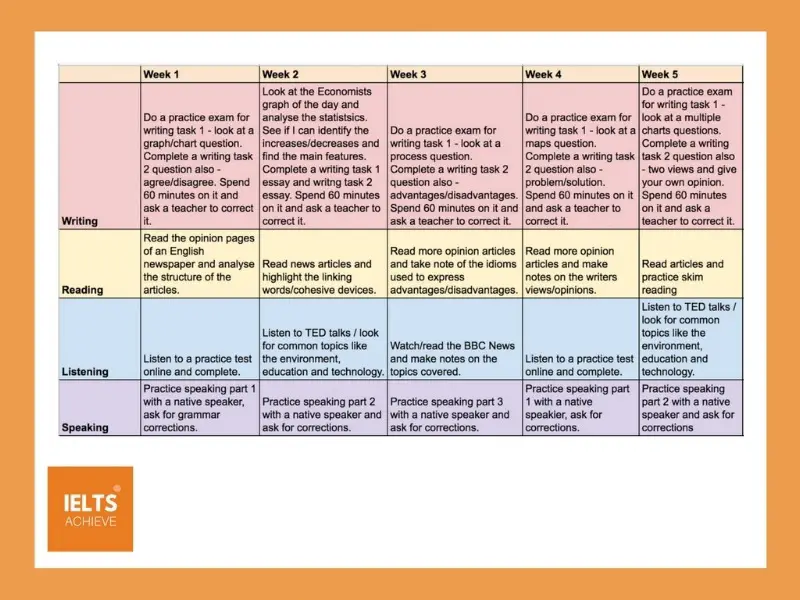
There are many ways in which you can prepare for your IELTS test, one way to start is to make a study plan. Focus on any weaknesses you may have and practice, getting a teacher to correct any essays or practice the speaking test with you. Many of the students I have taught who have scored a 7 or above have admitted to having studied for at least one hour per day.
Below is an example of a study plan, with each area of the exam covered. If you know that your main weakness is writing, spend more time on that – making sure you have an IELTS teacher correcting your work and giving you feedback. If you need to focus on vocabulary, practice and read as much as you can, especially for the Academic students who need to learn how to describe statistical trends.
Make your own study plan! Think about the following questions;
When is your exam?
How much time do you have to study each day or each week?
What areas do you need to focus on the most?
IELTS Writing Tips
Most students struggle with the writing test and require a lot of practice before test day. Read the writing task 1 and 2 posts on this website and study the different structures needed for different types of questions. Remember the following;
TIP 1: Read the question properly
Make sure you read it a few times and highlight any keywords. What is the question asking you to do? Do you have to give your opinion or not?
TIP 2: Make a plan before you start writing your essay.
Learn the structures needed and plan accordingly in your exam. Take a few minutes to do this, so you can easily write your essay, including all of the things you need.
TIP 3: Remember your essay structure
In writing task 2 remember how to structure the essay so that it becomes planted into your brain! Include an introduction, main body paragraph 1, main body paragraph 2 and a conclusion (this may change depending on the type of question, but this structure is the basic skeleton).
TIP 4: Don’t overthink it
if you have ideas that are quite simple, that is fine. They don’t have to be really deep and complex to get a high band score. For example – if asked to give reasons why so many people are obese these days – one reason is overeating easily available calorie-rich junk food. Think about what you know about the subject/topic and go from there. Have you read anything about it? or seen anything on the news or in a documentary? I remember watching a documentary about the top 20 most obese countries once. So I could use that as one of my examples. I also remember reading about how the costs are inflating the healthcare system and more of taxpayers money is being spent on that, rather on public services. So that could be another example to use in my essay. The point is that all examples should be relevant to the question, even if they are simple.
TIP 5: Vocabulary
Make sure you are using the right vocabulary in your essay. You might try to boast and show the examiner how many high-level words you know, which is fine if you know for sure that they fit into the sentence and have the right meaning.
TIP 6: Give your opinion when asked
in the essay or in the speaking test, when asked for your opinion, give it clearly. Use phrases like, in my opinion, in my view, I think that, I believe that…. and then explain.
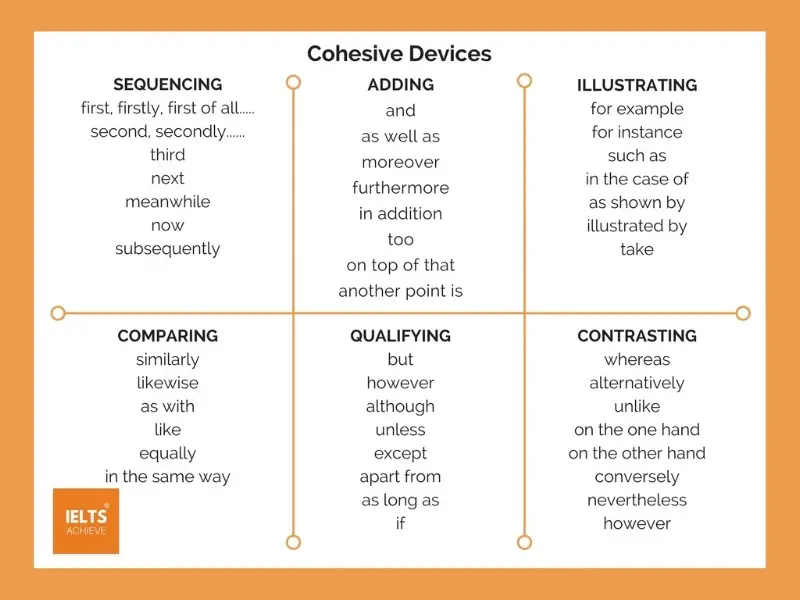
TIP 7: Use cohesive devices
this can get you high marks when used in the writing and speaking test. Don’t overdo it though! Overuse of these words can be a sure way to lose you marks. Words like – however, therefore, furthermore, in other words, for example, for instance, etc.
Planning for the big day!
When preparing for the day of the test, you should try to get there well on time. You must bring the same passport or ID card that you used on your application form. You also need to bring a pen, pencil and an eraser. You will not be allowed to take any electronic devices or a dictionary into the test area.
On the night before the test, read some English texts, similar to those you may read in the exam, for example, some opinion pieces from a newspaper. The Academic students could analyse graphs and charts as well or read over past assignments that have been corrected.
Things to do: You should also do the following:
Give yourself time to check over your work before the exam ends.
Highlight any keywords or numbers on the question paper.
Make notes on the question paper before you begin to write.
Always write in full sentences (no bullet points or unfinished sentences).
Paraphrase! Make sure you paraphrase the question.
Link your ideas together in writing task 2.
Support with relevant examples.
Read the question properly.
Things not to do: And please don’t:
Use informal language
Repeat the sentences written on the exam paper
Spend more than 20 minutes on task 1
Overuse those linking words/cohesive devices – moreover, however, nowadays etc.