Step-by-step guide to answering this type of IELTS Writing Task 1 question. Covers structure, key language, and band-scoring criteria.
Originally published May 2017. Last reviewed 3 July 2026.
In this post, we will look at the importance of being able to paraphrase. Paraphrasing is important, not only for the writing test but for all of the other parts of the test too. Being able to paraphrase will show the examiner that you have a wide vocabulary, helping you to achieve a higher band score.
To paraphrase text is to read the question then rewrite it in your own words. You should not copy words straight from the question, instead change the order of the words and choose words with a similar meaning (a synonym). This means you are using different words to write about the same idea.
Paraphrasing
Here is an example of a Writing Task 1 Question >>
The graph below shows the average monthly temperatures in three well-known cities. Summarise the information by selecting and reporting the main features and make comparisons where relevant.
Paraphrased >>
The line graph illustrates the climate conditions in Athens, Barcelona, and Sydney over the period of one year.
Here I changed temperatures to conditions (synonym) and then I added the three city names instead of saying ‘in three well-known cities’.
Using Synonyms
Synonyms are words you use when you want to write a word that has a similar meaning to the original word in the question. For example;
Area / space
Map / diagram / picture
Amount / number
Car / automobile / vehicle
Price / amount / cost
High / big / great
When paraphrasing the question, you don’t need to change all of the words, but you should try to change most of them. Be careful though, because choosing a word that has a similar meaning – not the same meaning can make the meaning of the sentence change or become unclear.
The best way to practice this is to have a look at writing task 1 questions and paraphrase/re-write the question in your own words. Whilst practising you can use an online thesaurus tool to help you find synonyms and learn new words.
We hope you found this post useful in helping you to study for the IELTS Test. If you have any questions please let us know in the comments below or on the Facebook page.
The best way to keep up to date with posts like this is to like us on Facebook, then follow us on Instagram and Pinterest.
If you need help preparing for the IELTS Test, join the IELTS Achieve Academy and see how we can assist you to achieve your desired band score. We offer an essay correction service, mock exams and online courses.
Step-by-step guide to answering this type of IELTS Writing Task 1 question. Covers structure, key language, and band-scoring criteria.
Originally published May 2017. Last reviewed 3 July 2026.
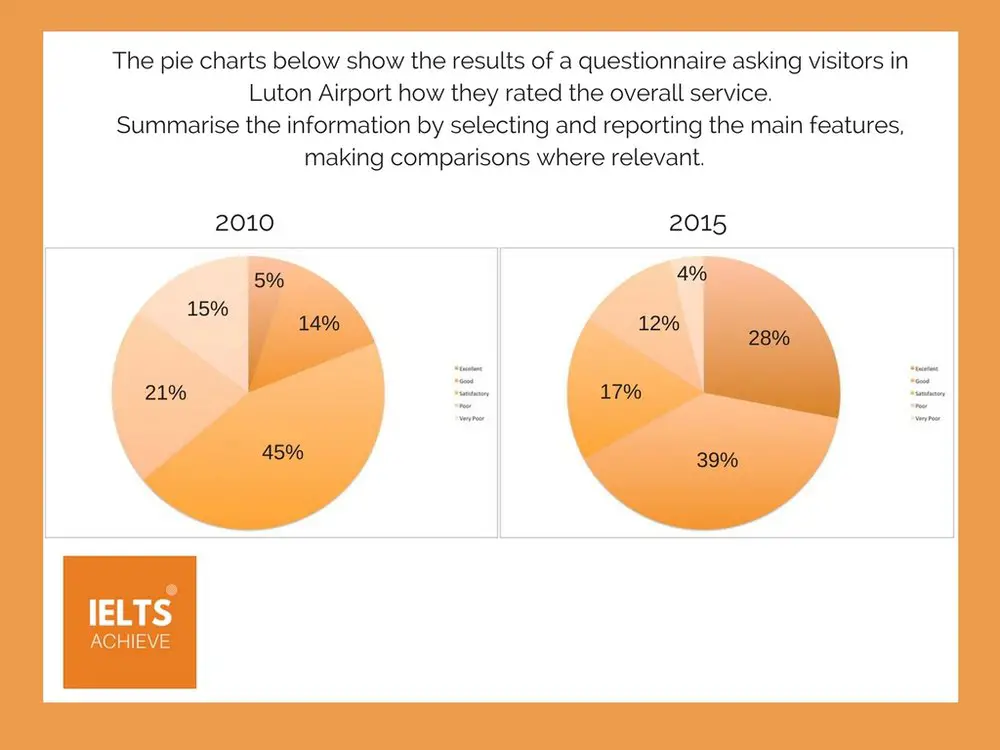
This post will help you to write a successful pie charts essay, there is a model answer for you to compare your work to at the end of the post.
Remember that your essay should have a minimum of 150 words and ideally should be completed in 20 minutes.
The writing task 1 essay structure should be as follows >>
Question
Read the question below carefully, what can you see in the information given?
Step 1 – Write the introduction
Write your own introduction of one or two sentences, paraphrasing the question, using synonyms where you can.
Step 2 – Write an overview
Write the overview – start this paragraph with the word ‘Overall...’ and write one or two sentences which describe the main features of the information presented in the charts.
Step 3 – Write the main body paragraphs
Write two main body paragraphs, going into detail and giving specific information about the charts. Remember to include data to support your findings. For example, look for the highs and lows and any major increases or decreases over time.
Step 4 – Check your work
When you have completed the essay, check it for any errors, spelling or grammar. Then check to see if you have included linking words that connect the information together, making it easy to read. For example, using the word ‘Overall..’ at the beginning of the overview paragraph. You can also use words like – on the one hand, on the other hand, furthermore, however, in addition, finally etc.
Model Answer
To view the model answer for this question please click the button below >>
We hope you found this post useful in helping you to study for the IELTS Test. If you have any questions please let us know in the comments below or on the Facebook page.
The best way to keep up to date with posts like this is to like us on Facebook, then follow us on Instagram and Pinterest.
If you need help preparing for the IELTS Test, join the IELTS Achieve Academy and see how we can assist you to achieve your desired band score. We offer an essay correction service, mock exams and online courses.
How to Describe Tables in IELTS Writing Task 1
Table questions present numerical data organised in rows and columns. Your task is to identify, compare, and summarise the key features without describing every single number.
Strategy for Table Questions
Scan for patterns: Look for the highest and lowest values, trends over time, and significant differences between categories.
Select key data: You cannot mention every number. Choose the most significant figures that illustrate trends or comparisons.
Group information: Organise your body paragraphs by theme (e.g., countries that increased vs. decreased) rather than going row by row.
Include specific figures: Support your observations with actual numbers from the table.
Useful Language for Tables
Function
Phrases
Highest value
The highest figure was recorded for…, X had the largest proportion at…
Lowest value
The lowest rate was seen in…, X accounted for the smallest share…
Comparison
X was significantly higher than Y…, Compared with X, Y was…
Approximate data
roughly, approximately, just over, just under, around
Common Mistakes
Describing every number in the table instead of selecting key data
Failing to make comparisons between categories
Writing without an overview paragraph
Using imprecise language when exact figures are available
Originally published on IELTS Achieve. Last reviewed 3 July 2026.