Comprehensive guide covering essential IELTS preparation strategies and techniques to help you achieve your target band score.
Originally published March 2023. Last reviewed 3 July 2026.
Adjectives and adverbs are essential components of English grammar that help to describe and provide additional information about nouns, pronouns, verbs, adjectives, and other adverbs. This guide will provide you with a thorough understanding of adjectives and adverbs, their uses, common mistakes, and tips for mastering their usage in your writing and speech.
Understanding Adjectives and Adverbs
Adjectives
Adjectives are words used to describe or modify nouns (people, places, things, or ideas) and pronouns. They provide more information about the qualities, characteristics, or features of the noun or pronoun they are describing.
There are two main ways to use adjectives:
Before the noun (attributive position): In this case, the adjective directly precedes the noun it modifies. Examples:
The red ball rolled away.
She has a friendly personality.
After a linking verb (predicative position): In this case, the adjective comes after a linking verb, such as ‘be’, ‘become’, ‘seem’, ‘feel’, ‘taste’, ‘look’, ‘sound’, or ‘smell’. Examples:
The ball is red.
She seems friendly.
Adverbs
Adverbs are words used to describe or modify verbs, adjectives, or other adverbs. They provide more information about the manner, time, place, frequency, degree, or other circumstances of the action or state they describe.
Adverbs are often created by adding ‘ly’ to an adjective, but some adverbs do not follow this rule, and some adjectives end in ‘ly’ without being adverbs.
Examples:
Adverbs modifying verbs:
She quickly ran to the store. (Manner)
He will soon arrive. (Time)
They live nearby. (Place)
She always takes her vitamins. (Frequency)
He almost finished the race. (Degree)
Adverbs modifying adjectives:
The incredibly talented musician played a beautiful piece.
It was a quite difficult puzzle.
Adverbs modifying other adverbs:
She finished the test very quickly.
He drives too fast.
It’s important to note that some adverbs have irregular forms, and some adjectives ending in ‘ly’ do not have adverbial forms. In such cases, a phrase like “in a … way” is used instead.
Examples:
Fast (adjective): That’s a fast car.
Fast (adverb): She runs fast.
Friendly (adjective): She has a friendly smile.
In a friendly way (adverbial phrase): She greeted me in a friendly way.
Comparative and Superlative Forms
Comparative and superlative forms of adjectives and adverbs are used to compare different degrees or levels of quality among two or more people, things, or actions. These forms help us indicate which item possesses a quality to a greater or lesser extent, or to the greatest or least extent of all items being compared.
Comparative Forms
Comparative forms are used to compare two people, things, or actions. We usually form the comparative by adding ‘-er’ to the adjective or adverb, or by using ‘more’ before the adjective or adverb.
Examples:
Adjectives:
She is taller than her sister. (Adding ‘-er’)
The painting is more beautiful than the photograph. (Using ‘more’)
Adverbs:
He runs faster than her. (Adding ‘-er’)
She sings more loudly than her friend. (Using ‘more’)
Superlative Forms
Superlative forms are used to compare three or more people, things, or actions. We usually form the superlative by adding ‘-est’ to the adjective or adverb, or by using ‘most’ before the adjective or adverb.
Examples:
Adjectives:
She is the tallest person in the class. (Adding ‘-est’)
That is the most beautiful painting I have ever seen. (Using ‘most’)
Adverbs:
He runs the fastest among his friends. (Adding ‘-est’)
She sings the most loudly in the choir. (Using ‘most’)
Keep in mind that some adjectives and adverbs have irregular comparative and superlative forms, such as ‘good’ (better, best), ‘bad’ (worse, worst), and ‘well’ (better, best).
Adjective and Adverb Clauses and Phrases
Adjective and adverb clauses and phrases provide additional information about nouns and verbs, respectively. They help make sentences more detailed and expressive.
Adjective Clauses
Adjective clauses, also known as relative clauses, are dependent clauses that provide additional information about a noun or pronoun. These clauses are introduced by relative pronouns (who, whom, whose, which, that) or relative adverbs (when, where, why).
Example:
The house that is painted blue belongs to my aunt. (The adjective clause describes the house.)
Adverb Clauses
Adverb clauses are dependent clauses that provide additional information about a verb, adjective, or adverb. These clauses are introduced by subordinating conjunctions, such as although, because, if, since, when, and while.
Example:
She will study until she knows all the material. (The adverb clause describes when she will study.)
Adjective Phrases
Adjective phrases are groups of words that function as adjectives but do not contain a subject and a verb. An adjective phrase consists of a single adjective or an adjective with accompanying modifiers, such as adverbs, determiners, or prepositional phrases.
Example:
The extremely tired man sat down. (The adjective phrase describes the man.)
Adverb Phrases
Adverb phrases are groups of words that function as adverbs but do not contain a subject and a verb. An adverb phrase consists of a single adverb or an adverb with accompanying modifiers, such as adverbs, determiners, or prepositional phrases.
Example:
She finished her work very quickly. (The adverb phrase describes how she finished her work.)
Common Mistakes with Adjectives and Adverbs
Mistakes with adjectives and adverbs can affect the clarity and correctness of a sentence. Understanding these common errors can help you avoid them in your writing and speaking.
1. Using Adjectives Instead of Adverbs
Adjectives are used to describe nouns, while adverbs are used to describe verbs, adjectives, or other adverbs. Using an adjective where an adverb is needed can lead to confusion.
Incorrect: She sings beautiful. Correct: She sings beautifully.
2. Double Negatives with Adverbs
Using a negative adverb with a negative verb can create a double negative, which can be unclear or convey the opposite meaning of what is intended.
Incorrect: He hardly knows nothing about the topic. Correct: He hardly knows anything about the topic.
3. Incorrect Comparative and Superlative Forms
Using the wrong form of an adjective or adverb in a comparison can lead to confusion or incorrect meaning.
Incorrect: She is the more intelligent of the two. Correct: She is the more intelligent of the two.
4. Misplacing Adverbs
The position of an adverb in a sentence can affect its meaning. Be sure to place adverbs close to the words they modify to avoid confusion.
Incorrect: She only wants to eat vegetables. Correct: She wants to eat only vegetables.
5. Confusing Adjectives and Adverbs with Similar Forms
Some adjectives and adverbs have similar forms, but different meanings. Be aware of these words and use them correctly.
Examples:
Good (adjective) vs. well (adverb)
Late (adjective and adverb) vs. lately (adverb)
By recognizing and avoiding these common mistakes, you can improve the clarity and correctness of your writing and speaking.
Tips for Using Adjectives and Adverbs Effectively
Using adjectives and adverbs effectively can enhance your writing and speaking, making it more engaging, precise, and expressive. Here are some tips to help you use these parts of speech to their full potential:
1. Be Specific
Choose adjectives and adverbs that convey precise and vivid descriptions, rather than relying on generic or overused words.
Example:
Instead of “She is happy,” try “She is ecstatic.”
2. Use Moderation
While adjectives and adverbs can enhance your writing, overusing them can make your text feel cluttered and difficult to read. Use them judiciously, focusing on the most important details or actions.
Example:
Instead of “The large, gray, stone, ancient castle,” try “The ancient, stone castle.”
3. Place Adverbs Carefully
The position of an adverb can affect the meaning of the sentence. Ensure that your adverbs are placed close to the words they modify, and be mindful of how their position can alter the intended meaning.
Example:
Instead of “She only wants to eat vegetables,” try “She wants to eat only vegetables.”
4. Vary Your Word Choices
Using a variety of adjectives and adverbs can make your writing more engaging and prevent it from sounding repetitive. Consider using synonyms, antonyms, or different degrees of comparison to convey your message.
Example:
Instead of “The car is fast,” try “The car is speedy.”
5. Proofread and Revise
After writing or preparing a speech, take the time to review your work and ensure that you have used adjectives and adverbs correctly. Check for common mistakes, such as using adjectives instead of adverbs, and make revisions as needed.
By following these tips and practicing your writing and speaking skills, you can become more adept at using adjectives and adverbs effectively, enhancing your communication and expression.
Practice Questions and Answers
To help you better understand and apply your knowledge of adjectives and adverbs, here are some practice questions and answers:
Question 1: Identify the adjective(s) and adverb(s) in the following sentence:
The young, cheerful girl sang beautifully at the concert.
Answer 1:
Adjective(s): young, cheerful
Adverb(s): beautifully
Question 2: Correct the following sentence if necessary:
He drives careful on the slippery road.
Answer 2:
He drives carefully on the slippery road.
Question 3: Choose the correct form of the adjective or adverb in parentheses:
She plays the piano (good/well).
Answer 3:
She plays the piano well.
Question 4: Complete the following sentence with an appropriate adjective or adverb:
The cat climbed the tree (quick/quickly) to escape the dog.
Answer 4:
The cat climbed the tree quickly to escape the dog.
Question 5: Rewrite the following sentence using an adverb clause:
She finished her homework. Then she went to the party.
Answer 5:
She went to the party after she finished her homework.
Practicing with questions like these can help solidify your understanding of adjectives and adverbs, and improve your ability to use them correctly in your writing and speaking.
Recap and Key Takeaways
Adjectives and adverbs play crucial roles in adding details, making comparisons, and providing clarity in our writing and speech. To recap what we’ve learned:
Adjectives describe nouns and pronouns, and can appear before nouns or after linking verbs.
Adverbs describe verbs, adjectives, or other adverbs, and often end in ‘-ly’.
Comparative and Superlative Forms are used to compare different degrees or levels of a quality.
Adjective and Adverb Clauses and Phrases are dependent clauses and groups of words that provide additional information about nouns and verbs, respectively.
Be aware of common mistakes involving adjectives and adverbs, such as using adjectives instead of adverbs, misplacing adverbs, and using incorrect comparative and superlative forms.
Use adjectives and adverbs effectively by being specific, using moderation, placing adverbs carefully, varying your word choices, and proofreading your work.
Practice your understanding of adjectives and adverbs through exercises and real-life applications.
By understanding the functions and proper usage of adjectives and adverbs, you can enrich your writing and speaking, making your communication more engaging, precise, and expressive.
Step-by-step guide to answering this type of IELTS Writing Task 1 question. Covers structure, key language, and band-scoring criteria.
Originally published May 2018. Last reviewed 3 July 2026.
In this post, we will look at a Writing Task 1 Academic process essay example from the IELTS writing task 1 Academic Test. Students often ask if the questions are repeated year after year and the answer is no, but the type of chart, graph or process can be.
There are so many questions written each year, you may find you practice answering various questions on different topics. It is best practice to learn how to answer each one of the various types of writing task 1 questions, from bar charts, line graphs, maps, process etc.
If you would like to learn how to structure a process essay please click the button below >
Take a look at the IELTS Writing Task 1 Academic essay example below >>
*This process question and answer were provided by a student. IELTS Achieve did not design this question*
The picture illustrates the process and production of milk, cheese, cream and butter for public consumption.
Overall, it can be observed that there are eight stages in this process, beginning with the cows grazing on grass in the field and ending with milk and dairy products being sold in the market.
First, cows are released in the field to graze on the grass, and then they are subjected to a milking machine twice a day for milk collection. Next, the milk is being stored in refrigeration storage on a daily basis. Following this, the milk is then collected and put into a tanker which then will be delivered to the dairy daily.
In the subsequent stage, the milk is being processed in the dairy into different milk products such as cheese, cream and butter, then the milk is then put through pasteurization and packaging. Finally, the milk and the dairy products are being delivered to supermarkets and shops for consumption.
Word count – 160 / Band score 8
Task Achievement – The answer provides a paraphrased question, to begin with, followed by an overview that gives the reader key information.
Coherence and Cohesion – The answer has been divided into clear logical paragraphs.
Lexical Resource – There is evidence of paraphrasing, synonyms and some less common words.
Grammatical Range and Accuracy – The answer has no grammatical errors. The sentences are mainly made up of multiple clauses and have a variety of structures.
We hope you found this post helpful in helping you to study for the IELTS Test. Let us know in the comments or on the Facebook page if you have any questions. The best way to keep up to date with posts like this is to like us on Facebook, and then follow us onInstagramand Pinterest. We offer essay correction services, mock exams, and online courses. If you need help preparing for the IELTS Test, join the IELTS Achieve Academy and see how we can help you achieve your desired band score faster.
Step-by-step guide to answering this type of IELTS Writing Task 1 question. Covers structure, key language, and band-scoring criteria.
Originally published May 2018. Last reviewed 3 July 2026.
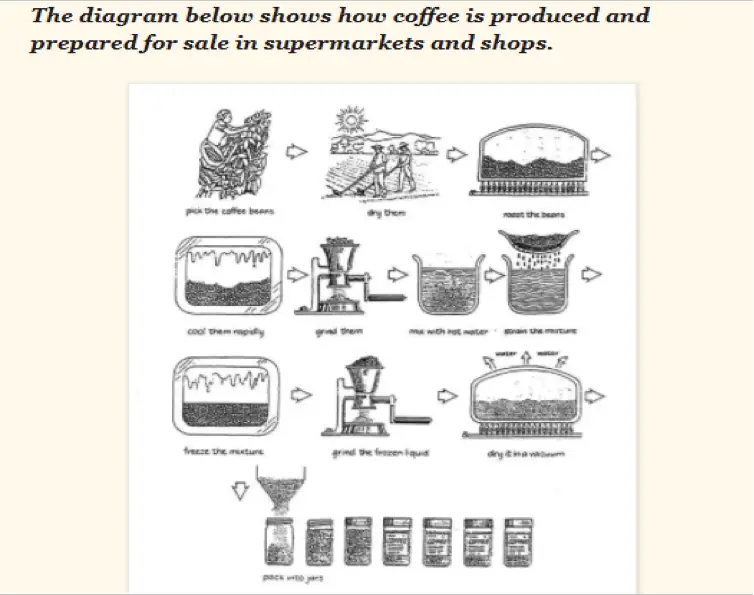
In this post, we will look at a Writing Task 1 Academic process essay example How coffee is produced ad prepared for sale? from the IELTS writing task 1 Academic Test.
Students often ask if the questions are repeated year after year and the answer is no, but the type of chart, graph or process can be. There are so many questions written each year, you may find you practice answering various questions on different topics. It is best practice to learn how to answer each one of the various types of writing task 1 questions, from bar charts, line graphs, maps, process etc.
If you would like to learn how to structure a process essay please click the button below: How to write a process essay
Take a look at the IELTS Writing Task 1 Academic essay Process example below:
*This process question and answer were provided by a student. IELTS Achieve did not design this question*
How coffee is produced ad prepared for sale?
The diagram below shows how coffee is produced and prepared for sale in supermarkets and shops.
Take a look at the model answer.
The picture describes the production of coffee and the preparation for delivery into different stores. Overall, there are 11 stages in manufacturing coffee. Beginning with picking up the coffee beans and ending with packaging and delivery for public consumption. First, the mature coffee beans are picked up in the coffee field. After that, the collected beans are then dried under the sun and then roasted in a roasting oven. Next, the roasted beans are placed in a cooling area to lower the temperature immediately. Afterwards, the coffee beans are then ground and then the mixture is later mixed with boiling water. In the subsequent stage, the mixture of water and ground coffee beans is then strained and placed in a freezer to chill. Consequently, the frozen liquid is subjected to a grinder and arranged in a drying vacuum to remove its water content. Finally, the dried ground coffee beans are being packed in a jar and they are being delivered to different stores.
Word count – 163 / Band score 80
Instructor Feedback on IELTS Process Question Essay: How Coffee is produced?
Task Achievement – The answer provides a paraphrased question, to begin with, followed by an overview that gives the reader key information.
Coherence and Cohesion – The answer has been divided into clear logical paragraphs.
Lexical Resource – There is evidence of paraphrasing, synonyms and some less common words.
Grammatical Range and Accuracy – The answer has no grammatical errors. The sentences are mainly made up of multiple clauses and have a variety of structures.
We hope you found this post helpful in helping you to study for the IELTS Test. Let us know in the comments or on the Facebook page if you have any questions. The best way to keep up to date with posts like this is to like us on Facebook, and then follow us onInstagramand Pinterest. We offer essay correction services, mock exams, and online courses. If you need help preparing for the IELTS Test, join the IELTS Achieve Academy and see how we can help you achieve your desired band score faster.
Step-by-step guide to answering this type of IELTS Writing Task 1 question. Covers structure, key language, and band-scoring criteria.
Originally published May 2018. Last reviewed 3 July 2026.
In this post, we will look at a Writing Task 1 Academic process essay example from the IELTS writing task 1 Academic Test. Students often ask if the questions are repeated year after year and the answer is no, but the type of chart, graph or process can be.
There are so many questions written each year, you may find you practice answering various questions on different topics. It is best practice to learn how to answer each one of the various types of writing task 1 questions, from bar charts, line graphs, maps, process etc.
If you would like to learn how to structure a process essay please click the button below >
Take a look at the IELTS Writing Task 1 Academic essay example below >>
*This process question and answer were provided by a student. IELTS Achieve did not design this question*
The diagram illustrates the procedure of how to recycle worn-out glass bottles.
Overall, it can be observed that there are three phases in recycling used glass bottles, beginning with the collection of wasted bottles and ending with the delivery of newly created bottles.
First, wasted glass bottles are gathered and put into a collection point and then these bottles will be transferred to a facility where they are placed into high-pressure water tanks to wash out dirt and impurities. Next, the bottles will be arranged and categorized into three colours (brown, green and clear).
In the subsequent stage, the bottles are then delivered to a glass factory where they will be smashed into small pieces. Then, the process continues by putting them into a burning furnace with temperatures ranging from 6000c up to 8000C and then a liquid is produced. Afterwards, the recycled liquid glass and new liquid glass will be combined and shaped in a glass mould. Finally, newly formed glasses are filled with products and delivered to different supermarkets.
Word count – 171 / Band score 8
Task Achievement – The answer provides a paraphrased question, to begin with, followed by an overview that gives the reader key information.
Coherence and Cohesion – The answer has been divided into clear logical paragraphs.
Lexical Resource – There is evidence of paraphrasing, synonyms and some less common words.
Grammatical Range and Accuracy – The answer has no grammatical errors. The sentences are mainly made up of multiple clauses and have a variety of structures.
We hope you found this post helpful in helping you to study for the IELTS Test. Let us know in the comments or on the Facebook page if you have any questions. The best way to keep up to date with posts like this is to like us on Facebook, and then follow us onInstagramand Pinterest. We offer essay correction services, mock exams, and online courses. If you need help preparing for the IELTS Test, join the IELTS Achieve Academy and see how we can help you achieve your desired band score faster.
Step-by-step guide to answering this type of IELTS Writing Task 1 question. Covers structure, key language, and band-scoring criteria.
Originally published May 2018. Last reviewed 3 July 2026.
In this post, we will look at a Writing Task 1 Academic process essay example from the IELTS writing task 1 Academic Test. Students often ask if the questions are repeated year after year and the answer is no, but the type of chart, graph or process can be.
There are so many questions written each year, you may find you practice answering various questions on different topics. It is best practice to learn how to answer each one of the various types of writing task 1 questions, from bar charts, line graphs, maps, process etc.
If you would like to learn how to structure a process essay please click the button below >
Take a look at the IELTS Writing Task 1 Academic essay example below >>
*This process question and answer were provided by a student. IELTS Achieve did not design this question*
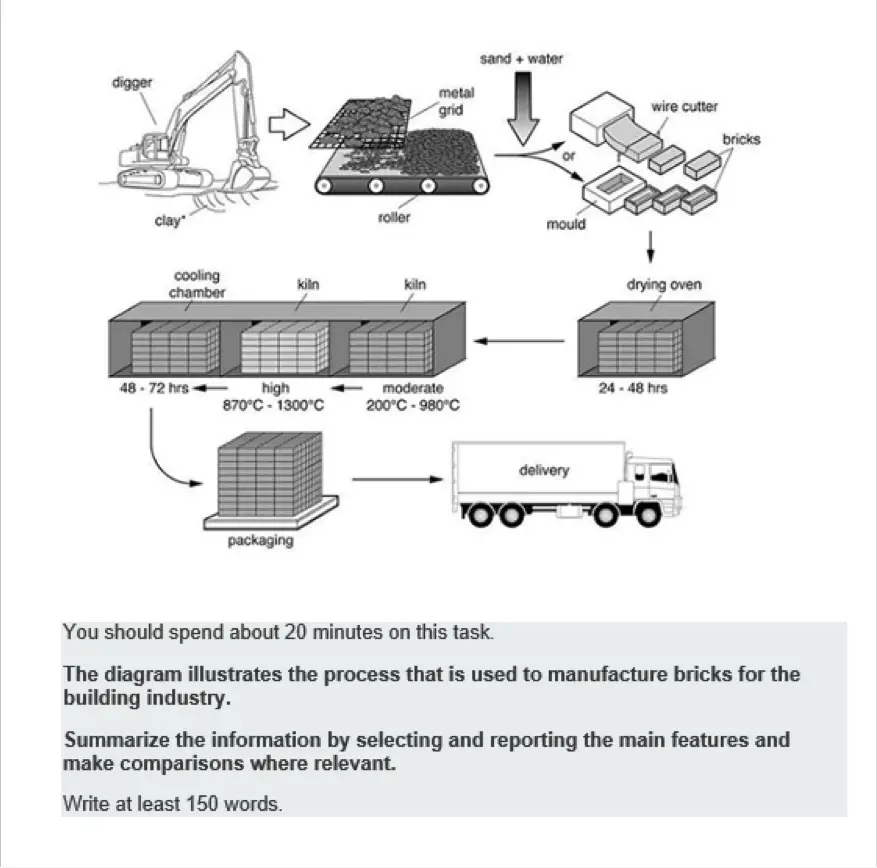
The picture shows the procedure of how to create bricks to be used in construction.
Overall, it can be observed that there are eight stages in the process, beginning with the digging of clay by the digger and ending with the bricks being delivered to different building sites.
To begin with, clay is collected by a bulldozer and then taken to a metal grid with a roller to press the clay and to incorporate sand and water. After this, the processed clay will then be subjected to a moulder or a wire cutter machine to form the clay into bricks.
In the subsequent stage, the newly formed brick will be placed in a drying oven where it will stay for about 24-48 hours. Next, the bricks will rest in two different chambers with temperatures ranging from 200 0C-9800C (1st chamber) and 8700C- 13000C ( 2nd chamber) respectively. Afterwards, the bricks will be exposed to a cooling chamber for about 48-72 hours and then later will be packed. Finally, the bricks are then stored and delivered to different construction sites.
Word count – 179 / Band score 8
Task Achievement – The answer provides a paraphrased question, to begin with, followed by an overview that gives the reader key information.
Coherence and Cohesion – The answer has been divided into clear logical paragraphs.
Lexical Resource – There is evidence of paraphrasing, synonyms and some less common words.
Grammatical Range and Accuracy – The answer has no grammatical errors. The sentences are mainly made up of multiple clauses and have a variety of structures.
We hope you found this post helpful in helping you to study for the IELTS Test. Let us know in the comments or on the Facebook page if you have any questions. The best way to keep up to date with posts like this is to like us on Facebook, and then follow us onInstagramand Pinterest. We offer essay correction services, mock exams, and online courses. If you need help preparing for the IELTS Test, join the IELTS Achieve Academy and see how we can help you achieve your desired band score faster.