Expert tips and strategies for this part of the IELTS Speaking test. Includes sample responses and key vocabulary for Band 7+.
Originally published August 2017. Last reviewed 3 July 2026.
In this post, you will see one of the most common IELTS speaking topics (Family) and sample answers.
Please remember that in the actual test you should give honest answers and talk about your own experiences, thoughts, feelings and opinions. Do not try to memorise answers, as the examiners will probably be able to guess and you will lose marks.
However, you are able to make up information to extend your answers, but be sure that you are confident when speaking about the chosen topic and that it is believable.
TIP >> Each answer should be at least 2-3 sentences long.
TIP >> Listen carefully to the question so that you answer in the correct tense.
TIP >> When answering a yes/no question – answer then give your reasons for your answer. You must extend your answer to gain more marks.
TIP >> Just relax and think of it as a regular conversation you are having, make eye contact and be positive.
Take a look at the questions and sample answers below on the topic of ‘Family‘ >>
Q: Could you tell me something about your family?
A: My family is quite small and most people live far away from each other. Some are at the top of the country and some at the bottom. More distant relatives live in France and Australia, so we don’t see them very often.
Q: Do you think it is good to live with grandparents?
A: In my opinion, living with your grandparents may be a way to save money and also to help to care for them. Perhaps they can’t do things they used to, like housework or cooking, so being able to help them would be a positive.
Q: What’s the women’s status in families?
A: Women are seen as the people in charge in most families, they have many roles within the family unit, often having qualifications and a career also. They are the carers, providers, mothers and managers.
Q: Do you think it good to be the only child in the family?
A: On the one hand, it could be a lonely existence when you are a small child but as you become older would start to enjoy having that space. On the other hand, they are missing out on the connection that you see between siblings.
Q: Is there any generation gap in your family?
A: There is a divide between the older members of the family and the young, with varying views on politics and religion which leads to misunderstandings.
Q: Do you like your family?
A: Yes of course! My immediate family – my parents are amazing people, kind, funny and caring. The other members of my family and my husbands family are all very lovely people, who have good times together.
Q: Who is your closest family member?
A: My mother is very close to me and we talk every day, often about trivial things like what our dogs have been doing. She likes to ask questions about my dog, to make sure he is being taken care of like a king!
Q: What are your parents like?
A: Very good, kind and funny people. They like to laugh, read, travel and like all of the same TV shows as me. They are very caring people too, helping in the community – for a children’s charity and to protect the environment.
We hope you found this post useful in helping you to study for the IELTS Test. If you have any questions please let us know in the comments below or on the Facebook page.
The best way to keep up to date with posts like this is to like us on Facebook, then follow us on Instagram and Pinterest.
If you need help preparing for the IELTS Test, join the IELTS Achieve Academy and see how we can assist you to achieve your desired band score. We offer an essay correction service, mock exams and online courses.
Expert tips and strategies for this part of the IELTS Speaking test. Includes sample responses and key vocabulary for Band 7+.
Originally published August 2017. Last reviewed 3 July 2026.
In this post, see the top 10 speaking part 1 tips that will help you to achieve a band score 7 or above.
The IELTS Speaking Test lasts 11-14 minutes.
The test has three parts, where you are interviewed by a trained examiner. You are not allowed to use a dictionary during the test. IELTS Academic and IELTS General students take the same test and it is marked in the same way.
PART 1 INFORMATION
To begin with, the examiner will introduce themselves to you, then ask you your name and for proof of identity.
Time:4-5 minutes You will be asked questions on familiar topics, like your hobbies, family, where you are from, what your hometown/city is like, etc.
The topics that are included:
Your studies/education
Hobbies/sports
Your family
What kind of movies, books, tv shows or music you like
What you like to eat / where you like to eat
Your job
Where you live
To view sample questions and answers on a variety of part 1 speaking topics, take a look at the other posts in this section.
Take a read through our top ten tips below, that will help you to gain a band score of 7 or above!
Speaking Tips
Tip 1: Be Prepared
As well as being prepared for the test questions on the day of your exam, you should also be aware of what to expect in terms of getting to the test centre and the beginning of the test. Arrive in plenty of time, so that you are not under pressure/late and have time to relax before the test.
The examiner will introduce themselves and ask you for your name and proof of identity (Passport etc), to begin with. They will also ask you where you are from, which requires a simple answer – this is more of a formality, so you don’t have to extend your answer here, but simply state, for example; “I am from Romania’ (or name the town/city etc you are from and where).
Take a look at this post for help with how to prepare for the speaking part 1 test..
Tip 2: Make A Good First Impression
Try to be relaxed and confident, having confidence will help you to do well in your test. Make eye contact with the examiner and answer any questions in a polite manner. Try to keep your body language friendly and open. Think of it as a natural conversation and try to stay calm, like you are talking to your IELTS teacher or practice partner.
Tip 3: Listen Carefully
Listen carefully to the examiner, so that you understand the questions and can answer in an appropriate way. You should also be listening for tenses – for example; “What TV Shows did you use to like as a child?’ then you know that you should answer in the past tense – ‘I used to watch…..’
You should also listen out for any yes/no questions and remember to answer and give reasons. Take a look at this post for help with how to answer those yes/no questions.
Tip 4: Show Enthusiasm
Show that you are interested in the questions by answering with enthusiasm, even if you are not really interested in the subject. Native speakers show enthusiasm by varying the pitch of their voice (intonation – the voice falls and rises) to show how they feel about something.
Listen to examples and think about how native speakers talk when answering questions, what happens to their voice? It gets higher when they are interested or excited by a subject and it falls when they are not happy or disinterested.
Watch the video clip below from the US TV show ‘Friends’ and see how the intonation falls and rises when the actors talk – can you notice the difference? How does it impact on what they are saying?
Tip 5: Extend Your Answers
When giving your answers, try to make sure that they are not too short – for example, if the examiner asks you what is your favourite TV show, saying ‘I really like Peaky Blinders’ is too short.
You can expand your answer by adding more detail of what it is about, and why you like it so much for example; ‘I really like the BBC drama Peaky Blinders, it has an excellent cast and the writing keeps me interested in the story. There is lots of action, as the story is centred on a gangster family in 1920’s Birmingham, who are up to no good!’.
The answers in part 1 should not be too long either, talking for 2 minutes or more is far too long, parts 2 and 3 will allow you to speak for a longer time and go into more detail.
You should aim to use more than one clause when you give your answers, for example;
Q: Do you work or study?
A: I work at the moment but I continue my studies at the same time. I continue to learn through courses and gain new qualifications every year, this means my knowledge is always up to date.
Take a look at this post for more information on how to extend your answers.
Tip 6: Be Confident
Show your confidence by speaking clearly and at a normal level. Don’t speak too loudly or quietly, make sure the examiner can understand and hear your answers. Have faith in yourself, to answer whatever questions you get to the best of your ability.
When answering the questions, try to be as honest as possible, telling the examiner your thoughts, feeling and opinions, for example:
Q: Do you think vacations are becoming more and more important?
A: Yes, I think that many people are working longer hours and have more stress than ever placed upon them. taking a break is necessary to unwind and recharge so that they can let go of the stress and focus on their own well-being.
Tip 8: Study/Look at past questions and sample answers
Look at past questions and sample answers to get an idea of how you can extend your answers and the type of questions that come up. There are some speaking topics that are popular, regularly being used over and over, which include;
Your studies/education
Hobbies/sports
Your family
What kind of movies, books, tv shows or music you like
What you like to eat / where you like to eat
Your job
Where you live
You may also be asked questions about any topic, recently there have been questions about flowers and photography. Going back to tip 7 – be honest, answer any questions you get with honesty, telling the examiner your own opinions, thoughts and views. Do not memorise answers to recite to the examiner, they will be able to tell and ask you something else.
Tip 9: Read The Criteria
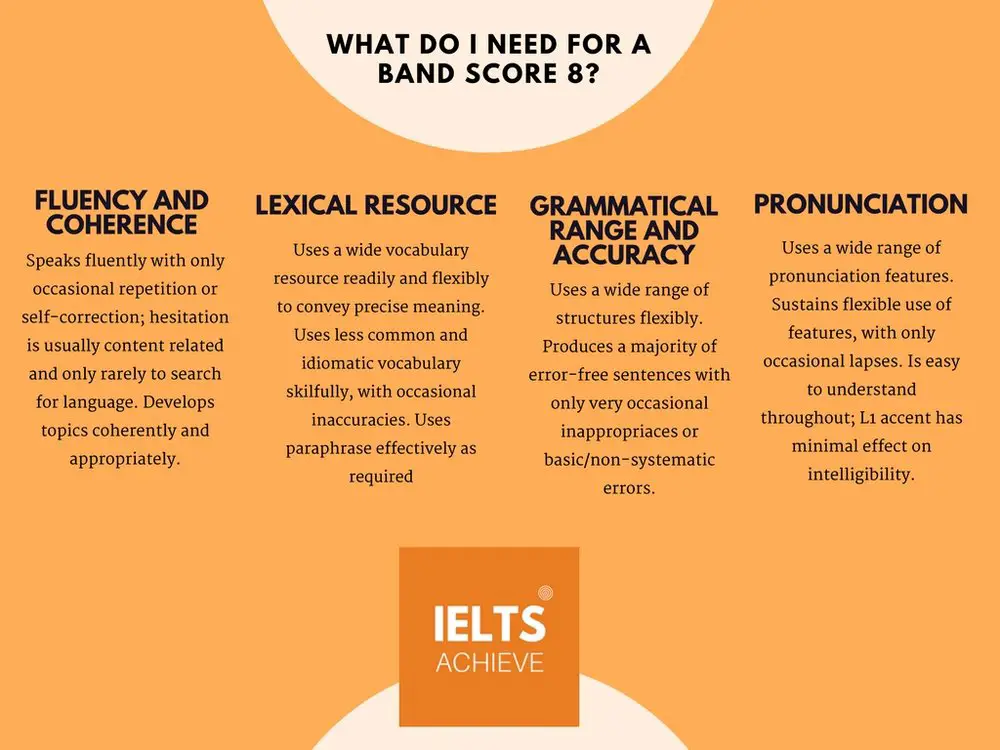
You should read through the marking criteria and be aware of what is required for a band score 7 or above. Many students do not do this and have no idea what they need to achieve in order to get the band score they want. Read it, understand it and aim to achieve it. Ask your IELTS teacher for help to understand it and to see the level you are at now.
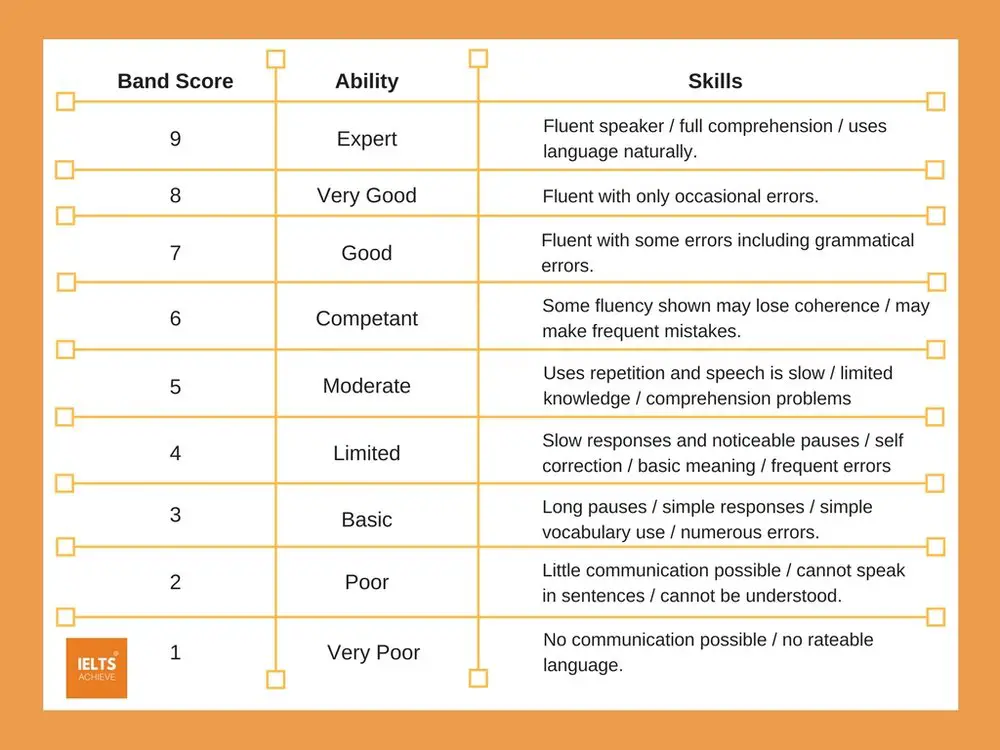
You should also read the scoring information to see how the band scores are given:
Tip 10: Practice
Practice as much as possible with your native speaking IELTS teacher, a partner or friend. Take a look at the most common topics (see the other posts in this section) and practice answering those questions. A good way to listen for errors is to record yourself speaking. Listen to your recording and notice any errors you have made, including grammar mistakes, pronunciation, intonation and fluency. Keep practising and use the posts in this section to help you.
Expert tips and strategies for this part of the IELTS Speaking test. Includes sample responses and key vocabulary for Band 7+.
Originally published August 2017. Last reviewed 3 July 2026.
In this post, we will be looking in-depth at part 1 of the speaking test.
The IELTS Speaking Test lasts 11-14 minutes.
The test has three parts, where you are interviewed by a trained examiner. You are not allowed to use a dictionary during the test. IELTS Academic and IELTS General students take the same test and it is marked in the same way.
PART 1 Information
To begin with, the examiner will introduce themselves to you, then ask you your name and for proof of identity.
4-5 minutes >> You will be asked questions on familiar topics, like your hobbies, family, where you are from, what your hometown/city is like, etc.
The topics might include;
Your studies/education
Hobbies/sports
Your family
What kind of movies, books, tv shows or music you like
What you like to eat / where you like to eat
Your job
Where you live
Part 1 Questions
The questions in part 1 will possibly be about your work or studies, hobbies, your family, where you live, hometown or where you live now. Your answers should include facts and your own opinions or feelings.
Possible questions >>
Do you live in a house or an apartment?
What do you do at the weekends?
Do you have any hobbies?
How often do you like to travel?
Where is a good place to visit in your hometown or city?
Do you go to the cinema often?
Example Q+A
Take a look at the questions below and the two possible answers, which one is better?
Question: Do you like to travel?
Answer 1: yes, I do.
Answer 2: Yes, I have been to many places in Europe, including Italy, Spain, Greece and the UK. In the future I would love to be able to visit and explore the USA, going to New York and perhaps driving through other states.
Which answer looks better to you?
Feedback: Answer 2!Why? The first answer does not fully answer the question and show off the students ability to speak English. In part one, your answer should be at least 2-3 sentences. The second answer is much better, giving background information (I have been to many places in Europe, including Italy, Spain, Greece and the UK.) and adding details (I would love to be able to visit and explore the USA).
Answering The Question
Make sure you answer the question fully, with correct tenses where appropriate.
Question: Do you enjoy going to the cinema?
Answer 1 – Kate: Yes, I do love going to the cinema and I always think it is good to go and see new movies, especially in the IMAX. On the other hand, I also like to watch movies in my house, as it is more comfortable.
Answer 2- Georgina: I went to the cinema last weekend. I was invited to go with a friend. She wanted to see the latest thriller.
Feedback: Georgina did not answer the question, she didn’t make it clear whether she enjoyed going to the cinema, she used the past tense and the question was in the present tense. her answer was also short in length. Kate has a high-level answer, she answered the question using varied vocabulary, not just repeating the words the examiner had used. She also connected her ideas by using ‘on the other hand’ and used the present tense.
Yes/No Questions
When you hear a yes/no question, try to start your answer with one of the following phrases >>
I don’t think so
not really
absolutely!
definitely!
I think so
not very often
most of the time
sometimes
yes, in general
For example for the following questions….the answers can be started with one of the phrases from above and expanded upon, you can add more detail or give an example. This is so you don’t answer the question with a simple yes or no, which would not get you many marks.
Question: Do you use your phone or tablet every day?
Answer: Absolutely! I always check my phone for emails and texts, then of course to see social media.
Question: Is travelling important to you?
Answer: Definitely! It is something that I aim to do as often as I can, for example, next year I plan to visit Barcelona.
Question: Is reading important to you?
Answer: Not really, I don’t have much time to read, I prefer to listen to music or watch netflix.
Preference Questions
Some part 1 questions may ask you about your preferences.
Can you see which is the better answer?
Question: Do you prefer travelling alone or in a group?
Answer 1 – Claire: I prefer to travel alone, I don’t really like to be in a group.
Answer 2 – Susan: I haven’t ever travelled on my own, I have always been with friends. It is so much fun to travel in a group, as you can share experiences and have a laugh with your friends. I think travelling alone in some parts of the world could be dangerous.
Feedback: Claire’s answer is short and repeats too many words from the question. Susan’s answer is better because she gives more detail and uses different words to the question, she also gives reasons for her preferences.
You can use the following phrases in your answers for a high-level answer >>
I like…… more than…..
It depends on………
I like both………..and………….
My first choice would be …………..
I’d rather…………..than………………..
For example, ‘I like both travelling on my own and with friends, because……’ or ‘I like travelling with friends more than on my own, because……’.
Using Would and Could
Some questions may ask you a hypothetical question, which invites you to use the words ‘would’ or ‘could’.
Question: Where would you recommend a foreigner to visit in your country?
Answer 1 – Marco: I will tell them to visit the Vatican and to see the sights.
Answer 2 – Ricardo: I would highly recommend that they visit the galleries and museums when in Rome, especially in the Vatican. A great historical site to see is the Colosseum, a stunning example of architecture. I could also recommend visiting the Trevi Fountain and sampling some delicious ice cream!
Feedback: Marco’s answer is short and does not use enough vocabulary. Ricardo expands on his answer, listing places to visit and uses the words ‘would’ and ‘could’ in his answer.
We hope you found this post useful in helping you to study for the IELTS Test. If you have any questions please let us know in the comments below or on the Facebook page.
The best way to keep up to date with posts like this is to like us on Facebook, then follow us on Instagram and Pinterest.
If you need help preparing for the IELTS Test, join the IELTS Achieve Academy and see how we can assist you to achieve your desired band score. We offer an essay correction service, mock exams and online courses.
Essential vocabulary and phrases for IELTS success. Includes contextual usage, collocations, and practice exercises.
Originally published July 2017. Last reviewed 3 July 2026.
In this post, we will be looking in-depth at lexical resources for IELTS Exams, Marking Criteria, Synonym, Antonym, Paraphrasing and Collocations. Also, check the list of Lexical resources for the IELTS Test.
What is a Lexical resource?
The lexical resource is the criteria that measure the capability of language knowledge of the candidate based on the use of the various aspects of contextual vocabulary in particular.
In IELTS lexical resources are measured in the Speaking and Writing section where the idea is to be presented by the candidate as a task.
Marking Criteria:
While you are preparing for your IELTS Speaking Test it is important that you understand the marking criteria.
Lexical resources count for around 20-25% of your speaking test score, therefore it is vital that you understand what the examiner wants.
You will be able to achieve a higher score if you can demonstrate your ability to paraphrase and use synonyms. Knowing how to say something in a different way.
Using varied vocabulary and common word combinations is important in order to get a band score 7 or above.
How can we improve lexical resources in IELTS?
To get better at Lexical resources in IELTS you need to focus on following elements of English Grammar:
Synonym
Antonym
Paraphrasing
Collocations
Synonyms
What is a synonym?
Synonym, in general, is a word or phrase that offers the same or similar meaning to the word or phrase provided. Example: synonym of amazing is incredible, awesome Use of synonyms is a good way to show your vocabulary knowledge, as long as they are appropriate choices.
To be successful in all areas of the IELTS test you need to be able to recognise and use synonyms appropriately.
One way to do this when you are practising is by looking up for synonyms of common words in a thesaurus. This can help you to find synonyms but also to learn to select the right synonym to fit into your sentence.
Use of synonym: Example;
Last year we visited Corfu in Greece and it was amazing.
Can you think of another word to use other than ‘amazing’?
How about incredible, marvellous, awesome, stunning or wonderful?
Last year we visited Corfu in Greece and it was incredible.
Antonyms
What is an Antonym?
Antonyms, in general, is a word or phrase that offers the opposite or different meaning to the word or phrase provided. Example: antonym of early is late. You can use antonyms, to show your vocabulary/lexical ability as long as they are appropriate choices.
For example:
My language lesson was really early today. My language lesson was really late today.
Other examples of antonyms:
Happy and sad
Young and old
Risky and safe
Rich and poor
Cool and hot
Excited and bored.
Paraphrasing
What is an Paraphrasing?
Paraphrasing is an activity of presenting the sentence or phrase using alternate words(usually synonym and antonym) to attend better clarity.
It is a skill that is needed in all parts of the test. When the examiner asks you a question, you should not repeat the question back to them as part of your answer.
Instead, you should paraphrase it and this means restructuring.
For example, if the examiner asks you:
What are the advantages and disadvantages of young people using social media?
Your answer could include the words benefits and drawbacks, instead of repeating the words, advantages and disadvantages.
Question example:
Examiner: What kind of holiday do you like?
Answer 1
The holidays I like tend to be anywhere that is hot with a beach! I like to go and spend time with my friends.
Answer 2
When I travel, I really enjoy visiting places with a warmer climate, where I can relax on a beach. Last year I visited Corfu in Greece and I had the most wonderful time, exploring small unspoilt beaches by hiring a boat to tour the island.
Which one do you think is the better answer?
Answer 2 is better because it answers the question with more specific information. It also does not repeat words that are in the question.
Collocations
What is an Collocations?
A collocation is made up of two or more words that are commonly used together in English. Think of collocations as words that usually go together.
The more you use collocations, the more you will sound like a native speaker.
There are different kinds of collocations in English. Strong collocations are word pairings that are expected to work together.
For example;
make the bed: I need to make the bed every morning.
do the homework: My niece does her homework after dinner.
take a risk: Some people don’t take enough risks in life.
give someone advice: The teacher gave us some advice on taking tests.
Common verb collocations are often followed by particular nouns or adjectives.
For example;
make a phone call: I have to go and make a phone call.
get wet: It rained today and I got wet.
keep a record: I keep a record of all of my bank statements.
break down: I was on the way to work this morning and my car broke down.
Collocations are often used as short expressions to describe how someone feels about a situation. In this case, collocations can be used in the adjective form, or also as emphatic expressions using an intensifier and a verb.
For example;
positively encourage someone to do something: I’d like to positively encourage you to apply for the position.
deeply regret the loss of someone/something: I deeply regret saying no to that job offer.
to be in an utter fury over something: I am in an utter fury over missing out on getting those gig tickets.
to go to great lengths to do something: She went to great lengths to be able to move to another country.
We hope you found this post useful in helping you to study for the IELTS Test. If you have any questions please let us know in the comments below or on the Facebook page.
The best way to keep up to date with posts like this is to like us on Facebook, then follow us on Instagram and Pinterest.
If you need help preparing for the IELTS Test, join the IELTS Achieve Academy and see how we can assist you to achieve your desired band score. We offer an essay correction service, mock exams and online courses.
Expert tips and strategies for this part of the IELTS Speaking test. Includes sample responses and key vocabulary for Band 7+.
Originally published July 2017. Last reviewed 3 July 2026.
In this post, we will be looking in-depth at fluency and coherence.
While you are preparing for your IELTS Speaking Test it is important that you understand the marking criteria. Fluency and coherence count for 25% of your speaking score, therefore it is vital that you understand what the examiner wants.
Fluent >> Able to express oneself easily and articulately / smoothly graceful and effortless.
Coherent >> Logical and consistent.
When you are speaking, you want to show the examiner that you can talk about topics easily, without long pauses and repetition. You also want to show them that you can organise your ideas in a logical way.
Fluent Speech
When you are fluently able to speak you can talk at a normal pace, pause occasionally for emphasis and self-correct.
Some students find themselves speaking too fast or repeating words and phrases, which is something you should avoid doing.
You should aim to practice speaking in English as often as possible and for those of you already living in the UK (or another English speaking country) take the opportunity to talk to friends or colleagues. You can ask them to ask you questions to help you practice and they can also give you some feedback!
Some questions they could ask you >>
What did you do last night? / or at the weekend?
Did you see the latest episode of …. (insert TV show name) what did you think of it?
When was the last time you went to the cinema?
Are you going on holiday this year? Where are you going?
Have you read any good books recently?
Did you see/read about… (insert news story) what did you think about that?
You should answer with full sentences and avoid repeating the question back to them.
Speaking Coherently
When you are answering questions you should organise the information logically, starting at the beginning, describing /explaining and concluding.
For example, read the text below >>
I read a good book the other day about this woman who gets on the same train every day. It starts with this woman getting fired from her job, then getting the train home. Actually, it starts with her on the train then explaining that she got fired. There are blanks in her memory. She likes to look at a house when the train passes and the woman that lives there. She can’t remember things. She drinks a lot. My friend told me to read this book. The book was fast paced and interesting. I enjoyed it. I read it on the plane last month when I went on holiday.
Here it is again but organised in a more logical way >>
I read a really good book when I went on holiday last month after my friend had recommended it to me. It was a thriller, with a woman who had an abusive relationship and a drinking problem, that had been fired from her job. She rides the tube every day pretending to go to work and she is intrigued by a house she sees. She envies the woman who lives there and the story develops from there. Then, she gets involved with the woman’s story putting together the gaps in her own memory and begins to see how her own life is connected. This book was fast paced and interesting!
Do you think the second paragraph is more logical?
Can you see the difference?
The events in the book/movie etc should be explained in logical order.
Using Cohesive Devices
Your ideas should be in logical order but also connected by cohesive devices.
For example, if you were telling a story about your educational background it could look like this >>
I started school at 5 years old. I went to secondary school when I was 12. I left that school at 18. I went to university for three years. I graduated with honours. I had training. I work in my chosen field.
Introducing cohesive devices will make it sound more natural and explain the order of events in a logical sounding way >>
Firstly, I started school at 5 years old, then I went to secondary school when I was 12. However, I left that school at 18. After that, I went to university for three years, where I graduated with honours. In addition to that, I had further training. Now, I finally work in my chosen field.
Take a look at the cohesive devices below, the words and phrases here will help you to organise your ideas >>
Sequencing
You can also use sequencing to express your ideas in a logical way, take a look at the words and phrases below >>
Practice
Practice answering these questions below using cohesive devices and sequencing >>
What do you think are the main reasons that students in recent years like to take a gap year?
What are the advantages and disadvantages of young people using social media?
Do you agree or disagree with the idea that technology is developing faster than the public think?
Is it a good idea to try out new restaurants recommended by friends?
What did you do last weekend
Can you use any of the following words or phrases in your answers?
Firstly / secondly……
Then
After that
Overall
However
In addition
Therefore
For example
For instance
On the one hand
On the other hand
Finally
Now
We hope you found this post useful in helping you to study for the IELTS Test. If you have any questions please let us know in the comments below or on the Facebook page.
The best way to keep up to date with posts like this is to like us on Facebook, then follow us on Instagram and Pinterest.
If you need help preparing for the IELTS Test, join the IELTS Achieve Academy and see how we can assist you to achieve your desired band score. We offer an essay correction service, mock exams and online courses.