A complete model answer and preparation guide for this IELTS Speaking cue card topic. Includes key vocabulary, follow-up questions, and examiner-approved response strategies.
Originally published September 2017. Last reviewed 3 July 2026.
In this post, you will see a sample cue card question, high-level answer and feedback.
Model Answer
I’d like to talk about how I like to travel to my parents home during the winter. I currently live in Spain and during the winter I like to travel home to visit my parents in the UK. They live in the North of England, so it is often very cold in the winter there. With temperatures getting below zero, you need to wear your warm clothes and make sure that you have the heating on when you are in the house. With living in Spain now, the temperatures in the winter are much warmer than in the UK. You can still sit outside for a coffee in December or January on a sunny day.
I like to visit my parents and in December it snows, with heavy thick snowflakes and a full pinkish, grey sky, the snow can get quite deep. I like to get dressed up in a big thick coat, woolly hat and scarf, put on my Wellington boots and go for a long walk in the snow. It is really pretty and awe inspiring to see everything covered in thick layers of white snow, with an eerie feeling too, as the streets are deserted and everything is quiet. Then after the walk when I return home again, I like to sit and drink tea or hot chocolate by the fire with the dogs and watch some English TV shows. They always have a good programme of viewing in December, with the run up to Christmas.
I really like to visit my parents home during the winter, not only to see them and spend time with them but to enjoy the winter weather. Going for long walks in the countryside or on the beach is really refreshing in the cold weather. You can feel like you have lots of energy after walking your dogs through a forest, so wrapped up in winter clothes so that only your face is exposed.
Being from somewhere that has a regular cold temperature with a vast difference in the seasons is great. I keep my winter wardrobe of a winter coat and wellington boots at their house, as I don’t really need them in Spain. The weather here is never as cold as there unless you travel to places that are high up in the mountains. Winter for me is never the same anywhere else, I always want to go home to get the full frosty experience.
Feedback
This is a strong answer, as there are examples given of what, where and why. The topic has been fully discussed, with additional information added that was not prompted by the bullet points.There are various tenses and structures used, for the past and present. There is also evidence of collocations being used and a high level of vocabulary.
We hope you found this post useful in helping you to study for the IELTS Test. If you have any questions please let us know in the comments below or on the Facebook page.
The best way to keep up to date with posts like this is to like us on Facebook, then follow us on Instagram and Pinterest.
If you need help preparing for the IELTS Test, join the IELTS Achieve Academy and see how we can assist you to achieve your desired band score. We offer an essay correction service, mock exams and online courses.
A complete model answer and preparation guide for this IELTS Speaking cue card topic. Includes key vocabulary, follow-up questions, and examiner-approved response strategies.
Originally published September 2017. Last reviewed 3 July 2026.
In this post, you will see a sample cue card question, high-level answer and feedback.
Model Answer
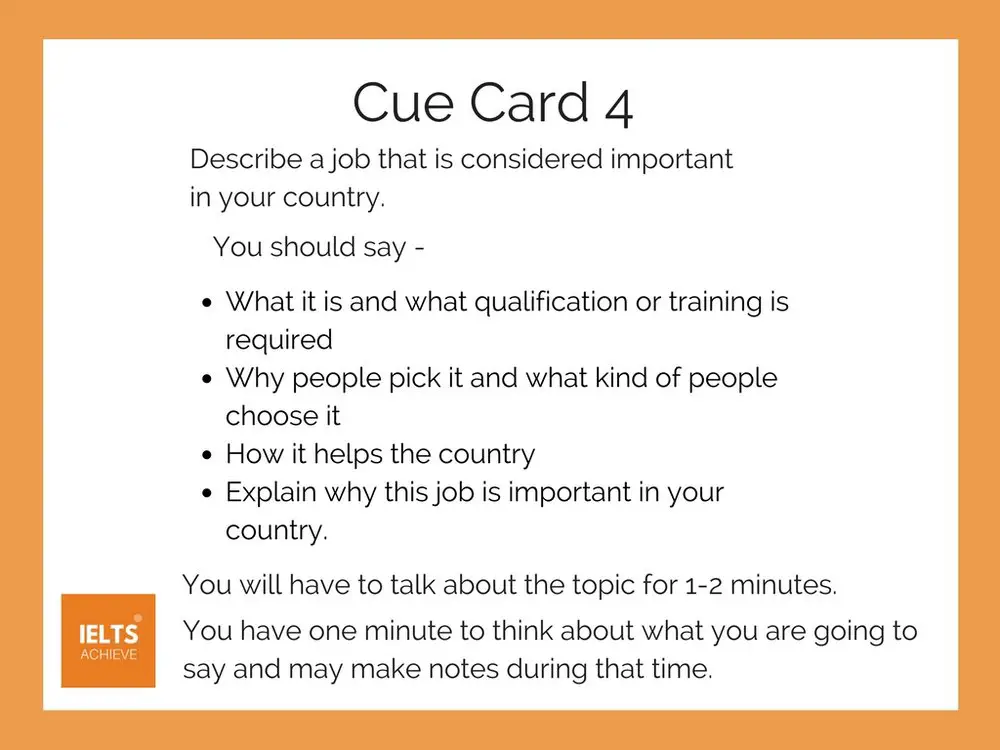
I’d like to talk about a job that I think is very important for everyone all over the world and that is the role of people in the medical profession. Doctors, nurses and all of the specialists that make up the healthcare systems have such an important role in society. They heal, nurture and save the lives of many people on a daily basis. Without these professionals, many people would suffer and medicine would not be moving forward at the rate it is today.
Doctors and other people in the medical profession require years of training at university before getting ‘hands on’ training in hospitals or GP practices. Many years of study and training is required for the very skilled, often continuing to study all through their career. For example, surgeons who specialise in niche areas will continue to study and teach even after they are fully qualified. The type of people that want to be in the medical profession are those who want to help people, academic and motivated. Some choose this profession as a way to solidify their career prospects and know that once qualified, their careers will grow in strength, making them secure financially. They also have huge job satisfaction knowing that every day they are helping others.
The skilled workers in the medical profession can help the country by providing a service that benefits the people who live there. By offering a good healthcare system, the country will be considered as a leader in government systems, with the quality of health care provided for free. Private medical care offered to those who can afford it is often supplied and uses doctors who specialise in certain areas, who work between all healthcare providers.
The role of doctors and nurses is really important in all areas of the profession, as society needs them. They are often overworked and underpaid for what they do, always giving and going that extra mile because they truly care for the well-being of others. In my opinion, society would crumble without this service and many people would not be taken care of or healed by those with the knowledge and skills to do so.
Feedback
This is a strong answer, as there are examples given of why and how this type of job is important. The topic has been fully discussed, with additional information added that was not prompted by the bullet points.There are various tenses and structures used, for the past and present. There is also evidence of collocations being used and a high level of vocabulary.
We hope you found this post useful in helping you to study for the IELTS Test. If you have any questions please let us know in the comments below or on the Facebook page.
The best way to keep up to date with posts like this is to like us on Facebook, then follow us on Instagram and Pinterest.
If you need help preparing for the IELTS Test, join the IELTS Achieve Academy and see how we can assist you to achieve your desired band score. We offer an essay correction service, mock exams and online courses.
A complete model answer and preparation guide for this IELTS Speaking cue card topic. Includes key vocabulary, follow-up questions, and examiner-approved response strategies.
Originally published August 2017. Last reviewed 3 July 2026.
In this post, you will see a sample cue card question, high-level answer and feedback.
Model Answer
I’d like to talk about a place I visited with my parents when I was about 10 years old in 1990. We went to the Lake District in Cumbria one summer. This is a lovely place, full of green fields, hills and of course lakes. It was about a 2-hour drive from our house and one into the countryside, the surrounding areas just became more and more beautiful to see.
In the summer, it is the perfect weather for exploring the lakes, from Lake Windermere to Grasmere, we explored the surrounding areas, with a visit to Beatrix Potters house, which is a National Trust owned property and also to the poet William Wordsworth’s house. I was very interested in reading when I was younger and enjoyed visiting the former homes of these well-known writers.
There are also many hiking trails in the Lake District, over the fells and beyond. We walked a great deal, with a map and a compass to guide us and even stopped for a picnic on the top of a hill. I enjoyed walking in the hills, learning about each area and how to read a map.
I would definitely visit the Lakes again and would like to see how the areas have changed since I was last there. I would also like to visit Beatrix Potters house again, now that I am older, I think I would appreciate it more. She is a very inspiring author and illustrator and I love that she was inspired by the nature and animals around her. I would also like to stay in a hotel near to Lake Windermere and if the weather is good, hire a boat and sail around to enjoy the surrounding nature.
Feedback
This is a strong answer, as there are examples given of where, when and why. The topic has been fully discussed, with additional information added that was not prompted by the bullet points, with information being added, from the memories of visiting the places mentioned. There are various tenses and structures used, for the past and present. There is also evidence of collocations being used and a high level of vocabulary.
We hope you found this post useful in helping you to study for the IELTS Test. If you have any questions please let us know in the comments below or on the Facebook page.
The best way to keep up to date with posts like this is to like us on Facebook, then follow us on Instagram and Pinterest.
If you need help preparing for the IELTS Test, join the IELTS Achieve Academy and see how we can assist you to achieve your desired band score. We offer an essay correction service, mock exams and online courses.
A complete model answer and preparation guide for this IELTS Speaking cue card topic. Includes key vocabulary, follow-up questions, and examiner-approved response strategies.
Originally published August 2017. Last reviewed 3 July 2026.
In this post, you will see a sample cue card question, high-level answer and feedback.
Model Answer
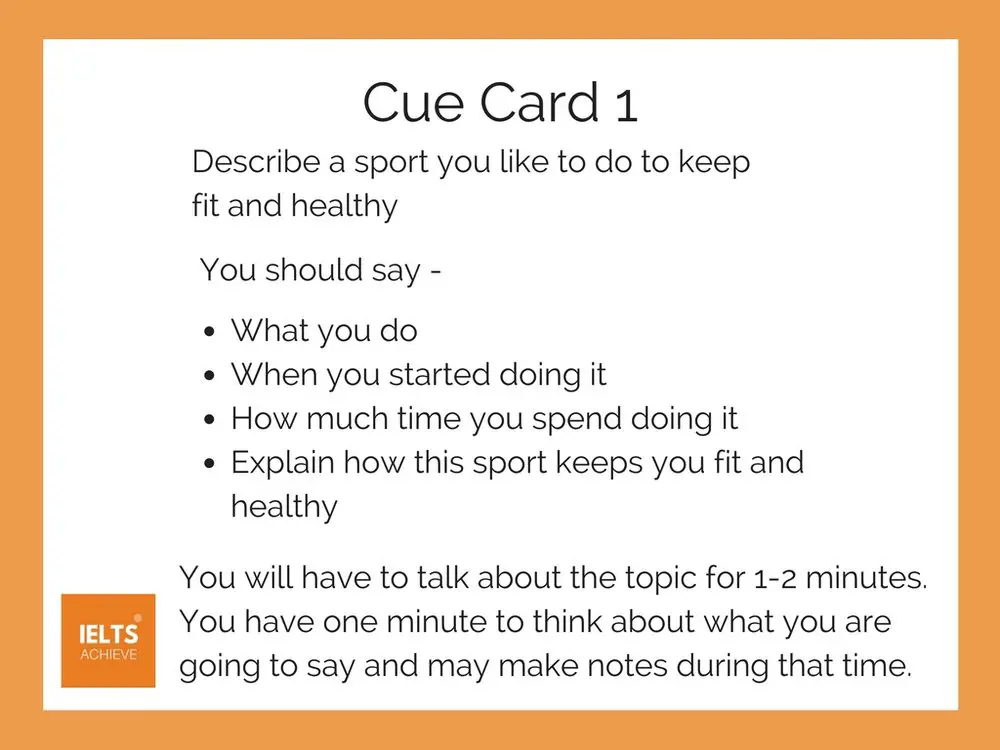
I think it’s important to exercise every day or at least three times per week, so I like to walk every morning and swim as often as I can. I learned to swim when I was at school and since then regularly visited the indoor pool, then when I moved to Spain I was going swimming nearly every day in the summer months. In the winter I like to go to an indoor pool, as it is heated and of course protects you from the elements outside.
There are many beaches close to my house, with crystal clear waters, surrounded by beautiful landscapes and hotels with large swimming pools, so I have a good choice of places to visit for a swim. I like to go to the pool when it is quiet, or the sea when it is calm. The clear salt waters are good for your health and it’s great to swim alongside the fish.
I used to go to a lot of classes in the UK, including Zumba and body combat. I had an accident during a body combat class and broke a bone in my foot, which meant that swimming and cycling were the only options open to me for a while. My doctor encouraged me to go swimming regularly, as he said the salt water would help my foot to heal and obviously to keep up my exercise routine. I really enjoyed swimming, so just kept doing it even after my foot had healed. Swimming keeps me fit and healthy as it is an all over body workout, using all of the muscles it is a great way to do cardiovascular exercise.
Feedback
This is a strong answer, as there is background given and the topic has been fully discussed.There are various tenses and structures used, for the past and present. The notes have prompts and keywords so that the topic could flow and include all of the given points from the cue card.
We hope you found this post useful in helping you to study for the IELTS Test. If you have any questions please let us know in the comments below or on the Facebook page.
The best way to keep up to date with posts like this is to like us on Facebook, then follow us on Instagram and Pinterest.
If you need help preparing for the IELTS Test, join the IELTS Achieve Academy and see how we can assist you to achieve your desired band score. We offer an essay correction service, mock exams and online courses.
Fluency and Coherence You should be able to speak without hesitation, have natural pauses, be able to order your ideas and connect them when telling a story.
Lexical Resource Be able to demonstrate the ability to use advanced vocabulary, synonyms, antonyms, intensifiers, collocations and idioms.
Grammatical Range and Accuracy Use complex senetences, connecting words, a variety of tenses, passive voice, conditionals.
Pronunciation Show that you can make individuals sounds, connecting sounds, word stress, sentence stress and intonation.
Do you know your own strengths and weaknesses? Do you practice speaking English regularly?
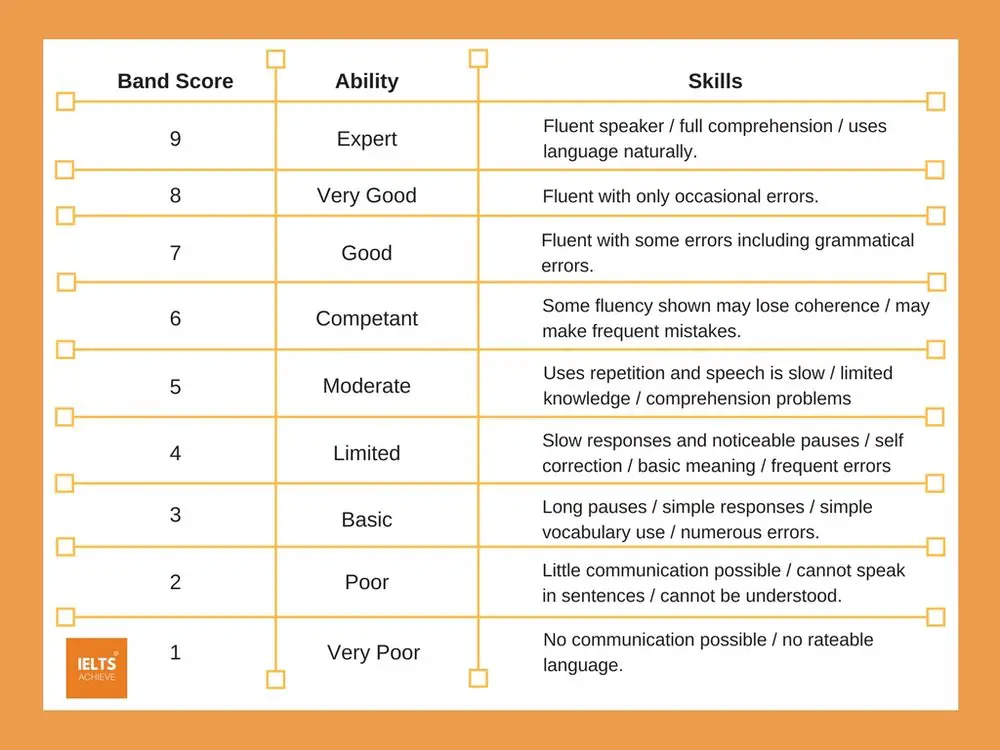
Hopefully, the answer to both of those questions is yes. You need to be able to identify your strengths and weaknesses so that you know where you need to improve, to reach the band score you want. Having lessons with a native speaking teacher is worth it so that they can identify your weaknesses and help you to work on them.
Looking at the table below, where would you say you are right now?
How can you start to improve?
Making a study plan and following it is a really great idea to get started. Read the sections below and get some ideas on how you can improve in all four areas of the IELTS Speaking Test marking criteria.
Fluency And Coherence
How can you improve Fluency and Coherence?
Practice with as many resources as you can for part 1, part 2 and part 3 questions. For parts 2 and 3 you should read the practice questions and see how well you understand them. Think of examples you can use in your answers and the structure of your answers. The part two answer should sound natural and be well structured, which can be challenging. In part 3 the answers should be extended and ideas should be linked.
Lexical Resource
How can you improve Lexical Resource?
For example, you could listen to podcasts and TED Talks, find a speaking partner to practice with and read some English news (online from the BBC News website or the Guardian) every night. You could also make vocabulary flashcards, listen to English music, listen to TED Talks and record yourself giving a summary of what you have heard. It is such a good idea to partner up with other IELTS students and practice speaking via Skype/Facetime etc. Take a look in the IELTS ACHIEVE Facebook group and meet someone you can start practising with.
Grammatical Range and Accuracy
How can you improve the Grammatical Range and Accuracy?
It is a good idea to record yourself speaking, answer some speaking mock questions, record yourself, then listen back to the recording and identify any errors you have made. You can check if your answer included the following:
Did you use the correct tense, did the verbs agree with the subjects?
Did you use complex sentences?
Did you use the passive voice and conditionals?
Did you use connecting words? Such as; before, after, because and although.
Alternatively, book lessons with a native speaking teacher and they will help you to improve.
Pronunciation
How can you improve Pronunciation?
One way to improve your pronunciation is to listen to native speakers, on the radio, tv or through TED Talks. Listen carefully to how the speakers pronounce words, how do they emphasise their points? Where do they place the word stress? Another way is to look up the pronunciation of words, practice saying them out loud and record yourself. You can then listen to the recording and see if you have made any errors. If you find it difficult to identify your own errors, then booking lessons with a native speaking English teacher who will correct you is the best way to improve.
Practice More
It’s fine to practice with past paper questions and other questions you may find online, but it is much better and beneficial for you to practice talking to people in real life. Say for example you have a friend who lives in the UK or the USA, make time to Skype with them and gossip! Or ask them to ask you some questions and give you feedback on how well you answered. Did they hear any errors? Could they understand you clearly? If you are already living in the UK (or another English speaking country) talk to friends, work colleagues etc about everyday subjects. Talk about the news ‘Did you see……. that story in the news? What did you think about it?…..’ Everyone has an opinion on popular news stories.
Just get talking about anything that interests you, so that you can practice.
Extend Your Answers
When you practice speaking to your partner, friends or work colleagues, practice extending your answers.
For example, if someone asks you:
What did you do at the weekend?
Answer 1 Nothing much, you?
Answer 2 I went to town on Saturday to have a look around, then had a coffee from my favourite coffee shop run by the hipsters next to Marks and Spencers. After that, I took my dog to the park where he played for a couple of hours with his friends. Finally, when it started to get dark, we went home and watched catch-up TV together on the sofa. On Sunday, I just relaxed, cleaned the house, then met some friends at the beach for a game of volleyball.
Answer 1 is not a good answer because it is short and doesn’t give away any information. Answer 2 is better because it answers the question, gives detail (extends) and includes components needed to score well on the marking criteria.
You need to show the examiner that you can answer the question, give more information (expand) and give an example. Even if that example is made up, that is ok as the examiner will not know (make it sound realistic though!).
What are you going to do to improve your speaking? Let us know in the comments below: