Fluency and Coherence You should be able to speak without hesitation, have natural pauses, be able to order your ideas and connect them when telling a story.
Lexical Resource Be able to demonstrate the ability to use advanced vocabulary, synonyms, antonyms, intensifiers, collocations and idioms.
Grammatical Range and Accuracy Use complex senetences, connecting words, a variety of tenses, passive voice, conditionals.
Pronunciation Show that you can make individuals sounds, connecting sounds, word stress, sentence stress and intonation.
Do you know your own strengths and weaknesses? Do you practice speaking English regularly?
Hopefully, the answer to both of those questions is yes. You need to be able to identify your strengths and weaknesses so that you know where you need to improve, to reach the band score you want. Having lessons with a native speaking teacher is worth it so that they can identify your weaknesses and help you to work on them.
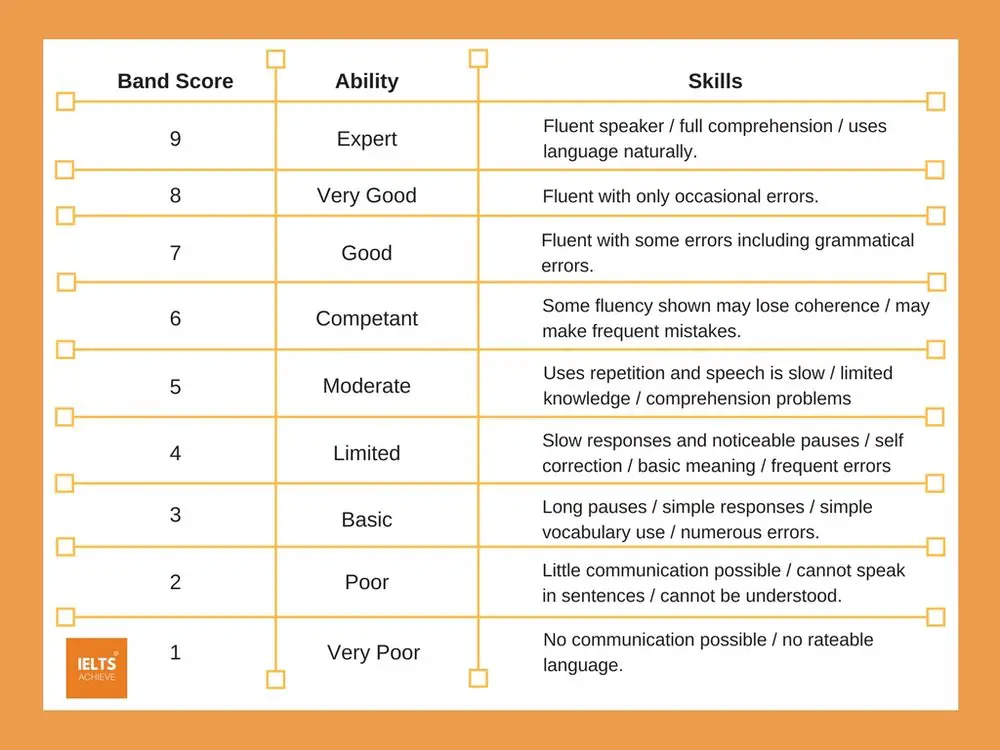
Looking at the table below, where would you say you are right now?
How can you start to improve?
Making a study plan and following it is a really great idea to get started. Read the sections below and get some ideas on how you can improve in all four areas of the IELTS Speaking Test marking criteria.
Fluency And Coherence
How can you improve Fluency and Coherence?
Practice with as many resources as you can for part 1, part 2 and part 3 questions. For parts 2 and 3 you should read the practice questions and see how well you understand them. Think of examples you can use in your answers and the structure of your answers. The part two answer should sound natural and be well structured, which can be challenging. In part 3 the answers should be extended and ideas should be linked.
Lexical Resource
How can you improve Lexical Resource?
For example, you could listen to podcasts and TED Talks, find a speaking partner to practice with and read some English news (online from the BBC News website or the Guardian) every night. You could also make vocabulary flashcards, listen to English music, listen to TED Talks and record yourself giving a summary of what you have heard. It is such a good idea to partner up with other IELTS students and practice speaking via Skype/Facetime etc. Take a look in the IELTS ACHIEVE Facebook group and meet someone you can start practising with.
Grammatical Range and Accuracy
How can you improve the Grammatical Range and Accuracy?
It is a good idea to record yourself speaking, answer some speaking mock questions, record yourself, then listen back to the recording and identify any errors you have made. You can check if your answer included the following:
Did you use the correct tense, did the verbs agree with the subjects?
Did you use complex sentences?
Did you use the passive voice and conditionals?
Did you use connecting words? Such as; before, after, because and although.
Alternatively, book lessons with a native speaking teacher and they will help you to improve.
Pronunciation
How can you improve Pronunciation?
One way to improve your pronunciation is to listen to native speakers, on the radio, tv or through TED Talks. Listen carefully to how the speakers pronounce words, how do they emphasise their points? Where do they place the word stress? Another way is to look up the pronunciation of words, practice saying them out loud and record yourself. You can then listen to the recording and see if you have made any errors. If you find it difficult to identify your own errors, then booking lessons with a native speaking English teacher who will correct you is the best way to improve.
Practice More
It’s fine to practice with past paper questions and other questions you may find online, but it is much better and beneficial for you to practice talking to people in real life. Say for example you have a friend who lives in the UK or the USA, make time to Skype with them and gossip! Or ask them to ask you some questions and give you feedback on how well you answered. Did they hear any errors? Could they understand you clearly? If you are already living in the UK (or another English speaking country) talk to friends, work colleagues etc about everyday subjects. Talk about the news ‘Did you see……. that story in the news? What did you think about it?…..’ Everyone has an opinion on popular news stories.
Just get talking about anything that interests you, so that you can practice.
Extend Your Answers
When you practice speaking to your partner, friends or work colleagues, practice extending your answers.
For example, if someone asks you:
What did you do at the weekend?
Answer 1 Nothing much, you?
Answer 2 I went to town on Saturday to have a look around, then had a coffee from my favourite coffee shop run by the hipsters next to Marks and Spencers. After that, I took my dog to the park where he played for a couple of hours with his friends. Finally, when it started to get dark, we went home and watched catch-up TV together on the sofa. On Sunday, I just relaxed, cleaned the house, then met some friends at the beach for a game of volleyball.
Answer 1 is not a good answer because it is short and doesn’t give away any information. Answer 2 is better because it answers the question, gives detail (extends) and includes components needed to score well on the marking criteria.
You need to show the examiner that you can answer the question, give more information (expand) and give an example. Even if that example is made up, that is ok as the examiner will not know (make it sound realistic though!).
What are you going to do to improve your speaking? Let us know in the comments below:
Expert tips and strategies for this part of the IELTS Speaking test. Includes sample responses and key vocabulary for Band 7+.
Originally published August 2017. Last reviewed 3 July 2026.
In the IELTS Speaking Test, you will be interviewed by an examiner for 11-14 minutes. The test has three parts and you are not allowed to use a dictionary. IELTS Academic and IELTS General students take the same test and it is marked in the same way.
Requirements from universities and immigration agencies vary. Most students will need at least a band score 6 for undergraduate study. For postgraduate study or immigration, a band score 7 is generally required.
One of the first things you should do is read the marking criteria to see what the examiners expect. This is really important, as you need to know what they are looking for in the band 7+ boxes.
You should be able to give the examiners exactly what they want, in order to get a 7+ band score.
In the IELTS Speaking Test, you will be assessed on the four main areas >>
Fluency and Coherence
Lexical resource
Grammatical Range and Accuracy
Pronunciation
What Is Your Level?
Look at the table below and according to the skill level where are you?
Think realistically about where your speaking level is at now and then plan how you can improve. Whether it is through self-study or having lessons with a native speaking English teacher, you must figure out a study plan that will allow you to improve.
Band Score 7 Marking Criteria >>
Fluency and Coherence
In this section, you must be able to:
‘Speaks at length without noticeable effort or loss of coherence. May demonstrate language related hesitation at times, or some self-repetition and/or self-correction. uses a range of connectives and discourse markers with some flexibility.’
This means that the student will be able to answer the question well, extending their answers, explaining and giving examples. Band score 7 students will be able to use discourse markers where it is appropriate.
Lexical Resource
In this section, you must be able to:
‘Uses vocabulary resource flexibly to discuss a variety of topics. Uses some less common and idiomatic vocabulary and shows some awareness of style and collocation, wit some inappropriate choices. Uses paraphrase effectively.’
This means that the student would be able to answer questions on a range of topics using a wide range of vocabulary. They would also be able to use idioms where appropriate, as well as collocations. Some minor errors are still permitted.
Grammatical Range and Accuracy
In this section, you must be able to:
‘Uses a range of complex structures with some flexibility. Frequently produces error-free sentences, though some grammatical mistakes persist.’
This means that the student will be able to use a variety of sentence structures and are able to form complex sentences. The majority of sentences would be error free, with some allowance for minor grammatical errors.
Pronunciation
In this section, you must be able to:
‘Shows all the positive features of Band 6 and some, but not all of the positive features of Band 8.’
The band 6 positive features include – ‘Uses a wide range of pronunciation features / Shows some effective use of features / Can generally be understood throughout.’
The band 8 positive features include – ‘Uses a wide range of pronunciation features / Sustains flexible use of features, with only occasional lapses. Is easy to understand throughout.’
This means that to score a band 7 the examiner must be able to understand the student clearly and that they talk in a natural sounding way. Make sure that you practice speaking in English about a range of topics, using word stress and intonation.
Band Score 8 Marking Criteria >>
Fluency and Coherence
In this section, you must be able to:
‘Speaks fluently with only occasional repetition or self-correction; hesitation is usually content related and only rarely to search for language. Develops topics coherently and appropriately.’
This meansthe student will be able to answer the question well, extending their answers, explaining and giving examples. Band score 8 students will be able to use discourse markers where it is appropriate. A band 8 student will be able to develop their answer to the question fully, giving a very well explained and detailed answer.
Lexical Resource
In this section, you must be able to:
‘Uses a wide vocabulary resource readily and flexibly to convey precise meaning. Uses less common and idiomatic vocabulary skilfully, with occasional inaccuracies. Uses paraphrase effectively as required.’
Band 8 students have a wealth of vocabulary and are able to use it well when speaking about almost any topic. They can use expressions and are able to use terms that are appropriate for the answer. The make hardly any errors when speaking.
Grammatical Range and Accuracy
In this section, you must be able to:
‘Uses a wide range of structures flexibly. Produces a majority of error-free sentences with only very occasional inappropriaces or basic/non-systematic errors.’
This means that the student will be able to use a variety of sentence structures and is able to form complex sentences. The majority of sentences will be error free, with some allowance for minor grammatical errors.
Pronunciation
In this section, you must be able to:
‘Uses a wide range of pronunciation features. Sustains flexible use of features, with only occasional lapses. Is easy to understand throughout; L1 accent has minimal effect on intelligibility.’
A band 8 student will be easy for the examiner to understand with minor errors. They will be able to talk with ease about all subjects, placing word stress where appropriate and using intonation naturally.
We hope you found this post useful in helping you to study for the IELTS Test. If you have any questions please let us know in the comments below or on the Facebook page.
The best way to keep up to date with posts like this is to like us on Facebook, then follow us on Instagram and Pinterest.
If you need help preparing for the IELTS Test, join the IELTS Achieve Academy and see how we can assist you to achieve your desired band score. We offer an essay correction service, mock exams and online courses.
Expert tips and strategies for this part of the IELTS Speaking test. Includes sample responses and key vocabulary for Band 7+.
Originally published August 2017. Last reviewed 3 July 2026.
In this post, we will look at the most common IELTS Speaking Topics.
It is hard to predict or plan for the type of topics that will come up in the speaking test. You should not try and rehearse memorised answers, as you never know what you might be asked.
According to research on past papers and from my past students, here is a list of common topics:
IELTS Speaking Part 1
In part 1 of the speaking test, you will be asked about familiar topics, such as your hobbies, family life and hometown. The list below shows the topics that may come up in the test.
Your country/Hometown
Family life
Friendship
Work
Education
Hobbies
Your Interests
Cinema/Movies
Reading/Books
Travel/Holidays
Shopping
Free time/Weekends
TV shows
Eating out/Restaurants
To practice with past question please take a look at Speaking Part 1 in more detail.
IELTS Speaking Part 2
In part two of the speaking test, you will get a cue card with a question that requires you to talk at length for 1-2 minutes. You are able to make notes for 1 minute to prepare. The list below shows the topics that may come up;
Health
Work
Education
Travel
The environment
A friend
A teacher
Something you own
Hobbies
Sports
Restaurants
Childhood
Technology
Party/Occasion
To practice with past question please take a look at Speaking Part 2 in more detail.
IELTS Speaking Part 3
In part 3 of the speaking test, you will go further into the topic relating to part 2. This will allow you to talk in-depth and offer your opinions and thoughts on the chosen subject. The list below shows the topics that may come up;
Travel
Education
Work
Health
Technology
The internet
Social Media
The environment
Healthy Eating/Lifestyle
Music
Crime/Justice
Sports
Hobbies
To practice with past questions please take a look at Speaking Part 3 in more detail.
Review And Strategy
It would be really hard to predict the topics that might come up on the speaking test, so you should continue to practice talking about everyday topics in English, as often as you can.
Remember that it is highly likely that the examiner will expect you to do the following if you wish to achieve a high band score:
To give your opinion
Talk about the past, present or future
Explain your views
Support your views with examples
Tell a story in your examples (logically)
Compare and contrast
I hope that you have found this post helpful if you have any questions please write them in the comments below.
Expert tips and strategies for this part of the IELTS Speaking test. Includes sample responses and key vocabulary for Band 7+.
Originally published July 2017. Last reviewed 3 July 2026.
In this post, we will be looking in-depth at English pronunciation.
While you are preparing for your IELTS Speaking Test it is important that you understand the marking criteria. Pronunciation counts for 25% of your speaking score, therefore it is vital that you understand what the examiner wants. Getting individual sounds correct is really important in order to gain a band score of 5 or higher. You will be able to achieve a higher score if you can demonstrate your ability to form individual sounds correctly; word stress, sentence stress, intonation (pitch), pausing and chunking, elision (dropping individual sounds), assimilation (changing individual sounds when you speak quickly) and linking (moving sounds from the end of one word to the beginning of the next).
In the IELTS Speaking Test, any form of pronunciation from British, American, Canadian, Australian etc is accepted.
Pronunciation
Pronunciation is the act or manner of speaking a word. Many words in English are not pronounced the way they are spelt, and some sounds can be represented by more than one combination of letters.
One of the most important aspects of the IELTS Speaking Test is pronunciation. Without clear pronunciation, it is difficult to make yourself understood. Native speakers emphasise the most important words in a sentence by pronouncing them slowly and loudly. Have you ever noticed this?
Word Stress
When you are speaking English the words you stress can change the underlying meaning of a sentence.
For example: look at the following sentence: I don’t think that is a good idea.
This simple sentence can have many levels of meaning based on the word you stress. Consider the meaning of the following sentences with the stressed word in bold. Read each sentence aloud and give a strong stress to the word in bold:
I don’t think that is a good idea. Meaning – other people might think it is a good idea.
I don’t think that is a good idea. Meaning – it’s not true that I think it is a good idea.
I don’t think that is a good idea. Meaning – I’m not sure if it is a good idea.
“There is a great deal of evidence that native speakers rely very much on the stress pattern of words when they are listening. In fact, experiments have demonstrated that often when a native speaker mishears a word, it is because the foreigner has put the stress in the wrong place, not because he or she mispronounced the sound of the word.”— Joanne Kenworthy, Teaching English Pronunciation. Longman, 1987
Punctuation
Use punctuation to help your pronunciation by adding a pause after each period, comma, semicolon or colon. By using punctuation to guide you when you pause, you will begin to speak in a more natural manner.
For example: I’m going to visit my friends in London. They have a beautiful house in Chelsea, so I’m staying with them for one week.
In this example, pause after ‘London’ and ‘Chelsea’. This will help anyone who’s listening to you follow you more easily. On the other hand, if you rush through the sentences, where the periods and commas (and other punctuation marks) would be, your pronunciation will sound unnatural and it will be difficult for listeners to follow your thoughts.
Intonation
Intonation is the act of raising and the lowering of the voice when speaking. In other words, intonation refers to the voice rising and falling. We use the pitch of our voice to change the meaning of what we are saying.
For example: Look at the questions below and then say them out loud, raising your voice on the last words, this allows the listener to know you are asking them a question:
Raising Your Voice at the End of a Question If the question is a yes / no question, the voice rises at the end of a question. Do you like living in Greece? Have you lived here for a long time? Did you visit any of the Ionian Islands last month?
Falling Voice at the End of a Question If the question is an information question – in other words, if you are asking a question with ‘where’, ‘when’, ‘what’, ‘which’, ‘why’, ‘what / which kind of..’, and questions with ‘how’ – let your voice fall at then end of a question.
Where are you going to stay on holiday this year?
When did you leave your town?
How long have you lived in the UK?
When using a question to clarify some information, let your voice rise to let the listener know that you expect more information.
Jane isn’t going to be at the restaurant, is she?
You understand your position here, don’t you?
We aren’t expected to finish the assignment by Tuesday, are we?
We also use a specific type of intonation when using commas in a list.
For example: John enjoys playing volleyball, swimming, kayaking, and quad biking. In this example, the voice rises after each item on the list. For the final item, let the voice fall. In other words, ‘volleyball’, ‘swimming’, and ‘kayaking’ all rise in intonation. The final activity, ‘quad biking’, falls in intonation.
Practice with a few more examples;
We bought some gluten-free pasta, bananas, orange juice and potatoes.
Maria wants to go to New York, Barcelona, Rome, and Athens.
Comprehensive guide covering essential IELTS preparation strategies and techniques to help you achieve your target band score.
Originally published July 2017. Last reviewed 3 July 2026.
In this post, we will be looking in-depth at the grammatical range and accuracy.
While you are preparing for your IELTS Speaking Test it is important that you understand the marking criteria. Grammatical range and accuracy count for 25% of your speaking score, therefore it is vital that you understand what the examiner wants.
You will be able to achieve a higher score if you can demonstrate your ability to use a variety of sentence structures, a variety of tenses and advanced verb forms including conditionals, modal verbs and the passive voice.
Complex Sentences
Complex sentences have more than one clause, they contain an independent clause (main clause) and at least one dependent clause.
Therefore, a complex sentence is made up of the main clause with one or more dependent clauses joined to it with an appropriate conjunction or pronoun.
The complex sentence is conventionally regarded as one of the four basic sentence structures in English. The other structures are the simple sentence, the compound sentence, and the compound-complex sentence.
Complex Sentences examples;
Although Lana had a busy day at work, she decided to go to the beach with her friends.
The woman who lives at the end of my street is good friends with my grandmother.
I wish that I could go on holiday this month with my friends to relax and have fun.
Complex sentences have more than one clause >>
Although Lana had a busy day at work, she decided to go to the beach with her friends.
The woman who lives at the end of my street is good friends with my grandmother.
I wish that I could go on holiday this month because I want to relax and have fun.
Sentences with multiple clauses use connecting words such as -> that, which, who, where, when, how, although, because, before, after, etc.
Can you answer these questions using complex sentences?
Where do you live?
I live in a house that is built on top of a larger house in a quiet area, which has great views of the city.
What is your favourite movie?
The movie that I can watch again and again is dirty dancing because it has a great love story with an amazing soundtrack.
Where do you like to go on holiday?
Although I like to travel to the city for some culture, I love to have a relaxing beach holiday, with hot weather and a laid back atmosphere.
What was the last book your read?
I read an interesting book that detailed the life stories of young women who worked in a factory in 1920’s called ‘The Radium Girls‘.
Simple And Complex Sentences
Native speakers use both simple and complex sentences when speaking. In the IELTS Speaking Test, it is important to use a variety of sentence structures.
A simple sentence is a sentence with only one independent clause (also known as a main clause). Also known as a clausal sentence.
For example;
My favourite book is Harry Potter.
I like to eat sorbet.
I buy gluten free pasta.
I enjoy swimming in the sea.
Look at the example below, can you see which sentences are complex and which ones are simple?
Question
Where is your favourite place to visit in your country?
I really enjoy walking my dog in a large park called Mon Repos because it is a great place to explore and some paths lead to a secluded beach. My dog enjoys it very much. We often take him there late afternoon, which is perfect for him as the temperature is a lot cooler and the other dog walkers are there, so he can play with his furry friends. Mon Repos is steeped in history, although it is open to the public now, it was where some of the Greek Royal family once lived.
The simple sentences are highlighted below >>
All of the other sentences are complex – > can you see the connecting words?
I really enjoy walking my dog in a large park called Mon Repos because it is a great place to explore and some paths lead to a secluded beach. My dog enjoys it very much. We often take him there late afternoon, which is perfect for him as the temperature is a lot cooler. When we visit the park the other dog walkers are often there, so he can play with his furry friends. Mon Repos is steeped in history. Although it is open to the public now, it was where some of the Greek Royal family once lived.
The example gives an answer to the question, but also provides extra information, which is a great way to be able to demonstrate vocabulary and grammar to the examiner.
We hope you found this post helpful in helping you to study for the IELTS Test. Let us know in the comments or on the Facebook page if you have any questions. The best way to keep up to date with posts like this is to like us on Facebook, and then follow us onInstagramand Pinterest. We offer essay correction services, mock exams, and online courses. If you need help preparing for the IELTS Test, join the IELTS Achieve Academy and see how we can help you achieve your desired band score faster.