Essential strategies and practice techniques for this IELTS Reading question type. Learn how to manage time and improve accuracy.
Originally published August 2017. Last reviewed 3 July 2026.
In this post, you will see one of the most common IELTS speaking topics (reading) and sample answers.
Please remember that in the actual test you should give honest answers and talk about your own experiences, thoughts, feelings and opinions. Do not try to memorise answers, as the examiners will probably be able to guess and you will lose marks.
However, you are able to make up information to extend your answers, but be sure that you are confident when speaking about the chosen topic and that it is believable.
TIP >> Each answer should be at least 2-3 sentences long.
TIP >> Listen carefully to the question so that you answer in the correct tense.
TIP >> When answering a yes/no question – answer then give your reasons for your answer. You must extend your answer to gain more marks.
TIP >> Just relax and think of it as a regular conversation you are having, make eye contact and be positive.
Take a look at the questions and sample answers below on the topic of ‘reading‘ >>
Q: Do you like to read books?
A: Yes, I love to read and try to read as often as I can. I have an e-reader and have more than 600 books in my library.
Q: What type of books do you like to read?
A: Mostly romance, I am a huge fan of old English classic literature, like Jane Austen or Charlotte Bronte. I also like to read modern romance, with Mills and Boon often slipping into my holiday reading list.
Q: Do you ever visit the library?
A: Not really, I used to when I was a student and as a teacher, but now it is so easy to buy books online and either have them delivered to your home or downloaded onto your e-reader. I am very forgetful, so always ended up with fines from the library for late returns!
Q: Do you prefer reading books or watching films?
A: I much prefer to read books, because I like to get lost in a story. It is a great way to fuel your imagination and to go somewhere else for a short period of time. You focus on the characters and the details given to you. Watching a movie does not often hold my attention in the same way.
We hope you found this post useful in helping you to study for the IELTS Test. If you have any questions please let us know in the comments below or on the Facebook page.
The best way to keep up to date with posts like this is to like us on Facebook, then follow us on Instagram and Pinterest.
If you need help preparing for the IELTS Test, join the IELTS Achieve Academy and see how we can assist you to achieve your desired band score. We offer an essay correction service, mock exams and online courses.
Expert tips and strategies for this part of the IELTS Speaking test. Includes sample responses and key vocabulary for Band 7+.
Originally published August 2017. Last reviewed 3 July 2026.
In this post, you will see one of the most common IELTS speaking topics (hometown) and sample answers.
Please remember that in the actual test you should give honest answers and talk about your own experiences, thoughts, feelings and opinions. Do not try to memorise answers, as the examiners will probably be able to guess and you will lose marks.
However, you are able to make up information to extend your answers, but be sure that you are confident when speaking about the chosen topic and that it is believable.
TIP >> Each answer should be at least 2-3 sentences long.
TIP >> Listen carefully to the question so that you answer in the correct tense.
TIP >> When answering a yes/no question – answer then give your reasons for your answer. You must extend your answer to gain more marks.
TIP >> Just relax and think of it as a regular conversation you are having, make eye contact and be positive.
Take a look at the questions and sample answers below on the topic of ‘hometown‘ >>
Q: Describe your hometown.
A: It is a big city in the North of England, with galleries, theatres and nightlife. It is a popular place for students, as there are two universities. Shopping and eating out are part of the lifestyle, with many places to go. In the surrounding areas, there are many historical places to visit.
Q: Is that a big city or a small place?
A: It is a big city, with a twenty-four-hour culture. It has a reputation as a party place, with many people travelling to visit the restaurants, bars and nightclubs in the city.
Q: What do you like (most) about your hometown?
A: I like that the city is close to historical sites in Northumberland. You can easily travel by car to places that the Vikings invaded and explore quaint seaside villages on the north coast.
Q: Is there anything you dislike about it?
A: I don’t like the drinking culture and the violence that follows. On a night out in the city, there is often a heavy police presence, as many people make trouble. People frequently drink alcohol from early in the morning until late at night, which in my opinion is not a good way to spend time or money.
Q: Do you think you will continue living there for a long time?
A: I don’t currently live there, I moved away for work and now live in Greece. I do however visit quite often to see friends and family. I have no plans to move back there anytime soon.
Q: Can you tell me something exciting about your town?
A: There have been quite a few celebrities from there, who have become well known in the media, including TV presenters Ant and Dec, Cheryl Cole, Sting and actor Charlie Hunnam.
Q: Has your hometown changed much since you were a child?
A: Yes it has evolved from a relatively quiet city to a hub of shopping and entertainment. There have been major developments, with shopping mall renovations and the addition of shop lined streets leading all around the city. There are also more restaurants and bars catering for all tastes.
Q: Are there any changes you would like to make in your hometown?
A: Perhaps the introduction of strict opening times for pubs, selling alcohol from a later time in the day. Also, the coffee shops could stay open much later, to promote a healthier culture of socialisation.
We hope you found this post useful in helping you to study for the IELTS Test. If you have any questions please let us know in the comments below or on the Facebook page.
The best way to keep up to date with posts like this is to like us on Facebook, then follow us on Instagram and Pinterest.
If you need help preparing for the IELTS Test, join the IELTS Achieve Academy and see how we can assist you to achieve your desired band score. We offer an essay correction service, mock exams and online courses.
Expert tips and strategies for this part of the IELTS Speaking test. Includes sample responses and key vocabulary for Band 7+.
Originally published August 2017. Last reviewed 3 July 2026.
In this post, you will see one of the most common IELTS speaking topics (your home) and sample answers.
Please remember that in the actual test you should give honest answers and talk about your own experiences, thoughts, feelings and opinions. Do not try to memorise answers, as the examiners will probably be able to guess and you will lose marks.
However, you are able to make up information to extend your answers, but be sure that you are confident when speaking about the chosen topic and that it is believable.
TIP >> Each answer should be at least 2-3 sentences long.
TIP >> Listen carefully to the question so that you answer in the correct tense.
TIP >> When answering a yes/no question – answer then give your reasons for your answer. You must extend your answer to gain more marks.
TIP >> Just relax and think of it as a regular conversation you are having, make eye contact and be positive.
Take a look at the questions and sample answers below on the topic of ‘your home‘ >>
Your home questions and answers
Q: Do you live in a house or a flat?
A: I currently live in a house with three bedrooms, a bathroom and an open living space, with a dining area and kitchen. It also has a large yard at the front of the house and a large veranda at the back of the house, which has great views.
Q: Do you like your house?
A: Very much! The house itself is very spacious for us and is in a good spot. I have my own office space and plenty of room still for all the family. Built on top of another house it has a high position, with great views of the town and even a sea view.
Q: Why do you like it?
A: Not only because it is very spacious, but because of its location. It is situated in a village on the outskirts of town, with a bus stop just metres away, which is convenient because I don’t always have the car. There is also a small supermarket less than 5 minutes walk from the house.
Q: How do you expect your future house to be and why?
A: In the future, we plan on building our own property to our uniquely designed specifications. With at least 3 bedrooms and 2 bathrooms, it would also have a large open plan living room/dining area, with a built in kitchen area. The outside would have a garden, patio, and car port.
Q: Do you like visitors coming to your home?
A: Definitely! I love it when people come to stay with us. We like to show them around the island and to visit the best spots for swimming. We also know where to take them for the best coffee in town and of course where the best places to eat are.
Q: Do you prefer to have friends visit you, or relatives?
A: I prefer to have family members staying with us, as we don’t get to see any of them very often. We try to visit them as often as we can, and they come to us for holidays normally in the summer months, so they can enjoy the weather.
Q: Do you often invite friends to visit your home?
A: yes, I have friends over most weekends. They come over for food and drinks on Saturday nights or Sunday afternoons. We often have Greek style barbeques, with plenty of food and more people than we can fit into our yard.
We hope you found this post useful in helping you to study for the IELTS Test. If you have any questions please let us know in the comments below or on the Facebook page.
The best way to keep up to date with posts like this is to like us on Facebook, then follow us on Instagram and Pinterest.
If you need help preparing for the IELTS Test, join the IELTS Achieve Academy and see how we can assist you to achieve your desired band score. We offer an essay correction service, mock exams and online courses.
Expert tips and strategies for this part of the IELTS Speaking test. Includes sample responses and key vocabulary for Band 7+.
Originally published August 2017. Last reviewed 3 July 2026.
In this post, see the top 10 speaking part 1 tips that will help you to achieve a band score 7 or above.
The IELTS Speaking Test lasts 11-14 minutes.
The test has three parts, where you are interviewed by a trained examiner. You are not allowed to use a dictionary during the test. IELTS Academic and IELTS General students take the same test and it is marked in the same way.
PART 1 INFORMATION
To begin with, the examiner will introduce themselves to you, then ask you your name and for proof of identity.
Time:4-5 minutes You will be asked questions on familiar topics, like your hobbies, family, where you are from, what your hometown/city is like, etc.
The topics that are included:
Your studies/education
Hobbies/sports
Your family
What kind of movies, books, tv shows or music you like
What you like to eat / where you like to eat
Your job
Where you live
To view sample questions and answers on a variety of part 1 speaking topics, take a look at the other posts in this section.
Take a read through our top ten tips below, that will help you to gain a band score of 7 or above!
Speaking Tips
Tip 1: Be Prepared
As well as being prepared for the test questions on the day of your exam, you should also be aware of what to expect in terms of getting to the test centre and the beginning of the test. Arrive in plenty of time, so that you are not under pressure/late and have time to relax before the test.
The examiner will introduce themselves and ask you for your name and proof of identity (Passport etc), to begin with. They will also ask you where you are from, which requires a simple answer – this is more of a formality, so you don’t have to extend your answer here, but simply state, for example; “I am from Romania’ (or name the town/city etc you are from and where).
Take a look at this post for help with how to prepare for the speaking part 1 test..
Tip 2: Make A Good First Impression
Try to be relaxed and confident, having confidence will help you to do well in your test. Make eye contact with the examiner and answer any questions in a polite manner. Try to keep your body language friendly and open. Think of it as a natural conversation and try to stay calm, like you are talking to your IELTS teacher or practice partner.
Tip 3: Listen Carefully
Listen carefully to the examiner, so that you understand the questions and can answer in an appropriate way. You should also be listening for tenses – for example; “What TV Shows did you use to like as a child?’ then you know that you should answer in the past tense – ‘I used to watch…..’
You should also listen out for any yes/no questions and remember to answer and give reasons. Take a look at this post for help with how to answer those yes/no questions.
Tip 4: Show Enthusiasm
Show that you are interested in the questions by answering with enthusiasm, even if you are not really interested in the subject. Native speakers show enthusiasm by varying the pitch of their voice (intonation – the voice falls and rises) to show how they feel about something.
Listen to examples and think about how native speakers talk when answering questions, what happens to their voice? It gets higher when they are interested or excited by a subject and it falls when they are not happy or disinterested.
Watch the video clip below from the US TV show ‘Friends’ and see how the intonation falls and rises when the actors talk – can you notice the difference? How does it impact on what they are saying?
Tip 5: Extend Your Answers
When giving your answers, try to make sure that they are not too short – for example, if the examiner asks you what is your favourite TV show, saying ‘I really like Peaky Blinders’ is too short.
You can expand your answer by adding more detail of what it is about, and why you like it so much for example; ‘I really like the BBC drama Peaky Blinders, it has an excellent cast and the writing keeps me interested in the story. There is lots of action, as the story is centred on a gangster family in 1920’s Birmingham, who are up to no good!’.
The answers in part 1 should not be too long either, talking for 2 minutes or more is far too long, parts 2 and 3 will allow you to speak for a longer time and go into more detail.
You should aim to use more than one clause when you give your answers, for example;
Q: Do you work or study?
A: I work at the moment but I continue my studies at the same time. I continue to learn through courses and gain new qualifications every year, this means my knowledge is always up to date.
Take a look at this post for more information on how to extend your answers.
Tip 6: Be Confident
Show your confidence by speaking clearly and at a normal level. Don’t speak too loudly or quietly, make sure the examiner can understand and hear your answers. Have faith in yourself, to answer whatever questions you get to the best of your ability.
When answering the questions, try to be as honest as possible, telling the examiner your thoughts, feeling and opinions, for example:
Q: Do you think vacations are becoming more and more important?
A: Yes, I think that many people are working longer hours and have more stress than ever placed upon them. taking a break is necessary to unwind and recharge so that they can let go of the stress and focus on their own well-being.
Tip 8: Study/Look at past questions and sample answers
Look at past questions and sample answers to get an idea of how you can extend your answers and the type of questions that come up. There are some speaking topics that are popular, regularly being used over and over, which include;
Your studies/education
Hobbies/sports
Your family
What kind of movies, books, tv shows or music you like
What you like to eat / where you like to eat
Your job
Where you live
You may also be asked questions about any topic, recently there have been questions about flowers and photography. Going back to tip 7 – be honest, answer any questions you get with honesty, telling the examiner your own opinions, thoughts and views. Do not memorise answers to recite to the examiner, they will be able to tell and ask you something else.
Tip 9: Read The Criteria
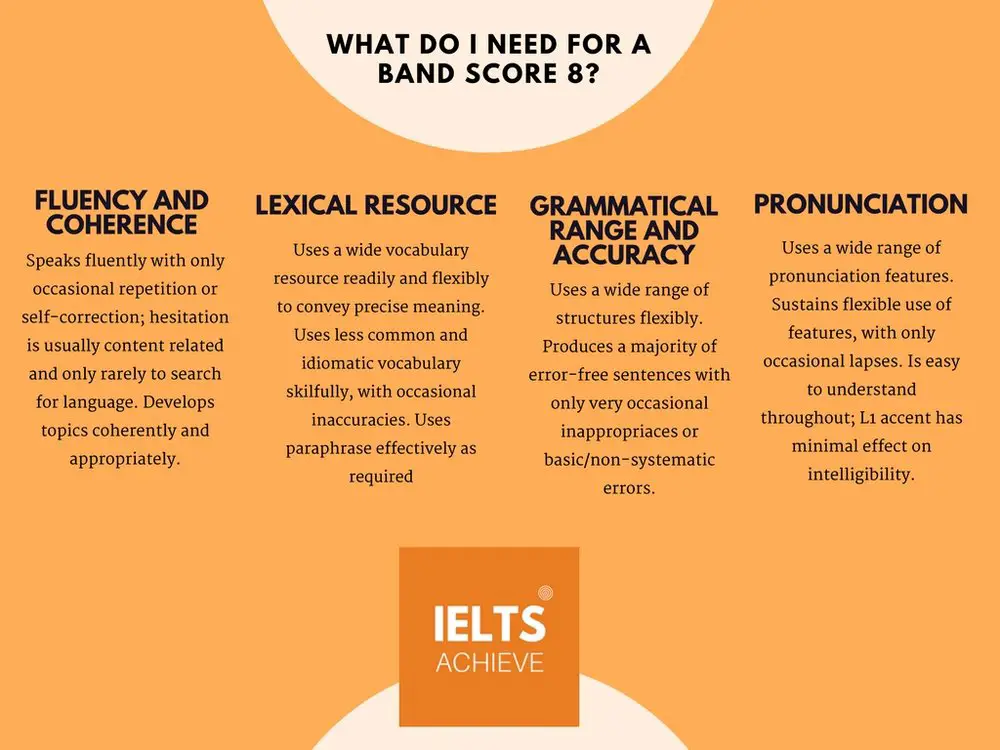
You should read through the marking criteria and be aware of what is required for a band score 7 or above. Many students do not do this and have no idea what they need to achieve in order to get the band score they want. Read it, understand it and aim to achieve it. Ask your IELTS teacher for help to understand it and to see the level you are at now.
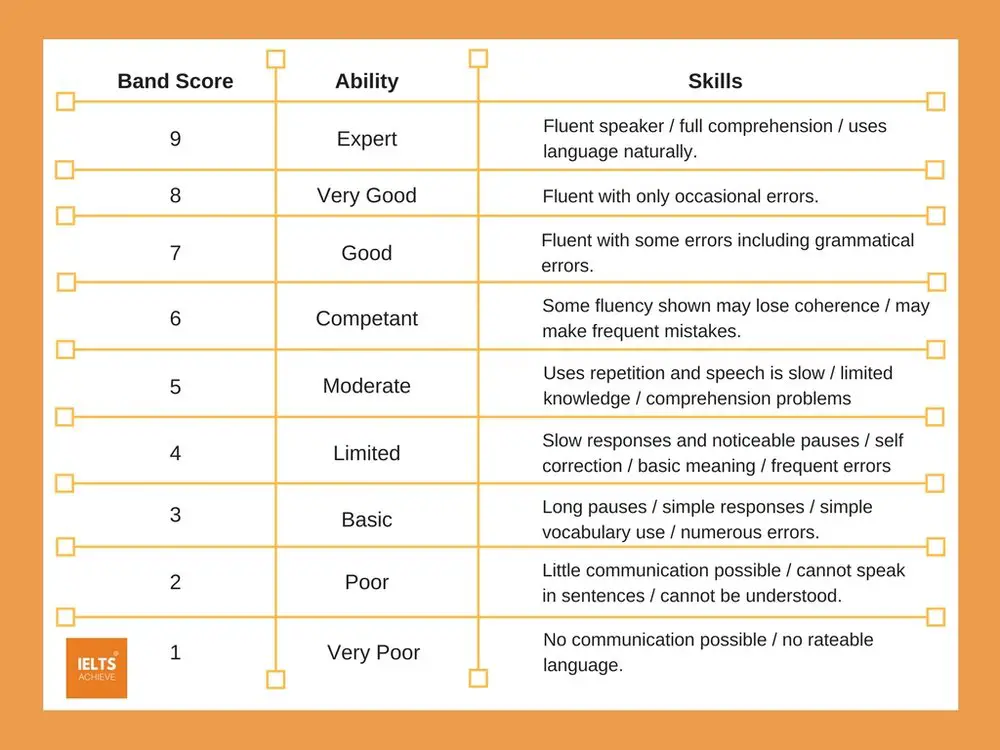
You should also read the scoring information to see how the band scores are given:
Tip 10: Practice
Practice as much as possible with your native speaking IELTS teacher, a partner or friend. Take a look at the most common topics (see the other posts in this section) and practice answering those questions. A good way to listen for errors is to record yourself speaking. Listen to your recording and notice any errors you have made, including grammar mistakes, pronunciation, intonation and fluency. Keep practising and use the posts in this section to help you.
Expert tips and strategies for this part of the IELTS Speaking test. Includes sample responses and key vocabulary for Band 7+.
Originally published August 2017. Last reviewed 3 July 2026.
In this post, we will be looking in-depth at part 1 of the speaking test.
The IELTS Speaking Test lasts 11-14 minutes.
The test has three parts, where you are interviewed by a trained examiner. You are not allowed to use a dictionary during the test. IELTS Academic and IELTS General students take the same test and it is marked in the same way.
PART 1 Information
To begin with, the examiner will introduce themselves to you, then ask you your name and for proof of identity.
4-5 minutes >> You will be asked questions on familiar topics, like your hobbies, family, where you are from, what your hometown/city is like, etc.
The topics might include;
Your studies/education
Hobbies/sports
Your family
What kind of movies, books, tv shows or music you like
What you like to eat / where you like to eat
Your job
Where you live
Part 1 Questions
The questions in part 1 will possibly be about your work or studies, hobbies, your family, where you live, hometown or where you live now. Your answers should include facts and your own opinions or feelings.
Possible questions >>
Do you live in a house or an apartment?
What do you do at the weekends?
Do you have any hobbies?
How often do you like to travel?
Where is a good place to visit in your hometown or city?
Do you go to the cinema often?
Example Q+A
Take a look at the questions below and the two possible answers, which one is better?
Question: Do you like to travel?
Answer 1: yes, I do.
Answer 2: Yes, I have been to many places in Europe, including Italy, Spain, Greece and the UK. In the future I would love to be able to visit and explore the USA, going to New York and perhaps driving through other states.
Which answer looks better to you?
Feedback: Answer 2!Why? The first answer does not fully answer the question and show off the students ability to speak English. In part one, your answer should be at least 2-3 sentences. The second answer is much better, giving background information (I have been to many places in Europe, including Italy, Spain, Greece and the UK.) and adding details (I would love to be able to visit and explore the USA).
Answering The Question
Make sure you answer the question fully, with correct tenses where appropriate.
Question: Do you enjoy going to the cinema?
Answer 1 – Kate: Yes, I do love going to the cinema and I always think it is good to go and see new movies, especially in the IMAX. On the other hand, I also like to watch movies in my house, as it is more comfortable.
Answer 2- Georgina: I went to the cinema last weekend. I was invited to go with a friend. She wanted to see the latest thriller.
Feedback: Georgina did not answer the question, she didn’t make it clear whether she enjoyed going to the cinema, she used the past tense and the question was in the present tense. her answer was also short in length. Kate has a high-level answer, she answered the question using varied vocabulary, not just repeating the words the examiner had used. She also connected her ideas by using ‘on the other hand’ and used the present tense.
Yes/No Questions
When you hear a yes/no question, try to start your answer with one of the following phrases >>
I don’t think so
not really
absolutely!
definitely!
I think so
not very often
most of the time
sometimes
yes, in general
For example for the following questions….the answers can be started with one of the phrases from above and expanded upon, you can add more detail or give an example. This is so you don’t answer the question with a simple yes or no, which would not get you many marks.
Question: Do you use your phone or tablet every day?
Answer: Absolutely! I always check my phone for emails and texts, then of course to see social media.
Question: Is travelling important to you?
Answer: Definitely! It is something that I aim to do as often as I can, for example, next year I plan to visit Barcelona.
Question: Is reading important to you?
Answer: Not really, I don’t have much time to read, I prefer to listen to music or watch netflix.
Preference Questions
Some part 1 questions may ask you about your preferences.
Can you see which is the better answer?
Question: Do you prefer travelling alone or in a group?
Answer 1 – Claire: I prefer to travel alone, I don’t really like to be in a group.
Answer 2 – Susan: I haven’t ever travelled on my own, I have always been with friends. It is so much fun to travel in a group, as you can share experiences and have a laugh with your friends. I think travelling alone in some parts of the world could be dangerous.
Feedback: Claire’s answer is short and repeats too many words from the question. Susan’s answer is better because she gives more detail and uses different words to the question, she also gives reasons for her preferences.
You can use the following phrases in your answers for a high-level answer >>
I like…… more than…..
It depends on………
I like both………..and………….
My first choice would be …………..
I’d rather…………..than………………..
For example, ‘I like both travelling on my own and with friends, because……’ or ‘I like travelling with friends more than on my own, because……’.
Using Would and Could
Some questions may ask you a hypothetical question, which invites you to use the words ‘would’ or ‘could’.
Question: Where would you recommend a foreigner to visit in your country?
Answer 1 – Marco: I will tell them to visit the Vatican and to see the sights.
Answer 2 – Ricardo: I would highly recommend that they visit the galleries and museums when in Rome, especially in the Vatican. A great historical site to see is the Colosseum, a stunning example of architecture. I could also recommend visiting the Trevi Fountain and sampling some delicious ice cream!
Feedback: Marco’s answer is short and does not use enough vocabulary. Ricardo expands on his answer, listing places to visit and uses the words ‘would’ and ‘could’ in his answer.
We hope you found this post useful in helping you to study for the IELTS Test. If you have any questions please let us know in the comments below or on the Facebook page.
The best way to keep up to date with posts like this is to like us on Facebook, then follow us on Instagram and Pinterest.
If you need help preparing for the IELTS Test, join the IELTS Achieve Academy and see how we can assist you to achieve your desired band score. We offer an essay correction service, mock exams and online courses.