IELTS Speaking Part 2 Tips
⚡ TL;DR
Expert tips and strategies for this part of the IELTS Speaking test. Includes sample responses and key vocabulary for Band 7+.
Originally published August 2017. Last reviewed 3 July 2026.
In this post, see the top 6 speaking part 2 tips that will help you to achieve a band score 7 or above.
The IELTS Speaking Test Part 2 lasts 3-4 minutes.
After part 1 the examiner will give you a card or booklet with your question and related ideas you need to talk about.
1 minute >> You will be given 1 minute to make notes.
1-2 minutes >> You will talk about for 1-2 minutes about the topic on the cue card/booklet.
1-2 minutes >> After you have finished speaking, the examiner will ask you one or two questions relating to what you have just talked about.
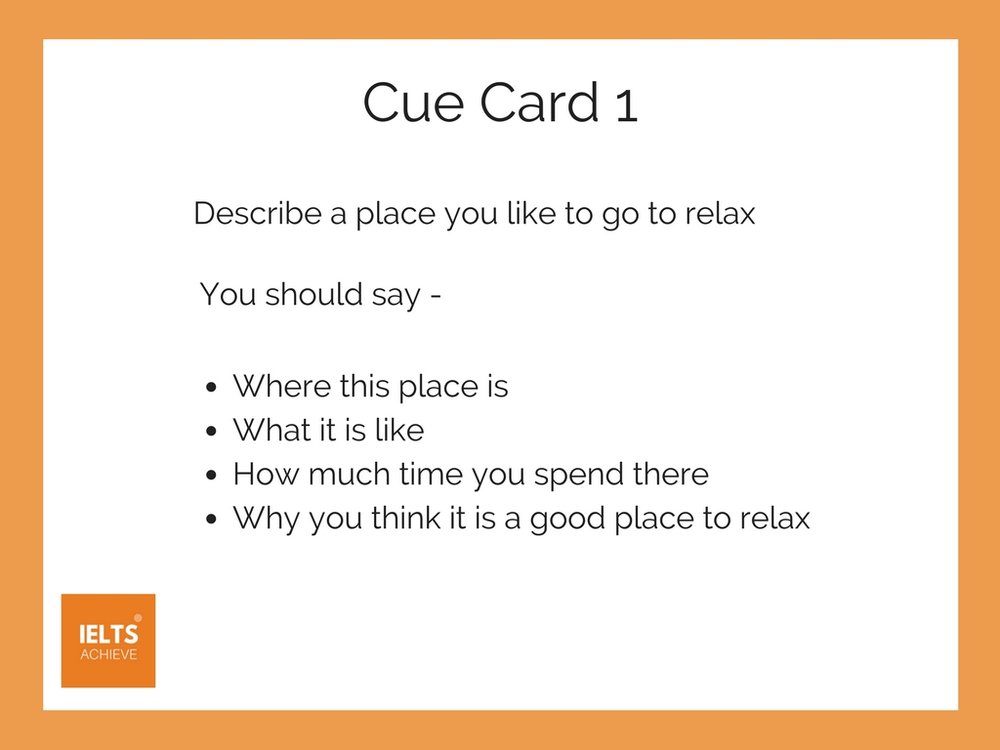
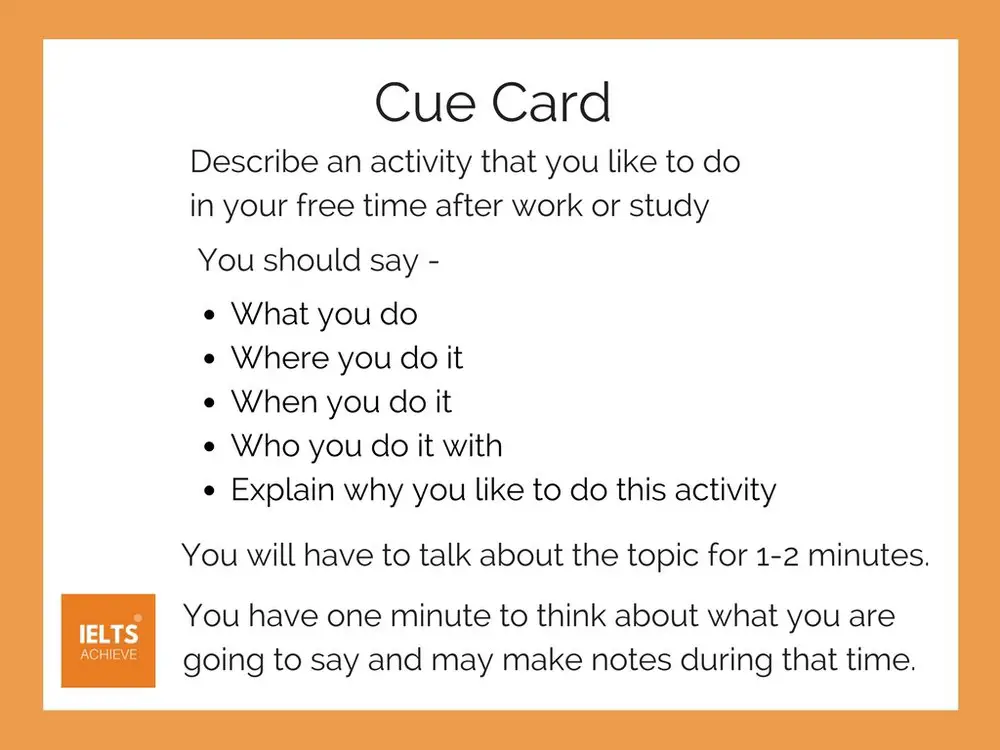
The cue card the examiner gives to you will look something like this >>
Some students admit to finding this part of the test difficult as they have to give a monologue for 1-2 minutes. They sometimes run out of ideas or start repeating themselves. Practising and developing a strategy can help to make sure that you have success in this area.
Read on for our top 6 tips for getting a high-level band score >>
SPEAKING Test Part 2 TIPS
TIP 1 >> Think of Ideas
When the examiner gives you the cue card during your speaking test, read the topic and the bullet points and think of ideas. It is better to think of a couple of relevant ideas, rather than too many ideas.
The bullet points on the cue card are there to help you to think of ideas so that you can develop an answer. However, you do not have to use those bullet points as a guide and can talk about anything you want in relation to the topic.
The cue card will give you the main topic, then list several bullet points below, stating ‘you should say‘ this means that it is optional. It is up to you, whether you wish to use those bullet points as a guide to help you, and add further information, or not. If there are any bullet points you do not wish to talk about, you may leave them out and talk about something else. As long as all of your ideas are related to the main topic and relevant, then you will still be able to gain a high-level band score.
TIP 2 >> Develop A Strategy
When planning your part 2 monologue, developing a strategy can help you to deliver a high-level answer.
Take a look at the post on how to develop a speaking test part 2 strategy.
TIP 3 >> Make Useful Notes
Making useful notes in the time allowed (1 minute) will help you to organise your thoughts and plan your answer.
Take a look at the post on how to organise your notes.
TIP 4 >> Be Honest
When answering the question, try to be as honest as possible, telling the examiner your thoughts, feeling and opinions. Use examples from your past experiences and be sure to give your opinion. You are allowed to make up information for your monologue, but make sure that you are really confident about what you are saying, as this may lead you into difficulties.
Being honest about your thoughts, feelings, opinions and own experiences is the best way to expand on the topic and give plenty of information to the examiner.
TIP 5 >> Extend Your Answers
When giving your answer, try to make sure that it is not too short – think of ideas that will allow you to talk about the topic confidently for 1-2 minutes.
You can expand your answer by adding more detail and giving examples. Whatever topic you get, you will be able to think of something relevant and share your own thoughts, feelings, opinions and experiences. You can also give relevant examples that can support your points.
Think about the who, what, when, where and how, then think of the details, where you went, who you went with, how you got there, etc.
The answers in part 2 should not be too long either if the examiner feels as though you have gone over your time, they will stop you and ask an extension question.
TIP 6 >> Practice
Practice as much as possible with your native speaking IELTS teacher, a partner or friend. Take a look at past cue cards (see the other posts in this section) and practice answering those questions, making use of the 1-minute note taking time. Whatever you do, don’t memorise any answers, the examiner will see through this and they can give you a low score.
Time yourself and see how much you can say in 1-2 minutes, you may need to develop your answer further or learn to be more concise.
A good way to listen for errors is to record yourself speaking. Listen to your recording and notice any errors you have made, including grammar mistakes, pronunciation, intonation and fluency. Keep practising and use the posts in this section to help you.
I hope that all of these tips have been useful to you in your IELTS practice and preparation, please let me know your thoughts in the comments below >>
We hope you found this post useful in helping you to study for the IELTS Test. If you have any questions please let us know in the comments below or on the Facebook page.
The best way to keep up to date with posts like this is to like us on Facebook, then follow us on Instagram and Pinterest.
If you need help preparing for the IELTS Test, join the IELTS Achieve Academy and see how we can assist you to achieve your desired band score. We offer an essay correction service, mock exams and online courses.