A complete model answer and preparation guide for this IELTS Speaking cue card topic. Includes key vocabulary, follow-up questions, and examiner-approved response strategies.
Originally published September 2017. Last reviewed 3 July 2026.
In this post, you will see a sample cue card question, high-level answer and feedback.
MODEL ANSWER
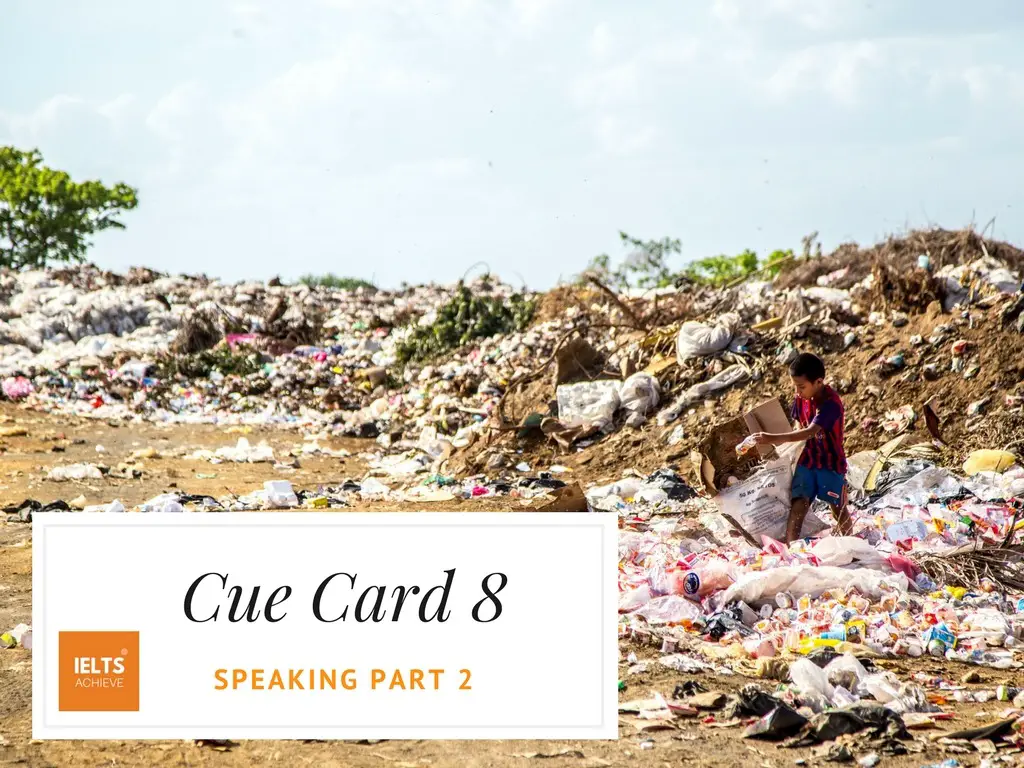
I’d like to talk about the litter problem that we have where I live. When you walk around your village, go into the town, visit monuments or any places really, there is always litter lying on the ground. Even though there are many rubbish bins in places that you pass, people still leave litter on the streets or anywhere they want. This is a huge problem for the environment, as animals can hurt themselves and obviously it looks terrible.
The main reason that this is such an issue, is that there are hundreds, maybe thousands of tourists that come here every year, leaving litter. The bins provided in many areas are quite small, often overflowing so much that there is a huge pile of growing litter right next to the bin. They are not emptied often enough in busy areas, causing a problem. this leads to stray animals inspecting the contents of the trash and makes the area look bad. The litter left behind in some areas, like next to ancient ruins or monuments is just carelessness from tourists. I have seen broken glass, bottles, papers and coffee cups all next to a very well known monument here on the island. I have collected litter to put into the bin, especially if it is broken glass and my dog is with me.
The people on the island are always complaining about the litter problem here, with demonstrations in town. The litter is not collected, sometimes for over a week and rubbish bins start to overflow. Sometimes the garbage collectors go on strike, leaving mountains of rubbish growing every day. This is a real issue, especially with so many tourists visiting the island each year.
To solve this problem, the authorities should provide more bins in built up areas and empty the trash daily. They could also put more signs up saying not to litter and perhaps introduce strict fines for those who do, for example, in the UK there are hefty fines for littering. They need to make people aware that it is not allowed and wrong to leave litter anywhere, making the place look untidy and harming the environment. If the local authorities can make some changes in the short term, then the whole of the island environment and famous well known areas will benefit in the long term.
FEEDBACK
This is a high-level answer, as there are concrete words being used to describe the problem. Words and phrases are used to describe thoughts and feelings about this problem. The bullet points have been covered with the extra information given (examples), which extends the answer. A solution is offered to combat this problem, with good use of vocabulary and collocations.
We hope you found this post useful in helping you to study for the IELTS Test. If you have any questions please let us know in the comments below or on the Facebook page.
The best way to keep up to date with posts like this is to like us on Facebook, then follow us on Instagram and Pinterest.
If you need help preparing for the IELTS Test, join the IELTS Achieve Academy and see how we can assist you to achieve your desired band score. We offer an essay correction service, mock exams and online courses.
Expert tips and strategies for this part of the IELTS Speaking test. Includes sample responses and key vocabulary for Band 7+.
Originally published September 2017. Last reviewed 3 July 2026.
In this post, you will see one of the most common IELTS speaking topics for part 3 (Music) and sample answers.
Please remember that in the actual test you should give honest answers and talk about your own experiences, thoughts, feelings and opinions. Do not try to memorise answers, as the examiners will probably be able to guess and you will lose marks.
However, you are able to make up information to extend your answers, but be sure that you are confident when speaking about the chosen topic and that it is believable.
TIP >> Listen to the questions the examiner asks you and think about the structure of the question. Are they asking your for your opinion? or to say how something has changed from the past to the present?
TIP >> Learn about the most commonly asked question types used in the part 3 questions. This will help you to identify how you should respond and what to look out for when you are practising.
TIP >> It is common for many people to say ‘I don’t know’ or to lose focus when they get a question they know little about. Always answer the questions and if you feel as though you don’t know about the topic, then buy yourself some time by saying; ‘I haven’t really thought about that before…. but in my opinion……’ then give your opinion, etc.
TIP >> Don’t try to answer the questions as quickly as possible, take your time and answer them to the best of your ability. Give your opinion, the reasoning behind it and support with specific examples.
Take a look at the questions and sample answers below on the topic of ‘Music‘ >>
Q: What kind of music is popular in your country?
A: In my country, there are many different types of music that people like to listen to. Pop music is always fashionable and so is folk music. People have many different tastes and there are always concerts for classical, rock, pop and folk. Traditional music is still much loved for weddings and baptism celebrations, as well as village festivals in the summer months.
Q: What do old people like to listen to?
A: They like to hear music from when they were younger, traditional music and sometimes classical. I don’t think they like to listen to pop songs or anything heavy, maybe they listen to the radio but something that is more relaxing. For instance, my grandma like to listen to a radio station that has a mixed programme of stories, interviews, plays and classical music.
Q: Do you play any musical instruments?
A: Yes, I play the piano and I started to learn when I was about 6 years old. I had lessons every Saturday in my house from a great teacher called Mr Haris. I loved learning and developing my skills. I like to play classical music and at Christmas love paying traditional Christmas carols. I think that it is important for children to learn how to play an instrument if they like it of course. It can help them to develop creative skills and give them much enjoyment.
Q: What might be the best age to start learning to play a musical instrument?
A: In my view starting to learn when you are young is the best option. Children’s minds are so impressionable when they are young, they retain information and soak it up like a sponge. They can develop their musical skills and see if they have a talent for it. if you start learning later in life, it will probably be more difficult to find the time, to have lessons and to practice.
We hope you found this post useful in helping you to study for the IELTS Test. If you have any questions please let us know in the comments below or on the Facebook page.
The best way to keep up to date with posts like this is to like us on Facebook, then follow us on Instagram and Pinterest.
If you need help preparing for the IELTS Test, join the IELTS Achieve Academy and see how we can assist you to achieve your desired band score. We offer an essay correction service, mock exams and online courses.