Proven strategies for this IELTS Listening question type. Includes prediction techniques and common traps to avoid.
Originally published June 2017. Last reviewed 3 July 2026.
In this post, we will look at how to write a formal letter.
A formal letter is written when you need to write to a company or organisation where you do not know the person to whom you are addressing. Sometimes these letters are addressed to a person of importance, who you do not know, in which case the person’s name and the title are used – ‘Dear Prime Minister May….’
A formal greeting > Dear Sir or Madam, Dear Sirs, Dear HR Manager
When signing off the letter, ‘Yours truly’, ‘Sincerely yours’ and ‘Yours faithfully’ would be used for semi-formal or formal letters.
Here is an example of a formal letter structure >>
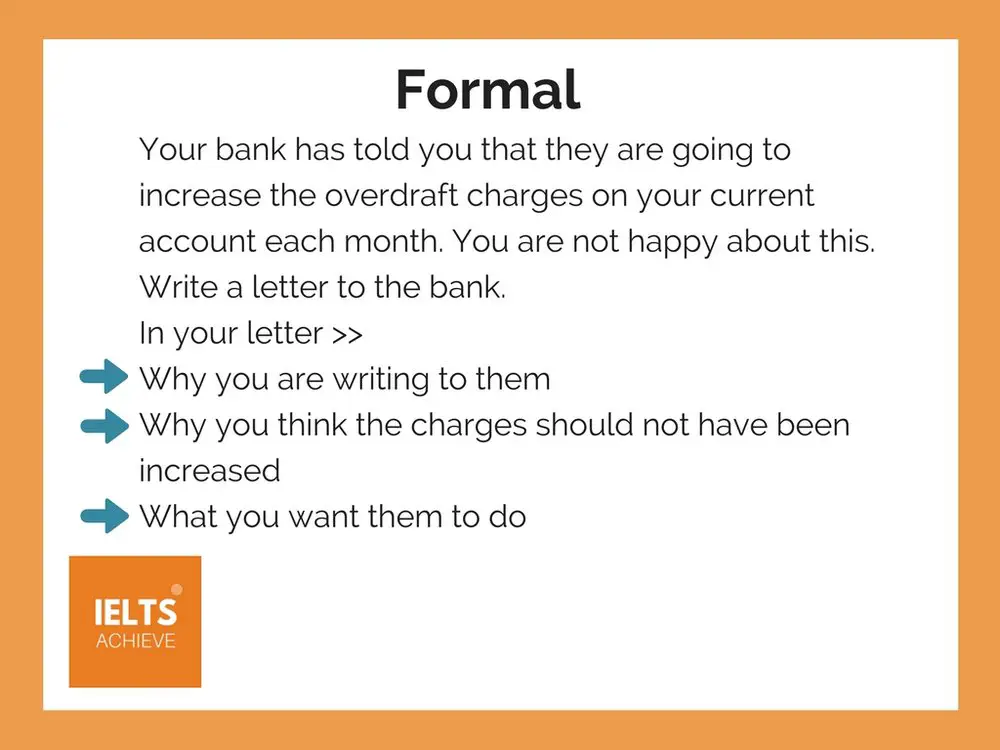
FORMAL QUESTION EXAMPLE >>
Write at least 150 words
You do not need to write any addresses
Begin your letter with ‘Dear…..”
TIP >> A formal letter would be written to someone that you don’t know. That is why when you start writing when you don’t know their name, you would write ‘Dear Sir/Madam….’
Model Answer >>
Dear Sir/Madam,
I am writing to you because I recently received a letter from you detailing the new overdraft charges that are going to be put into place next month.
As you will be aware I have a large overdraft currently exceeding £10,000 and the new charges will make it near impossible to pay off. I have had an account with your bank for over ten years and have never seen an increase in charges, such as those presented now.
I am aware that increased charges on large sums of money that have been borrowed are important in levying profits for your business. The increase that has been proposed of paying 5% on top of the regular amount of £350 in charges each month will become a large and difficult amount to repay.
I would, therefore, like you to write to me and explain why such a large increase has been planned. If you are unable to offer a response that is justifiable to both the bank and me, then I will have no choice but to complain to the Financial Ombudsman Service.
I await your response.
Yours faithfully,
Mr John Bell.
(Word Count – 192 / Band Score 9)
This letter covers the three main points in the task – why he is writing to the bank, why the charges should not have been increased and what he wants them to do.
It has been clearly organised with each key point being written about in a separate paragraph.
Paragraph 1 – Explains why he is writing to the bank
Paragraph 2 – Details of why the charges should not have been increased
Paragraph 3 – States what he wants them to do
The tone of the letter is formal and therefore appropriate as it is being sent to a person you do not know from a business. The language used makes sure the letter is polite (Dear Sir or Madam……I am aware that……I await your response……Yours faithfully).
There is also evidence of a range of sentence structures, no grammatical or spelling errors
We hope you found this post useful in helping you to study for the IELTS Test. If you have any questions please let us know in the comments below or on the Facebook page.
The best way to keep up to date with posts like this is to like us on Facebook, then follow us on Instagram and Pinterest.
If you need help preparing for the IELTS Test, join the IELTS Achieve Academy and see how we can assist you to achieve your desired band score. We offer an essay correction service, mock exams and online courses.
Step-by-step guide to answering this type of IELTS Writing Task 1 question. Covers structure, key language, and band-scoring criteria.
Originally published June 2017. Last reviewed 3 July 2026.
The General Training Writing test has two separate writing tasks in 60 minutes. For each part, you will receive a question paper and an answer sheet. You can make notes on the question paper, only the text on the answer sheet will be marked by the examiner. You can write your answers in pen or pencil and correct when necessary. You cannot use a dictionary or any electronic devices.
IELTS Academic and General Training students do different tests for part 1, but complete the same test for part 2. There are many resources to help you prepare for part 2 here.
You must answer both tasks and it is recommended that you spend 20 minutes on task 1 and 40 minutes on task 2. Part 2 is twice as important as your score for part 1. Writing task 1 has a minimum word count of 150 words and you must write a letter. Writing task 2 has a minimum word count of 250, you must write a discursive essay, you will be given an opinion, problem or issue that you need to discuss.
Requirements from universities and immigration agencies vary. Most students will need at least a band score 6 for undergraduate study. For postgraduate study or immigration, a band score 7 is generally required.
Marking Criteria
One of the first things you should do is read the marking criteria to see what the examiners expect. This is really important, as you need to know what they are looking for in the band 7+ boxes.
The information in the test question will tell you what to write about. To achieve a high Task Achievement score, you must write about all of the points in the letter and make sure everything is relevant. To improve your score for Coherence and Cohesion, use the information in the question to plan and organise your ideas clearly. To achieve a high score in the Lexical Resource, you should use synonyms and avoid copying words from the question. In Grammatical Range and Accuracy, make sure you check through your work for any grammatical and spelling errors.
Task Achievement
Does your letter answer all parts of the question?
Are your ideas relevant?
Coherence and Cohesion
Are your ideas well organised, clear and well connected?
Lexical Resource
Have you repeated any words?
Have you copied any words from the question?
Grammatical Range and Accuracy
Have you made any grammatical/spelling/punctuation errors?
Have you used a variety of sentence structures?
Have you used the right tenses?
TIP >> Leave at least 2/3 minutes to check your work before you finish this task.
TIP >> In IELTS writing task 1 for the General Training, students only need to write the greeting ‘Dear…’, the body text, the complimentary close (for example – yours sincerely) and their name. Addresses should NOT be included.
TIP >> You do not get more points for writing more than 150 words. You should only spend 20 minutes on this task as writing task 2 is harder and worth twice as much in terms of the score.
Letter Writing
In the General Training Task 1, you will be asked to write a letter. The letter must be written in the correct style, for example;
Informal – writing to a friend or family member (someone you know well)
Semi Formal – if you were writing for a work colleague (someone you know)
Formal – if you are writing to a business or local newspaper (a person you do not know)
Each type of letter will use different language, meaning it will both begin and end in a different way. When given a question, you will identify which type of letter you need to write by identifying the language in the question.
The letter questions will feature different content, which tells you if the letter is going to be informal, semi-formal or formal. Here is a list >>
Information request – any style
Making arrangements – formal
Applications – formal
Invitations – personal/semi-formal
Complaints – formal
Personal – informal
The following are examples of three different types of letters >>
Informal Letter Question >>
Write at least 150 words
You do not need to write any addresses
Begin your letter with ‘Dear…..”
TIP >> The informal letter question will normally have the word ‘friend’ in it. Asking you to write a letter to a friend is a key piece of information, telling you that the letter should be written in an informal style.
Semi Formal Letter Question >>
Write at least 150 words
You do not need to write any addresses
Begin your letter with ‘Dear…..”
TIP >> A semi-formal letter is often to someone that you know like a work colleague.
Formal Letter Question >>
Write at least 150 words
You do not need to write any addresses
Begin your letter with ‘Dear…..”
TIP >> A formal letter would be written to someone that you don’t know. That is why when you start writing when you don’t know their name, you would write ‘Dear Sir/Madam….’
There are practice tests you can download from the British Council.
We hope you found this post useful in helping you to study for the IELTS Test. If you have any questions please let us know in the comments below or on the Facebook page.
The best way to keep up to date with posts like this is to like us on Facebook, then follow us on Instagram and Pinterest.
If you need help preparing for the IELTS Test, join the IELTS Achieve Academy and see how we can assist you to achieve your desired band score. We offer an essay correction service, mock exams and online courses.