A detailed guide to this IELTS Writing Task 2 essay type, with structure templates, useful vocabulary, and techniques to achieve Band 7+.
Originally published December 2017. Last reviewed 3 July 2026.
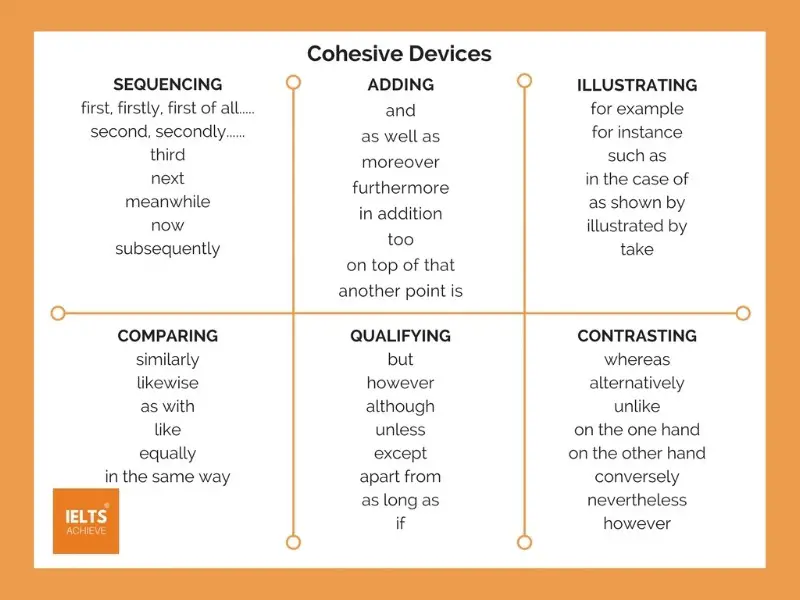
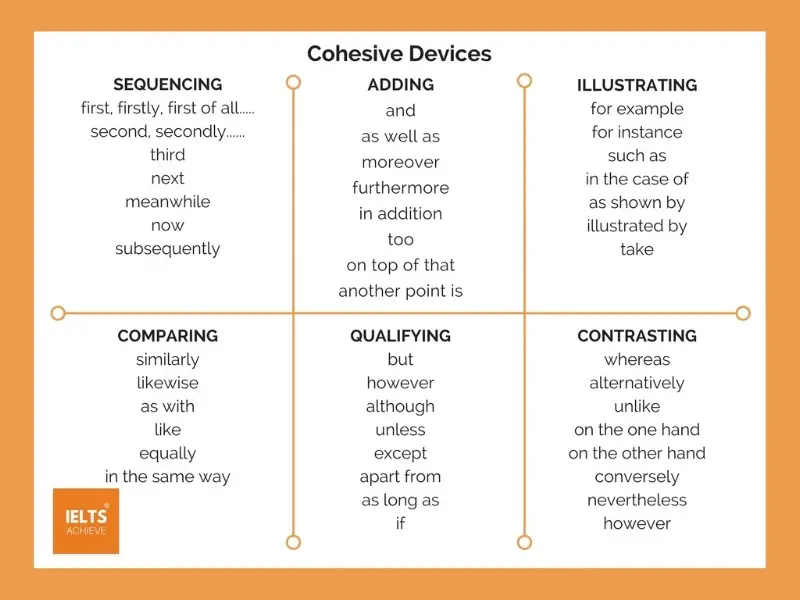
In this post, we will look at how to use cohesive devices in your IELTS writing task 2 essay. Being able to include cohesive devices in your writing is important because it shows the examiner that you know how to use them effectively. This can increase your band score in the coherence and cohesionsection.
Cohesive devices are also known as linking words and they are there to help the examiner to read through your essay clearly. Linking words are a great way to join your ideas together and make your sentences and your paragraph much more coherent.
Cohesive Devices
Below is a list of cohesive devices that you will use in your IELTS essays. In the IELTS exam, to reach a band 7 or above you need to be able to use a range of cohesive devices accurately.
Examples
In the writing task 2 marking criteria for a band score of 7, it states – ‘ uses a range of cohesive devices appropriately although there may be some under-/over-use‘. This means that the student understands how to use cohesive devices but is using too many (in nearly every sentence) or too few.
Many students who receive a band score 6 or lower, will have used far too many, making the writing sound mechanical and not like a native speaker. A high scoring answer of 8+ will contain a few but well placed cohesive devices as using them with precision and in the correct context counts for more than inserting as many as possible.
Take a look at the examples below with the cohesive devices highlighted in bold >>
Bad Example
On the one hand, the main advantage of having a standardised punishment system could lead to a downward trend in crime, as the system would serve as a deterrent. Therefore, this would allow the courts to easily hand out justice to all criminals, in order to make the judiciary system more powerful. For example, in some states in the USA, there are tough sanctions in place for criminals, including death by lethal injection. However, in 2014, the New York Times reported that up to 65% of criminals who were incarcerated for high-level crimes (murder, manslaughter) received the lethal injection.
Good Example
On the one hand, the main advantage of having a standardised punishment system could lead to a downward trend in crime, as the system would serve as a deterrent. This would allow the courts to easily hand out justice to all criminals, in order to make the judiciary system more powerful. For example, in some states in the USA, there are tough sanctions in place for criminals, including death by lethal injection. In 2014, the New York Times reported that up to 65% of criminals who were incarcerated for high-level crimes (murder, manslaughter) received the lethal injection.
How Should I Use Them In My Essay?
Review sample essays and see how many are used in high-level answers. You will see that there are the same ones used in many sample essays time and time again. Learn a core few and use them during your writing practice.
Take a look at this band 9 essay below and see how the cohesive devices have been used to introduce the reader to the paragraphs and to lead them through the essay effortlessly. The cohesive devices are highlighted in bold.
Essay Example >>
Question
In current society, many people are struggling with obesity. What is the main cause of this? What are the effects?
Answer
In many countries all over the world today, there are many people who are extremely overweight. This essay will firstly discuss the main reasons that this is happening and secondly look at the effects this is having on individuals and society.
Firstly, obesity is caused by many factors in modern society, including the easy availability of unhealthy food. When a bad diet is matched with a sedentary lifestyle, weight gain is inevitable, since eating large portions of food that is mainly processed, high in salt, sugar and filled with chemicals, the body gains weight fast. For example, a documentary by Channel 4 in 2016 showed that the most obese populations were situated in underdeveloped nations, like Venezuela, where people admitted to finding it difficult to eat a balanced and healthy diet and had no nutritional education.
Secondly, the effect that immense weight gain can have on a person, is that they will likely develop health issues, like diabetes or heart disease. As the body becomes larger, the metabolism slows down, so that the body is more likely to get a chronic illness. This is impacting on health services around the world, as hospitals are seeing an increased demand to care for obese patients. For instance, The NHS in the UK has admitted to spending around 16 billion per year on obese related diseases like diabetes. UK newspaper The Telegraph reported in 2016 that more money is spent on treating obesity in the UK than on staffing the police force and fire service.
In conclusion, obesity is being caused by easily available calorie-rich processed food and little exercise. The effects of this are impacting individuals health as well as the cost of national healthcare services. In order for obesity to be lessened, individuals should be educated about nutrition, furthermore, the governments should implement higher taxes on all junk food and sugar.
We hope you found this post helpful in helping you to study for the IELTS Test. Let us know in the comments or on the Facebook page if you have any questions. The best way to keep up to date with posts like this is to like us on Facebook, and then follow us onInstagramand Pinterest. We offer essay correction services, mock exams, and online courses. If you need help preparing for the IELTS Test, join the IELTS Achieve Academy and see how we can help you achieve your desired band score faster.
Comprehensive guide covering essential IELTS preparation strategies and techniques to help you achieve your target band score.
Originally published December 2017. Last reviewed 3 July 2026.
In this post, we will look at how to use complex sentences in your IELTS writing task 2 essay. Being able to include complex sentences in your writing is important because it shows the examiner that you know how to use them effectively. This can increase your band score in the grammatical range and accuracysection.
In order to gain a band score 7, you need to be able to show the examiner that you can ‘use a variety of complex structures’. For the higher band scores of 8, you need to ‘use a wide range of structures’ and for a band score 9 ‘use a wide range of structures with full flexibility and accuracy’. This means that you should include complex sentences in your essay, but you do not have to make all of your sentences complex.
What Is A Complex Sentence?
Complex sentences are when two or more basic sentences are joined together, using connecting words. Below you will see four simple sentences:
Simple Sentences
Communities meet online via private Facebook groups.
People no longer meet up in a community hall to discuss matters.
Many people do not socialise physically with others.
People like to isolate themselves in a virtual world.
If you wrote all of your sentences like this in the essay, you would gain a low band score. Therefore, you take the basic sentences like those above and make them into complex sentences by joining them together. Take a look at the example below where you can see the word ‘since’ joins the sentences together;
Complex Sentence Example
Communities meet online via private Facebook groups, instead of in a community hall to discuss matters, since this does not allow them to socialise physically with people, they isolate themselves in this virtual world.
Where do I use them in my essay?
In your writing task 2 essay, you can use a complex sentence in any part of the essay. Here we will look at how they can be used to explain your main idea in your main body paragraphs. Your first sentence can be a basic sentence, that introduces the main topic, followed by a complex sentence that explains the main idea, then an example, which can contain a mixture of simple and complex sentences. Think of it like this;
Main Body Paragraph
Simple sentence (introduce your topic)
Complex sentence (explain your topic/main idea)
Complex sentence (example)
Take a look at this example below from a discussion essay;
Firstly, during the last two decades, there have been many tech developments and advancements, bringing convenience to all. One significant attribute of this modernization is the internet, while this technology has made our lives more convenient in many aspects, including our approach to communication. In the past, we only used mail or the telephone to send our messages across the globe, whereas today, the internet allows us to reach out to almost everyone in just a few seconds. The inconvenience of long distances is eliminated as we can talk and even see distant friends or relatives for an unlimited time. For example, the internet connects people whose relatives or families are abroad, through Facebook, Twitter or Skype anytime and anywhere.
If we break it up you can see how it has been structured;
The first sentence – introduces the topic and is simple >
Firstly, during the last two decades, there have been many tech developments and advancements, bringing convenience to all.
The second part of the paragraph is more complex and gives the reader an explanation of the main topic. The words highlighted in bold connect the clauses and make the sentences complex >
One significant attribute of this modernization is the internet, while this technology has made our lives more convenient in many aspects, including our approach to communication. In the past, we only used mail or the telephone to send our messages across the globe, whereas today, the internet allows us to reach out to almost everyone in just a few seconds. The inconvenience of long distances is eliminated as we can talk and even see distant friends or relatives for an unlimited time.
The third part of the paragraph is the example and it is a complex sentence, connected by the words highlighted in bold >
For example, the internet connects people whose relatives or families are abroad, through Facebook, Twitter or Skype in order to contact them anytime and anywhere.
Clauses – A clause is the key element of a sentence.
A clause is a group of words that contains a subject and a verb. It can form part of a sentence or a complete simple sentence. Clauses can be main or subordinate and they can behave like adjectives or adverbs.
Main Clauses – Also known as an independent clause, the main clause includes a subject and a verb and expresses a complete thought. Main clauses are the same as simple sentences because they have to make sense on their own.
Example– The dog (subject) played (verb).
Subordinate Clauses – A subordinate clause (also called a dependent clause) contains a subject and a verb but it does not make sense on its own. It depends on the main clause for its meaning. Subordinate clauses often explain or add more information about where or when things happen, or how they are done. relative and adverbial clauses are types of subordinate clauses.
Example – Because the dog (subject) was lazy (verb).
Relative Clauses – Relative clauses are also known as adjective clauses, and they are a type of subordinate clause. Like adjectives and adjectival phrases, relative clauses describe nouns and pronouns. Unlike adjectives, they can only be placed after the noun or pronoun they are modifying. Relative clauses always start with one of the relative pronouns who, whom, whose, which or that, which acts as the subject or the object of the clause.
Examples
Subject > which was (verb) excellent (adjective)
Object > which the dog (subject) did (verb) every day (adverbial phrase)
Adverbial Clauses – An adverbial clause is a type of subordinate clause that behaves like an adverb. It gives additional information about how, when where and why something is happening. Adverbial clauses start with subordinators such as because, although, after, while, as and until.
Examples
Why? as (subordinator) the dog (subject) wanted (verb) food (object)
When? after (subordinator) the dog (subject) had eaten (verb) food (object)
Sentence Structures
Simple Sentences
A simple sentence is the same as the main clause. it must have a subject and one main verb and it must express a single idea. The subject is the person or thing that does the action (the verb), but one subject can be made up of more than one person or thing. Most simple sentences also include an object, which is the person or thing receiving the action.
Example
The student and his friends enjoyed the library field trip.
Compound Sentences
Compound sentences are made up of two or more main clauses, but no subordinate clauses. The main clauses are linked using conjunctions and the resulting sentence conveys different ideas of equal importance. Compound sentences are a useful way of connecting two or more ideas of equal importance. They help to improve the flow of a piece of writing as many successive simple sentences can be uncomfortable to read. to make most compound sentences, two main clauses, each containing a subject and a verb are joined together using a coordinating conjunction such as and, but or so. A comma is used before the coordinating conjunction to separate the two clauses.
Example
John is a student who loves to study English grammar, and he also reads many science fiction books.
Complex Sentences
A complex sentence is made up of a main clause and one or more subordinate clauses. The subordinate clause depends on the main clause for its meaning. Complex sentences are useful because they can be used to indicate that one idea is more important than another. The secondary idea is contained in a subordinate clause, which has a subject and a verb but does not make sense without the main clause to which it is attached. Subordinate clauses add information to main clauses.
Examples
John put his hat on because he was cold.
The couple allowed their dog to sleep on their bed, although they managed to have very little sleep.
Preparing For Your IELTS Test
Please practice writing IELTS essays and using complex sentences in your work before your test day. Some students try to write complex sentences, which then turn into very hard to understand sentences. They somehow get the word order muddled up and the writing becomes confusing. Don’t allow this to happen, check your work and practice, using essay examples to guide you.
Even better – have lessons or essay corrections with an experienced teacher, who can help you to understand how to structure your essay, make it clear and include all of the necessary elements to pass with a high band score.
We hope you found this post useful in helping you to study for the IELTS Test. If you have any questions please let us know in the comments below or on the Facebook page.
The best way to keep up to date with posts like this is to like us on Facebook, then follow us on Instagram and Pinterest.
If you need help preparing for the IELTS Test, join the IELTS Achieve Academy and see how we can assist you to achieve your desired band score. We offer an essay correction service, mock exams and online courses.
If you would like to purchase a 16 page PDF download that is easy to read and print out please take a look at the bookshop >
A detailed guide to this IELTS Writing Task 2 essay type, with structure templates, useful vocabulary, and techniques to achieve Band 7+.
Originally published December 2017. Last reviewed 3 July 2026.
In this post, I want to share with you hints, tips, do’s and don’ts that will lead you to a band score of 7 or above on the Academic test. It is not an easy thing to do, as many of you probably know already!
It takes determination and motivation to study hard around work, family and any other commitments you may have.
Take a look at how you can try to get the best results possible in the IELTS exam:
Make a study plan
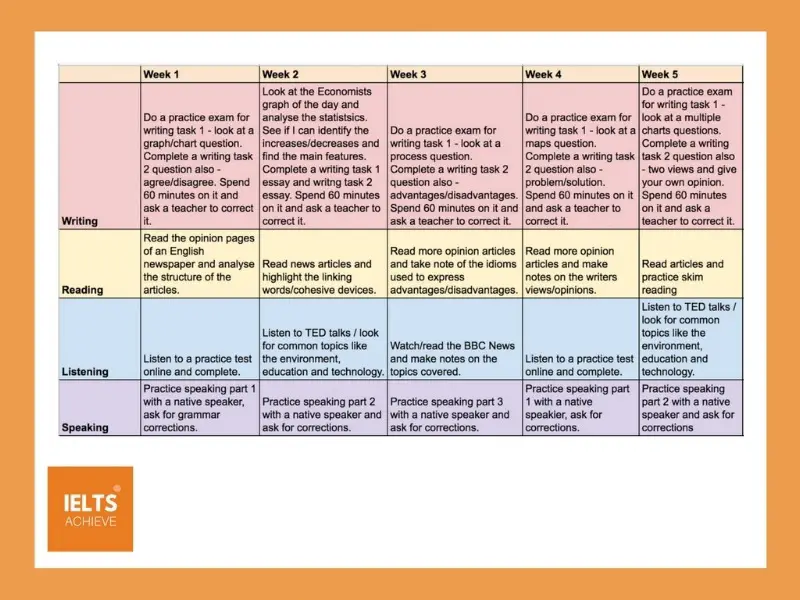
There are many ways in which you can prepare for your IELTS test, one way to start is to make a study plan. Focus on any weaknesses you may have and practice, getting a teacher to correct any essays or practice the speaking test with you. Many of the students I have taught who have scored a 7 or above have admitted to having studied for at least one hour per day.
Below is an example of a study plan, with each area of the exam covered. If you know that your main weakness is writing, spend more time on that – making sure you have an IELTS teacher correcting your work and giving you feedback. If you need to focus on vocabulary, practice and read as much as you can, especially for the Academic students who need to learn how to describe statistical trends.
Make your own study plan! Think about the following questions;
When is your exam?
How much time do you have to study each day or each week?
What areas do you need to focus on the most?
IELTS Writing Tips
Most students struggle with the writing test and require a lot of practice before test day. Read the writing task 1 and 2 posts on this website and study the different structures needed for different types of questions. Remember the following;
TIP 1: Read the question properly
Make sure you read it a few times and highlight any keywords. What is the question asking you to do? Do you have to give your opinion or not?
TIP 2: Make a plan before you start writing your essay.
Learn the structures needed and plan accordingly in your exam. Take a few minutes to do this, so you can easily write your essay, including all of the things you need.
TIP 3: Remember your essay structure
In writing task 2 remember how to structure the essay so that it becomes planted into your brain! Include an introduction, main body paragraph 1, main body paragraph 2 and a conclusion (this may change depending on the type of question, but this structure is the basic skeleton).
TIP 4: Don’t overthink it
if you have ideas that are quite simple, that is fine. They don’t have to be really deep and complex to get a high band score. For example – if asked to give reasons why so many people are obese these days – one reason is overeating easily available calorie-rich junk food. Think about what you know about the subject/topic and go from there. Have you read anything about it? or seen anything on the news or in a documentary? I remember watching a documentary about the top 20 most obese countries once. So I could use that as one of my examples. I also remember reading about how the costs are inflating the healthcare system and more of taxpayers money is being spent on that, rather on public services. So that could be another example to use in my essay. The point is that all examples should be relevant to the question, even if they are simple.
TIP 5: Vocabulary
Make sure you are using the right vocabulary in your essay. You might try to boast and show the examiner how many high-level words you know, which is fine if you know for sure that they fit into the sentence and have the right meaning.
TIP 6: Give your opinion when asked
in the essay or in the speaking test, when asked for your opinion, give it clearly. Use phrases like, in my opinion, in my view, I think that, I believe that…. and then explain.
TIP 7: Use cohesive devices
this can get you high marks when used in the writing and speaking test. Don’t overdo it though! Overuse of these words can be a sure way to lose you marks. Words like – however, therefore, furthermore, in other words, for example, for instance, etc.
Planning for the big day!
When preparing for the day of the test, you should try to get there well on time. You must bring the same passport or ID card that you used on your application form. You also need to bring a pen, pencil and an eraser. You will not be allowed to take any electronic devices or a dictionary into the test area.
On the night before the test, read some English texts, similar to those you may read in the exam, for example, some opinion pieces from a newspaper. The Academic students could analyse graphs and charts as well or read over past assignments that have been corrected.
Things to do: You should also do the following:
Give yourself time to check over your work before the exam ends.
Highlight any keywords or numbers on the question paper.
Make notes on the question paper before you begin to write.
Always write in full sentences (no bullet points or unfinished sentences).
Paraphrase! Make sure you paraphrase the question.
Link your ideas together in writing task 2.
Support with relevant examples.
Read the question properly.
Things not to do: And please don’t:
Use informal language
Repeat the sentences written on the exam paper
Spend more than 20 minutes on task 1
Overuse those linking words/cohesive devices – moreover, however, nowadays etc.