Step-by-step guide to answering this type of IELTS Writing Task 1 question. Covers structure, key language, and band-scoring criteria.
Originally published May 2017. Last reviewed 3 July 2026.
In this post, we will look at the importance of having a good clear overview. The overview is the most important paragraph in the writing task 1 essay and without one, you will lose marks. this will affect your score and your ability to gain a band score 7 or higher.
What is an overview?
An overview is where you clearly write about the general information you can see in the graph/chart/map/process.
For the graphs/charts questions – You give the examiner a clear overview of the main features and you can make comparisons if you can see any. You don’t have to mention any numbers/data/stats here; this information should be in the next two paragraphs.
For the maps questions – You give a general overview of the most noticeable changes that have occurred / or will occur in the future.
For the process questions – You state how many stages the process has, how it begins and how it ends.
Things you should look for in the charts/graph questions >>
Focus on what the main features are
Look at the highest and lowest numbers
See if there has been a substantial growth or decline in a particular category
If there are a few categories, check if there is an obvious way to group them together into just two or three groups.
Look for one or two categories, which break the pattern set by all of the others.
Sometimes there are several different main features, which you can identify. You can circle the key information on the question paper before you start to write about your main features.
Things you should look for in the maps questions >>
Focus on the main changes that you can see, have they improved anything?
Have they built anything in an area that was countryside before?
Have there been any dramatic changes?
Things you should look for in the process questions >>
Think about the number of stages that are in time order.
How many stages are there?
What is happening at the beginning?
What is happening at the end?
I advise my students to write the overview in the second paragraph, after the introduction (paraphrased question) and before the main body paragraphs. The overview leads the reader through into the main body of the essay, where the specific details are written about.
Essay Structure
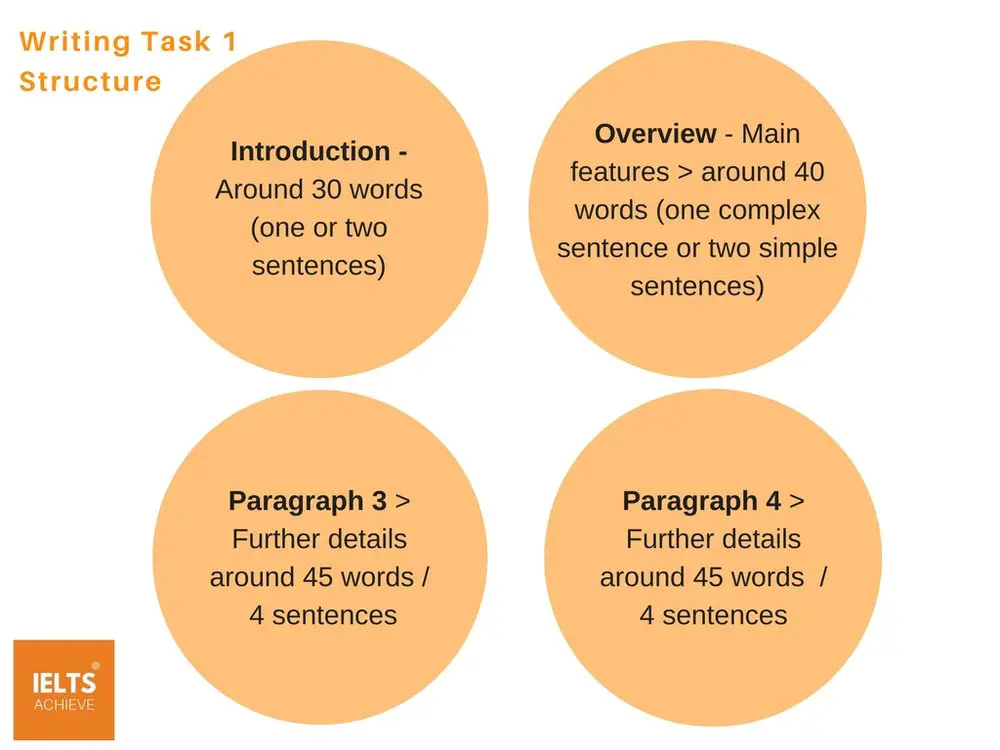
The structure should look like this >>
Paragraph 1- Introduction / Paraphrase the question.
Paragraph 2- Overview
Paragraph 3- Specific Details
Paragraph 4- Specific Details
Paragraph 2 – Overview of the main features
You need to be able to give a broad summary of the information. This is best started with Overall……. then giving details of the main features you can see. You can write this in one or two sentences.
You should try to make a complex sentence here by using a subordinate clause. This means when you are writing your sentences, you join two pieces of information with a linking word – while, whereas, with, although, even though. This can help you to gain more marks in the test.
Students often ask if they should write a conclusion in writing task 1 and the answer is no. This is not an opinion essay, therefore you do not need to give a conclusion. You stick to the facts in this essay, you do not give you own opinion.
Line graph question overview example >>
Overall, the highest recurrence of burglary was in Great Britain, which was fairly high from 2000-2009 in comparison to the other countries, while the lowest incidence when the study began in 2000 was in Spain. It can be seen that in 2009 Spain reported slightly lower figures than the other four countries.
Maps question overview example >>
Overall, the most important change will be the addition of safety measures and the appearance of foliage amid the initial monotonous city design. The sidewalks will be wider on both sides of the road and bicycle lanes will be added, while a pedestrian crossing will also be constructed at the bottom of the street. The crossing will have an island where pedestrians can wait.
Process question overview example >>
Overall, it can be observed that there are eight stages in this process, beginning with the collection of trees from the forest and ending with the paper being made in the paper making machine.
We hope you found this post useful in helping you to study for the IELTS Test. If you have any questions please let us know in the comments below or on the Facebook page.
The best way to keep up to date with posts like this is to like us on Facebook, then follow us on Instagram and Pinterest.
If you need help preparing for the IELTS Test, join the IELTS Achieve Academy and see how we can assist you to achieve your desired band score. We offer an essay correction service, mock exams and online courses.
Step-by-step guide to answering this type of IELTS Writing Task 1 question. Covers structure, key language, and band-scoring criteria.
Originally published May 2017. Last reviewed 3 July 2026.
This post will help you to write a successful line graph essay, there is a model answer for you to compare your work to at the end of the post.
Remember that your essay should have a minimum of 150 words and ideally should be completed in 20 minutes.
Line Graph Essay Structure
The writing task 1 essay should be as follows:
Sample Question: Line Graph
Read the question below carefully, what can you see in the information given?
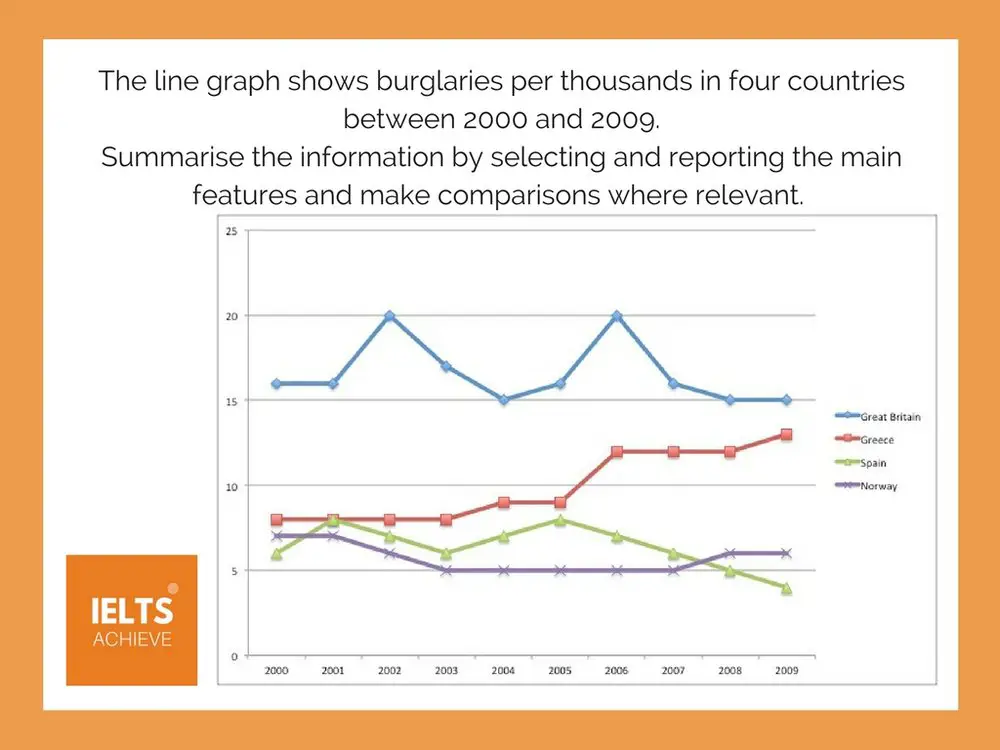
The line graph shows burglaries per thousand in four countries between 2000 and 2009. Summarise the information by selecting and reporting the main features and make comparisons where relevant.
STEP 1 – WRITE THE INTRODUCTION
Write your own introduction of one or two sentences, paraphrasing the question, using synonyms where you can.
STEP 2 – WRITE AN OVERVIEW
Write the overview – start this paragraph with the word ‘Overall...’ and write one or two sentences which describe the main features of the information presented in the line graph.
STEP 3 – WRITE THE MAIN BODY PARAGRAPHS
Write two main body paragraphs, going into detail and giving specific information about the graph. Remember to include data to support your findings. For example, look for the highs and lows and any major increases or decreases over time.
STEP 4 – CHECK YOUR WORK
When you have completed the essay, check it for any errors, spelling or grammar. Then check to see if you have included linking words that connect the information together, making it easy to read. For example, using the word ‘Overall..’ at the beginning of the overview paragraph. You can also use words like – on the one hand, on the other hand, furthermore, however, in addition, finally etc.
Model Answer for Line graph essay
To view more model answer for similar question please click the link below:
The graph illustrates comparative statistics on the number of burglaries in four countries (Great Britain, Greece, Spain and Norway) over a 10-year period (2000-2009). The units of thefts were measured in thousands.
Overall, the highest recurrence of burglary was in Great Britain, which was fairly high from 2000-2009 in comparison to the other countries, while the lowest incidence when the study began in 2000 was in Spain. It can be seen that in 2009 Spain reported slightly lower figures than the other four countries.
The graph shows that Great Britain’s burglaries were consistently high, never below the 20,000 mark, though the trend fluctuates over the 10-year period. According to the data, the country experienced the highest number of thefts during 2002 (20,000) and 2006 (20,000). However, it experienced its lowest amount stolen in 2009 at approximately 15,000.
Similarly, Spain experienced fluctuating trends, but on the opposite side of the spectrum as it reported the least amount of burglaries in 2000 (6,000) with frequency varying over the years and finally reporting a decline in 2009 (4,000). However, other notable statistics are Greece’s upward trend in the number of burglaries, which started in 2000 (8,000) and finally peaked at 14,000 during 2009. Norway is also noteworthy for having considerably low thefts over the course of 10 years compared to the other countries, dropping sharply in 2003, but increasing slightly from there, finally peaking at 6,000 slightly higher than Spain.
Step-by-step guide to answering this type of IELTS Writing Task 1 question. Covers structure, key language, and band-scoring criteria.
Originally published May 2017. Last reviewed 3 July 2026.
This post will help you to write a successful pie charts essay, there is a model answer for you to compare your work to at the end of the post.
Remember that your essay should have a minimum of 150 words and ideally should be completed in 20 minutes.
The writing task 1 essay structure should be as follows >>
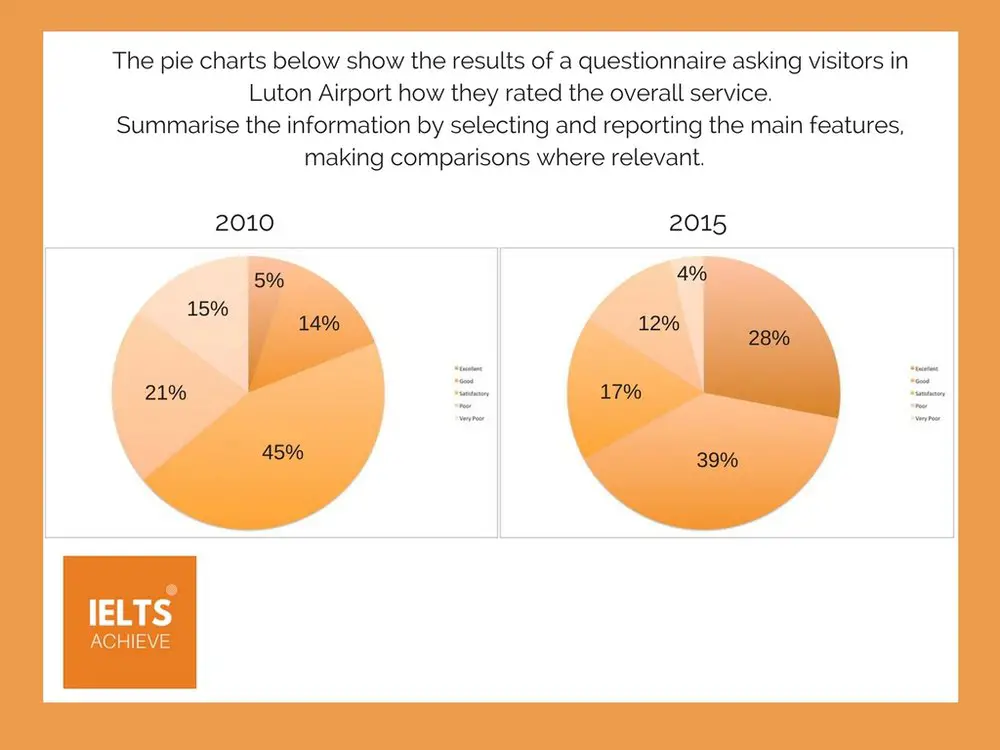
Question
Read the question below carefully, what can you see in the information given?
Step 1 – Write the introduction
Write your own introduction of one or two sentences, paraphrasing the question, using synonyms where you can.
Step 2 – Write an overview
Write the overview – start this paragraph with the word ‘Overall...’ and write one or two sentences which describe the main features of the information presented in the charts.
Step 3 – Write the main body paragraphs
Write two main body paragraphs, going into detail and giving specific information about the charts. Remember to include data to support your findings. For example, look for the highs and lows and any major increases or decreases over time.
Step 4 – Check your work
When you have completed the essay, check it for any errors, spelling or grammar. Then check to see if you have included linking words that connect the information together, making it easy to read. For example, using the word ‘Overall..’ at the beginning of the overview paragraph. You can also use words like – on the one hand, on the other hand, furthermore, however, in addition, finally etc.
Model Answer
To view the model answer for this question please click the button below >>
We hope you found this post useful in helping you to study for the IELTS Test. If you have any questions please let us know in the comments below or on the Facebook page.
The best way to keep up to date with posts like this is to like us on Facebook, then follow us on Instagram and Pinterest.
If you need help preparing for the IELTS Test, join the IELTS Achieve Academy and see how we can assist you to achieve your desired band score. We offer an essay correction service, mock exams and online courses.
How to Describe Tables in IELTS Writing Task 1
Table questions present numerical data organised in rows and columns. Your task is to identify, compare, and summarise the key features without describing every single number.
Strategy for Table Questions
Scan for patterns: Look for the highest and lowest values, trends over time, and significant differences between categories.
Select key data: You cannot mention every number. Choose the most significant figures that illustrate trends or comparisons.
Group information: Organise your body paragraphs by theme (e.g., countries that increased vs. decreased) rather than going row by row.
Include specific figures: Support your observations with actual numbers from the table.
Useful Language for Tables
Function
Phrases
Highest value
The highest figure was recorded for…, X had the largest proportion at…
Lowest value
The lowest rate was seen in…, X accounted for the smallest share…
Comparison
X was significantly higher than Y…, Compared with X, Y was…
Approximate data
roughly, approximately, just over, just under, around
Common Mistakes
Describing every number in the table instead of selecting key data
Failing to make comparisons between categories
Writing without an overview paragraph
Using imprecise language when exact figures are available
Originally published on IELTS Achieve. Last reviewed 3 July 2026.
Step-by-step guide to answering this type of IELTS Writing Task 1 question. Covers structure, key language, and band-scoring criteria for Academic and General Training candidates.
Originally published May 2017. Last reviewed 3 July 2026.
The IELTS Academic Writing Test has two separate writing tasks in 60 minutes. For each part, you will receive a question paper and an answer sheet. You can make notes on the question paper, only the text on the answer sheet will be marked by the examiner. You can write your answers in pen or pencil and correct when necessary. You cannot use a dictionary or any electronic devices.
IELTS Academic and General Training students do different tests for part 1 but complete the same test for part 2. There are many resources to help you prepare for part 2 here.
You must answer both tasks and it is recommended that you spend 20 minutes on task 1 and 40 minutes on task 2. Part 2 is twice as important as your score for part 1. Writing task 1 has a minimum word count of 150 words and you must write an essay. Writing task 2 has a minimum word count of 250, you must write a discursive essay, you will be given an opinion, problem or issue that you need to discuss.
Requirements from universities and immigration agencies vary. Most students will need at least a band score 6 for undergraduate study. For postgraduate study or immigration, a band score 7 is generally required.
In Academic Writing Task 1, you will be asked to write a short essay (150 words minimum) on a given chart, graph, process diagram or map. Each one has a slightly different essay structure, you can learn about those structures in the other posts in the writing task 1 section.
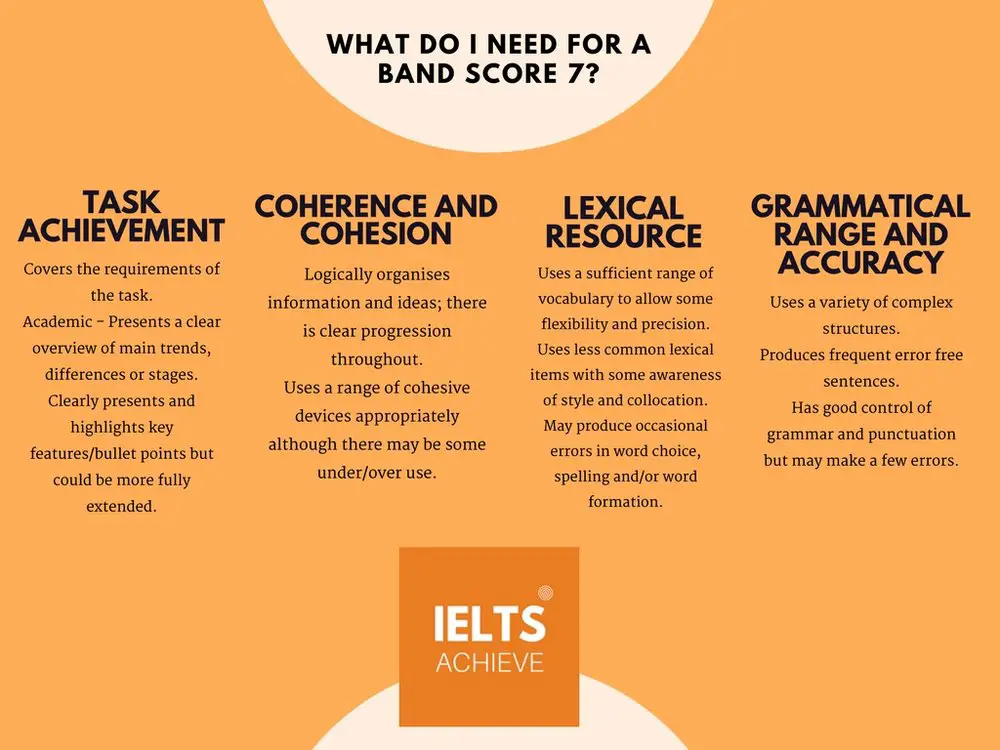
Writing Task 1 Marking Criteria
One of the first things you should do is read the marking criteria to see what the examiners expect. This is really important, as you need to know what they are looking for in the band 7+ boxes.
You should be able to give the examiners exactly what they want, in order to get a 7+ band score.
In the IELTS writing task 1 essay, you will be assessed on the four main areas >>
Task Achievement
Coherence and Cohesion
Lexical Resource
Grammatical Range and Accuracy
Let me break it down for you…….
Task Achievement
In this section, you must be able to ‘present a clear overview of the main trends, differences or stages’ this means that you are able to select the relevant information in the graph/chart. This should be very clear in your answer.
Coherence and Cohesion
In this section, you must produce an answer that can be easily understood by the reader (the examiner!). The criteria states that you should be able to ‘logically organises information and ideas; there is clear progression throughout’ this means that you have organised your information in easy to read paragraphs and the paragraphs have a good structure. The criterion also states that you should ‘uses a range of cohesive devices appropriately although there may be some under/overuse’. This refers to the use of linking words – such as; firstly, secondly, overall, one the one hand, on the other hand, furthermore, therefore, etc.
Lexical Resource
In this section the examiner will be looking at your vocabulary, making sure the words you have used are correct for this type of task. In the criteria, it states ‘uses a sufficient range of vocabulary to allow some flexibility and precision’. It is therefore important for you to study terms and keywords that can help you to gain a 7+ score in this task.
Grammatical Range and Accuracy
You have to write clear error-free sentences in this essay, as many grammatical or spelling errors will make the writing unclear and hard to follow. You also need to show that you have used the appropriate sentence structures, necessary for a formal academic essay. In the marking criteria, it states ‘uses a variety of complex structures, produces frequent error-free sentences, has good control of grammar and punctuation but may make a few errors’.
Writing Task 1 Structure
The structure that I advise my students to use, changes slightly depending on which question they have for writing task 1. However, it has a core structure, that if used well, will be sure to get you a band score 7+. You need to practice using this structure, with as many questions as you can, before sitting your IELTS test. This writing task 1 structure has been proven to be successful for my students and when perfected, can easily help you to achieve a high band score.
It is a 4-paragraph structure >>
Paragraph 1
This is the introduction to the essay and where you should start off by paraphrasing the question.
Do you understand what I mean, when I say ‘paraphrase’ the question?
This means that you rewrite the question in your own words using synonyms. You can’t just copy the question again or use the same words in the question. Paraphrase and show off your vocabulary knowledge by using synonyms. When practising your essay writing, use an online thesaurus to help you. This is a great tool and can help you to learn many new words.
Paragraph 2
This is the overview paragraph.
What is an overview? I hear you say.
An overview is where you clearly write about the general information you can see in the graph/chart. You give the examiner a clear overview of the main features and you can make comparisons if you can see any. You don’t have to mention any numbers/data/stats here; this information should be in the next two paragraphs.
Things you should look for >>
Focus on what the main features are
Look at the highest and lowest numbers
See if there has been a substantial growth or decline in a particular category
If there are a few categories, check if there is an obvious way to group them together into just two or three groups.
Look for one or two categories, which break the pattern set by all of the others.
Sometimes there are several different main features, which you can identify. You can circle the key information on the question paper before you start to write about your main features.
Paragraph 3
In the third paragraph, you write about the important details of the first main feature.
This is where you can give supporting details and write about the numbers, percentages or monetary values. You enter all of the stats/data needed to support your main feature.
You can also write about any comparisons that you can see.
Paragraph 4
In the fourth paragraph, you write about the important details of the second main feature.
This is where you continue to give supporting details and write about the numbers, percentages or monetary values. You enter all of the stats/data needed to support your second main feature.
You can also write about any comparisons that you can see.
You can’t get more points if you write more than 150 words, so should avoid writing too much. You should also be careful that you only spend around 20 minutes on this task, as writing task 2 is harder and more important in regards to the score.
There are practice tests you can download from the British Council.
We hope you found this post useful in helping you to study for the IELTS Test. If you have any questions please let us know in the comments below or on the Facebook page.
The best way to keep up to date with posts like this is to like us on Facebook, then follow us on Instagram and Pinterest.
If you need help preparing for the IELTS Test, join the IELTS Achieve Academy and see how we can assist you to achieve your desired band score. We offer an essay correction service, mock exams and online courses.