Formal And Informal Writing
⚡ TL;DR
Complete guide to writing this type of IELTS letter. Covers format, tone, useful phrases, and sample answers for Band 7+.
Originally published December 2017. Last reviewed 3 July 2026.

In this post, we will look at the differences between formal and informal writing. Formal and informal language refers to using different forms of language in different situations. For example, in writing, if you were writing an essay for university this would have a different tone than if you were writing a diary entry about your thoughts and feelings or an email to a friend.
In writing, writing an academic essay is different from writing a letter to a close friend. Using the correct form of language is essential for getting a high score on the IELTS writing test.
Informal Writing Style
Colloquial Language
Informal writing is similar to a spoken conversation. Informal writing may include slang, figures of speech, broken syntax, asides and so on. Informal writing takes a personal tone as if you were speaking directly to your audience (the reader). You can use the first or third person point of view (I and we), and you are likely to address the reader using second person (you and your).
Simple Sentences
Using short sentences is acceptable and sometimes essential to making a point in informal writing. There may be incomplete sentences or ellipsis(…) to make points.
Contractions and Abbreviations
Words are likely to be simplified using contractions (for example, I’m, doesn’t, couldn’t, it’s) and abbreviations (e.g. TV, photos) whenever possible.
Showing Empathy and Emotion
The author can show empathy towards the reader regarding the complexity of a thought and help them through that complexity. See our page: What is Empathy? for more.
Formal Writing Style
Complex Sentences
Longer sentences are likely to be more common in formal writing. You need to be as thorough as possible with your approach to each topic when you are using a formal style. Each main point needs to be introduced, explained and supported.
State The Objective
State your main points confidently and offer full supportive arguments. A formal writing style shows a limited range of emotions and avoids emotive punctuation such as exclamation points, ellipsis, etc. unless they are being cited from another source.
Use Full Words
No contractions should be used to simplify words (in other words use “It is” rather than “It’s”). Abbreviations must be spelt out in full when first used, the only exceptions being when the acronym is better known than the full name (BBC, ITV or NATO for example).
Third Person
Formal writing is not a personal writing style. The formal writer is disconnected from the topic and does not use the first person point of view (I or we) or second person (you).
When to Use Formal and Informal Writing
A formal writing style is necessary to use in the IELTS Test. If you are studying for the General Training writing test part 1, you should familiarise yourself with the difference between informal, semi-formal and formal letter writing.
Writing for the Academic writing test parts 1 and 2 and the General Training writing test part 2 requires the formal writing style, although during the speaking test you may use a more informal tone when speaking to the examiner.
Formal Writing Style in Writing Task 2
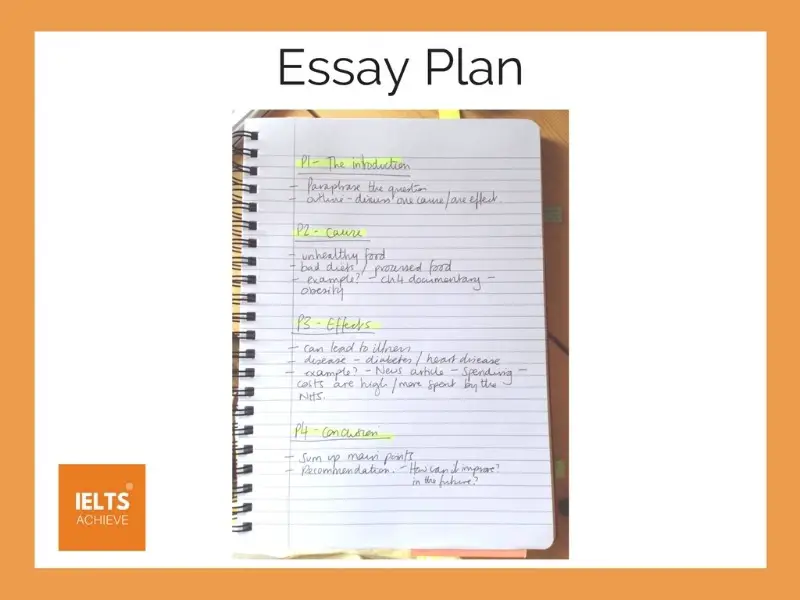
In writing task 2 you are expected to write your essay in a formal academic style. Here are two examples of the main body paragraph from a positive/negative question >
Bad Example
Sometimes working from home can be great, you can work when you want and live your life around your own clock. If you have kids to look after it makes it even better because you can work around their timetables. I can work from anywhere I want too like if I want to go on holiday I can just take my laptop with me and work from a cafe or anywhere that has wifi. You can fit your work around your life, which is really easy for all sorts of reasons. For example, my friend works from home and she loves it, she’s always saying how great it is that she can work from anywhere she wants to. She even went on holiday and worked from her sun lounger next to the swimming pool. I would love to do something like that for work, it sounds like it can give you lots of time to travel and explore the world.
Good Example
On the one hand, having the option to work from home, can have a positive impact on an employee’s schedule. This is especially so if the person has children or other dependants because working long hours is not always possible depending on your lifestyle. Therefore it allows the employee to manage their own schedule while ensuring that they maintain a work-life balance, working from wherever they are in the world. Having flexible working hours means that collecting children from school, spending time travelling and being able to attend non-work related appointments becomes much easier. For example, Google allows senior engineers to work remotely, using flexible hours for those who travel a lot or have the need to work with little interruptions.
Can you see the difference?
The bad example has been written in an informal manner as if the writer is writing to a friend. The good example shows the formal style and elements of a high-level IELTS main body paragraph, through the structure, use of cohesive devices, complex sentences and the tone.
We hope you found this post useful in helping you to study for the IELTS Test. If you have any questions please let us know in the comments below or on the Facebook page.
The best way to keep up to date with posts like this is to like us on Facebook, then follow us on Instagram and Pinterest.
If you need help preparing for the IELTS Test, join the IELTS Achieve Academy and see how we can assist you to achieve your desired band score. We offer an essay correction service, mock exams and online courses.