A detailed guide to this IELTS Writing Task 2 essay type, with structure templates, useful vocabulary, and techniques to achieve Band 7+.
Originally published December 2017. Last reviewed 3 July 2026.
In this post, you will learn how to understand any type of writing task 2 question. There are various types of task 2 questions and some students do not always understand what the question is asking them to do.
The examiner wants to see that you have clearly understood the question and written an easy to follow essay for them to read, with relevant information and specific examples.
Question Analysis
You need to start by reading the question and analysing it >
What type of essay is it?
Is it an opinion essay, agree/disagree, advantages/disadvantages, discussion, cause and effect, problem solution etc? You need to identify what type of question it is so that you can think about the structure you are going to use to write your essay. This will also help you to understand the question when you know the type of ideas and opinions you should be thinking about.
What is the main issue?
You need to read the question and pinpoint the main issue. The main issue is often linked to a sub-issue. You need to look at this to make sure you stay focused and don’t write generally about the topic. Stay on task and make sure that all of the information written in your essay is relevant.
What are the sub-issues?
The sub-issues are words that tell you more about the topic and the areas you need to discuss.
What instructions are you given?
The instruction words are the words that are giving you a command, asking you a question that you should answer in your essay. For example – to what extent do you agree? or discuss both views and give your opinion.
Question Example 1
Look at this example Task 2 question below >
Many people find it hard to balance their work with other parts of their lives. What are the reasons for this? How can this problem be overcome?
What type of essay is it? > problem/solution
What is the main issue? > work/life balance
What are the sub-issues? > many people find it hard
What instructions are you given? > What are the reasons for this? / How can this problem be overcome?
You can see here that the question is a problem/solution essay. The main issue is looking at work-life balance with the sub-issue being that many people find it hard to have a work-life balance. If you discussed the benefits of working more or working while you are away from work, then you would not be answering the question. Next, you should look at the instruction words, that are asking you – what are the reasons for this? and how can this problem be overcome? give relevant answers that answer this specifically.
Question Example 2
Look at this example Task 2 question below >
The maintenance of public libraries is a waste of money because of computer technologies which have the same function.
To what extent do you agree or disagree?
What type of essay is it? > agree/disagree
What is the main issue? > money (wasted) being used to maintain the libraries
What are the sub-issues? > computer technologies can easily do this.
What instructions are you given? > To what extent do you agree or disagree?
You can see here that the question is an agree/disagree essay. The main issue is looking at money, being wasted on maintaining public libraries with the sub-issue being that computer technologies exist that can do that job. If you discussed the need for public libraries in society or the rate at which this type of technology is growing, then you would not be answering the question. You should think about which side of the argument you side with more, then make that the focus of your answer. Next, you should look at the instruction words, that are asking you – To what extent do you agree or disagree?give relevant answers that answer this specifically.
We hope you found this post useful in helping you to study for the IELTS Test. If you have any questions please let us know in the comments below or on the Facebook page.
The best way to keep up to date with posts like this is to like us on Facebook, then follow us on Instagram and Pinterest.
If you need help preparing for the IELTS Test, join the IELTS Achieve Academy and see how we can assist you to achieve your desired band score. We offer an essay correction service, mock exams and online courses.
A detailed guide to this IELTS Writing Task 2 essay type, with structure templates, useful vocabulary, and techniques to achieve Band 7+.
Originally published December 2017. Last reviewed 3 July 2026.
In this post, I want to share with you hints, tips, do’s and don’ts that will lead you to a band score of 7 or above on the Academic test. It is not an easy thing to do, as many of you probably know already!
It takes determination and motivation to study hard around work, family and any other commitments you may have.
Take a look at how you can try to get the best results possible in the IELTS exam:
Make a study plan
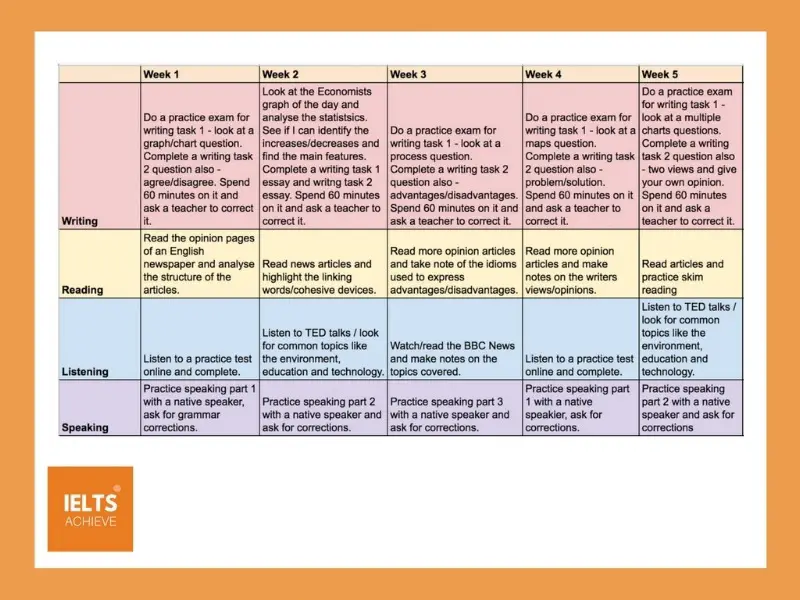
There are many ways in which you can prepare for your IELTS test, one way to start is to make a study plan. Focus on any weaknesses you may have and practice, getting a teacher to correct any essays or practice the speaking test with you. Many of the students I have taught who have scored a 7 or above have admitted to having studied for at least one hour per day.
Below is an example of a study plan, with each area of the exam covered. If you know that your main weakness is writing, spend more time on that – making sure you have an IELTS teacher correcting your work and giving you feedback. If you need to focus on vocabulary, practice and read as much as you can, especially for the Academic students who need to learn how to describe statistical trends.
Make your own study plan! Think about the following questions;
When is your exam?
How much time do you have to study each day or each week?
What areas do you need to focus on the most?
IELTS Writing Tips
Most students struggle with the writing test and require a lot of practice before test day. Read the writing task 1 and 2 posts on this website and study the different structures needed for different types of questions. Remember the following;
TIP 1: Read the question properly
Make sure you read it a few times and highlight any keywords. What is the question asking you to do? Do you have to give your opinion or not?
TIP 2: Make a plan before you start writing your essay.
Learn the structures needed and plan accordingly in your exam. Take a few minutes to do this, so you can easily write your essay, including all of the things you need.
TIP 3: Remember your essay structure
In writing task 2 remember how to structure the essay so that it becomes planted into your brain! Include an introduction, main body paragraph 1, main body paragraph 2 and a conclusion (this may change depending on the type of question, but this structure is the basic skeleton).
TIP 4: Don’t overthink it
if you have ideas that are quite simple, that is fine. They don’t have to be really deep and complex to get a high band score. For example – if asked to give reasons why so many people are obese these days – one reason is overeating easily available calorie-rich junk food. Think about what you know about the subject/topic and go from there. Have you read anything about it? or seen anything on the news or in a documentary? I remember watching a documentary about the top 20 most obese countries once. So I could use that as one of my examples. I also remember reading about how the costs are inflating the healthcare system and more of taxpayers money is being spent on that, rather on public services. So that could be another example to use in my essay. The point is that all examples should be relevant to the question, even if they are simple.
TIP 5: Vocabulary
Make sure you are using the right vocabulary in your essay. You might try to boast and show the examiner how many high-level words you know, which is fine if you know for sure that they fit into the sentence and have the right meaning.
TIP 6: Give your opinion when asked
in the essay or in the speaking test, when asked for your opinion, give it clearly. Use phrases like, in my opinion, in my view, I think that, I believe that…. and then explain.
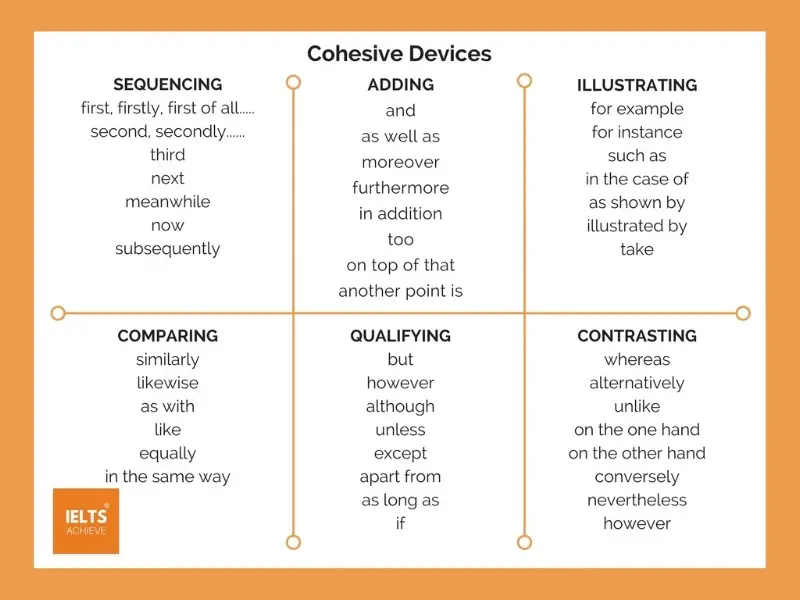
TIP 7: Use cohesive devices
this can get you high marks when used in the writing and speaking test. Don’t overdo it though! Overuse of these words can be a sure way to lose you marks. Words like – however, therefore, furthermore, in other words, for example, for instance, etc.
Planning for the big day!
When preparing for the day of the test, you should try to get there well on time. You must bring the same passport or ID card that you used on your application form. You also need to bring a pen, pencil and an eraser. You will not be allowed to take any electronic devices or a dictionary into the test area.
On the night before the test, read some English texts, similar to those you may read in the exam, for example, some opinion pieces from a newspaper. The Academic students could analyse graphs and charts as well or read over past assignments that have been corrected.
Things to do: You should also do the following:
Give yourself time to check over your work before the exam ends.
Highlight any keywords or numbers on the question paper.
Make notes on the question paper before you begin to write.
Always write in full sentences (no bullet points or unfinished sentences).
Paraphrase! Make sure you paraphrase the question.
Link your ideas together in writing task 2.
Support with relevant examples.
Read the question properly.
Things not to do: And please don’t:
Use informal language
Repeat the sentences written on the exam paper
Spend more than 20 minutes on task 1
Overuse those linking words/cohesive devices – moreover, however, nowadays etc.