Step-by-step guide to answering this type of IELTS Writing Task 1 question. Covers structure, key language, and band-scoring criteria.
Originally published October 2017. Last reviewed 3 July 2026.
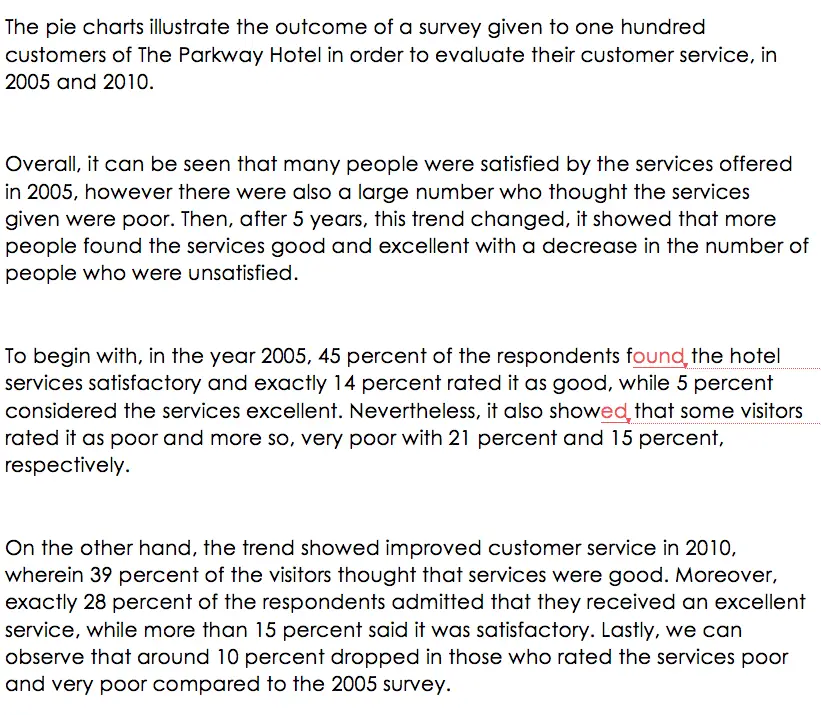
In this post, you will be able to view an essay example from a past student, with the corrections and feedback highlighted in red.
Most of the students studying for the IELTS Test have said they find the IELTS Writing Tasks difficult. I have corrected hundreds of task 1 and 2 essays on various topics, giving estimated band scores and detailed feedback. There are also suggestions on how to improve for a higher band score. Take a look at this student essay example and see how it compares to your own writing.
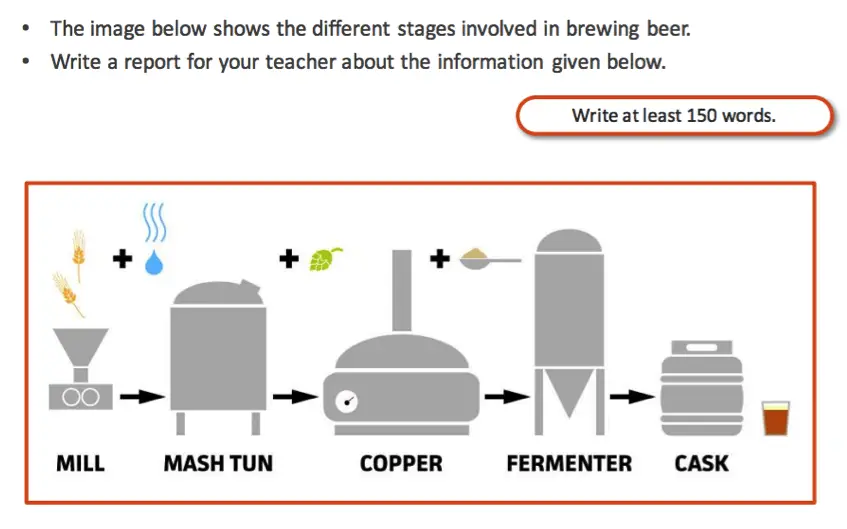
Writing Task 1 Question
Here is the task 1 essay with corrections, suggestions, feedback and an estimated band score >>
Do you want to get your essays corrected by a highly experienced IELTS teacher? Then take a look at our writing correction service.
We hope you found this post useful in helping you to study for the IELTS Test. If you have any questions please let us know in the comments below or on the Facebook page.
The best way to keep up to date with posts like this is to like us on Facebook, then follow us on Instagram and Pinterest.
What Band 9 Means for Task 1 Academic
A Band 9 response in IELTS Writing Task 1 Academic demonstrates a high level of competence across all four assessment criteria: Task Achievement, Coherence and Cohesion, Lexical Resource, and Grammatical Range and Accuracy.
Task Achievement at Band 9
The response fully satisfies all requirements, presents a clear overview, and accurately selects and reports key features with well-chosen supporting detail.
Coherence and Cohesion at Band 9
Information and ideas are logically organised with clear progression throughout. Paragraphing is managed skillfully, and cohesive devices are used appropriately.
How to Achieve Band 9
Analyse the visual data carefully: Spend 2-3 minutes identifying the main trends, key features, and notable comparisons before writing.
Write a clear overview: Summarise the most significant patterns in 2-3 sentences without including specific data.
Select and group information: Present data in logical paragraphs organised by trend, category, or time period.
Use accurate data: Reference specific numbers, percentages, and dates from the visual to support your descriptions.
Vary your language: Use a range of vocabulary for describing trends (increased, rose sharply, remained stable, declined gradually).
Originally published on IELTS Achieve. Last reviewed 3 July 2026.
Step-by-step guide to answering this type of IELTS Writing Task 1 question. Covers structure, key language, and band-scoring criteria.
Originally published October 2017. Last reviewed 3 July 2026.
In this post, you will be able to view an essay example from a past student, with the corrections and feedback highlighted in red.
Most of the students studying for the IELTS Test have said they find the IELTS Writing Tasks difficult. I have corrected hundreds of task 1 and 2 essays on various topics, giving estimated band scores and detailed feedback. There are also suggestions on how to improve for a higher band score. Take a look at this student essay example and see how it compares to your own writing.
Writing Task 1 Question
Here is the task 1 essay with corrections, suggestions, feedback and an estimated band score >>
Do you want to get your essays corrected by a highly experienced IELTS teacher? Then take a look at our writing correction service.
We hope you found this post useful in helping you to study for the IELTS Test. If you have any questions please let us know in the comments below or on the Facebook page.
The best way to keep up to date with posts like this is to like us on Facebook, then follow us on Instagram and Pinterest.
What Band 8 Means for Task 1 Academic
A Band 8 response in IELTS Writing Task 1 Academic demonstrates a high level of competence across all four assessment criteria: Task Achievement, Coherence and Cohesion, Lexical Resource, and Grammatical Range and Accuracy.
Task Achievement at Band 8
The response fully satisfies all requirements, presents a clear overview, and accurately selects and reports key features with well-chosen supporting detail.
Coherence and Cohesion at Band 8
Information and ideas are logically organised with clear progression throughout. Paragraphing is managed skillfully, and cohesive devices are used appropriately.
How to Achieve Band 8
Analyse the visual data carefully: Spend 2-3 minutes identifying the main trends, key features, and notable comparisons before writing.
Write a clear overview: Summarise the most significant patterns in 2-3 sentences without including specific data.
Select and group information: Present data in logical paragraphs organised by trend, category, or time period.
Use accurate data: Reference specific numbers, percentages, and dates from the visual to support your descriptions.
Vary your language: Use a range of vocabulary for describing trends (increased, rose sharply, remained stable, declined gradually).
Originally published on IELTS Achieve. Last reviewed 3 July 2026.
Step-by-step guide to answering this type of IELTS Writing Task 1 question. Covers structure, key language, and band-scoring criteria.
Originally published October 2017. Last reviewed 3 July 2026.
In this post, you will be able to view an essay example from a past student, with the corrections and feedback highlighted in red.
Most of the students studying for the IELTS Test have said they find the IELTS Writing Tasks difficult. I have corrected hundreds of task 1 and 2 essays on various topics, giving estimated band scores and detailed feedback. There are also suggestions on how to improve for a higher band score. Take a look at this student essay example and see how it compares to your own writing.
Writing Task 1 Question
Here is the task 1 essay with corrections, suggestions, feedback and an estimated band score >>
Do you want to get your essays corrected by a highly experienced IELTS teacher? Then take a look at our writing correction service.
We hope you found this post useful in helping you to study for the IELTS Test. If you have any questions please let us know in the comments below or on the Facebook page.
The best way to keep up to date with posts like this is to like us on Facebook, then follow us on Instagram and Pinterest.
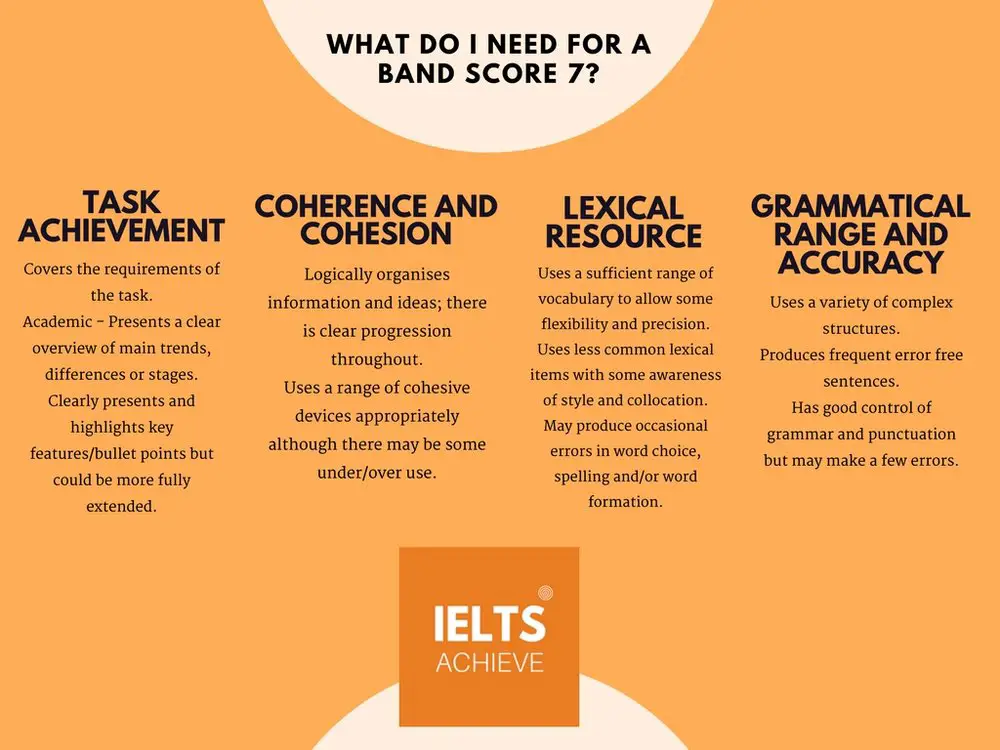
What Band 7 Means for Task 1 Academic
A Band 7 response in IELTS Writing Task 1 Academic demonstrates a high level of competence across all four assessment criteria: Task Achievement, Coherence and Cohesion, Lexical Resource, and Grammatical Range and Accuracy.
Task Achievement at Band 7
The response covers all requirements, presents a clear overview, and highlights key features appropriately, though some detail may be missing or over-extended.
Coherence and Cohesion at Band 7
Information is logically organised with clear progression. A range of cohesive devices is used flexibly, though there may be occasional over- or under-use.
How to Achieve Band 7
Analyse the visual data carefully: Spend 2-3 minutes identifying the main trends, key features, and notable comparisons before writing.
Write a clear overview: Summarise the most significant patterns in 2-3 sentences without including specific data.
Select and group information: Present data in logical paragraphs organised by trend, category, or time period.
Use accurate data: Reference specific numbers, percentages, and dates from the visual to support your descriptions.
Vary your language: Use a range of vocabulary for describing trends (increased, rose sharply, remained stable, declined gradually).
Official Band Descriptor Criteria at Band 7
The table below summarises what IELTS examiners look for at Band 7 across all four marking criteria for Writing Task 1 Academic, according to the band descriptors published jointly by the British Council, IDP: IELTS Australia, and Cambridge Assessment English (2024).
Criterion
Band 7 Descriptor Summary
Task Achievement
Covers the requirements of the task clearly; presents a clear overview of main trends, differences, or stages; clearly presents and highlights key features but could be more fully extended.
Coherence & Cohesion
Logically organises information with clear progression throughout; uses a range of cohesive devices appropriately though with some under- or over-use.
Lexical Resource
Uses a sufficient range of vocabulary to allow some flexibility and precision; uses less common vocabulary with some awareness of style and collocation; may produce occasional errors.
Grammatical Range & Accuracy
Uses a variety of complex structures; produces frequent error-free sentences; has good control of grammar and punctuation but may make a few errors.
How to Move Beyond Band 7
Ensure every key feature is fully extended with precise data. Where you mention a trend, support it with specific figures from the chart or table.
Reduce any remaining cohesive device overuse. At Band 8, cohesion should feel seamless rather than signposted with phrases like “Furthermore” or “In addition” in every sentence.
Develop your ability to paraphrase the question prompt effectively. Vary your language from the very first sentence to demonstrate lexical range.
Key Takeaways
At Band 7, the response clearly covers the task, presents an effective overview, and uses a range of vocabulary and grammar with good control (IELTS band descriptors, British Council, IDP, and Cambridge, 2024).
To reach Band 8, focus on eliminating minor cohesion issues and ensuring that every key feature is fully supported with precise figures.
Consistent timed practice under exam conditions is the most effective way to maintain Band 7 performance and push toward Band 8.
Originally published on IELTS Achieve. Last reviewed 3 July 2026.
Step-by-step guide to answering this type of IELTS Writing Task 1 question. Covers structure, key language, and band-scoring criteria.
Originally published October 2017. Last reviewed 3 July 2026.
In this post, you will be able to view an essay example from a past student, with the corrections and feedback highlighted in red.
Most of the students studying for the IELTS Test have said they find the IELTS Writing Tasks difficult. I have corrected hundreds of task 1 and 2 essays on various topics, giving estimated band scores and detailed feedback. There are also suggestions on how to improve for a higher band score. Take a look at this student essay example and see how it compares to your own writing.
Writing Task 1 Question
Here is the task 1 essay with corrections, suggestions, feedback and an estimated band score >>
Do you want to get your essays corrected by a highly experienced IELTS teacher? Then take a look at our writing correction service.
We hope you found this post useful in helping you to study for the IELTS Test. If you have any questions please let us know in the comments below or on the Facebook page.
The best way to keep up to date with posts like this is to like us on Facebook, then follow us on Instagram and Pinterest.
What Band 6 Means for Task 1 Academic
A Band 6 response in IELTS Writing Task 1 Academic demonstrates developing competence across all four assessment criteria: Task Achievement, Coherence and Cohesion, Lexical Resource, and Grammatical Range and Accuracy.
Task Achievement at Band 6
The response addresses the requirements, presents an overview (though it may be unclear), and presents key features adequately, though some may be inadequately covered.
Coherence and Cohesion at Band 6
Information is arranged coherently with clear overall progression. Cohesive devices are used effectively but may be mechanical or faulty at times.
How to Achieve Band 6
Analyse the visual data carefully: Spend 2-3 minutes identifying the main trends, key features, and notable comparisons before writing.
Write a clear overview: Attempt to summarise the overall trends, even if briefly.
Select and group information: Try to organise data into coherent groups rather than listing every detail.
Use accurate data: Reference specific numbers, percentages, and dates from the visual to support your descriptions.
Vary your language: Use a range of vocabulary for describing trends (increased, rose sharply, remained stable, declined gradually).
Official Band Descriptor Criteria at Band 6
The table below summarises what IELTS examiners look for at Band 6 across all four marking criteria for Writing Task 1 Academic, according to the band descriptors published jointly by the British Council, IDP: IELTS Australia, and Cambridge Assessment English (2024).
Criterion
Band 6 Descriptor Summary
Task Achievement
Addresses the task requirements though some details may be irrelevant or inaccurate; presents an overview with some key features highlighted.
Coherence & Cohesion
Arranges information coherently with clear overall progression; uses cohesive devices effectively though with some inaccuracy or repetition.
Lexical Resource
Uses an adequate range of vocabulary for the task; attempts less common vocabulary with some inaccuracy; makes some errors in spelling or word formation.
Grammatical Range & Accuracy
Uses a mix of simple and complex sentences; makes some errors in grammar and punctuation which rarely reduce communication.
How to Move Beyond Band 6
Focus on selecting and comparing the most significant data points rather than listing every detail. Examiners reward the ability to identify what matters most.
Expand your vocabulary for describing trends and comparisons. Replace overused words such as “increased” and “decreased” with alternatives like “surged,” “declined,” “fluctuated,” or “remained stable.”
Aim for greater accuracy in complex sentence structures. Practise using relative clauses, participle phrases, and conditional structures without grammatical errors.
Key Takeaways
Band 6 represents a competent performance: the task is addressed, ideas are organised, and communication is generally effective despite some errors (IELTS band descriptors, British Council, IDP, and Cambridge, 2024).
The main barriers between Band 6 and Band 7 are precision in data selection, more sophisticated vocabulary use, and consistently accurate complex grammar.
Regular timed practice with a variety of Task 1 question types builds the speed and flexibility needed to reach Band 7.
Originally published on IELTS Achieve. Last reviewed 3 July 2026.
Step-by-step guide to answering this type of IELTS Writing Task 1 question. Covers structure, key language, and band-scoring criteria.
Originally published October 2017. Last reviewed 3 July 2026.
In this post, you will be able to view an essay example from a past student, with the corrections and feedback highlighted in red.
Most of the students studying for the IELTS Test have said they find the IELTS Writing Tasks difficult. I have corrected hundreds of task 1 and 2 essays on various topics, giving estimated band scores and detailed feedback. There are also suggestions on how to improve for a higher band score. Take a look at this student essay example and see how it compares to your own writing.
Writing Task 1 Question
Here is the task 1 essay with corrections, suggestions, feedback and an estimated band score >>
Do you want to get your essays corrected by a highly experienced IELTS teacher? Then take a look at our writing correction service.
We hope you found this post useful in helping you to study for the IELTS Test. If you have any questions please let us know in the comments below or on the Facebook page.
The best way to keep up to date with posts like this is to like us on Facebook, then follow us on Instagram and Pinterest.
What Band 5.5 Means for Task 1 Academic
A Band 5.5 response in IELTS Writing Task 1 Academic demonstrates developing competence across all four assessment criteria: Task Achievement, Coherence and Cohesion, Lexical Resource, and Grammatical Range and Accuracy.
Task Achievement at Band 5.5
The response partially addresses the requirements with some attempt at an overview, but key features may be inadequately covered or unclear.
Coherence and Cohesion at Band 5.5
The response shows some organisation but may lack overall progression. Cohesive devices may be inadequate, inaccurate, or overused.
How to Achieve Band 5.5
Analyse the visual data carefully: Spend 2-3 minutes identifying the main trends, key features, and notable comparisons before writing.
Write a clear overview: Attempt to summarise the overall trends, even if briefly.
Select and group information: Try to organise data into coherent groups rather than listing every detail.
Use accurate data: Reference specific numbers, percentages, and dates from the visual to support your descriptions.
Vary your language: Use a range of vocabulary for describing trends (increased, rose sharply, remained stable, declined gradually).
Official Band Descriptor Criteria at Band 5.5
The table below summarises what IELTS examiners look for at Band 5.5 across all four marking criteria for Writing Task 1 Academic, according to the band descriptors published jointly by the British Council, IDP: IELTS Australia, and Cambridge Assessment English (2024).
Criterion
Band 5.5 Descriptor Summary
Task Achievement
Partially addresses the task requirements; the overview may be unclear or missing key features; data or key stages may be inaccurately described.
Coherence & Cohesion
Information is organised with some coherence but overall progression may be unclear; cohesive devices may be faulty or mechanical.
Lexical Resource
Uses a limited range of vocabulary; errors in word choice and spelling may cause difficulty for the reader.
Grammatical Range & Accuracy
Uses a limited range of structures; attempts complex sentences but with frequent errors; errors in grammar and punctuation may cause some difficulty.
How to Move Beyond Band 5.5
Practise identifying and clearly stating the overall trend or key pattern before writing about specific data points. Every Task 1 response must include an overview paragraph.
Use a wider range of linking words and transition phrases (for example, “by contrast,” “similarly,” “whereas”) to connect ideas more naturally across sentences.
Study model answers at Band 6 and 7 to observe how data is grouped logically rather than described point by point in chronological order.
Key Takeaways
A Band 5.5 response shows a partial attempt at the task but typically lacks a clear overview or accurate data selection, according to the published IELTS band descriptors (British Council, IDP, and Cambridge, 2024).
Moving from Band 5.5 to Band 6 or above requires stronger organisation, more precise vocabulary for describing data, and fewer grammatical errors in complex sentences.
Practise with official Cambridge IELTS past papers and compare your answers to published model responses to calibrate your understanding of what the examiner expects.
Originally published on IELTS Achieve. Last reviewed 3 July 2026.
Step-by-step guide to answering this type of IELTS Writing Task 1 question. Covers structure, key language, and band-scoring criteria.
Originally published June 2017. Last reviewed 3 July 2026.
The General Training Writing test has two separate writing tasks in 60 minutes. For each part, you will receive a question paper and an answer sheet. You can make notes on the question paper, only the text on the answer sheet will be marked by the examiner. You can write your answers in pen or pencil and correct when necessary. You cannot use a dictionary or any electronic devices.
IELTS Academic and General Training students do different tests for part 1, but complete the same test for part 2. There are many resources to help you prepare for part 2 here.
You must answer both tasks and it is recommended that you spend 20 minutes on task 1 and 40 minutes on task 2. Part 2 is twice as important as your score for part 1. Writing task 1 has a minimum word count of 150 words and you must write a letter. Writing task 2 has a minimum word count of 250, you must write a discursive essay, you will be given an opinion, problem or issue that you need to discuss.
Requirements from universities and immigration agencies vary. Most students will need at least a band score 6 for undergraduate study. For postgraduate study or immigration, a band score 7 is generally required.
Marking Criteria
One of the first things you should do is read the marking criteria to see what the examiners expect. This is really important, as you need to know what they are looking for in the band 7+ boxes.
The information in the test question will tell you what to write about. To achieve a high Task Achievement score, you must write about all of the points in the letter and make sure everything is relevant. To improve your score for Coherence and Cohesion, use the information in the question to plan and organise your ideas clearly. To achieve a high score in the Lexical Resource, you should use synonyms and avoid copying words from the question. In Grammatical Range and Accuracy, make sure you check through your work for any grammatical and spelling errors.
Task Achievement
Does your letter answer all parts of the question?
Are your ideas relevant?
Coherence and Cohesion
Are your ideas well organised, clear and well connected?
Lexical Resource
Have you repeated any words?
Have you copied any words from the question?
Grammatical Range and Accuracy
Have you made any grammatical/spelling/punctuation errors?
Have you used a variety of sentence structures?
Have you used the right tenses?
TIP >> Leave at least 2/3 minutes to check your work before you finish this task.
TIP >> In IELTS writing task 1 for the General Training, students only need to write the greeting ‘Dear…’, the body text, the complimentary close (for example – yours sincerely) and their name. Addresses should NOT be included.
TIP >> You do not get more points for writing more than 150 words. You should only spend 20 minutes on this task as writing task 2 is harder and worth twice as much in terms of the score.
Letter Writing
In the General Training Task 1, you will be asked to write a letter. The letter must be written in the correct style, for example;
Informal – writing to a friend or family member (someone you know well)
Semi Formal – if you were writing for a work colleague (someone you know)
Formal – if you are writing to a business or local newspaper (a person you do not know)
Each type of letter will use different language, meaning it will both begin and end in a different way. When given a question, you will identify which type of letter you need to write by identifying the language in the question.
The letter questions will feature different content, which tells you if the letter is going to be informal, semi-formal or formal. Here is a list >>
Information request – any style
Making arrangements – formal
Applications – formal
Invitations – personal/semi-formal
Complaints – formal
Personal – informal
The following are examples of three different types of letters >>
Informal Letter Question >>
Write at least 150 words
You do not need to write any addresses
Begin your letter with ‘Dear…..”
TIP >> The informal letter question will normally have the word ‘friend’ in it. Asking you to write a letter to a friend is a key piece of information, telling you that the letter should be written in an informal style.
Semi Formal Letter Question >>
Write at least 150 words
You do not need to write any addresses
Begin your letter with ‘Dear…..”
TIP >> A semi-formal letter is often to someone that you know like a work colleague.
Formal Letter Question >>
Write at least 150 words
You do not need to write any addresses
Begin your letter with ‘Dear…..”
TIP >> A formal letter would be written to someone that you don’t know. That is why when you start writing when you don’t know their name, you would write ‘Dear Sir/Madam….’
There are practice tests you can download from the British Council.
We hope you found this post useful in helping you to study for the IELTS Test. If you have any questions please let us know in the comments below or on the Facebook page.
The best way to keep up to date with posts like this is to like us on Facebook, then follow us on Instagram and Pinterest.
If you need help preparing for the IELTS Test, join the IELTS Achieve Academy and see how we can assist you to achieve your desired band score. We offer an essay correction service, mock exams and online courses.