Essential strategies and practice techniques for this IELTS Reading question type. Learn how to manage time and improve accuracy.
Originally published April 2023. Last reviewed 3 July 2026.
You should spend about 20 minutes on Questions 1-14, which are based on the Reading Passage below.
Canals on Mars
A Popular interest in Mars, the ‘Red Planet’, is long-established, but has enjoyed two dramatic flowerings, one in the 1890s and the other a century later.
B Any speculation about life on Mars, then or now, is part of a long discussion on ‘the plurality of worlds’. Pluralists believe that there are other worlds apart from ours which contain life — an idea that had its origins in classical Greece. In the 19th century, the new science of astrophysics suggested that large numbers of stars in the sky were similar to the sun in their composition — perhaps they too were circled by planetary systems. Nearer to home Mars, our neighbour in the solar system seemed to offer the evidence the pluralists had lacked until then.
C The characteristics of Mars’ orbit are such that its distance from Earth varies considerably — from 34.5 to 234.5 million miles. From an astronomer’s standpoint, it was particularly well-placed for observation in 1877, 1892 and 1909. Observations in each of these years intensified discussion about possible life on Mars.
D If life, intelligent or otherwise, were to be found on Mars, then life on Earth would not be unique. The scientific, theological and cultural outcomes of such a discovery could be stupendous. In 1859, Fr. Angelo Secchi, director of the Vatican observatory and a confirmed pluralist, observed markings on the surface of Mars, which he described as canals, ‘channels’. The fateful word had been launched on its career, although there was little immediate development from Secchi’s work.
E In 1877 another Italian, Giovanni Schiaparelli, one of Europe’s most distinguished astronomers, also observed the canals, but he added the refinement that they appeared to be constituents of a system. Other astronomers observed features that might be continents or seas; Schiaparelli confirmed these findings and gave them finely sonorous classical names such as Hellas, Mare Etythraeum, Promethei Sinus.
F Although Schiaparelli was cautious in his public statements, recent research suggests that he was a pluralist. Certainly his choice of familiar place names for the planet, and his publicising of the calla network, encouraged pluralist speculation. Inevitably, cumuli was soon being translated into English as ‘canals’ rather than ‘channels’. In 1882, Schiaparelli further fuelled speculation by discovering twin canals; a configuration which he named ‘gemination’; he described no fewer than sixty canals and twenty geminations.
G Some of Schiaparellrs findings were confirmed by the astronomers Perrotin and Thollon at Nice Observatory in 1886. In 1888, however, Perrotin confused matters by announcing that the Martian continent of ‘Libya’ observed by Schiaparelli in 1886 ‘no longer exists today’. The confusion grew; two prestigious observatories in the US found in one case no canals, in another a few of them but no geminations, and no changes to Libya.
H While the observers exchanged reports and papers, the popularisers got to work. They were generally restrained at first. The British commentator Richard Proctor thought that the canals might be rivers; he was among the first to suggest that a Martian canal would have to be ‘fifteen or twenty miles broad’ to be seen from Earth.
The leading French pluralist, Camille Flammarion, published his definitive La Planete Mars in 1892: ‘the canals may be due … to the rectification of old rivers by the inhabitants for the purpose of the general distribution of water…! Other commentators supposed the ‘canals’ might be an optical illusion, a line first advanced by the English artist Nathaniel Green, teacher of painting to Queen Victoria and an amateur astronomer.
I The canals debate might have levelled off at this point had it not been for the incursion of its most prominent controversialist — and convinced pluralist — Percival Lowell. Lowell, an eminent Bostonian, entered the astronomical argument after a career in business and diplomacy, mainly in the Orient. He may not have brought an entirely objective mind to the task. Even before he started observing he had announced that the canals were probably ‘the work of some sort of intelligent beings’.
J The newly-arrived popular press was very willing to report Lowell’s findings and views; canal mania grew apace. By 1910 Lowell had reported over 400 canals with.an average length of 1,500 miles. He wrote plausibly about the Martian atmosphere and the means by which the canals distributed water from Mars polar caps to irrigate the planet before evaporation returned moisture to the poles. This water cycle appealed to popular evolutionism which perceived Mars as an old, dying world trying to avert its fate by rational and large-scale engineering — this was, after all, an age of great canals: Panama, Dortmund-Ems, Manchester, Corinth.
Questions 1-2
Choose the correct letter, A, B, C or D.
1 What do pluralists believe?
A There is life in other parts of the universe.
B Other stars have planets.
C There is life on Mars.
D There are many other stars like the sun.
2 What circumstance helped astronomers to study Mars in the late 19th century?
A A new science had developed.
B People believed that there was life on other planets.
C Mars was close to Earth on several occasions.
D There was popular interest in Mars at the time.
Questions 3-8
Look at the following lists of astronomers and thinkers (Questions 3-8) and ideas about Mars (A-I).
Match each astronomer with the idea or ideas he expressed.
NB There are more ideas than astronomers and thinkers, so you will not need to use them all.
A A particular geographical feature of Mars has disappeared.
B People think they can see canals, but they do not really exist.
C Life on Mars has become extinct.
D Some canals are organised in pairs.
E The canals are used to carry water from colder areas to warmer areas.
F The canals must be extremely deep to carry so much water.
G The inhabitants of Mars are still building canals.
H The Martians have adapted natural features to meet their needs.
I The canals might be very wide and not artificial.
3 Schiaparelli………
4 Perrotin ……….
5 Proctor……..
6 Flammarion ………
7 Green……….
8 Lowell ……….
Questions 9-14
Do the following statements agree with the information given in the Reading Passage?
In boxes 9-14 on your answer sheet, write
YES if the statement agrees with the writer’s claims
NO if the statement contradicts the writer’s claims
NOT GIVEN if there is impossible to say what the writer thinks about this
9 Discussion about whether there is life on Mars forms part of a long tradition.
10 The belief that life existed on Mars was encouraged by a translation error.
11 The limitations of 19th century technology encouraged the idea that there were canals on Mars.
12 All Lowell’s statements about Mars were based on what he was able to see.
13 Lowell’s investigations of Mars aroused little interest outside the scientific community.
14 Lowell’s theory about how canals on Mars were used may have been inspired by fashionable ideas of the time.
Essential strategies and practice techniques for this IELTS Reading question type. Learn how to manage time and improve accuracy.
Originally published April 2023. Last reviewed 3 July 2026.
You should spend about 20 minutes on Questions 1-14, which are based on the Reading Passage below.
Tourism Reading Answers
A Tourism, holidaymaking and travel are, these days, more significant social phenomena than most commentators have considered. On the face of it, there could not be a more trivial subject for a book. And indeed, since social scientists have had considerable difficulty explaining weightier topics, such as work or politics, it might be thought that they would have great difficulties in accounting for more trivial phenomena such as holidaymaking. However, there are interesting parallels with the study of deviance.
This involves the investigation of bizarre and idiosyncratic social practices which happen to be defined as deviant in some societies but not necessarily in others. The assumption is that the investigation of deviance can reveal interesting and significant aspects of normal societies. It could be said that a similar analysis can be applied to tourism.
B Tourism is a leisure activity which presupposes its opposite, namely regulated and organised work. It is one manifestation of how work and leisure are organised as separate and regulated spheres of social practice in modern societies. Indeed acting as a tourist is one of the defining characteristics of being ‘modern’ and the popular concept of tourism is that it is organised within particular places and occurs for regularised periods of time.
Tourist relationships arise from a movement of people to, and their stay in, various destinations. This necessarily involves some movement, that is the journey, and a period of stay in a new place or places. ‘The journey and the stay’ are by definition outside the normal places of residence and work and are of a short term and temporary nature and there is a clear intention to return ‘home’ within a relatively short period of time.
C A substantial proportion of the population of modern societies engages in such tourist practices and new socialised forms of provision have developed in order to cope with the mass character of the gazes of tourists as opposed to the individual character of travel. Places are chosen to be visited and be gazed upon because there is an anticipation especially through daydreaming and fantasy of intense pleasures, either on a different scale or involving different senses from those customarily encountered. Such anticipation is constructed and sustained through a variety of non-tourist practices such as films, TV literature, magazines records and videos which construct and reinforce this daydreaming.
D Tourists tend to visit features of landscape and townscape which separate them off from everyday experience. Such aspects are viewed because they are taken to be in some sense out of the ordinary. The viewing of these tourist sights often involves different forms of social patterning with a much greater sensitivity to visual elements of landscape or townscape than is normally found in everyday life.
People linger over these sights in a way that they would not normally do in their home environment and the vision is objectified or captured through photographs, postcards, films and so on which enable the memory to be endlessly reproduced and recaptured.
E One of the earliest dissertations on the subject of tourism is Boorstin’s analysis of the pseudo event (1964) where he argues that contemporary Americans cannot experience reality directly but thrive on pseudo events. Isolated from the host environment and the local people the mass tourist travels in guided groups and finds pleasure in inauthentic contrived attractions gullibly enjoying the pseudo events and disregarding the real world outside.
Over time the images generated of different tourist sights come to constitute a closed self-perpetuating system of illusions which provide the tourist with the basis for selecting and evaluating potential places to visit. Such visits are made, says Boorstin, within the environmental bubble of the familiar American style hotel which insulates the tourist from the strangeness of the host environment.
F To service the burgeoning tourist industry, an array of professionals has developed who attempt to reproduce ever-new objects for the tourist to look at. These objects or places are located in a complex and changing hierarchy. This depends upon the interplay between, on the one hand, competition between interests involved in the provision of such objects and, on the other hand changing class, gender, and generational distinctions of taste within the potential population of visitors.
It has been said that to be a tourist is one of the characteristics of the modern experience. Not to go away is like not possessing a car or a nice house. Travel is a marker of status in modern societies and is also thought to be necessary for good health.
Questions 28-32
The Reading Passage has 6 paragraphs (A-F).
Choose the most suitable heading for each paragraph from the list of headings below.
Write the appropriate numbers (i-ix) in boxes 28-32 on your answer sheet.
Paragraph D has been done for you as an example.
Note: There are more headings than paragraphs, so you will not use all of them. You may use any heading more than once.
List of Headings
i The politics of tourism
ii The cost of tourism
iii Justifying the study of tourism
iv Tourism contrasted with travel
v The essence of modern tourism
vi Tourism versus leisure
vii The artificiality of modern tourism
viii The role of modern tour guides
ix Creating an alternative to the everyday experience
28 Paragraph A
29 Paragraph B
30 Paragraph C
Example Answer
Paragraph D ix
31 Paragraph E
32 Paragraph F
Questions 33-37
Do the following statements agree with the views of the writer in Reading Passage 35? In boxes 33-37 write :
YES if the statement agrees with the writer
NO if the statement contradicts the writer
NOT GIVEN if it is impossible to say what the writer thinks about this
33 Tourism is a trivial subject.
34 An analysis of deviance can act as a model for the analysis of tourism.
35 Tourists usually choose to travel overseas.
36 Tourists focus more on places they visit than those at home.
37 Tour operators try to cheat tourists.
Questions 38-41
Choose one phrase (A-H) from the list of phrases to complete each key point below.
Write the appropriate letters (A-H) in boxes 38-41 on your answer sheet.
The information in the completed sentences should be an accurate summary of points made by the writer.
NB There are more phrases A-H than sentences so you will not use them all. You may use any phrase more than once.
38 Our concept of tourism arises from …….
39 The media can be used to enhance …….
40 People view tourist landscapes in a different way from …….
41 Group tours encourage participants to look at …….
List of Phrases
A local people and their environment.
B the expectations of tourists.
C the phenomena of holidaymaking.
D the distinction we make between holidays, work and leisure.
Essential strategies and practice techniques for this IELTS Reading question type. Learn how to manage time and improve accuracy.
Originally published June 2017. Last reviewed 3 July 2026.
In this post, we will be looking at matching sentence endings.
In the IELTS Reading Test, you could be given questions that ask you to match sentence endings, often with many combinations that include incorrect sentences. To comprehend how to complete these questions, you need to see how ideas are connected in the texts.
You should read the first half of the sentence and then look through the text to find the information. After that read through the section of the text and choose the relevant sentence ending. There will be more sentence endings given than needed to complete the task.
Before trying the practice questions below, see if you can match the following sentence endings, only using your logic and knowledge of grammar >>
When I turn the key
If you turn the tap on
The child obesity rate
The hospital service
Substance abuse in teens
A. is steadily growing in high-income countries
B. creates many illnesses and problems
C. the door opens
D. reported cuts to spending in 2017
E. water flows out
F. reported they had been successful
Answers are at the bottom of the page.
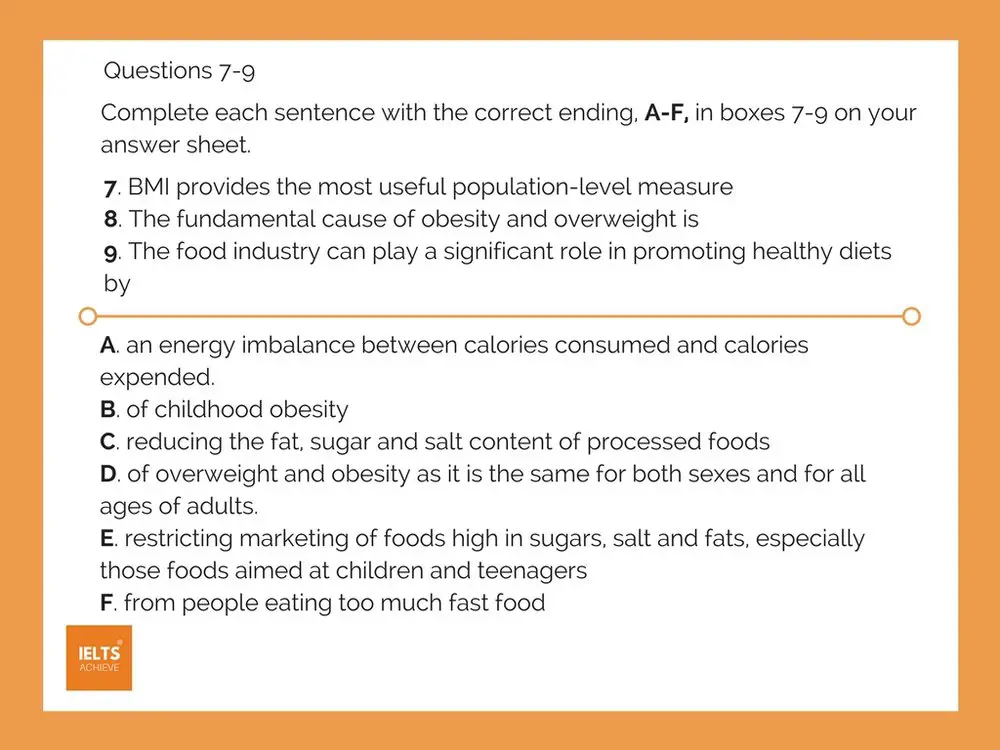
TEST QUESTION
In the IELTS test, the matching sentence endings questions will look similar to this example below >>
The paragraphs for the practice exercises are from a text called “Obesity and Overweight” from The World Health Organisation (WHO) website.
Exercise 1
What causes obesity and overweight?
The fundamental cause of obesity and overweight is an energy imbalance between calories consumed and calories expended. Globally, there has been:
an increased intake of energy-dense foods that are high in fat; and
an increase in physical inactivity due to the increasingly sedentary nature of many forms of work, changing modes of transportation, and increasing urbanisation.
Changes in dietary and physical activity patterns are often the result of environmental and societal changes associated with the development and lack of supportive policies in sectors such as health, agriculture, transport, urban planning, environment, food processing, distribution, marketing, and education.
Match the sentence endings >>
Weight issues are created when
Having a job where you are sitting for long periods of time or no exercise in your regular routine can
The situation around you can affect your
A. the number of calories burned are not the same as the calories that have been eaten
B. health and the lifestyle that you have
C. a person consumes too much fast food
D. lead to weight gain, because of less movement
E. make a person gain weight and go out less
F. outlook on life, which affects your daily diet and exercise routine
Answers are at the bottom of the page.
Exercise 2
How can overweight and obesity be reduced?
Overweight and obesity, as well as their related noncommunicable diseases, are largely preventable. Supportive environments and communities are fundamental in shaping people’s choices, by making the choice of healthier foods and regular physical activity the easiest choice (the choice that is the most accessible, available and affordable), and therefore preventing overweight and obesity.
At the individual level, people can:
limit energy intake from total fats and sugars;
increase consumption of fruit and vegetables, as well as legumes, whole grains and nuts; and
engage in a regular physical activity (60 minutes a day for children and 150 minutes spread through the week for adults).
Individual responsibility can only have its full effect where people have access to a healthy lifestyle. Therefore, at the societal level, it is important to support individuals in following the recommendations above, through sustained implementation of evidence-based and population-based policies that make regular physical activity and healthier dietary choices available, affordable and easily accessible to everyone, particularly to the poorest individuals. An example of such a policy is a tax on sugar-sweetened beverages.
Match the sentence endings >>
Being overweight
People can
Society must
A. offer help to those who are overweight, making sure that healthy diet options and regular activities are easily accessible
B. can be stopped, by making changes and receiving help from the community
C. is caused by being irresponsible
D. watch what they eat
E. be careful with their daily eating habits, making sure they consume a healthy amount of fruits and vegetables
F. promote a sugar tax on all unhealthy foods
Answers are at the bottom of the page.
Exercise 3
What are common health consequences of overweight and obesity?
Raised BMI is a major risk factor for noncommunicable diseases such as:
cardiovascular diseases (mainly heart disease and stroke), which were the leading cause of death in 2012;
diabetes;
musculoskeletal disorders (especially osteoarthritis – a highly disabling degenerative disease of the joints);
some cancers (including endometrial, breast, ovarian, prostate, liver, gallbladder, kidney, and colon).
The risk for these noncommunicable diseases increases, with increases in BMI.
Childhood obesity is associated with a higher chance of obesity, premature death and disability in adulthood. But in addition to increased future risks, obese children experience breathing difficulties, increased risk of fractures, hypertension, early markers of cardiovascular disease, insulin resistance and psychological effects.
Match the sentence endings >>
Eventual exposure
Being obese at a young age
The dangerous circumstances surrounding obesity
A. can lead to early death
B. are higher when a person’s BMI is immense
C. can make it tough for a young person at school
D. can lead to children struggling to breathe and other complications
E. projects a future of obesity and ongoing serious health issues
F. to the health issues caused by obesity can cause a number of diseases
Answers are at the bottom of the page.
REVIEW AND STRATEGY
The matching sentence endings are common in the IELTS Reading Test, therefore you should practice and develop a strategy for answering.
TIP >> Read the instructions before you start reading the text, partial sentences or the sentence endings.
TIP >> Read the partial sentences first and the sentence endings.
TIP >> Skim read the text and look for any clear answers.
TIP >> Choose your answers through an elimination process. Which ones do not fit? Which ones can you dismiss? Be attentive to synonyms and paraphrasing.
Answers >>
Practice Questions Answers >>
1 – C
2 – E
3 – A
4 – D
5 – B
Exercise 1 Answers >>
1 – A
2 – D
3. F
Exercise 2 Answers >>
1 – B
2 – E
3 – A
Exercise 3 Answers >>
1 – D
2 – E
3 – B
We hope you found this post useful in helping you to study for the IELTS Test. If you have any questions please let us know in the comments below or on the Facebook page.
The best way to keep up to date with posts like this is to like us on Facebook, then follow us on Instagram and Pinterest.
If you need help preparing for the IELTS Test, join the IELTS Achieve Academy and see how we can assist you to achieve your desired band score. We offer an essay correction service, mock exams and online courses.