Siddhartha Gautama, the Lord Buddha, was born in 623 B.C. in the famous gardens of Lumbini, which soon became a place of pilgrimage. Among the pilgrims was the Indian emperor Ashoka, who erected one of his commemorative pillars there. The site is now being developed as a Buddhist pilgrimage centre, where the archaeological remains associated with the birth of the Lord Buddha form a central feature.
The Lord Buddha was born in 623 BC in the sacred area of Lumbini located in the Terai plains of southern Nepal, testified by the inscription on the pillar erected by the Mauryan Emperor Asoka in 249 BC. Lumbini is one of the holiest places of one of the world’s great religions, and its remains contain important evidence about the nature of Buddhist pilgrimage centres from as early as the 3rd century BC.
The complex of structures within the archaeological conservation area includes the Shakya Tank; the remains within the Maya Devi Temple consisting of brick structures in a cross-wall system dating from the 3rd century BC to the present century and the sandstone Ashoka pillar with its Pali inscription in Brahmi script. Additionally, there are the excavated remains of Buddhist viharas (monasteries) of the 3rd century BC to the 5th century AD and the remains of Buddhist stupas (memorial shrines) from the 3rd century BC to the 15th century AD. The site is now being developed as a Buddhist pilgrimage centre, where the archaeological remains associated with the birth of the Lord Buddha form a central feature.
Practice tests are most valuable when used strategically. Simply completing tests without reflection leads to minimal improvement. Follow these steps for maximum benefit.
Before the Test
Set up proper test conditions — quiet room, no interruptions, strict timing
Use a printed answer sheet for Listening and Reading if possible
Have a stopwatch or timer visible throughout
During the Test
Listening: Use the preparation time to read questions ahead. Write answers as you hear them.
Reading: Spend no more than 20 minutes per passage. If stuck on a question, move on and return later.
Writing: Allocate 20 minutes for Task 1 and 40 minutes for Task 2. Plan before you write.
Speaking: Record yourself and listen back to identify areas for improvement.
After the Test
Score your Listening and Reading using the official answer key.
Review every wrong answer — understand why the correct answer is right.
Identify patterns in your mistakes (e.g., consistently missing matching questions).
For Writing, compare your response against the model answer and band descriptors.
Create a focused study plan targeting your weakest areas before the next practice test.
Originally published on IELTS Achieve. Last reviewed 3 July 2026.
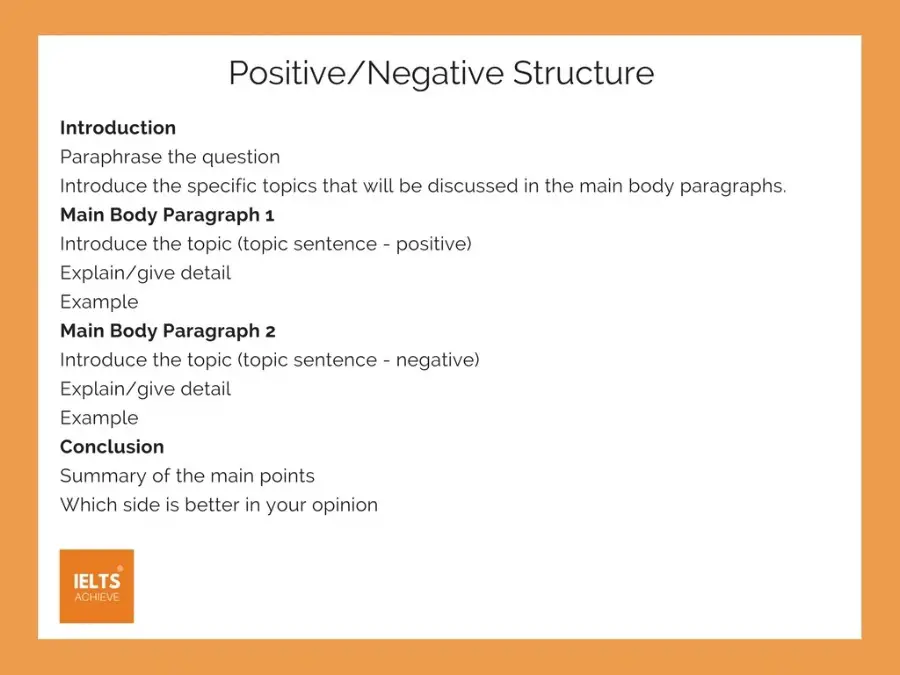
Do you want to learn how to create a positive/negative essay worthy of a high band score in writing task 2? Learn the structure needed, useful vocabulary and take a look at the sample answer
Young people prefer listening to music rather than listening to the news on the radio. Is this a positive or a negative trend? Provide reasons and examples for your opinion.
Companies spend millions each year on advertising online, in magazines and on billboards. These adverts can encourage people to buy goods that they do not really need. What are the positive and negative effects of consumerism?
Some car manufacturing companies have stated that there is a possibility that we will see flying cars in the future. Why is this going to happen? Will it be a positive or negative development?
More and more people are finding it increasingly important to wear fashionable clothes. Is this attitude to wearing clothes a positive or negative development?
How to Write a Positive or Negative Development Essay
This essay type asks you to evaluate whether a given trend or situation is positive, negative, or both. Your task is to present a clear opinion supported by specific reasons and examples.
Essay Structure
Introduction: Paraphrase the statement, then clearly state whether you consider it a positive or negative development (or both).
Body Paragraph 1: Discuss the positive aspects with specific examples and explanations.
Body Paragraph 2: Discuss the negative aspects (if arguing “both”) or provide further support for your position.
Conclusion: Restate your position and summarise the key reasons.
Common Topics
The trend of people working from home
The increasing use of technology in education
Young people leaving rural areas for cities
The growth of international tourism
The rise of social media communication
Key Phrases
Positive
Negative
This is largely a positive development because…
The drawbacks of this trend outweigh the benefits…
One significant advantage is…
A major concern is that…
This has led to improvements in…
This has resulted in a decline in…
Originally published on IELTS Achieve. Last reviewed 3 July 2026.
The IELTS Listening test consists of four sections with 40 questions total. You hear each recording only once, so preparation and practice with the format are essential.
Test Structure
Section
Context
Speakers
Questions
Section 1
Everyday social context
2 speakers (dialogue)
10
Section 2
Everyday social context
1 speaker (monologue)
10
Section 3
Educational/training context
2-4 speakers (discussion)
10
Section 4
Academic context
1 speaker (lecture)
10
Question Types You Will Encounter
Form/note completion: Fill in gaps with words from the recording
Multiple choice: Choose the correct answer from options
Matching: Match items from two lists
Map/plan/diagram labelling: Label locations or parts
Sentence completion: Complete sentences with words from the recording
Essential Tips
Read questions during preparation time to predict what you will hear.
Listen for synonyms and paraphrases — answers are rarely stated using the exact words from the question.
Check the word limit carefully (e.g., “NO MORE THAN TWO WORDS”).
Transfer answers carefully during the 10-minute transfer time at the end.
Originally published on IELTS Achieve. Last reviewed 3 July 2026.
IELTS uses a rotating question bank, meaning topics and passages are recycled across test centres worldwide. By studying recently reported exam questions, you can identify high-frequency themes and question types that are most likely to appear in your upcoming test.